

“`html
Mastering Your Prints: A Deep Dive into STL Mesh Repair for 3D Printable Car Models
The thrill of bringing a sleek, 3D printable car model to life on your 3D printer is undeniable. Whether you’re a seasoned maker or just embarking on your additive manufacturing journey, the ability to achieve flawless prints from detailed STL files is paramount. At 88cars3d.com, we pride ourselves on delivering high-quality, print-ready STL files designed for exceptional results. However, even the best-prepared models can sometimes encounter issues, particularly when navigating the complex world of mesh geometry. This article will serve as your comprehensive guide to understanding, diagnosing, and most importantly, repairing broken STL meshes. We’ll demystify the intricacies of mesh topology, explore common STL errors, and provide step-by-step workflows for using powerful software like Autodesk Meshmixer and Netfabb to ensure your printable car models are always print-perfect. Prepare to elevate your 3D printing game by mastering the art of STL mesh repair.
Understanding the Anatomy of an STL Mesh: What Makes a “Good” File?
The foundation of any 3D printable model lies in its mesh geometry. An STL (STereoLithography) file represents a 3D object as a collection of connected triangles, forming a surface mesh. For a 3D printer to interpret and successfully print an object, this mesh must adhere to specific structural rules. Think of it like building with LEGOs: each brick (triangle) must be correctly placed and connected to form a solid, watertight structure. A well-formed mesh is essentially a manifold surface, meaning it has a clear inside and outside, and every edge is shared by exactly two triangles. This watertight property is crucial because your slicing software needs to define a solid volume to extrude filament or cure resin. Problems arise when this structure is compromised, leading to what are often referred to as “broken” or “non-manifold” meshes. These issues can manifest as holes, flipped triangles, internal faces, or degenerate geometry. Recognizing these imperfections is the first step towards a successful print. At 88cars3d.com, our models are meticulously checked for these issues, but understanding the underlying principles allows you to tackle any file with confidence.
The Concept of Manifold Geometry: Watertight is Key
A manifold mesh is the gold standard for 3D printing. In simple terms, it’s a surface that can hold water. Every edge in a manifold mesh connects precisely two triangles. If an edge connects more than two triangles, it creates an internal junction or a branching structure that confuses the slicer. If an edge connects only one triangle, it signifies a hole or a gap in the surface. Furthermore, all triangles must have a consistent orientation, typically with their normal vectors pointing outwards from the model. This outward orientation tells the slicing software which side is the “outside” of the model. When these conditions aren’t met, the mesh becomes non-manifold, leading to print failures like incomplete layers, unexpected voids, or slicing errors. Understanding this concept helps in identifying the specific types of errors that need correction.
Common STL Errors and Their Visual Indicators
Several common errors can plague STL files. Holes are perhaps the most frequent, appearing as gaps or missing surfaces in the model. Flipped normals cause triangles to point inwards, creating internal surfaces or confusing the slicer about the model’s orientation. Non-manifold edges occur where an edge is shared by more than two triangles, often seen at complex intersections or where geometry has been poorly merged. Degenerate triangles are triangles with zero area (e.g., all vertices are the same point or lie on a single line), which serve no purpose and can cause calculation errors. Finally, internal faces are triangles completely enclosed within the model’s volume, which are unnecessary and can disrupt slicing. Many 3D printing slicers have basic error detection, but dedicated mesh repair tools offer far more robust solutions for diagnosing and fixing these issues before they impact your print.
Autodesk Meshmixer: A Powerful Free Tool for STL Mesh Repair
Autodesk Meshmixer is a free, versatile software that excels at mesh editing, manipulation, and repair. It’s an indispensable tool for anyone working with 3D printable models, especially those downloaded from online marketplaces or created through 3D scanning. Meshmixer provides a user-friendly interface with a powerful suite of automated and manual tools to fix common STL issues. Its strength lies in its ability to analyze mesh integrity and offer targeted solutions. Whether you’re dealing with a slightly imperfect file from 88cars3d.com or a heavily damaged scan, Meshmixer can often bring it back to a printable state. The software allows you to inspect your model at a granular level, identify problematic areas, and apply fixes with precision. Its capabilities extend beyond repair, including sculpting, hollowing, and adding support structures, making it a comprehensive solution for 3D model preparation.
Step-by-Step Mesh Repair Workflow in Meshmixer
Repairing an STL in Meshmixer typically follows a structured workflow. First, import your STL file (File > Import). Meshmixer will often automatically detect potential errors upon import. Navigate to the ‘Analysis’ menu and select ‘Inspector’. This tool will highlight errors on your model with distinct colors. Red indicates non-manifold edges, while other errors like holes might be indicated differently. For common issues like holes, you can use the ‘Auto Repair All’ button within the Inspector, which is surprisingly effective. If ‘Auto Repair All’ doesn’t fully resolve the problem, you can manually select holes using the ‘Edit’ > ‘Hole’ tools. The ‘Sphere Find’ and ‘Boundary Fill’ tools are also invaluable for closing gaps. For more complex issues like self-intersections or interior geometry, the ‘Sculpt’ tool can be used carefully to smooth or remove unwanted parts. Always save your work frequently (File > Save As) and consider saving intermediate versions to revert if a repair step causes unintended consequences.
Leveraging Meshmixer’s Inspector and Repair Tools
The ‘Inspector’ tool is your primary diagnostic aid. It visually flags non-manifold edges, holes, and other boundary issues. Once errors are highlighted, you can address them. The ‘Boundary Fill’ tool is excellent for closing holes; select the boundary loop of a hole and choose ‘Boundary Fill’. You can often adjust the fill method (e.g., ‘Triangle Fan’ or ‘Grid Fill’) for different results. For flipped normals, Meshmixer’s ‘Edit’ > ‘Normals’ > ‘Recalculate Normals’ can often fix these automatically. If you need to manually correct normals on specific faces, the ‘Edit’ > ‘Normals’ > ‘Flip Normals’ tool can be used. Remember to consistently check the ‘Show Triangles’ option in the View menu to get a clear understanding of the mesh structure you are working with. Precision is key, so zoom in closely to verify that repairs are complete and haven’t introduced new problems.
Autodesk Netfabb: Professional-Grade Mesh Repair and Preparation
For users requiring more advanced and robust mesh repair capabilities, Autodesk Netfabb stands out. While not free, Netfabb is the industry standard for professional additive manufacturing preparation, offering sophisticated algorithms for analyzing and repairing complex meshes. It excels in handling large, intricate models and automating repairs that might be time-consuming or impossible in simpler software. Netfabb’s strength lies in its comprehensive suite of analysis tools that go far beyond simple error detection, providing detailed reports on mesh quality and potential printability issues. It’s particularly effective for engineering-grade parts and complex assemblies, ensuring maximum reliability for critical prints. If you frequently encounter challenging STL files or work on professional projects, Netfabb is an investment that can significantly improve print success rates and reduce wasted material.
Netfabb’s Automated Repair Strategies and Advanced Analysis
Netfabb offers a variety of automated repair strategies designed to address specific types of mesh defects. The ‘Repair’ module provides options like ‘Remove Found Problems’, which attempts to automatically fix common issues such as holes, non-manifold edges, and stray triangles. For more targeted repairs, you can use tools like ‘Repair > Remove Self-Intersections’ or ‘Repair > Remove Interior.’ Netfabb’s strength lies in its ability to understand the underlying geometry and apply intelligent fixes. The ‘Analysis’ tab provides a wealth of information, including ‘Minimum Wall Thickness’, ‘Overhang Analysis’, and ‘Exploded View’, which are invaluable for understanding how a model will print and where potential weaknesses lie. These analyses help in preemptively identifying issues before they become critical printing failures.
Using Netfabb for Complex Assemblies and High-Detail Models
When dealing with complex car models that might consist of multiple parts needing to be combined into a single STL for printing, Netfabb’s ‘Boolean’ operations and ‘Part Actions’ are extremely useful. You can use ‘Union’ to merge separate parts into a single manifold mesh, ensuring no gaps or overlapping internal geometry. The software’s ability to handle high-polygon count meshes means that even the most detailed printable car models from sources like 88cars3d.com can be processed without significant performance degradation. Netfabb also excels at preparing models for specific printing technologies, offering tools for slicing models into printable sections or adding custom support structures tailored to the chosen printer and material. Its layer-by-layer analysis also provides insights into potential issues that might only appear during the printing process.
Best Practices for Print Orientation and Bed Adhesion
Beyond mesh repair, how you orient your model on the print bed and ensure proper adhesion are critical for success, especially with detailed automotive models. The orientation affects the amount of support needed, the surface finish, and the structural integrity of the print. For example, printing a car body upright might require extensive supports for the undercarriage and wheels, leading to a rougher finish in these areas. Rotating the model on its side might reduce supports but could introduce layer lines on visible body panels. Careful consideration of the model’s geometry and desired finish is essential. Bed adhesion is equally important; a print detaching mid-process is frustrating and wasteful. For FDM printing, this means ensuring your print bed is clean, level, and at the correct temperature, often using adhesion aids like glue stick or specialized sprays. Resin printers require a properly leveled build plate and sufficient suction release time between layers.
Optimizing Orientation for Reduced Supports and Enhanced Detail
When preparing a printable car model, consider the primary viewing angles. Orient the model to minimize overhangs in these critical areas. For a car, this often means angling it slightly to reduce the need for supports on the roof, hood, and doors. If possible, orienting the car with its wheels down but slightly tilted can provide a good balance. For resin prints, minimizing the angle of large, flat surfaces parallel to the build plate can prevent suction cup effects that can lead to print failures. Experimenting with different orientations in your slicer is key. Tools like Meshmixer and Netfabb can help visualize support structures before slicing, allowing you to make informed decisions about orientation. Often, rotating a model by just 15-30 degrees can dramatically reduce support requirements and improve surface quality.
Ensuring Reliable Bed Adhesion with FDM and Resin Printers
For FDM printing, a clean build surface is paramount. Use isopropyl alcohol to wipe down your print bed before each print. Ensure your bed is properly leveled; a slight ‘squish’ of the first layer is ideal. Adjusting the Z-offset can fine-tune this first layer adhesion. Consider using a brim or raft in your slicer settings, especially for models with small footprints or delicate parts like wing mirrors. Materials like PLA and PETG generally adhere well to PEI or glass surfaces, but ABS might require an enclosure and higher bed temperatures. For resin printing, the build plate must be perfectly level and clean. The initial layers often require longer exposure times to ensure they bond strongly to the build plate. Using rafts in your slicer can help distribute the load and provide a more secure base. Some resin users also find that lightly sanding the build plate can improve adhesion.
Slicing Strategies: Layer Height, Infill, and Supports for Car Models
Once your STL mesh is repaired and oriented, the next critical step is slicing – converting the 3D model into layer-by-layer instructions for your printer. This process involves a complex interplay of settings that directly impact print quality, time, and material usage. For detailed printable car models, finding the right balance is crucial. Layer height dictates the vertical resolution; smaller layer heights produce smoother curves and finer details but significantly increase print time. Infill determines the internal structure’s density and strength, impacting material consumption and print speed. Support structures are essential for bridging overhangs and preventing print failures, but their removal can sometimes damage delicate details. Mastering these slicing parameters is key to achieving professional-quality results from your downloaded STL files.
Layer Height vs. Print Time: Finding the Optimal Balance
The choice of layer height is one of the most significant factors affecting print time and surface quality. For most FDM printers, standard layer heights range from 0.1mm to 0.3mm. A typical car model might benefit from a layer height of 0.15mm or 0.2mm. This provides a good balance between detail and print speed. If you’re printing a high-detail section or a display model where aesthetics are paramount, you might opt for a finer 0.1mm layer height, but be prepared for the print duration to increase substantially – potentially doubling or tripling. Conversely, for functional prototypes or internal components where speed is prioritized over surface finish, a 0.3mm layer height might suffice. Always consider the scale of the model; smaller details require finer layer heights to be resolved accurately.
Infill Patterns and Densities for Strength and Weight
The infill defines the internal support structure of your print. For display models, a low infill density (e.g., 10-15%) is often sufficient, using patterns like ‘Grid’ or ‘Gyroid’ for a good balance of strength and speed. If the car model needs to be robust or withstand handling, increasing the infill density to 20-30% or higher can be beneficial. Advanced infill patterns like ‘Cubic’ or ‘Adaptive Cubic’ can offer better strength in multiple directions. For resin printing, infill is less relevant as the entire part is typically cured as a solid, though some slicers allow for hollowed prints with internal supports, which drastically reduces resin consumption and print time for larger models.
Support Structure Generation and Removal Techniques
Effective support generation is critical for complex shapes like car models. In FDM printing, ‘Tree’ supports (available in Cura and PrusaSlicer) are often preferred for detailed models as they can be easier to remove and leave fewer marks than traditional linear supports. Ensure your support density is not too high, which makes removal difficult. Adjust the ‘Support Z Distance’ and ‘Support XY Distance’ to control how easily supports detach from the model. For resin printing, supports are essential and should be placed strategically to bear the weight of overhangs without obscuring key details. Use fine-tipped supports where possible and consider adding multiple small supports rather than a few large ones. When removing supports, use sharp hobby knives, pliers, and files carefully. For FDM prints, gently breaking the support away first, then using tools to clean up any remaining contact points, is a common method. For resin, cutters and sanding are standard. Patience is key to avoiding damage.
Post-Processing: Bringing Your 3D Printed Car Model to Life
The journey doesn’t end when the print is finished. Post-processing is where a raw 3D print is transformed into a polished, professional-looking model. This stage involves cleaning, smoothing, assembling, and painting your printable car model. For FDM prints, this often includes removing support material, sanding layer lines, and filling gaps or imperfections. Resin prints typically require washing in isopropyl alcohol (IPA) to remove uncured resin, followed by a UV curing process to fully harden the part. Whether you’re printing a classic automobile from 88cars3d.com for a display shelf or a functional prototype, meticulous post-processing significantly enhances the final aesthetic and perceived quality. Embracing these techniques will elevate your hobbyist creations to museum-quality standards.
Sanding, Filling, and Smoothing Techniques
For FDM prints, sanding is crucial for achieving a smooth surface finish. Start with coarser grit sandpaper (e.g., 120-220 grit) to remove layer lines and support marks, progressing to finer grits (e.g., 400, 800, 1200, and even higher) for a polished look. Wet sanding, using water as a lubricant, can help prevent clogging and produce a smoother finish. For significant imperfections or gaps, filler primers or automotive body filler can be used. Apply thin layers, let them dry completely, and then sand smooth. For resin prints, the surface is generally smoother, but sanding might still be necessary in areas where supports were attached or if minor blemishes exist. After sanding, applying a filler primer can reveal any remaining imperfections that need further attention.
Painting and Finishing Your Automotive Masterpiece
Painting is where your 3D printed car model truly comes alive. Thoroughly clean the model and apply a suitable primer. For detailed models, a good quality primer is essential for adhesion and creating a uniform base color. Use hobby-grade acrylic paints or automotive spray paints. For realistic car finishes, multiple thin coats are better than one thick coat. Consider using an airbrush for smooth, even coverage, especially for metallic finishes or complex multi-color schemes. Masking tape is invaluable for achieving clean lines between different colors, such as window trims or racing stripes. Finally, a clear coat (gloss, satin, or matte, depending on the desired finish) will protect the paint job and provide a professional look. Weathering techniques, like adding subtle rust effects or grime, can add an extra layer of realism.
Mastering the art of STL mesh repair, combined with careful slicing and meticulous post-processing, is fundamental to achieving stunning results with your 3D printable car models. From understanding the core principles of manifold geometry to leveraging powerful software like Meshmixer and Netfabb, you now possess the knowledge to tackle even the most challenging files. Remember that every print is a learning opportunity; don’t be discouraged by failures, but rather use them as a chance to refine your techniques. Whether you’re downloading intricate designs from platforms like 88cars3d.com or working with your own creations, investing time in file preparation and understanding your printer’s nuances will yield exceptional rewards. Keep experimenting, keep learning, and happy printing!
“`
Featured 3D Car Models

BMW 7 Series E38 3D Model
Texture: Yes
Material: Yes
Download the BMW 7 Series E38 3D Model featuring its iconic luxury sedan design and classic aesthetics. Includes .blend, .fbx, .obj, .glb, .stl, .ply, .unreal, and .max formats for rendering, simulation, and game development.
Price: $10.79

BMW 6 Series 640i F12 3D Model
Texture: Yes
Material: Yes
Download the BMW 6 Series 640i F12 3D Model featuring a sleek design and detailed interior. Includes .blend, .fbx, .obj, .glb, .stl, .ply, .unreal, and .max formats for rendering, simulation, and game development.
Price: $10.79

BMW 6 Coupe E63 3D Model
Texture: Yes
Material: Yes
Download the BMW 6 Coupe E63 3D Model featuring a sleek design, detailed interior, and realistic exterior. Includes .blend, .fbx, .obj, .glb, .stl, .ply, .unreal, and .max formats for rendering, simulation, and game development.
Price: $10.79

BMW 5 Series Touring F11-007 3D Model
Texture: Yes
Material: Yes
Download the BMW 5 Series Touring F11-007 3D Model featuring a detailed exterior and interior. Includes .blend, .fbx, .obj, .glb, .stl, .ply, .unreal, and .max formats for rendering, simulation, and game development.
Price: $10.79

BMW 5 Series Gran Turismo F07-003 3D Model
Texture: Yes
Material: Yes
Download the BMW 5 Series Gran Turismo F07-003 3D Model featuring a detailed exterior and interior. Includes .blend, .fbx, .obj, .glb, .stl, .ply, .unreal, and .max formats for rendering, simulation, and game development.
Price: $10.79

BMW 5 Series E60 3D Model
Texture: Yes
Material: Yes
Download the BMW 5 Series E60 3D Model featuring its iconic sedan design, detailed exterior, and interior. Includes .blend, .fbx, .obj, .glb, .stl, .ply, .unreal, and .max formats for rendering, simulation, and game development.
Price: $10.79

BMW 5 E34-535i 3D Model
Texture: Yes
Material: Yes
Download the BMW 5 E34-535i 3D Model featuring an iconic design, detailed exterior and interior, and accurate representation. Includes .blend, .fbx, .obj, .glb, .stl, .ply, .unreal, and .max formats for rendering, simulation, and game development.
Price: $10.79

BMW 3 Series E46 3D Model
Texture: Yes
Material: Yes
Download the BMW 3 Series E46 3D Model featuring authentic exterior lines, a detailed interior, and separated components for animation. Includes .blend, .fbx, .obj, .glb, .stl, .ply, .unreal, and .max formats for rendering, simulation, and game development.
Price: $10.79
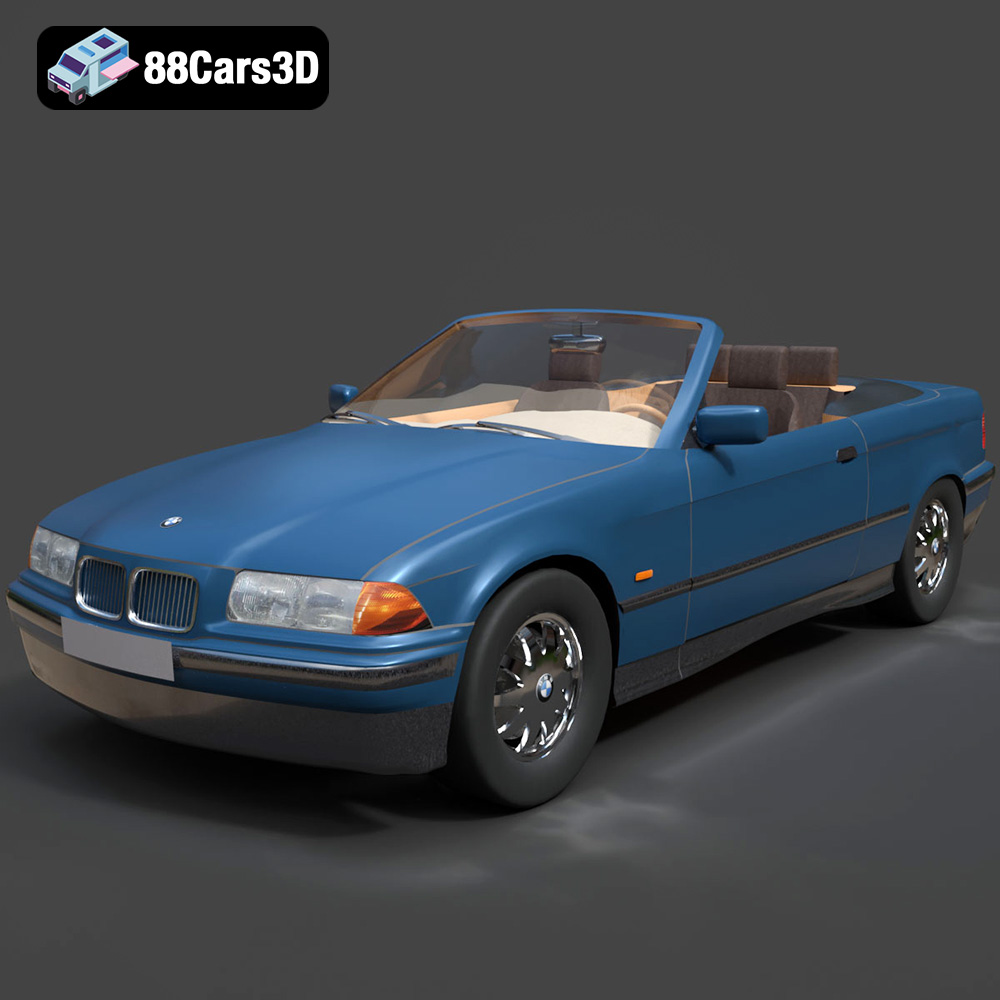
BMW 3 Series E36 Cabrio 325i 1998 3D Model
Texture: Yes
Material: Yes
Download the BMW 3 Series E36 Cabrio 325i 1998 3D Model featuring a classic convertible design and detailed interior. Includes .blend, .fbx, .obj, .glb, .stl, .ply, .unreal, and .max formats for rendering, simulation, and game development.
Price: $10.79

BMW 3 F30 3D Model
Texture: Yes
Material: Yes
Download the BMW 3 F30 3D Model featuring a detailed exterior, realistic interior, and optimized mesh. Includes .blend, .fbx, .obj, .glb, .stl, .ply, .unreal, and .max formats for rendering, simulation, and game development.
Price: $10.79
