

The Enduring Appeal of the BMW Z4 E85 in 3D Design and Digital Creation
In the vast landscape of automotive design, some vehicles transcend mere transportation to become icons of style, performance, and engineering. The BMW Z4 E85, with its distinctive ‘flame surfacing’ design and classic roadster proportions, is undoubtedly one such vehicle. For 3D artists, game developers, automotive designers, and visualization specialists, the ability to integrate such an iconic machine into their digital projects is invaluable. A high-quality 3D model of this beloved convertible offers a canvas for creativity, a foundation for photorealistic renders, and a dynamic asset for interactive experiences.
The quest for digital assets that perfectly capture the essence of their real-world counterparts is a constant challenge. This is where a meticulously crafted asset like the BMW Z4 E85 2005 3D Model truly shines. Provided by expert platforms like 88cars3d.com, such models are not just static representations; they are robust, production-ready assets designed to meet the rigorous demands of professional workflows. From high-fidelity automotive rendering to optimized game assets, this model embodies the precision and versatility required in modern digital pipelines, allowing creators to bring the spirit of German engineering directly into their projects with unparalleled visual fidelity.
Understanding 3D Model File Formats: The Backbone of Digital Assets
The true utility of any 3D model, especially complex automotive designs like the BMW Z4 E85, lies not only in its visual accuracy but also in its adaptability across various software environments and production pipelines. This adaptability is largely dictated by the file formats it supports. Each format is engineered with specific strengths, catering to different stages of a project or different end-use scenarios. Understanding these formats is crucial for maximizing efficiency and ensuring seamless integration, whether you are working on high-end automotive rendering or developing real-time game assets.
.blend – Blender’s Native Powerhouse
The .blend file is the native format for Blender, one of the most popular open-source 3D creation suites. A .blend file for the BMW Z4 E85 2005 3D Model offers a complete scene package, including not just the mesh data but also all materials, textures, lighting setups, camera positions, and even animation data if present. This format is ideal for users deeply integrated into the Blender ecosystem, providing full editability, access to procedural workflows, and node-based material systems. It allows for advanced customization, making it perfect for artists who wish to dissect the model, re-texture, or animate specific components within Blender.
.fbx – The Industry Workhorse for Interoperability
Autodesk’s .fbx (Filmbox) format is arguably the most widely adopted interchange format in the 3D industry, particularly for game development and animation. It excels at transferring comprehensive scene data, including geometry, materials, textures, animations, rigging, and even camera information, between different software packages like Maya, 3ds Max, Blender, Unity, and Unreal Engine. For the BMW Z4 E85 model, an .fbx file ensures that the asset can be smoothly imported into real-time environments or other DCC (Digital Content Creation) tools while retaining crucial data like PBR (Physically Based Rendering) material assignments and UV mapping, making it truly “game-engine ready.”
.obj – The Universal Standard
The .obj (Wavefront OBJ) format is a classic and highly universal 3D file format. Known for its simplicity, it primarily stores geometry data (vertices, normals, texture coordinates, and faces) along with references to external material files (.mtl). While it doesn’t support advanced features like rigging or animation, its widespread compatibility makes it an excellent choice for basic cross-software transfers. If you need a clean, universal mesh of the BMW Z4 E85 that can be opened in virtually any 3D application, .obj is a reliable option, serving as a fundamental building block for many projects.
.glb – Optimized for the Web and XR
.glb is the binary version of the glTF (GL Transmission Format), designed specifically for efficient transmission and loading of 3D scenes and models in web and extended reality (XR) contexts (AR/VR). It bundles textures and other assets directly into a single file, reducing HTTP requests and optimizing performance. For visualizing the BMW Z4 E85 in an augmented reality app, on a web viewer, or in a lightweight VR experience, the .glb format is indispensable due to its compact size and rapid load times, making interactive demonstrations highly accessible.
.stl – Precision for Physical Creation
The .stl (Stereolithography) format is the standard for 3D printing and rapid prototyping. It represents a 3D model as a series of connected triangles (a triangulated mesh), defining only the surface geometry without color, texture, or other attributes. For anyone looking to bring the BMW Z4 E85 into the physical world – perhaps as a scale model or a component for a larger physical prototype – the .stl file provides the necessary, manifold geometry for accurate manufacturing, ensuring printability and structural integrity.
.ply – For Detailed Data and Analysis
The .ply (Polygon File Format or Stanford Triangle Format) is often used for storing 3D data from 3D scanners, CAD software, or scientific visualization tools. It can store a wider range of properties than .obj or .stl, including color per vertex, normal information, and other attributes. For projects involving precise analysis, reverse engineering, or integrating scanned environmental data with the BMW Z4 E85, the .ply format offers a robust and detailed representation of the mesh, enabling accurate manipulation and study.
.unreal – Seamless Integration with Unreal Engine
The .unreal format refers to an asset that has been specifically configured and saved within the Unreal Engine environment. While not a standalone file type in the traditional sense, its inclusion signifies that the BMW Z4 E85 2005 3D Model has been pre-optimized and set up with appropriate materials, collision meshes, LODs (Levels of Detail), and potentially even blueprints for immediate use within Unreal Engine projects. This eliminates significant setup time for game developers and real-time visualization artists, allowing for drag-and-drop integration into complex virtual worlds.
.max – 3ds Max’s Comprehensive Project File
Finally, the .max file is the native project format for Autodesk 3ds Max, another cornerstone software in professional 3D content creation, especially prevalent in architectural visualization and high-end rendering. A .max file of the BMW Z4 E85 includes the complete scene, modifiers, complex material setups (e.g., V-Ray, Corona), lighting, animation, and rendering settings. This format is ideal for 3ds Max users who require full control over every aspect of the model for advanced rendering, intricate animations, or integration into large-scale arch-viz projects, offering unparalleled flexibility for detailed visual storytelling.
The Craft Behind High-Fidelity 3D Car Models
Creating a 3D model as iconic as the BMW Z4 E85 2005 requires more than just artistic skill; it demands a deep technical understanding of geometry, materials, and optimization. Professional 3D car models, such as those found on 88cars3d.com, are developed with an acute awareness of their diverse applications, from static renders to real-time simulations.
Meticulous Geometry and Topology
The foundation of any high-quality 3D asset is its geometry. For the BMW Z4 E85 2005 3D Model, this means a clean, efficient mesh primarily composed of quadrilaterals (quads), which are essential for smooth subdivision and distortion-free deformation. The topology is carefully constructed to accurately represent the car’s distinctive curves and sharp lines, particularly the ‘flame surfacing’ elements that define its aesthetic. This careful attention ensures that the model can be easily sculpted further if needed, or decimated for real-time applications without significant loss of detail. An optimized poly count balances visual fidelity with performance, making the model versatile for both close-up cinematic shots and game engine integration.
Authentic Material and Texture PBR Workflows
Visual realism in modern 3D rendering heavily relies on Physically Based Rendering (PBR) workflows. The BMW Z4 E85 model comes with realistic materials and textures designed for PBR. This involves creating intricate texture maps—such as Albedo (base color), Roughness, Metalness, Normal, and Ambient Occlusion—that accurately simulate how light interacts with different surfaces of the car, from the metallic paintwork to the rubber tires and glass. Precision UV mapping ensures that these textures are applied without stretching or distortion, providing a seamless, true-to-life appearance across all components, including the intricate details of the interior and the intricate alloy wheels.
Attention to Detail: Interior, Exterior, and Underbody
What sets professional 3D car models apart is their comprehensive detail. The BMW Z4 E85 2005 3D Model extends beyond just the exterior shell. It meticulously recreates the interior cabin, including the dashboard, seats, steering wheel, and console, ensuring that even close-up interior shots maintain authenticity. Exterior elements like headlights, taillights, emblems, and window trims are accurately modeled and textured. While often unseen, even elements like the undercarriage can be modeled with appropriate detail, providing a complete and robust asset that holds up under any camera angle or use case, from a full vehicle reveal to a granular component breakdown.
Real-Time Rendering and Game Development with the BMW Z4 E85
The demand for realistic automotive assets in interactive environments, such as video games, simulations, and real-time configurators, has never been higher. The BMW Z4 E85 2005 3D Model is engineered to excel in these dynamic settings, offering a seamless experience for developers.
Optimizing for Game Engines (Unreal Engine & Unity)
For game development, optimization is paramount. The BMW Z4 E85 model, provided in formats like .fbx and specifically .unreal, is designed to integrate efficiently into game engines such as Unreal Engine and Unity. This involves several key considerations:
- Levels of Detail (LODs): Multiple versions of the model are often provided or can be easily generated, each with varying polygon counts. Lower LODs are used when the car is far from the camera, reducing rendering overhead without noticeable quality loss.
- Collision Meshes: Custom collision geometry ensures accurate physical interactions within the game world.
- Material Setup: PBR materials are correctly configured for the respective engine’s rendering pipeline, ensuring consistent visual quality.
- Clean UVs: Optimized UV maps facilitate efficient texture atlasing and lightmap generation.
This proactive optimization minimizes the technical burden on developers, allowing them to focus on gameplay and immersive experiences rather than asset preparation.
Interactive Experiences: AR/VR and Simulations
The versatility of a high-quality 3D model extends to augmented reality (AR), virtual reality (VR), and advanced driving simulations. The .glb format, included with the BMW Z4 E85 model, is particularly well-suited for AR/VR due to its compact nature and browser-friendly properties. Imagine placing a virtual Z4 E85 in your driveway via an AR app or experiencing a simulated test drive with haptic feedback in VR. The model’s optimized geometry and realistic materials ensure low-latency rendering and believable interactions, crucial for preventing motion sickness and enhancing immersion in XR environments.
Case Study: Integrating into a Virtual Showroom
Consider a virtual automotive showroom where prospective buyers can interact with various car models in real-time. The BMW Z4 E85 2005 3D Model could be the centerpiece. Using Unreal Engine, a developer could import the .unreal asset, set up interactive hotspots to highlight features (e.g., opening the convertible top, changing paint colors, exploring the interior), and integrate realistic reflections and dynamic lighting. Such a setup provides an engaging, scalable, and cost-effective alternative to physical showrooms, offering a global reach for showcasing classic and modern vehicles alike. This directly benefits automotive marketing and sales, providing a unique customer experience.
Cinematic Automotive Rendering and Arch-Viz
Beyond real-time applications, the BMW Z4 E85 2005 3D Model truly shines in offline rendering scenarios, where ultimate visual fidelity is the goal. For cinematic sequences, high-resolution marketing materials, or integrating vehicles into architectural visualizations, precision and photorealism are paramount.
Achieving Photorealism in 3ds Max and Blender
When working in 3ds Max or Blender with rendering engines like V-Ray, Corona Renderer, or Cycles, the details of the BMW Z4 E85 model become critical. The clean geometry and well-defined PBR materials provide an excellent foundation. Artists can leverage advanced rendering features such as global illumination, physically accurate light sources, complex reflection shaders, and subsurface scattering (for materials like leather) to create breathtakingly realistic images. The .max and .blend files, complete with editable materials and lighting setups, allow for full customization and the ability to push the boundaries of photorealism, creating renders that are indistinguishable from real-life photographs.
Composing Dynamic Shots and Animations
The BMW Z4 E85 3D Model is not just for static beauty shots. Its robust construction makes it ideal for animation. Artists can rig the car for realistic suspension movement, animate the convertible top’s retraction, or create dynamic driving sequences. This involves carefully orchestrated camera movements, environmental effects (like rain or dust), and post-production touches. Whether it’s for a car commercial, a film sequence, or an interactive demonstration, the model provides the reliability and detail needed to convey motion and emotion effectively. The editable nature of the .max and .blend files provides the freedom to experiment with complex animation workflows.
Architectural Visualization Synergy
In architectural visualization (arch-viz), the presence of a high-quality vehicle can significantly enhance the realism and appeal of a scene. Placing the BMW Z4 E85 2005 3D Model in front of a modern home, parked on a city street, or cruising through a meticulously rendered landscape elevates the entire composition. It adds a sense of scale, lifestyle, and dynamic interest. The model’s detailed reflections interact realistically with the environment, picking up nuances from surrounding buildings and foliage. This synergy creates a more believable and aspirational visualization, demonstrating the broader utility of detailed 3D car models beyond purely automotive contexts.
Beyond the Screen: 3D Printing and Prototyping
The digital realm often serves as a precursor to the physical. For designers and enthusiasts alike, the ability to translate a digital 3D model into a tangible object opens up new avenues for creativity and product development. The BMW Z4 E85 2005 3D Model, with its diverse file formats, facilitates this transition seamlessly.
From Digital Mesh to Physical Object
The inclusion of the .stl format with the BMW Z4 E85 2005 3D Model is specifically aimed at 3D printing. This format simplifies the geometry into a triangulated mesh, a universally understood language for 3D printers. Preparing the model for printing involves ensuring that the mesh is “manifold” (watertight, with no holes or self-intersecting geometry) and scaled correctly. Once prepared, the Z4 E85 can be printed using various technologies, from FDM (Fused Deposition Modeling) to SLA (Stereolithography), allowing creators to hold a physical representation of this iconic roadster in their hands. This process is invaluable for model makers, hobbyists, and educators.
Rapid Prototyping and Concept Models
Beyond mere replication, 3D printing allows for rapid prototyping. Automotive designers or industrial design students might use the BMW Z4 E85 model as a base to experiment with custom body kits, aftermarket accessories, or even new interior layouts. By modifying the digital model and then 3D printing the altered components, they can quickly iterate on designs, test fitment, and present physical concept models. This significantly accelerates the design process, allowing for tangible feedback before committing to expensive tooling or full-scale manufacturing. The precision of the .ply format also supports this, providing a detailed polygon mesh that can be used for precise analysis and manipulation before physical output.
Choosing the Right Asset for Your Project
In a world overflowing with digital content, discerning the quality and utility of a 3D asset is paramount. Investing in a professional-grade model can save countless hours of work and significantly elevate the final output of any project. The BMW Z4 E85 2005 3D Model exemplifies the kind of asset that delivers exceptional value.
Evaluating Professional-Grade 3D Models
When selecting 3D car models, consider several factors:
- Accuracy: Does it faithfully represent the real-world vehicle?
- Geometry: Is the mesh clean, optimized, and ready for various workflows (subdivision, decimation)?
- Materials & Textures: Are they PBR-ready and high-resolution? Are UVs properly laid out?
- File Format Variety: Does it offer formats suitable for your specific software and end-use (e.g., .fbx for games, .max for rendering, .stl for printing)?
- Support: Is the provider reputable and able to assist with any technical queries?
The BMW Z4 E85 2005 3D Model meets these stringent criteria, making it a reliable choice for demanding professional projects.
The Value Proposition of 88cars3d.com
Platforms like 88cars3d.com specialize in providing exactly these types of high-quality, ready-to-use 3D car models. They understand the nuances of professional pipelines and curate collections that save artists and developers precious time and resources. Instead of spending days or weeks modeling a complex vehicle from scratch, a professional can acquire a meticulously crafted asset, complete with all necessary file formats and optimized materials, and integrate it into their project almost immediately. This allows for more focus on creative direction, rendering, and interactivity, ultimately delivering superior results faster. The BMW Z4 E85 2005 3D Model is a prime example of the value and quality offered by 88cars3d.com.
Driving Innovation with Premium 3D Car Models
From the intricate details of its ‘flame surfacing’ to the precision of its interior, the BMW Z4 E85 2005 is a car that captures the imagination. In the digital realm, a high-quality 3D representation like the BMW Z4 E85 2005 3D Model from 88cars3d.com provides an unparalleled asset for creators across various industries. Whether your goal is to produce stunning photorealistic renders, develop immersive game assets, build interactive AR/VR experiences, or even bring the car into the physical world through 3D printing, this model offers the versatility, accuracy, and optimization required for professional success.
Understanding the strengths of different file formats—from the comprehensive .max and .blend files to the game-ready .fbx and .unreal, the universal .obj, and the web-optimized .glb—empowers artists and developers to select the perfect tool for their specific needs. By leveraging such expertly crafted 3D car models, professionals can significantly streamline their workflows, enhance visual quality, and push the boundaries of digital content creation. The enduring legacy of the BMW Z4 E85 is now readily available to drive your next innovative project.
Featured 3D Model
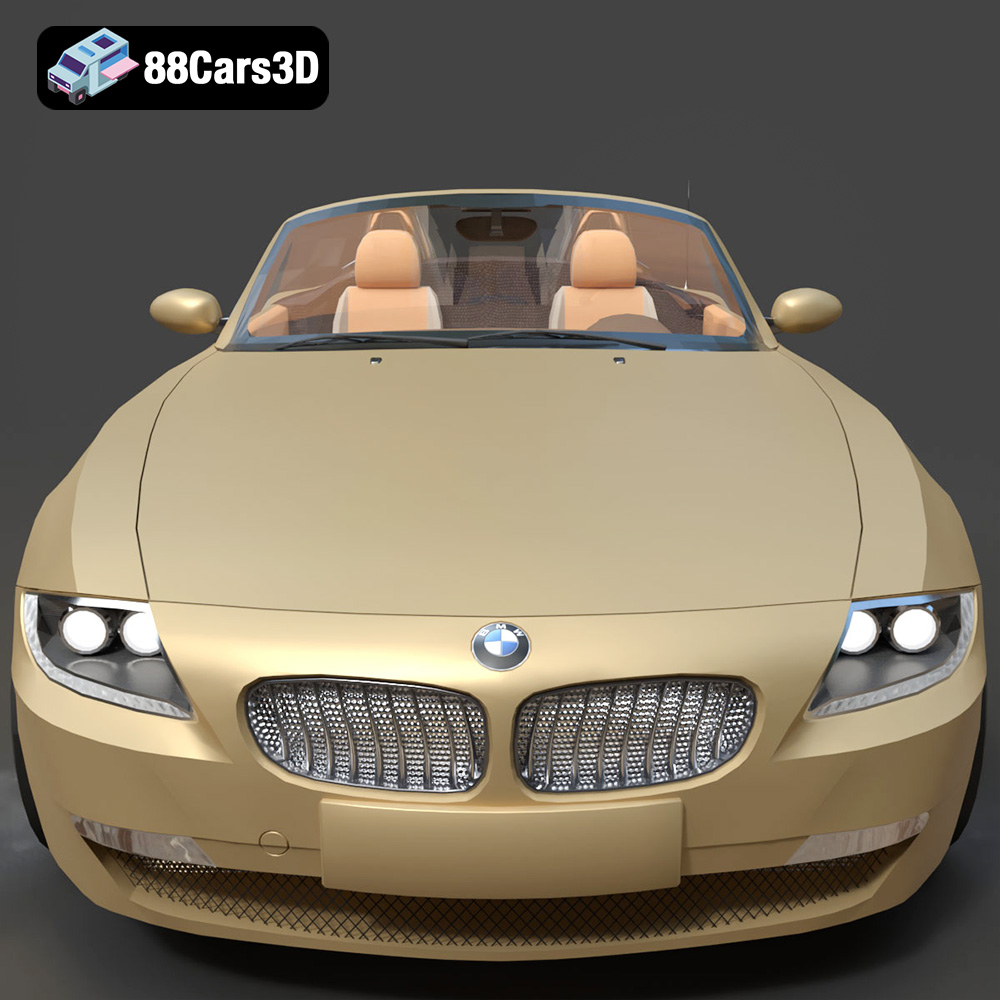
BMW Z4 E85 2005 3D Model
Capture the essence of German engineering with the highly detailed BMW Z4 E85 2005 3D Model. This meticulously crafted digital asset accurately represents the iconic roadster, offering unparalleled visual fidelity for professional projects. The model maintains true-to-life proportions and surface definition, making it ideal for close-up renders and detailed animations.This professional asset features clean, optimized geometry suitable for demanding production pipelines. All components, including the exterior body panels, wheels, and detailed interior, utilize realistic materials and textures to ensure immediate usability in any rendering environment. The model is built with efficiency and accuracy in mind, simplifying the integration process for designers and developers.The BMW Z4 E85 model is designed for versatile use across multiple industries. It serves as an excellent foundation for real-time game development (Unreal Engine, Unity), architectural visualization (arch-viz), automotive marketing content, interactive AR/VR experiences, and cinematic rendering projects. Its robust structure ensures reliable performance in both static renders and dynamic simulations.
$13.99
Product Image Gallery



Related Tags
.arvr
.blend
.bmw
.bmwz4
.car3dmodel
.convertible
.e85
.fbx
.gameasset
.glb
.max
.obj
.ply
.rendering
.roadster
.simulation
.sportsCar
.stl
.unreal
.z4
