

Mastering Digital Automotive Design: A Deep Dive into the BMW E36 Cabrio 3D Model
The allure of a classic automobile extends far beyond its physical presence; it resonates deeply within the digital realm, offering boundless possibilities for artists, designers, and developers. From high-octane racing simulations to architectural visualizations and cinematic sequences, high-quality 3D car models are the bedrock of realistic and engaging digital experiences. Today, we’re taking a closer look at a particularly captivating example: the BMW 3 Series E36 Cabrio 325i 1998 3D Model, a testament to meticulous craftsmanship and a powerful asset for any professional toolkit. This iconic convertible, representing a quintessential German sportscar from the late 90s, brings its distinctive blend of sporty elegance and timeless appeal to your digital projects, ready to be integrated into a myriad of applications.
In the world of 3D, precision and versatility are paramount. A well-constructed 3D car model isn’t just about looking good; it’s about seamless integration into diverse pipelines, from real-time game engines to photorealistic rendering suites. The BMW E36 Cabrio 325i 1998 3D Model available on 88cars3d.com embodies these principles, offering clean geometry, balanced detailing, and an optimized structure that promises superior performance across the board. Whether your goal is to render a breathtaking studio shot, develop an immersive AR/VR experience, or populate a sprawling open-world game, understanding the technical nuances and practical applications of such an asset is crucial. This article will explore the intricate details that make this model exceptional, delve into the various file formats it provides, and illustrate how it can elevate your professional automotive design and visualization workflows.
Understanding 3D Model File Formats: The Backbone of Digital Assets
The utility of a 3D model is often defined by its compatibility and the specific features supported by its file format. Professional 3D artists and developers work with a diverse ecosystem of software, and the ability to seamlessly transfer assets between them is critical. The BMW 3 Series E36 Cabrio 325i 1998 3D Model offers a comprehensive suite of file formats, ensuring maximum flexibility for any project. Let’s break down each one and understand its ideal application.
.blend – Fully Editable Blender Scene with Materials
The .blend format is native to Blender, a powerful open-source 3D creation suite. For users deeply integrated into the Blender ecosystem, this format is invaluable. It encapsulates the entire scene, including the model’s geometry, all applied materials (shaders, textures, UV maps), lighting setups, camera positions, and even animation data. This means you get a fully editable, ready-to-render scene, allowing for direct modifications, re-texturing, or further detailing using Blender’s robust toolset. Its primary advantage lies in its comprehensive nature, providing a complete project file for immediate use or customization.
.fbx – Ideal for Unreal, Unity, and Real-Time Pipelines
As a proprietary format developed by Autodesk, .fbx (Filmbox) has become an industry-standard for exchanging 3D data between various applications, especially for game development. It efficiently stores models, animations, rigs, and materials. For engines like Unreal and Unity, .fbx is often the preferred import format due to its excellent support for complex hierarchies, skeletal animations, and PBR (Physically Based Rendering) material definitions. When importing the E36 Cabrio as an .fbx, developers can expect a smooth transition of the model’s separated components (doors, wheels, suspension) and UV maps, ready for real-time engine optimizations and material setup.
.obj – Universal Format for Cross-Software Compatibility
The .obj (Wavefront OBJ) format is one of the most widely supported and truly universal 3D file types. It stores geometry data (vertices, normals, texture coordinates, faces) and can reference external .mtl (Material Template Library) files for basic material properties. While it doesn’t support animation or complex material node setups, its strength lies in its simplicity and unparalleled compatibility across almost all 3D software, including Maya, 3ds Max, Blender, Cinema 4D, and more. It’s an excellent choice for a clean geometric base when you need to bring the E36 Cabrio into an unfamiliar software or for archival purposes.
.glb – Optimized for AR, VR, and Browser-Based Display
.glb (GL Transmission Format Binary) is the binary version of glTF, specifically designed for efficient transmission and loading of 3D scenes and models by applications, especially those focused on augmented reality (AR), virtual reality (VR), and web-based viewing. It bundles textures, animations, and other data into a single file, making it incredibly streamlined for quick deployment. For showcasing the E36 Cabrio in an interactive web viewer or integrating it into an AR application on a mobile device, .glb offers optimal performance and a compact file size without sacrificing visual quality.
.stl – Suitable for 3D Printing Output
The .stl (STereoLithography) format is the de facto standard for 3D printing. It represents a 3D model as a series of connected triangles (a triangulated surface mesh) without any color, texture, or material information. Its primary purpose is to describe the surface geometry of an object for manufacturing. While the E36 Cabrio model is highly detailed, converting it to .stl means it’s ready for slicing software to prepare it for physical output, allowing enthusiasts to create tangible replicas of this classic car.
.ply – Precision Mesh Format for CAD or Analysis
.ply (Polygon File Format, or Stanford Triangle Format) is another format for storing 3D data, particularly useful for scanned data, engineering, and scientific applications. It can store a wider range of properties, including color, transparency, and often more precise vertex and face normals than .obj. While less common for general 3D rendering, it’s excellent for applications requiring high-fidelity mesh data for CAD (Computer-Aided Design) or detailed geometric analysis of the E36 Cabrio’s structure.
.unreal – Engine-Ready Asset for Real-Time Environments
This specialized format indicates an Unreal Engine project setup, often provided as a specific asset package or project file. It means the model has likely been pre-optimized, potentially with collision meshes, LODs (Levels of Detail), and a basic material setup, ready for direct import and integration into an Unreal Engine project. This significantly streamlines the workflow for game developers and real-time visualization artists, minimizing setup time and ensuring the E36 Cabrio performs optimally within the engine’s rendering pipeline.
.max – Editable 3ds Max Project for Animation and Rendering
The .max format is the native file type for Autodesk 3ds Max, a leading software in architectural visualization, animation, and game asset creation. Similar to .blend, a .max file contains all scene data—geometry, materials, textures, lighting, cameras, and animation. For users of 3ds Max, this provides a completely editable project file, making it straightforward to manipulate the E36 Cabrio model, set up complex rendering scenes, and create high-fidelity animations with ease. The organized hierarchy and proper pivot points (as specified in the product description) are particularly beneficial when working with the .max file.
The provision of such a comprehensive array of formats for the BMW E36 Cabrio 325i 1998 3D Model underscores its versatility and value, ensuring that professionals across various disciplines can seamlessly integrate this exceptional asset into their preferred workflows.
The Craft of Digital Automotive Design: Why Detail Matters
Creating a truly convincing 3D car model goes far beyond basic geometry. It demands an obsessive attention to detail, an understanding of automotive aesthetics, and a commitment to technical excellence. The BMW 3 Series E36 Cabrio 325i 1998 3D Model stands as a prime example of this dedication, meticulously capturing the essence of the original vehicle.
Exterior Authenticity: Capturing the E36’s Spirit
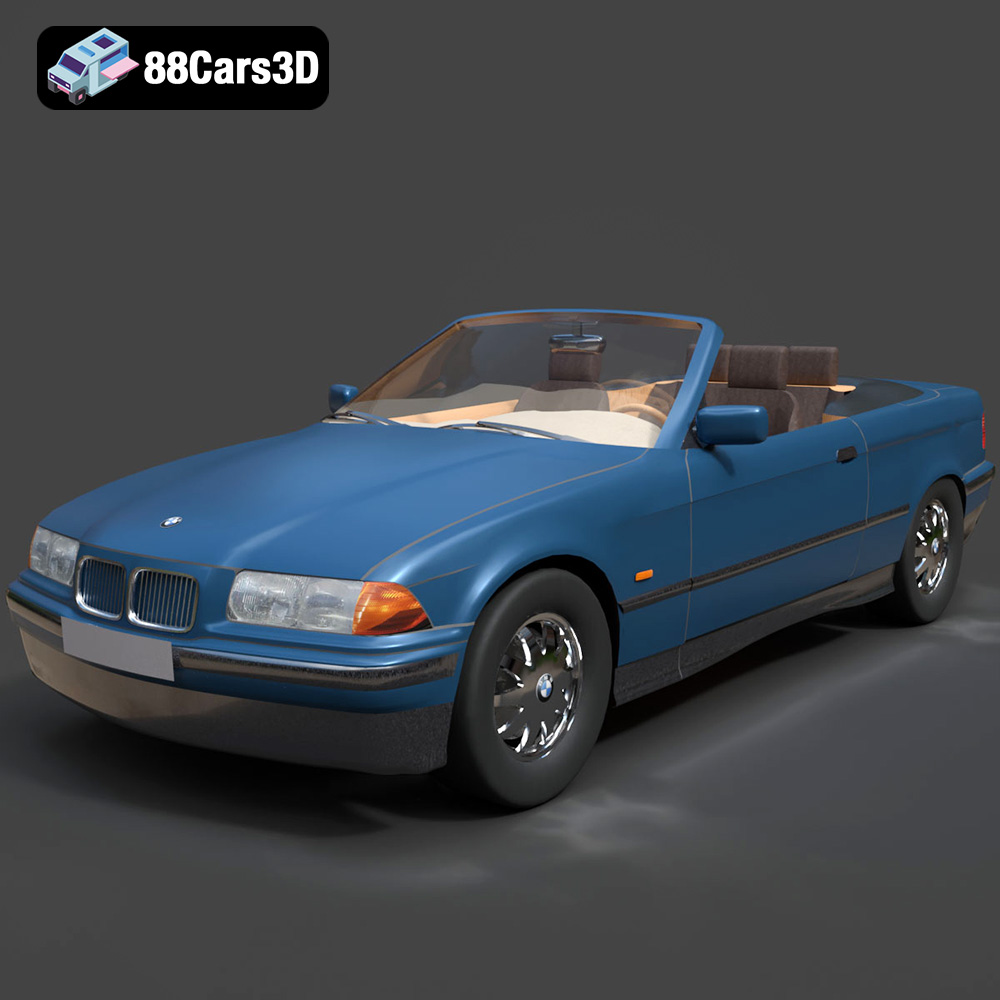
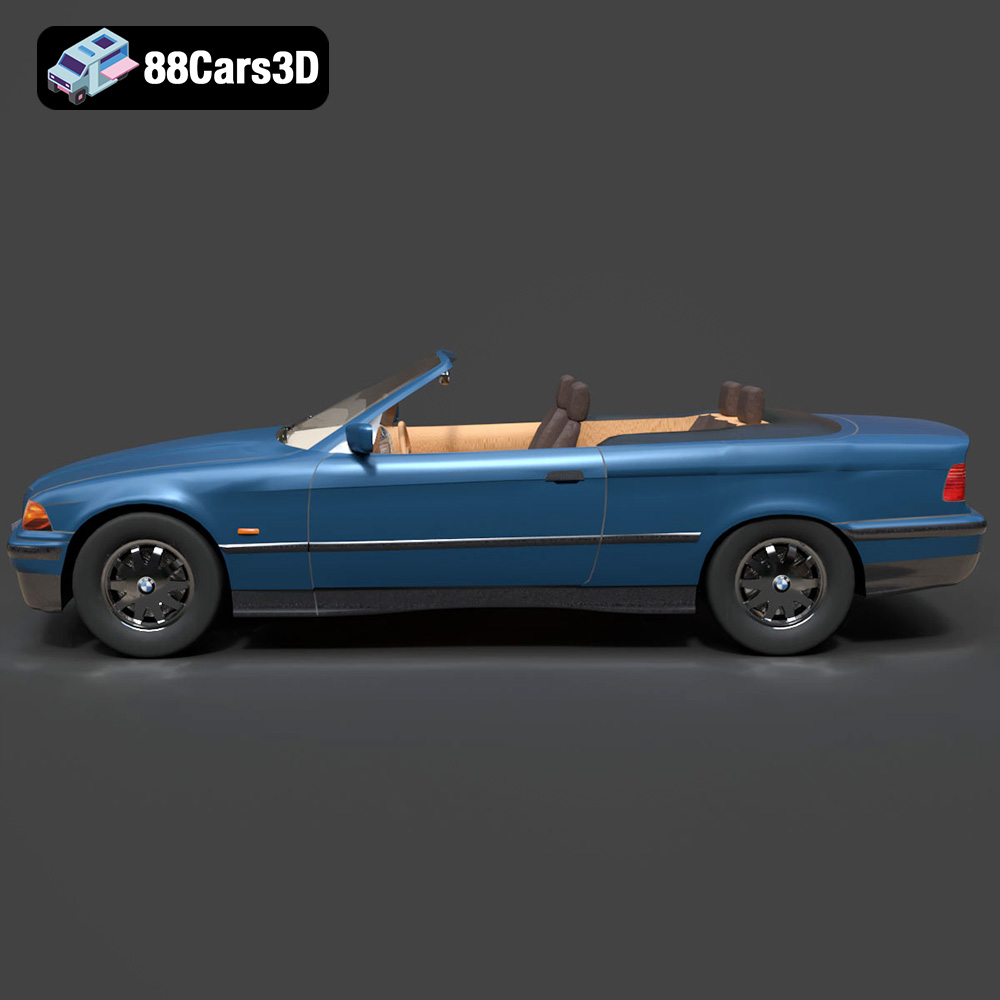
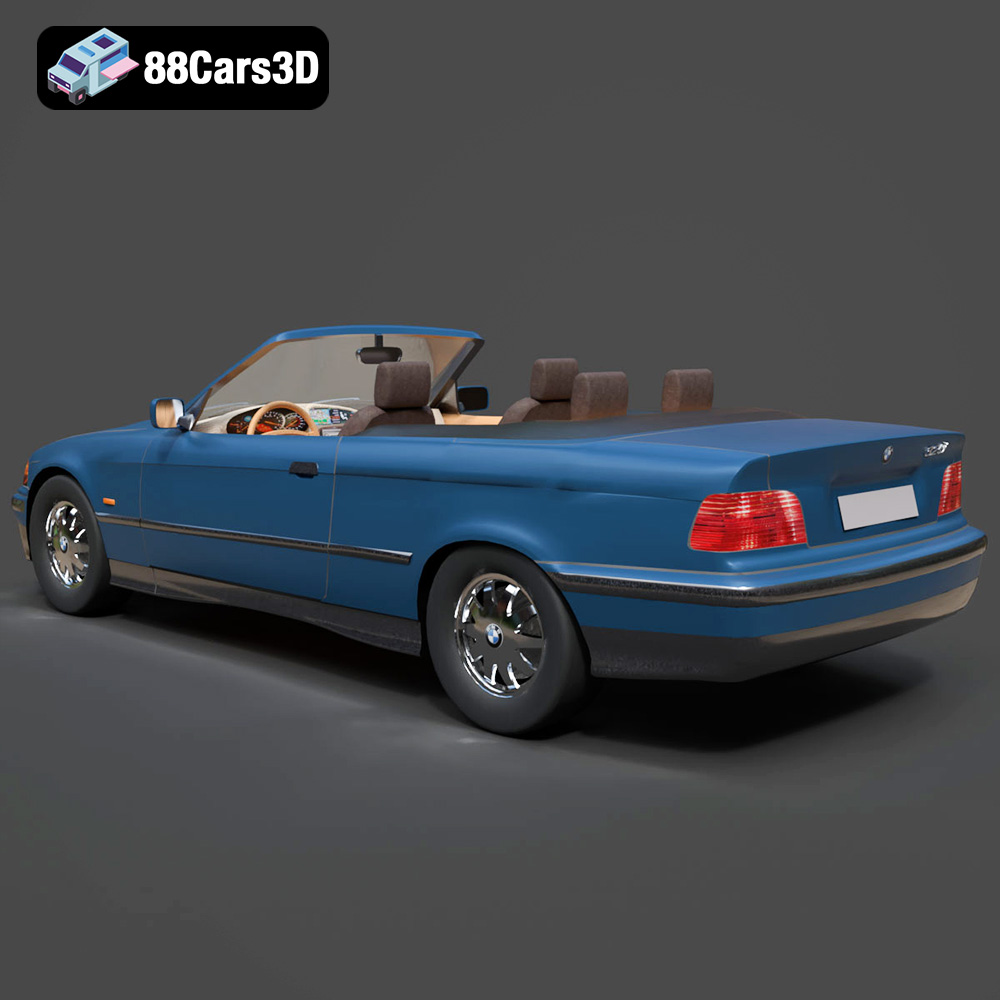
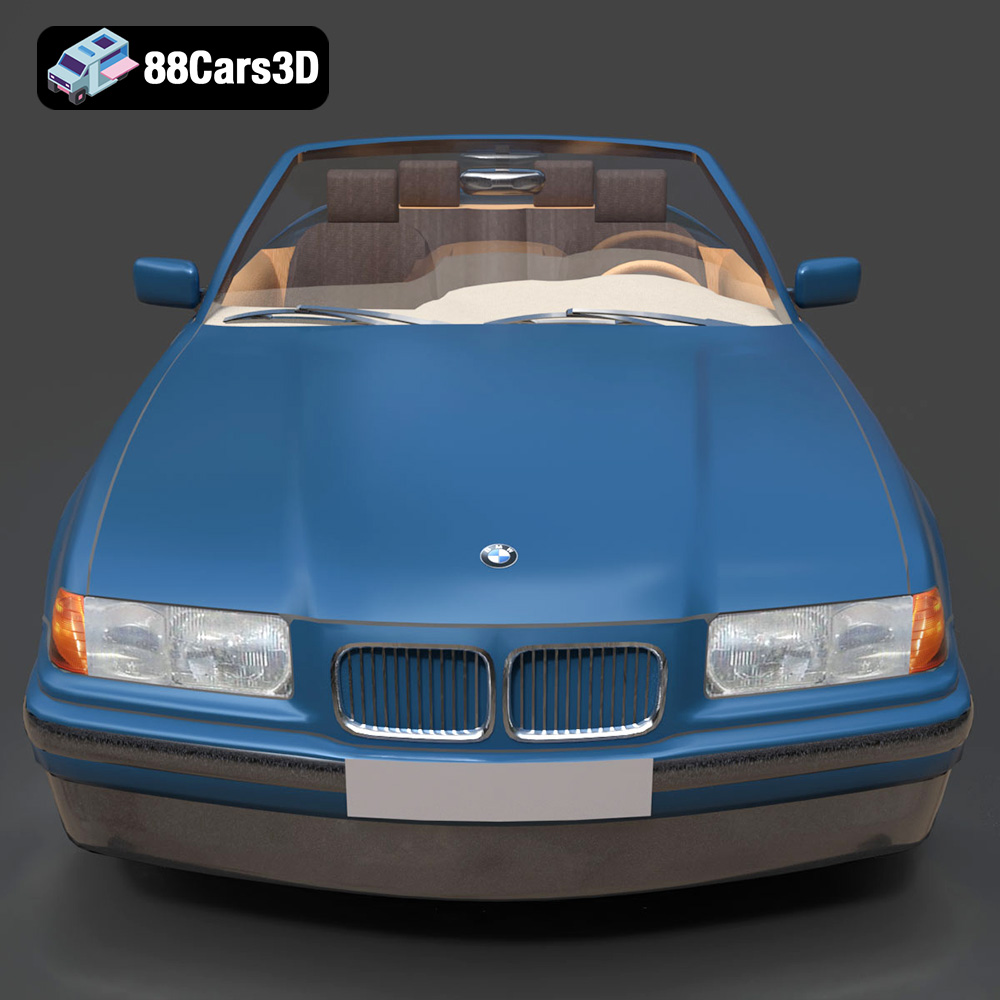
The exterior of any car is its most recognizable feature, and for a classic like the E36 Cabrio, authenticity is paramount. This 3D model boasts authentic body panels that faithfully reflect the E36’s classic lines and proportions. This isn’t just about surface accuracy; it’s about the subtle curvature, the sharpness of the creases, and the precise panel gaps that define its unique character. Key details include the realistic material definitions applied to the detailed headlights and taillights, which catch and refract light just like their real-world counterparts. The sporty alloy wheels and high-profile tires are not generic placeholders but specific renditions that complement the E36’s era-appropriate aesthetic. Even the convertible soft top is faithfully recreated, offering realism whether you choose to render it up or down. Furthermore, the separated components for doors, wheels, and suspension are a critical technical advantage, allowing for realistic animation of openings, wheel rotation, and suspension dynamics – essential for cinematic sequences or interactive simulations.
Interior Fidelity: Beyond the Dashboard
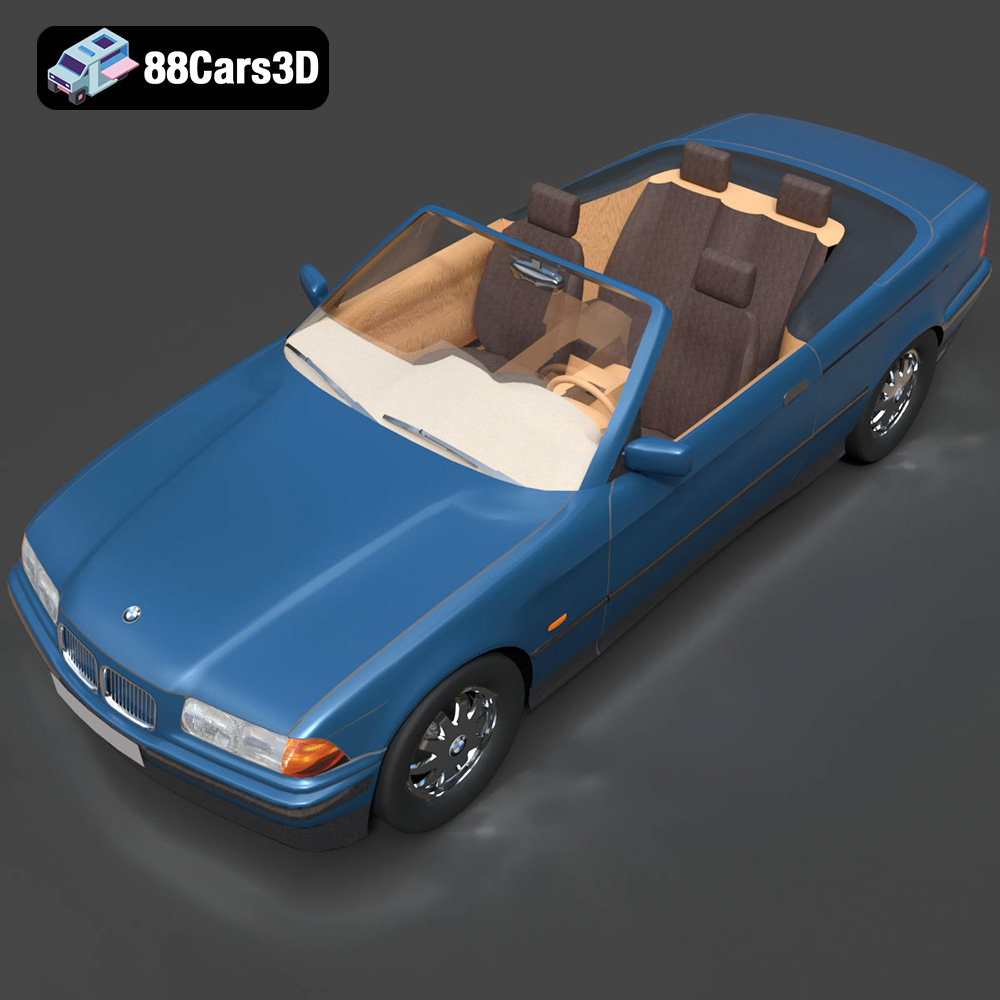
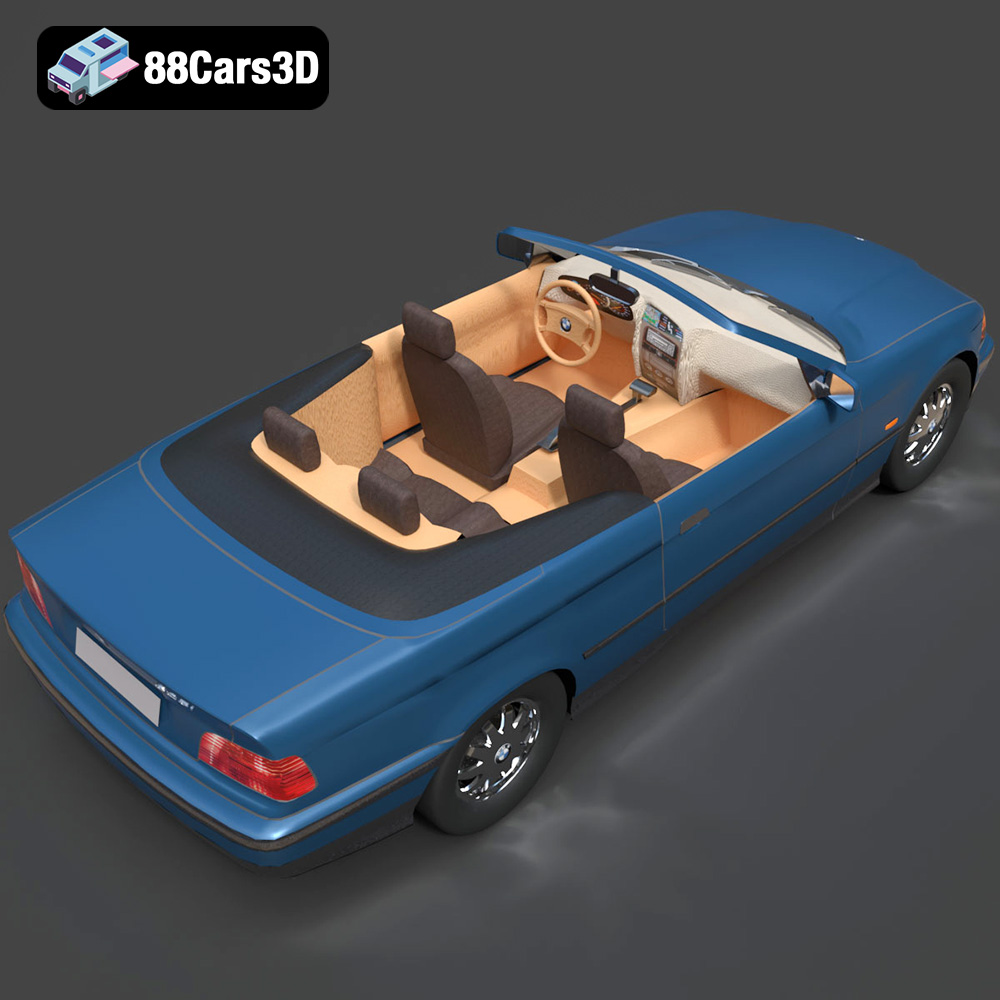
While often overlooked in distant shots, a detailed interior is crucial for close-up renders, AR/VR experiences, and immersive game environments. The E36 Cabrio 3D model extends its meticulous craftsmanship to the cabin, featuring a detailed dashboard complete with instruments and controls. This isn’t just a flat texture; it’s sculpted geometry that provides depth and realism. The comfortable seating upholstery and door panels are replicated with precision, complete with accurate textures and material properties that simulate fabric or leather. The steering wheel and gear shifter are also faithfully reproduced, ensuring that even in first-person views or interactive walkthroughs, the interior feels authentic. The optimized mesh quality of these interior elements ensures they hold up to close-up renders without excessive poly count, striking a balance between visual fidelity and performance efficiency.
Professional Workflows: Integrating the BMW E36 Cabrio
A high-quality 3D model like the BMW E36 Cabrio 325i 1998 is designed to be a versatile asset across various professional workflows. Its clean topology, accurate scale, and organized hierarchy make it an ideal starting point for numerous projects, from cinematic advertising to interactive experiences.
High-Fidelity Rendering in 3ds Max and Blender
For artists focused on producing stunning photorealistic images and animations, the E36 Cabrio model is perfectly suited for leading rendering software. In 3ds Max, utilizing the provided .max file, artists have direct access to the model’s geometry, materials, and potentially even lighting setups. This allows for fine-tuning reflections on the authentic body panels, adjusting the transparency of windows, and setting up complex studio lighting environments. With renderers like V-Ray or Corona integrated into 3ds Max, artists can achieve breathtaking results, simulating realistic paint finishes, metallic sheens, and soft shadows that truly bring the E36 to life. Similarly, for Blender users, the .blend file provides a complete scene. Cycles or Eevee renderers can be leveraged to create anything from stylized animations to hyper-realistic studio renders, making full use of the quad-dominant topology for smooth subdivisions and detailed surface scattering. The ability to easily adjust paint finishes, reflections, and decals offers immense creative freedom, allowing designers to showcase the E36 in various custom liveries or design preferences.
Real-Time Engine Integration: Unreal and Game Development
The demands of real-time applications, such as game development and interactive simulations, are unique. Performance, optimization, and seamless integration are critical. The E36 Cabrio’s availability in .fbx and a dedicated .unreal format makes it an excellent game asset. For developers working with Unreal Engine, the pre-configured .unreal asset can save significant time. This means the model is likely already set up with proper scale, pivot points, and potentially even initial PBR materials. The clean, quad-dominant topology is vital for generating efficient LODs (Levels of Detail), ensuring the car looks great up close without bogging down performance when viewed from a distance. Its organized hierarchy, with separated components for doors, wheels, and suspension, simplifies the rigging and animation process, crucial for creating interactive driving mechanics or cinematic in-game sequences. Whether it’s for a racing simulator that demands authentic vehicle physics or an open-world environment needing realistic background vehicles, this 3D car model is ready for prime time.
Expanding Horizons: AR/VR, Simulation, and 3D Printing
The versatility of a well-crafted 3D model extends far beyond traditional rendering and game development. The BMW 3 Series E36 Cabrio 325i 1998 3D Model is engineered to meet the demands of emerging technologies and specialized applications, showcasing its inherent value across a broad spectrum of digital endeavors.
Immersive Experiences with AR/VR
Augmented Reality (AR) and Virtual Reality (VR) represent the next frontier in interactive visualization, offering immersive experiences that blur the lines between the digital and physical worlds. For AR/VR applications, optimized geometry and efficient asset loading are crucial for maintaining fluid frame rates and preventing motion sickness. The E36 Cabrio’s availability in the .glb format is a significant advantage here. This format is specifically optimized for web-based, AR, and VR display, bundling all necessary data (model, textures, animations) into a single, compact file. This allows developers to easily integrate the E36 into interactive showrooms where customers can virtually explore the car, or into VR driving experiences that offer a realistic sense of presence. Imagine walking around the classic E36 in your living room via AR, or taking it for a virtual spin in a detailed VR environment – this model makes such immersive experiences readily achievable.
Engineering Visualization and Physical Replicas
Beyond entertainment, high-precision 3D models serve critical roles in simulation, training, and even physical manufacturing. For engineering visualizations and driving simulators, the accurate real-world scale and detailed internal components of the E36 Cabrio are invaluable. The model’s clean mesh quality and detailed components (such as suspension elements and interior controls) make it suitable for simulating mechanical interactions, driver training scenarios, or educational content that explains vehicle mechanics. The inclusion of the .ply format further supports these analytical workflows, as it excels in storing precise mesh data often used in CAD environments or for detailed structural analysis. Moreover, for enthusiasts who wish to bring the digital into the physical, the model is convertible to the .stl format, making it ready for 3D printing. This capability allows for the creation of physical replicas, from desktop models to larger scale prototypes, offering a tangible connection to this iconic vehicle. Whether for design iteration, display, or even custom parts manufacturing, the 3D printing readiness of this model adds another layer of utility.
Optimizing Your Automotive 3D Assets: Customization and Performance
The true power of a professional 3D car model lies not just in its initial quality, but in its adaptability and performance within diverse project environments. The BMW 3 Series E36 Cabrio 325i 1998 3D Model from 88cars3d.com is designed with optimization and customization at its core, enabling artists and developers to achieve their specific creative and technical goals.
Tailoring Visuals: Paint, Materials, and Lighting
One of the most exciting aspects of working with a high-fidelity 3D car model is the ability to customize its appearance to fit any narrative or aesthetic. The E36 Cabrio provides extensive customization options. Artists can easily adjust paint finishes, reflections, and decals to match specific liveries or design preferences, from a pristine showroom gloss to a gritty race-worn look. This is achieved by modifying the material properties within your chosen 3D software – whether it’s adjusting the metallic roughness and clear coat thickness for the body paint, or fine-tuning the reflectivity and tint of the window glass. Modifying material properties for metal, chrome, plastic, and rubber components allows for nuanced visual distinctions, enhancing realism. Furthermore, adapting lighting setups is crucial for achieving various moods and environments. A daylight studio render will emphasize the car’s curves and reflections, while a dramatic night scene with focused spotlights can highlight its aggressive posture. The clean topology and well-defined UVs of this model ensure that texture mapping and material assignments are straightforward and produce high-quality results, regardless of the desired visual style.
Technical Advantages for Seamless Projects
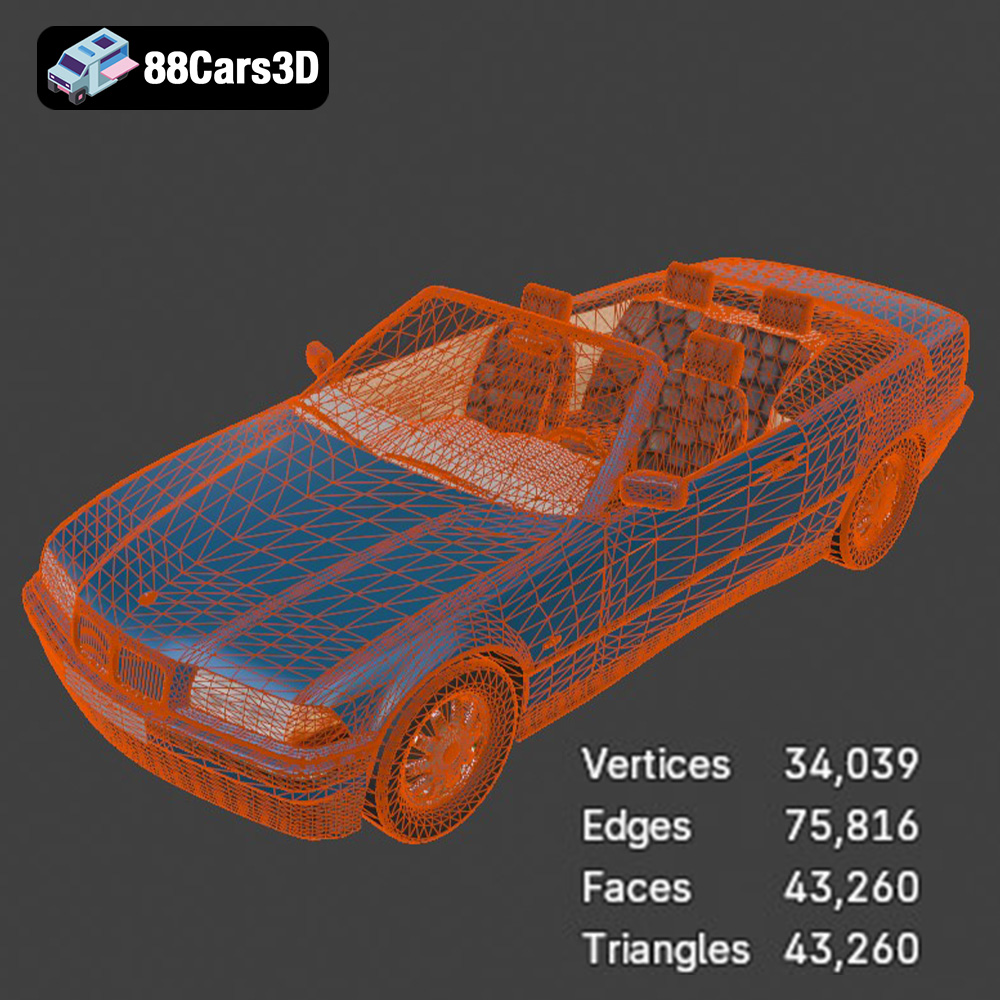
Beyond visual customization, the underlying technical structure of a 3D model dictates its performance and ease of use. The BMW E36 Cabrio 325i 1998 3D Model is built with several key technical advantages that streamline professional workflows. Its clean, quad-dominant topology is a cornerstone of professional 3D modeling. Quads (four-sided polygons) are ideal for subdivision, allowing for smooth surface deformations when applying modifiers or for creating different levels of detail (LODs) without introducing artifacts. This ensures the model can be scaled in detail from distant game assets to close-up cinematic shots. The accurate real-world scale ensures seamless integration into scenes, eliminating the need for tedious manual scaling and potential dimensional inaccuracies. This is particularly important for architectural visualization, automotive configurators, and physics-based simulations. Finally, an organized hierarchy with proper pivot points for animation and rigging is a critical feature. The ability to easily rotate doors, wheels, or manipulate suspension components around their natural axes saves animators countless hours, making the model production-ready for dynamic sequences or interactive controls. This attention to foundational technical quality is what truly sets professional 3D car models apart.
Conclusion: Drive Your Digital Projects with Iconic Quality
The BMW 3 Series E36 Cabrio 325i 1998 3D Model is more than just a collection of polygons and textures; it’s a meticulously crafted digital artifact that embodies the timeless appeal of a classic automotive icon. From its authentic exterior lines and detailed interior to its robust technical advantages and comprehensive file format support, this model offers unparalleled versatility and quality for a wide array of professional applications.
Whether you’re developing high-fidelity automotive rendering projects, creating immersive game assets for racing simulations, crafting engaging AR/VR experiences, or generating precise models for simulation and 3D printing, the E36 Cabrio is engineered to exceed expectations. Its clean topology, accurate scale, and organized hierarchy ensure seamless integration into diverse workflows, while the extensive customization options empower artists to tailor its appearance to any creative vision. The inclusion of formats like .blend, .fbx, .obj, .glb, .stl, .ply, .unreal, and .max guarantees compatibility with virtually any professional 3D software or engine.
Investing in such a high-quality 3D car model from a reputable marketplace like 88cars3d.com significantly reduces development time and elevates the visual fidelity of your projects. It allows designers and developers to focus on creativity and innovation, confident that their core assets are built on a foundation of precision and professional-grade engineering. Unlock the potential of this iconic BMW E36 Cabrio 325i 3D model and bring a touch of classic automotive excellence to your digital world, driving your projects forward with style and technical prowess.
Featured 3D Model
BMW 3 Series E36 Cabrio 325i 1998 3D Model
Experience the timeless appeal of the iconic BMW 3 Series E36 Cabrio 325i with this meticulously crafted 3D model. Representing a quintessential German convertible from the late 90s, this model captures the distinctive styling and sporty elegance that defined a generation. Built with clean geometry and balanced detailing, it ensures optimal performance for various applications. Ideal for high-quality rendering, immersive animation sequences, realistic simulations, and integration into game development projects.
Exterior Features:
Authentic body panels reflecting the E36’s classic lines
Detailed headlights and taillights with realistic material definitions
Sporty alloy wheels and high-profile tires
Faithful recreation of the convertible soft top
Separated components for easy animation of doors, wheels, and suspension
Transparent materials for windows and light covers
Interior / Mechanical Features:
Detailed dashboard with instruments and controls
Comfortable seating upholstery and door panels
Steering wheel and gear shifter replicated with precision
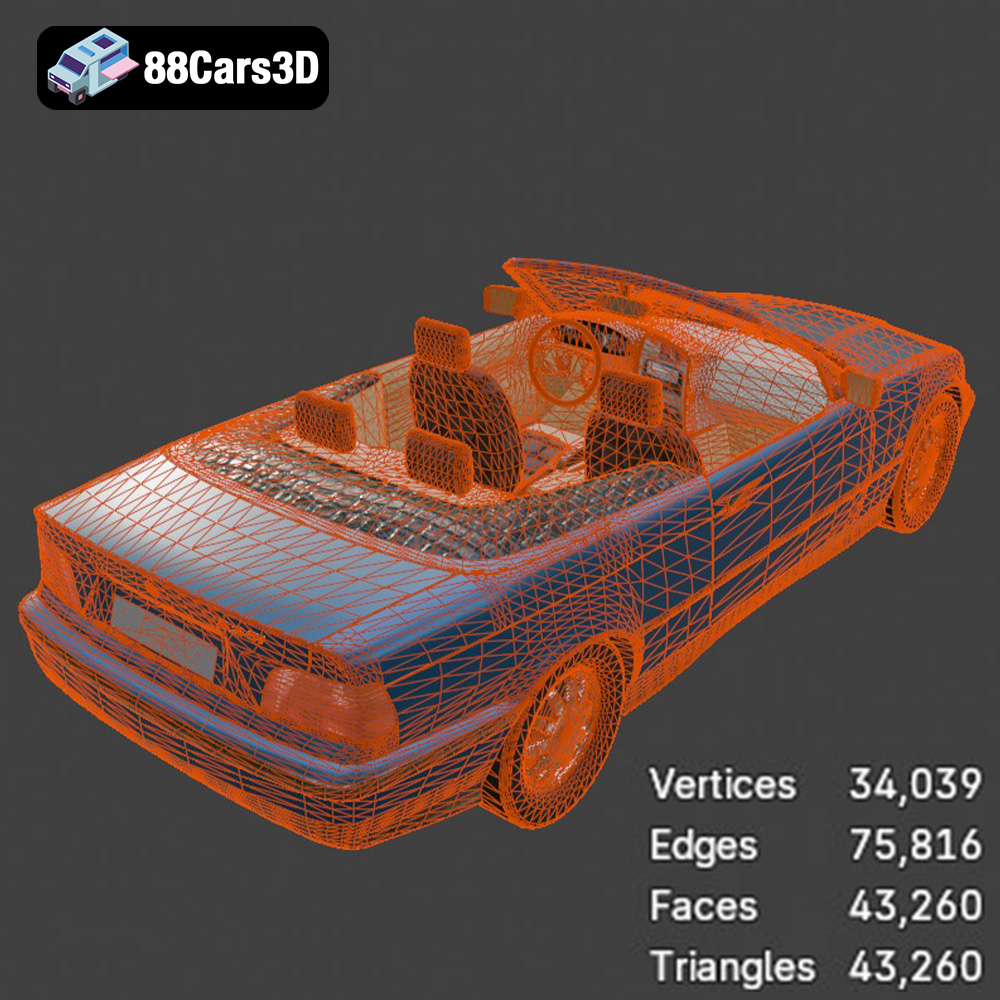
Optimized mesh quality suitable for close-up renders
Technical Advantages:
Clean, quad-dominant topology for easy subdivision and deformation
Accurate real-world scale ensures seamless integration into scenes
Organized hierarchy with proper pivot points for animation and rigging
Applications:
Rendering & Visualization: Perfect for studio renders, automotive showcases, and cinematic scenes
Game Development: Optimized as a game asset for racing simulations, open-world environments, and interactive experiences
AR/VR: Ready for immersive augmented and virtual reality applications
Simulation & Training: Suitable for driving simulators, engineering visualizations, and educational content
3D Printing: Convertible to .stl format for creating physical replicas
Customization Options:
Easily adjust paint finishes, reflections, and decals to match specific liveries or design preferences
Modify material properties for metal, chrome, plastic, and rubber components
Adapt lighting setups to achieve various moods and environments, from daylight to night scenes
Unlock the potential of this iconic BMW E36 Cabrio 325i 3D model to elevate your projects with its professional quality and versatile design, bringing a touch of classic automotive excellence to your digital world.
Included File Formats:
.blend – Blender project with materials
.fbx – Compatible with Unreal, Unity, and major 3D engines
.obj – Universal format for nearly all 3D software
.glb – Optimized for AR, VR, and web-based visualization
.stl – Ready for 3D printing
.ply – Mesh format for analysis and CAD workflows
.unreal – Unreal Engine project setup
.max – Editable 3ds Max scene for rendering and animation
$10.79
Product Image Gallery
Related Tags
.1998
.325i
.3series
.arvr
.blend
.bmw
.cabrio
.car
.classiccar
.convertible
.e36
.fbx
.gameasset
.glb
.max
.obj
.ply
.rendering
.simulation
.sportsCar
.stl
.unreal
