

Revitalizing Automotive History: The Art and Science of 3D Car Models for Modern Workflows
In the dynamic world of 3D visualization, automotive design, and interactive media, the demand for high-quality, technically precise 3D car models has never been greater. Whether you’re a seasoned game developer crafting an immersive open world, an architect integrating vehicles into a stunning visualization, or an enthusiast bringing a classic car to life in a digital studio, the foundation of your project hinges on the quality of your assets. The art lies not just in aesthetic appeal, but in the intricate technical details that ensure seamless integration and breathtaking realism across various platforms.
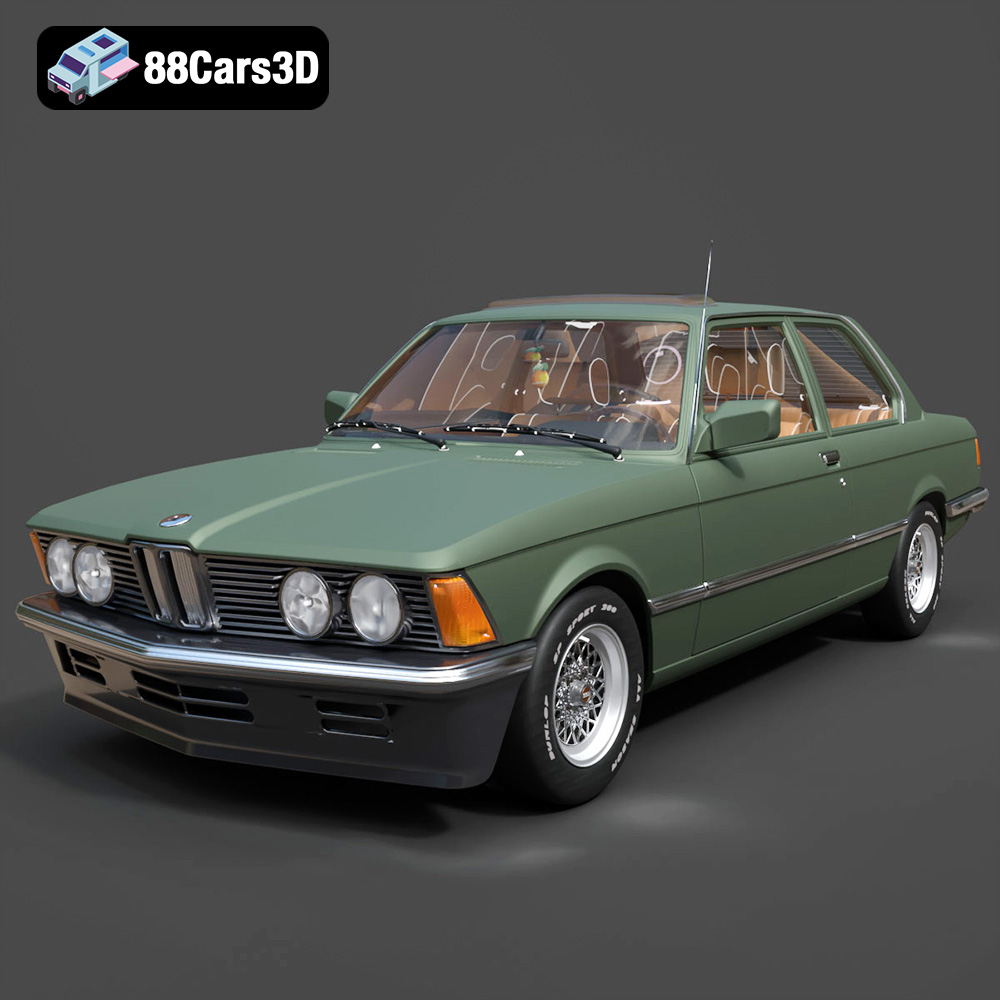
Today, we’re diving deep into the technical prowess behind such assets, using a prime example from the extensive collection at 88cars3d.com: the meticulously crafted BMW 3 Series E21 3D Model. This iconic first-generation compact executive car, renowned for its elegant lines and driver-focused design, serves as an excellent case study to explore the complexities and advantages of professional-grade 3D car models. From its faithful exterior reproduction to its detailed interior, and the underlying clean geometry, this model exemplifies what it takes to meet the rigorous demands of modern 3D production pipelines.
Understanding 3D Model File Formats
The versatility of a 3D model is often defined by the range and quality of its supported file formats. Each format serves a specific purpose, catering to different software, engines, and end-use applications. Understanding these distinctions is crucial for any professional working with 3D assets, as selecting the correct format can significantly impact workflow efficiency, model fidelity, and overall project success. The BMW 3 Series E21 3D Model, for instance, comes bundled with a comprehensive array of formats, ensuring its adaptability across virtually any professional pipeline.
.blend – Fully Editable Blender Scene with Materials
The `.blend` file is the native format for Blender, a powerful and increasingly popular open-source 3D creation suite. For users deeply integrated into the Blender ecosystem, this format offers the most flexibility. It contains not just the mesh data, but also all associated materials, textures, lighting setups, camera positions, and even animation data if present. This allows for full editability, from minor topological adjustments to complete material overhauls using Blender’s native Cycles or Eevee render engines. Having the original `.blend` file means direct access to the model’s construction, ideal for customization and learning from professional asset creation.
.fbx – Ideal for Unreal, Unity, and Real-Time Pipelines
The Filmbox (`.fbx`) format is an industry standard for interoperability between 3D applications, particularly favored in game development. It efficiently encapsulates 3D models, animations, cameras, and lighting, making it the go-to choice for importing assets into game engines like Unreal Engine and Unity. Its strength lies in its ability to preserve hierarchical structures, pivot points, and animation data, which is essential for animating components like doors, wheels, and suspension in a game environment. `.fbx` is optimized for real-time performance, making it a critical component for delivering game assets with minimal overhead while maintaining visual integrity.
.obj – Universal Format for Cross-Software Compatibility
The Wavefront OBJ (`.obj`) format is one of the most widely supported and universal 3D file formats. Almost every 3D software application can import and export `.obj` files, making it excellent for basic cross-software compatibility. While it primarily stores geometric data (vertices, normals, texture coordinates, and faces), it can reference external `.mtl` (material template library) files for basic material properties. For simple mesh transfer and when maximum compatibility is required, `.obj` remains a reliable choice, though it may not retain complex scene information like rigging or animations as effectively as `.fbx` or native formats.
.glb – Optimized for AR, VR, and Browser-Based Display
The GL Transmission Format (`.glb`) is a relatively newer standard, built on JSON, specifically designed for efficient transmission and loading of 3D scenes and models in web and real-time applications. `.glb` is a binary version of `.gltf`, encapsulating textures, materials, and animations directly within a single file. This “all-in-one” packaging makes it incredibly efficient for augmented reality (AR), virtual reality (VR), and browser-based 3D viewers, where quick loading times and streamlined asset delivery are paramount. For displaying the BMW 3 Series E21 3D Model on a website or integrating it into an AR experience, `.glb` is the format of choice.
.stl – Suitable for 3D Printing Output
Stereolithography (`.stl`) is the de facto standard file format for 3D printing. It represents a 3D model as a series of connected triangles (a tessellated surface) without any color or texture information. The critical aspect for `.stl` files is ensuring the mesh is “watertight” – meaning it has no holes or non-manifold geometry – to allow for successful slicing and printing. The E21 model’s geometry being watertight means it can be directly prepared for physical production, providing a tangible replica of the digital asset.
.ply – Precision Mesh Format for CAD or Analysis
The Polygon File Format (`.ply`), also known as the Stanford Triangle Format, is primarily used for storing 3D data from 3D scanners. It supports a wide range of properties for each vertex (color, normal, confidence, etc.) and face, making it robust for complex geometric data and scientific applications. While less common for everyday 3D modeling transfer than `.obj` or `.fbx`, `.ply` is valuable for precision mesh analysis, CAD workflows, and when detailed vertex data is critical.
.unreal – Engine-Ready Asset for Real-Time Environments
The `.unreal` format denotes a pre-configured Unreal Engine project or asset. This is a significant advantage for game developers, as it means the BMW 3 Series E21 3D Model comes with materials, textures, and possibly even basic collision or LOD (Level of Detail) setups already optimized and integrated within an Unreal Engine project structure. This drastically reduces setup time and ensures that the asset performs optimally within the engine, ready for immediate use in interactive experiences and game levels.
.max – Editable 3ds Max Project for Animation and Rendering
The `.max` file is the native format for Autodesk 3ds Max, a long-standing industry leader in 3D modeling, animation, and rendering, especially prevalent in architectural visualization and high-end cinematic production. Similar to the `.blend` file for Blender, the `.max` file provides complete editability of the scene, including complex materials, lighting, modifiers, and animation rigs. For studios that rely on 3ds Max for their primary workflow, having the native file ensures full control over every aspect of the E21 model, from detailed rendering passes to intricate animation sequences.
Crafting Automotive Realism: The BMW 3 Series E21 Model in Detail
Achieving photorealistic quality in 3D automotive models requires an obsessive attention to detail. It’s not just about getting the shape right; it’s about capturing the essence of the vehicle, from the subtle curves of its body to the intricate textures of its interior. The BMW 3 Series E21 3D Model exemplifies this philosophy, providing a foundation for truly stunning visuals.
Exterior Precision: Capturing Classic Lines
The first generation BMW 3 Series E21 is a design icon, celebrated for its elegant simplicity and sporty stance. This 3D model meticulously reproduces these characteristics. Key exterior features include a faithful representation of BMW’s signature kidney grille and the distinctive dual headlights, crucial elements that define the E21’s front fascia. Accurate panel gaps and surface curvatures are not merely aesthetic details; they are critical for realistic light reflections and shadows, which are paramount in high-quality automotive rendering. The car’s classic bodywork, from the gentle slope of the hood to the defined waistline, has been sculpted with precision.
Furthermore, details like the wheel rims and tires are not overlooked. The model features realistic tread patterns, adding another layer of authenticity that is often missed in lower-quality assets. Separated components for doors, hood, trunk, and wheels are a testament to its professional design, enabling dynamic animation workflows essential for cinematic sequences, interactive showcases, or complex simulations where components need to open or move independently. Transparent materials are correctly applied to windows, headlights, and taillights, ensuring realistic light interaction and reflections that enhance the overall visual fidelity.
Interior Authenticity: An Immersive Cockpit
While the exterior often grabs the initial attention, a truly great automotive 3D model extends its fidelity to the interior, providing an immersive experience whether the camera is outside or inside the cabin. The BMW 3 Series E21 3D Model boasts detailed interior elements, including the dashboard, steering wheel, seats, and door panels. These components are crafted for visual authenticity, replicating the period-correct design and texture. Replicated controls and gauges within the cockpit further enhance the immersive quality, allowing for close-up shots that hold up to scrutiny.
Beyond the visible interior, the model also incorporates underlying mechanical components such as basic suspension and brake caliper forms. While these might not be the primary focus for every project, their inclusion adds structural integrity and allows for more convincing simulations and deeper customization options if needed. The optimization here is key, providing enough detail for realism without overburdening the mesh count, thus maintaining efficient performance for various applications.
Technical Foundation for Professional Workflows
Beyond visual appeal, the true measure of a high-quality 3D model lies in its technical foundation. Professional users require assets that are not only accurate but also stable, efficient, and easy to manipulate within complex production environments. The BMW 3 Series E21 3D Model at 88cars3d.com is built with these professional demands in mind.
Optimized Geometry for Performance
A crucial technical advantage of this E21 model is its clean, quad-dominant topology. This means that the vast majority of its polygons are quads (four-sided polygons), which are widely preferred over triangles or N-gons in professional modeling. Quad topology ensures smooth subdivision, which is vital for adding further detail and achieving photorealistic curvature without introducing artifacts. It also facilitates clean deformation during animation, making it ideal for high-fidelity rendering where smooth surfaces are paramount. The balanced level of detail is a thoughtful compromise, providing ample visual complexity while keeping poly counts manageable for efficient rendering and real-time performance.
Animation-Ready Components
The model is constructed to real-world scale, a fundamental requirement for accurate integration into diverse scenes and environments, from architectural visualizations to realistic physics simulations. This adherence to real-world metrics ensures that the vehicle will look correct proportionally when placed alongside other assets or within a simulated environment.
Furthermore, an organized hierarchy with proper pivot points is a hallmark of a production-ready asset. The E21 model’s doors, hood, trunk, and wheels are separated and correctly pivoted, allowing for straightforward manipulation and animation. This structured approach saves animators countless hours, eliminating the need to manually adjust pivot points or rebuild hierarchies. Whether you’re creating an opening car door animation for a cinematic, or simulating wheel rotation in a game, this model is designed for seamless integration into animation pipelines.
Integrating the E21 into Diverse 3D Applications
The utility of a premium 3D car model extends across a multitude of industries and applications. The BMW 3 Series E21 3D Model’s robust design and broad compatibility make it an invaluable asset for a wide spectrum of creative and technical endeavors.
High-Fidelity Rendering and Visualization
For artists specializing in rendering and visualization, this E21 model is a dream to work with. Its clean topology and detailed features are perfect for creating stunning studio renders, cinematic sequences, and architectural visualizations. Whether you’re using V-Ray, Corona Renderer, Arnold, or other leading render engines in 3ds Max or Blender, the model’s precise geometry interacts beautifully with global illumination and complex material setups. Imagine the classic E21 bathed in golden hour light, parked elegantly in front of a modern architectural marvel, or racing through a beautifully rendered urban landscape—the possibilities for creating visually captivating scenes are endless. Its real-world scale ensures accurate integration into existing scenes, providing a cohesive visual narrative.
Game Development and Real-Time Environments
In the realm of game development, high-quality car models are essential for immersive experiences. The BMW 3 Series E21 3D Model is described as a production-ready asset, suitable for racing games, open-world environments, and interactive experiences. The included `.fbx` and `.unreal` formats are specifically tailored for engines like Unreal Engine and Unity, streamlining the import process. Developers can leverage its optimized mesh and separated components to implement realistic physics, damage models, and interactive elements. Its balanced detail ensures that it looks fantastic even with real-time rendering constraints, while allowing for further optimization through LODs (Level of Detail) if needed for various platforms and performance targets. The organized hierarchy facilitates easy integration with vehicle blueprint systems and animation controllers within these engines.
Simulation, Training, and AR/VR Experiences
Beyond entertainment, precise 3D models are critical for professional simulations and training. This E21 model is ideal for vehicle dynamics simulations, driver training modules, and educational content. Its accurate dimensions and detailed components can feed into complex physics engines to provide realistic behavioral data. For AR/VR applications, the `.glb` format ensures it’s optimized for real-time applications, enabling immersive augmented and virtual reality experiences. Imagine a user walking around a life-size E21 in an AR app, or driving it virtually in a VR simulation; the model’s fidelity and optimization are key to delivering these compelling interactions.
Customization and Adaptation for Unique Projects
Even with a perfectly crafted base model, the ability to customize and adapt it to specific project requirements is paramount. The BMW 3 Series E21 3D Model offers extensive customization options, giving artists and developers the freedom to bring their unique visions to life.
Tailoring Visuals to Your Vision
The model is designed for easy customization of paint finishes, livery designs, and decal placements. This flexibility allows for a myriad of visual styles, from showroom-pristine factory colors to custom racing liveries, or even weathered, post-apocalyptic textures. Adjusting material properties for metals, plastics, chrome, and rubber is straightforward, enabling the artist to achieve desired visual effects – from highly reflective chrome bumpers to matte paint jobs or distressed leather interiors. Modifying lighting setups is also a powerful way to create various atmospheric conditions and scene moods, transforming the car from a sunny summer cruiser to a moody, rain-soaked night driver, all through material and lighting tweaks.
Workflow Integration Examples: 3ds Max, Blender, and Unreal Engine
Let’s consider how a professional might integrate this model into specific workflows, highlighting the value of the included file formats.
3ds Max Workflow: A rendering artist working in 3ds Max would likely start with the provided `.max` file. This immediately grants access to the native scene setup. They could then leverage 3ds Max’s powerful modeling tools to make any specific modifications, such as adding custom body kits or internal components. For rendering, they would load their preferred engine like V-Ray or Corona. The clean topology of the E21 model ensures that applying subdivision modifiers (like Turbosmooth) will result in perfectly smooth surfaces. The organized hierarchy simplifies the process of animating door openings or wheel rotations. Material assignments can be fine-tuned using Substance Painter or directly within 3ds Max’s Slate Material Editor, linking high-resolution textures for ultimate realism in their automotive renders.
Blender Workflow: For a Blender user, the `.blend` file is the starting point. All materials and textures will be pre-loaded, ready for rendering with Cycles or Eevee. The artist could easily add custom shaders, modify the car’s paint using procedural textures, or even rig the suspension for advanced animations. Blender’s robust animation tools, combined with the model’s separated parts and correct pivot points, make creating a dynamic car commercial or a detailed vehicle breakdown straightforward. The open-source nature of Blender also provides a vast community and add-on ecosystem to further enhance the E21 model for specific artistic expressions.
Unreal Engine Workflow: A game developer working with Unreal Engine would benefit immensely from the `.fbx` or the pre-configured `.unreal` asset. Importing the `.fbx` allows for direct integration into an existing project. The developer would then set up physically based rendering (PBR) materials within Unreal, using textures provided or creating new ones. For an `.unreal` asset, much of this setup is already done. Blueprints can be created to handle vehicle physics, interactive elements (like opening doors via player input), and visual effects. The optimized mesh ensures efficient rendering, and the separated components simplify rigging for animation and collision detection. This E21 model becomes a ready-to-drive vehicle in a virtual world with minimal overhead, making it an ideal game asset.
Conclusion
The journey from a classic automotive design to a fully realized, production-ready 3D model is a testament to technical skill and artistic vision. The BMW 3 Series E21 3D Model stands as an exceptional example of this fusion, offering unparalleled detail, technical precision, and broad compatibility across a myriad of 3D applications and file formats.
Whether your project demands cinematic rendering, real-time game integration, immersive AR/VR experiences, or precise simulations, this E21 model provides a robust and flexible foundation. Its meticulously crafted exterior and interior, combined with optimized geometry and a comprehensive suite of file formats, ensure that it not only looks stunning but also performs flawlessly within your professional workflows.
Elevate your next project with an asset that truly understands the demands of modern 3D production. Explore the BMW 3 Series E21 3D Model and other premium 3D car models available at 88cars3d.com, your trusted source for high-quality digital automotive assets.
Featured 3D Model
BMW 3 Series E21 3D Model
Presenting a meticulously crafted 3D model of the iconic BMW 3 Series E21, representing the first generation of BMW’s compact executive car. This model captures the distinctive styling and classic allure of the E21 era, known for its elegant lines and driver-focused design. Built with clean geometry and a balanced level of detail, it is optimized for high-quality rendering, realistic animations, precise simulations, and robust integration into game development projects.
$20.79
Product Image Gallery


Related Tags
.3seriese21
.arvr
.blend
.bmw
.classiccar
.coupe
.fbx
.gameasset
.glb
.max
.obj
.ply
.rendering
.simulation
.stl
.unreal
.vintagecar
