Get 20% OFF All Premium 3D & STL Models!

In the expansive and rapidly evolving landscape of digital content creation, the demand for high-fidelity 3D models has never been greater. From captivating cinematic sequences and immersive game worlds to precise architectural visualizations and intricate product designs, the quality of your foundational assets dictates the final output’s realism and impact. Professionals across various industries, including automotive rendering, game development, and architectural visualization, constantly seek models that offer both aesthetic excellence and technical versatility.
At the heart of any compelling 3D project lies the integrity of its models. Whether you’re populating a bustling urban scene with detailed vehicles or crafting an interactive environment, the components must seamlessly integrate, perform efficiently, and offer robust customization. This pursuit of digital perfection often leads creators to specialized marketplaces like 88cars3d.com, where expertly crafted 3D assets simplify complex workflows and accelerate production.
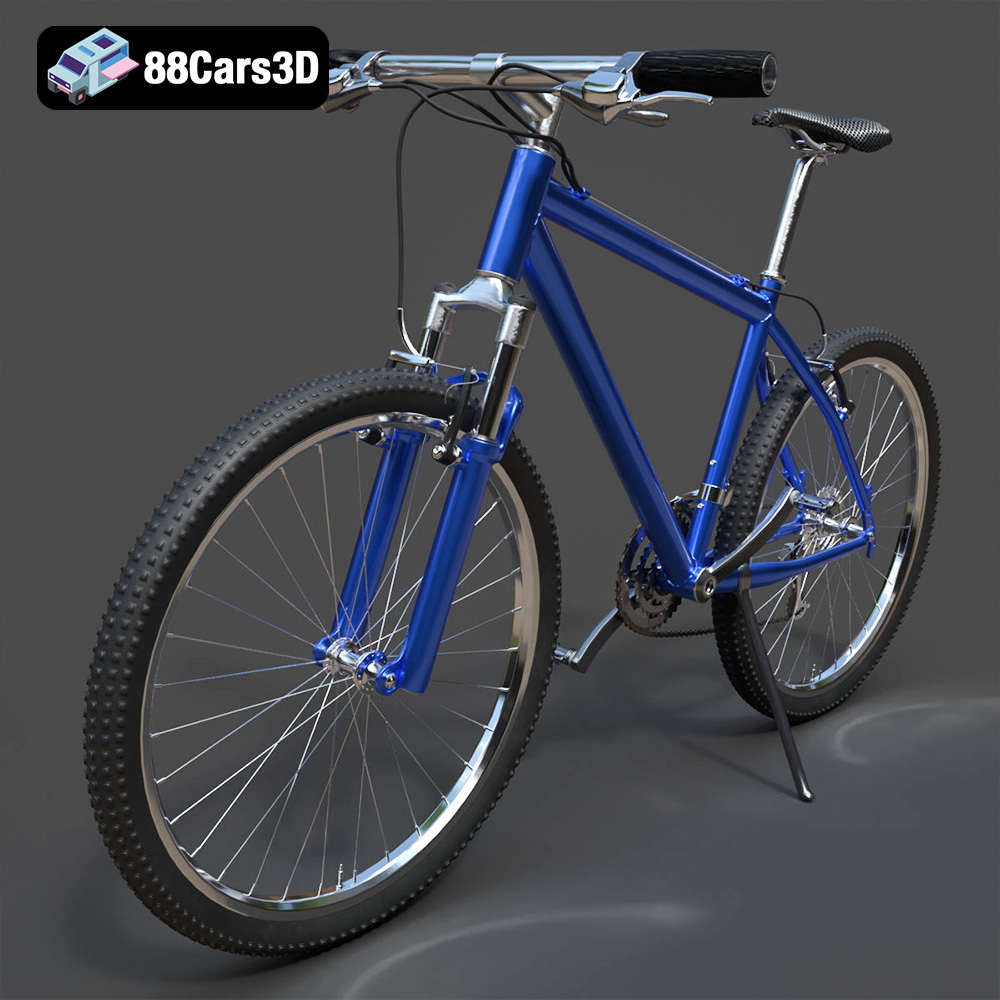
Today, we delve into the meticulous craftsmanship and technical prowess embodied by such assets, using the Bicycle 01-007 3D Model as a prime example. This versatile model, suitable for everything from realistic animations to game-ready environments, exemplifies the balance between visual quality and technical optimization that modern projects demand. It’s not just about what a model looks like, but how it’s built, how it performs, and how easily it can be integrated into diverse professional pipelines.
The flexibility of a 3D asset often hinges on the range of file formats it supports. Each format is designed with specific applications and software ecosystems in mind, offering unique advantages regarding data preservation, cross-software compatibility, and optimization for particular platforms. Understanding these formats is crucial for any professional working with 3D content, ensuring seamless integration and efficient workflows. The Bicycle 01-007 3D Model, for instance, provides a comprehensive suite of formats, catering to virtually every professional requirement.
The .blend format is Blender’s native file type, offering a complete and fully editable scene. When you acquire a .blend file, you gain access to not just the mesh data, but also all associated materials, textures, lighting setups, cameras, animation data, and even modifiers used during the modeling process. This makes it an invaluable resource for artists who primarily use Blender, allowing for deep customization and iteration. For the Bicycle 01-007 3D Model, the .blend file provides a ready-to-render scene with all materials pre-configured, making it a perfect starting point for personalized projects or learning from its construction.
.fbx (Filmbox) is a proprietary file format developed by Autodesk, widely regarded as an industry standard for exchanging 3D data between different software applications. Its strength lies in its ability to store not only geometry and UVs but also crucial information like animation, rigging, skinning, and material assignments. This makes it ideal for game development, particularly for engines like Unreal and Unity, where animated characters or dynamic objects like the Bicycle 01-007 need to be imported with their full kinematic setup. When you download the .fbx version of the Bicycle 01-007, you get a robust asset ready for real-time pipelines, complete with separated components for easy rigging.
The .obj (Wavefront OBJ) format is one of the oldest and most universally supported 3D file formats. It’s a simple, text-based format primarily used to store 3D geometry data (vertices, normals, texture coordinates, and faces) and links to external material files (.mtl). While it doesn’t support animation or advanced scene data, its widespread compatibility makes it an excellent choice for basic mesh exchange between virtually all 3D software. If you need to import the Bicycle 01-007 into an unusual or proprietary 3D application, .obj is often the most reliable “common denominator.”
.glb (GL Transmission Format Binary) is a relatively newer format, an evolution of glTF. It’s specifically optimized for efficient transmission and loading of 3D scenes and models in web browsers, augmented reality (AR), and virtual reality (VR) applications. A key advantage of .glb is that it packages all necessary assets (geometry, materials, textures, animations) into a single, self-contained binary file, reducing network requests and simplifying deployment. For showcasing the Bicycle 01-007 in an interactive web viewer or integrating it into an AR experience, .glb offers superior performance and ease of use.
.stl (Stereolithography) is the de facto standard file format for 3D printing. It represents a 3D model as a series of connected triangles, describing only the surface geometry without any color, texture, or material information. While simplistic, its ubiquity in the 3D printing ecosystem makes it indispensable for converting digital models into physical objects. Should you wish to 3D print a miniature version of the Bicycle 01-007, the .stl file ensures compatibility with most slicer software and 3D printers.
The .ply (Polygon File Format) is often used for storing 3D data obtained from 3D scanners, featuring high precision and the ability to include color, transparency, and range data for individual vertices and faces. It’s particularly useful in scientific visualization, CAD workflows, and reverse engineering, where detailed and accurate mesh information is paramount. For analytical purposes or integrating the Bicycle 01-007 into a CAD-centric project, the .ply format offers a robust data structure.
The inclusion of an .unreal specific asset indicates that the model has been pre-configured or optimized directly for the Unreal Engine. This could mean it comes as an Unreal Engine project file, or a specific asset package that is drag-and-drop ready, potentially with LODs (Levels of Detail), collision meshes, and material instances already set up. For game developers working within Unreal Engine, this offers the most streamlined integration for the Bicycle 01-007, minimizing setup time and ensuring optimal performance.
Similar to .blend for Blender, the .max format is the native file type for Autodesk 3ds Max. It encompasses the entire 3ds Max scene, including geometry, materials, textures, lighting, cameras, animation, and any modifiers or scripts used. For professionals entrenched in the 3ds Max ecosystem, this format provides maximum flexibility for rendering, animation, and further customization of the Bicycle 01-007 3D Model, allowing full access to its construction and attributes.
Providing a model like the Bicycle 01-007 in such a diverse array of formats underscores its professional-grade quality and the foresight of its creators. It ensures that regardless of your preferred software or end-use application, you have the right tool for the job.
Crafting a professional 3D model is a delicate balance between artistic vision and technical precision. It demands a deep understanding of geometry, materials, and optimization to ensure that the final asset is not only visually stunning but also functionally robust across various digital environments. The Bicycle 01-007 3D Model exemplifies this synthesis, demonstrating how meticulous planning in its construction translates directly into superior performance and visual quality.
The foundation of any high-quality 3D model is its geometry and topology. The Bicycle 01-007 3D Model boasts “clean quad-dominant topology.” This means that the vast majority of its faces are quadrilaterals (four-sided polygons), which are ideal for subdivision, smooth deformations during animation, and efficient unwrapping for texturing. Such clean geometry ensures that when the model is subdivided to higher detail levels for close-up renders, it retains smooth curves and surfaces without unsightly pinching or artifacts. This attention to detail is crucial for achieving high-fidelity rendering and maintaining performance, especially when used as game assets where poly count must be carefully managed.
Visual realism in 3D models relies heavily on sophisticated material and texture work. The Bicycle 01-007 incorporates “high-quality materials representing metal, rubber, and plastic components.” These aren’t just simple color shaders; they are typically PBR (Physically Based Rendering) materials, accurately simulating how light interacts with different surfaces. This means metals will have appropriate reflectivity and sheen, rubber will absorb light and show subtle roughness, and plastics will exhibit suitable gloss and subsurface scattering effects. Detailed UV unwrapping ensures that textures, such as tire tread patterns or frame decals, are applied without distortion, contributing significantly to the model’s authentic representation.
A often-overlooked but critical aspect of professional 3D modeling is adhering to real-world scale. The Bicycle 01-007 3D Model is built to “accurate real-world scale,” which is paramount for seamless integration into existing scenes, be it an architectural visualization project, an automotive rendering scene with other 3D car models, or a game environment. Without correct scale, objects appear unnatural, interact incorrectly with physics engines, and complicate lighting setups. This precision ensures that the bicycle will fit perfectly into any digital environment, maintaining consistent proportions with other assets.
A truly versatile 3D model proves its worth through its adaptability across diverse professional applications. The Bicycle 01-007 3D Model is designed with this versatility in mind, offering solutions for a spectrum of creative and technical challenges. From static visualizations to dynamic interactive experiences, its robust construction facilitates integration into established industry pipelines.
While 88cars3d.com is known for its exquisite 3D car models, the Bicycle 01-007 fits perfectly into the broader context of transportation and urban scene rendering. In automotive rendering, it can add depth and realism to street scenes, parking lots, or even showrooms, providing a lifestyle element alongside high-end vehicles. For architectural visualization, a detailed bicycle can bring a sense of scale, human activity, and environmental context to building exteriors, public spaces, or park renders. Its clean geometry and high-quality materials ensure it holds up under the scrutiny of studio renders and cinematic scenes, contributing to the overall narrative and visual richness of the composition.
The Bicycle 01-007 is explicitly “optimized as a game-ready asset.” This implies careful consideration of poly count, material efficiency, and organizational structure to ensure optimal performance in real-time engines like Unreal and Unity. Its separated components—wheels, handlebars, pedals, and chain—are crucial for rigging, allowing animators to create realistic riding cycles or interactive gameplay mechanics. This makes it an ideal asset for populating open-world environments, serving as a player vehicle in racing games, or enhancing the realism of interactive simulations where dynamic objects are key game assets.
The optimized .glb format makes the Bicycle 01-007 a prime candidate for augmented reality (AR) and virtual reality (VR) experiences. In AR, users could place a virtual bicycle in their physical environment, perhaps for product visualization or interactive storytelling. In VR, it could be a crucial interactive element within a virtual world, allowing users to “ride” through a simulated city. Beyond immersive entertainment, the model is also suitable for “simulation & training.” Imagine using it in a virtual cycling training application, a mechanical repair simulator, or an educational tool demonstrating bicycle physics. Its accurate mechanical representation is particularly beneficial here.
The true potential of a 3D model, especially one representing a mechanical object like a bicycle, often lies in its capacity for realistic animation and dynamic interaction. A well-structured model significantly streamlines the animation process, allowing artists to focus on creative storytelling rather than wrestling with complex geometry or incorrect pivot points. The Bicycle 01-007 3D Model is engineered precisely for this purpose.
The product description highlights “organized hierarchy with proper pivot points set for wheels, handlebars, and pedals.” This is paramount for efficient rigging and animation. A pivot point defines the center of rotation or transformation for an object. If a wheel’s pivot point isn’t precisely at its axle, it will wobble unnaturally when animated. Similarly, correct pivot points for the handlebars and pedals allow for realistic steering and pedaling motions with minimal effort. The “separated components” like the chain further enable intricate mechanical animations, such as a rolling chain driven by gear rotation, which would be incredibly difficult or impossible with a single, merged mesh.
The Bicycle 01-007 features a “precisely modeled drivetrain including chain, gears, and pedals,” along with “functional brake levers and cables.” This level of detail is not merely for visual fidelity; it supports accurate mechanical representation and simulation. Animators can link these components realistically, making the chain move with the pedals, and the gears engage as the wheels turn. For simulation purposes, such as an engineering analysis or a sports training module, the precise articulation of these parts allows for more accurate physics-based interactions. The “optimized mesh quality ensures smooth deformations during animation,” preventing unsightly stretching or tearing as components move or interact.
Beyond technical accuracy, animation brings narrative to digital scenes. Imagine the Bicycle 01-007 ridden through a bustling city street in an architectural visualization, adding a dynamic human element. Or perhaps it’s featured in a product commercial, showcasing its features in an engaging way. In game development, an animated bicycle can be a character’s mode of transport, an interactive environmental object, or a prop in a cutscene. Its readiness for animation means artists can quickly integrate it into their stories, whether for a cinematic sequence, a short film, or a dynamic in-game event, adding layers of realism and engagement to any project that might also feature high-quality 3D car models or other vehicle assets.
In the fast-paced world of 3D production, an asset’s longevity and value are significantly enhanced by its capacity for customization. Projects evolve, creative directions shift, and having a 3D model that can adapt to new requirements without needing a complete overhaul is invaluable. The Bicycle 01-007 3D Model is designed with this flexibility in mind, offering a range of options for artists and developers to tailor it to their specific needs, ensuring it remains a relevant and useful asset for years to come.
The ability to “easily modify paint finishes and add custom graphics or decals to the frame” is a powerful feature for any artist. This allows for branding, personalized aesthetics, or fitting the bicycle into specific visual themes. For example, a game developer might want multiple color variations for different in-game factions, or a product designer might need to showcase various paint schemes for client presentations. Furthermore, the option to “adjust material properties for metal, rubber, and plastic components” provides fine-grained control over how light interacts with the bicycle’s surfaces. This means you can make the metal frame look more worn, the rubber tires appear dirtier, or the plastic components shinier, creating a unique visual identity for each project without rebuilding the model from scratch.
A well-built 3D model should look good under any lighting condition, and its “flexible for lighting setup modifications” aspect is key here. Whether placed in a sun-drenched outdoor scene, a dimly lit urban alley, or a studio rendering environment, the materials and geometry of the Bicycle 01-007 are built to react realistically to light. This adaptability ensures that the model can be seamlessly integrated into diverse scenes, complementing other assets, including complex 3D car models, and enhancing the overall mood and atmosphere of the visualization. Its accurate real-world scale further aids this, ensuring realistic shadows and reflections within any environment.
Beyond digital rendering, the versatility of the Bicycle 01-007 extends to physical and analytical applications. Being “compatible for conversion to .stl format” means it can be readily prepared for 3D printing. This opens up possibilities for creating physical prototypes, scale models for architectural displays, or even collectibles. Imagine a client wanting a physical representation of the bike in an architectural model for a new building. The inclusion of the .ply format also caters to more technical workflows, making it suitable for “CAD or analysis.” Engineers or designers might use this for form studies, fitting analyses, or integrating the model into existing CAD assemblies, bridging the gap between artistic creation and technical specification.
In the dynamic realm of 3D modeling and digital content creation, the difference between a good project and a great one often comes down to the quality and versatility of its assets. The Bicycle 01-007 3D Model stands as a testament to this principle, embodying professional craftsmanship and meticulous attention to detail. From its clean quad-dominant topology and accurate real-world scale to its high-quality PBR materials and organized hierarchy with proper pivot points, every aspect of this model is engineered for peak performance and visual excellence.
Whether your project demands high-fidelity rendering for architectural visualizations, seamless integration as game assets in real-time environments, immersive experiences in AR/VR, or detailed simulations for training, the Bicycle 01-007 is equipped to meet and exceed expectations. Its broad array of included file formats—from .blend and .max for native software flexibility to .fbx and .unreal for engine compatibility, and even .glb for web/AR and .stl/.ply for physical and analytical applications—ensures that it fits effortlessly into any professional workflow.
Investing in a resource like the Bicycle 01-007 3D Model from a trusted source such as 88cars3d.com not only streamlines your production pipeline but also elevates the realism and impact of your digital creations. It’s more than just a model; it’s a foundation for innovation, offering the reliability and quality needed to bring your most ambitious digital visions to life, alongside other premium 3D car models and vehicle assets available on the platform.
Presenting the Bicycle 01-007 3D Model, a versatile and meticulously crafted asset designed for a wide range of digital projects. This model captures the essence of a modern bicycle, featuring a clean and efficient design suitable for urban commutes, recreational rides, or dynamic action scenes. Built with clean geometry and a balanced level of detail, it ensures optimal performance without sacrificing visual quality. Ideal for high-fidelity rendering, realistic animations, detailed simulations, and immersive game development environments.
Exterior Features:
Interior / Mechanical Features:
Technical Advantages:
Applications:
Customization Options:
Invest in the Bicycle 01-007 3D Model for a reliable, high-quality asset that brings realism and versatility to your digital projects, backed by professional craftsmanship and attention to detail.
Included File Formats:
Tags:
.bicycle.01-007.commuterbike.mountainbike.urbanbike.rendering.simulation.gameasset.arvr.blend.fbx.obj.glb.stl.ply.unreal.maxMercedes Benz CLS 500 3D Model
$19.99
.bicycle.01-007.commuterbike.mountainbike.urbanbike.rendering.simulation.gameasset.arvr.blend.fbx.obj.glb.stl.ply.unreal.max