Get 20% OFF All Premium 3D & STL Models!

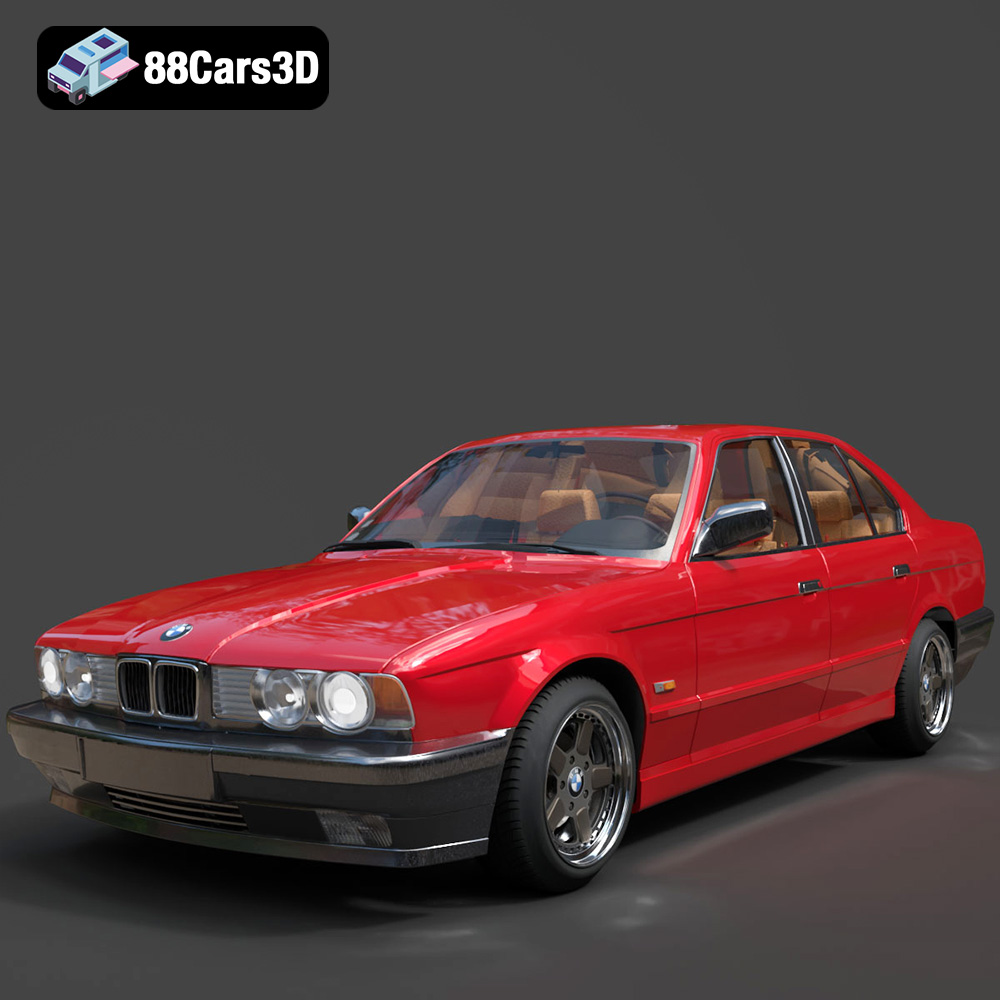
In the expansive realm of 3D visualization and digital content creation, the allure of expertly crafted automotive models remains timeless. Whether it’s for an architectural visualization project, a high-fidelity driving simulator, an immersive AR/VR experience, or a visually stunning game, the demand for high-quality 3D car models is constant. A truly exceptional model transcends mere aesthetics; it embodies technical precision, historical accuracy, and versatility across diverse professional pipelines. Today, we’ll delve into the intricacies of integrating such assets into demanding workflows, spotlighting a prime example of digital craftsmanship: the BMW 525i E34 1993 3D Model.
This iconic German executive sedan, celebrated for its blend of performance and understated elegance, offers a fantastic case study for understanding the multi-faceted demands placed on modern 3D assets. A model like the BMW 525i E34 1993 3D Model isn’t just a static object; it’s a dynamic tool engineered for photorealistic rendering, real-time interactivity, and even physical prototyping. Its ability to serve as a cornerstone for close-up renders, detailed automotive visualizations, and interactive experiences speaks volumes about its underlying quality and the thoughtful approach taken during its creation. Let’s explore the ecosystem of 3D automotive design and discover how a meticulously detailed asset elevates any project.
Classic cars hold a special place in the hearts of enthusiasts, designers, and historians alike. Digitally preserving these vehicles allows for their appreciation and integration into new contexts that were unimaginable in their original era. A well-executed 3D model of a classic, like the BMW 525i E34 1993, offers more than just visual appeal; it provides a portal to a bygone era of design and engineering.
Recreating a classic vehicle in 3D demands an obsessive attention to detail. Every curve, every panel gap, every emblem must be meticulously researched and modeled to reflect the true proportions and curvature of the original. For the BMW 525i E34 1993 3D Model, this means capturing the characteristic Hofmeister kink, the precise lines of its kidney grille, and the intricate details of its interior. This commitment to accuracy ensures that the digital representation resonates with the authenticity of the physical car, making it suitable for historical archives, museum exhibits, or educational content.
While nostalgia is a powerful driver, the practical applications of classic 3D car models are extensive. They are invaluable for comparison studies in modern automotive design, allowing engineers and designers to reference historical solutions and aesthetic principles. Furthermore, they are frequently used in period-specific film and television productions, historical simulations, and even as central pieces in virtual reality showrooms or interactive exhibits where physical access to the original vehicle might be limited or costly. The versatility of such a model extends its utility far beyond simple rendering, making it a truly valuable asset.
The choice of file format for a 3D model is often as crucial as the model’s quality itself, dictating its compatibility, performance, and the scope of its use across different software and platforms. High-quality 3D car models, such as those found on 88cars3d.com, typically come with a range of formats to ensure maximum flexibility for professional users. Understanding these formats is essential for efficient workflow integration.
The .blend format is the native file type for Blender, an incredibly powerful and popular open-source 3D creation suite. A .blend file like that included with the BMW 525i E34 1993 3D Model often contains not just the mesh data, but also materials, textures, lighting setups, camera positions, and even animation data. This makes it ideal for users working natively in Blender, allowing for immediate access to a pre-configured scene that can be quickly rendered or further customized. Technical details can include node-based material graphs (using Principled BSDF shader), complex scene hierarchies, and modifiers, offering full editability. Similarly, .max is the native format for Autodesk 3ds Max, a long-standing industry standard, particularly in architectural visualization and high-end rendering. A .max file provides an editable 3ds Max project, encompassing all aspects of the scene for animation, rigging, and advanced rendering with engines like V-Ray or Corona. For professionals deeply embedded in either Blender or 3ds Max pipelines, these native formats offer the most control and the richest scene data.
.fbx (Filmbox) is a proprietary file format developed by Autodesk, widely regarded as the industry standard for 3D data exchange, especially between different 3D software and game engines. It supports geometry, materials, textures, animations, and rigs, making it incredibly robust. For assets like the BMW 525i E34 1993, an .fbx file is ideal for exporting to Unreal Engine, Unity, or other real-time pipelines due to its comprehensive data encapsulation and efficient handling of complex scenes. It maintains scene hierarchy and often material assignments, simplifying the import process. .obj (Wavefront OBJ) is perhaps the most universal 3D file format. While older and simpler than .fbx, it remains a common choice due to its excellent cross-software compatibility. It primarily stores geometry (vertices, normals, texture coordinates, faces) and can reference external .mtl (material) files for basic material properties. It’s often used as a fallback or for simple mesh exchange when advanced features like animation are not required. Finally, .glb (GL Transmission Format Binary) is an increasingly important format, optimized for AR, VR, and browser-based display. It’s a binary version of glTF, designed for efficient transmission and loading of 3D scenes and models. .glb files are compact and self-contained, including textures and animations, making them perfect for web platforms and mobile AR applications where quick loading times and broad compatibility are paramount.
For more specialized applications, other formats become crucial. .stl (Stereolithography) is almost exclusively used for 3D printing and rapid prototyping. It defines only the surface geometry of a 3D object using a collection of triangular facets, without color, texture, or other CAD attributes. While simple, its ubiquity in the 3D printing world makes it indispensable for physical output. A detailed model like the BMW 525i E34 1993 in .stl format allows for the creation of physical scale models. .ply (Polygon File Format) is another precision mesh format, often used in scientific, CAD, or analysis contexts. It can store various properties beyond just geometry, such as color, transparency, normals, and even confidence values per vertex or face. This makes it suitable for scanned data or highly detailed models where specific attributes beyond visual appearance are important. Lastly, the .unreal format refers to engine-ready assets specifically packaged or pre-configured for use within Unreal Engine. This could involve an asset pack containing meshes, materials, textures, blueprints, and LODs, all set up to meet Unreal Engine’s performance and PBR (Physically Based Rendering) standards. This ‘out-of-the-box’ readiness significantly accelerates development for game studios and real-time visualization specialists.
Achieving photorealism in automotive rendering is a highly sought-after skill, essential for marketing, design reviews, and compelling visualizations. A high-quality 3D model forms the bedrock, but the rendering pipeline involves several critical steps to bring it to life, especially when working with assets like the BMW 525i E34 1993 3D Model.
Modern photorealistic rendering relies heavily on Physically Based Rendering (PBR) workflows. This means materials are defined using parameters that mimic real-world light interactions, such as albedo (base color), roughness, metallic, normal maps, and ambient occlusion. For the BMW 525i E34 1993, this translates to accurately portraying the gloss of its paint, the subtle reflections on its chrome trim, the texture of its interior leather, and the intricate patterns of its tire treads. Clean UV mapping is crucial here, ensuring textures are applied without distortion and resolution is maximized where needed for close-up shots.
Lighting is arguably the most critical element after the model itself. Automotive rendering often employs studio lighting setups, which utilize a combination of area lights, HDRI (High Dynamic Range Image) environment maps, and spotlights to sculpt the form of the vehicle and highlight its contours. A typical setup might involve a large softbox for general illumination, smaller lights to emphasize body lines, and an HDRI for realistic reflections and ambient light. Matching real-world lighting conditions or creating artistic moods through sophisticated lighting schemes is paramount to achieving a believable final image for any 3D car model.
Even the best raw render can be significantly improved with post-production. This phase involves color grading, adjusting contrast, adding depth of field, motion blur (if animated), lens flares, and subtle atmospheric effects. Tools like Adobe Photoshop or Blackmagic Fusion are commonly used to refine the image, correct imperfections, and add that final layer of polish that elevates a render from good to breathtaking. This stage ensures that the BMW 525i E34 1993 looks its absolute best, whether it’s a static image or part of an animated sequence.
The rise of real-time engines like Unreal Engine and Unity has revolutionized how 3D assets are utilized, pushing the boundaries of interactive experiences. For game developers and AR/VR creators, integrating 3D car models presents a unique set of challenges and opportunities, particularly with detailed assets like the BMW 525i E34 1993 3D Model.
Unlike offline rendering, real-time environments demand strict performance considerations. High-fidelity models, while stunning, can be computationally intensive. This is where Level of Detail (LOD) systems become essential. An asset like the BMW 525i E34 1993 would ideally come with multiple LODs – high-polygon for close-ups, medium-polygon for mid-range, and low-polygon for distant views. This allows the engine to dynamically swap models based on their distance from the camera, significantly optimizing rendering performance without sacrificing visual quality where it matters most. Furthermore, efficient topology and polygon count management are critical for maintaining smooth frame rates in demanding game engines. The product description highlights “optimized, clean geometry built for performance across various platforms,” which is a crucial attribute for real-time applications.
Integrating 3D car models into Unreal Engine or Unity involves more than just importing an FBX file. It requires setting up materials with PBR shaders, creating collision meshes for accurate physics interactions, and sometimes even custom blueprints or scripts for car controls, door animations, or interactive elements. The included .fbx and .unreal formats for the BMW 525i E34 1993 3D Model are specifically tailored for this. An .fbx is a versatile starting point, while a pre-configured .unreal asset can save hours of setup time, providing a fully textured, material-defined, and potentially even blueprint-ready car that can be dropped directly into a scene. This readiness significantly accelerates development cycles for those focused on creating immersive game assets.
Augmented Reality (AR) and Virtual Reality (VR) represent powerful new frontiers for automotive visualization. Imagine walking around the BMW 525i E34 1993 in your living room via AR, or exploring its detailed interior in a fully immersive VR experience. The .glb format, included with this model, is specifically optimized for these applications, offering a compact, efficient, and self-contained package for web and mobile AR/VR platforms. These technologies allow for unprecedented levels of interactivity and engagement, enabling virtual test drives, configuration experiences, and historical exploration in ways that traditional media cannot match.
In a fast-paced professional environment, time is a precious commodity. Creating a highly detailed 3D car model from scratch can take hundreds, if not thousands, of hours of skilled labor. This is where marketplaces like 88cars3d.com provide immense value, offering readily available, high-quality 3D models that meet professional standards.
For studios and freelancers, purchasing a pre-made asset like the BMW 525i E34 1993 3D Model means immediately bypassing the modeling, UV unwrapping, and initial texturing phases. This allows artists to focus on creative aspects like scene composition, lighting, animation, and post-production, significantly cutting down project timelines and costs. The “ready for immediate deployment” aspect of such models makes them indispensable tools for meeting tight deadlines and delivering polished results efficiently.
The quality of a 3D model directly impacts the final output. Low-quality models can lead to rendering artifacts, poor performance in real-time engines, and an overall unprofessional appearance. Assets acquired from reputable sources like 88cars3d.com are built with professional standards in mind, featuring clean geometry, optimized meshes, accurate proportions, and realistic material definitions. The BMW 525i E34 1993 3D Model, with its detailed interior and photorealistic results straight out of the box, exemplifies this commitment to excellence, ensuring consistency and a high level of detail across all applications.
The world of 3D automotive modeling is a dynamic and technically demanding field, constantly evolving with new tools and applications. From classic car enthusiasts seeking historical accuracy to game developers crafting immersive virtual worlds, the need for high-quality, versatile 3D car models is universal. The BMW 525i E34 1993 3D Model stands as an excellent example of an asset that meets these diverse professional requirements.
Its meticulously modeled surfaces, detailed interior, realistic material definitions, and availability in a wide array of formats — from native .blend and .max files to game-engine ready .fbx and .unreal, and AR/VR optimized .glb — ensure it’s a valuable tool for any project. Whether your goal is a stunning photorealistic render, integration into an interactive simulation, or a physical 3D print, this model provides the foundation for success. For professionals seeking reliable, production-ready 3D car models that streamline workflows and deliver exceptional results, exploring the curated selection at 88cars3d.com is a highly recommended step towards achieving your creative and technical aspirations.
Bring the iconic German executive sedan to your projects with the highly accurate BMW 525i E34 1993 3D Model. This model captures the precision and styling of the celebrated E34 generation, suitable for close-up renders, detailed automotive visualizations, and interactive experiences.
The asset features optimized, clean geometry built for performance across various platforms. Surfaces are meticulously modeled to reflect the true proportions and curvature of the original vehicle. It includes a detailed interior and realistic material definitions, ensuring photorealistic results straight out of the box.
This versatile 3D asset is ready for immediate deployment in various professional applications, including advanced visualization, architectural rendering integration, immersive AR/VR experiences, high-fidelity driving simulations, and modern game development environments (Unity, Unreal Engine).
$12.99
.525i
.arvr
.blend
.bmw
.car3dmodel
.classiccar
.e34
.fbx
.gameasset
.glb
.max
.obj
.ply
.rendering
.sedan
.simulation
.stl
.unreal