Get 20% OFF All Premium 3D & STL Models!

In the rapidly evolving landscape of digital content creation, the demand for exceptionally detailed and versatile 3D assets has never been higher. From blockbuster films and immersive video games to cutting-edge automotive design visualization and interactive AR/VR experiences, high-quality 3D car models are the backbone of photorealistic scenes and engaging real-time environments. These digital replicas are more than just pretty pictures; they are complex constructs of geometry, materials, and textures, meticulously crafted to serve a multitude of professional applications.
The journey from a designer’s concept to a fully realized digital vehicle involves a deep understanding of 3D software, rendering techniques, and optimization strategies. Professionals across industries seek assets that not only look stunning but are also technically sound, ensuring seamless integration into diverse pipelines. This quest for perfection is what drives marketplaces like 88cars3d.com, which specializes in offering premium 3D car models that meet rigorous industry standards.
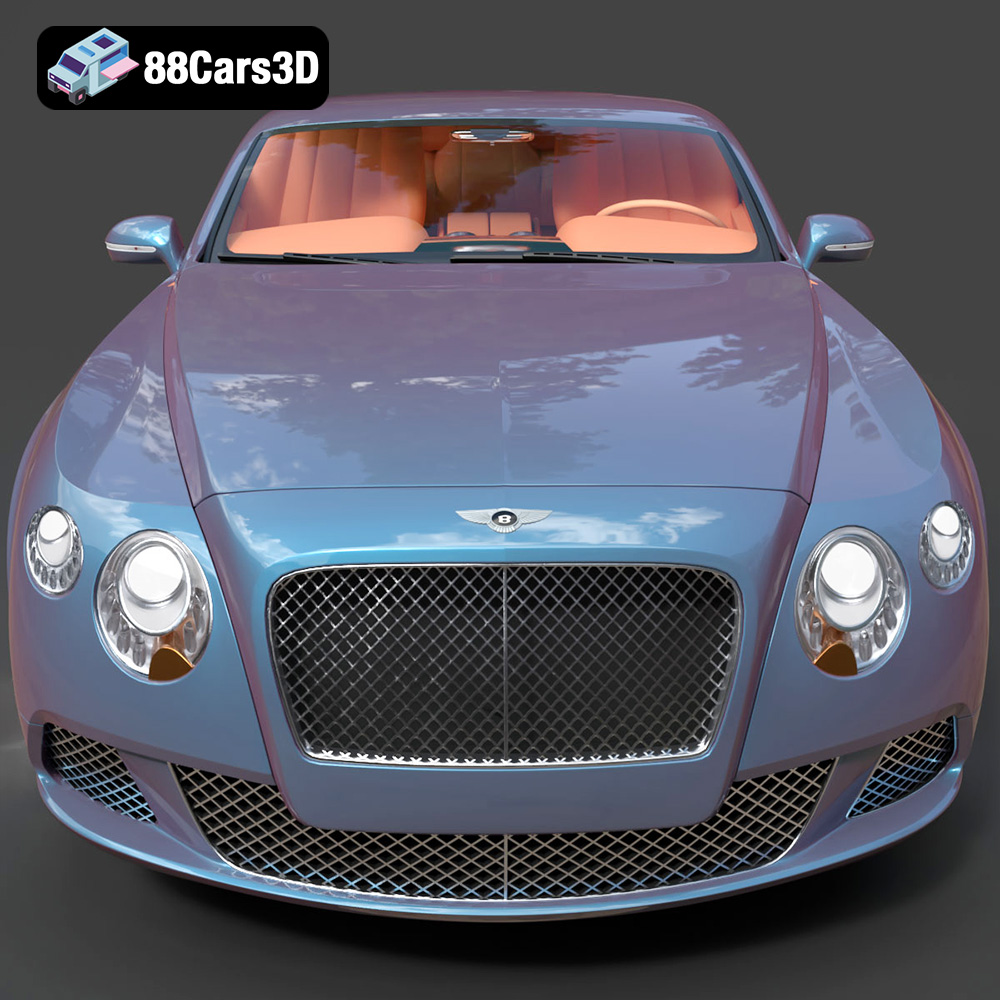
Today, we’re taking a deep dive into the technical intricacies and creative possibilities unlocked by such assets, using the magnificent Bentley Continental GT 2011 3D model as our prime example. This particular model stands out for its meticulous detailing, clean geometry, and comprehensive file format support, making it an ideal choice for anyone looking to elevate their automotive rendering or integrate a high-fidelity vehicle into a game or simulation.
The success of any 3D project often hinges on choosing the right file format for your assets. A high-quality 3D car model, such as the Bentley Continental GT 2011, comes equipped with a variety of formats, each serving distinct purposes and optimized for different software and applications. Understanding these formats is crucial for efficient workflow and ensuring compatibility across your pipeline. Let’s explore the most common and critical file types you’ll encounter.
The .blend format is native to Blender, a powerful and increasingly popular open-source 3D creation suite. When you acquire a .blend file for a model like the Bentley Continental GT 2011, you’re not just getting the geometry; you’re receiving a complete, editable scene. This includes the model’s mesh, its materials (often configured with PBR – Physically Based Rendering principles), textures, lighting setups, cameras, and even animation data if present. Artists who work primarily in Blender will find this format invaluable as it allows for full customization, modification, and re-rendering directly within their preferred environment without any loss of data or conversion artifacts. It’s excellent for detailed rendering projects, scene assembly, and further asset development.
.fbx (Filmbox) is an industry-standard proprietary file format developed by Autodesk, widely used for exchanging 3D data between various applications, especially in game development. Its strength lies in its ability to store not only geometry but also animation, rigging, materials, and texture references in a single file. This makes it the go-to format for importing 3D car models into game engines like Unreal Engine and Unity. For a model like the Bentley Continental GT 2011, an .fbx file ensures that the optimized mesh, UV maps, and basic material assignments translate effectively, ready for advanced shader setup within the engine. It’s crucial for real-time applications where performance and accurate data transfer are paramount.
The .obj (Wavefront OBJ) format is one of the oldest and most universal 3D file formats, making it incredibly versatile for cross-software compatibility. It primarily stores geometry (vertices, normals, texture coordinates, and faces) and can reference external .mtl (material) files for basic material properties. While .obj doesn’t store animation or advanced material setups like PBR shaders, its simplicity ensures that almost any 3D software can open and interpret it. It’s an excellent choice for general purpose importing, especially if you need to bring the Bentley Continental GT 2011 into a lesser-known application or if you plan to rebuild materials from scratch in your target software.
.glb (GL Transmission Format Binary) is an increasingly important format, especially in the realm of AR/VR and web-based 3D. It’s a binary version of glTF, designed to be a compact, efficient, and runtime-deliverable asset. A .glb file embeds all necessary data—geometry, materials, textures, animations—into a single file, making it incredibly easy to share and load directly into web browsers or AR/VR applications. For showcasing the Bentley Continental GT 2011 in an interactive web viewer or an augmented reality experience on a mobile device, .glb is the optimal choice due to its optimization for quick loading and rendering.
.stl (Stereolithography) is the standard file format for 3D printing. Unlike other formats that store complex polygonal data, .stl represents a 3D object as a collection of unconnected triangular facets that approximate its surface geometry. It contains no color, texture, or material information, focusing solely on the object’s shape for physical fabrication. If your project involves creating a physical prototype or a miniature model of the Bentley Continental GT 2011 through 3D printing, the .stl file is what you’ll use to send to your printer’s slicing software.
The .ply (Polygon File Format or Stanford Triangle Format) is another format that stores 3D data, often used for scanned data, CAD, and scientific applications where precision and detailed mesh information are crucial. It can store a variety of properties including color, transparency, and normals per vertex or face, which can be useful for analysis or specialized rendering. While less common for general-purpose rendering than .fbx or .obj, a .ply file for the Bentley Continental GT 2011 could be valuable for engineers or designers performing geometric analysis or intricate modifications.
The .unreal format, or rather assets specifically packaged and configured for Unreal Engine, signifies an asset that has been pre-processed and optimized for direct use within the Unreal ecosystem. This isn’t a standalone file format in the same way .fbx or .obj are, but rather a collection of files and configurations within an Unreal project. When an asset like the Bentley Continental GT 2011 is provided as “.unreal,” it implies that it’s already set up with proper materials (often PBR), collision meshes, LODs (Levels of Detail), and potentially even basic blueprints, significantly reducing the setup time for game developers and real-time visualization artists. It offers a true plug-and-play experience for Unreal Engine users.
Similar to .blend for Blender, the .max format is native to Autodesk 3ds Max, a stalwart in the 3D industry, especially in architectural visualization and high-end rendering. A .max file contains the complete scene data, including geometry, materials, lighting, cameras, animation, and scene organization. For professionals who utilize 3ds Max for their rendering pipelines, having the Bentley Continental GT 2011 available in this format means complete control over every aspect of the model, enabling advanced V-Ray or Corona renders, complex animations, and seamless integration into existing 3ds Max projects.
By offering a comprehensive array of these formats, the Bentley Continental GT 2011 3D model ensures maximum flexibility and utility, catering to a broad spectrum of professional workflows across different software and end-uses. This thoughtful approach to asset distribution is a hallmark of quality assets found on platforms like 88cars3d.com.
Automotive rendering is a specialized field within 3D visualization, where the pursuit of photorealism reaches its zenith. To truly capture the essence of a luxury grand tourer like the Bentley Continental GT 2011, every minute detail, from the reflectivity of its paint to the subtle texture of its interior leather, must be meticulously recreated. This process involves a blend of artistic vision and technical mastery.
At the heart of photorealistic rendering lies the accurate representation of materials. Modern rendering workflows heavily rely on Physically Based Rendering (PBR), which simulates how light interacts with surfaces in the real world. For a car model, this means crafting PBR materials for paint (clear coat, metallic flake), glass (transparency, refraction), chrome (high reflectivity, specularity), rubber (slight roughness, dark diffuse), and various interior components like leather, wood, and metal accents. The Bentley Continental GT 2011 3D model, for instance, boasts materials set up for photorealistic results, accurately replicating these complex surface properties. This involves creating or sourcing high-resolution textures for diffuse color, normal maps (for fine details like stitching), roughness, metallic, and ambient occlusion maps. A well-prepared asset will have clean UV mapping to ensure these textures apply flawlessly without stretching or distortion.
Even the most perfectly modeled and textured car will look flat without compelling lighting. Lighting is crucial for defining form, emphasizing contours, and creating atmosphere. In automotive rendering, High Dynamic Range Images (HDRIs) are often used to simulate real-world lighting environments, providing accurate reflections and ambient illumination. Coupled with sophisticated ray tracing algorithms in render engines like V-Ray, Corona Renderer, Octane, or Cycles (in Blender), these environments produce incredibly realistic shadows, global illumination, and reflections. Positioning virtual studio lights, softboxes, or simulating natural sunlight all contribute to highlighting the Bentley Continental GT’s luxurious curves and sophisticated design. The included .blend and .max files of the Bentley model would likely offer lighting setups that serve as excellent starting points for further artistic exploration.
While rendering engines produce highly realistic images, the final polish often comes in post-production. Techniques such as color grading, depth of field adjustments, lens flares, motion blur, and subtle atmospheric effects can significantly enhance the visual impact of an automotive render. Compositing the car into a real-world backplate or a synthetic environment further anchors it in reality. These steps are vital for elevating a render from merely accurate to truly breathtaking, making the digital Bentley Continental GT 2011 indistinguishable from its real-life counterpart.
Game development presents a unique set of challenges and opportunities for 3D car models. Unlike static renders, game assets must perform optimally in real-time, often under demanding conditions. The Bentley Continental GT 2011 3D model, with its optimized geometry and game-engine-ready formats like .fbx and .unreal, exemplifies a well-prepared asset for this demanding environment.
Performance is paramount in game development. High-poly models, while great for offline rendering, can cripple frame rates in real-time engines. Game-ready 3D car models, therefore, undergo rigorous optimization. This involves intelligent polygon reduction while retaining crucial visual details, often utilizing normal maps to project high-detail information onto lower-poly meshes. Developers also employ Levels of Detail (LODs), where simpler versions of the model are rendered at greater distances, seamlessly swapping between them to conserve resources. Clean, optimized geometry, a key feature of the Bentley Continental GT 2011 model, ensures that it can be integrated into demanding real-time applications without causing performance bottlenecks.
For a car to be interactive in a game, it needs accurate collision models and robust physics properties. Collision meshes, often simplified representations of the visual mesh, dictate how the car interacts with the game world and other objects. Physics assets, defining parameters like mass, friction, and suspension, govern how the car drives, crashes, and reacts to forces. When using a pre-configured .unreal asset, many of these settings are often already established, saving developers significant setup time. The Bentley Continental GT 2011 can be rigged with realistic physics to ensure its digital counterpart handles with the grace and power of the actual luxury vehicle.
A static car model comes to life with animation. This includes basic elements like rotating wheels, opening doors, working headlights, and dynamic suspension. More complex implementations might involve damage models, animated interiors, or driver animations. Proper rigging (creating a skeleton of bones to control the mesh) is essential for these animations. For high-end game development, the .fbx format is particularly useful as it carries animation data, allowing developers to import pre-animated components or easily rig the Bentley Continental GT 2011 for interactive sequences within their game engines.
The utility of high-quality 3D car models extends far beyond traditional rendering and game development. With advancements in augmented reality (AR), virtual reality (VR), and simulation technologies, these assets are becoming indispensable tools for a wide array of innovative applications.
Augmented Reality and Virtual Reality offer unparalleled opportunities for immersive experiences. Imagine placing the Bentley Continental GT 2011 in your driveway via an AR app on your phone, or exploring its luxurious interior in a full VR simulation. These applications demand highly optimized 3D models that can render smoothly on diverse hardware, from mobile devices to high-end VR headsets. The .glb format, included with the Bentley model, is specifically tailored for these environments due to its compact size and efficient loading. This allows users to interact with and visualize the car in new, engaging ways, offering everything from virtual showrooms to interactive product tours.
Precision and realism are paramount in professional driving simulations and training environments. Whether it’s for driver education, motorsport training, or engineering analysis, highly accurate 3D car models are essential. The Bentley Continental GT 2011 3D model, engineered for accurate visualization, provides the fidelity required for such applications. Its detailed digital representation can be integrated into simulation platforms to provide realistic visual feedback, complementing complex physics engines. This allows for virtual testing, scenario training, and performance analysis, providing invaluable insights without the need for physical prototypes or real-world risks.
The digital realm often intersects with the physical through 3D printing. While not every aspect of a rendering-focused model is suitable for 3D printing (e.g., extremely thin details or non-manifold geometry), assets like the Bentley Continental GT 2011 that include an .stl file are prepared for this transition. Engineers and designers can leverage these files to create physical prototypes, scale models, or even custom parts. This capability is crucial for early-stage design reviews, physical mock-ups, or simply creating tangible representations of digital assets, bridging the gap between virtual design and physical realization.
In a fast-paced creative industry, efficiency is as valuable as artistic talent. Professional 3D artists, game developers, and visualization specialists constantly seek ways to streamline their workflows without compromising on quality. This is where pre-made, high-quality 3D car models from trusted sources prove invaluable.
Creating a highly detailed 3D car model from scratch is an incredibly time-consuming and expensive endeavor. It requires specialized skills in modeling, UV unwrapping, texturing, and material setup, often taking weeks or even months for a single vehicle. For studios with tight deadlines and budgets, purchasing a ready-to-use asset like the Bentley Continental GT 2011 3D model from 88cars3d.com offers a significant advantage. The cost savings in artist hours alone can be substantial, allowing teams to allocate resources to other critical aspects of their projects. This efficiency doesn’t just apply to large studios; individual freelancers and small teams also benefit immensely by instantly accessing top-tier assets.
The quality of a 3D asset directly impacts the final output. Professional 3D car models are typically created by experienced artists who adhere to industry best practices. This includes maintaining clean, optimized geometry, ensuring proper UV mapping for texture application, and setting up PBR-ready materials. Furthermore, providing assets in multiple widely-used formats—as seen with the Bentley Continental GT 2011 model, which includes .blend, .fbx, .obj, .glb, .stl, .ply, .unreal, and .max—guarantees compatibility across various software and pipelines. This eliminates the headaches of format conversion issues, missing textures, or problematic geometry that often plague lower-quality, unverified assets.
While pre-made assets offer a head start, the ability to customize them is often crucial for specific project needs. High-quality models are typically structured in a way that facilitates easy modification. The Bentley Continental GT 2011 3D model, for example, is described as having a well-organized structure, making it easy to integrate and modify. This means artists can tweak materials, adjust specific components, create custom animations, or even re-mesh parts without having to start from zero. Having editable files like .blend and .max provides the ultimate flexibility, allowing artists to delve deep into the asset and tailor it precisely to their creative vision, from changing paint colors to adding custom accessories.
The world of 3D modeling and visualization is continuously evolving, driven by an insatiable demand for realism and immersion. High-quality 3D car models are more than just digital representations; they are fundamental building blocks for incredible creative projects across industries. From the meticulous crafting of photorealistic automotive renders to the rigorous demands of real-time game engines, and the cutting-edge frontiers of AR/VR and simulation, the right 3D asset can profoundly impact a project’s quality and efficiency.
The Bentley Continental GT 2011 3D model stands as a testament to what professional-grade assets can offer: meticulous detail, optimized geometry, versatile file format support, and materials configured for stunning visual fidelity. Such assets empower artists and developers to bring their visions to life with unparalleled precision and speed. By understanding the technical nuances of different file formats, embracing modern rendering techniques, and leveraging expertly crafted assets, professionals can unlock new levels of creativity and deliver exceptional results.
For those seeking to elevate their digital automotive projects, exploring the carefully curated selection of 3D car models available on platforms like 88cars3d.com is an essential step. Investing in well-prepared, multi-format assets like the Bentley Continental GT 2011 3D model ensures that your creative journey is built on a foundation of quality, compatibility, and efficiency, allowing you to focus on the art of storytelling and design.
Presenting the Bentley Continental GT 2011 3D model, engineered for accurate visualization. This asset captures the essence of the luxury grand tourer, offering a meticulously detailed digital representation ready for professional pipelines and detailed rendering. The model features clean, optimized geometry suitable for close-up renders and demanding real-time applications. Materials are set up for photorealistic results, accurately replicating the sleek exterior finish and luxurious interior components of the Continental GT. Every effort was made to ensure the structure is well-organized, facilitating easy integration and modification within your existing projects. Versatile for various industry needs, this asset is ideal for automotive visualization, architecture visualization (ArchViz), simulation training, interactive augmented reality (AR) and virtual reality (VR) experiences, and high-fidelity game development projects.
$14.99