Get 20% OFF All Premium 3D & STL Models!

In the vast and intricate world of 3D design, the ability to seamlessly integrate high-quality, authentic models into diverse projects is paramount. From breathtaking automotive visualizations to immersive game environments and precise engineering simulations, the foundation of any successful venture often lies in the fidelity and technical excellence of its core assets. Classic cars, with their timeless appeal and intricate designs, present a unique challenge and opportunity for 3D artists and developers. They embody not just a mode of transport, but a piece of history, an icon of design, and a cultural touchstone. Among these legends, the BMW 3 Series E21 stands out as a pioneering marvel, representing the genesis of a lineage that would define the compact executive segment for decades.
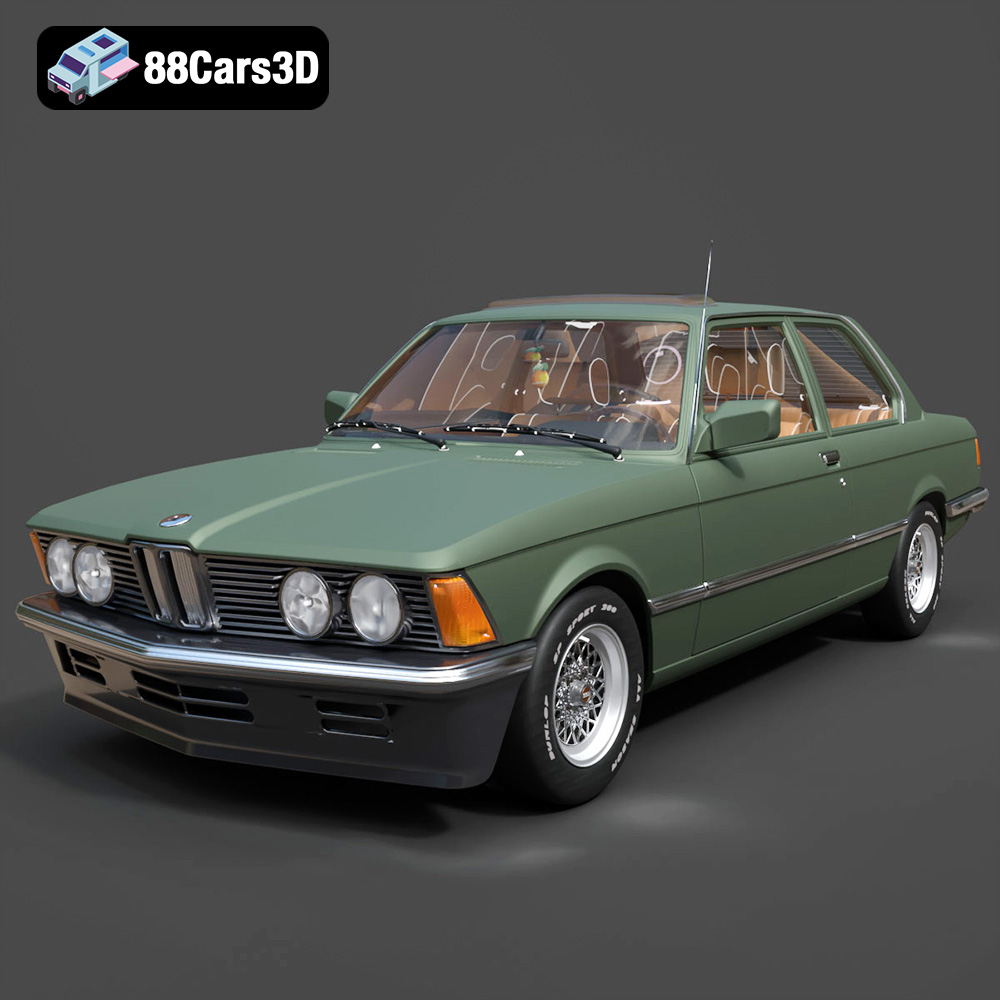
For professionals seeking to infuse their projects with a touch of classic German engineering, a meticulously crafted 3D model of this iconic vehicle is an invaluable asset. The BMW 3 Series E21 3D Model available on 88cars3d.com is a testament to precision and passion, designed not merely as a digital replica but as a versatile tool engineered for peak performance across a spectrum of applications. This model offers an exceptional blend of authentic aesthetics and robust technical specifications, ensuring it can drive the visual integrity and functional demands of any project, from photorealistic renders to real-time interactive experiences.
The allure of vintage automobiles extends far beyond their mechanical prowess; it lies in their unique design language, the curves, the stance, and the story they tell. Digitally preserving these automotive icons allows us to re-experience and reinterpret them in new and exciting ways. The BMW 3 Series E21, with its distinctive shark nose, elegant lines, and driver-focused cockpit, is a prime candidate for such digital resurrection. Crafting a 3D model that genuinely captures its essence requires an understanding of both artistic interpretation and technical accuracy.
The BMW 3 Series E21 3D Model is a faithful reproduction that goes beyond mere visual resemblance. It meticulously replicates the E21’s timeless bodywork, including its signature kidney grille and dual headlights, which are instantly recognizable. Crucially, the model boasts accurate panel gaps and surface curvatures, reflecting the vehicle’s original design integrity. This attention to detail ensures that light interacts with the surfaces precisely as it would on a physical car, leading to highly realistic reflections and shadows in renders. Furthermore, the model is built to real-world scale, a critical technical advantage that guarantees accurate integration into diverse scenes, whether for architectural visualization, urban planning, or film production.
A truly comprehensive 3D car model doesn’t stop at the exterior. The interior and underlying mechanical components play a vital role in creating an immersive experience, especially for simulations and interactive projects. The E21 model features detailed interior elements, including the dashboard, steering wheel, seats, and door panels, all crafted for visual authenticity. Replicated controls and gauges within the cockpit enhance the sense of realism, crucial for driving simulators or virtual showrooms. While optimized for efficient mesh quality, underlying mechanical components such as basic suspension and brake caliper forms are also present. This balance of detail ensures that the model is both visually convincing and performant, avoiding unnecessary polygon counts where they wouldn’t be seen but providing enough geometry for accurate rigging and basic mechanical animations.
Choosing the correct file format is a foundational decision in any 3D project, directly impacting compatibility, workflow efficiency, and the final quality of the output. A high-quality 3D asset, such as the BMW 3 Series E21 model, often comes packaged in multiple formats to cater to various software environments and specific use cases. Understanding these formats is crucial for any professional working with 3D car models.
The .blend format is native to Blender, a powerful open-source 3D creation suite widely adopted by artists and studios. When you acquire a .blend file, you’re not just getting the raw geometry; you’re typically receiving a fully editable Blender scene complete with materials, textures, lighting, and often animation setups. This format is ideal for artists who primarily work within Blender, offering the highest level of editability and direct access to all scene properties without any conversion artifacts. For the BMW E21, a .blend file means immediate access to its organized hierarchy, clean quad-dominant topology, and ready-to-render PBR materials, allowing for swift customization and scene integration directly within Blender.
.fbx (Filmbox) is an industry-standard proprietary file format developed by Autodesk, serving as a robust exchange format between various 3D applications, game engines, and animation software. It supports not only geometry but also materials, textures, animation, cameras, and lights, making it ideal for complex scene transfers. Its widespread compatibility makes it a go-to for pipelines involving Unreal Engine, Unity, 3ds Max, Maya, and Cinema 4D. For a 3D car model like the E21, an .fbx file ensures that all separated components (doors, hood, wheels) and their pivot points are preserved, facilitating dynamic animation workflows in any compatible software. On the other hand, .obj (Wavefront OBJ) is a more universal but simpler format. It primarily stores geometry (vertices, normals, texture coordinates, and faces) and can link to an external .mtl (material) file for basic material properties. While it doesn’t support animation or rigging, its near-universal compatibility makes it an excellent fallback for cross-software integration where only the mesh data is required. It’s often used for static renders or as a base for re-texturing in a new environment.
.glb (GL Transmission Format Binary) is the binary version of glTF, specifically optimized for web-based 3D, AR (Augmented Reality), and VR (Virtual Reality) applications. It bundles all necessary data (geometry, materials, textures, animations) into a single file, making it incredibly efficient for streaming and displaying 3D content in browsers or mobile applications. Its compact size and PBR material support make it perfect for showcasing the BMW E21 in an interactive web viewer or an AR experience. The .unreal format refers to Unreal Engine project files or assets specifically configured for the engine. An engine-ready asset in this format typically means the model has been imported, materials set up, collision meshes generated, and potentially even blueprint functionality added, making it a plug-and-play solution for real-time environments. For game developers, this significantly accelerates the integration of the E21 into a racing game or open-world scenario.
.stl (Stereolithography) is almost exclusively used for 3D printing. It represents the surface geometry of a 3D object using a collection of triangular facets. Crucially, for 3D printing, the model must be “watertight” – meaning it has no holes or gaps in its surface. The E21 model’s geometry is designed to be watertight, making it readily convertible to .stl for producing physical scale models. .ply (Polygon File Format) is a precision mesh format capable of storing a wide range of properties, including color, transparency, and surface normals, alongside geometry. It’s often used in scientific and engineering applications, such as CAD (Computer-Aided Design), 3D scanning, and analysis, where highly detailed and accurate mesh data is required. Finally, .max is the native file format for Autodesk 3ds Max. Similar to .blend, it provides a fully editable 3ds Max project scene, complete with materials, lighting, cameras, and potentially animation. This format is invaluable for professionals whose primary workflow is within 3ds Max, offering seamless integration and full control over all aspects of the scene for advanced rendering and animation tasks.
Automotive rendering is an art form that combines technical prowess with a keen eye for aesthetics. It’s about more than just making a car look good; it’s about crafting a narrative, evoking emotion, and showcasing design intent. The BMW 3 Series E21 3D Model provides an excellent foundation for achieving stunning visual results, whether for marketing, concept art, or cinematic sequences.
High-quality rendering hinges on realistic lighting and meticulously crafted materials. The E21 model comes with materials ready for customization, enabling artists to fine-tune every surface. Utilizing Physically Based Rendering (PBR) workflows, designers can adjust paint finishes for metallic flake, pearl, or matte effects, tweak chrome reflections, and perfect the subtle sheen of rubber and plastics. Experimenting with studio lighting setups—such as multi-point lights, softboxes, or HDRIs (High Dynamic Range Images)—can dramatically alter the mood and highlight the E21’s elegant lines. The transparent materials applied to windows, headlights, and taillights are crucial for realistic light interaction, allowing light to refract and reflect accurately, creating believable glass and lens effects.
Beyond static images, the E21 model is designed for dynamic animation. Its organized hierarchy with proper pivot points for doors, hood, trunk, and wheels makes rigging and animating straightforward. This capability allows for creating cinematic sequences, such as a classic E21 cruising down a scenic road, doors opening for a reveal, or intricate camera movements highlighting design details. Furthermore, the model’s real-world scale and authentic appearance make it perfect for architectural visualizations. Placing the BMW 3 Series E21 in front of a modern building or within a historical streetscape instantly adds context, scale, and a touch of nostalgic elegance, bringing the entire scene to life. This versatility underscores the value of investing in high-fidelity 3D car models from trusted sources like 88cars3d.com.
The demand for immersive, real-time experiences is constantly growing, from hyper-realistic racing games to interactive virtual showrooms and augmented reality applications. Integrating high-quality automotive assets into these dynamic environments requires models that are not only visually appealing but also highly optimized for performance.
Game development often involves balancing visual quality with performance budgets. The BMW 3 Series E21 3D Model is built with clean, quad-dominant topology and a balanced level of detail, making it an ideal candidate for real-time engines like Unreal Engine and Unity. Its clean geometry ensures efficient mesh rendering, and the logical separation of components allows for easy integration into an existing vehicle framework. Developers can readily generate LODs (Levels of Detail) from the base mesh to optimize rendering for different distances, ensuring smooth performance without sacrificing visual fidelity up close. Collision meshes can be quickly created, and materials can be adapted to the engine’s specific PBR workflow, often leveraging the provided .fbx or .unreal formats for seamless import and setup. This production-ready nature significantly reduces development time and resources, allowing teams to focus on gameplay and overall experience.
Augmented Reality (AR) and Virtual Reality (VR) applications demand extremely efficient 3D assets due to their stringent performance requirements. The E21 model’s optimized geometry and the availability of the .glb format make it perfectly suited for AR/VR integration. In AR, you could place a virtual E21 in your driveway, examining its details as if it were physically there. In VR, it could be the center piece of a virtual classic car museum or a drivable asset in a simulated environment. The .glb format, with its single-file nature and efficient data compression, is crucial for delivering fast-loading, high-quality models across various AR/VR platforms, from mobile devices to high-end headsets. The model’s real-world scale also enhances the sense of presence and realism in these immersive digital spaces.
The utility of a high-quality 3D car model extends far beyond purely visual applications. Its precision and structural integrity open doors to highly functional uses in engineering, simulation, and even physical manufacturing through 3D printing.
For engineering simulations, driver training modules, or virtual testing environments, geometric accuracy is paramount. The BMW 3 Series E21 3D Model, with its real-world scale and organized hierarchy, provides an excellent basis for vehicle dynamics simulations. The separation of components (wheels, suspension elements, chassis) allows for accurate rigging to a physics engine. This enables realistic behavior for suspension travel, steering, and body roll, providing valuable data for analysis or an authentic driving experience for training. The underlying mechanical components, even if basic in form, are sufficient to inform physics calculations and contribute to a more convincing simulation, making the model ideal for academic projects or professional training setups.
The ability to transform a digital model into a physical object offers exciting possibilities for product design, prototyping, and creating collector’s items. The E21 model’s geometry is described as “watertight,” meaning it forms a complete, solid mesh without any holes or gaps. This is a critical technical requirement for 3D printing, as it ensures the printer can correctly interpret the model’s volume. By converting the model to the .stl format, users can easily prepare it for printing on a wide range of 3D printers. This allows enthusiasts to create their own physical scale models of the iconic BMW 3 Series E21, perfect for display, custom dioramas, or even as a base for physical modifications and paint jobs, blurring the lines between the digital and physical realms.
In today’s fast-paced creative industries, time is a precious commodity. The choice between building a complex 3D car model from scratch and acquiring a professionally made asset often dictates project timelines and budget efficiency. This is where online marketplaces specializing in high-quality 3D car models, such as 88cars3d.com, prove indispensable.
Developing a 3D model with the intricate detail and technical precision of the BMW 3 Series E21 is a significant undertaking, requiring hundreds of hours from skilled 3D artists. By purchasing a pre-made, high-quality asset from 88cars3d.com, studios and individual artists can dramatically reduce development time and associated costs. This allows teams to allocate resources to other critical aspects of their project, such as environment design, animation, or interactive programming, without compromising on the quality of their core automotive assets. The immediate availability of the model in multiple formats further accelerates the integration process, ensuring projects stay on track and within budget.
A common misconception about pre-made 3D assets is a lack of flexibility. However, models like the BMW 3 Series E21 are designed with customization in mind. The clean, quad-dominant topology ensures smooth deformation if modifications are needed, and the organized hierarchy allows for easy manipulation of individual components. Artists can easily customize paint finishes, apply livery designs, and place decals to match specific project requirements. Material properties for metals, plastics, chrome, and rubber can be adjusted to achieve desired visual effects, ensuring that while the base model is consistent, its final appearance can be unique to each project’s vision. This adaptability makes the E21 model an invaluable and versatile tool, ready to be transformed to fit any creative brief.
In conclusion, the BMW 3 Series E21 3D Model from 88cars3d.com is more than just a digital representation of a classic car; it’s a meticulously engineered asset built to professional standards. Its faithful reproduction of the E21’s distinctive styling, combined with its clean geometry, real-world scale, and broad compatibility across numerous file formats, makes it an exceptionally versatile tool. Whether your project demands photorealistic renders for advertising, production-ready game assets for interactive experiences, precise models for engineering simulations, or even physical replicas via 3D printing, this model provides the technical foundation and visual fidelity required. Investing in such a high-quality asset streamlines workflows, saves valuable time, and ensures that your projects stand out with unparalleled detail and authenticity.
Presenting a meticulously crafted 3D model of the iconic BMW 3 Series E21, representing the first generation of BMW’s compact executive car. This model captures the distinctive styling and classic allure of the E21 era, known for its elegant lines and driver-focused design. Built with clean geometry and a balanced level of detail, it is optimized for high-quality rendering, realistic animations, precise simulations, and robust integration into game development projects.
Exterior Features:
Interior / Mechanical Features:
Technical Advantages:
Applications:
Customization Options:
Elevate your projects with this professionally crafted BMW 3 Series E21 3D model. Its exceptional detail, technical precision, and broad compatibility make it an invaluable asset for any serious 3D artist, developer, or simulator.
$20.79
.3seriese21
.arvr
.blend
.bmw
.classiccar
.coupe
.fbx
.gameasset
.glb
.max
.obj
.ply
.rendering
.simulation
.stl
.unreal
.vintagecar