The Art and Science of Premium 3D Car Models: Elevating Automotive Visualization and Game Development
In the dynamic world of 3D design, the demand for high-quality, production-ready assets is ceaseless. From cinematic automotive renders to immersive game environments and precise architectural visualizations, the foundation of any compelling project lies in the fidelity and technical integrity of its 3D models. Particularly when it comes to vehicles, the intricacies of design, material properties, and functionality require an expert touch to translate into a digital format that truly shines.
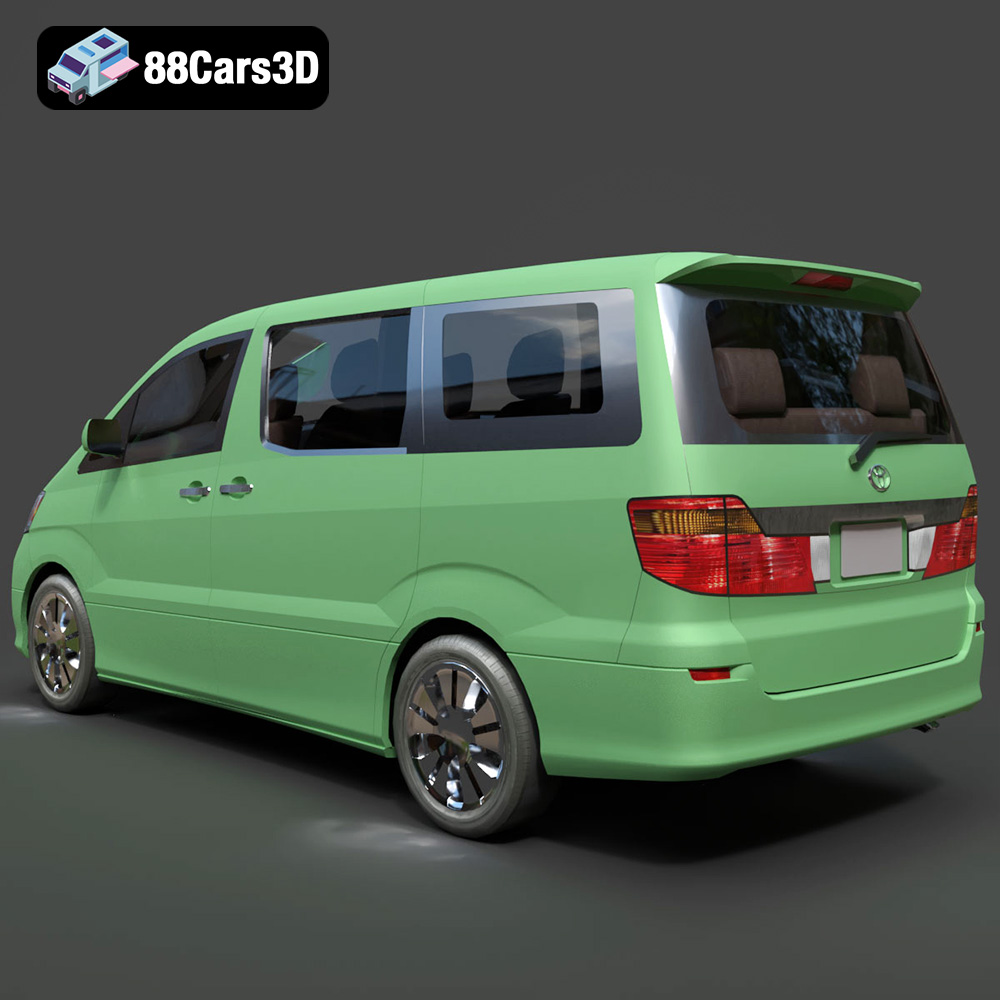
Today, we’re diving deep into what makes a 3D car model truly exceptional, exploring the technical nuances, workflow advantages, and diverse applications that professionals seek. We’ll examine how a meticulously crafted asset can streamline development, enhance visual appeal, and provide unparalleled versatility across various platforms. As a prime example of such excellence, we’ll frequently reference the Toyota Alphard 3D Model, a luxurious minivan recreated with stunning detail and engineered for peak performance across an array of professional 3D projects.
This comprehensive guide aims to arm designers, developers, and visual artists with the knowledge to appreciate and leverage premium 3D car models, understanding not just what they are, but how they integrate into demanding workflows to deliver outstanding results. Let’s embark on this journey to uncover the transformative power of quality 3D assets.
Understanding 3D Model File Formats
The choice of file format for a 3D model is far more than a technicality; it’s a strategic decision that impacts compatibility, performance, and the scope of a project. Each format serves specific purposes, optimized for different stages of the 3D pipeline – from initial creation to final deployment. Understanding these distinctions is crucial for anyone working with 3D car models, especially when sourcing assets like the Toyota Alphard 3D Model, which comes with a comprehensive suite of options.
Native Project Files: .blend and .max
- .blend – Fully Editable Blender Scene with Materials: Blender’s native file format, .blend, is a powerhouse for artists and studios relying on this increasingly popular open-source 3D suite. When you acquire a .blend file, you’re not just getting a model; you’re getting an entire project scene. This means all materials (including complex node setups), lighting, cameras, animation data, modifiers, and scene settings are preserved. For the Toyota Alphard 3D Model, the .blend file provides maximum flexibility for customization, allowing artists to easily adjust paint finishes, material properties, and even geometry if needed, all within Blender’s robust environment. It’s ideal for those who want to integrate the model seamlessly into existing Blender projects or modify it extensively for unique requirements.
- .max – Editable 3ds Max Project for Animation and Rendering: Similarly, the .max format is the proprietary file for Autodesk 3ds Max, a long-standing industry standard for architectural visualization, animation, and game development. A .max file offers the same level of comprehensive scene data as a .blend file, but within the 3ds Max ecosystem. It retains all scene objects, modifiers, materials (especially those optimized for V-Ray, Corona, or Arnold renderers), lighting setups, and animation curves. For users deeply integrated into a 3ds Max pipeline, the .max version of the Alphard model ensures native compatibility, leveraging its organized hierarchy and properly set pivots for immediate animation and high-fidelity rendering without conversion losses.
Universal Exchange Formats: .fbx, .obj, .ply
- .fbx – Ideal for Unreal, Unity, and Real-time Pipelines: Autodesk’s Filmbox (.fbx) is arguably the most widely adopted interchange format in the 3D industry, particularly dominant in game development and real-time applications. It excels at transferring geometry, materials, textures, animations, and rigging data between different 3D software and game engines like Unreal Engine and Unity. The .fbx version of the Toyota Alphard 3D Model is optimized for these environments, ensuring that critical data like UV mapping, material assignments, and hierarchical structure are preserved, making it production-ready for interactive experiences. Its efficiency and robust feature set make it the go-to for game assets and AR/VR integration.
- .obj – Universal Format for Cross-Software Compatibility: The Wavefront Object (.obj) format is a venerable and highly compatible format, often considered the “lowest common denominator” for 3D geometry. It primarily stores vertex positions, UV coordinates, normals, and polygon faces, with material definitions typically stored in a separate .mtl (material template library) file. While it doesn’t support animation or rigging, its simplicity and widespread support make it excellent for static model exchange between virtually any 3D software. For the Alphard, the .obj provides a clean mesh that can be imported into any package for modeling, sculpting, or rendering, serving as a reliable fallback or primary choice when complex scene data isn’t needed.
- .ply – Precision Mesh Format for CAD or Analysis: The Polygon File Format (.ply) is often used for storing 3D data from 3D scanners, CAD software, and scientific applications. It can store a wide range of data, including color, transparency, and surface normals per vertex or per face. While less common for general-purpose 3D car models, its inclusion for the Alphard indicates its suitability for more technical applications, such as precise measurement, engineering analysis, or conversion to CAD formats. It offers a robust and accurate representation of the mesh, crucial for scenarios where geometric integrity is paramount.
Specialized Formats for Modern Applications: .glb, .stl, .unreal
- .glb – Optimized for AR, VR, and Browser-based Display: The GL Transmission Format Binary (.glb) is the binary version of glTF, a royalty-free specification for the efficient transmission and loading of 3D scenes and models by engines and applications. It’s the “JPEG of 3D” – compact, efficient, and increasingly popular for web-based 3D, AR (Augmented Reality), and VR (Virtual Reality) experiences. The .glb version of the Alphard is specifically tailored for these immersive platforms, ensuring quick loading times and broad compatibility across modern browsers and devices, perfect for interactive product showcases or virtual showrooms.
- .stl – Suitable for 3D Printing Output: The Stereolithography (.stl) format is the industry standard for 3D printing. It represents a 3D model as a series of connected triangles, describing only the surface geometry of the object. While it doesn’t carry color or material information, its universal acceptance by 3D printers and slicer software makes it indispensable for physical prototyping. The Toyota Alphard 3D Model can be easily converted to .stl, allowing designers to produce high-quality physical replicas of the minivan, whether for concept models, design reviews, or even collectible miniatures.
- .unreal – Engine-Ready Asset for Real-time Environments: While technically not a single file format in the same vein as .fbx or .obj, the “.unreal” entry signifies a pre-configured Unreal Engine project or asset package. This means the Toyota Alphard 3D Model is not just compatible with Unreal; it comes optimized and potentially pre-setup within an Unreal project. This could include pre-applied materials, LODs (Levels of Detail), collision meshes, and even blueprints for interactive elements. This level of integration drastically cuts down on setup time, allowing developers to drop the asset directly into their real-time environments and begin development immediately.
The provision of such a diverse array of file formats with the Toyota Alphard 3D Model from 88cars3d.com underscores its professional-grade quality and versatility, ensuring it meets the specific needs of virtually any 3D project.
The Intersection of Luxury and Digital Craftsmanship: Introducing the Toyota Alphard 3D Model
In the realm of high-end automotive design, the Toyota Alphard stands as a symbol of luxury, comfort, and distinctive presence. Translating such an iconic vehicle into a digital asset requires not only artistic skill but also a deep understanding of technical precision. The Toyota Alphard 3D Model available on 88cars3d.com embodies this fusion, offering a highly detailed and faithful digital recreation that meets the rigorous demands of professional 3D production.
Capturing the Essence of a Luxury Minivan
The product description highlights the meticulous attention to detail: “accurately modeled body panels reflecting the Alphard’s signature styling,” “detailed headlights and taillights with transparent materials,” and “precisely crafted wheels and tires.” These aren’t mere aesthetic boasts; they are critical technical attributes. Accurate modeling means the silhouette, curves, and proportions precisely match the real-world vehicle, essential for realistic renders and credible simulations. The use of transparent materials for lighting elements ensures proper light interaction and reflection, crucial for photorealism. Furthermore, the inclusion of “basic undercarriage components” and “comprehensive interior detailing” means the model can hold up under scrutiny from various camera angles, whether for close-up shots or views through the realistic window glass.
The Professional Advantage of a Ready-Made Asset
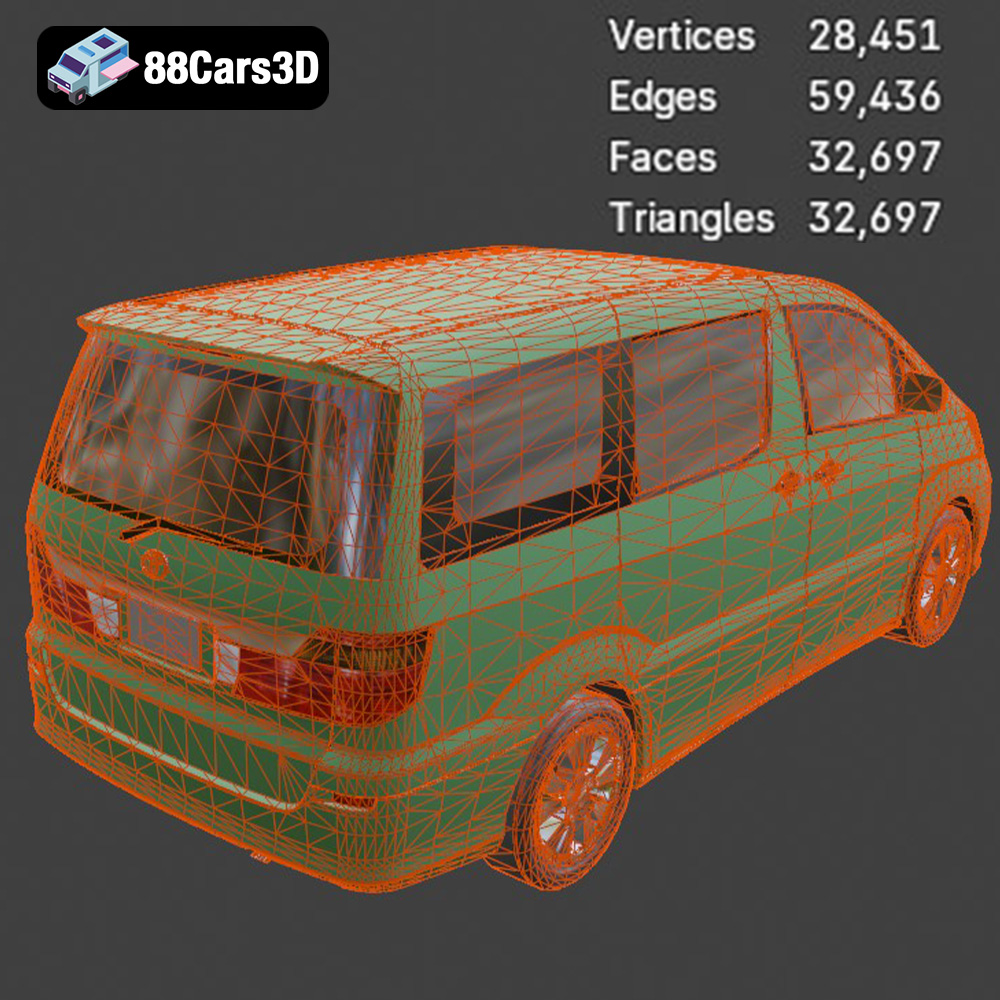
For studios and individual professionals, time is a valuable commodity. Creating a vehicle model of this caliber from scratch can take hundreds of hours. By utilizing a production-ready asset like the Toyota Alphard 3D Model, designers can bypass this arduous initial phase and jump straight into project-specific tasks like scene integration, animation, or material customization. This efficiency doesn’t come at the cost of quality; instead, it leverages expert craftsmanship, offering a clean, quad-dominant topology for smooth subdivision, modeled to real-world scale, and logically organized with properly set pivots. These technical advantages translate directly into streamlined workflows, fewer errors, and ultimately, a higher quality final product.
Crafting Impeccable Automotive Renders: From Studio to Arch-Viz
Automotive rendering is an art form that blends technical prowess with an eye for visual storytelling. Whether for marketing campaigns, product showcases, or integration into architectural scenes, the goal is always to achieve stunning photorealism. A high-quality 3D car model, such as the Toyota Alphard 3D Model, is an indispensable tool in this process, providing the canvas upon which artists paint their digital masterpieces.
Achieving Photorealism with Advanced Materials and Lighting
Photorealism in rendering isn’t just about accurate geometry; it’s about how light interacts with surfaces. The Alphard model’s “detailed headlights and taillights with transparent materials” and “realistic window glass” are crucial here. These elements, when combined with advanced material definitions for paint, chrome, rubber, and plastics, allow renderers like V-Ray, Corona, or Arnold (especially when using the .max or .blend files) to calculate reflections, refractions, and global illumination with stunning accuracy. Artists can leverage physically-based rendering (PBR) workflows to precisely adjust roughness, metallic properties, and normal maps, ensuring the digital Alphard looks indistinguishable from its real-world counterpart under any lighting condition, from a sun-drenched exterior to a moody studio shot.
Integrating the Alphard into Complex Scenes (e.g., Architectural Visualizations)
One of the key applications for premium 3D car models is in architectural visualization (Arch-Viz). Placing a realistic vehicle in front of a building render or within a street scene significantly enhances the believability and scale of the environment. The Toyota Alphard 3D Model, modeled to real-world scale, integrates seamlessly into any scene. Its “clean geometry” and “balanced detailing” ensure it doesn’t bog down complex Arch-Viz scenes with excessive poly counts, while still providing enough detail for close-up hero shots. Designers can use the .max or .blend versions to fine-tune the Alphard’s materials to match the mood of the architectural environment, adjusting paint reflectivity for a wet street or adding subtle dirt textures for a more lived-in feel.
Animation Workflows for Automotive Marketing
For marketing and advertising, static renders often aren’t enough. Dynamic animations that showcase a vehicle’s features, elegance, and presence are paramount. The Alphard model is built with “separated components such as doors, hood, and trunk for easy animation workflows” and a “logically organized hierarchy with properly set pivots.” This design foresight dramatically simplifies the animation process. Animators can effortlessly open doors, rotate wheels, or even animate suspension movements, creating compelling narratives without the hassle of rebuilding or re-rigging the model. Using the .fbx file, these animations can then be exported for use in various platforms, from video presentations to interactive online configurators.
Game Development and Real-Time Environments: Optimizing for Performance
The demands of real-time rendering in game development, AR, and VR are distinct from those of offline rendering. While visual fidelity is still paramount, performance and optimization become critical. A high-quality 3D car model for these applications must strike a delicate balance between detail and efficiency. The Toyota Alphard 3D Model, available through 88cars3d.com, is engineered with these considerations in mind, making it an excellent game asset.
Balancing Visual Fidelity with Performance Budgets
Game engines operate under strict performance budgets, measured in frames per second (FPS). High poly counts can quickly cripple performance. While the Alphard model is detailed, its “optimized mesh quality” and “clean, quad-dominant topology” are key advantages. This means the model maintains a high visual standard while being manageable within real-time budgets. Developers can implement techniques like LODs (Levels of Detail), where simplified versions of the model are swapped in when the car is further from the camera, further enhancing performance without sacrificing perceived quality. The .fbx and .unreal formats are specifically designed to facilitate this optimization process within game engines.
Leveraging the .fbx and .unreal Formats in Game Engines (Unreal, Unity)
The .fbx format is the cornerstone of game asset pipelines. When importing the Alphard .fbx file into Unreal Engine or Unity, developers can bring in not only the geometry but also PBR materials, textures, and the hierarchical structure. The “logically organized hierarchy” of the Alphard model means components like wheels, doors, and steering wheel are separate objects with correct pivots, ready for rigging to a vehicle physics system. For Unreal Engine users, the dedicated “.unreal” file takes this a step further, potentially offering a pre-configured asset with collision meshes, material instances, and even basic Blueprints for immediate integration into an open-world simulation or racing game. This significantly reduces setup time, allowing developers to focus on gameplay and interaction.
Dynamic Interactions and Vehicle Physics Integration
In games and simulations, vehicles aren’t static; they interact with the environment, react to physics, and are often driven by players. The Alphard’s structure, with its separated components, is perfectly suited for this. Developers can easily attach physics assets to the main body, wheels, and suspension, allowing for realistic driving mechanics. The precisely crafted wheels and tires can be rigged to rotate independently, and the doors, hood, and trunk can be animated to open and close, adding a layer of interactivity and realism. Whether it’s for a virtual car showroom experience, an immersive driving simulator, or a feature in an open-world adventure, the technical foundation of the Alphard 3D Model supports complex, dynamic interactions.
Beyond Visualization: AR/VR, Simulation, and 3D Printing
The utility of a robust 3D car model extends far beyond traditional rendering and game development. Emerging technologies like Augmented Reality (AR) and Virtual Reality (VR), as well as established fields like simulation and 3D printing, all leverage high-quality 3D assets to create immersive experiences, facilitate training, and even produce physical prototypes. The Toyota Alphard 3D Model demonstrates its versatility by supporting these diverse applications through its comprehensive file format offerings and meticulous construction.
Immersive Experiences with AR/VR Ready Models (.glb)
Augmented Reality (AR) and Virtual Reality (VR) are transforming how we interact with digital content. For automotive companies, this means virtual showrooms, interactive product configurators, and immersive driving experiences. The .glb format, included with the Alphard model, is specifically optimized for these applications. Its compact size and efficient loading make it ideal for web-based AR experiences on mobile devices or high-fidelity VR environments. Imagine potential customers exploring the luxurious interior of the Toyota Alphard in a VR headset, or seeing it projected into their driveway via AR – the quality of the 3D model directly translates to the realism and impact of these immersive scenarios. The Alphard’s “real-world scale” ensures accurate spatial representation in AR/VR environments, enhancing believability.
Precision for Simulation and Training (.ply, real-world scale)
In professional training and simulation, accuracy is paramount. Driving simulators, for example, require highly precise vehicle models to replicate real-world physics and handling characteristics. The inclusion of the .ply format and the “modeled to real-world scale” attribute of the Toyota Alphard 3D Model underscore its suitability for such demanding applications. The .ply format, known for its precision in representing mesh data, can be vital for engineering simulations or for integrating the vehicle into highly accurate physics engines. This allows for realistic scenario planning, driver training modules, and even vehicle dynamics testing in a virtual environment, providing a cost-effective and safe alternative to physical prototypes.
Bringing Digital to Physical with 3D Printing (.stl)
The ability to transition from a digital design to a physical object is a fascinating aspect of 3D modeling. The .stl format is the universal language of 3D printing, making the Toyota Alphard 3D Model convertible for physical production. Designers, enthusiasts, or marketing teams can leverage this to create high-quality physical scale models of the Alphard. This could be for design reviews, tactile prototypes, educational purposes, or even unique promotional merchandise. The model’s “clean geometry” ensures a smooth and accurate conversion to an .stl file, minimizing errors during the slicing and printing process and resulting in a high-fidelity physical output that truly reflects the digital craftsmanship.
The Technical Edge: Why Quality Matters in 3D Car Models
The adage “you get what you pay for” holds particular weight in the specialized field of 3D modeling. While free or low-cost models might seem appealing, they often come with hidden costs in terms of clean-up time, performance issues, and compromised quality. Investing in a premium asset, like the Toyota Alphard 3D Model from 88cars3d.com, is an investment in efficiency, quality, and project success. This technical edge is defined by several core principles.
The Power of Clean Topology and Real-World Scale
Clean, quad-dominant topology is a fundamental technical advantage. This refers to a mesh constructed primarily with four-sided polygons (quads), which deform smoothly during animation and subdivision, preventing unsightly pinching or artifacts. Poor topology, often found in quickly made or converted models, leads to headaches when trying to animate, sculpt, or render. The Alphard’s commitment to clean topology ensures that regardless of whether you’re zooming in for a close-up render or deforming it for an animation, its surfaces will remain smooth and accurate. Similarly, being modeled to real-world scale isn’t just a convenience; it’s a necessity for physically accurate lighting, rendering, and simulation. Objects at incorrect scales can lead to issues with light intensity, material properties, and collision detection in game engines.
Streamlined Workflows: Hierarchy, Pivots, and Customization
A truly professional 3D model is organized for efficiency. The Alphard model boasts a logically organized hierarchy with properly set pivots. This means that components like doors, wheels, and steering wheel are separate, correctly named objects, and their pivot points (the center of rotation/transformation) are placed precisely where they should be (e.g., at the hinge of a door, the axle of a wheel). This thoughtful organization is a game-changer for animators and riggers, allowing for effortless manipulation and articulation without needing to spend hours correcting basic setup issues. Furthermore, the ability to easily modify paint finishes and apply custom graphics, along with adjusting material properties, provides a powerful customization framework. This means the Alphard can be adapted to specific branding, scenarios, or aesthetic preferences without compromising its underlying quality.
The Value of a Production-Ready Asset from 88cars3d.com
Ultimately, a production-ready asset is one that saves time, reduces frustration, and delivers consistent, high-quality results. The Toyota Alphard 3D Model exemplifies this ethos. It’s not just a collection of polygons; it’s a carefully engineered digital product designed to integrate seamlessly into diverse professional pipelines. From the inclusion of multiple optimized file formats to its meticulous geometric and organizational integrity, every aspect is geared towards professional application. Sourcing such assets from platforms like 88cars3d.com ensures that designers and developers can access reliable, expert-level 3D car models, allowing them to focus on creative execution rather than technical remediation. This makes premium 3D models an indispensable part of any serious 3D workflow.
Drive Your Projects Forward with Premium 3D Assets
In the expansive and increasingly demanding world of 3D visualization and real-time development, the value of high-quality, technically sound 3D car models cannot be overstated. We’ve explored the intricate details that elevate a simple mesh into a production-ready asset, capable of transforming projects across automotive rendering, game development, AR/VR, simulation, and even 3D printing.
From understanding the nuances of various file formats like .blend, .fbx, and .unreal, to appreciating the critical importance of clean topology, real-world scale, and logical organization, it’s clear that a well-crafted 3D model is a cornerstone of efficiency and excellence. The ability to seamlessly integrate such models into complex workflows, achieve photorealistic renders, optimize for real-time performance, and even produce physical prototypes underscores their versatility and indispensable nature.
The Toyota Alphard 3D Model stands as a testament to this commitment to quality. Its meticulous detailing, thoughtful technical construction, and extensive file format support make it an ideal asset for professionals seeking to enhance their projects with a luxurious and versatile vehicle. By choosing premium 3D car models from trusted sources like 88cars3d.com, you’re not just acquiring an asset; you’re investing in a streamlined workflow, superior visual fidelity, and the confidence that your digital creations will meet the highest industry standards. Elevate your next project and bring your visions to life with the precision and professionalism that only top-tier 3D assets can provide.
Featured 3D Model
Toyota Alphard 3D Model
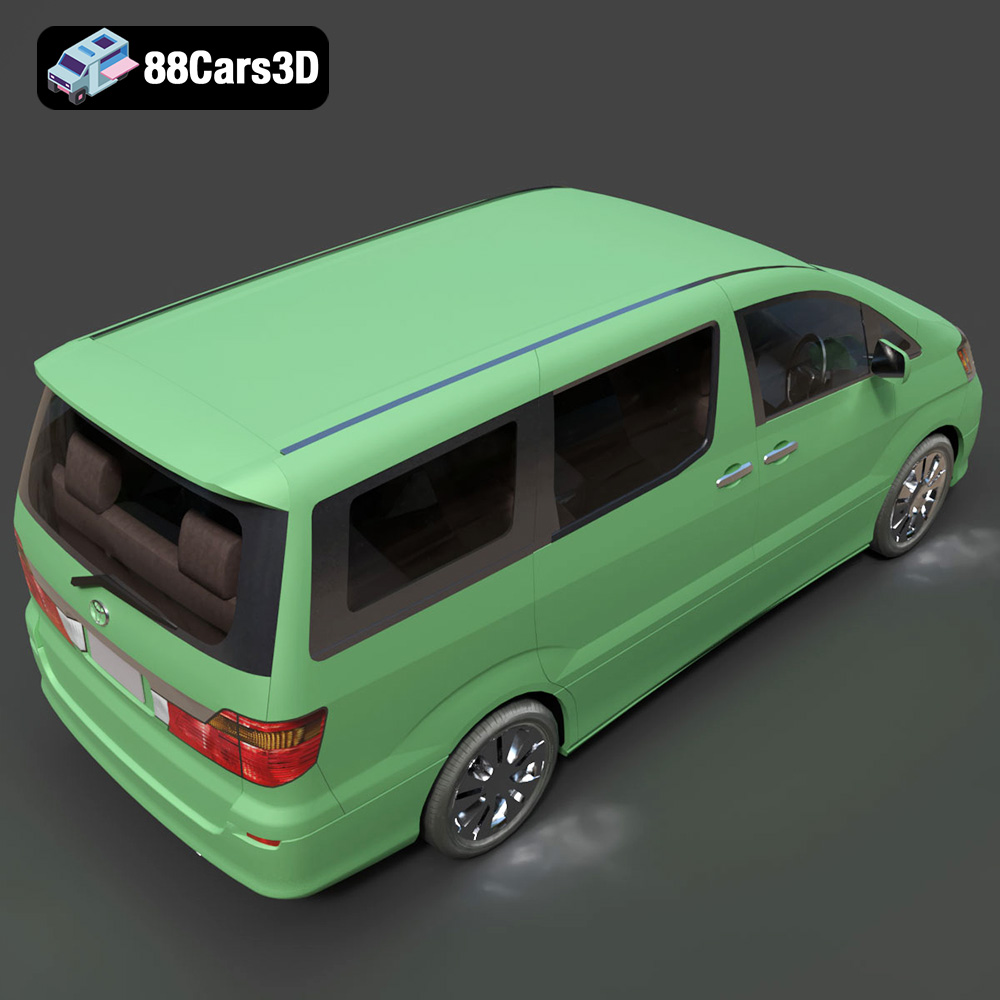
Presenting the highly detailed Toyota Alphard 3D Model, a faithful digital recreation of the iconic luxury minivan. This model captures the Alphard’s distinctive aesthetic, known for its opulent design, spacious interior, and commanding road presence. Built with clean geometry and balanced detailing, it ensures optimal performance across various applications. Ideal for high-quality rendering, realistic animations, immersive simulations, and robust game development projects.Exterior Features:
- Accurately modeled body panels reflecting the Alphard’s signature styling.
- Detailed headlights and taillights with transparent materials for realistic illumination effects.
- Precisely crafted wheels and tires, enhancing the vehicle’s authentic appearance.
- Separated components such as doors, hood, and trunk for easy animation workflows.
- Realistic window glass with appropriate transparency for clear views of the interior.
Interior / Mechanical Features:
- Comprehensive interior detailing, including dashboard, steering wheel, seats, and central console.
- Optimized mesh quality to balance visual fidelity with efficient polycount.
- Basic undercarriage components for added realism in complex scenes.
Technical Advantages:
- Clean, quad-dominant topology for smooth subdivision and distortion-free deformation.
- Modeled to real-world scale, ensuring accurate integration into any scene or project.
- Logically organized hierarchy with properly set pivots, facilitating effortless animation and manipulation.
Applications:
- Rendering & Visualization: Perfect for studio renders, architectural visualizations, and cinematic scenes.
- Game Development: Optimized as a game asset for racing games, open-world simulations, and virtual environments.
- AR/VR: Ready for immersive augmented and virtual reality experiences.
- Simulation & Training: Suitable for driving simulators, educational modules, and technical training.
- 3D Printing: Convertible to .stl format for creating high-quality physical models.
Customization Options:
- Easily modify paint finishes and apply custom graphics to match branding or personal preferences.
- Adjust material properties for metals, chrome accents, rubber, and plastics to achieve desired visual effects.
- Adapt lighting setups to complement various scene environments and moods.
The Toyota Alphard 3D Model stands as a testament to precision and versatility. It’s an essential asset for professionals seeking a high-quality, production-ready luxury minivan model for any demanding 3D project.Included File Formats:
- .blend – Blender project with materials
- .fbx – Compatible with Unreal, Unity, and major 3D engines
- .obj – Universal format for nearly all 3D software
- .glb – Optimized for AR, VR, and web-based visualization
- .stl – Ready for 3D printing
- .ply – Mesh format for analysis and CAD workflows
- .unreal – Unreal Engine project setup
- .max – Editable 3ds Max scene for rendering and animation
$21.99
Product Image Gallery