

The Timeless Appeal: Crafting and Utilizing High-Fidelity 3D Car Models in Modern Production
In the dynamic world of 3D production, from blockbuster game development to cinematic visualizations and cutting-edge AR/VR experiences, the demand for exceptionally detailed and versatile 3D car models has never been higher. Automotive models serve as critical assets, bringing realism, narrative depth, and interactive potential to countless projects. Whether it’s a sleek supercar tearing through a digital landscape or a vintage classic cruising a meticulously rendered street, the quality of the 3D model dictates the success of the final visual.
Today, we delve into the intricate processes behind creating and deploying such assets, highlighting how a professional-grade model can elevate any project. We’ll explore the technical specifications, file formats, and advanced workflows that characterize top-tier 3D car models, using a prime example of excellence: the BMW 7 Series E38 3D Model. This meticulously crafted asset perfectly embodies the blend of historical significance, design elegance, and technical precision required in modern 3D pipelines.
Understanding 3D Model File Formats: The Backbone of Digital Automotive Assets
The choice of file format for a 3D model is far more than a mere technicality; it’s a strategic decision that impacts compatibility, feature retention, performance, and ultimately, the success of a project. For designers, animators, and game developers, understanding the nuances of each format is crucial when working with 3D car models like the BMW 7 Series E38. Here’s a detailed look at the prevalent formats and their ideal applications:
.blend – The Blender Powerhouse
The .blend format is the native file type for Blender, the powerful open-source 3D creation suite. When you acquire a .blend file, you’re not just getting the mesh; you’re getting a fully editable Blender scene. This typically includes the model’s geometry, materials, textures, lighting setups, camera positions, and even animation data, all within a single package. For users deeply integrated into the Blender ecosystem, a .blend file offers unparalleled flexibility for customization, material tweaks, scene composition, and continued development, making it an excellent starting point for any project intending to leverage Blender’s robust toolset.
.fbx – The Industry Interoperability Standard
.fbx (Filmbox) is a proprietary file format owned by Autodesk and stands as one of the most widely adopted interchange formats in the 3D industry. Its strength lies in its ability to encapsulate a vast array of 3D data, including meshes, materials, textures, animations, skinning, and camera information. This makes .fbx an ideal choice for transferring complex 3D car models between different DCC (Digital Content Creation) applications like 3ds Max, Maya, and Blender, and crucially, for integration into game engines such as Unreal Engine and Unity. Its robust support for animation and scene hierarchy makes it a go-to for real-time pipelines where performance and fidelity are paramount.
.obj – The Universal Static Mesh Solution
The .obj (Wavefront OBJ) format is a venerable and universally recognized standard for 3D geometry. It’s a simple, text-based format primarily used for exchanging polygonal meshes. While it excels at storing vertex data, normals, texture coordinates (UVs), and faces, it typically lacks support for advanced features like animation, rigging, or complex material definitions (though it can link to an accompanying .mtl file for basic material properties). For static renders, 3D printing preparation, or as a reliable fallback for cross-software compatibility, .obj remains an indispensable format, ensuring your 3D car models are accessible almost anywhere.
.glb – Optimized for AR, VR, and Web
.glb (GL Transmission Format Binary) is the binary version of glTF, a modern, royalty-free specification for the efficient transmission and loading of 3D scenes and models by applications. .glb packages all necessary data—geometry, textures, materials (often PBR-based), and animation—into a single file, making it highly optimized for web-based 3D viewers, AR/VR experiences, and mobile applications. Its compact size and efficient parsing make it perfect for interactive real-time displays where performance and quick loading times are essential, such as showcasing the BMW 7 Series E38 3D model in an augmented reality app.
.stl – The Gateway to 3D Printing
.stl (Stereolithography) is the de facto standard for 3D printing. This format represents a 3D model’s surface geometry using a tessellation of triangular facets. It is fundamentally a mesh-only format, meaning it stores no color, texture, or material information. When preparing a 3D car model for physical production, converting it to .stl is a critical step, ensuring the model’s watertightness and proper resolution for the chosen printing method. High-quality 3D car models designed with clean geometry, like those found on 88cars3d.com, are typically well-suited for conversion to .stl for flawless physical output.
.ply – Precision for CAD and Analysis
The .ply (Polygon File Format) is a file format for storing graphical objects that is particularly well-suited for representing scanned 3D data. It can store a variety of properties, including color, transparency, surface normals, and range data, either per vertex or per face. While less common for general 3D asset exchange than .fbx or .obj, .ply is frequently used in scientific applications, CAD systems, and for models derived from 3D scanning, where high precision and diverse attribute storage are required for analysis or detailed engineering visualization.
.unreal – Engine-Ready for Real-Time Environments
The term .unreal, when referred to as a file format, typically signifies a pre-configured asset or an entire project package specifically prepared for Unreal Engine. This isn’t a standalone file type in the traditional sense, but rather a collection of files and settings that allow for direct, optimized integration into an Unreal Engine project. This would include properly set up materials (often using Unreal’s PBR workflow), collision meshes, Level of Detail (LODs) for performance optimization, and potentially blueprints or other engine-specific logic. For game developers and real-time visualization artists, receiving a model in an “Unreal-ready” format dramatically accelerates the workflow by eliminating tedious setup steps.
.max – The 3ds Max Native Format
The .max format is the native file type for Autodesk 3ds Max, a leading software for 3D modeling, animation, and rendering. Similar to .blend, a .max file contains a complete 3ds Max scene, encompassing all geometry, modifiers, materials, textures, lighting, cameras, and animation curves. For studios and artists primarily working within 3ds Max, having a .max file offers full access to the original project, allowing for intricate adjustments, re-rigging, complex animation, and high-fidelity rendering using powerful renderers like V-Ray or Corona. It provides the utmost control for those deeply embedded in the 3ds Max pipeline.
By offering this comprehensive suite of formats, the BMW 7 Series E38 3D model ensures maximum flexibility and compatibility, allowing professionals to integrate this classic vehicle seamlessly into virtually any production pipeline.
The Art of Automotive 3D Modeling: Capturing Classics and Modern Marvels
Creating a truly authentic 3D car model is an intricate blend of artistic skill and technical precision. It goes far beyond simply tracing blueprints; it involves capturing the essence, the spirit, and every minute detail of a vehicle. For a classic like the BMW 7 Series E38, this means recreating its distinctive lines, the subtle curves of its body panels, and the sophisticated presence that defined a generation of luxury sedans. This dedication to accuracy is what transforms a mere digital object into a compelling, believable asset.
Precision in Geometry and Topology
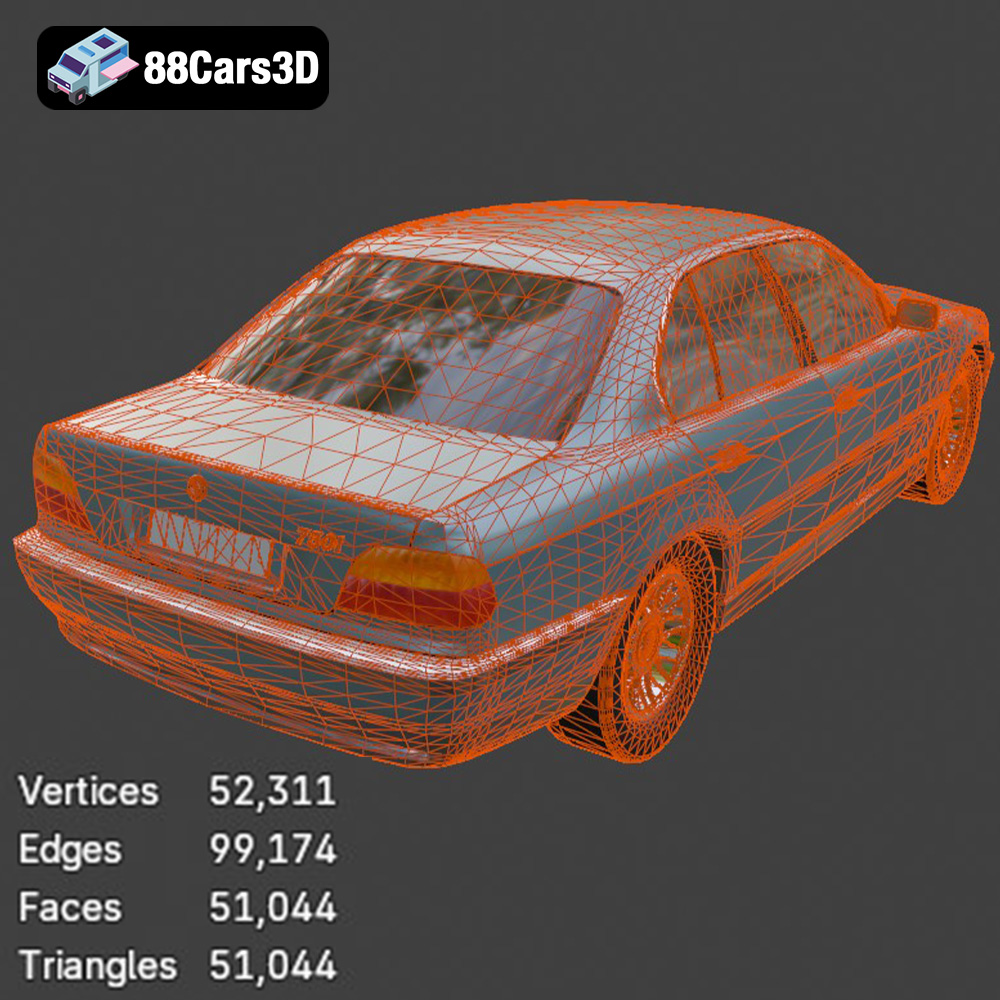
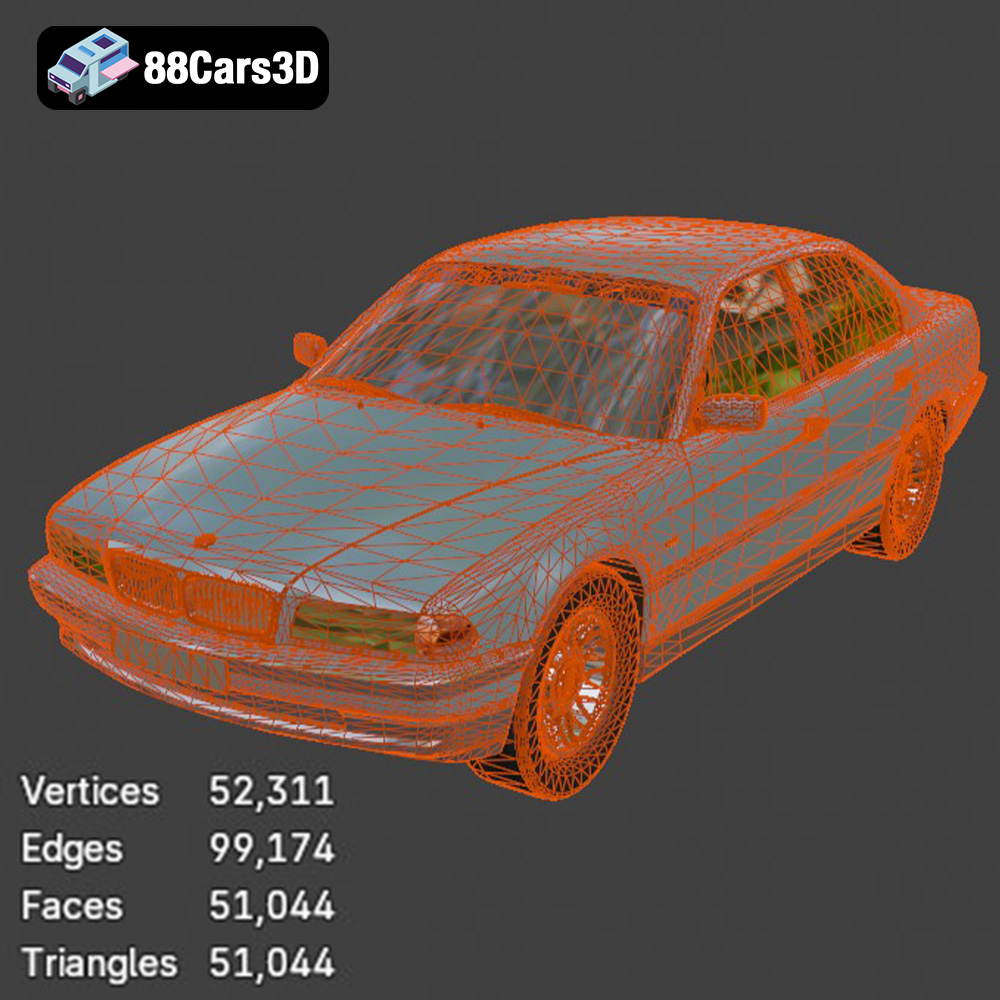
The foundation of any high-quality 3D model is its geometry and topology. A “clean quad-dominant topology,” as specified for the BMW 7 Series E38 3D model, is paramount. This refers to a mesh predominantly built with four-sided polygons (quads), arranged in an organized, flowing manner. Why is this important? Quads allow for smooth subdivision, meaning if you need to increase the detail of the model for close-up shots or high-resolution renders, the mesh will deform gracefully without pinching or unwanted artifacts. This is crucial for reflecting the smooth, elegant surfaces of a luxury car, avoiding the unsightly angularity that can plague models with poorly constructed geometry.
Furthermore, maintaining “real-world scale” ensures that the model integrates seamlessly into any scene without requiring manual scaling adjustments. This accuracy is vital for architectural visualizations, simulations, and consistent scene composition.
Mastering Materials and Textures
Beyond the mesh, materials and textures breathe life into a 3D car model. The detailed description of the E38 model highlights “detailed front grille, headlights, and taillights with transparent materials for realistic lighting,” and “authentic wheel designs and realistic tire profiles.” Achieving this level of realism involves meticulous UV unwrapping – the process of flattening the 3D surface into a 2D map for texture application. Proper UVs ensure textures wrap correctly, preventing stretching or distortion, which is particularly important for complex surfaces like tire treads or intricate dashboard details.
Material properties – reflections, refractions, glossiness, and normal mapping – are then carefully calibrated to mimic real-world surfaces. The subtle glint of chrome, the deep sheen of automotive paint, the delicate transparency of glass, and the tactile feel of interior fabrics all contribute to the model’s overall believability. The ability to “easily modify paint finishes, colors, and add custom graphics or liveries” and “adjust material properties for metals, chrome, rubber, glass, and plastics” speaks to the model’s flexibility and potential for creative adaptation.
Seamless Integration: Leveraging High-Quality Car Models in Professional Workflows
The true test of a premium 3D car model lies in its ability to be effortlessly integrated into diverse professional workflows. From cinematic animations to interactive experiences, the right model acts as a catalyst, accelerating production and enhancing visual fidelity. The BMW 7 Series E38 3D model is engineered with this versatility in mind, ensuring it’s not just a beautiful asset but also a highly functional one.
Animation and Rigging Efficiency
For animators, a well-prepared 3D car model significantly reduces setup time. The E38 model’s “separated components like doors, hood, and trunk” along with an “organized hierarchy with proper pivot points” are key indicators of its animation readiness. Pivot points, correctly placed at the hinges of doors or the center of wheels, allow animators to rotate or open components naturally, just as they would in the real world. This meticulous organization streamlines the rigging process, making it straightforward to prepare the car for driving simulations, cinematic sequences, or interactive showcases where parts need to move realistically.
Rendering & Visualization Excellence
In architectural visualization (arch-viz) and product rendering, the inclusion of a realistic vehicle can dramatically enhance a scene’s atmosphere and sense of scale. The BMW 7 Series E38, with its “clean quad-dominant topology” and “UV unwrapped with appropriate texture mapping,” is perfect for “high-resolution studio renders, cinematic scenes, and architectural visualizations.” Artists can drop this model into a street scene or a luxury garage and achieve stunning, photorealistic results with minimal post-processing. The ability to “adapt lighting setups to achieve diverse scene moods and visual effects” further empowers artists to integrate the car seamlessly into any visual narrative, whether it’s a moody night render or a sun-drenched daytime scene.
Beyond Static Imagery: Interactive Displays
The increasing demand for interactive content – from online car configurators to showroom displays – benefits immensely from optimized 3D assets. A model like the E38, designed with “optimized mesh quality to balance detail with performance,” can be readily used in real-time interactive applications. Users can explore the vehicle from all angles, open doors, change colors, and even inspect the “detailed dashboard with instrumentation” in an immersive digital environment, creating engaging customer experiences that transcend static images.
Optimizing for Performance: Game Development, AR/VR, and Real-Time Rendering
In the realm of interactive media, performance is king. Game developers, AR/VR creators, and real-time visualization artists require 3D car models that are not only visually stunning but also incredibly efficient. The challenge lies in balancing fidelity with frame rate, and this is where a professionally optimized asset truly shines. The BMW 7 Series E38 3D model is built with this crucial balance in mind, making it an indispensable asset for real-time applications.
Game Development Assets
For game development, every polygon and every draw call counts. An “optimized mesh quality to balance detail with performance” means the model can be integrated into racing simulations, open-world environments, or interactive experiences without bogging down the game engine. Developers often employ techniques like Level of Detail (LODs) – where simplified versions of the model are rendered at greater distances – to maintain high frame rates. A well-constructed base model like the E38 provides an excellent foundation for generating these LODs, ensuring a consistent visual experience across various distances and hardware configurations. The inclusion of the “.unreal” format further underlines its readiness for direct integration into robust game pipelines.
Immersive AR/VR Experiences
Augmented Reality (AR) and Virtual Reality (VR) platforms demand even stricter performance considerations due to their high refresh rates and stereoscopic rendering requirements. The BMW 7 Series E38 3D model is “ideal for creating immersive augmented and virtual reality automotive showcases,” thanks to its optimization. Lightweight yet detailed, it can be seamlessly displayed on mobile AR devices or high-end VR headsets, allowing users to interact with a lifelike representation of the classic sedan in their own environment or a fully virtual world. The “.glb” file format, specifically optimized for AR/VR and web-based visualization, is particularly valuable here, ensuring quick loading and smooth interaction.
Real-Time Rendering Workflows
Real-time rendering extends beyond games and AR/VR, encompassing applications like live architectural walkthroughs, product configurators, and virtual production sets. In these scenarios, the ability to render complex scenes instantly is paramount. The E38 model’s clean geometry and efficient UV mapping allow for rapid processing by real-time renderers, ensuring smooth camera movements and instant feedback during development. This significantly accelerates iterative design processes and allows for dynamic presentation without the lengthy render times associated with offline rendering. This efficiency translates directly to saving time and resources for studios leveraging advanced workflows.
The Versatility of the BMW 7 Series E38 3D Model in Production
The true mark of a superior 3D asset is its adaptability across a multitude of applications and project types. The BMW 7 Series E38 3D model stands out as a prime example of such versatility, offering a professional-grade solution for a wide array of creative and technical endeavors. From archival visualization to modern simulations, this model proves to be an indispensable tool.
Historical Accuracy for Documentary and Film
For filmmakers and documentarians seeking to recreate specific eras, the BMW 7 Series E38 offers an authentic representation of a luxury sedan from 1994 to 2001. Its “accurately modeled body panels reflecting the E38’s signature design” ensures historical precision, making it perfect for period pieces, reenactments, or archival projects. The ability to render it in cinematic scenes allows for dynamic storytelling, placing the classic car within historically accurate digital environments.
Automotive Training and Engineering Visualizations
Beyond entertainment, precise 3D models are invaluable in educational and industrial contexts. The E38 model is “suitable for driving simulators, automotive training modules, and engineering visualizations.” Imagine a virtual training environment where aspiring mechanics can interact with a digital twin of the E38, exploring its “basic undercarriage and engine bay details” or understanding its internal components without risk or expense. Engineers can use such models for early-stage design review, aerodynamic simulations, or structural analysis, visualizing concepts before physical prototypes are built. The inclusion of the “.ply” format further supports its use in precision mesh analysis workflows, crucial for engineering applications.
Product Showcases and Marketing Materials
For automotive brands or dealerships, high-quality 3D models are a cornerstone of modern marketing. The E38 model can be deployed in captivating online showrooms, interactive advertisements, or high-resolution brochures. Its “detailed dashboard with instrumentation, steering wheel, and center console controls” combined with “comfortable seating and door panel textures” allows for stunning interior renders, showcasing the car’s luxury and craftsmanship. This level of detail elevates marketing materials, providing a deeper, more engaging experience for potential customers. When sourced from a reputable marketplace like 88cars3d.com, such assets deliver consistent quality and reliability.
Beyond the Screen: 3D Printing and Physical Prototyping
While most 3D models are destined for digital screens, a select few are robust enough to transition into the physical world through 3D printing. This capability opens up exciting new avenues for enthusiasts, designers, and manufacturers, allowing them to hold a tangible representation of their digital creations. The BMW 7 Series E38 3D model, with its inherent quality, is perfectly poised for this transformation.
From Pixels to Plastic: The .stl Advantage
The “3D Printing: Can be easily converted to .stl format for physical model production” feature of the E38 model highlights its readiness for additive manufacturing. As discussed, the .stl format triangulates the model’s surface, defining its physical shape for 3D printers. A clean, watertight mesh – a hallmark of well-modeled automotive assets – is essential for successful 3D printing. Any gaps or intersecting geometry can lead to printing errors, but a model built with “clean quad-dominant topology” inherently minimizes these issues, ensuring a smooth transition from digital to physical.
Enthusiasts can print scale models for display, collectors can create unique pieces, and hobbyists can customize their own E38 miniatures. This tactile experience adds another dimension to appreciating the intricate details of the original design.
Prototyping and Scale Models
In professional settings, 3D printing from a detailed model like the E38 can serve as a rapid prototyping tool. While not typically used for full-scale vehicle prototypes, it’s invaluable for creating scale models for design reviews, wind tunnel testing (with appropriate simplifications), or showcasing specific components. An automotive designer could, for instance, print a scaled version of a custom wheel design for the E38 to evaluate its aesthetics or fit. This iterative process, enabled by high-fidelity 3D models, significantly accelerates development cycles and reduces costs by catching potential issues early.
The ability to transform a digital asset into a physical object underscores the comprehensive value of a meticulously crafted 3D car model, demonstrating its utility far beyond virtual environments.
Crafting the Perfect Automotive Visualization: Advanced Rendering Techniques
Achieving photorealism in automotive rendering is an art form that combines technical mastery with an artistic eye. It’s about more than just a good model; it’s about making that model truly come alive through sophisticated lighting, material shaders, and post-processing. The BMW 7 Series E38 3D model provides an exceptional canvas for artists to explore and implement advanced rendering techniques.
Leveraging Physically Based Rendering (PBR)
Modern rendering relies heavily on Physically Based Rendering (PBR) workflows, which aim to simulate how light interacts with materials in the real world. The E38 model, with its “UV unwrapped with appropriate texture mapping,” is perfectly suited for PBR. Artists can apply realistic PBR textures (albedo, roughness, metallic, normal maps) to its surfaces, allowing render engines like V-Ray, Corona Renderer (for 3ds Max), Cycles, or Eevee (for Blender) to produce stunningly accurate reflections, refractions, and diffuse lighting. This ensures that the car’s paint gleams authentically, its chrome shines with a true metallic sheen, and its glass accurately reflects the environment.
Mastering Lighting and Environment
No car model, however detailed, looks good without proper lighting. High Dynamic Range Image (HDRI) lighting is a cornerstone of realistic automotive rendering, providing both detailed reflections and accurate global illumination. Artists can place the E38 within an HDRI environment – perhaps a studio, an urban street, or a natural landscape – to instantly give it realistic lighting and reflections. Further refinement comes from adding targeted area lights or spotlights to emphasize specific features, like the “detailed front grille” or the contours of the body. The E38 model’s materials are designed to respond beautifully to these nuanced lighting setups, allowing for endless creative possibilities, from dramatic studio shots to serene outdoor scenes.
Compositing and Post-Production
The final layer of polish for any high-end automotive visualization comes in post-production. While the 3D render provides the foundation, techniques like color grading, depth of field, motion blur, lens flares, and subtle atmospherics can elevate an image from great to extraordinary. Because the BMW 7 Series E38 3D model is built with rendering quality in mind, it provides clean render passes (e.g., diffuse, reflection, shadow, ambient occlusion) that can be expertly composited in software like Adobe Photoshop or Nuke. This multi-layered approach allows artists to fine-tune every aspect of the final image, ensuring the classic E38 looks its absolute best, whether for a commercial, a portfolio piece, or an online gallery at 88cars3d.com.
Conclusion
The journey from a concept to a fully realized, versatile 3D car model is a testament to both artistic vision and rigorous technical execution. As we’ve explored, a truly professional asset like the BMW 7 Series E38 3D model isn’t just a static representation; it’s a dynamic tool engineered for seamless integration across the diverse landscape of modern 3D production.
From its “clean quad-dominant topology” and “real-world scale” to its robust support for a multitude of file formats (.blend, .fbx, .obj, .glb, .stl, .ply, .unreal, .max), this model exemplifies the standards required for high-quality rendering, immersive game development, sophisticated AR/VR experiences, and even tangible 3D prints. Its meticulous detailing, from exterior panels and lighting to interior instrumentation and materials, ensures authenticity and visual appeal in any application.
Investing in a high-fidelity 3D car model not only saves invaluable production time but also elevates the quality and impact of your final project. Whether you’re crafting cinematic visualizations, developing the next generation of driving simulators, or creating interactive automotive showcases, the BMW 7 Series E38 3D Model offers the technical excellence and aesthetic precision to bring your visions to life. Explore this and other exceptional 3D car models at 88cars3d.com, and unlock the full potential of your creative endeavors.
Featured 3D Model
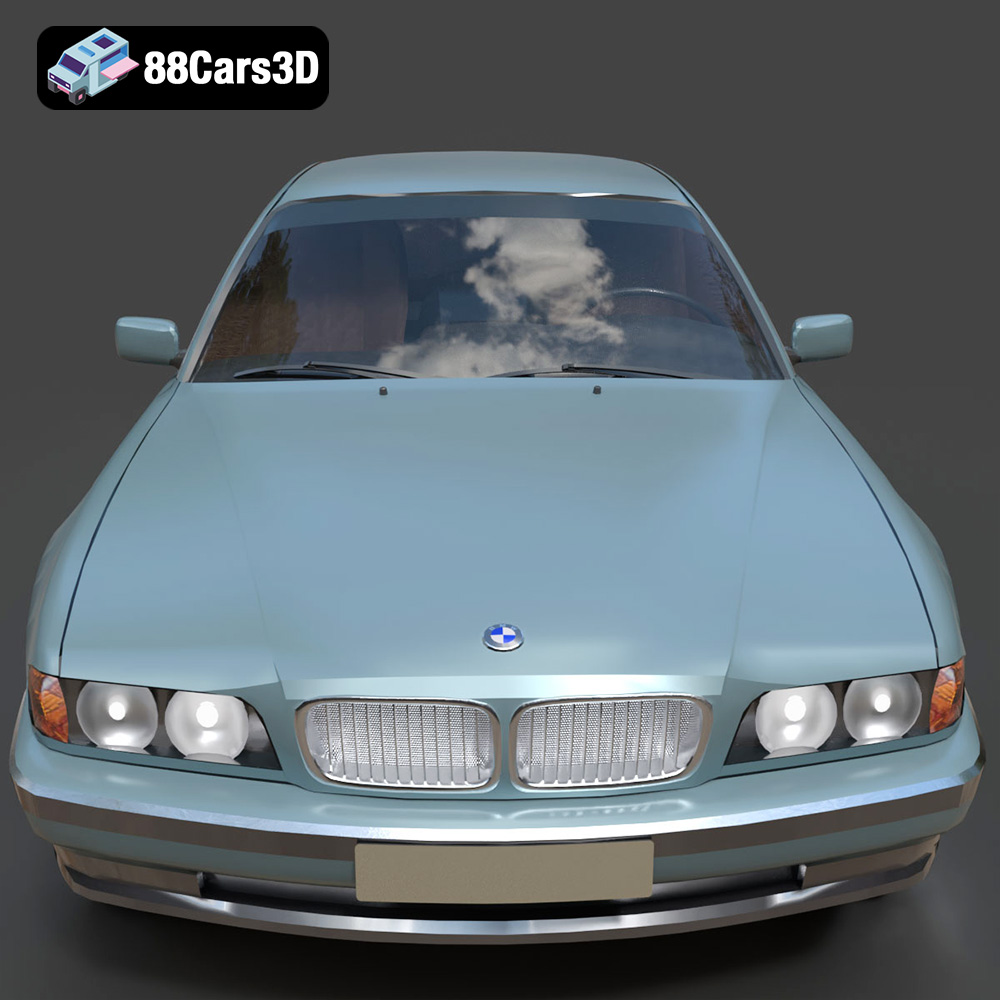
BMW 7 Series E38 3D Model
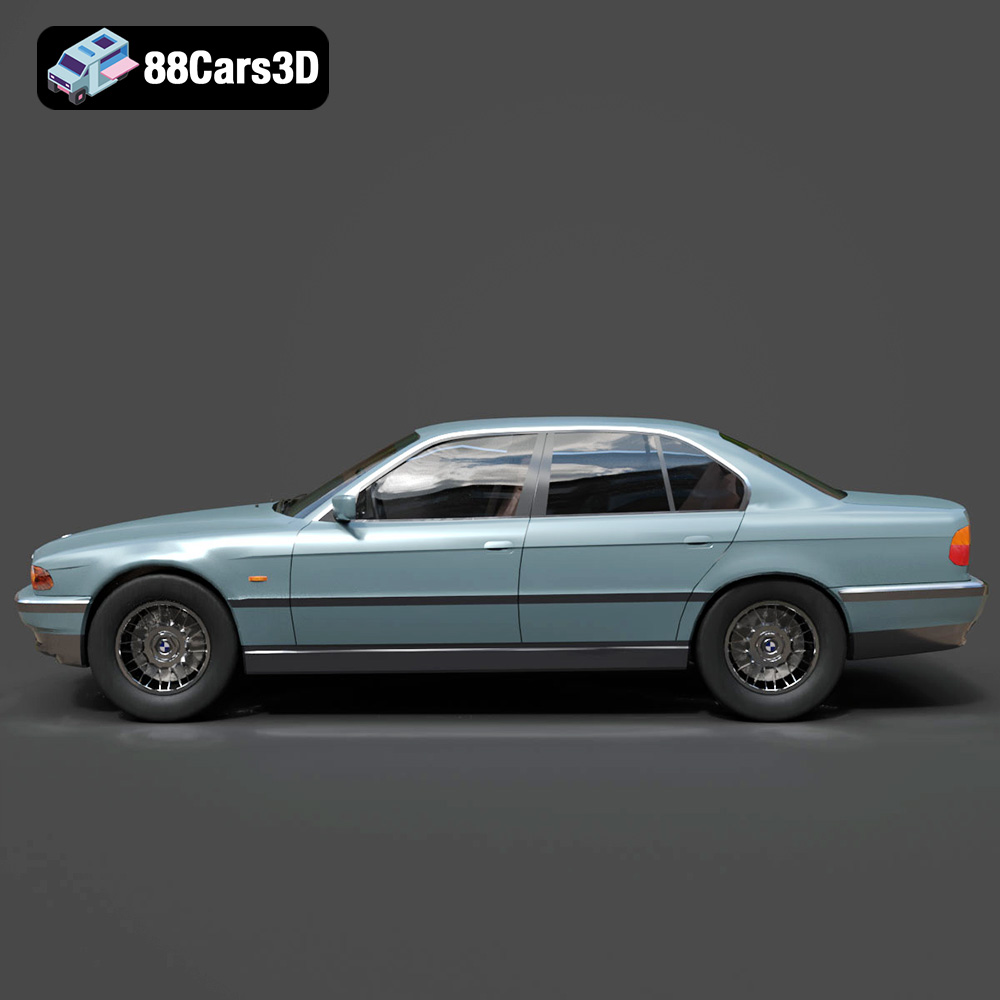
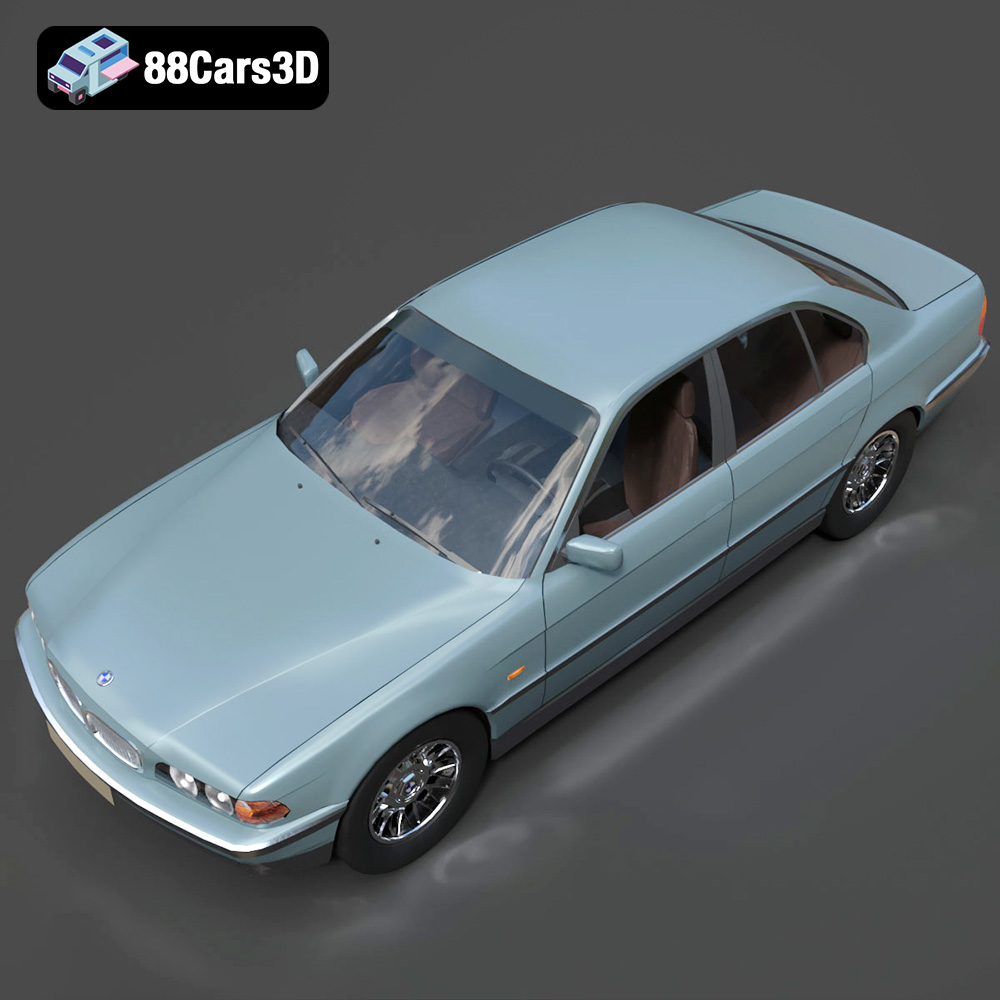
Experience the timeless elegance and sophisticated engineering of the BMW 7 Series E38 with this meticulously crafted 3D model. Representing the iconic luxury full-size sedan produced from 1994 to 2001, this model captures the distinctive lines and refined presence of a true automotive classic. Built with clean geometry and balanced detailing, it is optimized for high-quality rendering, realistic animation, immersive simulation, and efficient integration into game development projects.
Exterior Features:
- Accurately modeled body panels reflecting the E38’s signature design
- Detailed front grille, headlights, and taillights with transparent materials for realistic lighting
- Authentic wheel designs and realistic tire profiles
- Separated components like doors, hood, and trunk for ease of animation and customization
- Clear window glass and functional mirrors
Interior / Mechanical Features:
- Detailed dashboard with instrumentation, steering wheel, and center console controls
- Comfortable seating and door panel textures reflecting the luxury interior
- Optimized mesh quality to balance detail with performance, suitable for various applications
- Basic undercarriage and engine bay details for exterior renders
Technical Advantages:
- Clean quad-dominant topology ensures smooth subdivision and deformation
- Modeled to real-world scale for accurate integration into scenes
- Organized hierarchy with proper pivot points for easy manipulation and animation of parts
- UV unwrapped with appropriate texture mapping for high-fidelity renders
Applications:
- Rendering & Visualization: Perfect for high-resolution studio renders, cinematic scenes, and architectural visualizations
- Game Development: Optimized as a game asset for racing simulations, open-world environments, and interactive experiences
- AR/VR: Ideal for creating immersive augmented and virtual reality automotive showcases
- Simulation & Training: Suitable for driving simulators, automotive training modules, and engineering visualizations
- 3D Printing: Can be easily converted to .stl format for physical model production
Customization Options:
- Easily modify paint finishes, colors, and add custom graphics or liveries
- Adjust material properties for metals, chrome, rubber, glass, and plastics to match specific rendering styles
- Adapt lighting setups to achieve diverse scene moods and visual effects
This BMW 7 Series E38 3D model offers a professional-grade asset for any project requiring a blend of luxury, detail, and historical automotive significance. Its versatility across multiple platforms and applications makes it an indispensable addition to your 3D asset library.
Included File Formats:
- .blend – Blender project with materials
- .fbx – Compatible with Unreal, Unity, and major 3D engines
- .obj – Universal format for nearly all 3D software
- .glb – Optimized for AR, VR, and web-based visualization
- .stl – Ready for 3D printing
- .ply – Mesh format for analysis and CAD workflows
- .unreal – Unreal Engine project setup
- .max – Editable 3ds Max scene for rendering and animation
$10.79
Product Image Gallery



Related Tags
.7seriese38
.arvr
.blend
.bmw
.classiccar
.fbx
.gameasset
.glb
.luxurycar
.max
.obj
.ply
.rendering
.sedan
.simulation
.stl
.unreal
