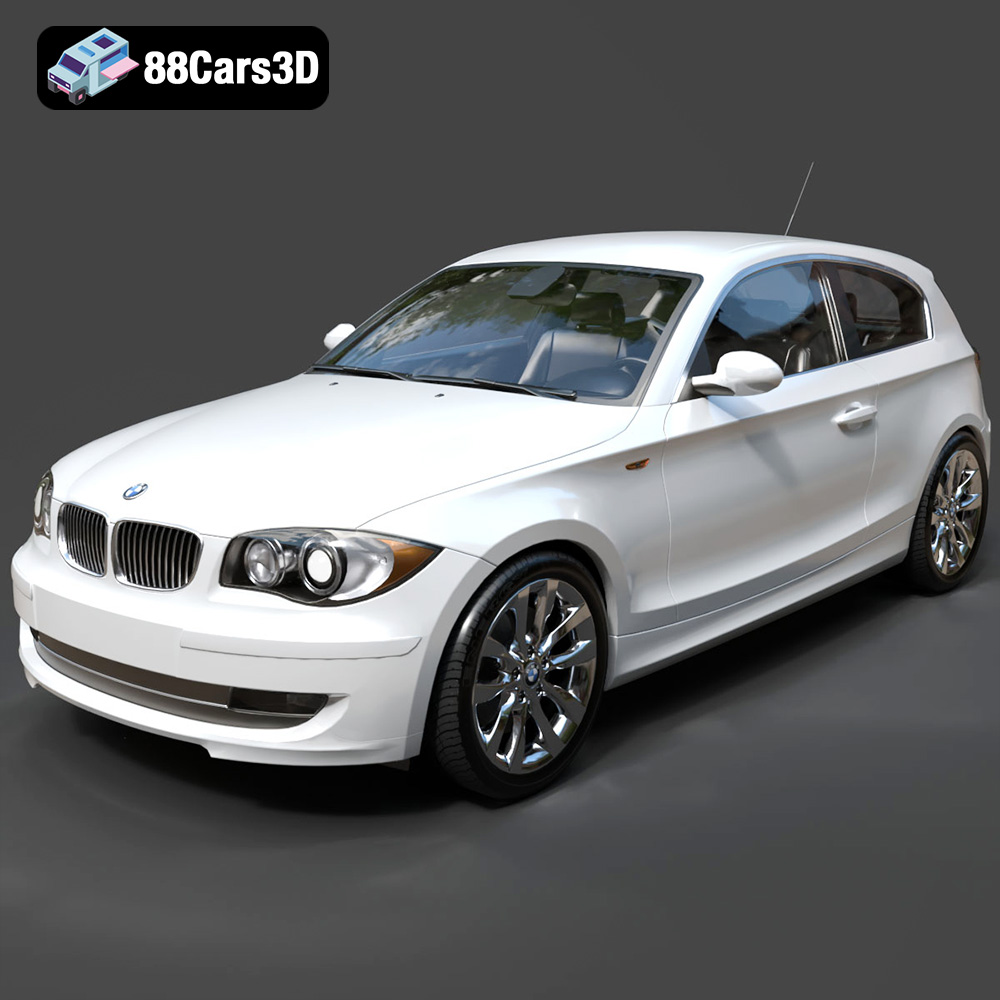
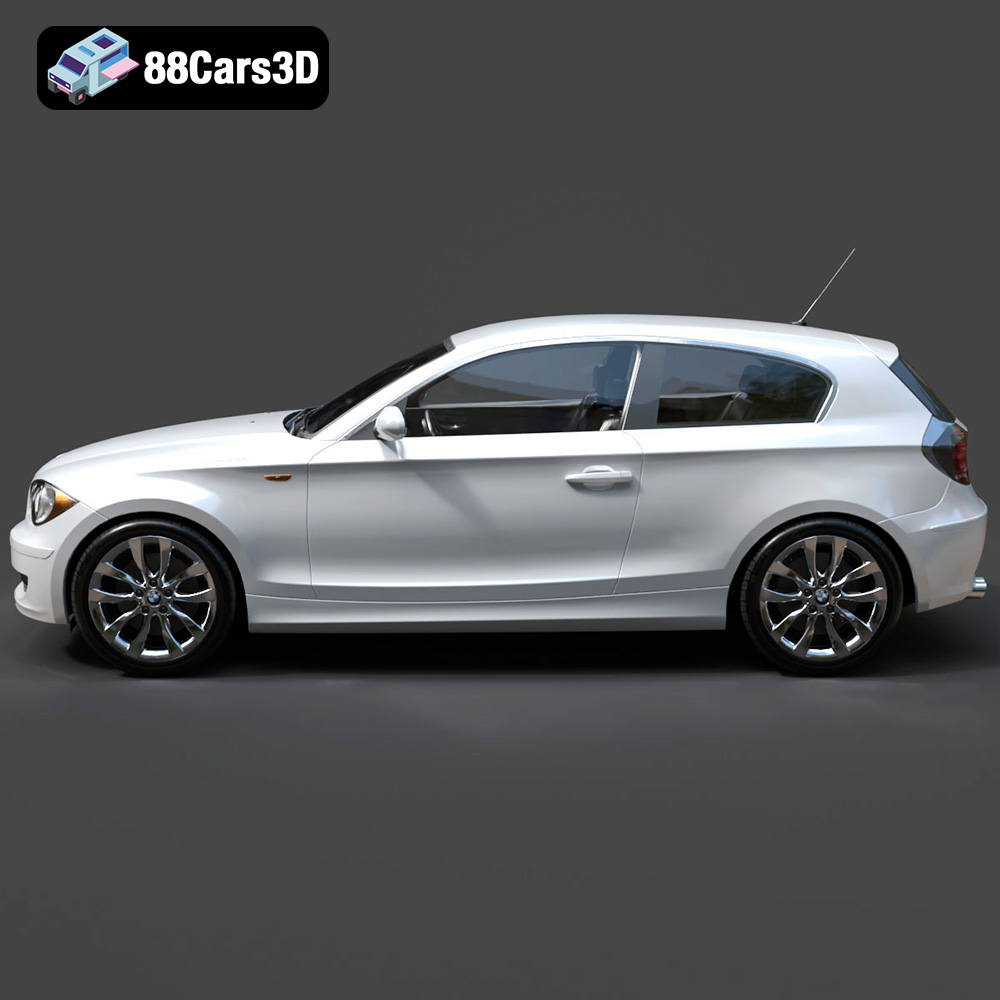
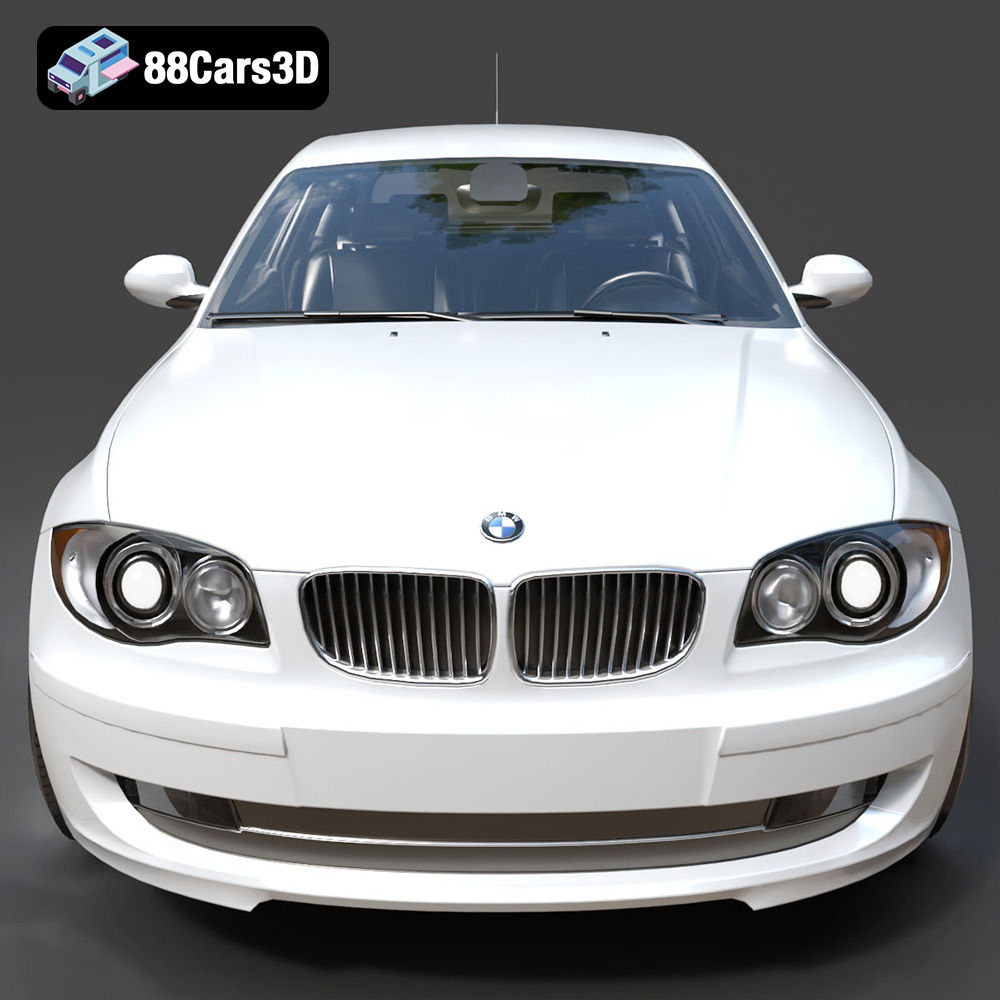
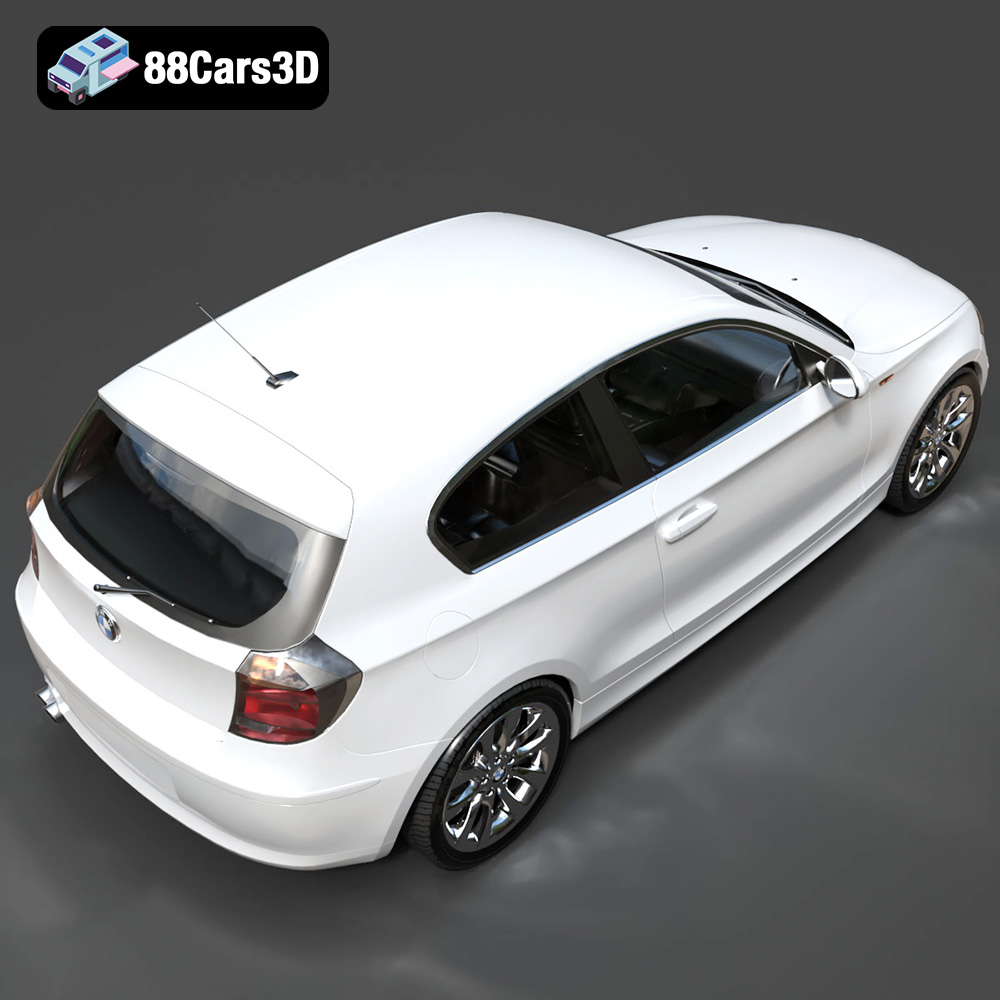
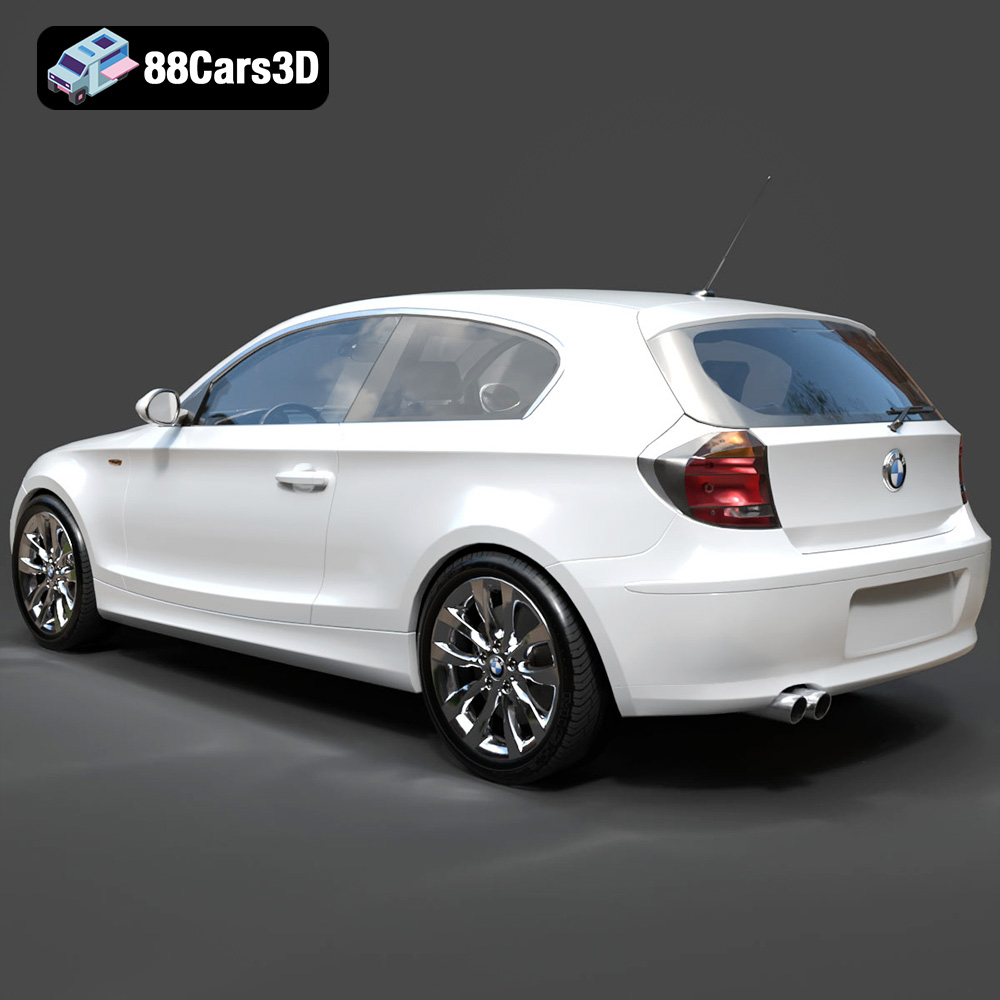
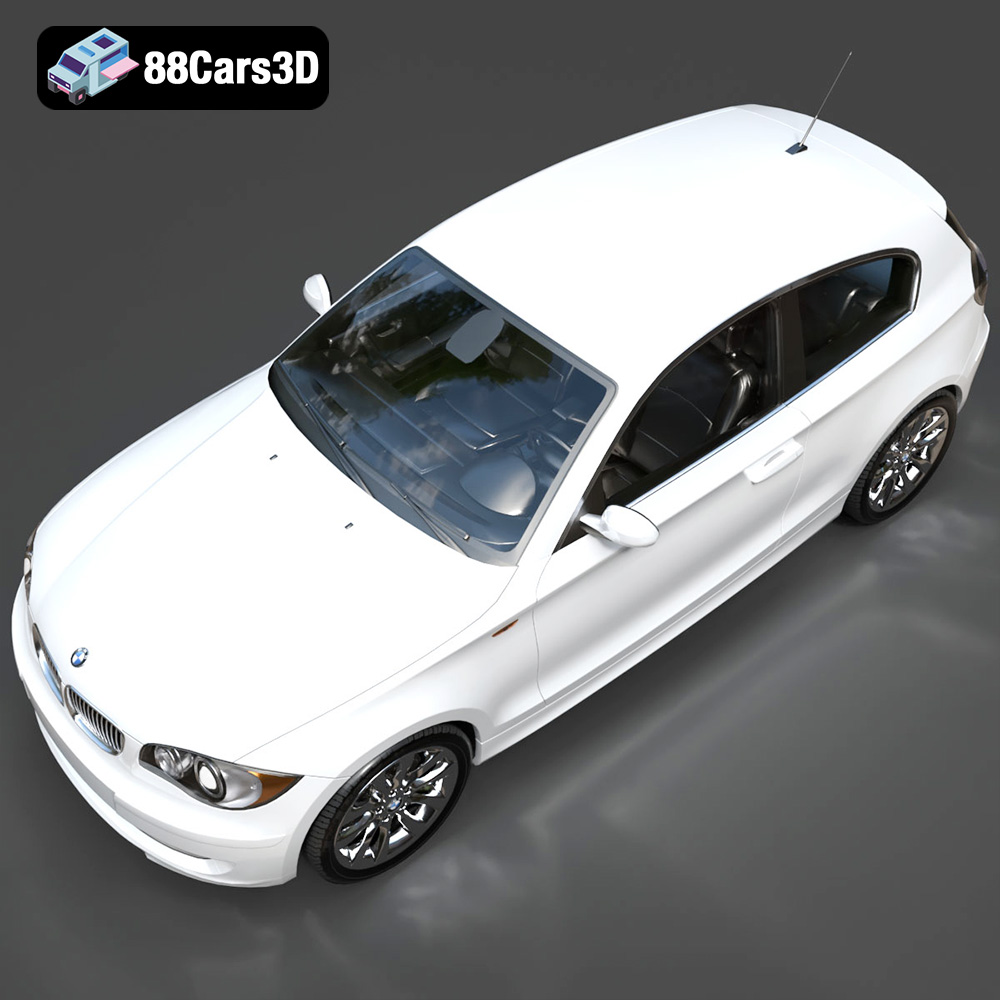
In the demanding world of 3D visualization, game development, and interactive experiences, the quality of your assets dictates the fidelity of your final output. Automotive models, in particular, require an exceptional level of detail, accuracy, and technical preparation to meet professional standards. From the gleam of a perfectly rendered paint job to the intricate mechanics beneath the chassis, every element contributes to a truly immersive and believable digital representation.
For artists, developers, and designers striving for photorealism and seamless integration, choosing the right 3D car models is paramount. It’s about more than just aesthetics; it’s about clean geometry, optimized textures, and versatile file formats that empower rather than hinder your creative process. Today, we’re diving deep into the technical prowess and multifaceted applications of a prime example of such an asset: the BMW 1 Series 3-Door E81 3D Model. This meticulously crafted digital recreation of BMW’s dynamic hatchback offers a robust foundation for everything from high-fidelity rendering to real-time game environments, providing a versatile tool for a wide spectrum of professional workflows.
We’ll explore how such a detailed model can elevate your projects, from its technical advantages like clean quad-dominant topology and real-world scale, to its adaptability across various platforms, including 3ds Max, Blender, Unreal Engine, and more. Understanding the nuances of high-quality 3D automotive assets is key to unlocking their full potential, and the BMW E81 serves as an excellent case study for what to look for in premium 3D car models.
Understanding 3D Model File Formats
One of the most critical aspects of any professional 3D asset, especially complex 3D car models like the BMW 1 Series 3-Door E81, is the range and quality of its included file formats. Different stages of a project, different software packages, and different end-use scenarios each demand specific file types to ensure maximum compatibility, efficiency, and fidelity. The BMW E81 model from 88cars3d.com exemplifies this versatility by offering a comprehensive suite of formats, each serving a unique purpose in the professional workflow.
.blend – Fully Editable Blender Scene with Materials
The .blend format is the native file type for Blender, an increasingly popular open-source 3D creation suite. When a 3D model is provided in .blend format, it means you’re getting a complete Blender scene, often with materials, textures, lighting, and even camera setups pre-configured. This is invaluable for artists who primarily work in Blender, offering full editability of the mesh, rigging, and shader networks without any loss of data that might occur during conversion. For the BMW E81, having a native .blend file ensures that all PBR (Physically Based Rendering) materials, intricate shader details, and scene organization are preserved for immediate use or modification within Blender.
.fbx – Ideal for Unreal, Unity, and Real-Time Pipelines
.fbx (Filmbox) is an industry-standard proprietary file format developed by Autodesk, widely used for exchanging 3D data between different 3D applications and game engines. It excels at transferring geometry, materials, animations, and even skeletal deformation data. Its strength lies in its robustness for interoperability, making it the go-to choice for integrating 3D car models into real-time environments like Unreal Engine and Unity. For the BMW E81, the .fbx file ensures that the model, its hierarchy, UVs, and basic material assignments translate accurately into these engines, forming the backbone of game assets and real-time visualizations.
.obj – Universal Format for Cross-Software Compatibility
The .obj (Wavefront OBJ) format is one of the oldest and most universally supported 3D file formats. It’s a simple, text-based format primarily used for transferring geometric data (vertices, normals, UV coordinates) and can reference external material files (.mtl). While it doesn’t support animation or advanced scene data, its widespread compatibility across virtually all 3D software makes it indispensable for cross-platform projects or as a fallback option. The BMW E81’s .obj version guarantees that the core mesh data is accessible in any 3D application, from Maya to Cinema 4D, providing a solid foundation for further development.
.glb – Optimized for AR, VR, and Browser-Based Display
.glb (GL Transmission Format Binary) is an increasingly important format, especially for web-based 3D, Augmented Reality (AR), and Virtual Reality (VR) applications. It’s a binary version of glTF, which packages 3D model data (geometry, materials, textures, animations) into a single, self-contained file. This makes .glb files incredibly efficient for transmission and loading, ideal for displaying interactive 3D content directly in web browsers or AR/VR experiences. The BMW E81 in .glb format is perfectly optimized for immersive viewing and integration into lightweight, interactive environments.
.stl – Suitable for 3D Printing Output
The .stl (Stereolithography) format is the standard file type for 3D printing. It represents a 3D model as a series of connected triangles, describing only the surface geometry without color or texture information. While additional preparation is often required to ensure a watertight, manifold mesh for successful printing, providing an .stl version of the BMW E81 model offers a direct path from digital asset to physical prototype. This is crucial for product design, prototyping, and creating tangible representations of digital concepts.
.ply – Precision Mesh Format for CAD or Analysis
.ply (Polygon File Format) is another format for storing 3D data, particularly useful for scanned data, CAD, and scientific applications where precision and a detailed description of the mesh are paramount. It can store a wider range of properties than .obj, including color, transparency, and even specific normal data per vertex. For the BMW E81, the .ply format ensures that the precise geometry and vertex data are available for advanced analysis, reverse engineering, or integration into CAD workflows where accuracy is critical.
.unreal – Engine-Ready Asset for Real-Time Environments
The inclusion of an .unreal file directly signifies an asset that has been specifically prepared and configured for Unreal Engine. This typically means the asset is not just imported, but set up with proper materials, collision meshes, LODs (Levels of Detail), and potentially even basic blueprints for interactive components within the Unreal ecosystem. For game developers and real-time visualization artists, this “engine-ready” format of the BMW E81 dramatically accelerates integration, reducing setup time and ensuring optimal performance within Unreal Engine.
.max – Editable 3ds Max Project for Animation and Rendering
Finally, the .max format is the native file type for Autodesk 3ds Max, a powerhouse in architectural visualization, product rendering, and animation. A .max file of the BMW E81 means the model is provided in its native environment, complete with editable modifiers, advanced V-Ray or Corona materials, lighting setups, and animation rigs. This offers the highest level of flexibility for professional rendering artists and animators who require full control over every aspect of the scene for producing high-fidelity images and cinematic sequences.
The availability of all these formats for the BMW 1 Series 3-Door E81 3D Model underscores its professional-grade quality and unparalleled versatility, making it a truly future-proof asset for any project.
The Art of Automotive Rendering: Bringing the BMW E81 to Life
Automotive rendering is a specialized field that demands an acute understanding of light, material science, and composition. The goal is often to create images so realistic they are indistinguishable from photographs. The BMW 1 Series 3-Door E81 3D Model, with its “accurately modeled body panels and sleek automotive lines,” provides an exceptional canvas for achieving these photorealistic results. When working with high-quality 3D car models, the focus shifts from fixing geometry to finessing the details that bring a scene to life.
High-Fidelity Visualization with 3ds Max
For many professionals, 3ds Max remains a cornerstone for high-fidelity rendering. The native .max file included with the BMW E81 model is a testament to this, offering a ready-to-render setup that can be customized. Within 3ds Max, artists leverage powerful renderers like V-Ray or Corona to simulate real-world light physics. This involves setting up physically accurate cameras, choosing appropriate HDRI (High Dynamic Range Image) environments for realistic reflections and illumination, and fine-tuning global illumination settings. The clean topology of the BMW E81 ensures smooth subdivision, preventing unsightly artifacts and making it ideal for close-up renders where surface imperfections would be glaringly obvious.
Crafting Realistic Materials and Lighting
The magic of automotive rendering often lies in its materials. Car paint, in particular, is a complex shader requiring multiple layers of reflection, clear coat, and metallic flakes. The BMW E81 model is designed to support advanced material properties for its “reflective paint finishes and chrome accents,” allowing artists to precisely dial in parameters for glossiness, anistropy, and Fresnel reflections. Detailed headlamps and taillights with transparent materials further enhance realism, while high-resolution wheel and tire treads add crucial detail that holds up even in extreme close-ups. Beyond the car itself, meticulous lighting setup—including rim lights, fill lights, and often complex studio setups—is essential to highlight the car’s contours and create dramatic visual appeal. The properly set pivot points for components like doors and the hood also mean that cinematic animations can be effortlessly choreographed, further enhancing the model’s visual narrative.
Post-Production Techniques for Cinematic Results
Even the best raw render can be elevated through professional post-production. Software like Adobe Photoshop or Nuke can be used to refine colors, adjust contrast, and add atmospheric effects. Techniques such as depth of field, subtle motion blur for animated sequences, lens flares, and chromatic aberration can inject a cinematic quality into automotive renders. Combining multiple render passes (e.g., diffuse, reflection, refractions, Z-depth) allows for non-destructive adjustments, giving artists immense control over the final image. The sheer quality of the BMW E81 3D model means less time spent correcting render issues and more time focused on artistic enhancements, translating directly into more impactful and visually stunning marketing materials or architectural visualizations.
Driving Innovation: The BMW E81 in Game Development
The gaming industry thrives on immersion and interactivity, and high-quality 3D car models are central to delivering these experiences. Whether it’s a high-octane racing simulator or a sprawling open-world adventure, vehicles must not only look convincing but also perform optimally in real-time environments. The BMW 1 Series 3-Door E81 3D Model is engineered precisely for this purpose, described as “optimized for efficient rendering and real-time applications,” making it an ideal game asset.
Optimizing for Real-Time Performance (Unreal/Unity)
Game development requires a careful balance between visual fidelity and performance. The BMW E81’s “balanced level of detail” and “optimized mesh quality” are key here. While a high-poly model is great for rendering, game engines often demand optimized polygon counts and efficient UV mapping to maintain high frame rates. For the BMW E81, the provided .fbx and .unreal formats are crucial. These engine-ready assets likely include pre-configured LODs (Levels of Detail), where simplified versions of the model are swapped in as the car moves further from the camera, dramatically reducing render load without a noticeable drop in visual quality. Collision meshes, essential for realistic physics interactions, are also typically part of well-prepared game assets.
Integrating into Open-World Environments
In large open-world games, vehicles are more than just props; they are often central to traversal and gameplay. Integrating the BMW E81 into such environments involves several steps. Its “modeled to real-world scale” characteristic ensures accurate scaling alongside other environmental assets. Developers will apply vehicle physics systems (e.g., Chaos Vehicle in Unreal, standard physics in Unity) to simulate realistic handling, suspension, and tire grip. The detailed interior, including the dashboard and seating, becomes vital for first-person driving perspectives, enhancing player immersion. Efficient asset streaming techniques are also employed to load and unload the car model and its textures as the player moves through the world, ensuring smooth transitions and minimal loading screens.
Animating the E81 for Dynamic Gameplay
A static car model has limited appeal in a game; it needs to move and react. The BMW E81 model, with its “separated components like doors, hood, and trunk for animation workflows” and “properly set pivot points,” is designed with animation in mind. This allows developers to easily animate wheels for realistic rotation, create suspension compression and rebound, and enable interactive elements like opening doors, bonnets, or trunks. Basic undercarriage and visible suspension components further enhance the realism for players who might inspect their vehicle or experience damage. These interactive elements are often driven by gameplay logic through scripting or visual scripting tools like Unreal Engine’s Blueprints, turning a static mesh into a dynamic, player-controlled vehicle.
Beyond the Screen: AR/VR, Simulation, and 3D Printing
The applications for high-quality 3D car models extend far beyond traditional rendering and game development. As technology evolves, so too do the ways we interact with digital assets. The BMW 1 Series 3-Door E81 3D Model’s comprehensive file format support and technical advantages position it perfectly for emerging fields like Augmented Reality (AR), Virtual Reality (VR), advanced simulations, and even physical manufacturing through 3D printing.
Immersive Experiences with GLB and STL
For AR/VR applications, efficiency and accessibility are paramount. The .glb format, specifically optimized for AR, VR, and web-based visualization, allows the BMW E81 to be seamlessly integrated into immersive experiences. Imagine viewing the BMW E81 in your driveway via an AR app, or exploring its interior in a VR showroom. The compact, single-file nature of .glb ensures quick loading times and broad compatibility across different AR/VR platforms, making it an ideal choice for interactive product showcases or virtual test drives. For physical representation, the .stl format is essential for 3D printing. While some models may require additional preparation to ensure watertight geometry suitable for additive manufacturing, providing the .stl file facilitates the transition from digital to tangible, allowing for the creation of physical models for display, prototyping, or educational purposes.
Precision for Simulation and Training
Accuracy is non-negotiable in simulation and training environments. Driving simulators, for instance, demand vehicles modeled to “real-world scale” with accurate geometry and components to provide a realistic experience. The BMW E81’s “detailed dashboard, steering wheel, and control console” are crucial for training scenarios where visual feedback and precise interaction with the vehicle’s interior are necessary. Educational modules can utilize the model to teach automotive design, engineering principles, or even mechanics, highlighting specific components like the “basic undercarriage and visible suspension components.” The .ply format can also play a role here, offering a high-precision mesh for detailed analysis or integration into specialized CAD/CAM software for engineering simulations.
From Digital to Physical: 3D Printing the E81
The ability to convert a 3D model into a physical object through 3D printing opens up a world of possibilities. While the BMW E81 is provided with an .stl file, the actual process of 3D printing involves careful preparation. This includes checking for manifold geometry (no holes or non-closed surfaces), ensuring appropriate wall thickness, and adding necessary support structures depending on the printing technology. Artists and designers can use a 3D printed version of the E81 for rapid prototyping, creating scaled models for display, or even testing ergonomic elements. It bridges the gap between the virtual and the tangible, making the digital asset truly versatile. The clean geometry of the 88cars3d.com model makes this transition smoother, requiring less pre-processing for a successful print.
The Technical Edge: Why Quality 3D Car Models Matter
The true value of a premium 3D asset like the BMW 1 Series 3-Door E81 3D Model lies in its underlying technical excellence. While visual appeal is often the first thing noticed, it’s the invisible structural and organizational attributes that determine a model’s long-term utility, flexibility, and performance across diverse applications. Investing in high-quality 3D car models from a reputable source like 88cars3d.com saves countless hours in rework and ensures a smoother, more efficient production pipeline.
Clean Topology and UV Mapping
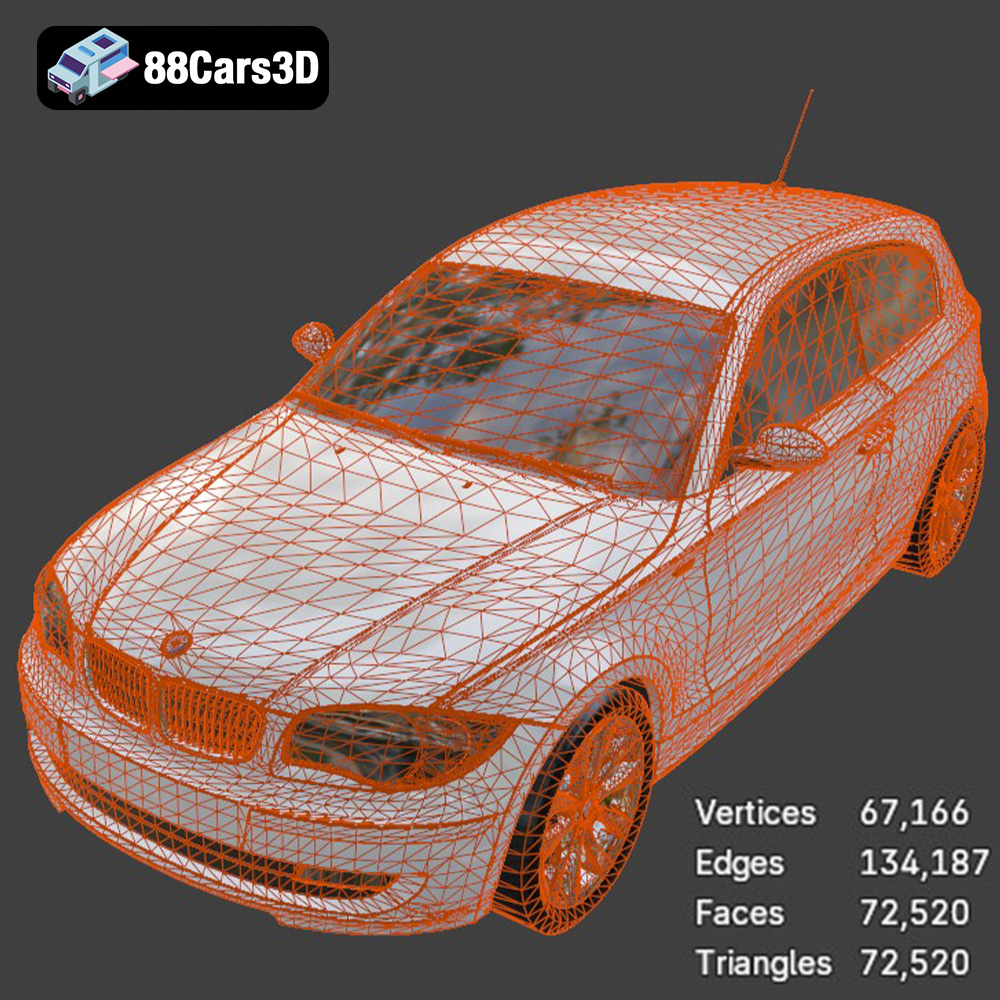
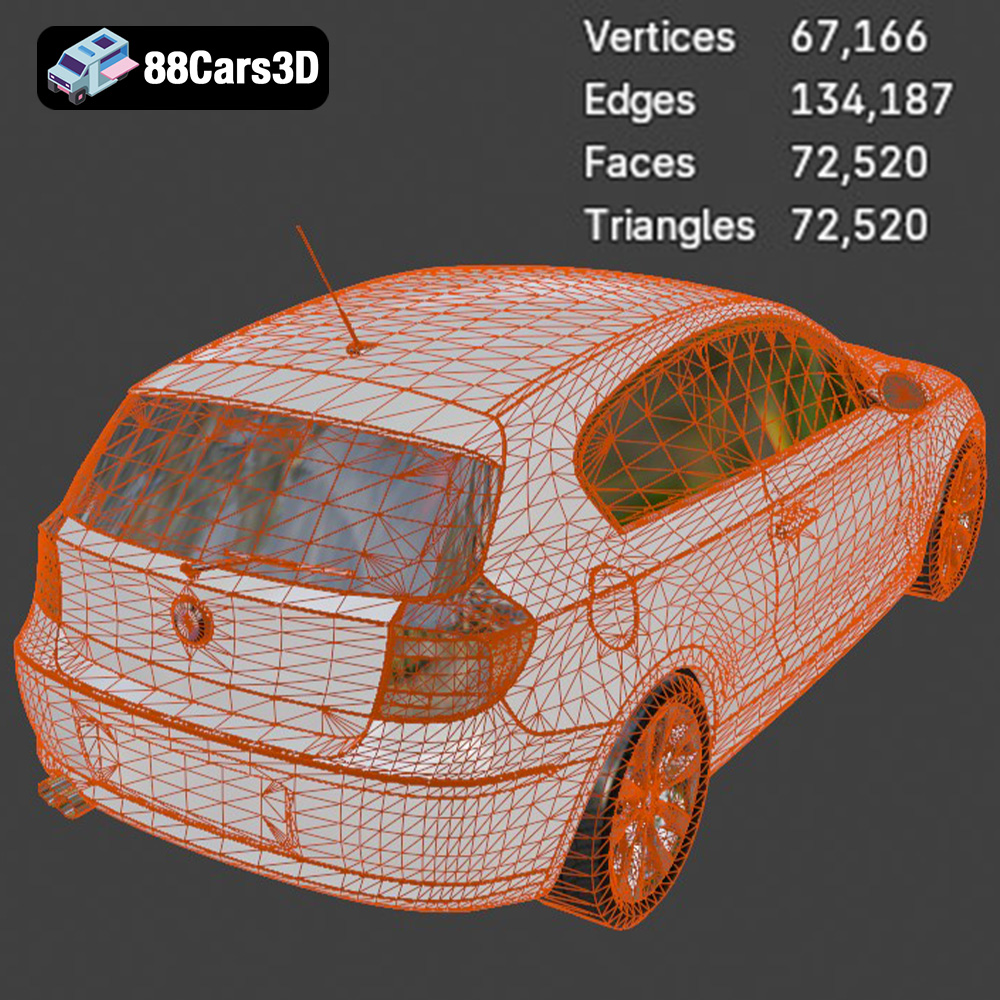
At the heart of any excellent 3D model is its topology – the arrangement of vertices, edges, and faces that form the mesh. The BMW E81 boasts “clean quad-dominant topology for smooth subdivision and deformation.” Quad-dominant means the model is primarily built with four-sided polygons, which are ideal for subdivision surfaces (like MeshSmooth or TurboSmooth) that create smooth, curved surfaces without pinching or artifacts. This is critical for automotive models where sleek lines and perfectly curved panels are essential. Coupled with this is meticulous UV mapping, which is the process of unfolding the 3D mesh into a 2D space to apply textures. Proper UVs ensure textures wrap seamlessly, minimize distortion, and allow for efficient texture painting and baking of details like ambient occlusion or normal maps, leading to a much more realistic final product.
Real-World Scale and Asset Organization
A common pitfall with lower-quality assets is incorrect scaling. The BMW E81 is “modeled to real-world scale,” which is fundamental for accurate integration into any scene, be it an architectural visualization, a driving simulator, or a game environment. Correct scale ensures that physics simulations behave realistically and that the model fits naturally alongside other assets without manual resizing. Beyond scale, the model features an “organized hierarchy with properly set pivot points for easy animation.” This means that individual components like wheels, doors, hood, and trunk are separate objects, correctly grouped, and have their pivot points (the center of rotation) accurately placed. This organization is a professional standard that drastically simplifies animation workflows, allowing artists to quickly rig and animate car components without tedious setup or guesswork.
Versatility and Customization Potential
Even the most detailed 3D car model wouldn’t be truly professional without the capacity for customization. The BMW E81 excels in this regard, offering extensive “customization options.” Artists can “easily modify paint finishes and apply custom graphics or liveries,” which is vital for branding, diverse visual variations in games, or client-specific renders. The ability to “adjust material properties for metal, glass, rubber, and plastics” means the model can be adapted to various lighting conditions, stylistic demands, or even specific manufacturing material representations. Furthermore, the flexibility to “customize lighting setups” allows the model to seamlessly integrate into any scene or mood, whether it’s a dramatic studio render, a sunny outdoor environment, or a moody night scene. This inherent versatility ensures that the BMW E81 model remains a valuable asset across countless projects and creative interpretations.
Conclusion
The world of 3D modeling for automotive design, rendering, and game development is a complex and evolving landscape. Success hinges not just on artistic vision but on the technical integrity and versatility of the 3D assets you employ. The BMW 1 Series 3-Door E81 3D Model stands as a prime example of what a high-quality, professional-grade 3D car model should offer: meticulous detail, clean geometry, comprehensive file format support, and robust optimization for a myriad of applications.
From producing stunning photorealistic renders in 3ds Max, to integrating seamlessly into real-time game engines like Unreal, to enabling immersive AR/VR experiences, and even providing a foundation for physical 3D prints, this model demonstrates the power of a well-crafted digital asset. Its organized hierarchy, real-world scale, and clean quad-dominant topology are not just buzzwords; they are fundamental technical advantages that save time, enhance performance, and unlock creative potential for professionals across industries.
For those seeking to elevate their projects with unparalleled realism and efficiency, investing in assets like the BMW 1 Series 3-Door E81 3D Model from 88cars3d.com is a strategic decision. It’s an investment in quality, versatility, and the technical foundation necessary to bring your most ambitious digital visions to life, ensuring your work stands out in a competitive and visually driven market.
Featured 3D Model
BMW 1 Series 3-Door E81 3D Model
Experience the precision and iconic design of the BMW 1 Series 3-Door E81 with this meticulously crafted 3D model. Representing the dynamic and compact nature of BMW’s popular hatchback, this model is built with clean geometry and a balanced level of detail, making it ideal for a wide range of professional applications. Whether for high-fidelity rendering, realistic animations, immersive simulations, or integrating into game development projects, this model provides a versatile and high-quality asset.
Exterior Features:
- Accurately modeled body panels and sleek automotive lines
- Detailed headlamps and taillights with transparent materials for realism
- Authentic BMW grille and badging
- High-resolution wheels and tire treads
- Separated components like doors, hood, and trunk for animation workflows
- Reflective paint finishes and chrome accents
Interior / Mechanical Features:
- Detailed dashboard, steering wheel, and control console
- Comfortable seating and textured upholstery
- Optimized mesh quality for performance without sacrificing detail
- Basic undercarriage and visible suspension components for a complete representation
Technical Advantages:
- Clean quad-dominant topology for smooth subdivision and deformation
- Modeled to real-world scale for accurate integration into projects
- Organized hierarchy with properly set pivot points for easy animation
- Optimized for efficient rendering and real-time applications
Applications:
- Rendering & Visualization: Create stunning studio renders, cinematic scenes, and architectural visualizations.
- Game Development: Perfect as a vehicle asset for racing games, open-world environments, and interactive experiences.
- AR/VR: Integrate into augmented and virtual reality applications for immersive viewing and training.
- Simulation & Training: Utilize for driving simulators, educational modules, and technical demonstrations.
- 3D Printing: Convertible to .stl for creating physical models (additional preparation may be required).
Customization Options:
- Easily modify paint finishes and apply custom graphics or liveries.
- Adjust material properties for metal, glass, rubber, and plastics to match specific scene requirements.
- Customize lighting setups to achieve desired atmospheric effects and reflections.
This BMW 1 Series 3-Door E81 3D model offers unparalleled quality and versatility, serving as an essential asset for professionals seeking realism and efficiency in their projects. Elevate your visualizations and interactive experiences with this meticulously crafted digital asset.
Included File Formats:
- .blend – Blender project with materials
- .fbx – Compatible with Unreal, Unity, and major 3D engines
- .obj – Universal format for nearly all 3D software
- .glb – Optimized for AR, VR, and web-based visualization
- .stl – Ready for 3D printing
- .ply – Mesh format for analysis and CAD workflows
- .unreal – Unreal Engine project setup
- .max – Editable 3ds Max scene for rendering and animation
Tags:
.bmw, .1series3doore81, .hatchback, .compactcar, .rendering, .simulation, .gameasset, .arvr, .blend, .fbx, .obj, .glb, .stl, .ply, .unreal, .maxMercedes Benz CLS 500 3D Model
$14.79
Product Image Gallery