

Elevating Digital Realism: The Indispensable Role of Premium 3D Car Models in Modern Visualization
In the rapidly evolving landscape of digital content creation, the demand for photorealistic assets continues to soar. From cinematic sequences and high-fidelity game environments to immersive AR/VR experiences and detailed architectural visualizations, the foundation of compelling visual storytelling often rests on the quality of its core assets. Automotive design, in particular, requires an unparalleled level of precision and aesthetic fidelity. This is where truly exceptional 3D car models become not just useful, but absolutely essential.
Imagine needing to showcase the aggressive stance and luxurious details of a brand new performance vehicle, long before its physical production is complete. Or perhaps populate a sprawling open-world game with vehicles that look indistinguishable from their real-world counterparts. This is the realm where models like the BMW M3 2024 3D Model shine, offering artists and developers a powerful tool to bring their visions to life with stunning accuracy. This precision-engineered asset captures the essence of performance luxury, meticulously reproducing the iconic grille design, dynamic silhouette, and every subtle curve of the modern M3 generation. Optimized for close-up renders and demanding simulation environments, it ensures visual fidelity across all professional applications, serving as a testament to the value of high-quality 3D car models in today’s digital age.
Understanding 3D Model File Formats: The Backbone of Digital Workflow
The versatility of a premium 3D model isn’t just in its visual quality, but also in its accessibility across various software and platforms. This hinges entirely on the file formats it supports. Each format is designed with specific use cases, advantages, and technical characteristics in mind. Understanding these distinctions is crucial for seamless integration into diverse professional pipelines.
.blend – The Blender Powerhouse
The .blend format is the native file type for Blender, a popular open-source 3D creation suite. A .blend file like the one included with the BMW M3 2024 3D Model typically encapsulates the entire scene: the 3D mesh data, materials (often configured for Blender’s Cycles or Eevee render engines), textures, lighting setups, cameras, animations, modifiers, and even custom scripts. This makes it a complete, fully editable project file. For artists working primarily in Blender, it offers the ultimate flexibility for modifications, re-texturing, animation, or integration into existing Blender scenes. Its self-contained nature ensures that all scene data travels together, minimizing setup time.
.fbx – The Industry Workhorse for Interoperability
Developed by Autodesk, .fbx (Filmbox) is arguably one of the most widely adopted 3D exchange formats, particularly in game development and animation. It excels at preserving complex scene data such as mesh geometry, materials (though often simplified to basic properties for exchange), textures, bone animations, rigging, and camera information. The .fbx format is ideal for moving assets between different 3D software (e.g., from 3ds Max or Blender to Unreal Engine or Unity). Its robust support for skeletal animation and hierarchies makes it the go-to choice for dynamic assets, ensuring that a 3D car model can be easily integrated and animated within a game engine.
.obj – The Universal Geometry Standard
.obj (Wavefront Object) is one of the oldest and most universally supported 3D file formats. It primarily stores geometric data – vertices, faces, normals, and UV coordinates – and can reference external material (.mtl) and texture files. While it doesn’t support advanced features like animation, rigging, or scene lights, its simplicity and widespread compatibility make it an excellent choice for basic mesh exchange between virtually any 3D software. For the BMW M3 2024 3D Model, the .obj version serves as a reliable fallback, ensuring that even niche or older applications can import and render the base geometry.
.glb – The AR/VR and Web-Optimized Choice
.glb (GL Transmission Format Binary) is the binary version of glTF, an open-standard 3D file format developed by the Khronos Group. It’s specifically designed for efficient transmission and loading of 3D scenes and models in web browsers, AR (Augmented Reality), and VR (Virtual Reality) applications. A key advantage of .glb is its self-contained nature, embedding all textures, animations, and other data directly into a single file, reducing HTTP requests and streamlining deployment. It supports Physically Based Rendering (PBR) materials, ensuring consistent visual quality across different renderers. For interactive 3D car models in a browser or mobile AR app, .glb is the superior choice for performance and ease of integration.
.stl – The 3D Printing Specialist
.stl (STereoLithography) is the standard file format for 3D printing. It represents a 3D model as a series of connected triangles, describing only the surface geometry without color, texture, or material information. The key requirement for an .stl file is that it must represent a “watertight” mesh, meaning it has no holes or gaps, ensuring that the 3D printer can accurately interpret the object’s volume. While not used for rendering, having an .stl version of the BMW M3 2024 3D Model allows for physical prototyping, miniature creation, or design verification through 3D printing.
.ply – Precision Mesh for Analysis and Scan Data
.ply (Polygon File Format or Stanford Triangle Format) is primarily used for storing 3D data from 3D scanners, CAD software, or for applications requiring precise mesh data. It can store not only XYZ coordinates but also color, normals, transparency, and even properties like confidence values or texture coordinates per vertex or face. While less common for general rendering than .fbx or .obj, its ability to store detailed information makes it valuable for scientific visualization, analysis, or when working with highly precise captured data, offering a robust representation of the BMW M3’s geometry.
.unreal – Engine-Ready for Real-Time Dominance
While not a universal file format in the traditional sense, the term “.unreal” often refers to assets that are fully configured and optimized for direct import and use within Unreal Engine. This typically means an .fbx file that has been meticulously prepared with proper mesh scaling, PBR material assignments (using Unreal’s material system), LODs (Levels of Detail), collision meshes, and sometimes even pre-configured blueprints or animation sequences. Having an “.unreal” version of a 3D car model like the BMW M3 2024 significantly reduces development time for game artists and real-time visualization specialists, ensuring peak performance and visual quality within the engine.
.max – The 3ds Max Project File
.max is the native file format for Autodesk 3ds Max, a powerful 3D modeling, animation, and rendering software widely used in architectural visualization, product design, and cinematic production. Similar to .blend, a .max file contains the complete scene data, including geometry, materials (often V-Ray, Corona, or Arnold specific), lighting, cameras, animation keyframes, and modifiers. For professionals entrenched in the 3ds Max ecosystem, this file offers the highest degree of editability and allows for seamless integration into complex rendering and animation pipelines without any loss of data fidelity inherent in conversion processes.
The Art and Science of High-Fidelity Automotive 3D Modeling
Creating a 3D car model of the caliber of the BMW M3 2024 is a demanding blend of artistic skill and technical precision. It goes far beyond simply replicating shapes; it involves understanding automotive design language, manufacturing processes, and the subtle interplay of light on complex surfaces.
Meticulous Reproduction of Design Aesthetics
The BMW M3 2024 is characterized by its aggressive styling, distinctive kidney grille, sculpted body lines, and aerodynamic elements. A high-quality 3D model must capture these nuances with absolute fidelity. This means paying attention to the exact curvature of the hood, the sharpness of the character lines along the doors, and the intricate details of the headlight and taillight clusters. The model’s description highlights “meticulously reproducing the aggressive styling, iconic grille design, and dynamic silhouette,” indicating this level of care has been taken. This realism is paramount for automotive marketing and configurator applications where brand identity and design accuracy are critical.
Structurally Clean Topology and UV Mapping
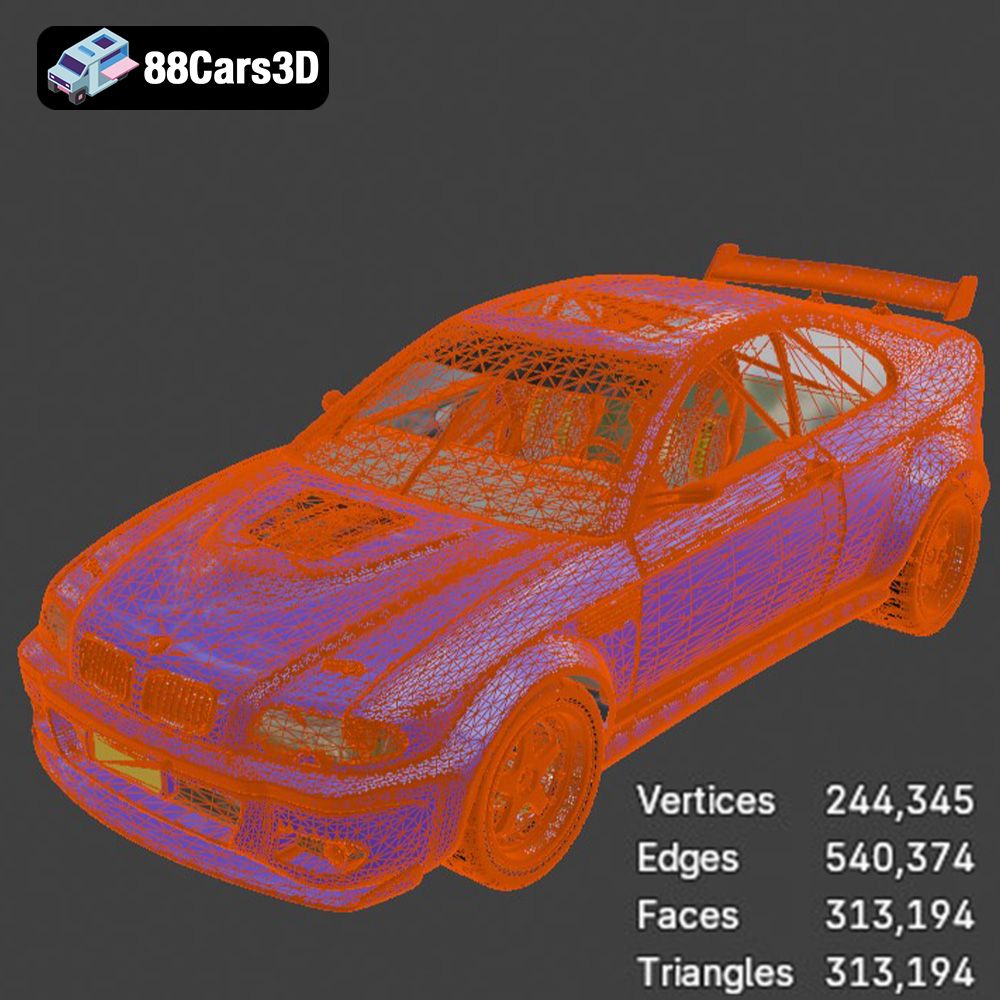
Underneath the stunning visuals lies a critical technical foundation: the topology. “Structurally clean topology” means the mesh is constructed with quads (four-sided polygons) where possible, with minimal triangles or n-gons, leading to smooth subdivision, deformation, and rendering. This is essential for clean reflections and realistic shadows. Alongside this, professional UV mapping is crucial. UVs dictate how 2D textures wrap around the 3D surface. Accurate, non-overlapping UVs ensure textures like paint, carbon fiber, or dashboard details appear crisp and distortion-free, making the BMW M3 2024 3D Model ready for advanced material setups.
Professionally Configured Materials and Textures
The perceived realism of a 3D car model heavily relies on its materials. The BMW M3 2024 3D Model features “professionally configured materials designed to react realistically to virtual lighting.” This implies the use of Physically Based Rendering (PBR) workflows, where materials are defined by properties like albedo (base color), roughness, metallicness, normal maps, and ambient occlusion. These properties ensure that the virtual paint gleams correctly, chrome reflects accurately, and tire rubber absorbs light realistically, regardless of the lighting conditions in the virtual scene. This attention to material science is what transforms a good model into a truly spectacular one, especially for automotive rendering.
Integrating 3D Car Models into Professional Workflows
The true value of a versatile asset like the BMW M3 2024 3D Model lies in its ability to seamlessly integrate into diverse professional pipelines. From generating marketing imagery to populating interactive simulations, its utility is broad.
Automotive Rendering for Marketing and Visualization
For advertising agencies, automotive manufacturers, and visualization studios, high-quality 3D car models are indispensable. The BMW M3 2024 3D Model, with its “unparalleled realism” and “optimized for close-up renders,” is perfect for creating stunning marketing visuals. Imagine a campaign showcasing the M3 in an urban environment, a scenic drive, or a studio setting. Using software like 3ds Max or Blender with render engines such as V-Ray, Corona Renderer, Cycles, or Arnold, artists can control every aspect of lighting, camera angles, and environment to produce photorealistic stills and animations. The included .max and .blend files with pre-configured materials simplify this process significantly, cutting down on setup time and allowing artists to focus on creative direction.
Game Development: High-Fidelity Game Assets
Modern video games demand increasingly realistic visuals. The BMW M3 2024 3D Model serves as an excellent game asset for racing simulators, open-world games, or even mobile titles. The included .fbx and .unreal formats are specifically tailored for integration into major game development pipelines like Unreal Engine and Unity. For game developers, this means a pre-optimized model with clean geometry, efficient UVs, and PBR materials that will perform well in real-time environments. Developers might further optimize it by generating various Levels of Detail (LODs) for performance, setting up collision meshes, and integrating it with vehicle physics systems.
AR/VR Experiences and Immersive Simulations
Augmented Reality (AR) and Virtual Reality (VR) are revolutionizing how we interact with digital content. For automotive companies, this means virtual showrooms, interactive training simulations, or immersive design reviews. A model like the BMW M3 2024, optimized for AR/VR, becomes a core component. The .glb format, with its web and real-time efficiency, is particularly suited for these applications. Users could virtually walk around the M3, open doors to view the “fully realized interior,” or even place it in their driveway using an AR application, creating highly engaging and informative experiences.
Case Studies and Practical Applications
To further illustrate the practical impact of premium 3D car models, let’s explore a few hypothetical scenarios where the BMW M3 2024 3D Model would be invaluable.
Scenario 1: Automotive Commercial Production
A leading advertising agency is tasked with creating a launch commercial for the new BMW M3. Instead of waiting for physical prototypes and costly location shoots, they leverage the BMW M3 2024 3D Model from 88cars3d.com. Using the .max file in 3ds Max, they animate the car driving through a stunning, entirely CGI-generated cityscape. The highly detailed exterior and fully realized interior allow for dynamic camera shots, from sweeping exterior pans to intimate cockpit views. The “structurally clean topology” ensures flawless reflections as it speeds through virtual puddles, and “professionally configured materials” capture the nuanced gleam of the paint under virtual studio lights. This approach saves millions in production costs and offers complete creative control.
Scenario 2: Next-Generation Racing Game Development
A game studio is developing a new realistic racing simulator. They require a fleet of meticulously detailed vehicles, including the BMW M3 2024. The studio acquires the model and utilizes the .unreal file for direct import into Unreal Engine. The pre-configured asset allows their environment artists to quickly place the car in various track environments, while vehicle engineers integrate its realistic physics. The “accurate scale” and detailed brake calipers contribute to the game’s immersive realism, allowing players to feel the precision of the M3 both visually and dynamically on the track. The inclusion of a “fully realized interior” makes the first-person driving experience truly immersive, enhancing player engagement.
Scenario 3: Architectural Visualization with Lifestyle Elements
An architectural visualization firm is creating a photorealistic render for a luxury residential complex, complete with parking garages and outdoor driveways. To convey a high-end lifestyle, they need a premium vehicle parked prominently. They choose the BMW M3 2024 3D Model. Using the .obj file for universal compatibility, they import it into their ArchViz software (e.g., V-Ray for SketchUp or Enscape for Revit). The model’s “unparalleled realism” instantly elevates the scene, grounding the architectural design in a believable, aspirational context. The accurate scale ensures it fits naturally within the virtual environment, adding a layer of authenticity that generic models simply cannot provide.
Optimizing for Performance and Realism
Achieving both stunning realism and efficient performance in 3D visualization requires careful attention to detail throughout the modeling process. High-quality 3D car models like the BMW M3 2024 are designed with these considerations in mind.
The Balance of Poly Count and Detail
A common misconception is that more polygons always equate to better quality. While high poly counts allow for intricate details, they can also significantly impact real-time performance. Professional 3D models strike a balance. The BMW M3 2024 3D Model, described as “optimized for close-up renders and demanding simulation environments,” suggests a judicious use of polygons. This typically means higher poly counts for visible areas like the exterior body, wheels, and interior, and potentially lower detail for obscured or background elements. Techniques like normal mapping are used to fake high-polygon detail on lower-polygon meshes, providing visual richness without the performance overhead.
LODs (Levels of Detail) for Scalable Performance
In real-time applications like games or interactive simulations, LODs are critical. This involves creating multiple versions of the same model, each with progressively fewer polygons. When the object is close to the camera, the highest detail version is rendered. As it moves further away, lower detail versions are swapped in, significantly reducing the rendering load without a noticeable drop in visual quality. While not explicitly listed as an included format, a professionally made model like the BMW M3 2024 3D Model is built with the underlying clean topology that makes creating LODs a straightforward process for developers, especially when using the .fbx or .unreal formats.
Shader Optimization and PBR Workflows
The visual fidelity of a 3D model also hinges on its shaders and materials. As mentioned, the BMW M3 2024 3D Model employs “professionally configured materials designed to react realistically to virtual lighting.” This almost certainly implies a Physically Based Rendering (PBR) workflow. PBR materials accurately simulate how light interacts with real-world surfaces, resulting in consistent and believable visuals across various lighting conditions and renderers. Optimized PBR setups ensure that complex materials, like metallic car paint or glossy carbon fiber, render efficiently without sacrificing realism, which is paramount for both high-end cinematic rendering and real-time game engines.
Conclusion: The Imperative of Quality in 3D Car Models
In the competitive world of digital content creation, the difference between a good project and an outstanding one often comes down to the quality of its assets. For anything involving vehicles, particularly high-performance luxury cars, the bar for realism and detail is incredibly high. Generic, low-resolution models simply won’t cut it when the goal is to captivate an audience or deliver an immersive experience.
The BMW M3 2024 3D Model stands as a prime example of what a premium 3D car model should be: a precision-engineered asset with structurally clean topology, accurate scale, professionally configured materials, and a fully realized interior. Its versatility, evidenced by the inclusion of multiple industry-standard file formats like .blend, .fbx, .obj, .glb, .stl, .ply, .unreal, and .max, ensures it’s ready for immediate deployment across a vast array of professional applications – from cinematic rendering and architectural visualization to virtual reality and high-fidelity game development. By investing in such high-caliber 3D car models, artists and developers can unlock new levels of visual fidelity and efficiency in their projects.
For professionals seeking to elevate their digital automotive projects, 88cars3d.com offers a curated selection of high-quality 3D models that meet the most stringent industry standards. The BMW M3 2024 3D Model is just one shining example of the dedication to realism and technical excellence that can be found, providing the essential building blocks for truly impactful visual experiences.
Featured 3D Model
BMW M3 2024 3D Model
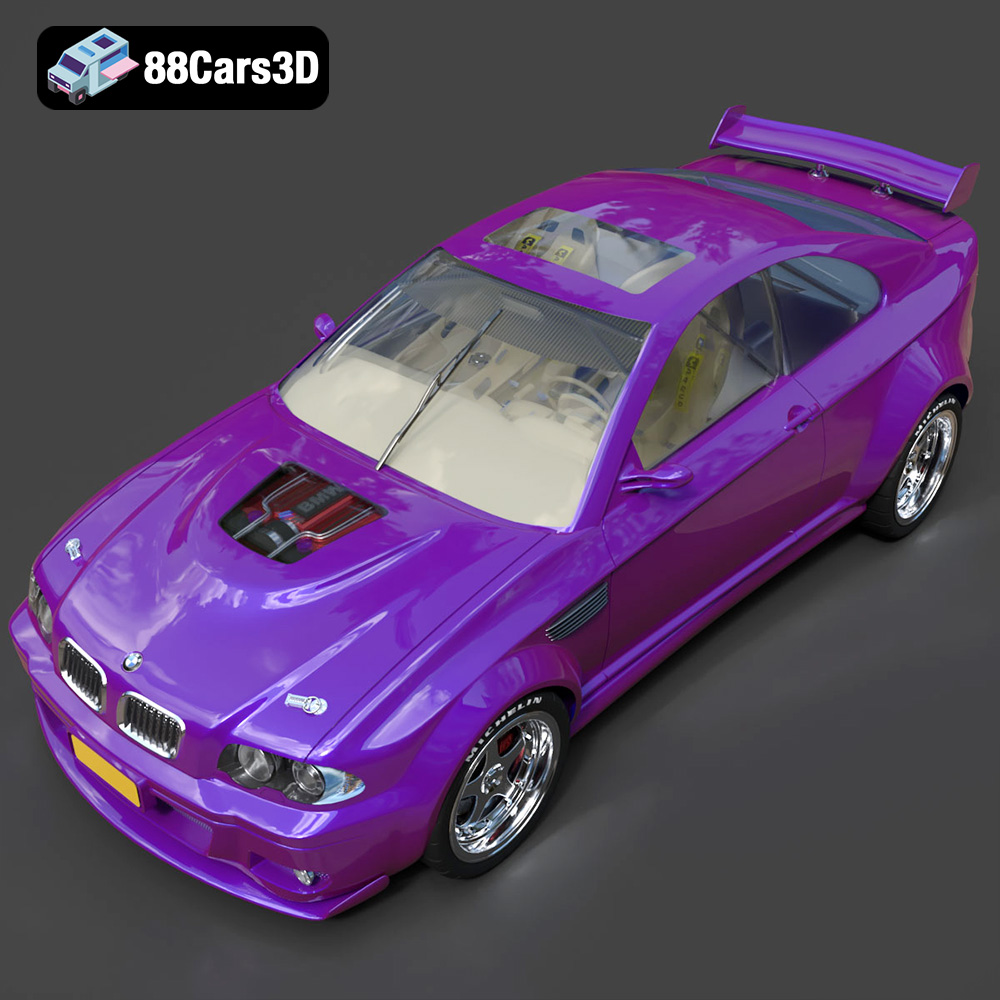
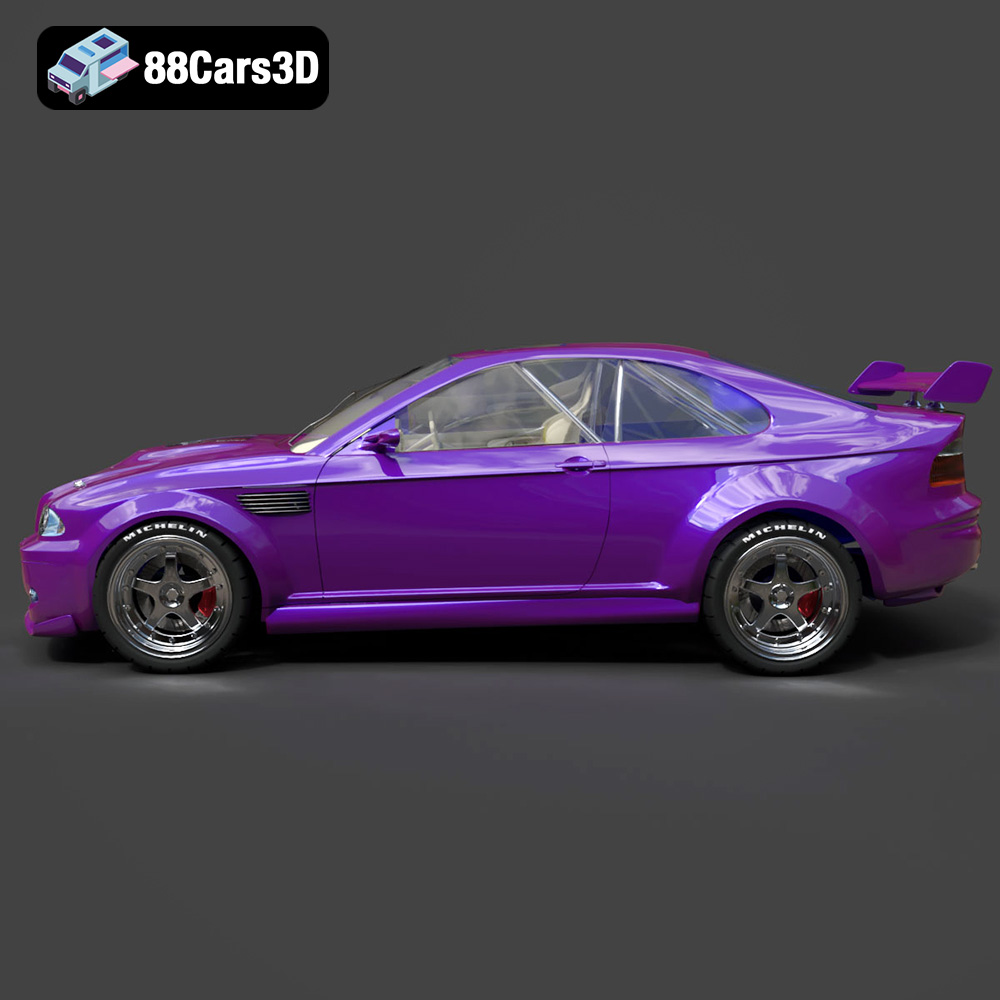
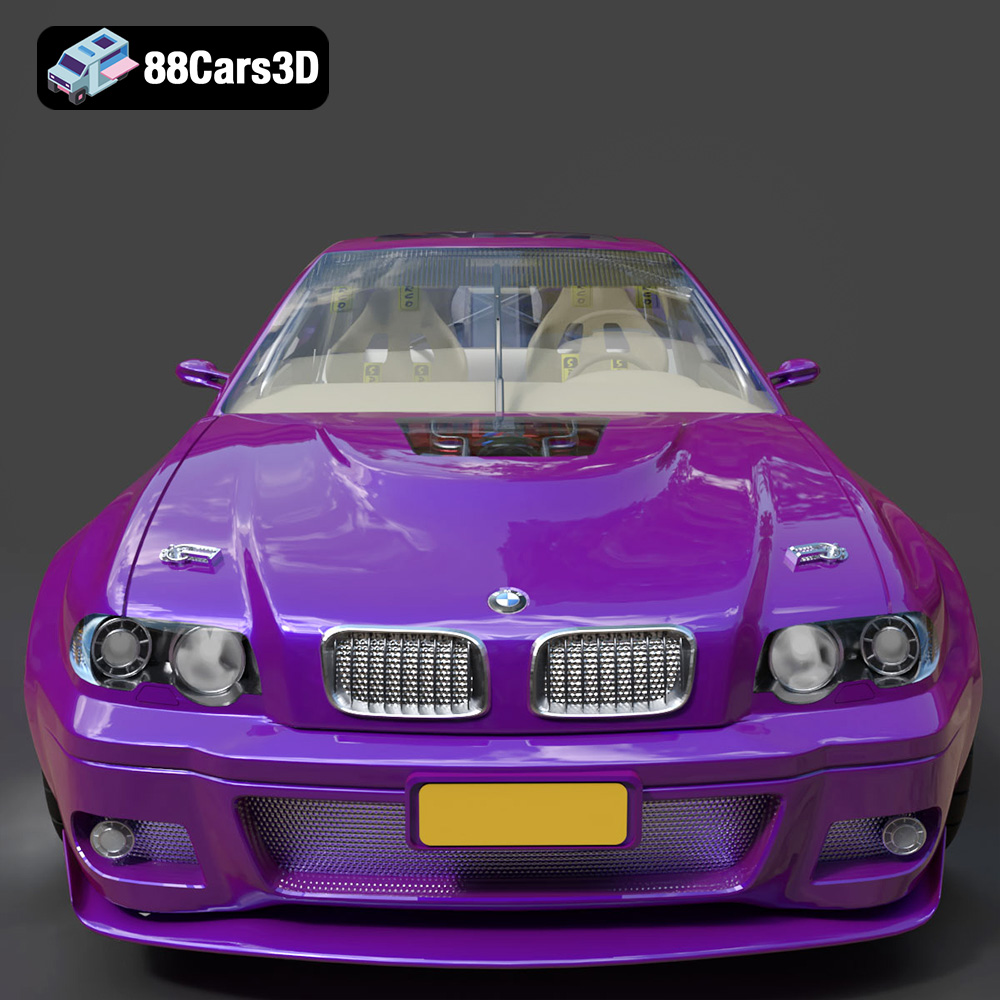
Capture the essence of performance luxury with the highly detailed BMW M3 2024 3D Model. This precision-engineered asset offers unparalleled realism, meticulously reproducing the aggressive styling, iconic grille design, and dynamic silhouette of the modern M3 generation. Optimized for close-up renders and demanding simulation environments, the model ensures visual fidelity across all professional applications. Key features include structurally clean topology, accurate scale, and professionally configured materials designed to react realistically to virtual lighting. Every external detail, from the wheels and brake calipers to the subtle curves of the body paneling, has been accurately modeled. A fully realized interior is included, making this asset ideal for first-person views and immersive virtual experiences. This versatile 3D asset is ready for immediate deployment in various projects, including cinematic rendering, architectural visualization, virtual reality (VR) and augmented reality (AR) experiences, high-fidelity simulations, and integration into major game development pipelines such as Unreal Engine and Unity.
$13.99
Product Image Gallery



Related Tags
.arvr
.blend
.bmw
.car3dmodel
.fbx
.gameasset
.glb
.m3
.max
.obj
.performancecar
.ply
.rendering
.sedan
.simulation
.sportssedan
.stl
.unreal
