Mastering Automotive 3D: Elevating Projects with High-Quality 3D Car Models
In the rapidly evolving world of digital visualization, the demand for photorealistic and highly optimized 3D assets is paramount. From blockbuster game titles and cinematic animations to cutting-edge architectural visualizations and industrial design presentations, high-quality 3D car models serve as indispensable components. These assets don’t just fill a scene; they define its authenticity, convey scale, and inject realism that captivates audiences. Professionals across various industries consistently seek models that offer both visual fidelity and technical versatility, ensuring seamless integration into complex pipelines.
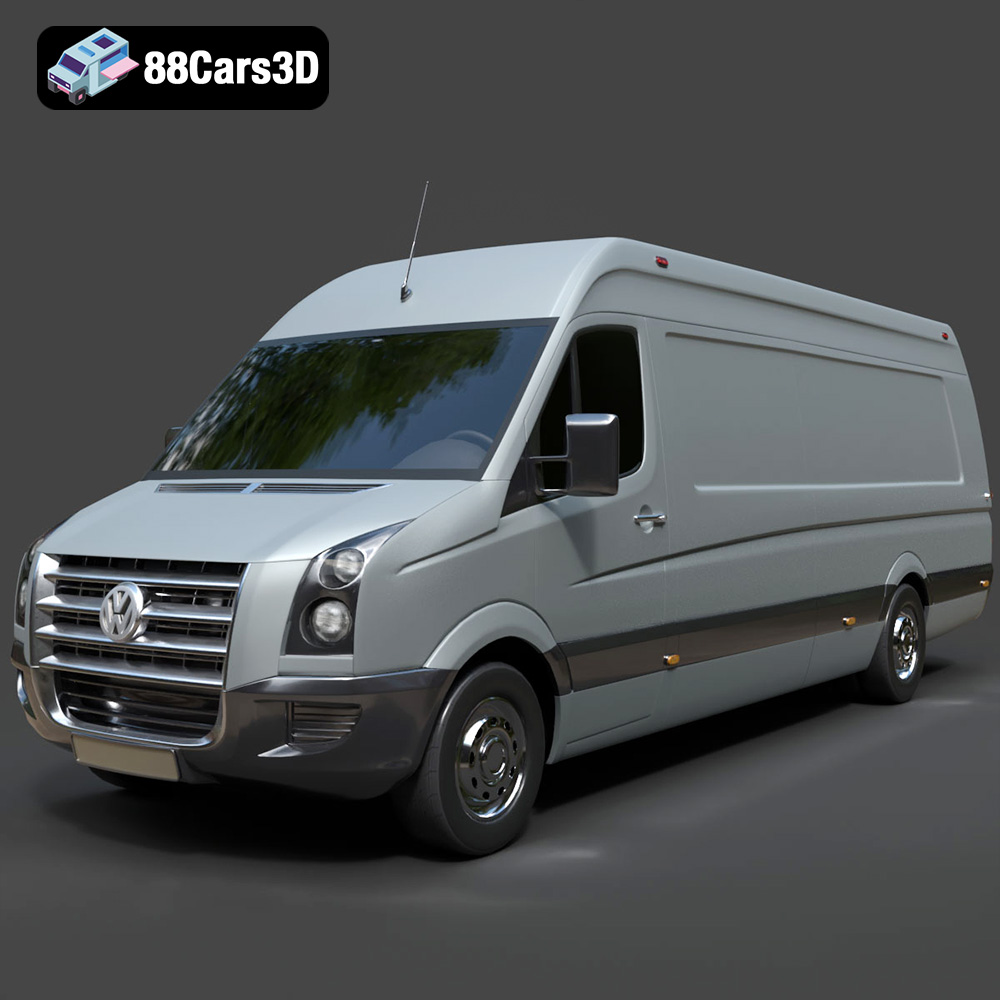
The selection of a robust 3D vehicle model can drastically impact project timelines and final output quality. Imagine crafting a detailed urban environment for an architectural proposal or developing a realistic training simulation for logistics. Generic placeholders simply won’t suffice when precision and visual accuracy are critical. This is where specialized platforms like 88cars3d.com shine, providing a curated collection of professional-grade 3D car models designed to meet the rigorous demands of today’s digital artists and developers. A prime example of such an asset is the Volkswagen Crafter 2020 3D Model, a meticulous recreation designed to perform exceptionally across diverse applications, offering outstanding visual accuracy and optimized geometry for a truly versatile solution.
Understanding 3D Model File Formats: Choosing the Right Tool for the Job
The versatility of a 3D model often hinges on the range of file formats it supports. Each format is engineered with specific strengths, catering to different stages of a production pipeline, software ecosystems, and end-use scenarios. Understanding these distinctions is crucial for seamless workflow integration and optimal performance. The Volkswagen Crafter 2020 3D Model, for instance, offers a comprehensive suite of formats, ensuring its adaptability for virtually any professional project.
.blend – The Native Blender Scene
The .blend file format is native to Blender, the powerful open-source 3D creation suite. When you receive a .blend file, you’re not just getting a mesh; you’re getting a complete Blender scene. This includes the model’s geometry, all materials and textures configured within Blender’s Cycles or Eevee render engines, lighting setups, cameras, and even animation data if present. For users deeply integrated into the Blender ecosystem, a .blend file offers maximum editability and immediate usability, allowing for effortless modifications, rigging, or scene composition without loss of fidelity.
.fbx – The Industry Workhorse for Interoperability
.fbx (Filmbox) is arguably the most widely adopted proprietary file format for 3D data exchange, especially within game development and animation studios. Developed by Autodesk, FBX is highly versatile, supporting geometry, materials (often as PBR maps), textures, rigging, skinning, and animation. Its strength lies in its ability to reliably transfer complex scene data between different 3D software applications (like 3ds Max, Maya, Blender) and game engines (Unreal Engine, Unity). For real-time pipelines, .fbx is often the go-to choice due to its robust support for mesh optimization and animation curves.
.obj – The Universal Geometry Standard
.obj (Wavefront Object) is one of the oldest and most universal 3D file formats. It primarily stores geometric data – vertices, normals, UV coordinates, and faces. While it’s excellent for mesh data and highly compatible across virtually all 3D software, its material definition (typically in a companion .mtl file) is basic, often requiring manual recreation of advanced PBR materials upon import. Despite this, .obj remains a fundamental format for clean mesh transfer, offering unparalleled cross-software compatibility for the Volkswagen Crafter 2020 3D Model.
.glb – Optimized for AR, VR, and Web
.glb (GL Transmission Format Binary) is a modern, compact, and efficient file format designed specifically for the transmission and loading of 3D scenes and models into web-based applications, Augmented Reality (AR), and Virtual Reality (VR) experiences. It bundles 3D model data (geometry, materials, textures, animations) into a single binary file, making it incredibly easy to share and integrate into real-time interactive environments. Its optimization for rapid loading and display makes it an indispensable format for immersive applications.
.stl – The Standard for 3D Printing
.stl (STereoLithography) is the de-facto standard file format for 3D printing. It represents a 3D model as a collection of unconnected triangular facets, defining only the surface geometry without color, texture, or material information. While not suitable for rendering or animation, .stl files are essential for rapid prototyping and manufacturing processes. When considering the Volkswagen Crafter 2020 3D Model for physical output, the .stl format ensures precise translation of its robust structure into a tangible object.
.ply – Precision Mesh for CAD and Analysis
.ply (Polygon File Format or Stanford Triangle Format) is a file format for storing 3D data from 3D scanners. It can store not only the geometry of an object but also color, transparency, texture coordinates, and even properties like confidence values for data points. While not as common for general 3D asset exchange as .fbx or .obj, .ply is highly valued in scientific, engineering, and CAD applications where precise mesh data, often derived from laser scanning or structured light, is critical for analysis and highly detailed visualization.
.unreal – Engine-Ready for Real-Time Environments
The .unreal format signifies an asset that has been specifically prepared and often pre-configured for direct use within Unreal Engine. This might involve optimized mesh importing, PBR material setups with engine-specific nodes, LODs (Levels of Detail) already generated, and proper collision meshes. Such engine-ready assets significantly streamline the development process for game designers and simulation engineers, drastically reducing the time spent on integration and optimization within the Unreal ecosystem.
.max – The 3ds Max Project File
The .max file is the native project file format for Autodesk 3ds Max, a leading software in architectural visualization, product design, and animation. Similar to .blend, a .max file contains the entire scene data, including geometry, materials (V-Ray, Corona, Arnold), lighting, cameras, modifiers, and animation. For professionals working within 3ds Max, this format provides complete flexibility for rendering high-fidelity images, complex animations, or integrating the model into existing large-scale scenes.
Automotive Rendering: Bringing the Crafter to Life with Photorealism
Automotive rendering is an art form that merges technical precision with creative vision. It’s about showcasing a vehicle not just as a static object, but as a dynamic presence capable of evoking emotion and conveying quality. The Volkswagen Crafter 2020 3D Model from 88cars3d.com is specifically designed for this purpose, offering the meticulous detail required for stunning photorealistic results.
Advanced Material and Texture Configuration
Achieving photorealism starts with materials. The Crafter model comes with professionally configured materials and textures, meaning the hard work of setting up physically based rendering (PBR) workflows is largely done. This typically involves a suite of texture maps:
- Albedo/Base Color: Defines the base color of the surface without lighting information.
- Metallic: Specifies which parts of the surface are metallic.
- Roughness: Controls the microsurface detail, influencing how light scatters and reflects.
- Normal/Bump: Adds apparent surface detail without increasing polygon count.
- Ambient Occlusion (AO): Simulates soft global illumination, adding depth to crevices.
These maps, combined with shaders in renderers like V-Ray, Corona, or Cycles, accurately simulate how light interacts with the Crafter’s paint, glass, rubber, and chrome surfaces. The “straight out of the package” readiness means less time tweaking and more time creating breathtaking visualizations.
Workflow in 3ds Max and Blender for High-Fidelity Renders
Whether you prefer Autodesk 3ds Max or Blender, the workflow for rendering the Volkswagen Crafter 2020 3D Model is streamlined. In 3ds Max, artists can import the .max or .fbx file, which typically retains much of the material information. Using powerful render engines like V-Ray or Corona Renderer, one can set up complex lighting scenarios, from studio backdrops with softbox lights to realistic outdoor environments using HDRI (High Dynamic Range Image) maps. The Crafter’s detailed exterior and fully modeled interior allow for intricate camera angles, showcasing everything from the dashboard details to the robust cargo area.
Similarly, in Blender, importing the .blend file provides immediate access to pre-configured materials suitable for Cycles or Eevee. Blender’s node-based material system offers immense flexibility for further customization, while its powerful rendering capabilities can produce stunning images and animations. Artists can easily set up virtual studios, animate door openings, or place the Crafter within realistic architectural scenes, leveraging Blender’s extensive toolkit for lighting, camera animation, and post-processing.
Game Development & Real-Time Applications: Optimizing for Performance
In game development and real-time simulations, performance is as crucial as visual fidelity. Every polygon, texture resolution, and shader instruction contributes to the overall frame rate. The Volkswagen Crafter 2020 3D Model is explicitly built with optimized, clean geometry, making it ideal for integration into demanding real-time environments like Unreal Engine and Unity.
Integrating into Unreal Engine and Unity
For Unreal Engine, the provided .fbx and dedicated .unreal formats are invaluable. The .fbx file can be imported directly, bringing in the mesh, PBR textures, and UV mapping. Artists can then set up Unreal’s material instances using the provided texture maps (Base Color, Normal, Metallic, Roughness, AO) to achieve photorealistic PBR shading. The .unreal format potentially streamlines this even further, offering a pre-packaged asset that requires minimal setup within the engine itself, saving precious development time.
In Unity, the .fbx file similarly serves as the primary import format. Unity’s Universal Render Pipeline (URP) or High-Definition Render Pipeline (HDRP) can leverage the PBR textures to render the Crafter model with stunning realism while maintaining performance. Proper setup of collision meshes, LODs (Levels of Detail), and occlusion culling ensures the model performs efficiently, whether it’s a prominent feature in a driving simulator or part of a bustling urban background in an open-world game.
Optimized Geometry and PBR Workflows for Real-Time
The concept of “optimized, clean geometry” means the mesh is structured efficiently, minimizing unnecessary polygons while retaining essential detail. This is critical for maintaining high frame rates in real-time applications. High-quality 3D car models from 88cars3d.com typically feature well-managed poly counts and clean topology, which also facilitates efficient UV unwrapping. Properly unwrapped UVs are essential for applying textures without stretching or distortion, and for optimizing texture memory usage, which is paramount in game development. The PBR (Physically Based Rendering) texture workflow ensures that materials respond realistically to light, providing consistent visual quality across different lighting conditions and environments within the game engine.
AR/VR & Immersive Experiences: Stepping into the Digital Van
Augmented Reality (AR) and Virtual Reality (VR) represent the forefront of immersive digital experiences, placing users directly within interactive 3D environments. For these applications, models must be highly optimized for real-time performance, yet detailed enough to withstand close inspection. The Volkswagen Crafter 2020 3D Model, particularly with its .glb format, is perfectly positioned for this rapidly expanding domain.
Leveraging .glb for Web and Mobile AR/VR
The .glb format is a game-changer for AR/VR deployment. Its single-file, binary nature, combined with its optimization for quick loading and rendering, makes it ideal for web-based AR experiences (like viewing the Crafter in your driveway via a smartphone) or integrating into VR training modules. Imagine a logistics company using VR to train new drivers on the interior layout and specific features of the Crafter before they even step into a physical vehicle. The interactive nature of AR/VR, powered by high-quality 3D models, offers unparalleled engagement and learning opportunities.
Creating Interactive Simulations and Virtual Showrooms
Beyond simple viewing, the Crafter model can be the centerpiece of complex interactive simulations. In a virtual showroom, prospective buyers could explore the Crafter’s exterior, open doors, examine the fully modeled interior, and even customize paint colors or cargo configurations in real-time. For training purposes, the model can be integrated into scenarios simulating loading and unloading processes, maintenance procedures, or even emergency response drills, all within a safe and repeatable virtual environment. The model’s “robust structure” and “fully modeled interior space” ensure that these immersive experiences are not just visually appealing but also functionally accurate and rich in detail.
3D Printing & Prototyping: Bringing the Crafter into the Physical World
While often associated with digital screens, 3D models also serve a vital role in the physical world through 3D printing and rapid prototyping. Whether for conceptual models, scale replicas, or functional parts, the accuracy of the source 3D model is paramount. The Volkswagen Crafter 2020 3D Model supports this transition from digital to physical with its dedicated .stl and .ply formats.
From Digital Mesh to Tangible Object with .stl
The .stl format is the industry standard for 3D printing. When preparing the Crafter model for 3D printing, the .stl file ensures that the geometry is accurately represented as a series of triangles, which 3D printers interpret to build the object layer by layer. While the model itself is designed for visual accuracy, the .stl output would capture the vehicle’s “robust structure” and “functional design” in a tangible form. This could be used for creating scale models for display, architectural site plans where miniature vehicles add context, or even for educational purposes.
Utilizing .ply for High-Precision Prototypes and Analysis
The .ply format offers an alternative for highly detailed mesh output, often preferred in scenarios requiring greater precision or additional data layers. While .stl is a general standard, .ply can sometimes be used for more intricate prototypes where precise surface data is critical. For instance, if one were reverse-engineering a specific component of the Crafter’s design, a .ply output might offer advantages in retaining more nuanced geometric information derived from the original 3D asset, especially if combined with laser scanning data for comparison.
Real-World Impact: Case Studies for the Volkswagen Crafter 2020 3D Model
The true value of a versatile 3D asset like the Volkswagen Crafter 2020 3D Model is best demonstrated through its diverse professional applications. Its combination of visual accuracy and technical optimization makes it a valuable tool across multiple industries.
Architectural Visualization: Populating Digital Environments
In architectural visualization (Arch-Viz), realistic context is key. Empty streets or static, generic vehicles detract from the realism of a meticulously designed building. Integrating the Volkswagen Crafter model into an urban scene instantly adds credibility and life. Imagine a new logistics hub render with Crafter vans arriving and departing, or a city street render showing commercial activity. The model’s “outstanding visual accuracy” ensures it holds up even in close-up shots within a busy architectural scene, enhancing the overall believability and impact of the visualization.
Advanced Training Simulations and Logistics Planning
For industries relying on commercial vehicles, training and planning are continuous processes. The Crafter model can be integrated into advanced training simulators for drivers learning vehicle dimensions, maneuverability in tight spaces, or cargo loading procedures. Logistics companies can use the model in simulation software to optimize delivery routes, visualize fleet movements, or plan warehouse layouts. The “fully modeled interior space” is particularly beneficial here, allowing for detailed training on cabin ergonomics and cargo management, offering a realistic virtual environment for practical skill development.
Large-Scale Game Development and Virtual Production
In large-scale game development, such as open-world titles or racing simulators, the Crafter can serve as an authentic background vehicle, AI-driven traffic, or even a player-controlled asset for specific missions. Its optimized geometry ensures it won’t be a performance bottleneck, while its detailed design maintains visual consistency with other high-quality game assets. In virtual production, where digital sets are created for film and television, the Crafter could be used for pre-visualization of scenes involving commercial vehicles, allowing directors and cinematographers to block out shots and experiment with camera angles long before physical production begins.
Conclusion: The Indispensable Value of Professional 3D Car Models
The digital landscape demands assets that are not only visually stunning but also technically robust and adaptable. High-quality 3D car models are more than just eye candy; they are foundational elements that drive realism, efficiency, and immersion across a multitude of professional applications. From the intricate details required for automotive rendering and the performance optimizations crucial for game development, to the interactive demands of AR/VR and the precision needed for 3D printing, a well-crafted 3D vehicle model is an indispensable tool.
The Volkswagen Crafter 2020 3D Model exemplifies this versatility. Its meticulous capture of the Crafter’s functional design, robust structure, and fully modeled interior, combined with a comprehensive suite of optimized file formats, positions it as a premier asset for any professional seeking excellence. Whether you’re an architect populating a scene, a game developer building a city, or an engineer prototyping a concept, this model provides the visual accuracy and technical readiness to elevate your project.
Investing in professional-grade assets like the Volkswagen Crafter 2020 3D Model from trusted marketplaces like 88cars3d.com ensures that your creative vision is backed by quality and performance, allowing you to focus on innovation rather than asset creation. Embrace the power of meticulously crafted 3D car models and unlock new possibilities for your digital endeavors.
Featured 3D Model
Volkswagen Crafter 2020 3D Model
Experience precision with the Volkswagen Crafter 2020 3D Model. This asset meticulously captures the functional design and robust structure of the modern commercial utility vehicle. Created for professional environments, this model offers outstanding visual accuracy, making it perfect for close-up renders, animations, and detailed simulations. This 3D vehicle model is built with optimized, clean geometry suitable for real-time applications and rendering pipelines. It features professionally configured materials and textures to ensure photo-realistic results straight out of the package. The exterior body panels, detailed chassis, and fully modeled interior space are accurately represented, providing a complete and versatile 3D asset. The Volkswagen Crafter model is ideal for various digital projects, including architectural visualization where realistic commercial traffic is needed, advanced training simulations, large-scale game development (compatible with Unreal Engine and Unity), and immersive Augmented Reality (AR) or Virtual Reality (VR) environments.
$22.99
Product Image Gallery