

Unleashing Digital Precision: The Power of High-Fidelity 3D Car Models in Modern Design
In the fast-paced world of digital visualization, automotive design, and interactive media, the demand for unparalleled realism and technical precision is higher than ever. From blockbuster films and AAA video games to cutting-edge architectural visualizations and advanced engineering simulations, high-quality 3D car models serve as the backbone for creating immersive and believable experiences. They are not merely digital replicas; they are intricate data sets that convey form, function, and aesthetic with painstaking accuracy, essential for professional studios and individual artists alike.
Imagine showcasing a luxury vehicle in a virtual showroom, animating it for a high-stakes commercial, or integrating it seamlessly into a photorealistic urban environment. The success of such endeavors hinges on the quality of the underlying 3D asset. This is where a model like the Bentley Continental Flying Spur 3D Model truly shines. It’s an exemplar of meticulous craftsmanship, designed to meet the rigorous demands of professional pipelines. With its iconic silhouette, detailed engineering, and optimized topology, it provides a robust foundation for projects demanding nothing less than perfection.
This comprehensive guide delves into the technical intricacies of 3D car models, exploring their applications across various industries, the critical role of file formats, and how a premium asset like the Bentley Continental Flying Spur can elevate your creative output. We’ll uncover the workflows in popular software like 3ds Max and Blender, discuss optimization for real-time engines such as Unreal Engine, and highlight why choosing a reputable source like 88cars3d.com for your 3D car models is a strategic decision for any serious professional.
The Foundation of Digital Automotive Excellence: Why Quality 3D Models Matter
The pursuit of visual fidelity in digital environments begins with the source assets. For automotive projects, this means highly detailed and technically sound 3D car models. A superior model transcends mere aesthetics; it embodies a host of technical considerations that enable seamless integration into diverse pipelines, from static renders to dynamic simulations.
Precision in Design and Visualization
When working on automotive rendering projects, the exact curvature of a car body, the subtle reflections on chrome, or the intricate stitching on leather upholstery all contribute to the overall realism. A high-quality 3D model provides this level of detail from the outset. It ensures that the digital representation accurately reflects the real-world object’s proportions, material characteristics, and unique design language. For instance, the Bentley Continental Flying Spur 3D Model is described as having “exceptionally clean topology” and “meticulously modeled components,” including complex interior details and authentic exterior badging. This attention to detail is paramount for architectural visualization (ArchViz) where a vehicle needs to ground a scene in reality, or for cinematic sequences where close-ups demand flawless surfaces.
Poorly constructed models, on the other hand, can lead to numerous issues: unsightly triangulation, inconsistent shading, inaccurate reflections, and difficulties during animation or UV unwrapping. Investing in a precisely crafted 3D car model saves countless hours of remediation and ensures a polished, professional final product.
Bridging the Gap Between Concept and Reality
Beyond visual fidelity, premium 3D car models are crucial for bridging the gap between conceptual design and tangible reality. In engineering and product development, these models are used for virtual prototyping, aerodynamic simulations, and ergonomic studies long before a physical prototype is built. For game development and virtual reality (VR) applications, they provide the interactive elements that define user experience. The ability to manipulate, customize, and integrate these models across different platforms and software is a testament to their inherent versatility.
Models sourced from platforms like 88cars3d.com are built with this versatility in mind, offering multiple file formats and optimized structures that cater to a wide array of professional applications. Whether it’s for a client presentation, a marketing campaign, or a vehicle simulation, the underlying quality of the 3D asset dictates the success and efficiency of the entire workflow.
Understanding 3D Model File Formats
The utility and versatility of a 3D car model are significantly influenced by the file formats it supports. Different formats are optimized for specific purposes, software compatibility, and industry pipelines. A truly professional asset, like the Bentley Continental Flying Spur 3D Model, provides a comprehensive suite of formats, ensuring maximum adaptability for diverse projects. Understanding these formats is crucial for any 3D artist or developer.
Native and Universal Formats for Diverse Workflows
The backbone of many 3D projects lies in native software formats and widely supported universal interchange formats:
- .blend – This is Blender’s native file format, offering a fully editable scene. When a model like the Bentley Continental Flying Spur is provided in .blend, it means users gain access to the complete Blender project, including materials, lighting setups, cameras, and potentially animation rigs. This format is ideal for artists who primarily work in Blender, allowing for deep customization and leveraging Blender’s powerful rendering engines like Cycles or Eevee. Technical details often include embedded textures, shader nodes, and scene data, providing a self-contained project file.
- .max – The native file format for Autodesk 3ds Max, one of the industry-standard software for 3D modeling, animation, and rendering. Similar to .blend, a .max file provides an editable 3ds Max project, complete with intricate scene setups, modifiers, materials (often V-Ray or Corona), and animation data. This format is essential for professionals relying on 3ds Max for high-end automotive rendering and animation, allowing them to dissect and modify every aspect of the model within a familiar environment.
- .obj – The Wavefront OBJ format is a universal standard for exchanging 3D geometry data. It’s renowned for its widespread compatibility across virtually all 3D software applications. An .obj file primarily stores vertex positions, UV coordinates, normals, and face information, defining the mesh’s geometry. It often comes with an associated .mtl (material library) file that describes basic material properties and links to texture maps. While it doesn’t support advanced features like rigging or animation, its universality makes it an indispensable format for cross-software collaboration and a reliable fallback when other formats fail.
Specialized Formats for Real-Time and Manufacturing
Beyond general-purpose formats, several specialized options cater to specific industry needs, particularly in game development, AR/VR, and 3D printing:
- .fbx – Developed by Autodesk, FBX (Filmbox) is a widely used proprietary format for 3D content creation, especially within the game development industry. It supports not only mesh data but also animation, rigging, skinning, blend shapes, lights, cameras, and material properties. This makes it ideal for transferring complex assets like animated 3D car models between different 3D software packages (e.g., Maya, 3ds Max, Blender) and into game engines like Unreal Engine and Unity. The Bentley Continental Flying Spur 3D Model in .fbx ensures it is “game-engine ready,” preserving all necessary data for real-time performance.
- .unreal – This isn’t a single file format in the traditional sense but rather a term indicating assets specifically configured and optimized for direct import and use within Unreal Engine. It typically implies a package containing the .fbx geometry, PBR (Physically Based Rendering) textures, material instances, and potentially LODs (Levels of Detail) structured correctly within an Unreal project. Having a pre-configured .unreal asset significantly streamlines the integration process, saving developers valuable time on setup and optimization within the engine.
- .glb – GLB (GL Transmission Format Binary) is a relatively new, highly efficient, and compact format designed for the web, AR (Augmented Reality), and VR (Virtual Reality). It’s a binary version of the glTF format, packing all model data (geometry, materials, textures, animations) into a single file. This single-file nature makes .glb models incredibly fast to load and display in browsers and mobile AR applications, making the Bentley model in this format perfect for interactive web showcases or AR experiences on smartphones.
- .stl – STL (Stereolithography) is the de facto standard file format for 3D printing. It represents a 3D model as a collection of triangles (a tessellated surface) without color, texture, or other CAD attributes. For the Bentley Continental Flying Spur 3D Model, the .stl format means it has been processed to be suitable for additive manufacturing, ensuring a watertight mesh and proper geometry for physical output. It’s crucial for prototyping or creating physical scale models.
- .ply – The Polygon File Format, or PLY, is a versatile format for storing 3D data from 3D scanners. It supports vertex positions, normals, colors, and even data like transparency, making it suitable for high-precision mesh data. While less common for general-purpose exchange than .obj or .fbx, it’s highly valued in scientific visualization, CAD, and specific engineering analysis where detailed polygon information and attribute preservation are paramount.
The availability of such a diverse range of formats for the Bentley Continental Flying Spur 3D Model underscores its professional utility, catering to virtually every potential use case from rendering to manufacturing.
Crafting Photorealistic Automotive Renders with 3ds Max and Blender
Achieving photorealistic results with 3D car models requires more than just a high-quality asset; it demands a deep understanding of rendering principles, material science, and artistic composition. Professional software like Autodesk 3ds Max and Blender offer robust toolsets for transforming raw 3D data into stunning visuals.
Leveraging Advanced Materials and Textures
The visual appeal of any 3D car model, including the Bentley Continental Flying Spur, heavily relies on its materials and textures. Photorealism is achieved through physically based rendering (PBR) workflows, where materials accurately simulate how light interacts with surfaces in the real world. This means carefully crafted albedo (color), roughness, metallic, normal, and ambient occlusion maps.
In 3ds Max, artists utilize advanced rendering engines like V-Ray or Corona Renderer, employing sophisticated shader networks to define car paint with clear coat layers, realistic glass with accurate refraction, and convincing leather or carbon fiber textures. The Bentley Continental Flying Spur 3D Model provides “realistic materials and textures” applied across body, glass, chrome, and leather surfaces. In Blender, Cycles or Eevee engines, combined with a node-based shader editor, allow for similar levels of complexity, enabling artists to replicate the luxurious sheen of the Bentley’s finish or the subtle imperfections of its chrome accents. Clean UV mapping, which the product description implies by mentioning “optimized topology,” is essential here, ensuring textures stretch correctly across the model’s surfaces without distortion.
Mastering Lighting and Composition for Impact
No matter how detailed a 3D car model is, poor lighting can render it lifeless. Effective lighting is crucial for defining form, creating mood, and highlighting key design features. Artists often employ various lighting techniques:
- HDRI (High Dynamic Range Imaging): Environment maps provide realistic global illumination and reflections, making the Bentley appear integrated into its surroundings.
- Area Lights and Spotlights: These are used to accentuate specific details, create highlights, and simulate studio lighting setups for product photography.
- Volumetric Lighting: Adds atmosphere and depth, simulating fog or dust, especially effective for dramatic shots.
Composition, drawing from traditional photography principles, involves framing the subject, using rule of thirds, leading lines, and depth of field to guide the viewer’s eye and tell a story. Whether the Bentley Continental Flying Spur is posed majestically against a city skyline or captured in a dynamic close-up, thoughtful lighting and composition elevate the render from a simple visualization to a work of art.
The Role of Clean Topology and UVs in Rendering
Underneath the stunning visuals lies the mesh geometry, or topology. “Clean topology” means a mesh composed predominantly of quadrangles (four-sided polygons) arranged in a logical flow that respects the model’s curvature and deformation. This is vital for:
- Smooth Subdivision: When applying subdivision surfaces (like OpenSubdiv in 3ds Max or Blender’s Subdivision Surface modifier), clean topology ensures smooth curves and avoids pinching or artifacts.
- Optimized UV Mapping: A well-organized mesh makes UV unwrapping (the process of flattening the 3D surface to a 2D plane for texturing) much easier and more efficient, preventing texture distortion.
- Efficient Rendering: Simpler, cleaner geometry can sometimes render more efficiently and is easier for ray tracing algorithms to process, leading to faster render times.
The description of the Bentley Continental Flying Spur 3D Model specifically highlights its “exceptionally clean topology optimized for performance without sacrificing visual fidelity.” This is a significant technical advantage, assuring artists that the model is built on a solid foundation, ready for high-end rendering without hidden issues.
Optimizing 3D Car Models for Real-Time Environments (Unreal Engine & Unity)
While photorealistic rendering focuses on visual fidelity in static or pre-rendered sequences, real-time environments like game engines prioritize performance alongside visual quality. Integrating a complex 3D car model, such as the Bentley Continental Flying Spur, into Unreal Engine or Unity requires specific optimization techniques to ensure smooth frame rates and responsive interactions.
Performance Considerations: Poly Count and LODs
The raw polygon count of a highly detailed model, suitable for cinematic renders, is often too high for real-time applications. Game engines must render thousands, if not millions, of polygons per frame, often at 60 FPS or higher. This necessitates optimization:
- Poly Count Reduction: Techniques like decimation or manual retopology are used to lower the polygon count while retaining as much visual detail as possible.
- Levels of Detail (LODs): This crucial optimization involves creating multiple versions of the same model, each with progressively fewer polygons. When the car is far from the camera, a low-poly LOD is rendered. As it gets closer, a higher-poly LOD is swapped in. The Bentley Continental Flying Spur 3D Model, with its “clean topology optimized for performance,” is an excellent candidate for generating efficient LODs, ensuring scalability across different game engine requirements.
Additionally, draw calls (the number of times the CPU tells the GPU to render something) are minimized by combining meshes where possible and efficiently managing materials. The “game-engine ready format for Unreal Engine and Unity” provided by 88cars3d.com for the Bentley model implies that these considerations have already been factored in, streamlining the integration process for developers.
Implementing Game-Ready Assets and Physics
Beyond geometry, real-time integration involves setting up materials, physics, and interactive elements. In Unreal Engine or Unity, PBR materials are applied using texture maps (Albedo, Normal, Roughness, Metallic, Ambient Occlusion) to achieve realistic surface properties. The “realistic materials and textures” of the Bentley model ensure these properties translate effectively into the game engine.
Physics assets are vital for vehicles. This includes defining collision meshes (often simpler than the render mesh), setting up suspension, tire friction, and engine parameters. Vehicles in game engines use complex components like wheel colliders and constraint systems to simulate realistic driving dynamics. For a model like the Bentley Continental Flying Spur, accurate physical properties are essential for creating an authentic driving simulation experience.
Case Study: Integrating the Bentley Continental Flying Spur into a Virtual World
Consider a scenario where the Bentley Continental Flying Spur 3D Model is integrated into an open-world driving simulator built with Unreal Engine. The “pre-configured for Unreal Engine use” (.unreal) file format simplifies the initial import significantly. The developer would:
- Import the .unreal or .fbx asset: This brings in the mesh, materials, and textures.
- Generate LODs: Based on the optimized clean topology, automatic LOD generation or manual creation ensures performance across various distances.
- Set up Materials: Assign the provided PBR textures to Unreal’s material system, adjusting parameters for metallic paint, glass transparency, and leather reflections.
- Configure Physics Asset: Create a simplified collision mesh for the car body and attach wheel colliders to each wheel, tuning suspension, spring strength, and damping.
- Implement Vehicle Blueprint: Develop a custom vehicle blueprint or use Unreal’s built-in vehicle system to control acceleration, braking, steering, and transmission, linking it to the Bentley’s mesh.
- Add Interactivity: Enable interior features like working doors, lights, and dashboard gauges, leveraging the model’s “complex interior details.”
This streamlined process, facilitated by a high-quality, game-ready asset from 88cars3d.com, allows developers to focus on gameplay and user experience rather than wrestling with asset preparation, ultimately delivering a more polished and efficient product.
Beyond Rendering: The Versatility of High-Quality Car Models
The applications for meticulously crafted 3D car models extend far beyond just automotive rendering and game development. Their inherent detail and adaptability make them invaluable assets across a spectrum of creative and technical industries.
Architectural Visualization (ArchViz) and Cinematic Applications
In ArchViz, 3D car models are essential for populating scenes and adding a sense of scale, realism, and life to architectural renders. A luxury sedan like the Bentley Continental Flying Spur can instantly elevate the perceived value and sophistication of a building design. Placed strategically in driveways, parking lots, or on virtual streets, it grounds the architectural render in reality, making the environment more believable and engaging for clients. Its precise details and realistic materials ensure it stands up to close scrutiny within high-resolution stills or animated walkthroughs.
For cinematic sequences, whether for commercials, feature films, or product showcases, detailed 3D car models are indispensable. They can be animated to perform complex stunts, participate in virtual car chases, or simply serve as elegant background elements. The “complex interior details” and “authentic exterior badging” of the Bentley model mean it can be used for tight close-up shots, interior views, and motion graphics without compromising visual integrity.
AR/VR Experiences and Interactive Showcases
Augmented Reality (AR) and Virtual Reality (VR) are transforming how we interact with digital content. High-quality 3D car models are at the forefront of this revolution. Imagine a virtual showroom where prospective buyers can walk around the Bentley Continental Flying Spur, open its doors, examine its interior, and even change its color in real-time. The .glb format included with this model is specifically optimized for such web-based and mobile AR/VR applications, ensuring quick loading times and seamless interaction. Businesses can leverage these interactive experiences for marketing, sales, and even remote training, providing an immersive glimpse into a product that might otherwise be physically out of reach.
3D Printing and Prototyping
The utility of 3D car models extends into the physical realm through 3D printing. While a fully detailed model may require simplification for direct printing, having a clean, accurate source mesh, like that of the Bentley Continental Flying Spur, provides an excellent starting point. The included .stl format is specifically designed for 3D printing and prototyping, allowing designers, engineers, or enthusiasts to produce physical scale models. This can be invaluable for design reviews, creating tangible prototypes, or even for collectible merchandise. The precision captured in the digital model translates directly to the accuracy of the physical print, offering a unique bridge between the digital and material worlds.
The 88cars3d.com Advantage: Sourcing Premium 3D Car Models
For professionals who cannot afford to compromise on quality or efficiency, the source of their 3D car models is a critical consideration. Online marketplaces like 88cars3d.com specialize in providing high-quality, production-ready assets, saving artists and studios countless hours of modeling and texturing from scratch.
Curated Quality and Professional Standards
At 88cars3d.com, the emphasis is on curated quality. This means that models are meticulously crafted and vetted to meet professional industry standards. Such models feature clean topology, accurate proportions, realistic PBR materials, and often include multiple levels of detail and a variety of file formats. The Bentley Continental Flying Spur 3D Model exemplifies this commitment, offering “exceptionally clean topology,” “meticulously modeled components,” and “realistic materials and textures” across a comprehensive set of file formats.
This level of detail and technical correctness ensures that whether you are working in 3ds Max for a high-end animation, Blender for an architectural scene, or Unreal Engine for a driving simulation, the asset will perform reliably and integrate seamlessly into your workflow without requiring extensive cleanup or rework. This professional-grade standard is what differentiates premium assets from generic alternatives.
Streamlining Your Creative Workflow
Time is a valuable commodity in any creative pipeline. Sourcing pre-made, high-quality 3D car models from 88cars3d.com dramatically streamlines the workflow. Instead of spending weeks or months modeling a complex vehicle from scratch, artists can immediately jump into lighting, rendering, animating, or integrating the asset into their projects. The inclusion of multiple file formats—from .blend and .max for comprehensive editing to .fbx and .unreal for game-engine readiness, and .glb for web/AR—ensures that the model is instantly usable across various platforms without compatibility headaches.
This efficiency allows studios to take on more projects, meet tighter deadlines, and allocate resources to other critical aspects of production, ultimately boosting productivity and creative output. For individual artists, it democratizes access to assets that would otherwise be beyond their scope to create, empowering them to produce stunning visualizations and interactive experiences.
Conclusion
The world of 3D visualization is driven by precision, realism, and versatility. High-quality 3D car models are not just static images; they are dynamic, multifaceted assets that power everything from photorealistic renders in architectural visualization to immersive experiences in game development and AR/VR. Understanding the technical nuances of these models, including their topology, material systems, and the critical role of diverse file formats, is essential for any professional in the field.
The Bentley Continental Flying Spur 3D Model stands as a prime example of what a premium asset can offer. Its meticulous detail, clean topology, authentic materials, and comprehensive file format support (including .blend, .fbx, .obj, .glb, .stl, .ply, .unreal, and .max) make it an incredibly valuable resource for a wide array of professional applications. Whether your project demands stunning visual fidelity in 3ds Max or Blender, robust performance in Unreal Engine, or tangible output via 3D printing, this model is engineered for success.
By choosing high-quality 3D car models from trusted sources like 88cars3d.com, artists and developers can significantly enhance their creative potential, streamline their workflows, and deliver unparalleled results in an increasingly demanding digital landscape. Invest in precision, and watch your projects accelerate towards excellence.
Featured 3D Model
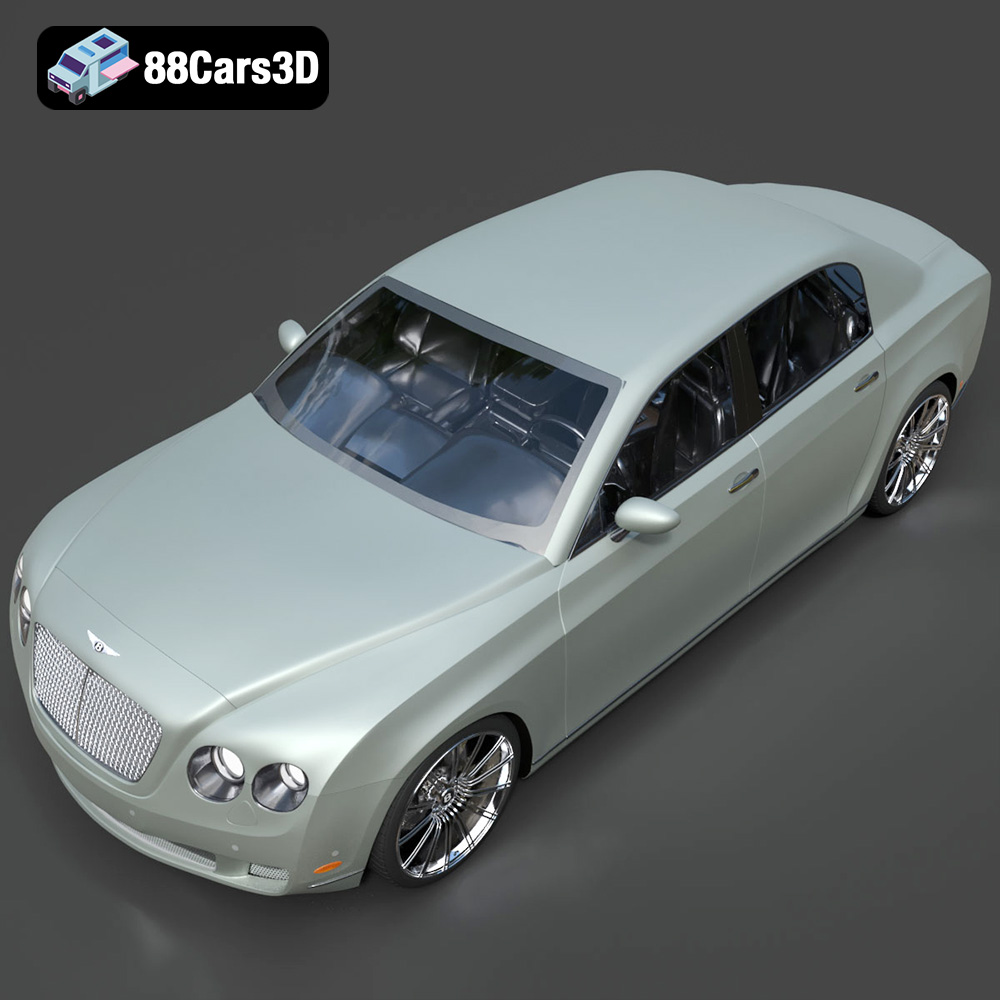
Bentley Continental Flying Spur 3D Model
Experience the sophistication of luxury motoring with this precise 3D model of the Bentley Continental Flying Spur. This model captures the iconic silhouette and detailed engineering of the executive sedan, making it perfect for photorealistic rendering projects, automotive visualization, and virtual production environments. The asset features exceptionally clean topology optimized for performance without sacrificing visual fidelity. All components are meticulously modeled, including complex interior details, chassis elements, and authentic exterior badging. Realistic materials and textures are applied across the body, glass, chrome, and leather surfaces, ensuring professional results in any rendering engine. Designed for maximum versatility, the Bentley Continental Flying Spur 3D Model is suitable for professional applications including architectural visualization (ArchViz), cinematic sequences, detailed vehicle simulations, and integration into modern game engines like Unity and Unreal Engine. Whether you require a static render or a dynamic asset for a driving simulator, this model is built for reliable performance.
$14.99
Product Image Gallery




Related Tags
.arvr
.bentley
.blend
.car3dmodel
.continental
.continentalflyingspur
.executivecar
.fbx
.flyingspur
.gameasset
.glb
.luxurycar
.max
.obj
.ply
.rendering
.sedan
.simulation
.stl
.unreal
