Elevating Your Vision: The Critical Role of High-Fidelity 3D Car Models in Modern Design
In the fast-evolving realms of automotive design, visualization, and interactive entertainment, the quality of your 3D assets is paramount. From concept ideation to marketing campaigns, and from immersive game worlds to virtual reality experiences, a highly detailed and technically sound 3D model can significantly impact the final output and efficiency of any project. The demand for assets that are not only visually stunning but also optimized for performance across diverse platforms has never been higher.
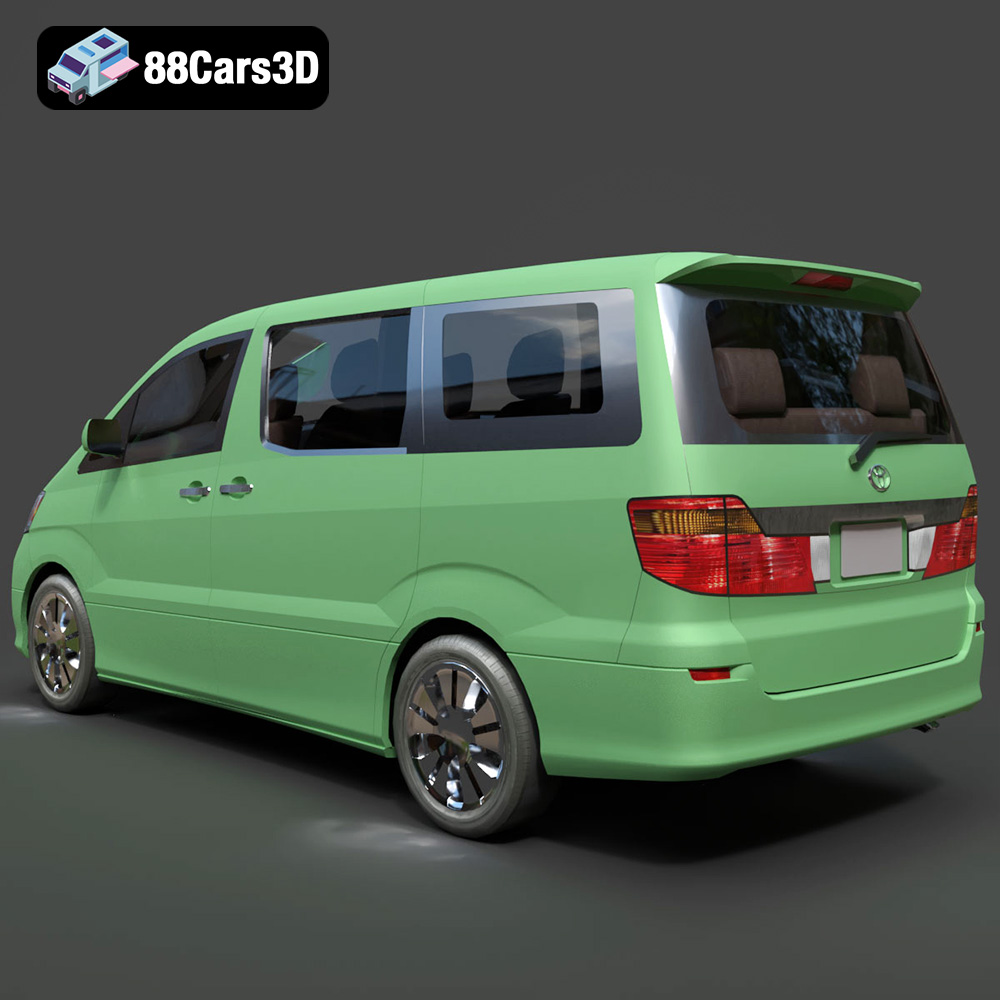
Today, we’re diving deep into the intricate world of premium 3D vehicle assets, exemplified by models like the Toyota Alphard 3D Model available at 88cars3d.com. This sophisticated digital recreation of the iconic luxury minivan stands as a testament to precision engineering in the 3D space, offering a robust foundation for a multitude of professional applications. We’ll explore how such meticulously crafted models become indispensable tools for designers, developers, and artists, enabling them to push boundaries and achieve unparalleled realism and efficiency in their creative endeavors.
Understanding 3D Model File Formats: The Backbone of Digital Assets
Choosing the correct file format for your 3D models is a crucial decision that impacts workflow, compatibility, and final output quality. Each format is designed with specific use cases and technical advantages in mind. Understanding these nuances ensures seamless integration into your projects, whether you’re aiming for photorealistic renders, real-time game environments, or physical 3D prints. The Toyota Alphard 3D Model, for instance, comes in a comprehensive suite of formats, catering to virtually every professional need.
.blend – The Native Blender Ecosystem
The .blend format is Blender’s native file type, offering a complete and editable scene. When you receive a .blend file, you’re getting more than just the mesh; you’re gaining access to the entire Blender project. This includes not only the vehicle’s geometry and meticulously configured materials but also lighting setups, camera positions, animation data, modifiers, and even custom scripts. For artists and studios primarily working within the Blender environment, the .blend file provides maximum flexibility for customization, rigging, and advanced rendering with Cycles or Eevee. Its non-destructive workflow allows for extensive modifications without permanently altering the base mesh, making it ideal for iterative design and detailed refinement of the Toyota Alphard 3D Model.
.fbx – The Industry Standard for Interoperability
Autodesk’s .fbx (Filmbox) format has become an unofficial industry standard for exchanging 3D data between different software applications. It’s renowned for its robust support for mesh geometry, materials, textures, animations, bones, and even camera data. This makes .fbx an ideal choice for pipelines involving multiple software packages, such as exporting models from a modeling application (like 3ds Max or Blender) into game engines like Unreal Engine or Unity, or into other rendering software. For game developers using the Toyota Alphard 3D Model, .fbx ensures that all relevant data, including the separated components for animation, translates cleanly, facilitating smooth import and setup in real-time environments.
.obj – The Universal Geometry Carrier
The .obj (Wavefront Object) format is one of the most widely supported and simplest 3D file formats. It primarily stores geometric data, including vertices, normals, UV coordinates, and faces. While it can reference external material (.mtl) files for basic color and texture information, it does not support advanced features like animation, rigging, or complex material networks. Its universality makes it an excellent choice for straightforward mesh exchange across nearly all 3D software. If you need a clean, unadorned mesh of the Toyota Alphard 3D Model for sculpting, retopology, or simply as a base for a completely new material setup in an obscure renderer, .obj is your go-to.
.glb – Optimized for AR, VR, and Web
The .glb (GL Transmission Format Binary) is a modern, efficient format designed for the transmission and loading of 3D scenes and models in a single binary file. It’s particularly optimized for use in web-based applications, augmented reality (AR), and virtual reality (VR) experiences due to its compact size and efficiency. A .glb file typically includes geometry, materials, textures, animations, and skeletal data, making it a self-contained package. For interactive showrooms, virtual product configurators, or AR marketing campaigns featuring the Toyota Alphard, .glb provides a streamlined solution for delivering high-quality 3D content directly to web browsers or mobile devices.
.stl – The Language of 3D Printing
The .stl (Stereolithography) format is the cornerstone of additive manufacturing, commonly known as 3D printing. It represents 3D surfaces as a series of connected triangles, forming a tessellated model. .stl files contain only geometric data and no color, texture, or material information. While suitable for precise physical replication, it’s not ideal for rendering or animation workflows. For engineers or hobbyists looking to create a physical replica of the Toyota Alphard 3D Model, converting the high-detail digital asset into an .stl provides the necessary data for a 3D printer to accurately reconstruct the vehicle layer by layer.
.ply – Precision Mesh for CAD and Analysis
The .ply (Polygon File Format) is another widely supported format, often used for storing 3D data from 3D scanners, CAD applications, or for scientific and engineering analysis. It can store a wider range of properties than .obj, including color, transparency, normals, texture coordinates, and even properties for individual vertices and faces. While less common in general animation pipelines, its precision and ability to store rich per-vertex data make it valuable for specialized applications, such as quality control, reverse engineering, or detailed structural analysis of the Toyota Alphard’s geometry.
.unreal – Engine-Ready for Real-Time Environments
The .unreal format refers to assets specifically configured and packaged for direct import and optimal performance within the Unreal Engine ecosystem. This often means pre-optimized meshes, material instances, collision meshes, LODs (Levels of Detail), and sometimes even blueprint setups. Receiving the Toyota Alphard 3D Model in an .unreal package significantly streamlines the integration process for game developers and real-time visualization artists. It bypasses many of the manual import and setup steps, ensuring that the model is immediately usable with Unreal’s powerful rendering and simulation capabilities, maintaining PBR (Physically Based Rendering) accuracy and scene integrity.
.max – The 3ds Max Project Powerhouse
The .max format is Autodesk 3ds Max’s native file type. Similar to .blend for Blender, a .max file contains the complete 3ds Max scene, including the Toyota Alphard 3D Model’s geometry, complex material shaders (e.g., V-Ray, Corona), lighting setups, camera animations, rigs, and scene hierarchies. For professionals deeply embedded in the 3ds Max pipeline, this format offers the most control and flexibility for high-end architectural visualization, cinematic rendering, and advanced animation. It allows for full access to every parameter, enabling artists to fine-tune every aspect of the model and its environment to achieve peak realism.
The Art and Science of Automotive Rendering
Automotive rendering is a specialized field that demands an exquisite balance of artistic vision and technical prowess. Achieving photorealistic results requires not just a high-quality model, but also a deep understanding of lighting, materials, and composition. The Toyota Alphard 3D Model, with its detailed exterior and interior, serves as an excellent foundation for such endeavors.
Crafting Photorealistic Materials and Textures
The realism of an automotive render hinges significantly on its materials. For the Toyota Alphard, this means accurately recreating the sheen of its metallic paint, the reflectivity of chrome accents, the subtle texture of the tire rubber, and the delicate transparency of the window glass and headlight lenses. PBR (Physically Based Rendering) workflows are essential here, where material properties like albedo, roughness, metallicness, and normal maps simulate how light interacts with surfaces in the real world. A well-constructed model like the Alphard comes with pre-configured PBR materials, saving artists countless hours in setup and allowing them to immediately focus on scene composition and lighting.
Beyond surface properties, specific details like the intricate patterns in seat upholstery or the subtle grain of dashboard plastics are brought to life through high-resolution texture maps. These textures are mapped precisely onto the model using efficient UV layouts, ensuring no stretching or distortion, even on complex curved surfaces inherent to vehicle design. The ability to easily modify paint finishes or apply custom graphics, as offered by this model, empowers artists to adapt the vehicle to diverse scenarios, from luxury advertisements to fleet branding concepts.
Mastering Lighting and Environment for Impact
Lighting is the soul of any render. For automotive visualization, it’s about showcasing the vehicle’s form, contours, and reflective surfaces in the most flattering light. This can range from a pristine studio setup with controlled softboxes to a dynamic outdoor environment with natural sunlight and HDR (High Dynamic Range) image-based lighting. The Toyota Alphard 3D Model, built to real-world scale and with proper pivot points, integrates seamlessly into any lighting scenario. Artists can experiment with various environments – perhaps a bustling urban street for a dynamic shot, a serene mountain pass to emphasize luxury, or a minimalist showroom to highlight design purity. The transparent materials of the headlights and taillights allow for realistic illumination effects, essential for night scenes or dramatic atmospheric renders, adding another layer of authenticity to the visual narrative.
Developing Immersive Game Environments with Optimized 3D Assets
Game development places unique demands on 3D assets: they must be visually compelling, but crucially, also highly optimized for real-time performance. The Toyota Alphard 3D Model is engineered to strike this balance, making it an invaluable asset for game creators.
Polycount Management and Level of Detail (LODs)
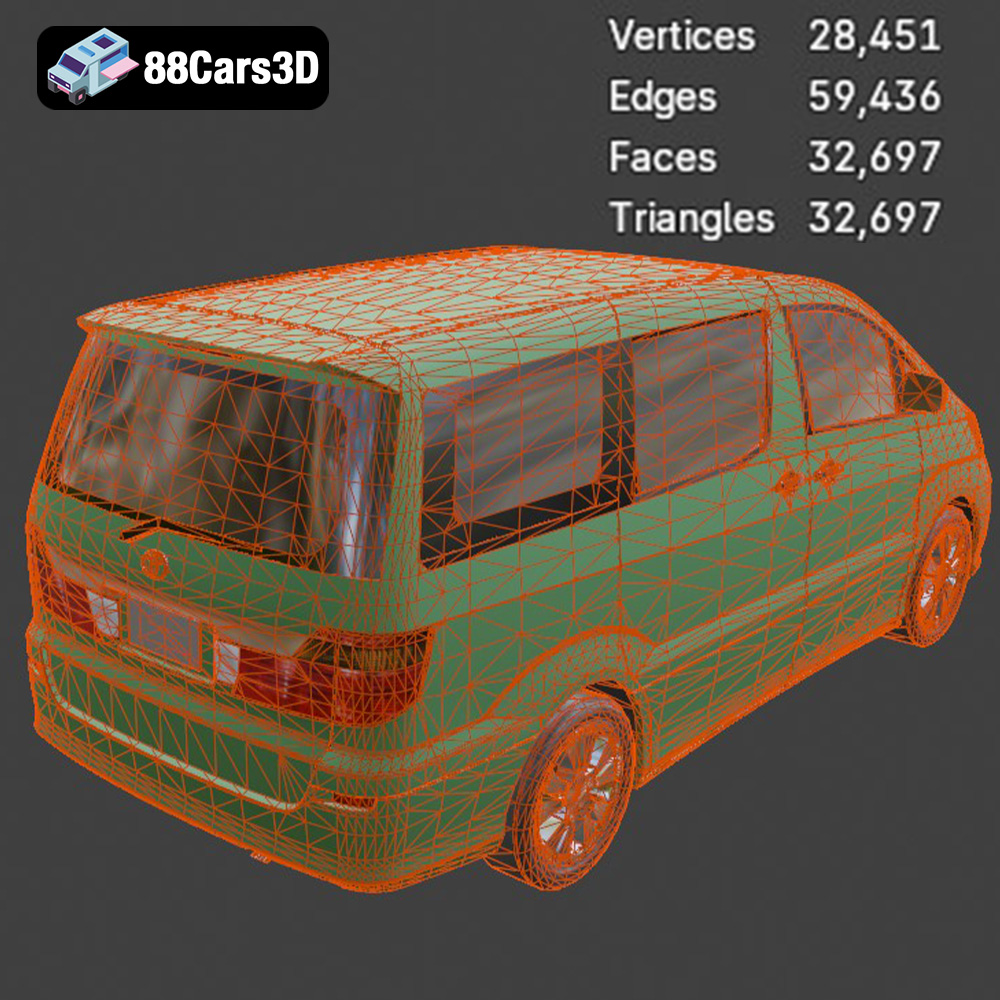
One of the primary challenges in game development is managing polycount – the number of polygons that make up a 3D model. While high polycounts contribute to visual fidelity, they can severely impact frame rates in real-time engines. A model like the Alphard is built with “optimized mesh quality” and “balanced detailing,” meaning it maintains visual integrity without being excessively heavy. Furthermore, professional game assets often employ Level of Detail (LOD) systems. This involves creating multiple versions of the same model, each with a progressively lower polycount. The engine then automatically switches between these LODs based on the vehicle’s distance from the camera. The distant Alphard might use a few thousand polygons, while a close-up view might utilize tens of thousands, ensuring performance without sacrificing visual quality where it matters most.
The “clean, quad-dominant topology” of the Toyota Alphard 3D Model is especially beneficial here. It allows for efficient automatic LOD generation and smooth deformation if the vehicle needs to be damaged or animated, avoiding artifacts common with triangulation or messy geometry. This attention to underlying mesh structure is a hallmark of high-quality game assets.
Implementing Realistic Vehicle Physics and Interactions
Beyond just appearance, game assets must interact realistically with the game world. For a vehicle like the Toyota Alphard, this involves setting up physics assets for collision detection, defining suspension parameters, and integrating driving mechanics. The “separated components such as doors, hood, and trunk” are crucial for implementing interactive elements, like opening doors for character entry, or simulating collision damage where parts deform or detach. The model’s logical hierarchy and properly set pivots greatly facilitate the rigging process, whether for suspension articulation, wheel rotation, or steering mechanisms. This level of preparation ensures that integrating the Alphard into a driving simulator or an open-world game is a streamlined process, allowing developers to focus on gameplay rather than extensive asset cleanup.
Beyond the Screen: AR/VR, Simulation, and 3D Printing
The versatility of a well-crafted 3D model extends far beyond traditional rendering and game engines, opening doors to cutting-edge applications in augmented reality, virtual reality, detailed simulations, and even physical manufacturing.
Immersive Experiences in AR/VR
Augmented Reality (AR) and Virtual Reality (VR) are transforming how we interact with digital content, offering immersive experiences that blend the digital with the physical. For automotive applications, this means everything from virtual showrooms where customers can explore a Toyota Alphard in their driveway via AR, to full-scale VR driving experiences. Models destined for AR/VR must be optimized for real-time performance and often delivered in compact formats like .glb. The Alphard’s “optimized mesh quality” and “clean geometry” make it an ideal candidate for these demanding environments, ensuring smooth frame rates and realistic visual fidelity even on mobile AR platforms or standalone VR headsets. Imagine walking around the Alphard, opening its doors, and even sitting virtually inside, all powered by this meticulously crafted 3D model.
High-Fidelity Simulation and Training
Simulation and training platforms are critical across various industries, from automotive engineering to military training. A highly accurate 3D model of a vehicle like the Toyota Alphard can be integrated into driving simulators for driver training, vehicle dynamics testing, or even for developing autonomous driving algorithms. The “real-world scale” and “comprehensive interior detailing” are particularly important here, providing an authentic representation of the vehicle’s cockpit and external dimensions. Basic undercarriage components add another layer of realism for complex scenarios involving vehicle inspections or maintenance training modules. The precision of the model ensures that the simulation accurately reflects the physical characteristics of the actual vehicle, making training exercises more effective and realistic.
Bringing Digital to Life with 3D Printing
While often associated with digital displays, 3D models can also bridge the gap to the physical world through 3D printing. The Toyota Alphard 3D Model, convertible to the .stl format, allows for the creation of high-quality physical replicas. This can be invaluable for design reviews, scale models for presentations, or even collectible items. The model’s “clean, quad-dominant topology” is a significant advantage, as it translates cleanly into the triangulated mesh required by .stl, minimizing errors and ensuring a smooth, accurate physical print. This capability underscores the multi-faceted utility of a professionally developed 3D asset, extending its value beyond purely digital domains.
Mastering Your 3D Workflow: Integration and Customization
The true value of a premium 3D asset lies not just in its inherent quality, but also in how easily it integrates into existing workflows and adapts to specific project requirements. The Toyota Alphard 3D Model excels in this regard, offering unparalleled flexibility for artists and developers.
Seamless Integration Across Diverse Software
Professional pipelines often involve a mix of software, each chosen for its specialized capabilities. Whether you’re a Blender enthusiast, a 3ds Max power user, or a developer primarily working in Unreal Engine, the provision of multiple file formats (.blend, .max, .fbx, .unreal, .obj) ensures that the Toyota Alphard 3D Model drops into your preferred environment with minimal friction. This eliminates the time-consuming process of format conversion, mesh cleanup, or material recreation that often accompanies lower-quality assets. The “logically organized hierarchy with properly set pivots” further simplifies integration, making it straightforward to rig for animation, apply constraints, or position accurately within complex scenes.
For studios with established pipelines, this compatibility translates directly into efficiency. An architectural visualization team using 3ds Max and V-Ray can leverage the .max file for immediate high-fidelity renders, while a game studio can use the .unreal or .fbx versions for real-time applications, all deriving from the same high-quality source model from 88cars3d.com.
Unleashing Creativity with Customization Options
Every project has unique demands, and the ability to customize assets without compromising quality is paramount. The Toyota Alphard 3D Model offers extensive customization options, empowering artists to tailor it to their precise vision. Easily modifying paint finishes allows for quick color changes to match brand guidelines or artistic moods. Applying custom graphics can transform the minivan into a branded company vehicle, a unique concept car, or even a vehicle for a specific in-game faction. Adjusting material properties for metals, chrome, rubber, and plastics provides granular control over the visual aesthetics, letting artists fine-tune reflections, roughness, and subtle surface details to achieve their desired realism.
Furthermore, the model’s clean topology and well-structured UVs mean that more advanced customizations, such as adding custom body kits, spoilers, or intricate decals, can be done efficiently and effectively. This level of adaptability ensures that the Toyota Alphard 3D Model is not just a static asset, but a dynamic foundation for countless creative iterations.
The Value of Production-Ready Assets from 88cars3d.com
In today’s fast-paced digital production environment, time is a critical commodity. Building a highly detailed, technically accurate 3D vehicle model from scratch can take hundreds of hours of expert labor, involving meticulous modeling, UV unwrapping, texturing, and optimization. This is where a marketplace like 88cars3d.com provides immense value, offering production-ready 3D car models that save both time and resources.
A “production-ready” asset, such as the Toyota Alphard 3D Model, means it has already undergone the rigorous process of quality assurance. It boasts clean, quad-dominant topology for smooth deformation and subdivision, accurately modeled body panels, detailed lights, wheels, and a comprehensive interior. It’s built to real-world scale, has a logical hierarchy, and includes properly set pivots, all of which are essential for hassle-free animation and manipulation. The inclusion of multiple industry-standard file formats further ensures that these assets are immediately usable across a wide array of software and pipelines.
For studios operating on tight deadlines or independent artists looking to elevate their portfolio without the overhead of extensive modeling, sourcing high-quality assets from 88cars3d.com is a strategic advantage. It allows them to focus their creative energy on lighting, composition, animation, or gameplay mechanics, knowing that the foundational vehicle model is robust and visually impeccable. This investment in premium assets directly translates into higher quality final outputs, greater project efficiency, and ultimately, more successful creative endeavors.
Conclusion: Driving Innovation with Premium 3D Models
The journey through the intricacies of 3D car models reveals a landscape where technical precision meets artistic expression. From the foundational understanding of diverse file formats to the nuanced art of rendering and the demanding requirements of game development, every aspect contributes to the creation of compelling digital experiences. Models like the Toyota Alphard 3D Model are more than just digital objects; they are meticulously engineered tools designed to empower professionals across various industries.
Its clean geometry, detailed features, and versatile file format support underscore its value as an essential asset for anyone serious about high-quality rendering, immersive simulations, game development, AR/VR, or even 3D printing. By providing a solid, production-ready foundation, such models free up valuable time and resources, allowing artists and developers to focus on innovation and creativity.
Whether you’re crafting a cinematic advertisement, building the next-generation driving simulator, or creating an interactive virtual showroom, the quality of your 3D assets will dictate the success of your project. Explore premium 3D car models, including the exceptional Toyota Alphard 3D Model, at 88cars3d.com and equip your pipeline with the tools necessary to drive your vision forward.
Featured 3D Model
Toyota Alphard 3D Model
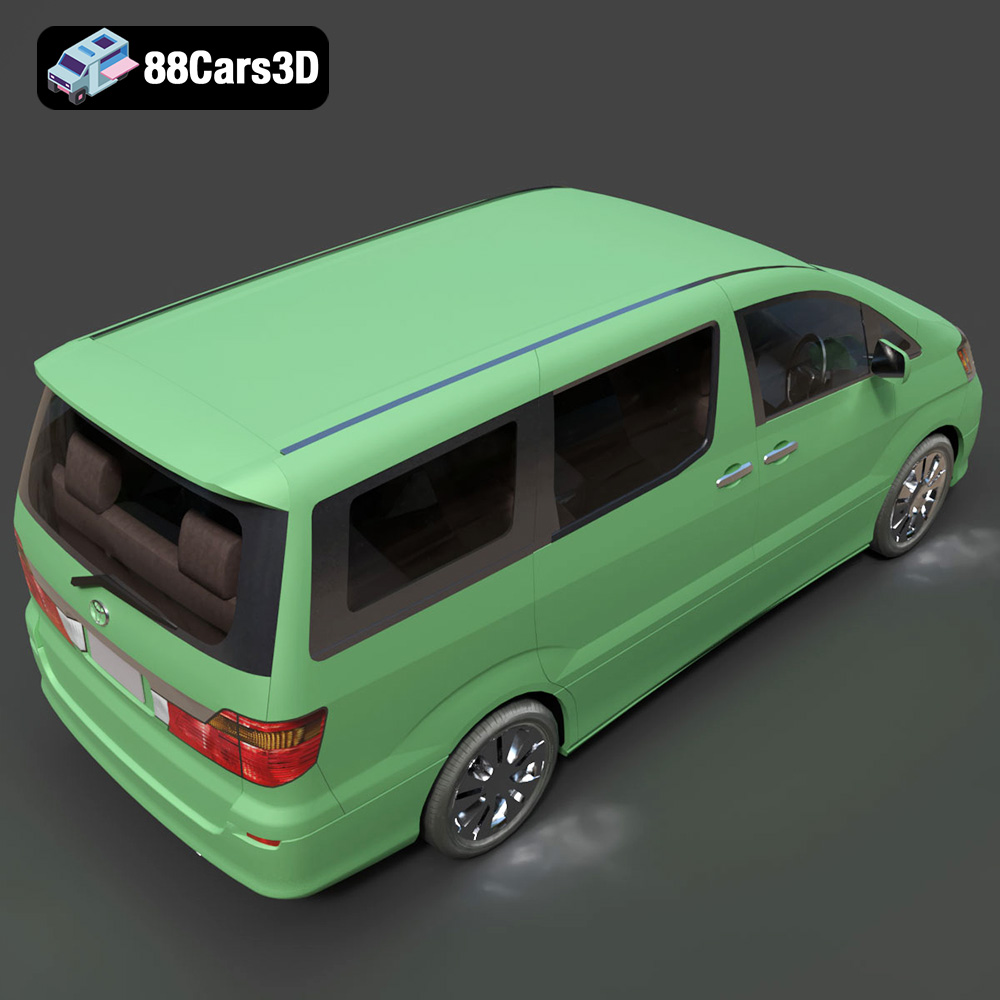
Presenting the highly detailed Toyota Alphard 3D Model, a faithful digital recreation of the iconic luxury minivan. This model captures the Alphard’s distinctive aesthetic, known for its opulent design, spacious interior, and commanding road presence. Built with clean geometry and balanced detailing, it ensures optimal performance across various applications. Ideal for high-quality rendering, realistic animations, immersive simulations, and robust game development projects.
Exterior Features:
- Accurately modeled body panels reflecting the Alphard’s signature styling.
- Detailed headlights and taillights with transparent materials for realistic illumination effects.
- Precisely crafted wheels and tires, enhancing the vehicle’s authentic appearance.
- Separated components such as doors, hood, and trunk for easy animation workflows.
- Realistic window glass with appropriate transparency for clear views of the interior.
Interior / Mechanical Features:
- Comprehensive interior detailing, including dashboard, steering wheel, seats, and central console.
- Optimized mesh quality to balance visual fidelity with efficient polycount.
- Basic undercarriage components for added realism in complex scenes.
Technical Advantages:
- Clean, quad-dominant topology for smooth subdivision and distortion-free deformation.
- Modeled to real-world scale, ensuring accurate integration into any scene or project.
- Logically organized hierarchy with properly set pivots, facilitating effortless animation and manipulation.
Applications:
- Rendering & Visualization: Perfect for studio renders, architectural visualizations, and cinematic scenes.
- Game Development: Optimized as a game asset for racing games, open-world simulations, and virtual environments.
- AR/VR: Ready for immersive augmented and virtual reality experiences.
- Simulation & Training: Suitable for driving simulators, educational modules, and technical training.
- 3D Printing: Convertible to .stl format for creating high-quality physical models.
Customization Options:
- Easily modify paint finishes and apply custom graphics to match branding or personal preferences.
- Adjust material properties for metals, chrome accents, rubber, and plastics to achieve desired visual effects.
- Adapt lighting setups to complement various scene environments and moods.
The Toyota Alphard 3D Model stands as a testament to precision and versatility. It’s an essential asset for professionals seeking a high-quality, production-ready luxury minivan model for any demanding 3D project.
Included File Formats:
- .blend – Blender project with materials
- .fbx – Compatible with Unreal, Unity, and major 3D engines
- .obj – Universal format for nearly all 3D software
- .glb – Optimized for AR, VR, and web-based visualization
- .stl – Ready for 3D printing
- .ply – Mesh format for analysis and CAD workflows
- .unreal – Unreal Engine project setup
- .max – Editable 3ds Max scene for rendering and animation
Tags:
.toyota, .alphard, .minivan, .luxuryvan, .van, .rendering, .simulation, .gameasset, .arvr, .blend, .fbx, .obj, .glb, .stl, .ply, .unreal, .max
$21.99
Product Image Gallery