

The Precision Art of Automotive 3D Modeling: Fueling Your Creative Engines
In the dynamic world of digital content creation, the demand for hyper-realistic 3D assets continues to accelerate. From breathtaking cinematic sequences to immersive virtual experiences and cutting-edge game environments, high-quality 3D car models are indispensable. They form the backbone of visual storytelling, allowing artists and developers to convey speed, luxury, and intricate engineering with unparalleled fidelity. The difference between a good project and a truly exceptional one often lies in the quality of its core assets.
This pursuit of perfection is particularly evident in the realm of automotive visualization. Capturing the essence of a modern performance vehicle, such as the sleek and aggressive BMW M3 2024, requires not just artistic flair but also meticulous technical execution. A well-crafted 3D model goes beyond mere aesthetics; it embodies accurate dimensions, structurally clean topology, and materials that react realistically to light. It’s about bringing a machine to life in the digital space, ready for any challenge – be it a close-up render that highlights every curve or a real-time simulation demanding optimal performance.
The BMW M3 2024 3D Model exemplifies this blend of artistry and engineering. It’s a precision-engineered asset that meticulously reproduces the iconic grille design, dynamic silhouette, and aggressive styling of the latest M3 generation. Optimized for close-up renders and demanding simulation environments, this model ensures visual fidelity across all professional applications. Whether you’re a seasoned professional looking to enhance your project or an aspiring artist seeking a high-benchmark asset, understanding the nuances of 3D car models and their applications is crucial. Let’s delve into the technical depths and creative potential these assets unlock, exploring how products like the BMW M3 2024 3D Model from 88cars3d.com streamline professional workflows and elevate digital content.
Understanding 3D Model File Formats
The choice of file format for a 3D model is far more critical than simply picking one that opens in your preferred software. Each format carries specific characteristics, strengths, and limitations that dictate its suitability for different stages of a project, from initial modeling to final deployment in games, AR/VR, or 3D printing. Understanding these nuances is essential for efficient workflow and ensuring compatibility across various pipelines.
.blend – The Native Blender Powerhouse
The .blend format is Blender’s native file type, offering a complete scene package. When you acquire a .blend file like that included with the BMW M3 2024 3D Model, you’re getting more than just the mesh; it typically contains all materials, textures, lighting setups, camera positions, animations, and even physics simulations. This makes it ideal for users who work primarily in Blender, providing a fully editable and ready-to-render environment. Its strength lies in preserving all aspects of the Blender scene, ensuring that the artist’s original vision for lighting and material properties is maintained.
.fbx – The Industry Standard for Interchange
The .fbx (Filmbox) format is a proprietary file format owned by Autodesk, widely adopted as an industry standard for interoperability between 3D applications and game engines. It excels at transferring 3D models, animation data, cameras, and even material assignments. For game development, especially with engines like Unreal and Unity, .fbx is often the go-to format due to its robust support for mesh data, skeletal animations, and UV mapping. While it can carry material information, specific shader setups often need to be recreated in the target engine.
.obj – The Universal Workhorse
.obj (Wavefront OBJ) is one of the oldest and most widely supported 3D file formats, making it a truly universal choice. It primarily stores geometry (vertices, normals, texture coordinates, and faces) and can reference external material definition files (.mtl). Its simplicity and widespread compatibility mean almost any 3D software can open and work with an .obj file. However, it doesn’t support animation or scene information, making it best suited for static mesh transfer where fidelity to geometry is paramount.
.glb – Optimized for AR, VR, and Web
.glb (GL Transmission Format Binary) is the binary version of glTF, a royalty-free specification for the efficient transmission and loading of 3D scenes and models by applications. It packages textures, animations, and other data directly into a single file, making it incredibly convenient for web-based 3D, augmented reality (AR), and virtual reality (VR) applications. Its compact size and single-file nature are highly advantageous for streaming and quick deployment in lightweight environments, perfectly suited for interactive experiences of the BMW M3 2024 in a browser or mobile AR app.
.stl – The 3D Printing Backbone
.stl (Stereolithography) is the dominant file format for 3D printing. It represents a 3D model as a collection of unconnected triangular facets, defining only the surface geometry without color, texture, or other model attributes. While excellent for conveying shape for manufacturing, it’s not suitable for rendering or animation due to its lack of detailed surface information. For prototyping a physical miniature of the BMW M3 2024, an .stl export would be the logical step.
.ply – Precision Mesh for Analysis
The .ply (Polygon File Format or Stanford Triangle Format) is a file format for storing three-dimensional data from 3D scanners. It can store a variety of properties, including color, transparency, normals, texture coordinates, and even confidence values for each vertex or face. It’s often used in academic and research contexts for detailed mesh analysis, particularly when dealing with data derived from scanning real-world objects. Its precision makes it valuable for applications requiring accurate geometric representation.
.unreal – Engine-Ready for Real-Time Environments
The .unreal format, or more accurately, assets that are “pre-configured for Unreal Engine use,” are not a single file extension but rather a collection of files and settings optimized for direct import into Unreal Engine. This often means the mesh, textures, and materials are already set up according to Unreal’s specifications, potentially with collision meshes, LODs (Levels of Detail), and blueprint configurations. This significantly accelerates integration, minimizing the need for manual setup and ensuring immediate real-time performance and visual consistency within the engine.
.max – The Professional 3ds Max Project
Similar to .blend, .max is the native file format for Autodesk 3ds Max, a leading software in professional visualization, animation, and rendering. An included .max file for the BMW M3 2024 3D Model provides a complete 3ds Max scene, including geometry, materials, lighting, cameras, and potentially animation. This offers maximum flexibility for artists using 3ds Max, allowing full control over rendering setups, scene modifications, and integration into existing 3ds Max projects, from architectural visualizations to product showcases.
The availability of such a diverse range of formats for the BMW M3 2024 3D Model on 88cars3d.com underscores its versatility and readiness for almost any professional pipeline, saving valuable time and ensuring optimal integration.
The Art of Automotive Rendering: Bringing Cars to Life
Automotive rendering is a specialized discipline within 3D visualization that focuses on creating photorealistic images and animations of vehicles. It’s a field where precision, aesthetic sensibility, and technical mastery converge to produce stunning visual content for advertising, design reviews, and virtual showrooms. The quality of the underlying 3D car models is paramount to achieving this level of realism.
Achieving Photorealism: Materials and Lighting
The illusion of reality in a render stems heavily from the interaction of light with materials. For an automotive model like the BMW M3 2024, this means accurately replicating the complex interplay of reflections, refractions, and diffuse scattering seen on car paint, glass, chrome, and rubber. Professional 3D models come with carefully calibrated materials, often using Physically Based Rendering (PBR) workflows. PBR materials simulate how light behaves in the real world, accounting for metallic, roughness, and normal properties, among others.
- Car Paint Shaders: These are notoriously complex, often involving multiple layers to simulate flake effects, clear coats, and metallic sheens. The BMW M3 2024 3D Model’s professionally configured materials are designed to react realistically to virtual lighting, crucial for convincing paint jobs.
- Glass and Chrome: Accurate refraction for windows and highly reflective properties for chrome accents require precise material settings and clean geometry to avoid artifacts.
- Studio Lighting Techniques: Beyond material settings, the lighting setup is key. Virtual studio lighting often mimics real-world photographic studios, using large softboxes and rim lights to highlight contours and provide appealing reflections. High Dynamic Range Image (HDRI) environments are also frequently used to provide realistic ambient lighting and reflections from real-world scenes.
Workflow in 3ds Max and Blender for Cinematic Renders
Both 3ds Max and Blender are industry powerhouses for cinematic rendering, each offering robust tools for automotive visualization. When using an asset like the BMW M3 2024 3D Model, the workflow typically involves:
- Import and Scene Setup: Loading the .max or .blend file, which often includes a starting point with materials and potentially basic lighting.
- Refining Materials: While included materials are a great starting point, artists often fine-tune them to match specific creative visions or render engine requirements (e.g., V-Ray, Corona, Cycles, Octane). This might involve adjusting texture maps, color variations, or adding custom details.
- Lighting and Environment: Crafting the perfect lighting scenario is critical. This could involve placing virtual studio lights, integrating the car into an architectural visualization scene with existing light sources, or using HDRI maps for environmental reflections and illumination.
- Camera Positioning and Animation: Selecting dramatic camera angles and, for animations, orchestrating dynamic camera movements to showcase the vehicle’s design and features. The included fully realized interior of the BMW M3 2024 3D Model makes it ideal for first-person views or driver’s perspective shots, adding another layer of immersion for cinematic work.
- Rendering and Post-Production: The final stage involves rendering high-resolution images or animation sequences, followed by post-production in software like Adobe Photoshop or After Effects to add color grading, effects, and final touches to enhance visual appeal.
High-Fidelity 3D Car Models in Game Development
The demands of game development present a unique set of challenges and opportunities for 3D car models. While photorealism is a goal, it must be balanced with performance optimization for real-time environments. A game-ready asset, such as the BMW M3 2024 3D Model, bridges this gap, offering visual quality without bogging down frame rates.
Optimizing for Real-Time Performance: Poly Counts and LODs
Unlike pre-rendered cinematics, game engines must render complex scenes dozens or even hundreds of times per second. This necessitates careful optimization of 3D assets:
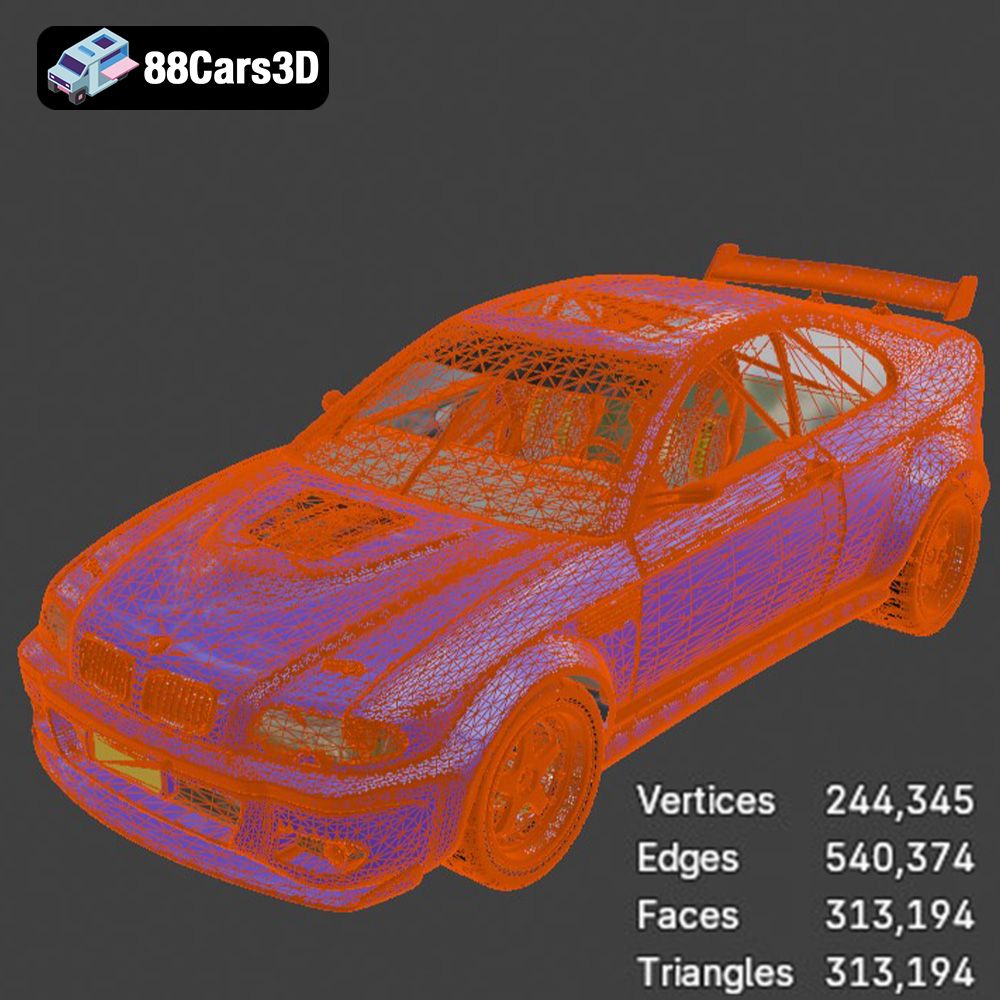
- Poly Count Management: While the BMW M3 2024 3D Model offers “unparalleled realism” and is optimized for “close-up renders,” for game use, particularly in open-world environments, the raw poly count might need adjustment. High-detail models are often provided with clean, structurally sound topology, making them easier to optimize without losing fidelity.
- Levels of Detail (LODs): A crucial optimization technique involves creating multiple versions of a model with varying levels of geometric detail. When the car is far from the camera, a low-polygon LOD is used; as it gets closer, higher-polygon LODs are swapped in. This ensures visual quality where it matters most while conserving resources elsewhere. A professional model like the one from 88cars3d.com is designed for easy LOD generation or may even include them.
- Efficient UV Mapping: Clean UV mapping is essential for applying textures without stretching or distortion and for efficient texture packing, which reduces draw calls in game engines.
Integrating into Unreal Engine and Unity Pipelines
The BMW M3 2024 3D Model is specifically mentioned as being ready for integration into major game development pipelines like Unreal Engine and Unity. The inclusion of .fbx and .unreal (pre-configured) formats directly addresses this need.
- Unreal Engine Workflow:
- Importing: Using the .fbx file for direct import. The .unreal package offers an even smoother experience, with mesh, materials, and potentially collision volumes already set up.
- Material Setup: Utilizing Unreal’s powerful material editor to recreate PBR materials using provided texture maps (albedo, normal, roughness, metallic, ambient occlusion). The pre-configured materials in the .unreal file will significantly speed up this process.
- Collision: Setting up accurate collision meshes for realistic interaction with the game world.
- Physics and Driving Systems: Integrating the model into a vehicle blueprint, configuring suspension, engine parameters, and tire physics to create a realistic driving experience. The accurate scale and robust geometry of the BMW M3 2024 3D Model are critical here.
- Unity Workflow:
- Importing: Dragging and dropping the .fbx file into the Unity project.
- Material Creation: Assigning standard PBR materials in Unity, linking the appropriate texture maps.
- Rigidbody and Colliders: Adding a Rigidbody component and appropriate collider shapes (e.g., Mesh Collider, Box Collider) for physical interaction.
- Vehicle Controller Scripts: Integrating the model with Unity’s various vehicle physics assets (e.g., Wheel Colliders) and custom control scripts for realistic handling.
Professional assets like the BMW M3 2024 3D Model dramatically cut down development time by providing a high-quality, pre-optimized starting point, allowing developers to focus on gameplay and immersive experiences rather than asset creation.
Beyond Rendering and Gaming: AR/VR, Simulation, and Prototyping
The utility of high-quality 3D car models extends far beyond traditional rendering and game development. They are increasingly vital tools in cutting-edge fields like Augmented Reality (AR), Virtual Reality (VR), professional simulations, and even manufacturing prototyping. The versatility of an asset like the BMW M3 2024 3D Model makes it invaluable across these diverse applications.
Immersive Experiences in AR/VR
AR and VR are transforming how we interact with digital content, offering unprecedented levels of immersion. Automotive models play a significant role here, enabling virtual showrooms, interactive product configurators, and training simulations.
- Virtual Showrooms: Imagine prospective buyers exploring the BMW M3 2024 in a VR headset, walking around it, opening doors, and sitting inside the fully realized interior. They could customize colors and trims in real-time, experiencing the vehicle long before it reaches a physical dealership. The .glb format is particularly suited for this due to its optimization for web and mobile AR/VR.
- Interactive Configurators: AR applications on smartphones can project a 3D model of the BMW M3 2024 onto a real-world surface, allowing users to view the car in their driveway, change its paint color, or examine details as if it were truly there. The robust geometry and detailed textures of this specific model ensure a convincing AR experience.
- Training and Maintenance: VR can be used to train technicians on complex repair procedures or to educate sales staff about vehicle features in an engaging, interactive environment.
High-Fidelity Simulation and Visualization
Professional simulations demand highly accurate 3D models to ensure reliable and realistic outcomes. From autonomous driving development to urban planning, precise vehicle representations are critical.
- Autonomous Vehicle Testing: Developing self-driving algorithms requires vast amounts of simulation data. High-fidelity 3D car models populate these virtual environments, allowing AI systems to learn to identify vehicles, predict their behavior, and navigate complex traffic scenarios safely. The accurate scale and detailed external features of the BMW M3 2024 make it perfect for populating such virtual test beds.
- Traffic Flow Analysis: Urban planners and engineers use simulations to model traffic patterns, assess infrastructure changes, and predict congestion. Realistic car models add visual fidelity to these simulations, making them more understandable and presentable to stakeholders.
- Forensic Reconstruction: In accident investigations, 3D simulations using accurate vehicle models can help reconstruct events, analyze impact dynamics, and determine causes.
3D Printing and Prototyping
Beyond the digital realm, 3D models serve a crucial role in physical prototyping and manufacturing. The .stl and .ply formats provided with the BMW M3 2024 3D Model open doors to these possibilities.
- Scale Models and Miniatures: Designers and enthusiasts can 3D print physical scale models of the BMW M3 2024 for display, educational purposes, or as part of larger dioramas. The precision of the digital model translates directly into the accuracy of the physical print.
- Design Review and Ergonomics: While full-scale prototypes are expensive, printing specific components or scaled-down versions allows for early physical review of design elements, panel gaps, or ergonomic considerations, providing tangible feedback during the design process.
- Custom Parts and Accessories: Hobbyists or aftermarket designers might use parts of the model (e.g., wheel designs) as a basis for designing and 3D printing custom accessories or modifications, leveraging the precise digital foundation.
The versatility and multi-format support of professional 3D car models from sources like 88cars3d.com make them indispensable assets across a spectrum of industries, enabling innovation and efficiency in both digital and physical design and production.
Optimizing Your Workflow with Professional 3D Assets
In any professional creative pipeline, time is a precious commodity. Creating a highly detailed 3D car model from scratch, like the BMW M3 2024, can take hundreds of hours of dedicated work from experienced 3D artists. This includes meticulous blueprint research, complex modeling, intricate UV mapping, texture creation, and sophisticated material setup. For studios and individual freelancers, the cost-benefit analysis often favors acquiring ready-to-use, professional-grade assets.
The Value Proposition of Pre-Made, High-Quality Models
Purchasing a professionally crafted 3D model offers several distinct advantages that significantly optimize workflow:
- Time Savings: This is arguably the biggest benefit. Instead of investing weeks or months in asset creation, an artist can immediately integrate the model into their scene, cutting down production schedules dramatically. This is particularly crucial for tight deadlines in advertising, film, or game development.
- Cost Efficiency: While there’s an upfront cost, it’s often a fraction of the expense of commissioning or internally producing a model of equivalent quality, considering artist salaries, software licenses, and overhead.
- Guaranteed Quality: Reputable marketplaces like 88cars3d.com curate their offerings, ensuring that assets like the BMW M3 2024 3D Model meet high professional standards for accuracy, topology, materials, and overall presentation. This eliminates the uncertainty of creating assets from scratch or relying on unverified sources.
- Consistency Across Projects: Using high-quality purchased assets can help maintain a consistent level of detail and realism across different projects, enhancing a studio’s overall portfolio.
Seamless Integration and Customization
A truly professional 3D model isn’t just high-quality; it’s also designed for ease of use and customization. The inclusion of multiple file formats with the BMW M3 2024 3D Model—from .blend and .max for comprehensive scene control to .fbx and .unreal for game engines—is key to this flexibility.
- Editable Files: Formats like .blend and .max provide a fully editable project, allowing artists to delve into the model’s structure, modify geometry, adjust materials to suit specific rendering engines or stylistic needs, and even animate components like doors or wheels. The “structurally clean topology” mentioned in the description is vital here, ensuring modifications can be made without introducing errors.
- Game-Engine Ready: Assets specifically designed for Unreal Engine and Unity mean reduced setup time. Materials might require some tweaking to fully integrate into a custom game pipeline, but the core work of modeling, UV mapping, and initial texture application is already complete.
- Scalability: High-detail models provide a solid foundation for scalability. You can easily create lower-polygon LODs from a high-quality base model, but it’s much harder to add detail to a low-res model without extensive re-modeling. The BMW M3 2024 3D Model’s optimization for “close-up renders” indicates it has the detail to be scaled down effectively.
By leveraging expertly crafted 3D car models, artists and developers can significantly accelerate their creative process, maintain high visual standards, and deliver compelling results more efficiently. It’s about smart resource allocation that empowers creativity rather than hindering it with repetitive technical tasks.
Conclusion
The digital landscape is continuously evolving, pushing the boundaries of realism and immersion in everything from cinematic advertising to interactive gaming and cutting-edge AR/VR experiences. At the heart of this evolution lies the demand for exceptionally high-quality 3D assets, none more impactful than meticulously crafted 3D car models. These assets are not merely decorative elements; they are foundational components that dictate the visual fidelity, performance, and overall impact of a project.
We’ve explored the intricate world of 3D modeling, delving into the critical role of file formats, the artistry behind automotive rendering, the technical demands of game development, and the burgeoning applications in AR/VR, simulation, and even physical prototyping. Throughout these discussions, the importance of precise engineering, clean topology, and professionally configured materials has been a recurring theme, highlighting what truly distinguishes a professional-grade asset.
The BMW M3 2024 3D Model from 88cars3d.com stands as a prime example of such an asset. Its unparalleled realism, meticulous reproduction of the M3’s aggressive styling, and inclusion of a fully realized interior make it an incredibly versatile tool for any professional pipeline. With support for a wide array of formats including .blend, .fbx, .obj, .glb, .stl, .ply, .unreal, and .max, it ensures seamless integration and maximum flexibility for artists and developers across various industries.
Investing in high-quality, ready-to-use 3D models like the BMW M3 2024 is more than just an expense; it’s a strategic decision that empowers creators to accelerate their workflows, maintain uncompromised visual standards, and channel their energy into innovative storytelling rather than exhaustive asset creation. Whether you’re crafting a blockbuster game, a compelling automotive advertisement, or an immersive virtual reality experience, the right 3D assets are the fuel for your creative engine. Explore the possibilities and elevate your projects with the exceptional models available at 88cars3d.com.
Featured 3D Model
BMW M3 2024 3D Model
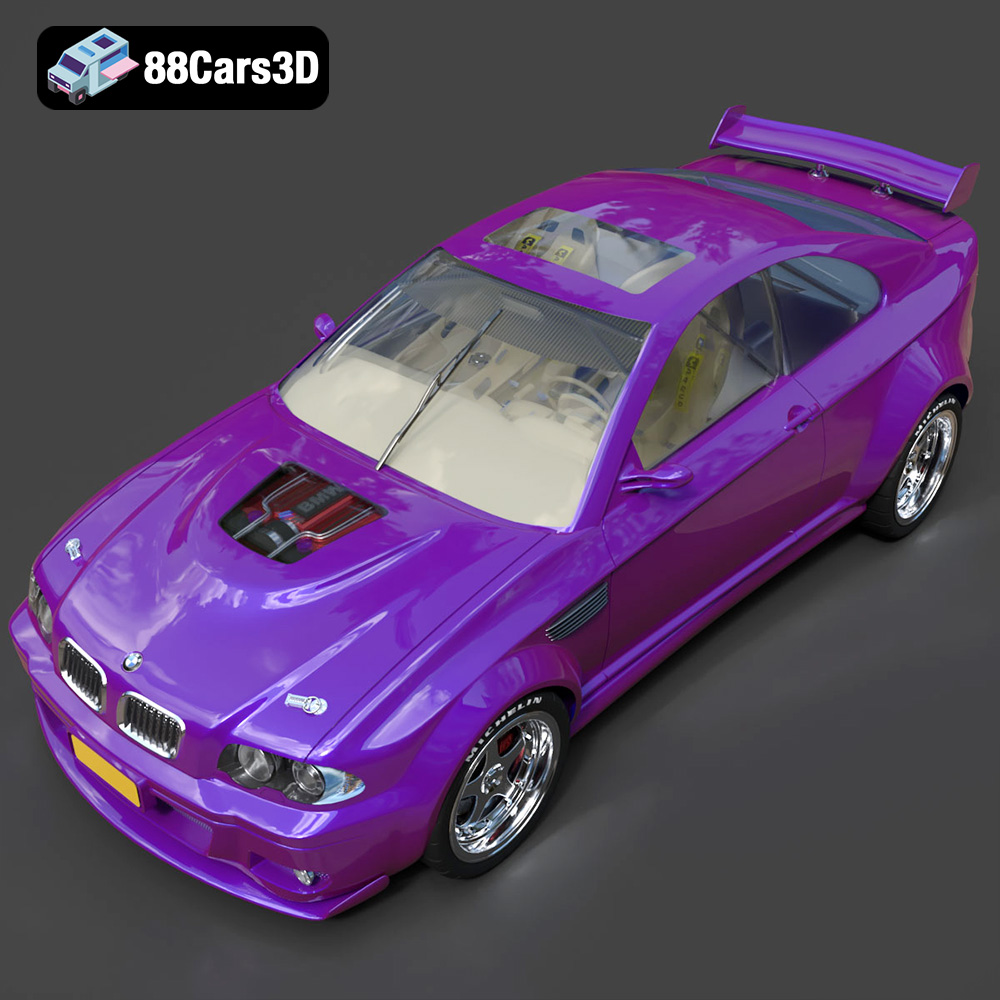
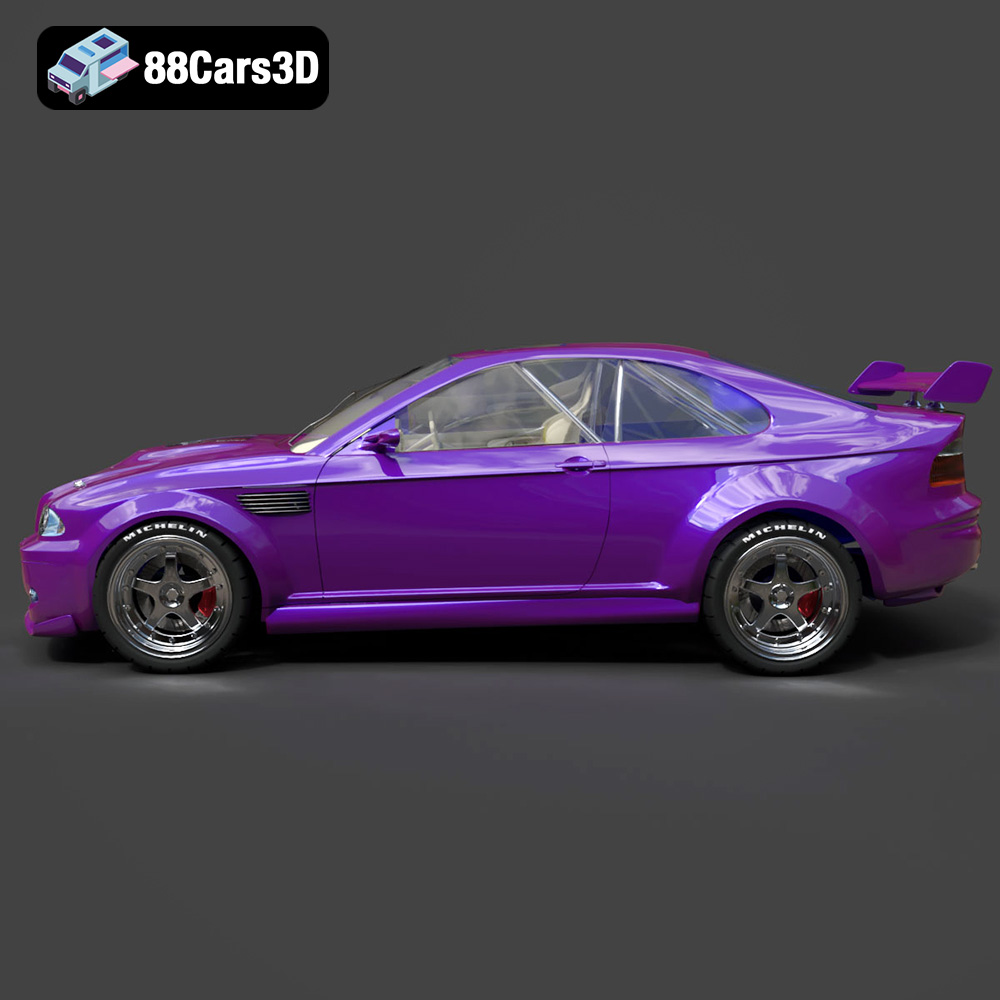
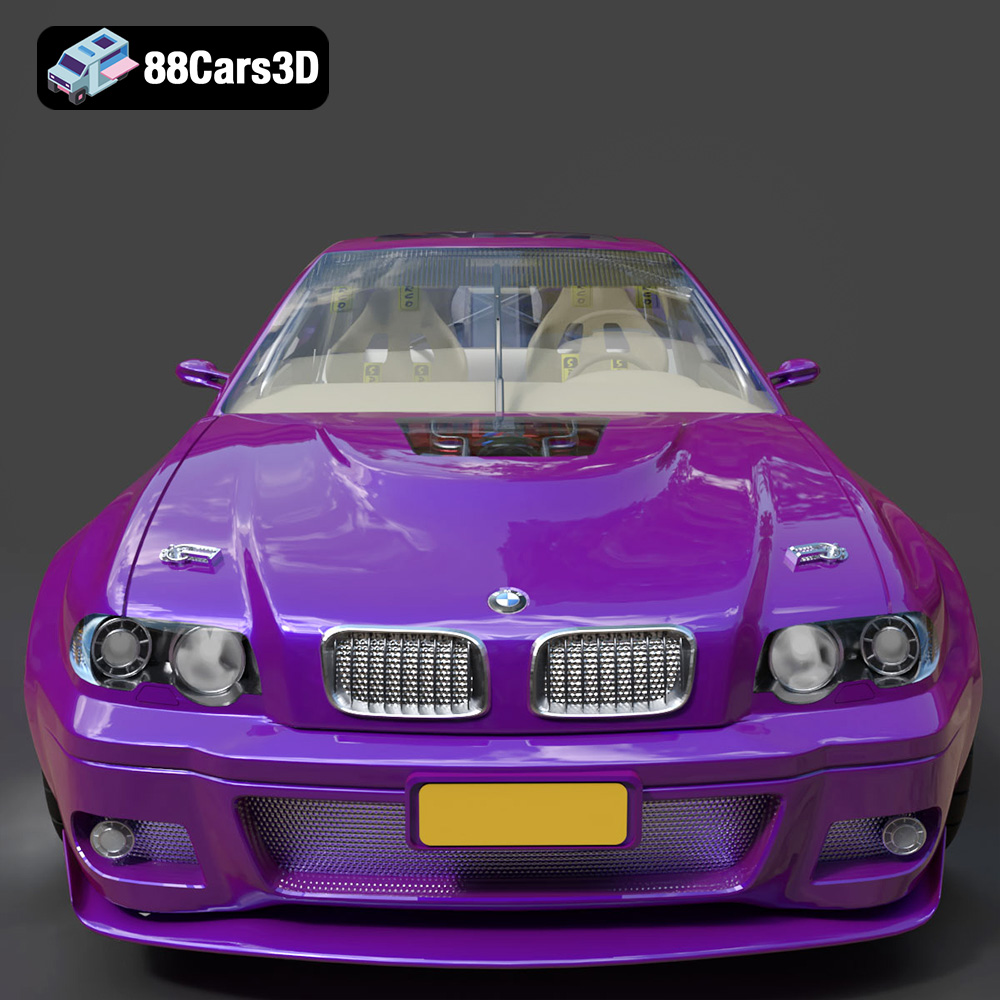
Capture the essence of performance luxury with the highly detailed BMW M3 2024 3D Model. This precision-engineered asset offers unparalleled realism, meticulously reproducing the aggressive styling, iconic grille design, and dynamic silhouette of the modern M3 generation. Optimized for close-up renders and demanding simulation environments, the model ensures visual fidelity across all professional applications. Key features include structurally clean topology, accurate scale, and professionally configured materials designed to react realistically to virtual lighting. Every external detail, from the wheels and brake calipers to the subtle curves of the body paneling, has been accurately modeled. A fully realized interior is included, making this asset ideal for first-person views and immersive virtual experiences. This versatile 3D asset is ready for immediate deployment in various projects, including cinematic rendering, architectural visualization, virtual reality (VR) and augmented reality (AR) experiences, high-fidelity simulations, and integration into major game development pipelines such as Unreal Engine and Unity.
$13.99
Product Image Gallery



Related Tags
.arvr
.blend
.bmw
.car3dmodel
.fbx
.gameasset
.glb
.m3
.max
.obj
.performancecar
.ply
.rendering
.sedan
.simulation
.sportssedan
.stl
.unreal
