

Mastering Automotive Visualization: A Technical Deep Dive into Utilizing High-Fidelity 3D Car Models
The pursuit of photorealism in digital media—whether for feature film VFX, cutting-edge game development, or sophisticated product visualization—demands assets built with meticulous technical precision. Nowhere is this standard higher than in automotive modeling. Capturing the subtle curvature, precise panel gaps, and distinctive character of a vehicle requires both artistic skill and deep technical expertise in geometry construction and material definition. Achieving cinematic quality or real-time efficiency begins with selecting the right foundation.
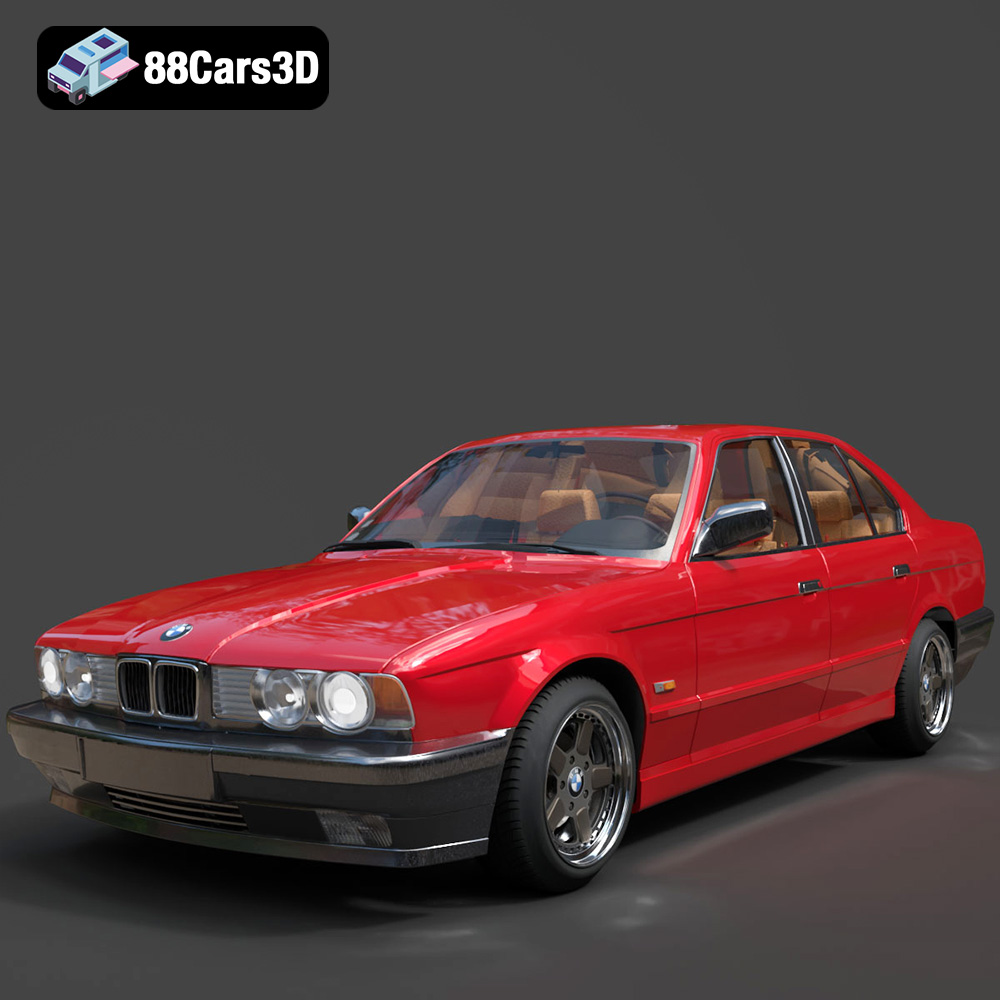
For designers and developers looking to integrate classic automotive appeal into their projects, the era of the early 1990s presents a rich subject. We are focusing today on an excellent example of a highly versatile asset: the BMW 525i E34 1993 3D Model. This asset provides not just a visual representation, but a fully optimized technical starting point for complex professional workflows, from dedicated automotive rendering projects to demanding real-time environments.
When sourcing professional-grade assets, platforms like 88cars3d.com specialize in providing models that are clean, accurately scaled, and prepared for immediate deployment, saving countless hours typically spent on cleanup and optimization. Understanding the technical specifications of such a model is crucial for maximizing its potential across diverse applications.
The Foundation of Quality: Geometry and Topology Optimization
In high-fidelity modeling, the quality of the mesh topology dictates performance, deformation control, and rendering smoothness. A professional-grade 3D car model, such as the BMW E34, must strike a careful balance between polygon count (poly count) and geometrical accuracy.
Optimizing High-Poly Detail for Close-Up Shots
For hero shots and detailed visualizations, geometric detail cannot be faked. Automotive surfaces require smooth, continuous curvature free of pinching or shading artifacts. This is achieved through strict adherence to quad topology. Quads (four-sided polygons) ensure predictable subdivision results and clean light reflection across wide surfaces, critical for simulating realistic car paint.
- Poly Count Strategy: While high-resolution renders may utilize subdivision surfaces to push the effective poly count into the millions, the base mesh (LOD0) must be manageable. For assets intended for both high-end rendering and real-time use, the LOD0 count usually ranges from 150,000 to 300,000 polygons, depending on interior detail. The E34 model provides the necessary density to hold shape without being overly cumbersome to manipulate.
- Panel Gaps and Hard Edges: Panel gaps are crucial for realism. They are defined not by simple cuts but by strategically placed edge loops that define the exact width and depth of the separation between body panels. These details must be modeled directly into the geometry rather than relying solely on normal maps for the highest fidelity renders.
- Interior Complexity: The interior, featuring the dashboard, seats, and controls, often accounts for a large percentage of the poly budget. Effective interior modeling requires prioritizing visibility—using greater detail on elements visible through the windshield (e.g., the steering wheel and main dials) while optimizing less visible areas.
UV Mapping Strategy for Realistic Textures
UV mapping is the invisible backbone of texturing. A disorganized UV layout leads to wasted texture space, poor texel density, and visible stretching. Professional 3D car models demand a clean, non-overlapping UV map structure, typically spread across multiple texture sets (UV tiles or UDIMs).
- Texel Density Consistency: All major surfaces (body, glass, tires, interior plastics) should maintain a relatively consistent texel density. This ensures that a 4K texture applied to the body appears equally sharp as a 2K texture applied to a smaller wheel component.
- Modular UVs: Separating the model into logical UV sets allows artists to apply specialized shaders easily. For example, one set for the metallic body paint, another for the complex tire sidewall detail (which often uses decals and displacement), and a third for glass and chrome trims.
- Lightmap UVs: For game development and interactive visualization (especially in Unreal Engine or Unity), a second, often automated, UV set (UV Channel 1) must be created. This channel must be free of overlaps and is essential for baking static global illumination, preventing lighting seams and artifacts in the final environment.
Understanding 3D Model File Formats
The hallmark of a truly professional 3D car model package, such as the BMW 525i E34 available on 88cars3d.com, is the inclusion of multiple, optimized file formats. Each format serves a specific purpose in the production pipeline, ensuring compatibility, performance, or editability. Choosing the right format for a task is a critical technical decision that influences workflow efficiency and final output quality. This versatility is non-negotiable for serious visualization professionals.
Editable and Proprietary Formats for Advanced Editing
These formats preserve the full scene hierarchy, material definitions, modifiers, and sometimes even lighting setups, making them the ideal choice for starting complex rendering or animation projects.
- .max (3ds Max): This is the native file format for Autodesk 3ds Max, a long-standing industry standard for automotive rendering and visualization. The .max file provided ensures that all proprietary material systems (like V-Ray or Corona setups), scene organization, camera placement, and animation rigging are preserved and immediately editable by the artist using 3ds Max.
- .blend (Blender): The native Blender file provides the model fully configured within the Blender ecosystem. For users focused on Cycles or Eevee rendering, the .blend file is essential as it retains all node-based materials, geometry modifiers (like subdivision surfaces), and potentially a functional lighting studio setup, allowing for rapid iteration and photorealistic rendering.
- .unreal (Unreal Engine): This format signifies a highly specialized, engine-ready asset. The .unreal file or associated content package usually includes pre-configured material instances, proper scaling (using Unreal’s standard of centimeters), LODs, and potentially even simplified collision geometry, bypassing the need for manual setup and reducing integration time significantly when developing game assets.
Standardized Formats for Interchange and Real-Time Pipelines
These formats are designed for cross-platform compatibility, focusing on transmitting geometry, UVs, and fundamental material data effectively.
- .fbx (Filmbox): Arguably the most crucial interchange format for modern pipelines. .fbx excels because it accurately transfers geometric data *and* critical scene hierarchy, animation data, and bone structures. It is the gold standard for moving assets into real-time engines like Unreal Engine and Unity, guaranteeing that parent-child relationships (e.g., body to door to wheel) are correctly interpreted for complex vehicle physics and interactions.
- .obj (Wavefront OBJ): A universal, geometry-focused format. The .obj file is highly stable and compatible with virtually every 3D application (including ZBrush, Substance Painter, and CAD software). While it does not carry complex rigging or proprietary shader definitions, it reliably transfers mesh, UVs, and sometimes basic texture links, making it ideal for texture mapping workflows.
Specialized Formats for Emerging Applications
As 3D technology expands into new fields, specialized formats cater to specific needs like portability and physical production.
- .glb (GL Transmission Format Binary): This format is highly optimized for delivery across the web, AR (Augmented Reality), and VR (Virtual Reality). It bundles the mesh, materials, and textures into a single binary file, ensuring rapid loading and minimal resource consumption. The .glb file is the choice for deploying the E34 model in browser-based configurators or mobile AR applications.
- .stl (Stereolithography): A triangulated surface format used predominantly for 3D printing and rapid prototyping. While the model may require cleanup and hollowing for successful printing, the inclusion of the .stl file ensures the geometric data is immediately ready for additive manufacturing software, enabling users to create physical scale models of the BMW 525i E34.
- .ply (Polygon File Format): Often used in scan data, CAD, and scientific visualization, .ply supports properties like color, transparency, and sometimes precision volumetric data per vertex. It is valuable when the model needs to interface with engineering software or specific analysis tools where high precision mesh representation is required over simple visualization.
Achieving Photorealism in Automotive Rendering Workflows
Photorealistic automotive rendering is defined by accurate material simulation, particularly the nuanced look of car paint, glass, and highly reflective metals. Utilizing the editable files (.max and .blend) allows for granular control over these elements.
V-Ray and Corona Renderer Integration in 3ds Max
3ds Max remains a dominant force in visualization due to its robust integration with powerful unbiased rendering engines like V-Ray and Corona. The provided .max file serves as the ideal starting point for studio-grade rendering.
- Advanced Car Paint Shaders: Simulating real automotive paint requires a multi-layered material structure. The base layer includes the diffuse color and metallic flake map. This is topped by a high-gloss, clear coat layer (a second specular lobe). This clear coat layer must have a very high IOR (Index of Refraction) and ultra-low roughness to achieve the signature mirror-like finish, effectively simulating the protective lacquer on the E34’s classic metallic finish.
- HDRI Environment Setup: Successful reflective rendering hinges on the environment. Using a high dynamic range image (HDRI) for lighting is essential, not only for accurate global illumination but also because the environment map dictates the quality and sharpness of reflections on the car body. A crisp HDRI prevents reflections from appearing muddy or unrealistic.
- Caustics and Glass Precision: Headlights and taillights contain complex refractive geometry. The model must have properly modeled light reflectors and lenses. In V-Ray, enabling caustics can add an extra layer of realism, showing how light focuses through the glass elements, though this requires careful optimization of render settings.
Node-Based Material Creation in Blender
Blender’s Cycles renderer offers powerful physically-based rendering (PBR) tools accessible through its node editor. The .blend file provides an excellent foundation for PBR texture implementation.
- PBR Texture Set Workflow: All modern rendering relies on PBR texture sets: Albedo (color), Roughness, Metallic, Normal, and optionally Ambient Occlusion. These maps, paired with the E34 geometry, drive the appearance of everything from the matte texture of the tires to the reflective sheen of the chrome trim.
- Optimizing Cycles and Eevee: For the highest quality output, Cycles (the path tracer) is preferred, but for rapid previews or stylized animation, Blender’s real-time engine, Eevee, is viable. The E34 model’s geometry is optimized enough to handle Eevee’s limitations, provided the artist sets up screen-space reflections and irradiance volumes correctly for convincing real-time lighting.
- Accurate Light Interaction: Ensuring the car’s materials accurately interact with light means correctly setting the Metallic value (1.0 for chrome parts like grilles and badges, 0.0 for plastics and paint) and using dedicated clear-coat nodes to separate the base color reflection from the top glossy surface reflection, mimicking the layered paint job of the original BMW 525i.
Implementing the BMW E34 as a High-Fidelity Game Asset
The transition from a high-poly visualization model to a performant game asset requires stringent optimization. The goal is scalability and speed without a catastrophic loss of visual integrity. The availability of .fbx and .unreal files for the BMW E34 model addresses this challenge directly.
Unreal Engine Deployment Pipeline
Unreal Engine demands assets that are tailored for its unique lighting and physics systems. The .unreal file specifically accelerates this process.
- Level of Detail (LOD) Generation: Performance in open-world or racing simulations hinges on dynamic poly count reduction based on camera distance. A standard vehicle asset requires at least four LODs.
- LOD0 (Hero): Full detail (e.g., 200,000 polys).
- LOD1 (Mid-Range): Significant interior reduction, minor exterior simplification (e.g., 70,000 polys).
- LOD2 (Distant): Wheels simplified, small details merged, window interiors removed (e.g., 25,000 polys).
- LOD3 (Far View/Shadow Only): Drastic reduction to basic silhouette, often using a proxy mesh or simple billboard (e.g., 5,000-10,000 polys).
The E34 model must be accompanied by these simplified meshes to maintain high frame rates (FPS).
- Physics and Collision Setup: Accurate driving physics rely on collision meshes. Simple box collisions are usually insufficient for realistic driving. Custom collision meshes (often convex hulls labeled UCX in the geometry source) are required to accurately define the wheel arches, bumpers, and body shell, ensuring predictable interaction with track geometry and surrounding objects using systems like Chaos Physics.
- Dynamic Material Instances: Utilizing Unreal’s Material Instances allows developers to quickly change the paint color, wheel finish, or decal application without recompiling shaders, providing maximum flexibility for in-game customization of the 1993 BMW 525i.
Managing Scale and Engine Compatibility in Unity
Unity, another massive environment for game assets, requires similar attention to scaling and optimization, often relying heavily on the .fbx format for reliable import.
- Scale Correction: Unity typically uses meters as its standard unit. It is vital that the imported E34 model is correctly scaled (e.g., 4.7 meters long) to interact naturally with environment assets and physics calculations. Incorrect scaling leads to issues with lighting intensity, camera clipping, and gravity simulation.
- Shader Graph Integration: Utilizing Unity’s Shader Graph allows developers to translate the complex PBR materials into performant, node-based shaders that execute efficiently within the engine’s High-Definition Render Pipeline (HDRP) or Universal Render Pipeline (URP). This customization ensures the high-quality look of the model is retained even in real-time environments.
Beyond Visualization: AR/VR and Simulation Case Studies
Professional 3D assets are increasingly being deployed outside of traditional rendering engines. The strict performance constraints of virtual reality, augmented reality, and high-fidelity driving simulators demand models that are inherently lean and optimized for speed.
Low-Latency Requirements for Immersive Experiences
AR/VR viewers, particularly on mobile devices, cannot tolerate high draw calls or polygon budgets. This is where specialized formats like .glb become invaluable.
- .glb Optimization for Web Delivery: The binary nature of the .glb format makes it perfect for instant loading in web-based viewers or mobile AR apps like Apple’s ARKit or Google’s ARCore. The model must be highly streamlined—often texture resolutions are reduced, and mesh detail is baked down into normal maps—to ensure the E34 loads instantly and maintains 60+ FPS, critical for preventing motion sickness in VR environments.
- Interactive Inspections: In VR, high-quality 3D car models are used for virtual showrooms or interactive training. This necessitates accurate rigging for components like doors, hood, and trunk, allowing the user to physically open and interact with the vehicle in the virtual space. The robust hierarchy provided by the .fbx file facilitates this rigging process.
Precision Modeling for Driving Dynamics
Engineering and simulation tools—used for training professional drivers, vehicle dynamics analysis, or testing autonomous systems—require models that are not just visually accurate but structurally accurate.
- Mass and Center of Gravity (CoG): The geometry provided by the E34 model must allow for accurate calculation of mass distribution. In simulation software, key components must be separate (engine block, chassis frame, wheels) so that correct weight and inertia values can be assigned, ensuring the simulated cornering and acceleration match the real 1993 vehicle dynamics.
- CAD Integration via .ply: For deep analysis, the precision geometry provided by the .ply format can sometimes be integrated into CAD programs or structural analysis software, allowing engineers to examine drag coefficients or structural integrity based on the visual design, bridging the gap between artistic representation and technical engineering.
Conclusion: The Value of Technical Readiness
In today’s fast-paced digital production environment, time spent on cleaning geometry, fixing bad UVs, or manually converting file formats is time lost. Investing in a highly engineered asset, such as the BMW 525i E34 1993 3D Model, provides a tangible advantage by delivering a technically sound foundation ready for any professional pipeline.
Whether your focus is high-end photorealistic automotive rendering using 3ds Max, developing immersive game assets for Unreal Engine, or creating lightweight AR visualizations using the .glb format, the versatility and geometric precision of this model ensure seamless integration. The depth of the included file formats, which cater explicitly to editing, rendering, real-time, and prototyping needs, solidifies its position as a truly professional resource.
Explore this and other expertly crafted 3D car models by visiting 88cars3d.com, where technical excellence meets artistic fidelity, giving you the perfect starting point for your next complex visualization project.
Featured 3D Model
BMW 525i E34 1993 3D Model
Bring the iconic German executive sedan to your projects with the highly accurate BMW 525i E34 1993 3D Model. This model captures the precision and styling of the celebrated E34 generation, suitable for close-up renders, detailed automotive visualizations, and interactive experiences. The asset features optimized, clean geometry built for performance across various platforms. Surfaces are meticulously modeled to reflect the true proportions and curvature of the original vehicle. It includes a detailed interior and realistic material definitions, ensuring photorealistic results straight out of the box. This versatile 3D asset is ready for immediate deployment in various professional applications, including advanced visualization, architectural rendering integration, immersive AR/VR experiences, high-fidelity driving simulations, and modern game development environments (Unity, Unreal Engine).
$12.99
Product Image Gallery


Related Tags
.525i
.arvr
.blend
.bmw
.car3dmodel
.classiccar
.e34
.fbx
.gameasset
.glb
.max
.obj
.ply
.rendering
.sedan
.simulation
.stl
.unreal
