Get 20% OFF All Premium 3D & STL Models!

In the expansive and ever-evolving world of 3D visualization, automotive models stand as a pinnacle of detail, precision, and artistic expression. Whether for breathtaking renders, immersive game environments, or even tangible 3D prints, the demand for high-quality 3D car models is constant. A meticulously crafted vehicle asset doesn’t just represent a car; it embodies engineering, design philosophy, and a powerful aesthetic. Today, we delve into the intricate processes and diverse applications that elevate a digital asset from a simple mesh to a versatile tool for professionals across industries, focusing on a prime example: the BMW Z4 3D Model available on 88cars3d.com.
The BMW Z4, with its sporty proportions, elongated hood, and dynamic styling, is an iconic roadster that perfectly encapsulates modern automotive design. Translating such a vehicle into a digital realm requires a profound understanding of both the real-world subject and the technical demands of 3D pipelines. This article explores how a premium model like the Z4 is engineered for various uses, from the subtle nuances of its sculpted body lines to the critical considerations for its deployment in real-time engines or as a physical object.
Creating compelling 3D car models is a blend of artistic vision and rigorous technical execution. It begins with an appreciation for the original vehicle’s design intent and ends with a versatile digital asset that can serve multiple professional needs.
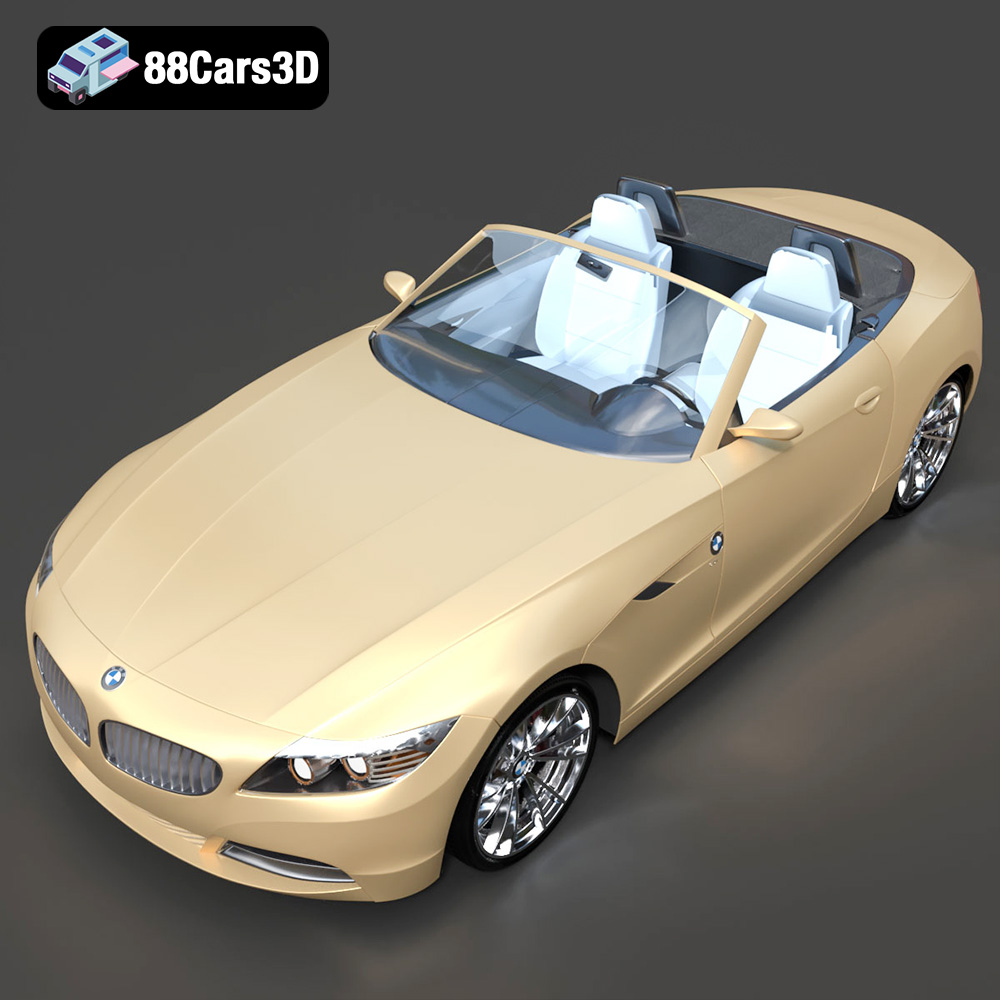
The foundation of any exceptional 3D automotive model lies in its accuracy. For the BMW Z4 3D Model, this means painstakingly recreating every curve, vent, and iconic element that defines the roadster. The signature kidney grille, the aggressive front fascia, the detailed headlights and taillights—each component must be meticulously modeled to capture the Z4’s low stance and dynamic performance styling. This level of detail isn’t merely aesthetic; it’s crucial for achieving photorealism in renders and ensuring brand consistency in promotional materials or simulations. The model’s ability to accurately represent the Z4’s real-world proportions ensures that it looks correct from every angle, under any lighting condition.
Beyond visual fidelity, the underlying technical construction of a 3D model dictates its usability and performance. The BMW Z4 3D Model boasts clean, quad-based topology. This is a critical advantage, as quad-dominant meshes are ideal for subdivision surfacing, allowing for smooth, artifact-free forms even at extreme close-ups or when applying complex modifiers. Proper topology also ensures seamless deformation for animation, making it suitable for anything from a simple door opening to complex vehicle physics simulations. Furthermore, real-world scale accuracy is paramount. Whether integrating the car into an architectural visualization scene or a driving simulator, the model must adhere to real-world dimensions to maintain believability and ensure proper interaction within the virtual environment. Incorrect scaling can lead to frustrating adjustments and break the illusion of realism.
One of the most crucial aspects of working with 3D car models is understanding the various file formats available. Each format is designed with specific use cases and software ecosystems in mind, impacting compatibility, features, and overall workflow efficiency. The BMW Z4 3D Model from 88cars3d.com offers a comprehensive suite of formats, ensuring broad applicability across different professional pipelines.
The .blend format is native to Blender, the powerful open-source 3D creation suite. When you receive a .blend file, you’re not just getting the mesh; you’re getting a fully editable Blender scene. This includes all materials (often set up with Cycles or Eevee render engines), lighting, camera setups, and even potentially animation data. For Blender users, this format offers the most flexibility for customization, allowing direct manipulation of textures, shaders, and geometry, as well as easy integration into existing Blender projects. It’s the ideal starting point for artists who prefer to work within Blender’s robust environment, enabling them to leverage all of the software’s advanced features.
.fbx (Filmbox) is arguably the most widely used proprietary 3D file format for data exchange between different 3D software applications and game engines like Unreal Engine and Unity. Developed by Autodesk, it excels at preserving crucial data such as geometry, materials (with PBR maps), textures, rigging, animation, and cameras. Its strong support for skeletal animation and instancing makes it indispensable for game development and real-time visualization. When you import an .fbx, you can expect a high degree of fidelity in preserving the original model’s visual and functional attributes across different platforms, making it an excellent choice for universal deployment.
The .obj (Wavefront OBJ) format is a venerable and widely supported open standard for storing 3D geometry data. It’s a universal format that can be opened by virtually any 3D software. While it’s excellent for basic mesh data (vertices, faces, normals) and UV coordinates for texturing, its material support is simpler, often relying on an associated .mtl file for basic color and texture references. It doesn’t typically store animation or rigging data. For designers needing to move a clean mesh between different modeling applications without complex features, .obj is a reliable, lightweight choice, offering maximum cross-software compatibility for the BMW Z4’s core geometry.
.glb (GL Transmission Format Binary) is the binary version of glTF, a royalty-free specification for the efficient transmission and loading of 3D scenes and models by applications. It’s becoming the “JPEG of 3D” due to its efficiency and compact nature, embedding textures and animation directly within a single file. This optimization makes .glb perfect for AR/VR applications, web-based 3D viewers, and social media filters where file size and quick loading times are critical. For showcasing the BMW Z4 in a virtual showroom or an interactive web experience, the .glb format provides an excellent balance of quality and performance.
The .stl (Stereolithography) format is the de-facto standard for 3D printing. It represents a 3D model as a series of connected triangles, defining only the surface geometry without color, texture, or material information. This triangular mesh is what 3D slicer software uses to generate toolpaths for 3D printers. The BMW Z4 3D Model being available in .stl format means it’s ready to be transformed into a physical collectible roadster miniature. It’s crucial for .stl files to have “manifold” geometry, meaning no holes, overlapping faces, or inverted normals, to ensure a successful print, which is a key technical advantage of models built for 3D printing from reputable sources like 88cars3d.com.
.ply (Polygon File Format) is another common format for storing 3D data, particularly useful for scanned data, point clouds, and meshes that originate from scientific or engineering applications. It can store not just geometric data but also properties like color, transparency, and even normal vectors per vertex or face. While less common for general purpose 3D model distribution than .fbx or .obj, it offers a robust way to represent complex geometry with additional attributes, often used in CAD, reverse engineering, or precise analytical workflows where the BMW Z4 might be studied for its aerodynamics or structural integrity.
The .unreal format signifies an asset specifically optimized for direct integration into Unreal Engine projects. This often means the model comes with pre-configured materials, textures, collision meshes, LODs (Levels of Detail), and sometimes even basic animation setups that are ready to be dropped into an Unreal Engine scene. This dramatically accelerates development for game designers and real-time visualization specialists, as it bypasses much of the manual setup typically required. For a model like the BMW Z4 intended for racing games or architectural walk-throughs, an .unreal file provides an immediate head start.
Similar to .blend for Blender, the .max format is the native file type for Autodesk 3ds Max, a leading professional 3D computer graphics program for making 3D animations, models, games, and images. A .max file contains the complete scene data, including geometry, materials, lighting, cameras, animation, and modifiers. For professionals working within the 3ds Max ecosystem, this format offers the highest level of editability and control, allowing them to leverage 3ds Max’s advanced rendering capabilities (e.g., V-Ray, Corona Renderer) and animation tools to create stunning visuals or integrate the BMW Z4 into complex cinematic sequences.
The versatility of a high-quality 3D asset like the BMW Z4 3D Model truly shines when integrated into diverse professional workflows. Its clean structure and multiple file formats make it an invaluable resource for artists and developers.
For cinematic quality visuals, the BMW Z4 model is a dream. In applications like 3ds Max or Blender, artists can leverage sophisticated PBR (Physically Based Rendering) materials to create incredibly realistic surfaces. Imagine applying a metallic paint finish that glints under studio lights, or the subtle imperfections of a realistic roadster tire texture. With the included .max and .blend formats, artists have full control over scene lighting, camera angles, and advanced rendering settings using engines like V-Ray, Corona, Cycles, or Eevee. The model’s optimized polygon count and clean quad-based topology ensure that even with heavy subdivision for close-up shots, render times remain manageable and the surfaces are perfectly smooth. This makes it ideal for luxury automotive presentations, studio lighting setups, and promotional content.
In the realm of game development, performance is as crucial as visual fidelity. The BMW Z4 3D Model is designed with real-time engines in mind. Its optimized polygon count ensures that it won’t bog down game performance, while proper pivot placement for components like doors, wheels, and the steering wheel simplifies animation and interactivity. Game developers can utilize the .fbx or even the dedicated .unreal format for seamless integration into Unreal Engine or Unity. This allows for quick setup of driving mechanics, physics simulations, and custom shader work. Imagine using this Z4 model in a high-octane racing game, an open-world driving simulation, or even as part of a detailed traffic system in an urban environment.
Augmented Reality (AR) and Virtual Reality (VR) are transforming how we interact with digital content. The BMW Z4 model is perfectly suited for these immersive applications. Its realistic details and real-world scale make it an excellent candidate for virtual showrooms, where potential customers can explore the car in a virtual space, or for interactive car configurators that allow real-time customization of colors, wheels, and interior options. The .glb format, with its efficiency and embedded textures, is particularly beneficial for web-based AR experiences, allowing users to “place” the Z4 in their driveway using just a smartphone camera. This technology bridges the gap between digital representation and tangible interaction, enhancing engagement and decision-making.
One of the most exciting capabilities of the BMW Z4 3D Model is its suitability for 3D printing. This transforms the digital asset into a physical object, offering unique opportunities for collectors, hobbyists, and prototype designers.
The inclusion of the .stl format directly positions this BMW Z4 model for additive manufacturing. An .stl file represents the geometric surface of the 3D model using a tessellation of triangles. This format is the language that 3D printers understand, allowing them to construct the object layer by layer. For enthusiasts, the ability to 3D print a detailed replica of the Z4 means they can hold a physical manifestation of their favorite roadster, customize it with unique paint jobs, or even display it as a high-quality collectible. This direct conversion from digital to physical opens up a new dimension of interaction with 3D car models.
Successful 3D printing requires careful attention to settings. For the BMW Z4 model, recommended scales like 1:24, 1:18, 1:12, or 1:10 allow for varying levels of detail and print time. A layer height of 0.10–0.18 mm ensures a good balance between detail and print duration, with finer layers often recommended for resin printing to capture intricate features like subtle body lines. A wall thickness of 2–3 mm provides structural integrity, while an infill of 15–30% optimizes material usage and strength. Supports are often necessary for overhangs such as mirrors, open roof edges, and the underbody to prevent warping or collapse during printing. A clever trick for achieving a smooth finish on key surfaces like the roof and hood is printing the body upside-down. Wheels are best printed separately to capture their detailing without compromising the main body’s finish. Finally, post-processing is key: sanding, applying primer, painting with metallic automotive finishes, and a clear coat can elevate a raw print to a showroom-quality miniature.
The ability to 3D print the BMW Z4 model caters to a diverse audience. Model car collectors can create unique pieces that are not available off-the-shelf. Automotive designers can use the physical prints as rapid prototypes to evaluate forms and proportions in a tangible way before committing to expensive manufacturing processes. Hobbyists can enjoy the satisfaction of building and finishing their own scale model, adding personal touches. The versatility extends to creating custom display models for desktop showcases or enhancing existing dioramas, making the digital model a gateway to physical creativity.
While rendering, gaming, and 3D printing are primary applications, the inherent quality and flexibility of the BMW Z4 3D Model extend its utility into many other professional and creative fields.
Beyond entertainment, precise 3D car models are vital for technical simulations. The BMW Z4 model, with its real-world scale and accurate proportions, can be integrated into automotive engineering simulations to study aerodynamics, crash dynamics, or vehicle behavior under various conditions. For training purposes, it can serve as a visual aid in virtual maintenance scenarios, driver training simulators, or even for sales personnel to understand car features in an interactive 3D environment. Its clean geometry facilitates accurate physics calculations and realistic visual feedback.
Architects and interior designers frequently use 3D car models to breathe life and realism into their visualization projects. Placing a high-fidelity BMW Z4 3D Model in the driveway of a luxury villa or a multi-story car park in an architectural render immediately enhances the scene’s believability and aspirational quality. It helps to ground the architectural design in a realistic context, adding a sense of scale and lifestyle. The model’s detailed exterior and interior mean it holds up under close scrutiny, making it perfect for high-end property marketing materials.
For advertising agencies, film production studios, and marketing teams, the BMW Z4 3D Model is an indispensable asset for creating stunning visuals without the logistical complexities and costs associated with real-world car shoots. From dynamic camera moves showcasing the Z4’s sleek lines in a virtual commercial to integrating it into a complex digital environment for a feature film, the model provides ultimate creative freedom. Lighting, environment, and car modifications can be adjusted instantaneously, allowing for unparalleled iteration and refinement to achieve the perfect promotional visual or cinematic shot.
The world of 3D modeling offers unparalleled possibilities for creativity and technical innovation. A high-quality asset like the BMW Z4 3D Model exemplifies the power of meticulously crafted digital content, serving as a cornerstone for projects ranging from hyper-realistic automotive rendering to immersive game development, interactive AR/VR experiences, and tangible 3D prints. Its clean topology, accurate scaling, detailed features, and diverse file format compatibility ensure its utility across virtually any professional workflow.
Whether you’re a seasoned 3D artist aiming for a show-stopping render, a game developer building the next big racing title, or a hobbyist eager to 3D print a collectible miniature, the flexibility and precision of this BMW Z4 model streamline your creative process. Investing in such a comprehensive and well-engineered 3D asset from a reputable source like 88cars3d.com empowers you to bring your visions to life with confidence and exceptional quality. Explore the possibilities and elevate your projects with premium 3D car models today.
The BMW Z4 3D Model is a premium digital recreation of the iconic two-seat roadster developed by BMW. Known for its sporty proportions, long hood, short rear deck, and dynamic performance styling, the Z4 embodies precision engineering and modern roadster design. This 3D model accurately captures the Z4’s low stance, sculpted body lines, signature kidney grille, aerodynamic side vents, and sleek convertible profile. Designed with clean geometry and real-world scaling, it is ideal for rendering, animation, game development, AR/VR applications, and automotive simulations. Perfect for coastal driving scenes, luxury showrooms, racing environments, promotional visuals, and interactive vehicle experiences. Includes .blend, .fbx, .obj, .glb, .stl, .ply, .unreal, and .max formats for rendering, simulation, AR/VR, game development, and 3D printing.
$29.90
.arvr
.blend
.bmw
.car3dmodel
.convertible
.fbx
.gameasset
.glb
.max
.obj
.ply
.rendering
.roadster
.simulation
.sportsCar
.stl
.unreal
.vehicleasset
.z4
automotive3d