

Bringing Aviation History to Life: A Deep Dive into the Polikarpov Po-2 3D Model
In the expansive world of 3D visualization, historical accuracy and meticulous detail stand as pillars of compelling content. From recreating legendary battles to developing immersive simulations, the demand for authentic digital assets is ever-growing. While many focus on the sleek lines of modern vehicles, the charm and significance of vintage aircraft offer a unique canvas for artists and developers alike. This is where a truly exceptional asset, like the Polikarpov Po-2 3D Model, transcends a simple digital file, becoming a gateway to the past.
The Polikarpov Po-2, affectionately known as the “Kukuruznik” (corn-duster), is a testament to rugged design and versatile utility. This legendary Soviet biplane, a workhorse of the mid-20th century, served in roles ranging from training and reconnaissance to light bombing, famously flown by the “Night Witches.” Capturing such an icon in three dimensions requires not just artistic skill, but a deep understanding of technical precision. The Polikarpov Po-2 3D Model, available at 88cars3d.com, delivers on this promise, offering a high-detail digital recreation that empowers creators across various professional domains. It’s an indispensable resource for anyone looking to infuse their projects with a touch of aviation history, whether for stunning renders, interactive game environments, or even tangible 3D prints.
Understanding 3D Model File Formats: The Backbone of Digital Assets
The versatility of any high-quality 3D model, including sophisticated 3D car models or historical aircraft like the Polikarpov Po-2, hinges significantly on the file formats it supports. Different formats are optimized for distinct purposes, software compatibility, and workflow stages. Understanding these distinctions is crucial for professionals to ensure seamless integration and optimal performance in their projects. The Polikarpov Po-2 3D Model from 88cars3d.com comes equipped with a comprehensive suite of formats, addressing a wide spectrum of industry needs.
.blend – The Blender Powerhouse
The .blend format is native to Blender, an incredibly powerful and increasingly popular open-source 3D creation suite. When a model is provided in .blend format, it means you’re getting a fully editable Blender scene. This typically includes the mesh, materials, textures, lighting, camera setups, and even animation data, all contained within a single file. For artists and studios primarily working in Blender, this offers maximum flexibility for modifications, rigging, and rendering using Cycles or Eevee.
.fbx – The Industry Workhorse for Interoperability
.fbx (Filmbox) is an Autodesk-developed proprietary file format widely recognized as the industry standard for 3D data exchange between different software applications. Its strength lies in its ability to store not only geometry and materials but also complex animation data, skeletal rigs, and even embedded textures. For real-time pipelines, especially in game development with engines like Unreal and Unity, .fbx is often the go-to choice due to its robust support for animation and general scene data transfer without significant data loss. This makes the Po-2 .fbx ideal for immediate integration into interactive experiences.
.obj – The Universal Geometry Standard
The .obj (Wavefront Object) format is one of the oldest and most universally compatible 3D formats. It’s primarily used for storing 3D geometry – vertices, UVs, normals, and faces – and can reference external material (.mtl) and texture files. While it doesn’t support animation or rigging, its simplicity and widespread adoption make it excellent for static model interchange between virtually any 3D software. For basic rendering or detailed modeling, .obj provides a clean, foundational mesh.
.glb – Optimized for the Web and Immersive Experiences
.glb is the binary version of the GL Transmission Format (glTF), often referred to as the “JPEG of 3D.” It’s specifically designed for efficient transmission and loading of 3D scenes and models in web-based applications, augmented reality (AR), virtual reality (VR), and other real-time environments. A .glb file contains all necessary data – geometry, materials, textures, and animations – in a single, self-contained package. For demonstrating the Polikarpov Po-2 in a browser or an AR app, .glb is the superior choice.
.stl – The Standard for 3D Printing
The .stl (Stereolithography) format is the undisputed standard for 3D printing. It represents a 3D model as a series of connected triangles, defining only the surface geometry of an object without color, texture, or other attributes. For anyone looking to bring the Polikarpov Po-2 into the physical world as a collectible scale model, the .stl format is essential for preparing it for fabrication.
.ply – Precision Mesh for Scans and CAD
The .ply (Polygon File Format) is another format for storing 3D data, particularly known for handling point clouds and polygon meshes generated from 3D scanning or scientific instruments. It can store various properties beyond just geometry, such as color, transparency, and confidence data, per vertex or per face. While less common for general artistic asset exchange, it’s invaluable for certain CAD or analytical workflows where high precision mesh data is critical.
.unreal – Engine-Ready for Real-Time Environments
The inclusion of an .unreal file (often a .uasset or an optimized package for the engine) indicates that the Polikarpov Po-2 3D Model has been specifically prepared and optimized for direct import and use within the Unreal Engine. This often means textures are properly packed, materials are set up, and potential collision meshes or LODs are included, significantly streamlining the workflow for game developers and real-time visualization artists.
.max – The 3ds Max Project File
Finally, the .max format is the native file type for Autodesk 3ds Max. Similar to .blend for Blender, a .max file stores a complete scene, including all modeling, texturing, lighting, animation, and rendering information. For professionals heavily invested in the 3ds Max ecosystem, having the model in its native format provides the highest level of editability and ensures full access to all scene components and modifiers for advanced customization and rendering.
The provision of these diverse formats with the Polikarpov Po-2 3D Model underscores its professional-grade quality and adaptability, making it an invaluable asset for any creative endeavor.
The Polikarpov Po-2 3D Model: A Deep Dive into Authenticity and Detail
Creating a digital twin of a historical aircraft like the Polikarpov Po-2 is an exercise in both art and archival research. The model must not only look convincing but also stand up to scrutiny from aviation enthusiasts and historians. The Polikarpov Po-2 3D Model excels in this regard, offering a blend of accuracy, aesthetic appeal, and technical robustness.
Capturing History with Precision
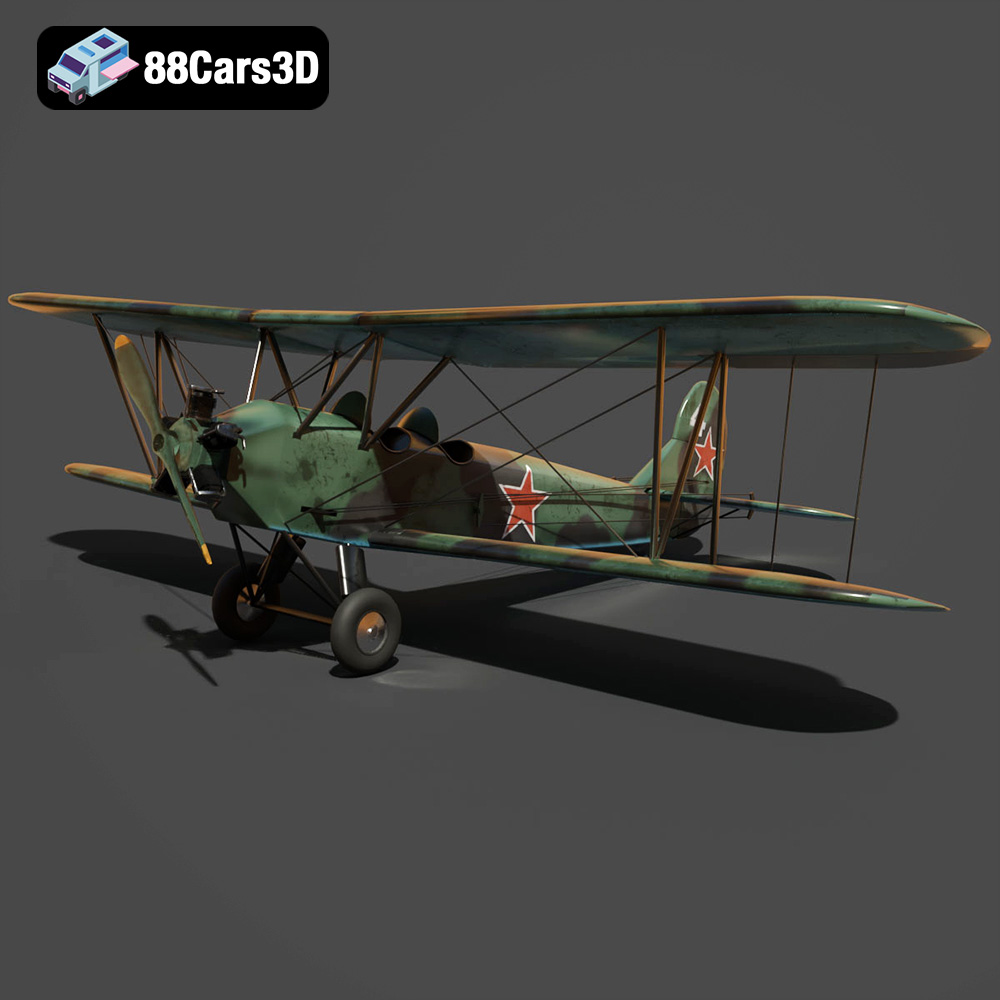
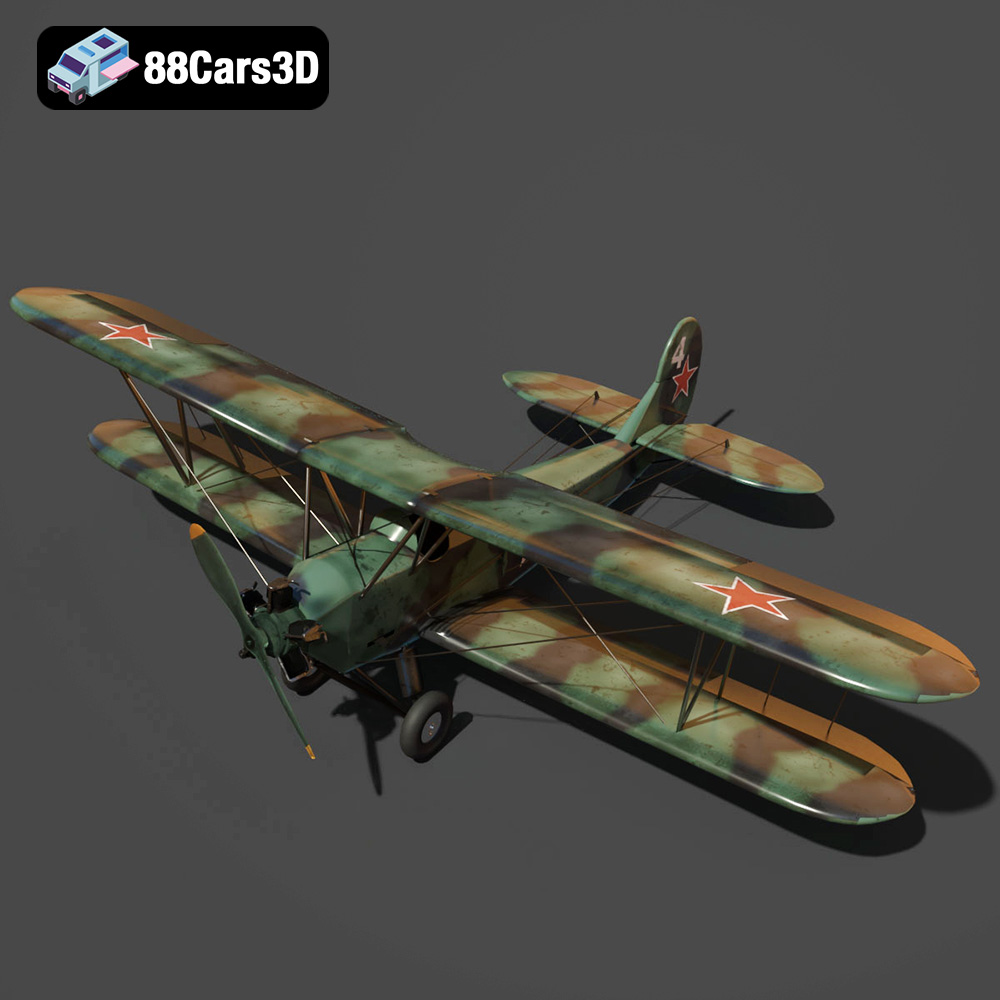
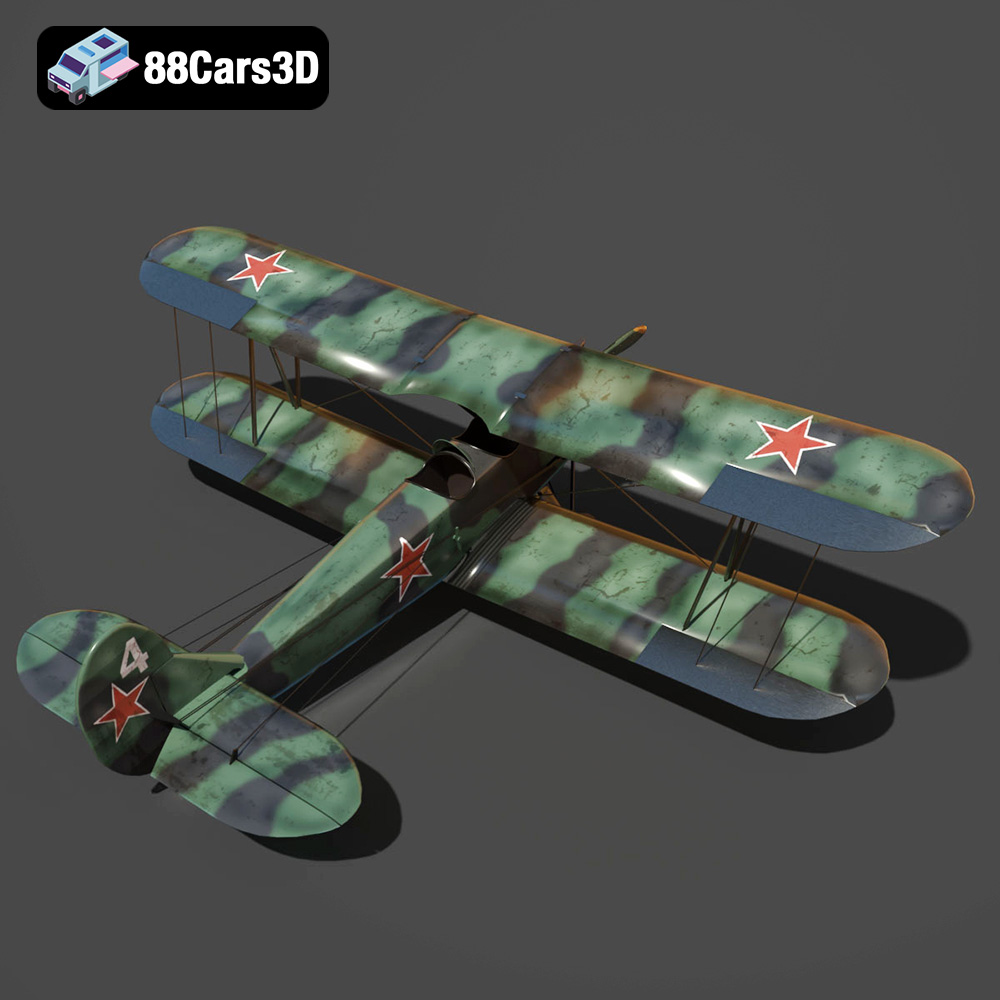
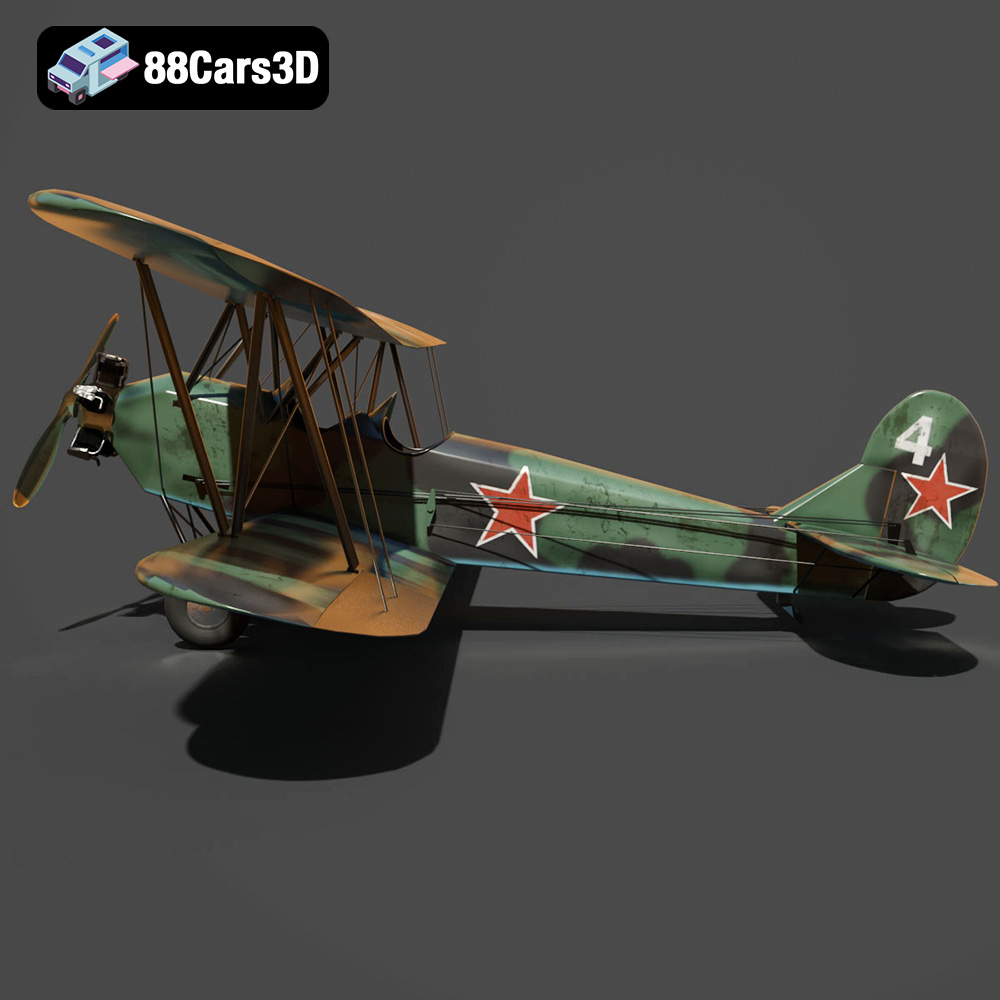
The Po-2’s defining characteristics – its iconic dual-wing configuration, the robust strut-supported wing assembly, and its distinctive radial engine housing – are all meticulously recreated. The model pays homage to the aircraft’s lightweight wooden structure and fabric-covered wings, translating these real-world material properties into digital textures and surface details. This commitment to detail ensures that the model is not just a generic biplane, but recognizably the legendary Po-2. Furthermore, the model is built with real-world scale accuracy, a critical factor for simulations and accurate historical visualizations, ensuring it fits seamlessly into environments alongside other accurately scaled assets, including 3D car models and infrastructure.
Exterior and Interior Fidelity
The exterior of the model boasts features such as a detailed radial engine cowling, a realistic propeller assembly, and fabric-style control surfaces (ailerons, rudder, elevators) that evoke the aircraft’s construction. The fixed landing gear with its tailwheel, along with period-correct fuselage proportions, solidifies its historical authenticity. Crucially, elements like the propeller and control surfaces are separated, with proper pivot setup, allowing for immediate animation without complex rigging. Inside, the open dual cockpit configuration is fully modeled, featuring a dual-seat layout, instrument panel detailing, control stick, and rudder pedals, along with basic seat and harness structures. This level of interior fidelity, while perhaps not required for distant shots, adds significant value for close-up renders, cinematic sequences, and interactive cockpit experiences in simulators.
Optimized for Performance and Realism
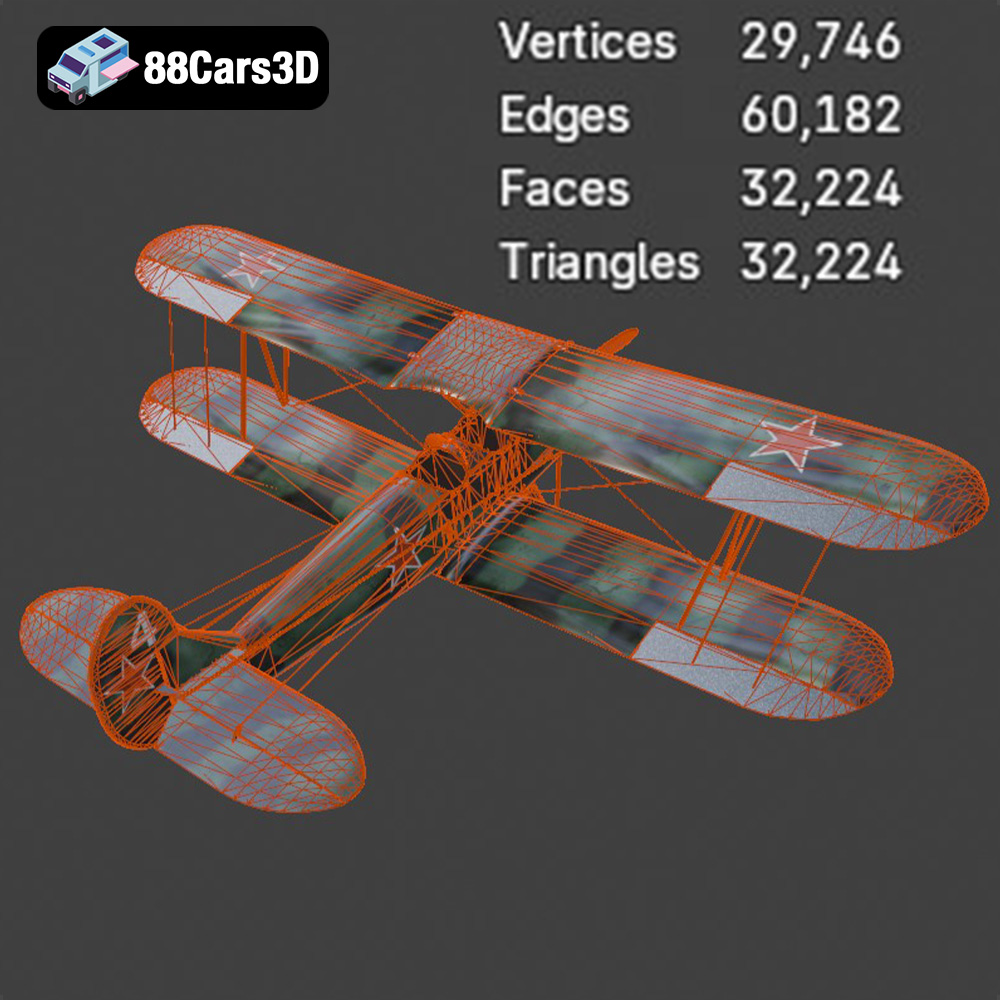
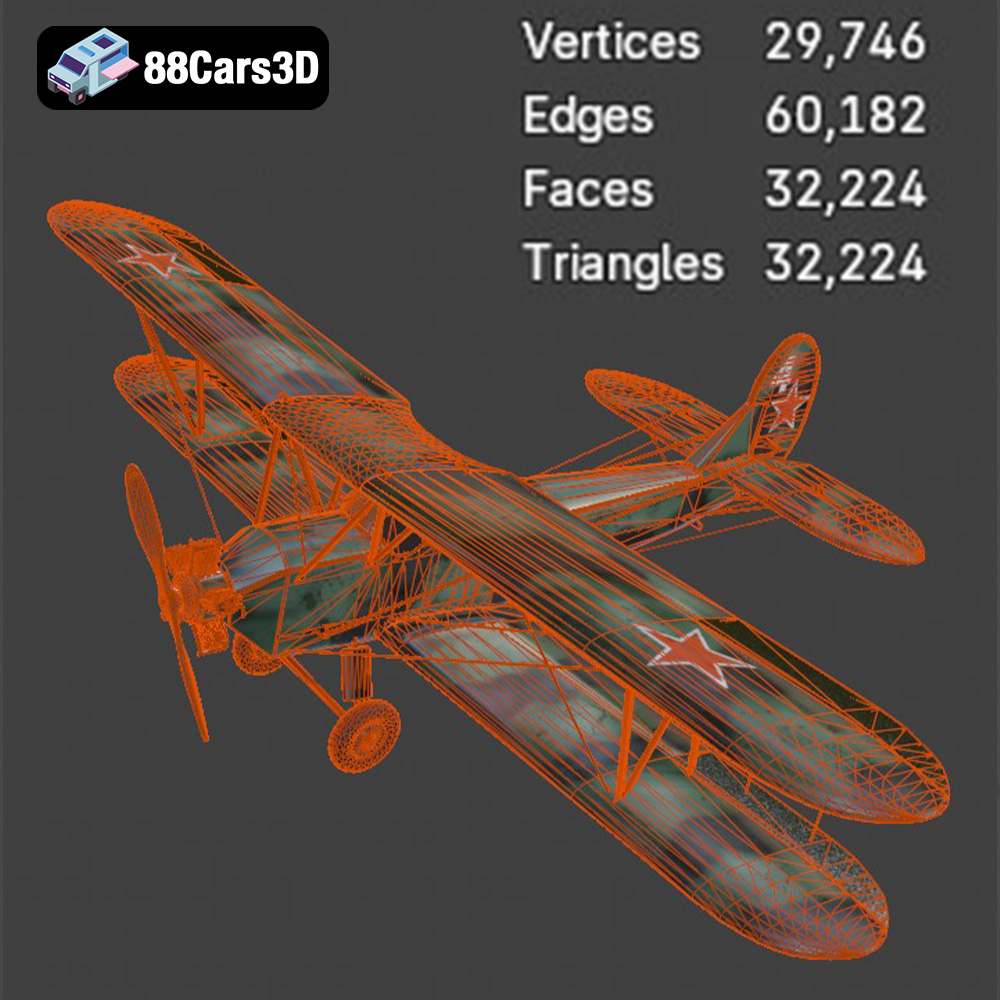
Beyond visual accuracy, the technical underpinnings of the Polikarpov Po-2 3D Model are designed for professional use. It features a clean and well-organized mesh structure with optimized polygon flow. This technical advantage is paramount for achieving both high-quality renders and efficient real-time performance. A clean topology minimizes rendering artifacts, simplifies UV unwrapping, and ensures that the model can be easily integrated into game engines without excessive polygon counts bogging down frame rates. This optimization is crucial whether the model is used for a historical documentary, a flight simulator, or as an engaging game asset.
Integrating the Po-2 into Professional Workflows
The true measure of a high-quality 3D asset lies in its utility across diverse professional pipelines. The Polikarpov Po-2 3D Model, with its detailed design and technical advantages, is engineered to be a versatile tool for artists, designers, and developers working in various industries, from automotive rendering to game development.
High-Fidelity Rendering and Visualization
For rendering artists, the Po-2 model provides an excellent foundation for creating stunning visual content. Using software like 3ds Max, Blender, or other packages, artists can leverage its clean topology and optimized geometry. The inclusion of the native .blend and .max files allows for direct manipulation within these powerful environments. Imagine orchestrating a dramatic sunset scene with the Po-2 silhouetted against a golden sky, or a detailed historical reconstruction for a museum exhibit. Its period-correct features lend themselves perfectly to historical accuracy. Lighting the fabric-covered wings to highlight their texture, adding subtle weathering to the fuselage, or crafting a realistic airfield environment can transform the model into a breathtaking visual narrative. While perhaps not a traditional “automotive rendering” project, the principles of realistic material setup, sophisticated lighting, and environmental integration are directly transferable.
Game Development and Real-Time Environments
The demands of game development are stringent, requiring models that are both visually rich and highly optimized for real-time performance. The Polikarpov Po-2 3D Model shines here, particularly with its .fbx and .unreal formats. For game developers, this means faster integration into engines like Unreal Engine and Unity. The clean mesh and optimized polygon flow are critical for maintaining high frame rates. With separate components for animation (propeller, control surfaces), it’s straightforward to implement flight mechanics and visual effects. Developers can create immersive flight simulators where players experience the nuances of flying this historical biplane, or integrate it as a background asset or even a playable vehicle in WWII-themed open-world games. Proper pivot setups ensure that animations are smooth and believable, adding to the overall player experience.
AR/VR and Interactive Experiences
The burgeoning fields of Augmented Reality (AR) and Virtual Reality (VR) demand highly optimized assets that can be loaded and rendered quickly on various devices. The Polikarpov Po-2 3D Model’s optimized geometry, coupled with its .glb format, makes it an ideal candidate for AR/VR applications. Imagine an interactive museum exhibit where visitors can walk around a life-sized virtual Po-2, examining its details up close, or an educational VR experience that places students in the cockpit of this historic aircraft. The .glb format ensures efficient delivery and real-time rendering, creating compelling, immersive experiences that bring history to the user’s fingertips.
3D Printing: Bringing the Po-2 into the Physical Realm
Beyond digital screens, the appeal of a tangible, physical model remains strong. The ability to transform a digital asset into a real-world object via 3D printing opens up exciting possibilities for collectors, educators, and hobbyists. The Polikarpov Po-2 3D Model, available in the .stl format, is perfectly suited for this transition, allowing enthusiasts to hold a piece of aviation history in their hands.
From Digital Mesh to Tangible Miniature
The .stl format is the universal language of 3D printing. It translates the detailed mesh of the Po-2 into a series of triangles that 3D printers can interpret to build the object layer by layer. For models of this complexity, including intricate wing struts, landing gear, and propeller blades, the quality of the source mesh is paramount. The clean and well-organized geometry of the Polikarpov Po-2 3D Model ensures that the .stl conversion is smooth, resulting in a manifold mesh that prints reliably without errors or gaps, leading to a high-quality physical output.
Optimized Print Settings and Post-Processing
Successful 3D printing requires careful attention to specific settings, and the Polikarpov Po-2 model provides clear guidance for optimal results. Recommended scales of 1:72, 1:48, 1:32, and 1:24 cater to various display preferences, from desktop miniatures to larger, more detailed collectibles. For FDM printers, a layer height of 0.08–0.16 mm and a wall thickness of 1.2–2 mm are suggested, striking a balance between detail and structural integrity. An infill of 15–25% provides sufficient strength without excessive material usage.
Due to the biplane’s intricate structure, supports are required for delicate areas like the wing struts, landing gear, and propeller. Print orientation is also crucial; printing the fuselage horizontally and the wings separately helps minimize support material and ensures better surface finish. Post-processing, including sanding, priming, and applying a matte military paint finish with optional historical decals, can elevate the printed model to a true work of art, capturing the operational realism of its historical counterpart. The technical detail provided ensures that even those new to 3D printing can achieve impressive results.
Customization and Creative Versatility
A truly professional 3D asset goes beyond static representation; it offers the flexibility for artists to inject their own creative vision and tailor it to specific project needs. The Polikarpov Po-2 3D Model provides extensive avenues for customization, enabling creators to craft unique narratives and visuals.
Tailoring the Po-2 for Specific Narratives
The ability to customize the model’s appearance allows for a broad range of historical contexts and artistic interpretations. Artists can easily change the camouflage patterns to reflect different operational periods or modify the livery to represent various training schemes. Adding historical insignia, squadron markings, or even victory stars can transform a generic biplane into a specific, identifiable aircraft with its own story. Furthermore, adjusting the propeller pitch angle can simulate different flight conditions, from parked to full throttle. For ultimate realism, artists can apply varying degrees of weathering, from subtle dust and grime to battle damage and worn paint, conveying the harsh realities of wartime service. This level of granular control over appearance is crucial for projects demanding meticulous historical accuracy or evocative storytelling.
Lighting and Scene Composition
Beyond material customization, the way the Polikarpov Po-2 3D Model is presented through lighting and scene composition can dramatically alter its impact. Imagine configuring dramatic lighting for a cinematic war project, casting long shadows across an airfield at sunrise, or illuminating the cockpit for an in-flight scene at dusk. The model’s robust technical setup, including proper pivots for animation, supports dynamic lighting scenarios. Artists can experiment with atmospheric effects, volumetric fog, and environmental reflections to create truly immersive visuals. Whether it’s showcasing the biplane in a serene historical reconstruction or placing it in the heart of a chaotic combat scenario, the model’s adaptability allows for boundless creative expression.
Conclusion
The Polikarpov Po-2 3D Model is more than just a digital replica; it is a meticulously crafted, technically robust, and historically authentic asset designed to meet the rigorous demands of modern 3D production. From its precise dual-wing structure and detailed radial engine to its optimized mesh and animation-ready components, every aspect has been considered for professional application. The comprehensive support for multiple file formats – including .blend, .fbx, .obj, .glb, .stl, .ply, .unreal, and .max – ensures unparalleled compatibility across diverse workflows, whether you’re working on intricate automotive rendering, developing cutting-edge game assets, creating immersive AR/VR experiences, or producing high-quality 3D prints.
This model serves as a prime example of the exceptional quality and versatility available to 3D artists and developers. Its ability to serve as a cornerstone for historical visualizations, simulation projects, and even collectible scale models underscores its value. For those seeking to elevate their projects with assets that combine historical fidelity with technical excellence, the Polikarpov Po-2 3D Model from 88cars3d.com is an invaluable resource. Explore this exceptional piece of aviation history and discover how high-quality 3D models can transform your creative endeavors.
Featured 3D Model
Polikarpov Po-2 3D Model 3D Printable STL
The Polikarpov Po-2 3D Model is a high-detail digital recreation of the legendary Soviet multi-role biplane widely used for training, reconnaissance, and light bombing missions during the mid-20th century. Known for its lightweight wooden structure and fabric-covered wings, the Po-2 became one of the most produced biplanes in aviation history. This 3D model accurately represents the aircraft’s dual-wing configuration, strut-supported wing assembly, radial engine housing, fixed landing gear, open cockpit layout, tailwheel structure, and fabric-textured control surfaces. Designed with clean topology and real-world scale accuracy, it is ideal for rendering, animation, historical visualization, simulation, and game development. Perfect for WWII scenes, historical reconstructions, aviation museums, flight simulators, and cinematic war projects. Includes .blend, .fbx, .obj, .glb, .stl, .ply, .unreal, and .max formats for rendering, simulation, AR/VR, game development, and 3D printing.
$15.9
Product Image Gallery

Related Tags
.aircraft3dmodel
.arvr
.aviation
.biplane
.blend
.fbx
.flightsimulator
.gameasset
.glb
.historicalaircraft
.max
.obj
.ply
.po2
.polikarpov
.rendering
.simulation
.stl
.unreal
.wwiiaircraft
