Get 20% OFF All Premium 3D & STL Models!

Welcome to 88cars3d.com, your premier destination for high-quality, 3D printable car models! Whether you’re a seasoned maker, a dedicated hobbyist, or just starting your 3D printing journey, you understand that the journey from a digital file to a tangible object often involves more than just hitting ‘print.’ The STL file, the de facto standard for 3D printing, is fundamentally a mesh representation of your object. While robust, these meshes can sometimes require refinement, repair, or even modification to perfectly suit your printing needs or creative vision. This is where specialized software comes into play.
This comprehensive guide will delve into the world of STL file editing, exploring the best free and paid software solutions available to help you prepare, repair, and even customize your 3D models. We’ll cover everything from basic mesh repair and support generation to more advanced modeling techniques. Understanding these tools will empower you to overcome common printing challenges, optimize your models for specific printers and materials, and ultimately achieve flawless results. Prepare to elevate your 3D printing game as we explore the software that can transform your STL files from good to exceptional.
Before diving into software, it’s crucial to grasp the nature of the STL (STereoLithography) file format. At its core, an STL file describes the surface geometry of a three-dimensional object using a collection of connected triangles (facets). Each triangle is defined by three vertices and a normal vector, which indicates the outward-facing direction of the surface. This simple yet effective representation is why STL has become the industry standard for 3D printing, as it’s easily interpreted by slicing software.
However, this triangular representation isn’t always perfect. Issues can arise during the modeling process or file export, leading to what are known as “non-manifold” geometry or “mesh errors.” These can include holes in the mesh, inverted normals, overlapping triangles, or edges shared by more than two facets. Such errors can cause significant problems for slicing software, leading to failed prints, incorrect slicing, or missing sections in the final object. Learning to identify and repair these issues is a fundamental skill for any serious 3D printer operator.
Each triangle in an STL file is a facet composed of three vertices. The order in which these vertices are listed is important, as it defines the direction of the normal vector. The normal vector points outwards from the surface of the model. If all normal vectors point inwards, the slicer won’t know which side is the “outside” of the model, leading to printing errors. Tools like Netfabb or Meshmixer can highlight these inverted normals, allowing you to correct them.
Key Takeaway: A “watertight” or “manifold” mesh is essential for successful 3D printing. This means the mesh forms a closed surface with no holes or gaps, and every edge is shared by exactly two facets. Any deviation from this can lead to slicing errors.
Identifying common mesh errors is the first step towards successful editing. These include:
These errors, if left unaddressed, can transform a perfectly designed model into a printing nightmare. Fortunately, the software we’ll explore can automatically detect and often repair many of these common issues.
For those on a budget or preferring open-source solutions, a robust selection of free software is available. These tools offer powerful capabilities for mesh repair, manipulation, and even basic modeling. While they might have a steeper learning curve than some paid alternatives, their functionality is often more than sufficient for most hobbyist and professional needs.
When you download a print-ready STL file from platforms like 88cars3d.com, it’s generally well-prepared. However, even the best models can benefit from minor adjustments. Perhaps you need to thicken a thin wall for FDM printing, add custom supports, or combine multiple STL files into a single print.
Autodesk Meshmixer is a widely acclaimed free tool that excels at preparing 3D models for printing. It offers an intuitive interface for a wide range of tasks, from simple mesh repair to complex sculpting and hollowing. Its automatic repair functions are particularly impressive, capable of fixing most common STL errors with a few clicks. Meshmixer also provides excellent tools for generating support structures, which can be crucial for intricate models like detailed car bodies. You can also use it to combine multiple models, sculpt details, smooth surfaces, and even perform boolean operations (adding or subtracting shapes).
Key Features:
Blender is a professional, free, and open-source 3D creation suite that encompasses modeling, sculpting, animation, rendering, and more. While it’s a comprehensive package that can seem intimidating initially, its modeling and mesh editing capabilities are second to none, even for complex tasks. For STL editing, Blender offers tools to fix non-manifold geometry, remesh surfaces for better topology, and perform intricate modifications. It’s an excellent choice if you plan to do more than just repair; for example, if you want to integrate parts of one model into another or add entirely new features.
Key Features:
For users who frequently download models from marketplaces such as 88cars3d.com and want to make more significant design alterations, Blender provides the necessary depth.
MeshLab is another powerful open-source system for processing and editing 3D triangular meshes. It’s particularly strong in mesh analysis, cleaning, inspection, and rendering. While it might not be as intuitive for sculpting as Meshmixer or Blender, it offers a vast array of filters for mesh simplification, repair, and parameterization. If you’re dealing with very large or complex meshes, MeshLab’s efficiency can be a significant advantage. It’s excellent for analyzing mesh quality, checking for errors, and applying filters to optimize mesh topology for printing.
Key Features:
While free software can handle many tasks, paid solutions often offer more advanced features, streamlined workflows, better integration with professional CAD software, and dedicated customer support. These are typically favored by professionals, engineers, and serious hobbyists who require precision, efficiency, and specialized tools for complex projects.
If you’re working with highly detailed car models from 88cars3d.com and need to perform complex modifications or integrate them into larger assemblies, paid software might be a worthwhile investment.
Autodesk Netfabb is a leading professional software solution for additive manufacturing. It combines powerful mesh repair, design, and preparation tools specifically tailored for 3D printing. Netfabb excels at handling complex geometries and large datasets, offering highly automated repair workflows that are critical in production environments. It provides advanced simulation capabilities to predict print outcomes and optimize build strategies. For users who need to prepare multiple parts for a build plate, optimize orientation, generate sophisticated support structures, and perform quality control checks, Netfabb is an industry benchmark.
Key Features:
Autodesk Fusion 360 is a cloud-based 3D CAD, CAM, CAE, and PCB software platform. While primarily a design tool, it has robust capabilities for working with meshes and preparing them for 3D printing. Fusion 360 allows you to import STL files, convert them into editable solid or surface bodies, and then modify them using standard CAD modeling techniques. This is incredibly powerful if you want to add precise features, create enclosures, or integrate STL models into more complex mechanical designs. It also has built-in tools for creating support structures and simulating the printing process.
Key Features:
For engineers and designers already working within the SolidWorks ecosystem, its STL editing capabilities, particularly with add-ins like Visualize or Simulation, can be leveraged. SolidWorks allows you to import STL files, and with specific tools or add-ons, you can mesh repair, analyze surface quality, and even convert them to parametric models for further modification. While not its primary function, SolidWorks provides the precision and integrated workflow that many professional design environments demand.
Key Features:
Regardless of the software you choose, mastering a few key techniques will significantly improve your 3D printing success rate. These techniques focus on ensuring the integrity of the mesh and optimizing it for the slicing process.
When you acquire models from sources like 88cars3d.com, they are typically designed for excellent printability. However, you might encounter situations where minor adjustments are needed, such as scaling, orienting for print, or adding custom supports for specific printer setups.
Most STL editing software offers automated repair functions. These are excellent for quickly fixing common issues like holes, inverted normals, and non-manifold edges. Tools like Meshmixer’s “Auto Repair” or Netfabb’s “Error Analysis” are your first line of defense. However, automation isn’t always perfect. Sometimes, automated repairs can introduce new issues or simplify the mesh too aggressively, losing detail.
Manual repair involves using specific tools to address individual errors. This might include:
For critical repairs or when maintaining fine details is paramount, manual intervention is often necessary.
The best STL preparation often depends on your 3D printing technology.
For FDM Printing:
For Resin Printing (SLA/DLP):
Often, you might want to combine multiple STL files or modify existing ones. For instance, you might want to print a car model in multiple parts and assemble them, or add a custom base to a display model.
The “best” software is subjective and depends heavily on your specific requirements, budget, and technical skill level. For beginners and hobbyists focusing on mesh repair and basic modifications, free options like Meshmixer and Blender are excellent starting points.
If you’re an engineer, designer, or operate in a professional setting where precision, advanced features, and integration with other tools are critical, then paid software like Netfabb or Fusion 360 will likely offer a more robust and efficient workflow.
Consider these factors when making your choice:
By understanding the strengths of each software category and mastering the essential techniques, you can confidently tackle any STL file editing task, ensuring your 3D prints from 88cars3d.com and elsewhere are always of the highest quality.
The ability to effectively edit and prepare STL files is a cornerstone of successful 3D printing. Whether you’re downloading a meticulously crafted collectible car model from 88cars3d.com or working on your own original designs, understanding how to navigate and manipulate mesh data can save you time, material, and frustration. We’ve explored a range of powerful software, from free and accessible tools like Meshmixer and Blender to professional-grade solutions like Netfabb and Fusion 360.
Key takeaways include the importance of a watertight mesh, understanding the differences between FDM and resin printing preparation needs, and mastering fundamental repair and modification techniques. By investing time in learning these software tools and processes, you unlock a new level of control over your 3D prints. You can overcome common printing obstacles, optimize models for your specific printer and material, and bring your creative visions to life with greater accuracy and detail. Start experimenting with the software that best suits your needs, and you’ll soon find that your STL file preparation workflow becomes a seamless and rewarding part of the additive manufacturing process.

Texture: Yes | Material: Yes | 3D Printable: Yes. Download the Italian Thoroughbreds Bundle featuring 5 iconic 3D models: Lamborghini Huracán Performante, Ferrari 458 Italia, Lamborghini Urus, Diablo SV, and Maserati GT. Optimized for 4K rendering and 3D printing (STL included). Save 50% with this ultimate Italian vehicle collection.
Price: $199.99

Download the Elite Future Mobility Bundle featuring 4 highly optimized 3D models: Tesla Model S, Avatr 11, Li L9, and Zoox Robotaxi. Perfect for ArchViz, Smart City renders, and game dev. Optimized for Unreal Engine and Blender. Includes .fbx, .obj, and .max formats.
Price: $99

🚗 5 Iconic German Cars (BMW M4 G82, M5 CS, X3, 1 Series & Mercedes E-Class). ✅ Optimized for ArchViz: Ready for Corona & V-Ray. 💰 Save €71 with this limited-time collection! 🚀 Instant Download after purchase.
Price: $119

Download the Extreme Off-Road & Survival 3D Models Bundle! Includes the Brabus 800 Adventure, Dodge Ram Bigfoot, Spec Truck, and a Caravan. Save over €210 on this premium 4-in-1 off-grid vehicle pack for ArchViz and game development.
Price: $149.99
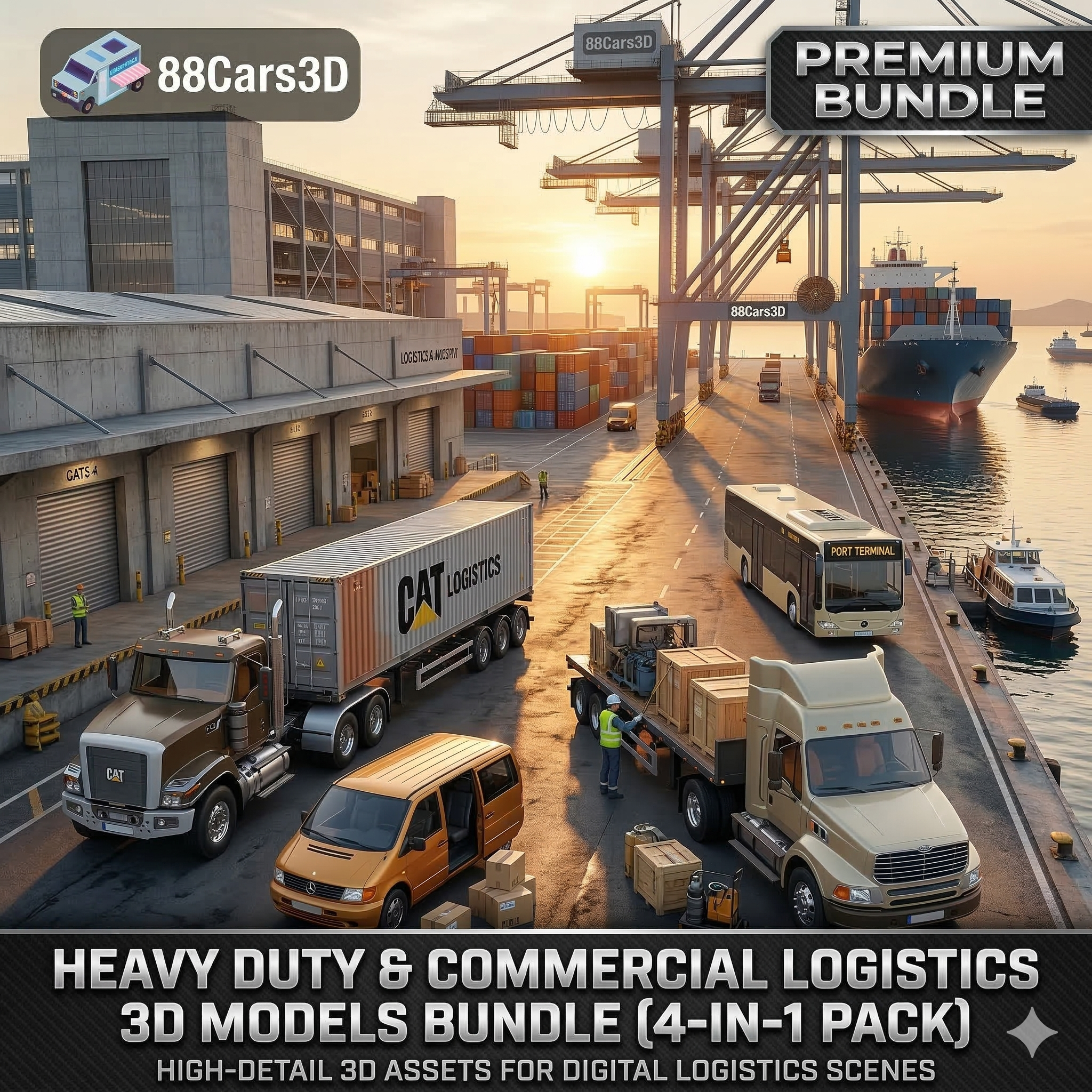
Download the Heavy Duty & Commercial Logistics 3D Models Bundle! Includes the Ford Sterling, Caterpillar CT680, Mercedes Citaro Bus, and Vito Van. Save over €130 on this massive, game-ready 4-in-1 industrial vehicle pack.
Price: $109.99

Download the Ultimate Custom Motorcycles 3D Models Bundle. Includes a Custom Chopper, Ducati 916 Café Fighter, Harley XR1200X, and BMW K100. Perfect premium props for luxury ArchViz garages. Save over €250 today!
Price: $159.99

Download the ultimate JDM Street Racing 3D Models Bundle! Includes the Nissan GT-R, Toyota Supra, Mazda RX-7, Lancer Evo IX, and Honda NSX. Save big on this highly optimized, game-ready 5-in-1 Japanese legend car pack.
Price: $129.99

Download the ultimate American Muscle & Cinematic Classics 3D Models Bundle! Includes the Dodge Charger ’68, Mustang Eleanor GT500, Camaro Z28 ’79, and a custom ’69 Mustang. Save over €240 on this game-ready, premium 4-in-1 pack.
Price: $149.99
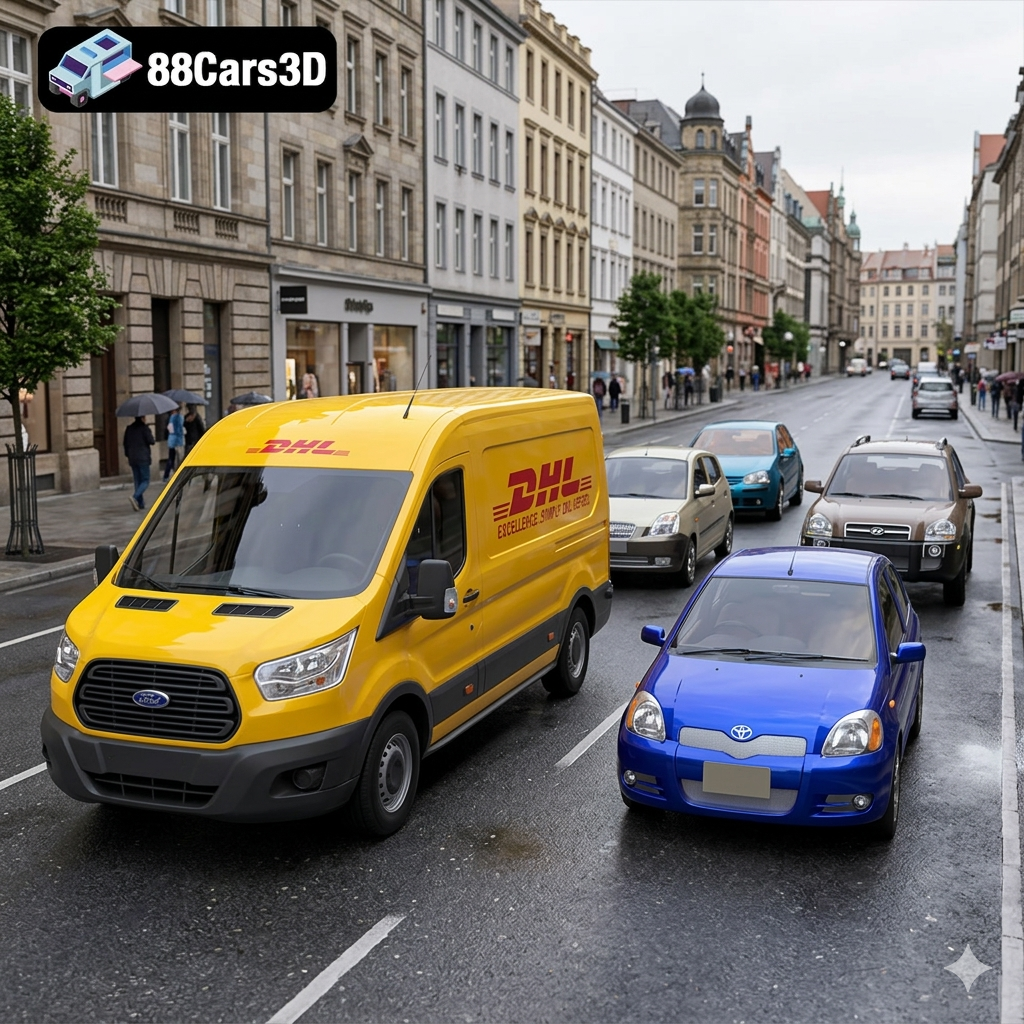
Download the Everyday City Traffic 3D Models Bundle. Includes the VW Golf, Kia Picanto, Hyundai Tucson, Toyota Yaris, and a DHL Ford Transit Van. Save big on this 5-in-1 pack, perfectly optimized for realistic ArchViz streets and game traffic.
Price: $99.99

Download the Future of Mobility EV 3D Models Bundle. Includes the Volvo EX30, Tesla Model S, AVATR 11, Porsche Taycan, and a Siemens EV Charger. Save big on this highly optimized 5-in-1 pack for ArchViz and game development!
Price: $89.99

