Get 20% OFF All Premium 3D & STL Models!

In the vast landscape of automotive design, visualization, and digital content creation, the demand for high-quality, authentic 3D car models is ceaseless. Whether you’re an architect integrating vehicles into a scene, a game developer populating a virtual world, an automotive designer prototyping concepts, or a hobbyist crafting intricate 3D prints, the foundation of your project lies in the fidelity of your assets. Today, we’re diving deep into a particular digital titan that embodies rugged utility and meticulous detail: the Ford F-250 Super Duty Super Cab XLT 2015 3D Model.
This isn’t just any pickup truck model; it’s a testament to precision, capturing the imposing, muscular stance of America’s iconic heavy-duty workhorse. As the final iteration of the legendary steel-body generation, the 2015 F-250 Super Duty holds a special place, revered for its blend of raw power and unpretentious functionality. A premium 3D car model of this caliber provides an unparalleled resource for creators looking to infuse their projects with genuine automotive character, whether for extreme close-up rendering, cinematic sequences, or even creating physical scale models through 3D printing. The detail present in this particular Ford F-250 Super Duty Super Cab XLT 2015 3D Model, available on 88cars3d.com, makes it a hero asset ready to anchor a diverse range of professional and enthusiast applications.
When acquiring a sophisticated 3D car model like the Ford F-250 Super Duty, understanding the various file formats it comes in is crucial for seamless integration into your preferred workflow. Each format serves a specific purpose, offering different levels of compatibility, data retention, and optimization for various applications, from rendering to real-time engines and even 3D printing. The Ford F-250 Super Duty Super Cab XLT 2015 3D Model is exceptionally versatile, offering a comprehensive suite of file formats to meet almost any digital need.
The .blend file format is the native format for Blender, the popular open-source 3D creation suite. When you receive a .blend file, you’re getting a complete Blender scene, often including the model’s geometry, materials, textures, lighting, camera setups, and even animation data. For users deeply embedded in the Blender ecosystem, this format offers the most direct and editable experience. It preserves all the intricate details of the model’s construction, making it ideal for artists who want to dissect, modify, or re-render the F-250 Super Duty within Blender’s powerful environment. It’s the go-to for maximum flexibility and access to the original artist’s scene setup.
.fbx (Filmbox) is a proprietary file format owned by Autodesk, designed for high-fidelity data exchange between 3D software applications. It’s incredibly versatile, supporting geometry, materials, textures, rigging, animation, and even camera and lighting data. This makes .fbx the industry standard for transferring complex 3D car models between programs like 3ds Max, Maya, Cinema 4D, and into game engines like Unreal Engine and Unity. For a model like the F-250, an .fbx file ensures that all crucial elements like separated doors, wheels, and steering components (ready for animation) are preserved, making it an ideal choice for collaborative workflows and real-time pipelines.
.obj (Wavefront Object) is one of the oldest and most universally supported 3D file formats. While it primarily stores geometry (vertices, normals, UVs, and faces), it can reference external material files (.mtl) for basic material properties and textures. Its simplicity makes it highly compatible across virtually all 3D software. For the F-250 Super Duty, an .obj file guarantees that the core mesh data is accessible, even if some advanced material setups might need reconstruction in the target application. It’s a reliable choice for cross-software compatibility, especially when the primary concern is the geometric accuracy of the model.
.glb (GL Transmission Format Binary) is the binary version of glTF, a royalty-free specification for the efficient transmission and loading of 3D scenes and models by applications. It’s quickly becoming the standard for 3D web content, AR/VR experiences, and lightweight real-time applications because it packages all assets (geometry, textures, animations) into a single, self-contained file. For displaying the F-250 Super Duty in a web viewer or an AR application, .glb offers an optimized, compact solution without sacrificing visual quality.
The .unreal format refers to assets specifically prepared for or exported from Unreal Engine. While not a generic file format in the same way as .fbx or .obj, its inclusion implies that the Ford F-250 model has been specifically processed and optimized for Unreal Engine’s unique PBR (Physically Based Rendering) material system and asset pipeline. This could mean pre-configured materials, collision meshes, or other engine-specific optimizations, streamlining its integration into a demanding real-time environment.
.stl (Stereolithography) is perhaps the most widely recognized format for 3D printing. It represents a 3D model as a series of connected triangles, describing only the surface geometry without color, texture, or other properties. While lacking in visual data, its simplicity makes it universally compatible with 3D printers and slicing software. The F-250 Super Duty’s availability in .stl format means it’s ready to be transformed from a digital asset into a tangible, physical object, perfect for custom RC truck bodies or scale models.
.ply (Polygon File Format) is another format for storing 3D data, often used for scanned data or precise mesh representations. It can store not only geometry but also color information per vertex or face, normals, and other attributes. While less common for general 3D model exchange than .fbx or .obj, its inclusion for the F-250 suggests a robust, precision-oriented mesh, potentially useful for specialized CAD or analysis applications.
The .max file format is the native scene file for Autodesk 3ds Max, a leading software in architectural visualization, automotive rendering, and animation. Similar to .blend, a .max file contains the complete 3ds Max scene, including the F-250 model’s geometry, complex materials, lighting, cameras, and any modifiers or animation applied. For 3ds Max users, this format offers the highest level of editability and direct access to the artist’s original setup, making it ideal for further refinement, rendering, and animation work within this powerful software.
The comprehensive range of formats included with the Ford F-250 Super Duty Super Cab XLT 2015 3D Model underscores its versatility and value, ensuring that professionals across various disciplines can seamlessly integrate this exceptional automotive rendering asset into their projects.
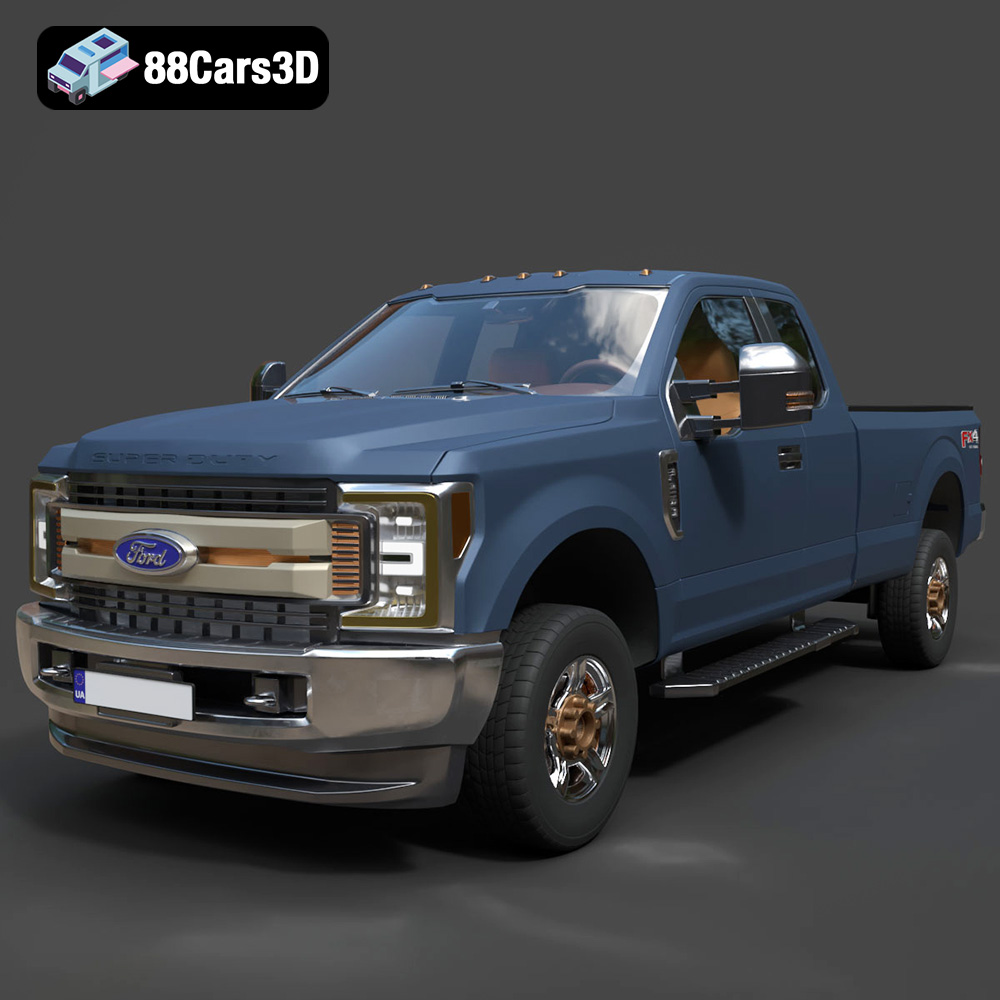
The true measure of a premium 3D car model lies in its attention to detail. This Ford F-250 Super Duty Super Cab XLT 2015 3D Model is a prime example of such meticulous craftsmanship. It’s built to deliver maximum visual fidelity, ensuring that every curve, seam, and component is accurately represented. This level of detail is critical for projects demanding photorealistic outcomes, whether in high-resolution stills or dynamic cinematic sequences.
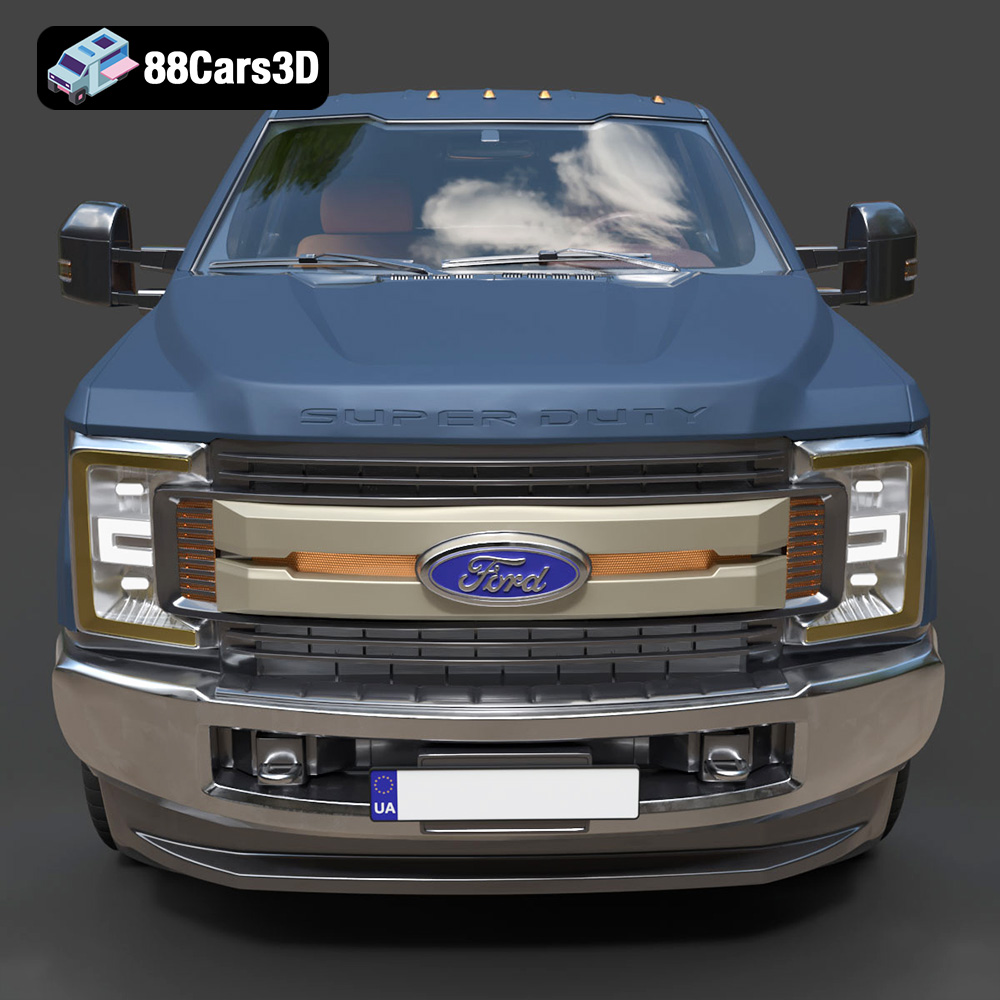
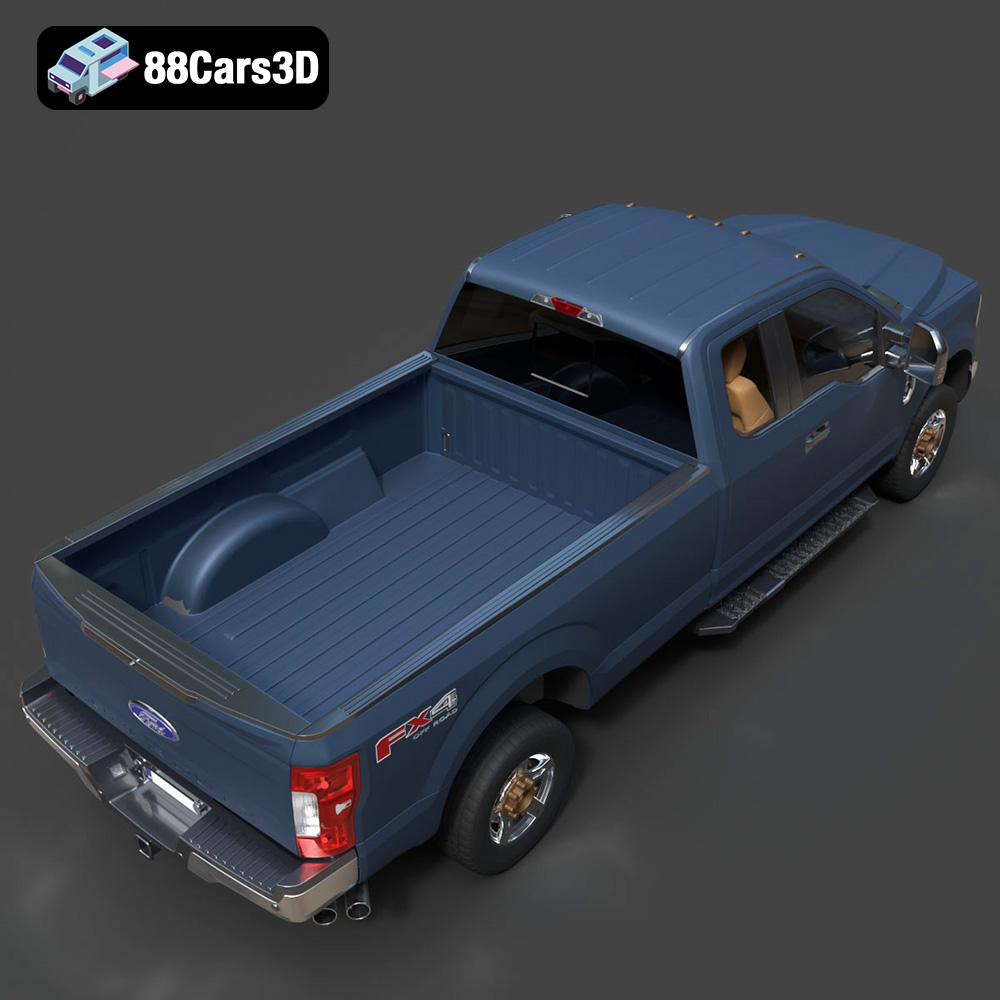
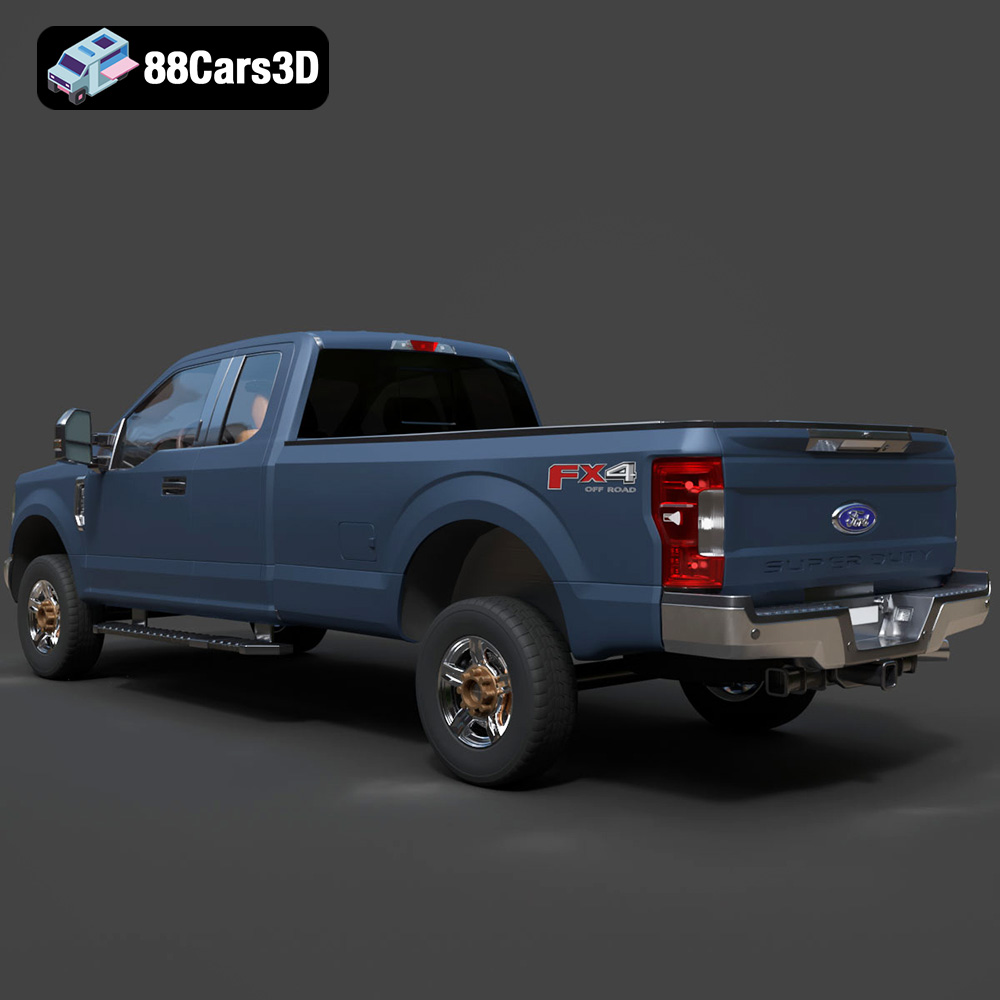
The external features of this 3D model are where the Ford F-250 truly shines. The model accurately captures the distinctive XLT-spec chrome front grille, a signature element of the 2015 F-250 Super Duty, alongside its massive stacked headlight clusters. These details aren’t merely approximations; they reflect the precise geometry and proportions of the real truck. The “Super Cab” extended cabin configuration, with its accurate door panel gaps and rear-hinged half doors, is meticulously recreated. Even functional components like the telescoping trailer-tow side mirrors and heavy-duty chrome bumpers are modeled with exacting detail. Furthermore, the cargo bed features a fully detailed tailgate and bed rails, complete with rear step details. The standard XLT alloy wheels, wrapped in rugged all-terrain tires, complete the authentic exterior package. Crucially, elements such as the wheels, steering components, doors, and tailgate are separated, making the model instantly ready for complex animations, a vital feature for automotive rendering specialists.
Beyond the robust exterior, the interior of the Ford F-250 Super Duty Super Cab XLT 2015 3D Model also receives significant attention. The spacious Super Cab layout is faithfully reproduced, featuring front bucket/bench seating and rear folding seats. The XLT-spec cloth or durable vinyl seating geometry includes authentic seam detailing, adding to the realism for close-up shots. The dashboard is accurate, showcasing the central infotainment screen layout and the truck’s rugged climate controls. A heavy-duty multi-function steering wheel and column shifter are also present, ensuring the interior is as convincing as the exterior. This optimized geometry makes the model perfectly suitable for high-resolution first-person POV rendering, essential for virtual showrooms or interactive experiences.
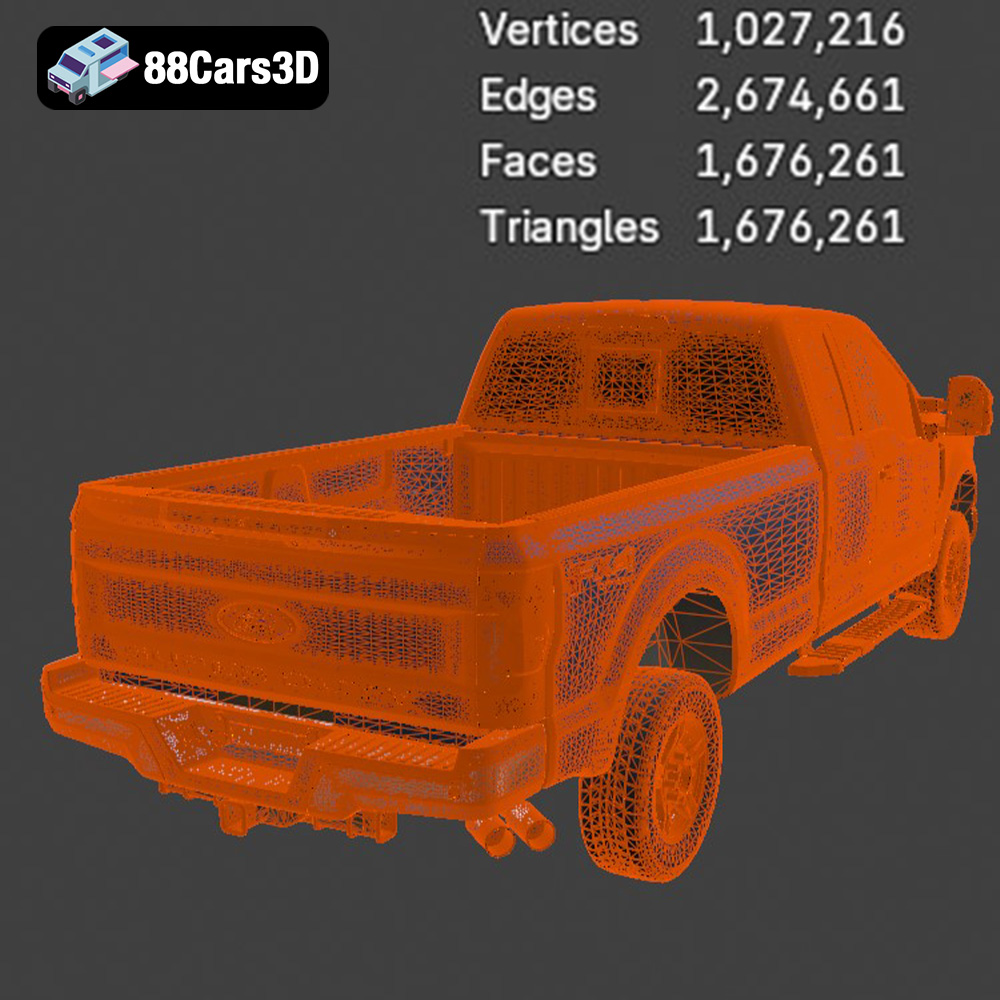
Technical specifications tell a powerful story about the model’s quality. With over 1,027,216 vertices, 2,674,661 edges, and a staggering 1,676,261 faces / polygons (or triangles), this Ford F-250 model boasts a dense, uncompromising topology. This high polygon count is not just a number; it’s the foundation for maximum exterior and interior realism. It allows for incredibly smooth curves, sharp edges, and subtle surface variations that are indistinguishable from the real vehicle. This makes it a “hero” asset, designed for scenarios where visual perfection is paramount – whether it’s a glossy advertising campaign, a detailed automotive visualization, or a high-fidelity cinematic production. The real-world scale accuracy, based on Ford factory dimensions, further cements its value as a professional-grade asset.
The Ford F-250 Super Duty Super Cab XLT 2015 3D Model is more than just a beautiful digital asset; it’s a versatile tool engineered for seamless integration into various professional pipelines. Its high-fidelity construction and detailed features make it an invaluable resource for studios and individual artists alike.
For artists working in 3ds Max, Blender, or other leading 3D software for automotive rendering, this F-250 model provides a robust starting point. The included .max and .blend formats ensure that users of these specific software packages can directly access the model with its intended scene setup, materials, and potentially even lighting. Imagine an advertising agency needing a rugged pickup for a construction equipment commercial; the Ford F-250 Super Duty Super Cab XLT 2015 3D Model can be easily textured, lit, and rendered to stunning photorealistic effect. Its dense geometry ensures that extreme close-ups on the chrome grille, the detailed XLT alloy wheels, or the interior stitching hold up under scrutiny. The separated animated parts (wheels, doors, tailgate, steering) allow for dynamic shots, showcasing the truck in motion or with open doors, adding layers of realism to any cinematic production.
While the Ford F-250 Super Duty 3D Model is presented as a high-poly “hero” asset (at ~1.67 million polygons), it serves as an excellent foundation for game development and real-time visualization, particularly for cutscenes, high-detail vehicle showcases, or VR experiences where graphical fidelity is prioritized. For real-time applications like a drivable vehicle in Unreal Engine or Unity, the model would typically require manual retopology or decimation. This process reduces the polygon count while retaining visual detail through techniques like normal mapping. Game artists can use the high-poly model as a baking source for textures and normals onto a much lower-poly game mesh, achieving stunning visuals without impacting performance. The inclusion of an .unreal specific file or pre-optimized .fbx often means a head start on material setup and asset integration within the engine.
Architectural visualization studios frequently incorporate vehicles into their renderings to add scale, context, and realism to their building designs. A detailed vehicle like the F-250 can instantly ground a scene, whether it’s parked outside a suburban home or an industrial complex. Similarly, for commercial fleet branding mockups, the model can be used to visualize custom liveries, branding elements, or utility modifications on the truck. Marketing teams can leverage this 3D model to create compelling product pitches, showcasing new accessories or demonstrating the truck’s capabilities in various simulated environments. The real-world scale accuracy and compatibility with major 3D software platforms make it an indispensable tool for these demanding commercial applications.
One of the most exciting applications of this highly detailed 3D model is its suitability for 3D printing. The Ford F-250 Super Duty Super Cab XLT 2015 3D Model is not just a visual spectacle; it’s a blueprint for tangible creation, opening up avenues for custom RC truck bodies, intricate scale models, or automotive collectibles.
The model’s robust geometry, coupled with its .stl and .ply file formats, makes it an excellent candidate for 3D printing. For custom RC crawler bodies or larger scale models, the recommended scales of 1:24, 1:18, or 1:10 offer a great balance between detail retention and manageable print size. When preparing for printing, attention to print settings is paramount. A layer height of 0.08–0.16 mm will capture the finer details, while a wall thickness of 1.5–2.5 mm is recommended, especially for a large truck body, to ensure structural integrity and durability. An infill of 15–25% provides a good balance between strength and material usage. Given the F-250’s complex form, supports will be required for overhangs such as the tow mirrors, wheel arches, exhaust system, and intricate undercarriage details. Strategic print orientation is also key; printing the cab and bed separately or angling them appropriately can prevent warping and achieve a smoother surface finish, with wheels typically printed as individual components.
Once printed, the journey from raw plastic to a finished replica begins with diligent post-processing. This typically involves sanding to smooth out layer lines, followed by applying a primer to create a uniform surface for paint. For authentic reproduction, standard factory paint colors from the 2015 Ford palette, such as Oxford White, Blue Jeans Metallic, or Ingot Silver, can be applied. To capture the F-250’s distinctive XLT chrome accents, a silver metalizer paint can be meticulously applied to the grille, bumpers, and other chrome elements, bringing the miniature truck to life with a realistic sheen. This hands-on process allows enthusiasts to create highly personalized and accurate scale models, demonstrating the incredible versatility of high-quality 3D car models beyond purely digital realms.
A truly valuable 3D model offers more than static perfection; it provides a canvas for creative expression and adaptation. The Ford F-250 Super Duty Super Cab XLT 2015 3D Model is designed with this flexibility in mind, allowing artists and designers to tailor it to their specific project needs, adding a personalized touch to their automotive rendering and visualization efforts.
One of the most immediate customization options is altering the vehicle’s aesthetics. Users can easily change exterior paint colors to match classic 2015 Ford factory options or experiment with custom hues to fit a unique brand identity or scene mood. The separated wheel and tire setups offer immense freedom to modify the truck’s stance and character. Swapping the stock XLT alloy wheels for aggressive aftermarket lift-kit setups can instantly transform the F-250 from a dependable work truck into an imposing off-road beast. Furthermore, the detailed cargo bed provides opportunities for adding various accessories, such as a toolbox, a sleek tonneau cover, or even a heavy-duty fifth-wheel hitch, enhancing its utility and narrative context within a scene. This level of granular control allows the F-250 to seamlessly adapt to diverse visual narratives, from a rugged construction site to a pristine showroom floor.
Beyond static visual changes, the model’s design with separate, properly pivoted components—wheels, steering, doors, and tailgate—unlocks significant animation potential. For automotive rendering artists, this means the truck can be easily rigged for realistic movement. Imagine an animation showcasing the F-250 navigating a challenging off-road course, with its suspension articulating, wheels turning, and doors opening for character interaction. Or a commercial where the tailgate smoothly lowers, revealing branded cargo. The accurate geometry and pivot points minimize the setup time for animators, making it a highly efficient asset for dynamic sequences. This capability is invaluable for cinematic productions and interactive simulations where vehicles need to perform specific actions rather than just sitting idly.
Whether you’re aiming for photorealistic stillness or dynamic storytelling, the customization options provided by this detailed 3D model ensure that the Ford F-250 Super Duty Super Cab XLT 2015 can be precisely molded to fulfill your creative vision, making it a highly adaptable asset from 88cars3d.com.
In the demanding world of 3D content creation, the foundation of any successful project is the quality of its assets. The Ford F-250 Super Duty Super Cab XLT 2015 3D Model stands as a shining example of a premium, high-fidelity asset, meticulously crafted to meet the rigorous demands of professionals across various industries. From its dense topology and accurate exterior and interior details to its comprehensive suite of file formats and suitability for both high-end rendering and detailed 3D printing, this model is designed for excellence.
We’ve explored how its 1.67 million polygons translate into uncompromising realism for cinematic automotive rendering, how its diverse file formats enable seamless integration into workflows ranging from Blender to Unreal Engine, and how its precise geometry makes it an ideal candidate for detailed 3D printed replicas. The ability to customize its aesthetics and animate its components further solidifies its position as a versatile and indispensable tool for any artist or studio.
Whether you’re developing the next blockbuster game, producing a high-impact advertising campaign, designing a new architectural visualization, or bringing a stunning scale model to life, investing in high-quality 3D car models like the Ford F-250 Super Duty Super Cab XLT 2015 is a strategic decision that pays dividends in realism, efficiency, and creative freedom. Discover this exceptional 3D model and many more at 88cars3d.com, your premier source for professional-grade automotive 3D assets.
The Ford F-250 Super Duty Super Cab XLT 2015 3D Model is a premium, high-detail digital recreation of America’s iconic heavy-duty work truck. Representing the final iteration of the legendary steel-body generation, this 2015 model captures the imposing, muscular stance that makes the F-250 a favorite for towing, off-roading, and commercial fleets. Built with dense, uncompromising topology (over 1.6 million polygons), it provides maximum visual fidelity for extreme close-up rendering, cinematic automotive visualization, commercial fleet mockups, and high-end 3D printing. Perfect for rugged off-road scenes, construction site environments, commercial vehicle pitches, and high-end cinematic productions. Includes .blend, .fbx, .obj, .glb, .stl, .ply, .unreal, and .max formats. Optimized for high-resolution studio rendering and commercial visualization, with accurate real-world scale and proper pivot setup for animation. Also a great base for 3D printing custom RC truck bodies or diecast hobbyist prints at scales like 1:24, 1:18, or 1:10.
$69.99
.automotive
.blend
.fbx
.ford
.obj
.rendering
.stl
.xlt
2015-ford
3d printing
car-3d-model
f-250
heavy-duty
high poly
pickup-truck
super-cab
super-duty