Get 50% OFF All Premium 3D & STL Models!

The automotive industry thrives on stunning visuals. From concept cars unveiled at international expos to high-impact marketing campaigns and interactive configurators, the demand for photorealistic vehicle representations is insatiable. For years, achieving this level of visual fidelity often required dedicated offline rendering software, leading to lengthy render times and complex workflows. However, with the rapid advancements in real-time engines, particularly Unreal Engine, the line between real-time and offline rendering has blurred dramatically. Enter Path Tracing in Unreal Engine – a game-changer for automotive visualization that brings true offline rendering quality directly into your real-time pipeline.
Path Tracing in Unreal Engine is not just another rendering feature; it’s a paradigm shift for artists and developers aiming for unparalleled visual accuracy. By simulating light paths in a physically correct manner, it unlocks a level of realism that was once exclusive to traditional renderers. For anyone working with high-quality 3D car models, like those available on 88cars3d.com, mastering Path Tracing is essential for creating compelling cinematics, marketing stills, and immersive experiences that truly stand out. This comprehensive guide will take you through the technical intricacies of setting up, optimizing, and leveraging Path Tracing to achieve breathtaking automotive renders, ensuring your projects consistently deliver top-tier visual excellence.
In the realm of automotive design and marketing, photorealism isn’t a luxury; it’s a necessity. Consumers expect to see vehicles with immaculate reflections, nuanced material responses, and lighting that perfectly mimics the real world. While Unreal Engine’s real-time rendering capabilities, powered by features like Lumen and Nanite, have made incredible strides in achieving real-time fidelity, there are specific scenarios where uncompromised, physically accurate light simulation is paramount. This is where Path Tracing takes center stage, offering a level of visual integrity that surpasses even the most advanced real-time solutions for static renders and cinematics.
Path Tracing operates on the principle of simulating light as it bounces through a scene, tracing individual rays from the camera into the environment and accumulating samples. This method inherently accounts for complex light phenomena such as global illumination, accurate reflections, refractions, soft shadows, and even caustics, all without the approximations often found in real-time rendering. For automotive visualization, this means car paint gleams with perfect metallic flakes and clear coat reflections, glass exhibits correct internal reflections and refractions, and chrome surfaces mirror their surroundings with absolute precision. The result is an image free from the common artifacts of real-time rasterization or even hybrid ray tracing, providing a truly photographic quality that is essential for high-stakes marketing materials or cinematic sequences.
To fully appreciate Path Tracing, it’s crucial to understand how it differs from real-time rendering. Real-time rendering, even with hardware-accelerated Ray Tracing features like those in Unreal Engine’s Lumen, prioritizes speed and interactivity. It uses a combination of rasterization, screen-space effects, and limited ray bounces to achieve high frame rates. While this is excellent for interactive applications like games or real-time configurators, there are compromises. Global illumination might be approximated, reflections might be screen-space or limited in depth, and complex light interactions like caustics are often not fully simulated. Performance is king, and some physical accuracy is sacrificed for interactivity.
Path Tracing, conversely, is an unbiased rendering technique. It doesn’t rely on approximations. Instead, it simulates the full physics of light, tracing millions of individual light paths to build up a statistically accurate image. Each pixel accumulates multiple samples, leading to a converged, noise-free result that is physically correct. This process, while computationally intensive and slower than real-time rendering, yields images of unparalleled fidelity. For a high-quality 3D car model sourced from platforms like 88cars3d.com, this means every curve, every material property, and every surface interaction is rendered with maximum authenticity, making it the ideal choice for final-pixel output where quality is paramount over frame rate.
The advantages of using Path Tracing for high-end automotive visuals are profound. Firstly, it provides uncompromised image quality, ensuring that every marketing render, high-resolution still, or cinematic sequence is indistinguishable from a photograph. The accurate simulation of light bounces creates incredibly soft and realistic shadows, and indirect lighting fills the scene naturally, mimicking how light behaves in the real world. This eliminates common real-time rendering artifacts such as light leaks, blotchy global illumination, or inaccurate reflections that can break immersion.
Secondly, Path Tracing naturally handles complex materials and intricate geometries, which are abundant in automotive design. The subtle interplay of light across a multi-layered car paint, the precise refraction through a complex headlight lens, or the crisp reflections on polished chrome are all rendered with physical accuracy. This fidelity is particularly beneficial when showcasing premium 3D car models, ensuring that the inherent quality of the asset shines through without any visual compromises. For designers and marketers, this translates into confidence that their visualizations accurately represent the sophisticated engineering and aesthetic appeal of their vehicles, delivering a powerful visual message that resonates with the audience.
Integrating Path Tracing into your Unreal Engine workflow requires a few specific configurations and an understanding of how it interacts with the engine’s broader rendering features. While Unreal Engine is primarily known for its real-time capabilities, its Path Tracer is a robust feature designed for high-fidelity offline output. The process begins with enabling the necessary rendering features within your project settings and extends to meticulously preparing your scene with appropriate lighting and environment assets.
A successful Path Tracing setup hinges on ensuring your project is configured to utilize ray tracing capabilities, as Path Tracing is built upon this foundation. Beyond basic project settings, your choice of lighting and environmental assets plays a crucial role in the quality of the final render. High-Dynamic Range Images (HDRIs) are particularly powerful for providing realistic, geographically accurate lighting and reflections, while precise placement and configuration of synthetic light sources ensure your vehicle is illuminated exactly as intended. Mastering these setup steps is fundamental to unlocking the full potential of Path Tracing for your automotive visualization projects.
Before you can leverage Path Tracing, you must ensure that Ray Tracing is enabled for your Unreal Engine project. This requires a compatible GPU (NVIDIA RTX or AMD Radeon RX series 6000/7000) and specific project settings. Navigate to Edit > Project Settings > Engine > Rendering. Under the “Ray Tracing” section, enable the “Ray Tracing” checkbox. You might also need to ensure “Support Hardware Ray Tracing” is enabled. After making these changes, restart the editor.
Once Ray Tracing is enabled, you can activate the Path Tracer. The simplest way is through the Viewport options: click the “Perspective” dropdown, then navigate to View Modes > Path Tracing. Alternatively, you can use console variables for more granular control. In the console (accessed by pressing `~`), use r.PathTracing.Enable 1 to turn it on and r.PathTracing.Enable 0 to turn it off. For persistent settings, you can add these variables to your DefaultEngine.ini file under the [SystemSettings] section. It’s also beneficial to set your engine scalability to “Epic” (Settings > Engine Scalability Settings > Global Illumination > Epic) to ensure all related rendering features are at their highest quality. Remember, Path Tracing can be demanding, so monitor your GPU VRAM and ensure your drivers are up to date for optimal performance.
The quality of your Path Traced render is heavily dependent on your scene’s lighting and environment. For automotive visualization, High Dynamic Range Images (HDRIs) are often the cornerstone of realistic illumination. Place a Skylight in your scene and set its `Source Type` to `SLS Specified Cubemap`. Import a high-quality HDRI texture and assign it to the `Cubemap` slot of the Skylight. Crucially, enable `Real Time Capture` on the Skylight for accurate dynamic lighting. HDRIs provide an infinite light source with varied intensities and colors, naturally illuminating your 3D car models with complex, realistic indirect light and reflections.
In addition to the Skylight, strategically use `Directional Light` for sunlight, ensuring “Cast Ray Traced Shadows” is enabled for crisp, accurate shadows. For interior shots or studio setups, `Rect Lights` and `Spot Lights` become indispensable. Configure these lights with physically plausible intensities (e.g., using real-world lumen values) and enable “Cast Ray Traced Shadows.” The Path Tracer accurately calculates light bounces from these sources, so fewer, well-placed, and correctly configured lights generally yield better results than many weak, poorly configured ones. Consider using `Lightmass Portal` actors around openings in enclosed spaces to guide light rays effectively, improving noise reduction and render times in complex architectural environments surrounding your vehicles.
While Path Tracing in Unreal Engine excels at handling complex geometries and materials, preparing your 3D car models and their associated PBR materials correctly is crucial for achieving truly photorealistic results and efficient rendering. High-quality assets, such as those found on 88cars3d.com, are typically built with clean topology and well-defined UVs, providing an excellent foundation. However, understanding the specific considerations for Path Tracing ensures that every detail, from the curvature of a fender to the nuanced reflectivity of car paint, is rendered with maximum accuracy and minimal artifacts.
The interaction of light with surfaces is at the heart of Path Tracing, making physically based rendering (PBR) materials absolutely essential. Correctly configured PBR materials dictate how light is absorbed, reflected, and refracted, directly influencing the realism of your automotive renders. Attention to detail in setting up textures, material parameters, and specific material types like glass and car paint will significantly elevate the visual fidelity. This section delves into the best practices for geometry and topology, as well as the detailed creation of PBR materials tailored for the demanding accuracy of Path Tracing.
Even though Unreal Engine’s Nanite virtualized geometry system allows for incredibly high polygon counts in real-time, clean and optimized topology for your 3D car models still holds significant value for Path Tracing. While the Path Tracer can technically handle dense meshes, well-structured geometry with consistent polygon distribution contributes to smoother reflections, more accurate shading, and can sometimes influence render times by simplifying ray intersection calculations. When sourcing automotive assets from marketplaces such as 88cars3d.com, you can expect clean quad-based topology and proper UV mapping, which are ideal starting points.
Ensure that your meshes have consistent normals and tangents. Inconsistencies can lead to visible artifacts or inaccurate light interaction, especially on highly reflective surfaces like car bodies. For detailed elements that might not be visible from all angles or at extreme distances, consider using Level of Detail (LODs) if you also plan to use the models in real-time scenarios, although for pure Path Tracing, the highest fidelity model is typically preferred. Avoid self-intersecting geometry or flipped faces, as these can confuse the Path Tracer and lead to black spots or incorrect lighting. Proper UV mapping is also critical, not just for texture display but also for accurate lightmap baking (if used for real-time GI fallback) and consistent material projection across surfaces, ensuring that PBR textures render without distortion.
Physically Based Rendering (PBR) materials are the cornerstone of photorealism, and their accurate setup is paramount for Path Tracing. In Unreal Engine’s Material Editor, you’ll typically work with parameters like Base Color (Albedo), Metallic, Roughness, Specular, Normal, and Ambient Occlusion (AO). For automotive materials, these parameters require careful calibration.
Always use high-resolution PBR textures (e.g., 4K or 8K) for critical automotive components. Create master materials with parameters exposed as Material Instances to allow for quick iteration on color, roughness, and other properties without recompiling shaders. This workflow significantly speeds up the design process when iterating on different vehicle finishes.
Once you’ve mastered the basic setup and material creation for Path Tracing in Unreal Engine, you can delve into more advanced features and techniques to further refine your automotive visualizations. The power of Path Tracing lies in its ability to simulate complex physical phenomena, but understanding how to control these simulations, optimize render times, and integrate with Unreal Engine’s cinematic tools is key to unlocking truly professional results. This includes managing the balance between render samples and noise, leveraging specialized effects like caustics, and orchestrating high-fidelity renders through the Movie Render Queue.
These advanced techniques allow artists to push the boundaries of realism, adding subtle yet impactful details that elevate a scene from good to outstanding. Whether it’s the intricate light patterns refracted through a headlight lens, the atmospheric depth provided by volumetric fog, or the seamless animation of a vehicle reveal, Path Tracing, when combined with Unreal Engine’s comprehensive toolset, offers an unparalleled platform for creating visually stunning automotive content. Let’s explore how to harness these capabilities for your next project.
Path Tracing operates by casting numerous rays and collecting “samples per pixel” (SPP). The more samples, the less noise and the cleaner the image, but also the longer the render time. This presents a critical trade-off. You can control the SPP using the console command r.PathTracing.SamplesPerPixel [number]. For initial previews, a lower number like 64 or 128 might suffice. For final high-quality renders, values ranging from 512 to 4096 (or even higher for extreme quality or complex scenes) are common. The ideal SPP depends heavily on scene complexity, material roughness, and lighting conditions.
To mitigate long render times while still achieving clean results, Unreal Engine includes a powerful `Path Tracing Denoiser`. This AI-powered tool analyzes the noisy output of a lower-SPP render and intelligently removes noise without blurring details. You can enable it in the Post Process Volume: under Rendering Features > Path Tracing > Path Tracing Denoiser. Using the denoiser allows you to use fewer samples (e.g., 256-1024 SPP) and still get a clean image, drastically reducing render times without sacrificing significant quality. Experiment with different SPP values and denoiser settings to find the optimal balance for your specific automotive scene and hardware configuration.
One of Path Tracing’s standout features is its inherent ability to accurately simulate complex light phenomena that are difficult or impossible to achieve with real-time methods:
For producing high-quality automotive cinematics, integrating Path Tracing with Unreal Engine’s `Sequencer` is a powerful workflow. Sequencer is a non-linear editor that allows you to animate cameras, lights, vehicles (e.g., door opens, wheel turns), and other scene elements over time. To render a cinematic with Path Tracing, you’ll use the `Movie Render Queue` (MRQ) instead of the legacy Movie Scene Capture. MRQ offers advanced output settings critical for high-fidelity renders.
In Sequencer, create your cinematic sequence. Add your camera, the 3D car model, and any animation tracks. When you’re ready to render, click the “Render” button in Sequencer and select “Movie Render Queue.” In MRQ, add a new render job and select the “PathTracer” preset. Crucially, go into the “Settings” of the PathTracer preset:
This combination ensures your Path Traced cinematic renders are of the highest possible quality, ready for professional post-production and distribution.
While Path Tracing prioritizes quality over speed, efficient workflow and optimization strategies are still essential, especially for complex automotive visualization projects. Long render times can hinder iteration and productivity, so understanding how to balance quality with performance is key. This involves making informed decisions about scene complexity, lighting, and Path Tracer specific settings. Furthermore, anticipating and solving common issues, as well as leveraging automation, can significantly streamline your production pipeline, ensuring smooth progress from initial setup to final render.
Effective optimization isn’t just about tweaking numbers; it’s about intelligent scene design and leveraging Unreal Engine’s tools to their fullest. This section will guide you through practical tips for reducing render times, diagnosing typical Path Tracing problems, and adopting best practices that make your automotive visualization workflow more robust and efficient. From managing your GPU resources to automating repetitive tasks, these insights will empower you to deliver high-quality renders on schedule and with minimal frustration.
Achieving stunning Path Traced renders involves a delicate balance between visual quality and acceptable render times. Here are strategies to optimize this trade-off:
r.PathTracing.MaxBounces [number]: Limits the number of light bounces. While higher numbers are more physically accurate, often 4-8 bounces are sufficient for most scenes before further bounces contribute negligibly to visual quality but add significantly to render time.r.PathTracing.MaxPathLength [number]: Similar to max bounces, but controls the maximum path length a ray can travel.r.PathTracing.SamplesPerPixel [number]: As discussed, find the lowest acceptable value when used with the denoiser.r.PathTracing.AdaptiveSampling 1: Enables adaptive sampling, which focuses more samples on noisy areas, potentially speeding up convergence in cleaner areas.Even with careful setup, you might encounter issues. Here are common pitfalls and how to troubleshoot them:
For extensive automotive projects, especially those requiring multiple variations (color options, wheel changes, different environments), automating your rendering workflow is invaluable. The `Movie Render Queue` supports batch rendering, allowing you to queue up multiple cinematic sequences or even static renders with different camera angles and export settings. For advanced automation, you can leverage Unreal Engine’s `Blueprint` visual scripting system. For instance, you could create a Blueprint that:
This kind of automation is incredibly powerful for generating large sets of marketing images or configurator assets without manual intervention. Combining this with `Sequencer` for animating camera fly-throughs or showcasing specific features creates an efficient and highly productive pipeline. Always use version control (e.g., Perforce or Git) for your Unreal Engine projects, especially when dealing with multiple iterations and complex assets, to ensure project stability and collaboration.
The integration of Path Tracing in Unreal Engine represents a monumental leap forward for automotive visualization, bridging the gap between traditional offline rendering fidelity and the dynamic capabilities of a real-time engine. For artists and developers working with high-quality 3D car models, like those meticulously crafted and optimized for Unreal Engine on 88cars3d.com, Path Tracing provides the ultimate tool for achieving truly photorealistic results. Whether you’re creating breathtaking marketing stills, cinematic vehicle reveals, or interactive configurator assets, the power to simulate light with physical accuracy is now at your fingertips.
Mastering Path Tracing involves understanding its core principles, meticulously setting up your Unreal Engine project, optimizing your 3D assets and PBR materials, and leveraging advanced features like denoisers and the Movie Render Queue. While it demands a higher computational cost than real-time rendering, the unparalleled visual quality it delivers makes it an indispensable component of any professional automotive visualization pipeline. By embracing these techniques, you can ensure your projects not only meet but exceed the industry’s exacting standards for visual realism.
We encourage you to experiment with Path Tracing in your next project, pushing the boundaries of what’s possible in automotive visualization within Unreal Engine. The future of high-fidelity rendering is here, and with platforms like 88cars3d.com providing the foundation of exceptional 3D car models, your journey towards stunning photorealism is well-supported. Dive in, explore the possibilities, and let your automotive creations shine with the uncompromised brilliance of Path Tracing.

Texture: Yes | Material: Yes | 3D Printable: Yes. Download the Italian Thoroughbreds Bundle featuring 5 iconic 3D models: Lamborghini Huracán Performante, Ferrari 458 Italia, Lamborghini Urus, Diablo SV, and Maserati GT. Optimized for 4K rendering and 3D printing (STL included). Save 50% with this ultimate Italian vehicle collection.
Price: $199.99

Download the Elite Future Mobility Bundle featuring 4 highly optimized 3D models: Tesla Model S, Avatr 11, Li L9, and Zoox Robotaxi. Perfect for ArchViz, Smart City renders, and game dev. Optimized for Unreal Engine and Blender. Includes .fbx, .obj, and .max formats.
Price: $99

🚗 5 Iconic German Cars (BMW M4 G82, M5 CS, X3, 1 Series & Mercedes E-Class). ✅ Optimized for ArchViz: Ready for Corona & V-Ray. 💰 Save €71 with this limited-time collection! 🚀 Instant Download after purchase.
Price: $119

Download the Extreme Off-Road & Survival 3D Models Bundle! Includes the Brabus 800 Adventure, Dodge Ram Bigfoot, Spec Truck, and a Caravan. Save over €210 on this premium 4-in-1 off-grid vehicle pack for ArchViz and game development.
Price: $149.99

Download the Heavy Duty & Commercial Logistics 3D Models Bundle! Includes the Ford Sterling, Caterpillar CT680, Mercedes Citaro Bus, and Vito Van. Save over €130 on this massive, game-ready 4-in-1 industrial vehicle pack.
Price: $109.99

Download the Ultimate Custom Motorcycles 3D Models Bundle. Includes a Custom Chopper, Ducati 916 Café Fighter, Harley XR1200X, and BMW K100. Perfect premium props for luxury ArchViz garages. Save over €250 today!
Price: $159.99

Download the ultimate JDM Street Racing 3D Models Bundle! Includes the Nissan GT-R, Toyota Supra, Mazda RX-7, Lancer Evo IX, and Honda NSX. Save big on this highly optimized, game-ready 5-in-1 Japanese legend car pack.
Price: $129.99

Download the ultimate American Muscle & Cinematic Classics 3D Models Bundle! Includes the Dodge Charger ’68, Mustang Eleanor GT500, Camaro Z28 ’79, and a custom ’69 Mustang. Save over €240 on this game-ready, premium 4-in-1 pack.
Price: $149.99

Download the Everyday City Traffic 3D Models Bundle. Includes the VW Golf, Kia Picanto, Hyundai Tucson, Toyota Yaris, and a DHL Ford Transit Van. Save big on this 5-in-1 pack, perfectly optimized for realistic ArchViz streets and game traffic.
Price: $99.99
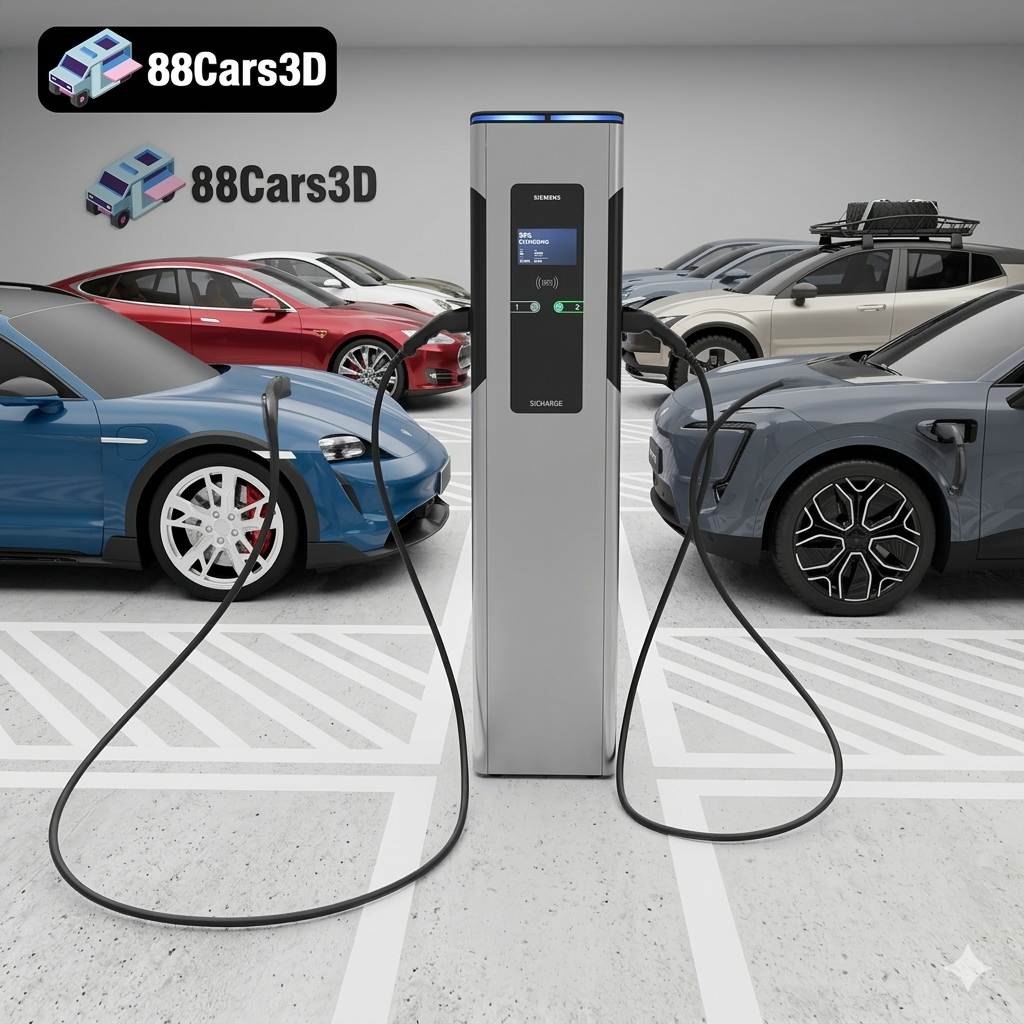
Download the Future of Mobility EV 3D Models Bundle. Includes the Volvo EX30, Tesla Model S, AVATR 11, Porsche Taycan, and a Siemens EV Charger. Save big on this highly optimized 5-in-1 pack for ArchViz and game development!
Price: $89.99

