Get 20% OFF All Premium 3D & STL Models!

The allure of classic automobiles transcends generations, captivating enthusiasts with their unique blend of design, engineering, and history. For 3D artists, game developers, automotive designers, and visualization specialists, bringing these iconic machines into the digital realm presents a fascinating challenge and a rewarding opportunity. A meticulously crafted 3D car model of a vintage vehicle can breathe life into a scene, ground a virtual world in realism, or even become a tangible collectible through 3D printing.
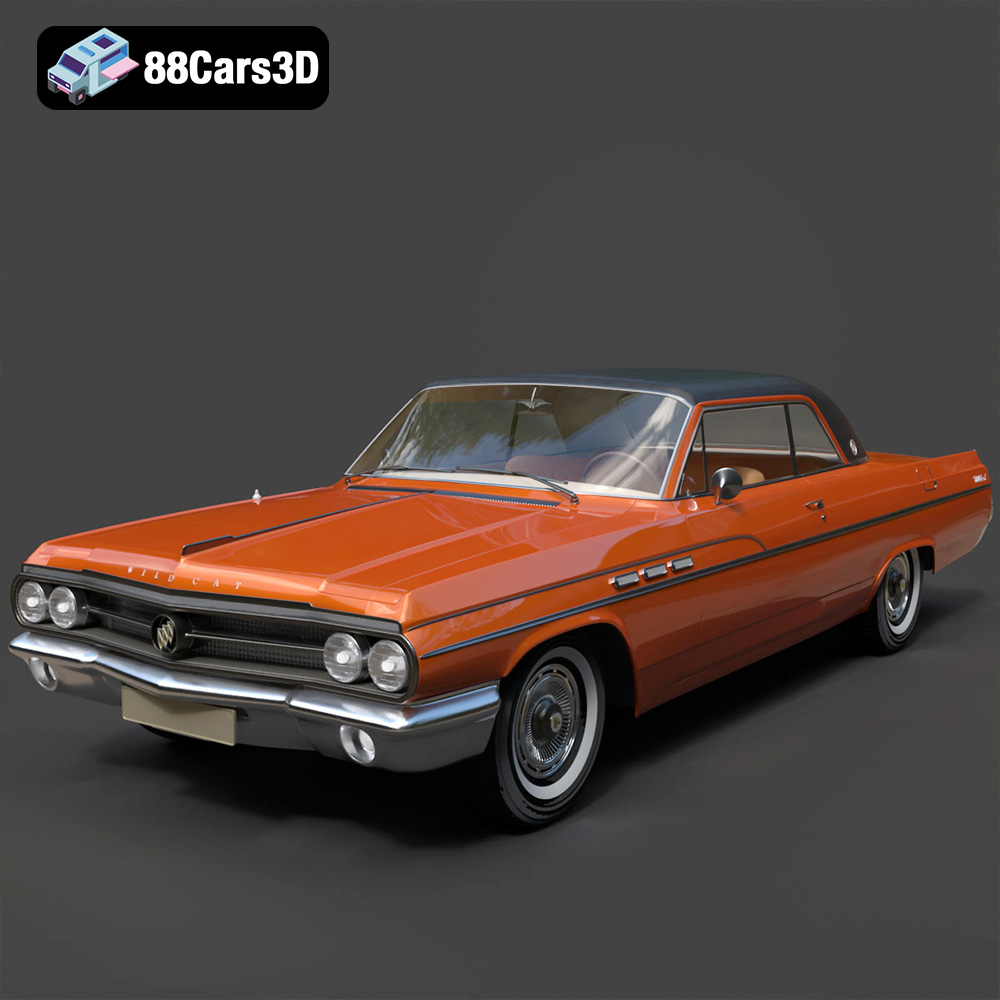
Among the pantheon of American automotive legends, the 1963 Buick Wildcat Convertible stands out with its powerful V8 engine heritage and bold, luxurious styling. This grand tourer represents an era of distinctive design and open-top cruising appeal, making it a prime candidate for digital recreation. Imagine the possibilities: rendering it cruising down a sun-drenched boulevard, integrating it as a detailed game asset in a vintage driving simulator, or even printing a miniature replica for your desk. This is precisely what the Buick Wildcat Convertible 1963 3D Model from 88cars3d.com offers—a high-detail digital asset ready for a multitude of creative and professional applications.
In this comprehensive guide, we’ll delve into the technical intricacies of acquiring and utilizing premium 3D car models, exploring the essential file formats, professional workflows, and specialized applications that elevate digital automotive art to new heights. We’ll specifically highlight how a model of this caliber empowers creators across industries, from high-fidelity automotive rendering to immersive AR/VR experiences and detailed 3D prints.
Choosing the correct file format for your 3D car models is a critical decision that impacts compatibility, feature retention, and overall workflow efficiency. Each format is designed with specific use cases and software ecosystems in mind. The Buick Wildcat Convertible 1963 3D Model comes packaged with a comprehensive array of formats, ensuring maximum flexibility for any project. Let’s explore these essential formats in detail:
The .blend format is native to Blender, a powerful open-source 3D creation suite. When you receive a .blend file, you’re getting a complete Blender scene, often including materials, textures, lighting setups, and even animations. This format is ideal for users deeply integrated into the Blender ecosystem, allowing for immediate modification, retopology, custom rigging, and advanced rendering with Cycles or Eevee. For the Buick Wildcat, this means direct access to the model’s clean topology and material definitions, enabling artists to fine-tune every aspect for bespoke projects without any loss of data during import/export processes.
Autodesk’s .fbx (Filmbox) format is a widely adopted, proprietary file format for 3D content exchange, especially prevalent in game development and animation. It excels at storing hierarchical relationships, skeletal animations, and comprehensive material data. For importing complex 3D car models into game engines like Unreal Engine or Unity, .fbx is often the go-to choice due to its robust support for mesh data, UVs, normals, blend shapes, and often rudimentary material assignments. Its efficiency and widespread compatibility make it indispensable for transferring the Buick Wildcat into a real-time environment where performance and fidelity are paramount.
The .obj (Wavefront OBJ) format is one of the oldest and most universally supported 3D file formats. It’s a simple, human-readable plain-text format that describes the geometry of a 3D model, including vertices, faces, normals, and UV coordinates. While .obj typically doesn’t store animation or complex material definitions (these are usually handled by an accompanying .mtl file for basic materials), its widespread compatibility makes it an excellent choice for cross-software transfers. If you need to import the Buick Wildcat into a less common 3D application or simply require a clean mesh without complex scene data, .obj provides a reliable bridge.
.glb (GL Transmission Format Binary) is the binary version of the glTF format, designed for efficient transmission and loading of 3D scenes and models by applications. It’s quickly becoming the standard for 3D content on the web, in AR/VR applications, and for mobile viewing, largely due to its compact size and comprehensive support for PBR (Physically Based Rendering) materials, animations, and scene hierarchies. The .glb format for the Buick Wildcat makes it perfect for interactive web viewers, immersive AR experiences where you can place the car in your physical space, or light VR showrooms, offering a balance of visual quality and rapid loading.
The .stl (Stereolithography) format is the industry standard for 3D printing. It represents a 3D model as a collection of unconnected triangular facets, defining only the surface geometry without color, texture, or other attributes. For 3D printing the Buick Wildcat, the .stl file ensures that the model’s geometry is manifold (watertight) and ready for slicing software. This format is crucial for manufacturing physical replicas, from small-scale collectibles to larger display pieces, allowing designers to transform digital designs into tangible objects.
.ply (Polygon File Format or Stanford Triangle Format) is another format for storing 3D data, particularly useful for scanned data, point clouds, and mesh data from scientific or engineering applications. It can store a wider range of properties than .stl, including color, transparency, and sometimes even material properties per vertex or face. While not as common for general 3D model exchange as .fbx or .obj, its precision and ability to store complex attribute data make it valuable for specific workflows involving CAD integration, reverse engineering, or detailed mesh analysis of the Buick Wildcat.
While not a standalone file extension in the traditional sense like .fbx or .obj, an “.unreal” asset typically refers to a model that has been meticulously prepared and often pre-imported into an Unreal Engine project. This implies that the model has been optimized, has proper collision meshes, LODs (Levels of Detail), and a PBR material setup within the Unreal Engine environment. For the Buick Wildcat, an “unreal” version means less work for game developers, allowing for immediate integration into an Unreal project with minimal setup, ensuring optimal performance and visual fidelity within the engine’s real-time rendering pipeline.
The .max format is the native file format for Autodesk 3ds Max, a leading software in professional 3D modeling, animation, and rendering. A .max file contains a complete 3ds Max scene, including all geometry, textures, materials, lighting, cameras, and animation data. For users working within 3ds Max, this format provides full editability of the Buick Wildcat Convertible 1963 3D Model, enabling detailed scene construction, advanced material customization, complex animation sequences, and high-quality rendering with engines like V-Ray or Corona. It offers the most control and flexibility for artists leveraging the powerful tools of 3ds Max.
The meticulous process of transforming a classic automobile like the 1963 Buick Wildcat Convertible into a high-fidelity 3D car model requires a deep understanding of automotive design, historical accuracy, and 3D modeling principles. It’s a labor of love that results in a digital asset ready for anything from museum-quality visualizations to interactive simulations.
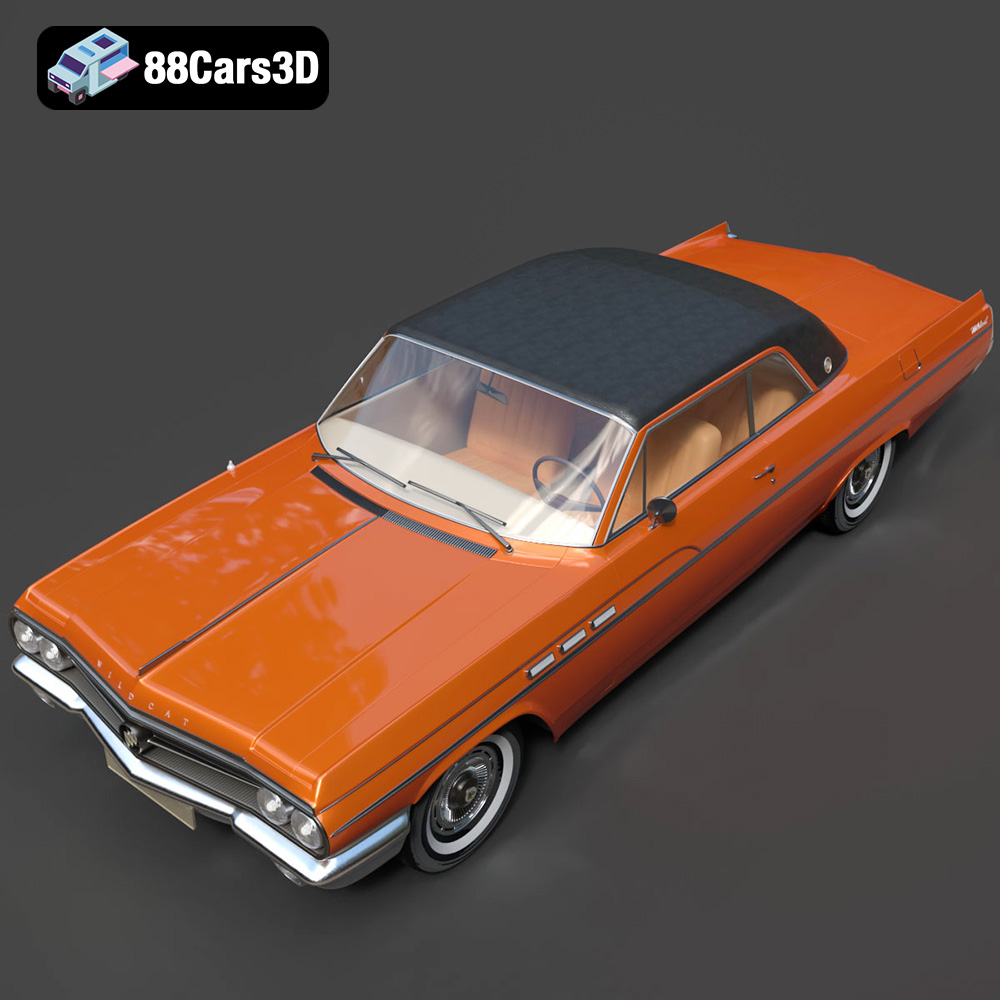
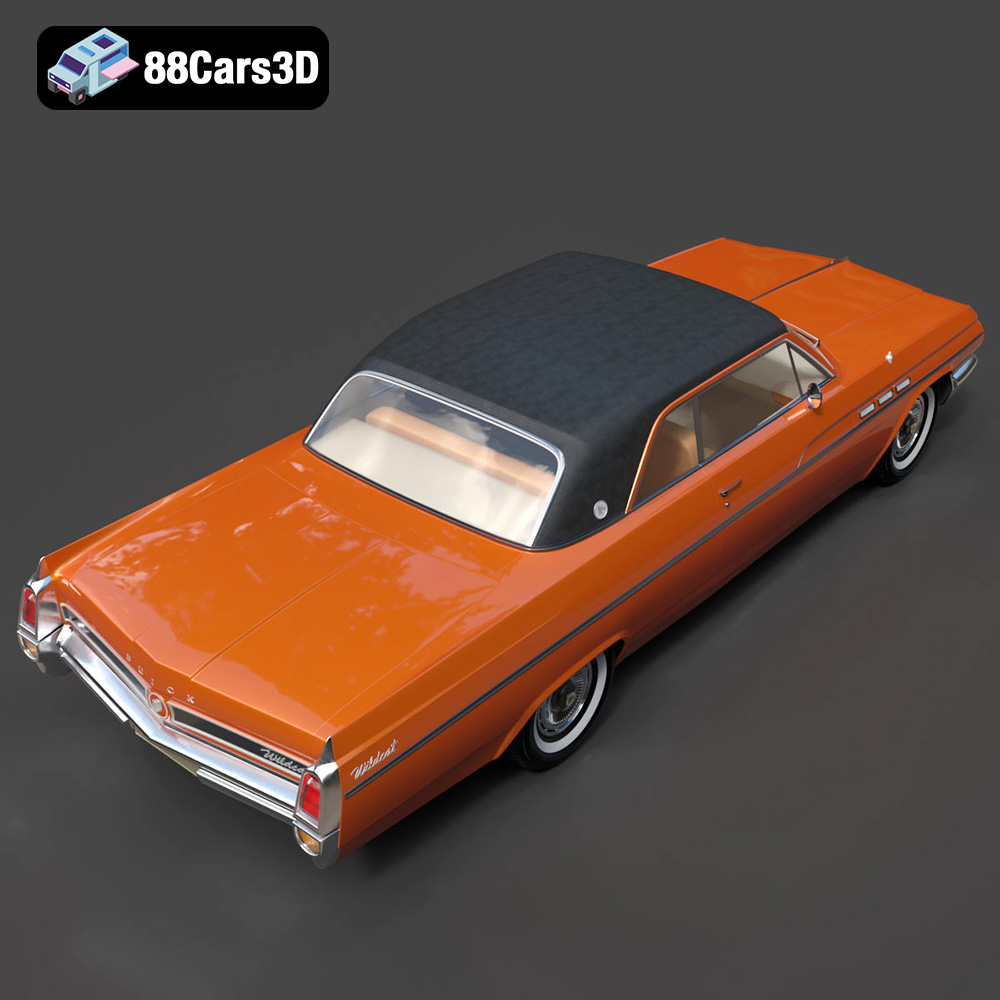
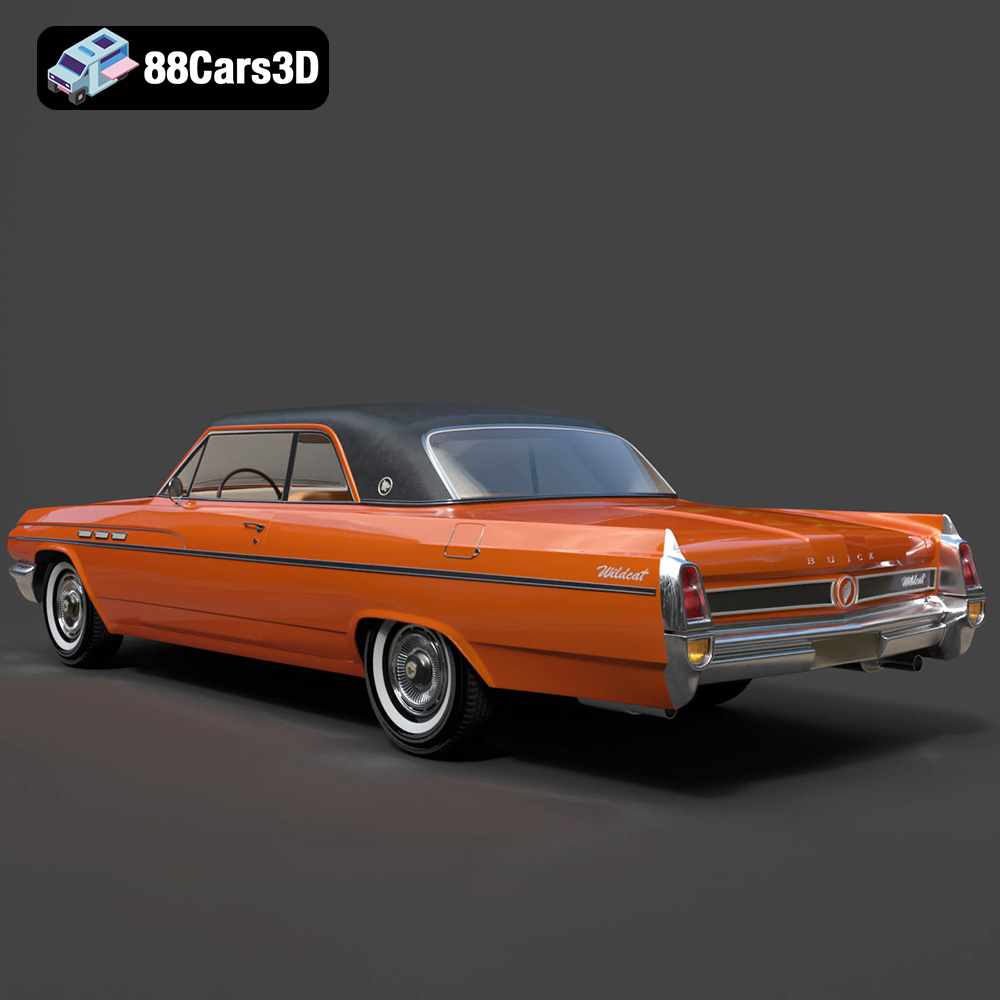
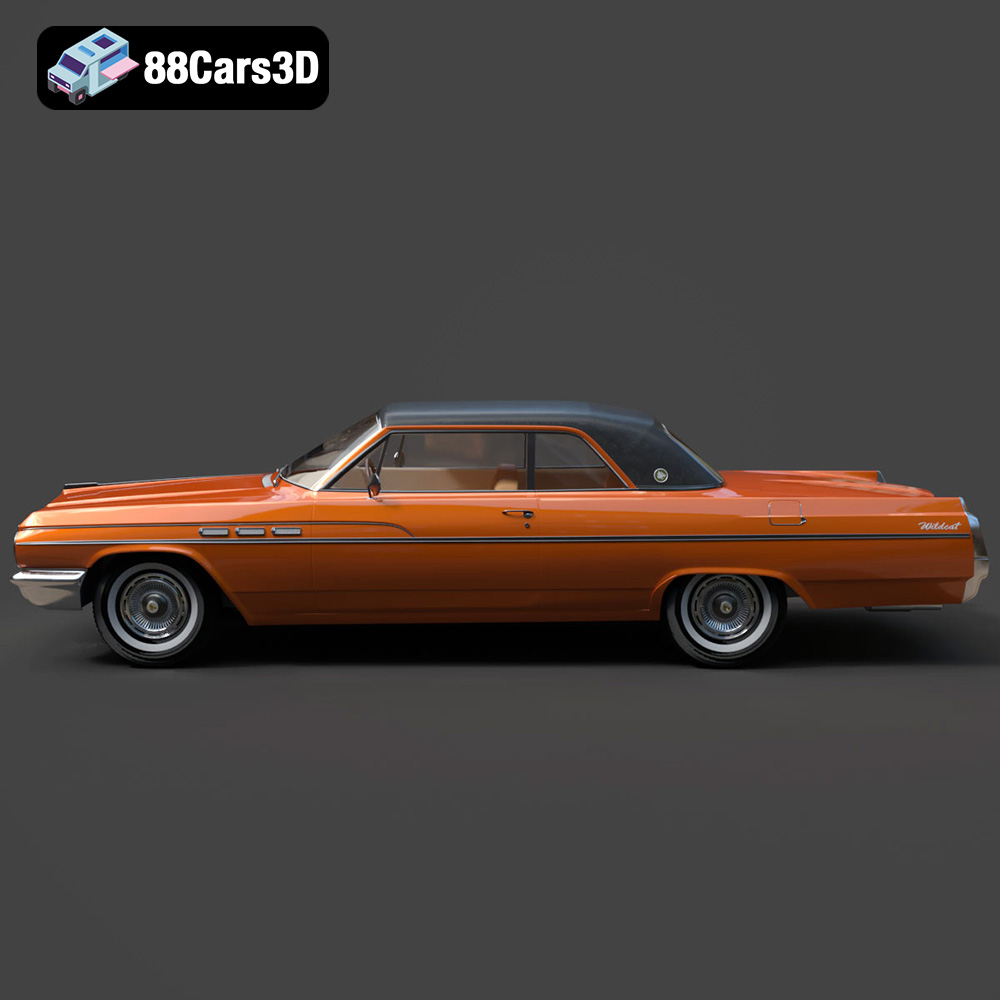
The Buick Wildcat of 1963 is instantly recognizable by its distinctive exterior. The 3D model from 88cars3d.com accurately replicates its long and wide body proportions, which are crucial for conveying its full-size performance character. Details such as the dual headlight front fascia, the intricate chrome grille, and the gleaming chrome front and rear bumpers are meticulously sculpted. The sculpted side lines and emblem detailing reflect the sophistication of early 1960s American automotive design. Furthermore, the model includes a convertible soft-top with ready configurations for both “up” and “down,” offering versatility for diverse scene compositions. Classic chrome wheels with whitewall tire styling complete the period-correct look, while separate wheels and steering components ensure readiness for animation.
A truly comprehensive 3D car model doesn’t stop at the exterior. The interior of the Buick Wildcat Convertible 1963 is also faithfully recreated, offering a vintage dashboard with an analog gauge cluster that evokes the era. The classic steering wheel design, front bench or bucket seat configuration, center console, and gear selector detailing provide a fully realized cockpit. Even the door panels with their chrome trim accents are considered, ensuring that the model holds up to close-up shots and interior renders. This level of detail makes the model suitable for immersive first-person views in virtual reality or intricate cinematic sequences.
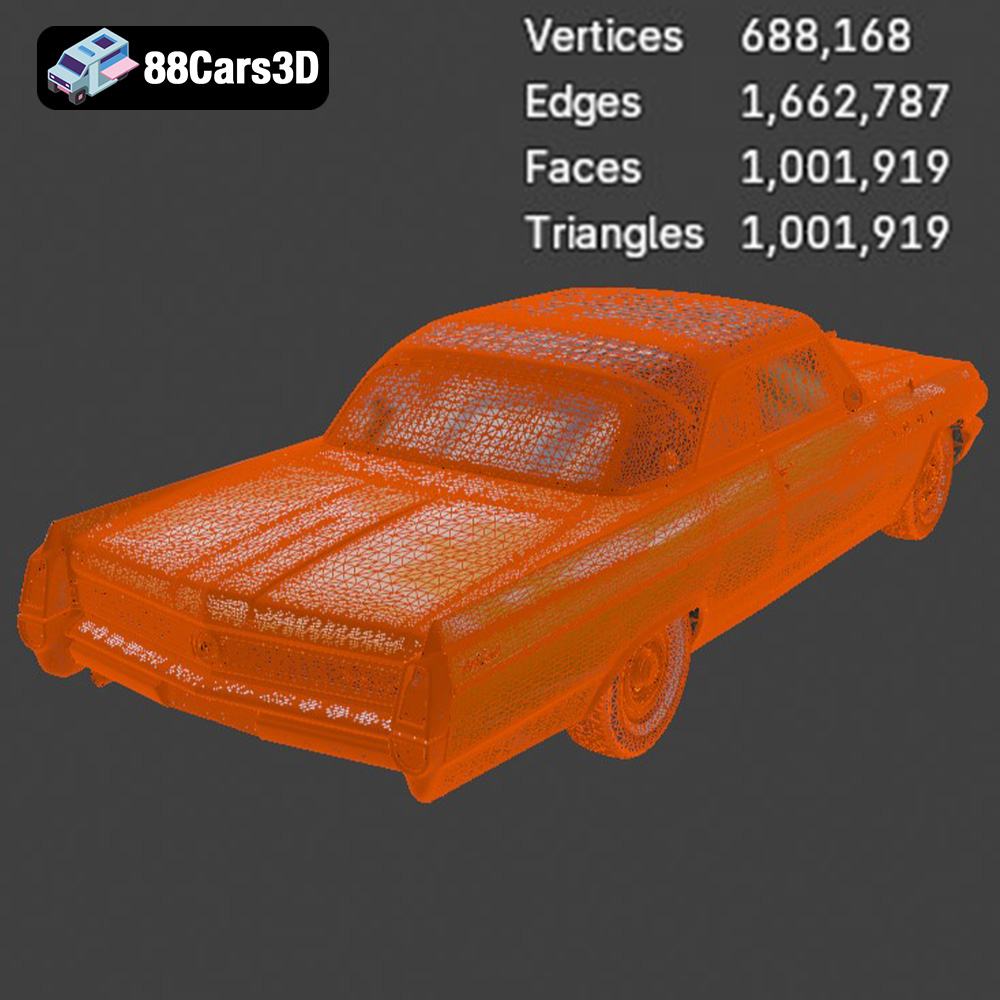
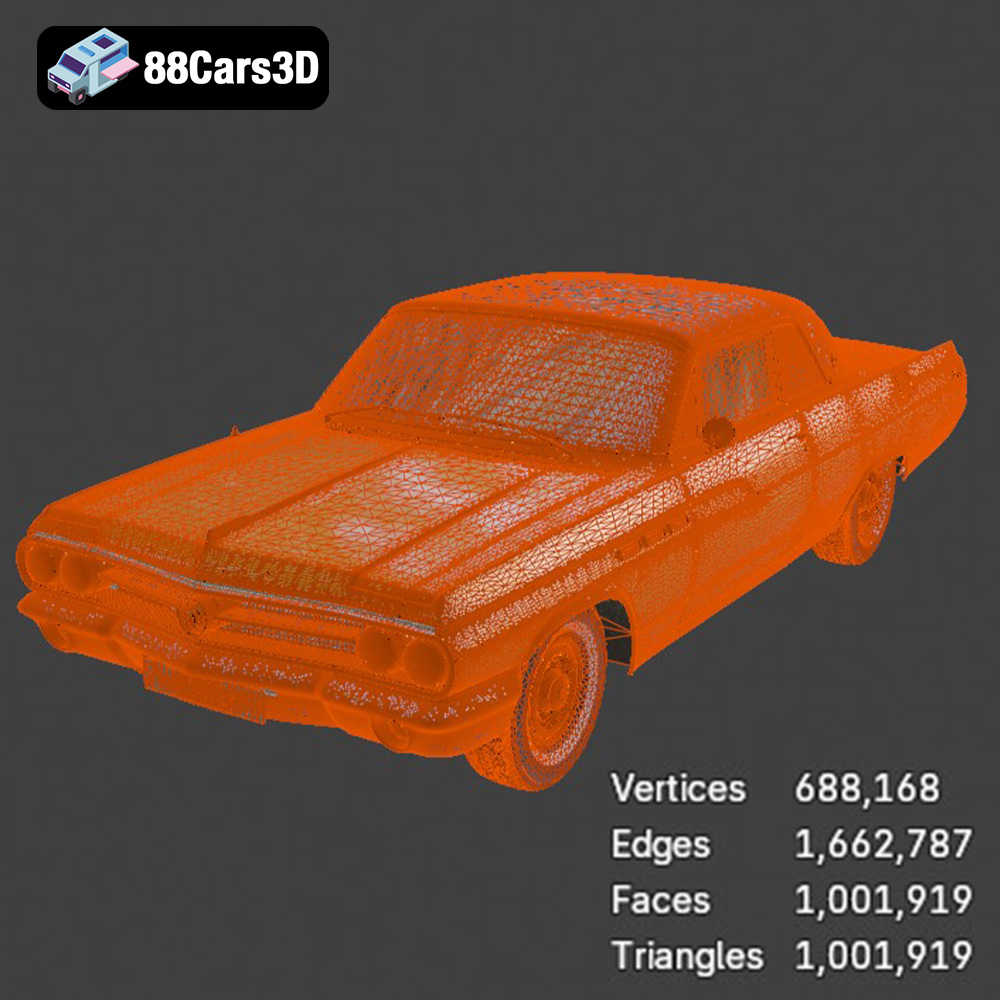
Beyond visual accuracy, the technical underpinnings of a premium 3D car model are paramount. The Buick Wildcat model boasts a clean and well-organized mesh structure, which is vital for smooth deformations during animation and efficient rendering. Real-world scale accuracy ensures that the model integrates seamlessly into scenes with other assets and adheres to realistic physics in simulations. An optimized polygon flow is critical for balancing visual realism with performance, whether for high-quality automotive rendering or as a performant game asset. Additionally, proper pivot setups for steering and wheel rotation are implemented, facilitating easy animation and integration into driving mechanics.
High-quality 3D car models like the Buick Wildcat Convertible 1963 are more than just static objects; they are versatile tools that power diverse professional workflows across multiple industries. Their design enables seamless integration and superior results.
For stunning visual presentations, the Buick Wildcat model provides an excellent foundation for high-fidelity automotive rendering. In software like 3ds Max (with its native .max format) or Blender (with its .blend scene), artists can leverage advanced rendering engines such as V-Ray, Corona, or Cycles. The model’s clean mesh and pre-separated components allow for sophisticated material application, from metallic car paint shaders to realistic chrome and glass. Lighting setups can be tailored to evoke specific moods, whether it’s a golden hour sunset cruise or a studio showroom presentation. Detailed textures for the interior, tires, and other elements enhance realism, making the final renders indistinguishable from photographs. This is ideal for classic car promotions, retro marketing visuals, and automotive heritage projects, where visual impact is key.
The demands of game development require 3D car models that are not only visually appealing but also optimized for real-time performance. The Buick Wildcat, available in .fbx and prepared for Unreal (.unreal), fits perfectly into this pipeline. Game artists can easily import the model into Unreal Engine or Unity, utilizing its clean topology and optimized geometry. Essential steps involve creating appropriate Levels of Detail (LODs) to manage polygon count based on distance from the camera, setting up collision meshes for realistic physics interactions, and implementing PBR materials that respond correctly to dynamic lighting. The separated wheels and steering components are invaluable for rigging and animating the vehicle for driving mechanics, making it suitable for open-world driving games, 1960s-themed environments, and vintage cruising simulations. The quality of the model from 88cars3d.com ensures that it performs efficiently without sacrificing visual integrity.
Immersive technologies like Augmented Reality (AR) and Virtual Reality (VR) open new avenues for experiencing classic cars. The Buick Wildcat Convertible 1963 3D Model, particularly in its .glb format, is ideal for these applications. Developers can create interactive classic car showrooms where users can explore the Wildcat from any angle, open doors, or even customize its paint job in a virtual space. In AR, the model can be placed in real-world environments, allowing users to visualize the classic car in their driveway or garage. Performance optimization is key here, balancing visual quality with the smooth frame rates necessary for a comfortable and engaging immersive experience. This enables interactive historical automotive experiences and next-generation product showcases.
The digital fidelity of the Buick Wildcat Convertible 1963 3D Model extends beyond virtual environments to the tangible world through 3D printing. Transforming a complex digital car into a physical scale model is an exciting prospect, allowing enthusiasts to hold a piece of automotive history in their hands.
For 3D printing, the .stl format is paramount. This format describes the surface geometry of the 3D model using a tessellated mesh of triangles, ensuring that the model is “watertight” or “manifold”—meaning it has a completely closed surface without any holes or intersecting geometry. This is crucial for slicing software, which converts the 3D model into printable layers. The Buick Wildcat model is designed to be convertible to .stl, making it ready for physical production. Users can select recommended scales such as 1:32, 1:24, 1:18, or 1:12, depending on the desired detail and print size. Each scale offers a balance between capturing intricate features and manageability during the printing and post-processing phases.
Achieving a high-quality 3D print requires careful consideration of printer settings. For the Buick Wildcat, a layer height of 0.08–0.16 mm is recommended to capture fine details like chrome trim and body lines. Wall thickness should be between 1.2–2.0 mm to ensure structural integrity without excessive material usage. An infill of 15–25% provides adequate internal support for strength. Supports are typically required for overhangs such as mirrors, bumper overhangs, and the windshield frame, preventing print failures. For best results, the body should be printed angled for a smooth surface finish, while wheels are often printed separately to preserve their circular shape and allow for easier painting and assembly.
After the physical print is complete, post-processing is essential to elevate the 3D printed Buick Wildcat from a raw plastic object to a refined collectible. This typically involves sanding to smooth out layer lines, followed by applying primer to create an even surface for painting. For a truly authentic look, a gloss pastel or metallic paint finish, reminiscent of classic 1960s colors, is highly recommended. Chrome detailing, often achieved with specialized metallic paints or foils, can bring out the gleam of the grille, bumpers, and trim. This meticulous post-processing transforms the 3D printed model into a miniature work of art, perfect for display or as a unique automotive collectible.
One of the most compelling advantages of utilizing a professional 3D car model from 88cars3d.com is the immense creative freedom it offers. The Buick Wildcat Convertible 1963 3D Model is not a rigid asset but a flexible canvas for artistic expression and specific project requirements.
The digital nature of the model allows for extensive customization. Artists can easily change the body color, experimenting with classic 1960s finishes to match a particular era, mood, or client brief. Imagine a vibrant turquoise Wildcat for a beach scene or a sophisticated metallic silver for a classic car show. Beyond color, the model allows for adding whitewall or custom wheel variations, instantly altering its character. The ability to configure the soft-top up or down is invaluable for narrative flexibility, portraying the car ready for a drive or parked elegantly with the top stowed. Small details like adding vintage license plates can further enhance realism and contextualize the vehicle within a specific region or time.
Lighting is a powerful tool in automotive rendering, capable of transforming the perception of a vehicle. With the Buick Wildcat model, artists can adjust lighting to craft specific narratives. A soft, warm sunset cruise lighting scheme can evoke nostalgia and romance, highlighting the car’s curves and chrome with long, dramatic shadows. Conversely, a bright, crisp retro city scene might emphasize the car’s bold lines and reflect the urban environment. Studio lighting setups can be used for clean, product-style renders, focusing on the model’s design and detail. The versatility of the 3D model ensures that it responds beautifully to any lighting environment, allowing artists to tell compelling visual stories and achieve the perfect mood for their scenes.
The world of 3D modeling offers unparalleled opportunities for artists and professionals to recreate, visualize, and interact with iconic designs. The Buick Wildcat Convertible 1963 3D Model exemplifies the pinnacle of high-quality 3D car models, providing an incredibly detailed and versatile asset that caters to a broad spectrum of applications, from cinematic automotive rendering to immersive game development and detailed 3D printing.
Its comprehensive array of included file formats—ranging from fully editable .blend and .max scenes to universally compatible .fbx and .obj, and specialized formats like .glb for AR/VR and .stl for 3D printing—ensures seamless integration into virtually any professional workflow. The meticulous attention to detail, from its iconic exterior and faithful interior to its clean topology and animation-ready components, makes it a truly premium asset. Whether you are crafting retro boulevard scenes, developing a vintage driving simulation, or producing a physical scale model, this Buick Wildcat 3D model delivers the fidelity and flexibility required to bring your creative visions to life.
For those seeking top-tier 3D car models that combine historical accuracy with technical excellence, 88cars3d.com stands as a reliable source. Elevate your projects and explore the endless possibilities that a truly exceptional digital asset, like the Buick Wildcat Convertible 1963 3D Model, can offer.
The Buick Wildcat Convertible 1963 3D Model is a high-detail digital recreation of the classic American full-size performance convertible known for its bold styling, powerful V8 engine heritage, and open-top cruising appeal. The 1963 Wildcat combined luxury comfort with muscle-era presence, making it a standout of early 1960s American automotive design. This 3D model accurately represents the long and wide body proportions, dual headlight front fascia, chrome grille and bumpers, sculpted side lines, convertible soft-top configuration, rear deck detailing, and period-correct wheel design. Built with clean topology and real-world scale accuracy, it is ideal for rendering, animation, automotive visualization, game development, and AR/VR experiences. Perfect for retro boulevard scenes, beach environments, classic car showcases, cinematic productions, and vintage driving simulations.
$29.9
.1960scar
.americanclassic
.arvr
.automotive
.blend
.buick
.car3dmodel
.classiccar
.convertible
.fbx
.gameasset
.glb
.max
.obj
.ply
.rendering
.simulation
.stl
.unreal
.vintagecar
.wildcat1963