Get 50% OFF All Premium 3D & STL Models!

The roar of a finely tuned engine, the screech of tires as they grip the asphalt, the precise ballet of suspension absorbing every bump – achieving truly realistic vehicle physics in a virtual environment is a holy grail for game developers, automotive visualization specialists, and simulation engineers alike. Unreal Engine, with its robust Chaos Physics system, offers an unparalleled toolkit for bringing these intricate dynamics to life. It’s more than just making a car move; it’s about capturing the nuanced feel, weight, and responsiveness that makes a driving experience truly immersive and believable.
From high-octane racing games to sophisticated automotive configurators and immersive VR training simulations, the demand for authentic vehicle behavior is paramount. This comprehensive guide will deep-dive into the technical intricacies of creating realistic vehicle physics in Unreal Engine, leveraging its powerful features to transform static 3D models into dynamic, responsive machines. We’ll cover everything from project setup and advanced tuning parameters to Blueprint scripting, performance optimization, and integrating high-quality assets. By the end, you’ll have a solid understanding of how to craft compelling driving experiences that resonate with realism and precision.
Unreal Engine offers powerful tools for vehicle simulation, and at its core lies the Chaos Physics engine. This system provides a highly customizable and scalable framework for simulating rigid body dynamics, which is perfectly suited for complex vehicles. Before diving into the nitty-gritty of tuning, it’s essential to understand the underlying architecture and how to properly set up your project and assets.
The journey begins by ensuring your Unreal Engine project has the necessary plugins enabled. For vehicle physics, you’ll primarily work with the Chaos Vehicles plugin. This plugin provides the specialized components and classes required to define and control wheeled vehicles. Once enabled, you gain access to the ChaosVehiclePawn and ChaosWheeledVehicleMovementComponent, which are the bedrock of your vehicle’s physics simulation. These components are designed to work seamlessly with skeletal meshes, allowing for accurate visual representation alongside the physics simulation.
Proper asset preparation is crucial. A high-quality 3D car model, such as those available on marketplaces like 88cars3d.com, provides an excellent starting point. These models often come with clean topology, separate meshes for wheels, and are already optimized for real-time rendering. For vehicle physics, your car model typically needs to be a Skeletal Mesh, with the wheels defined as separate bones or skeletal meshes that can rotate independently and interact with the ground through collision shapes. This setup allows the Chaos physics engine to accurately simulate wheel rotation, suspension compression, and tire friction.
For many years, Unreal Engine relied on NVIDIA’s PhysX engine for its physics simulations. However, with Unreal Engine 4.26 and beyond, Epic Games fully transitioned to its in-house Chaos Physics system. This transition brought significant improvements in performance, scalability, and stability, especially for scenarios involving a large number of simulated objects and complex interactions. Chaos Vehicles is built directly on this modern system, offering a more integrated and flexible solution for vehicle dynamics.
The key advantage of Chaos Vehicles lies in its native integration with Unreal Engine’s architecture, allowing for greater control and optimization opportunities. It offers improved determinism, which is crucial for consistent multiplayer experiences and repeatable simulations. While legacy PhysX vehicles might still function in older projects, new development should invariably leverage Chaos Vehicles to take full advantage of Unreal Engine’s latest advancements and ensure long-term compatibility. This also opens doors for more advanced features like destruction and soft body physics, which can eventually integrate with vehicle damage models.
To implement a vehicle using Chaos Vehicles, you’ll primarily interact with a Skeletal Mesh and a Vehicle Blueprint. The Skeletal Mesh represents your vehicle’s visual model and must be set up with a bone hierarchy that includes individual bones for each wheel. These wheel bones are critical as they define the pivot points and rotation axes for the simulated wheels.
Within your Vehicle Blueprint (derived from ChaosVehiclePawn), you’ll add the ChaosWheeledVehicleMovementComponent. This component is where all the magic happens. Here, you’ll define the specific properties for each wheel, including its associated bone name, suspension parameters, tire type, and collision settings. Each wheel requires a precise setup to accurately represent its real-world counterpart. For instance, the wheel radius, width, and offset must closely match the physical dimensions of the car model.
The component also manages the creation of a Physics Asset, which defines the collision geometry for your vehicle. For complex car models, it’s often best to manually create or refine the Physics Asset to ensure optimized and accurate collision boundaries that don’t overly complicate the physics calculations. This involves using simple collision primitives (spheres, capsules, boxes) for the main chassis and individual wheels, ensuring that the collision shapes closely follow the contours of the vehicle without being excessively complex, which could hinder performance.
Once your vehicle’s foundational components are in place, the true art of realistic vehicle physics begins with tuning its properties. This involves meticulously adjusting numerous parameters related to suspension, engine, transmission, and tires. Each setting contributes to how the vehicle feels and behaves, requiring a careful balance to achieve the desired level of realism, whether it’s a heavy-duty truck, a nimble sports car, or an off-road buggy. Understanding the real-world implications of these settings is key to making informed adjustments.
The ChaosWheeledVehicleMovementComponent exposes a comprehensive array of properties, often categorized under Suspension, Engine, Transmission, and Differential. These parameters are not arbitrary numbers; they directly correspond to mechanical characteristics of a real vehicle. For instance, suspension stiffness is measured in Newtons per meter (N/m), and engine torque is in Newton-meters (Nm). This adherence to real-world units makes it easier to reference actual vehicle specifications when aiming for hyper-realism.
Iterative testing is vital in this phase. Make small adjustments to one or two parameters at a time, then test the vehicle in various scenarios (straight acceleration, cornering, braking, over bumps) to observe the impact. A common mistake is to adjust too many variables simultaneously, making it difficult to pinpoint the source of an undesirable behavior. Professional developers often use a debug overlay to visualize wheel forces, suspension compression, and tire slip, which provides invaluable feedback during the tuning process. For a deeper dive into the technical details of these parameters, the official Unreal Engine documentation on Chaos Vehicles is an excellent resource.
The suspension system is arguably the most critical component for a vehicle’s feel. It dictates how the car handles bumps, transfers weight during cornering and braking, and ultimately, how comfortable or sporty the ride is. Key parameters include:
Balancing these values is crucial. A well-tuned suspension will allow the car to absorb bumps gracefully, maintain tire contact with the ground, and transfer weight predictably during dynamic maneuvers, providing excellent feedback to the driver.
The powertrain dictates the vehicle’s acceleration, top speed, and power delivery characteristics:
Tuning the powertrain involves understanding how these components work together. For instance, a high final drive ratio will provide strong acceleration but reduce top speed, while a low ratio will do the opposite. The engine’s torque curve dictates the powerband, influencing when the driver needs to shift gears for optimal performance.
Tires are the only contact point between the vehicle and the ground, making their simulation critical for realistic handling. The Chaos Vehicles system uses a highly configurable tire model:
Accurate tire tuning involves creating realistic friction curves that account for both longitudinal (acceleration/braking) and lateral (cornering) forces. Factors like tire pressure, temperature, and wear can also be simulated with more advanced systems, adding another layer of realism. A common challenge is making tires feel “grippy” enough without making the car feel like it’s on rails, and allowing for predictable sliding and recovery when pushed to the limit.
While the Chaos Vehicles component handles the core physics simulation, Unreal Engine’s visual scripting system, Blueprints, is essential for bringing your vehicle to life with interactive controls, custom logic, and gameplay features. Blueprints allow you to connect player input to the vehicle’s movement, implement advanced driving aids, and create dynamic interactions that go beyond simple physics. This is where the vehicle transitions from a physics simulation to a truly interactive experience.
A well-structured Blueprint is key to managing complexity. Typically, you’ll have a main Vehicle Blueprint that inherits from ChaosVehiclePawn, containing the visual mesh, the movement component, and all the custom logic. Event graphs will handle input, update various vehicle states, and trigger visual or audio effects. Functions and macros can encapsulate reusable logic, keeping the graph clean and manageable. For example, a function might handle all the gear-shifting logic, while another might calculate dynamic downforce based on speed.
Blueprints also provide an excellent way to debug and visualize vehicle parameters in real-time. By connecting debug print strings or custom HUD elements to various properties of the ChaosWheeledVehicleMovementComponent (like current gear, engine RPM, wheel slip values, suspension compression), you can gain immediate insight into the physics simulation, which is invaluable during the tuning process. This immediate feedback loop significantly accelerates development and helps identify issues quickly.
The first step in making a vehicle controllable is setting up input mapping. In Unreal Engine, this is typically done through the Project Settings, defining actions (like “Accelerate,” “Brake,” “Steer Right,” “Steer Left”) and mapping them to keyboard keys, gamepad buttons, or even custom input devices. Once defined, these inputs can be accessed directly within your Vehicle Blueprint’s Event Graph.
Common Blueprint nodes for vehicle control include:
SetThrottleInput: Takes a float value (0.0 to 1.0) to control acceleration.SetBrakeInput: Takes a float value (0.0 to 1.0) to control braking.SetSteeringInput: Takes a float value (-1.0 to 1.0) for steering, where -1.0 is full left and 1.0 is full right.SetHandbrakeInput: For engaging the handbrake.You’ll typically connect these nodes to the output of your input actions. For example, an “Accelerate” input action could drive the throttle input, and an “Axis Mapping” for “Steering” could drive the steering input, ensuring smooth, analog control. You might also implement a simple “Toggle Handbrake” action that sets the handbrake input to 1.0 or 0.0 depending on its current state.
Blueprints allow for the creation of sophisticated custom logic that goes beyond basic control. This could include:
These systems enhance both the realism and the gameplay experience, giving the developer precise control over how the vehicle behaves in response to various conditions and player actions.
Beyond core control, Blueprints are invaluable for implementing driver aids and gameplay-specific features:
These features elevate the realism and playability of the vehicle, offering a rich interactive experience. They often involve complex mathematical calculations and careful state management within Blueprints to ensure smooth and predictable behavior.
Realistic physics is only half the equation; the visual representation must match the underlying simulation to create a truly immersive experience. A meticulously tuned vehicle that looks bland or lifeless will break immersion. Unreal Engine offers a suite of powerful rendering features that, when combined with high-quality 3D car models, can elevate the visual fidelity to photorealistic levels. This synergy between physics and graphics is what truly sells the illusion of reality.
From stunning PBR materials that accurately react to light to dynamic visual effects that convey speed and interaction with the environment, every detail contributes. The goal is to make the player feel the weight and power of the vehicle, not just through its physics, but also through its visual presence. This involves careful integration of advanced rendering techniques like Lumen for global illumination, Nanite for high-fidelity geometry, and Niagara for dynamic particle effects.
The quality of your initial 3D car model is paramount here. Starting with a model that has clean topology, proper UV mapping, and prepared material slots dramatically streamlines the visualization pipeline. Marketplaces like 88cars3d.com specialize in providing such production-ready assets, reducing the time and effort required to achieve stunning visuals.
When sourcing automotive assets, platforms like 88cars3d.com offer 3D car models specifically designed for Unreal Engine projects, featuring optimized meshes, PBR textures, and often, pre-configured material instances. Integrating these models involves:
By starting with such assets, artists and developers can focus more on lighting, effects, and interaction rather than struggling with basic asset preparation.
Dynamic visual effects bring the vehicle to life and provide crucial feedback to the player. Unreal Engine’s Niagara particle system is the go-to solution for creating these effects:
These effects should be synchronized with the physics simulation. For example, a high wheel slip ratio should trigger more intense smoke effects, visually reinforcing the vehicle’s behavior.
A well-designed camera system is crucial for immersive driving. The camera needs to convey speed, emphasize vehicle movement, and provide a clear view of the action:
Blueprints are excellent for managing these dynamic camera behaviors, allowing you to switch between camera views, adjust their properties, and trigger effects based on gameplay events.
Achieving realistic vehicle physics in real-time, especially in complex environments or for specific target platforms like AR/VR, demands meticulous performance optimization. Physics simulations are computationally intensive, and a poorly optimized vehicle can quickly bottleneck your project’s frame rate. Balancing visual fidelity with performance is a constant challenge, but Unreal Engine provides numerous tools and best practices to achieve this equilibrium.
Optimization is not an afterthought; it should be considered from the very beginning of development. Every component, from the number of bones in your skeletal mesh to the complexity of your Physics Asset and the frequency of Blueprint updates, can impact performance. Profiling your project regularly using tools like the Unreal Insights or the Stat commands (e.g., Stat Physics, Stat UnitGraph) is crucial for identifying bottlenecks and understanding where CPU or GPU resources are being consumed. A disciplined approach to asset optimization and code efficiency is key to maintaining a smooth, high-fidelity experience.
If your project involves multiplayer, accurately replicating vehicle physics across a network is a complex challenge. Physics simulations are inherently non-deterministic, meaning they can drift out of sync between clients if not handled carefully. Unreal Engine provides specific mechanisms for network replication of vehicles:
Mastering networked physics requires a deep understanding of Unreal Engine’s replication system and careful tuning to balance responsiveness with consistency.
Effective optimization relies on robust profiling and debugging. Unreal Engine offers several tools:
Stat UnitGraph, Stat Engine, Stat Physics, and Stat Render provide real-time performance metrics for different parts of the engine. Stat Physics is particularly useful for identifying the cost of physics calculations.p.DebugDrawPhysics 1 to visualize collision shapes, or p.Chaos.DebugDraw.Enabled 1 for more detailed Chaos physics visualizations. This helps verify that your Physics Asset is correctly defined and that collisions are occurring as expected.Regular profiling at different stages of development helps catch performance regressions early and ensures the final product runs smoothly across target hardware.
The power of Unreal Engine’s vehicle physics extends far beyond traditional racing games. Its capabilities are increasingly leveraged in high-fidelity simulation, interactive experiences, and virtual production workflows. By combining realistic vehicle dynamics with advanced rendering and interactivity, developers can create truly groundbreaking applications for various industries. This section explores some of these cutting-edge uses and additional considerations for advanced scenarios.
The flexibility of Unreal Engine allows for deep customization, enabling developers to build highly specific behaviors and integrate external data. This could involve linking vehicle physics to external hardware controllers, simulating vehicle damage with procedural destruction, or integrating real-world telematics data for hyper-realistic training simulators. The emphasis shifts from simply making a car drive to simulating complex systems and interactions within a broader context.
Furthermore, the integration of vehicle physics with Unreal Engine’s virtual production toolkit, like Sequencer, opens up new avenues for cinematic content creation, where vehicles move and interact with environments in a physically accurate manner, enhancing the visual storytelling and realism of digital scenes. This holistic approach ensures that every aspect of the vehicle, from its internal mechanics to its external appearance and interactive behavior, contributes to a cohesive and believable experience.
Realistic vehicle physics is a cornerstone of modern automotive configurators and AR/VR applications. In a configurator, users can customize a vehicle in real-time – changing paint colors, wheel designs, interior trim, and even engine options. Integrating physics allows these configurations to be experienced dynamically:
These applications provide powerful marketing tools and training simulations, allowing users to interact with vehicles in ways that mimic real-world experiences.
Unreal Engine’s Sequencer, its powerful non-linear cinematic editor, can harness the realistic vehicle physics for stunning animated content. Instead of keyframing every movement, you can drive your vehicle in real-time or simulate physics-driven events and record them directly into Sequencer:
This workflow significantly speeds up cinematic content creation, allowing artists to focus on artistic direction rather than tedious manual animation of complex mechanical systems.
While the Chaos Vehicles component provides a robust baseline, advanced projects might require even deeper control over vehicle dynamics:
These advanced techniques push the boundaries of realism, transforming Unreal Engine into a sophisticated platform for research, development, and high-fidelity training.
Creating realistic vehicle physics in Unreal Engine is a multifaceted endeavor, blending the precision of engineering with the artistry of game development. It demands a thorough understanding of the Chaos Physics system, meticulous tuning of countless parameters, and the strategic application of Unreal Engine’s powerful rendering and scripting tools. From setting up the skeletal mesh and configuring the Chaos Vehicles component to crafting intricate Blueprint logic for control and driver aids, every step contributes to the authenticity of the driving experience.
We’ve explored the importance of starting with high-quality assets, like the optimized 3D car models available on 88cars3d.com, and how to integrate them seamlessly. We’ve delved into the nuances of suspension, engine, transmission, and tire tuning, highlighting the iterative nature of achieving believable dynamics. Furthermore, we’ve covered critical aspects of visual fidelity through advanced materials and particle effects, and the indispensable role of performance optimization for real-time applications, particularly in demanding scenarios like AR/VR.
Whether you’re developing a racing simulator, an automotive configurator, or a virtual production scene, mastering vehicle physics in Unreal Engine will empower you to deliver unparalleled realism and immersion. The journey is one of continuous learning and refinement, but with the tools and techniques outlined here, you have a robust foundation to build truly exceptional interactive vehicle experiences. So, fire up Unreal Engine, grab your favorite car model, and start creating virtual drives that feel undeniably real.

Texture: Yes | Material: Yes | 3D Printable: Yes. Download the Italian Thoroughbreds Bundle featuring 5 iconic 3D models: Lamborghini Huracán Performante, Ferrari 458 Italia, Lamborghini Urus, Diablo SV, and Maserati GT. Optimized for 4K rendering and 3D printing (STL included). Save 50% with this ultimate Italian vehicle collection.
Price: $199.99

Download the Elite Future Mobility Bundle featuring 4 highly optimized 3D models: Tesla Model S, Avatr 11, Li L9, and Zoox Robotaxi. Perfect for ArchViz, Smart City renders, and game dev. Optimized for Unreal Engine and Blender. Includes .fbx, .obj, and .max formats.
Price: $99

🚗 5 Iconic German Cars (BMW M4 G82, M5 CS, X3, 1 Series & Mercedes E-Class). ✅ Optimized for ArchViz: Ready for Corona & V-Ray. 💰 Save €71 with this limited-time collection! 🚀 Instant Download after purchase.
Price: $119

Download the Extreme Off-Road & Survival 3D Models Bundle! Includes the Brabus 800 Adventure, Dodge Ram Bigfoot, Spec Truck, and a Caravan. Save over €210 on this premium 4-in-1 off-grid vehicle pack for ArchViz and game development.
Price: $149.99

Download the Heavy Duty & Commercial Logistics 3D Models Bundle! Includes the Ford Sterling, Caterpillar CT680, Mercedes Citaro Bus, and Vito Van. Save over €130 on this massive, game-ready 4-in-1 industrial vehicle pack.
Price: $109.99

Download the Ultimate Custom Motorcycles 3D Models Bundle. Includes a Custom Chopper, Ducati 916 Café Fighter, Harley XR1200X, and BMW K100. Perfect premium props for luxury ArchViz garages. Save over €250 today!
Price: $159.99

Download the ultimate JDM Street Racing 3D Models Bundle! Includes the Nissan GT-R, Toyota Supra, Mazda RX-7, Lancer Evo IX, and Honda NSX. Save big on this highly optimized, game-ready 5-in-1 Japanese legend car pack.
Price: $129.99

Download the ultimate American Muscle & Cinematic Classics 3D Models Bundle! Includes the Dodge Charger ’68, Mustang Eleanor GT500, Camaro Z28 ’79, and a custom ’69 Mustang. Save over €240 on this game-ready, premium 4-in-1 pack.
Price: $149.99

Download the Everyday City Traffic 3D Models Bundle. Includes the VW Golf, Kia Picanto, Hyundai Tucson, Toyota Yaris, and a DHL Ford Transit Van. Save big on this 5-in-1 pack, perfectly optimized for realistic ArchViz streets and game traffic.
Price: $99.99
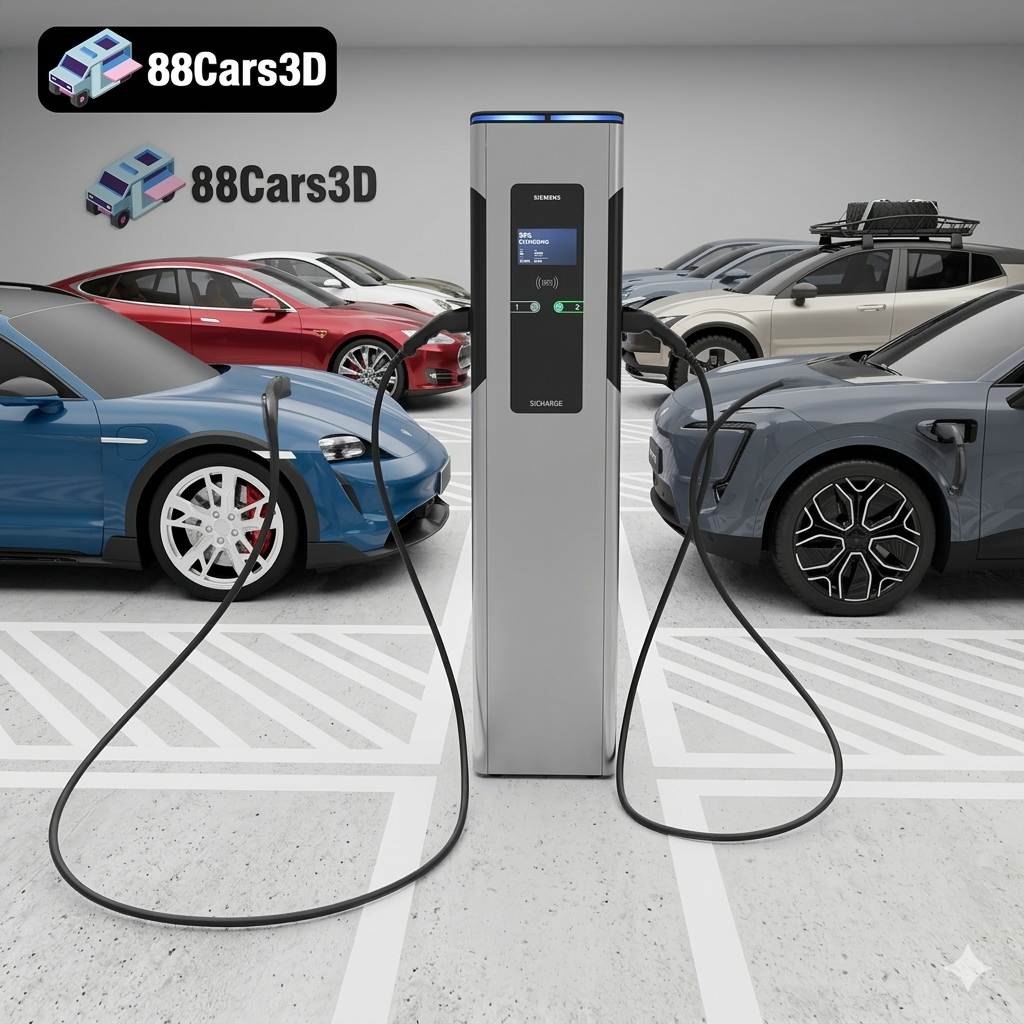
Download the Future of Mobility EV 3D Models Bundle. Includes the Volvo EX30, Tesla Model S, AVATR 11, Porsche Taycan, and a Siemens EV Charger. Save big on this highly optimized 5-in-1 pack for ArchViz and game development!
Price: $89.99

