Get 50% OFF All Premium 3D & STL Models!

The mobile gaming industry is a powerhouse, continually pushing the boundaries of what’s possible on handheld devices. From casual racers to immersive open-world experiences, the demand for high-quality visuals on limited hardware presents a unique challenge for 3D artists and game developers. Creating captivating 3D car models for these environments isn’t just about making them look good; it’s about making them perform flawlessly. This comprehensive guide will take you on a deep dive into the intricate world of low-poly automotive asset creation, revealing the technical workflows, optimization strategies, and artistic considerations essential for bringing stunning vehicles to life within the constraints of mobile platforms. You’ll learn about efficient topology, strategic UV mapping, PBR material creation, game engine integration, and advanced optimization techniques that will ensure your mobile game cars not only look fantastic but also run smoothly.
At the heart of any successful game asset lies meticulously crafted topology. For mobile game cars, this is doubly true, as every polygon counts. Efficient topology isn’t just about reducing polygon count; it’s about distributing polygons intelligently to maintain the car’s distinctive shape, facilitate smooth shading, and optimize performance. A well-constructed low-poly car model can convey significant detail with a surprisingly small number of triangles, primarily through the clever use of normal maps and careful edge flow.
Polygon budgeting is the first critical step. For a hero car in a mobile racing game, you might aim for a total triangle count between 5,000 and 20,000, including wheels and interior elements visible from the outside. Background or less important vehicles would fall into a much lower range, perhaps 1,000-5,000 triangles. The key is to prioritize where polygons are spent. Focus on the main contours, fender flares, door lines, and areas where the silhouette changes dramatically. Flat surfaces, on the other hand, require minimal polygon density.
Clean edge flow is paramount for achieving smooth shading and realistic reflections. Even with a low polygon count, edges should follow the natural curves and creases of the car body. This prevents pinching and allows the normal map to interpret details more effectively. When modeling, it’s generally best to work with quads (four-sided polygons) as they are easier to manipulate and subdivide, though the final export to a game engine will convert everything to triangles. Ensure your quads are as evenly sized as possible to avoid distortion during texturing and deformation. Avoid stretching polygons excessively.
The art of low-poly modeling involves knowing where to “cheat” and where to retain fidelity. Prioritize the car’s unique silhouette above all else. A recognizable car, even with simplified details, will always look better than a highly detailed but oddly shaped one. Use polygons to define the core shape of the car: the hood, roof, trunk, and wheel arches. Details like door handles, grilles, and emblems can often be represented primarily by normal maps baked from a high-poly sculpt. This technique allows for the illusion of complex geometry without the performance cost.
When considering details, think about their visibility and impact. A subtle curve on a fender might be more important than intricate headlight internals that are rarely seen up close. Iteratively refine your model, stepping back frequently to view it from different angles and distances, just as it would appear in a game. This helps ensure that the essential character of the vehicle is preserved.
Even experienced artists can fall prey to common modeling issues. N-gons (polygons with more than four sides) should be avoided, as they can lead to unpredictable triangulation and shading artifacts in game engines. Non-manifold geometry, where edges or vertices are shared by more than two faces, can cause issues with rendering, physics, and even UV mapping. Overlapping vertices, where multiple vertices occupy the same space, are another common problem that can be cleaned up by merging vertices within a small threshold.
To address these, regularly use your 3D software’s clean-up tools (e.g., Blender’s “Clean Up” menu, 3ds Max’s “XForm” or “STL Check” utilities, Maya’s “Mesh > Clean Up”). For drastic polygon reduction, manual retopology is often preferred over automatic decimation tools, which can create messy, unoptimized meshes. Manual retopology allows precise control over edge flow and polygon distribution, ensuring the mesh remains clean and game-ready.
UV mapping is the unsung hero of 3D asset creation, especially for mobile games. It’s the process of unfolding your 3D model’s surface into a 2D space, allowing textures to be applied accurately. For low-poly car models, efficient UV layout is critical for maximizing texture quality, reducing memory footprint, and minimizing draw calls in the game engine.
The goal of efficient UV mapping is to minimize seams, prevent texture distortion, and achieve uniform texel density. Texel density refers to the number of pixels per unit of 3D space. Maintaining a consistent texel density across your model ensures that textures appear equally sharp everywhere. For car models, it’s common to have a primary UV set that covers the entire exterior body, often split into logical pieces like the hood, roof, doors, and fenders.
When creating UV islands, try to make them as large as possible and pack them tightly into the 0-1 UV space without overlapping (unless intentional for repeated elements). Overlapping UVs for symmetrical or identical parts (e.g., left and right doors, all four wheels) is a powerful optimization technique. If these parts use the same texture area, you effectively halve the texture memory required for those elements. This is a crucial strategy for mobile. Minimize seams by placing them in less visible areas, such as along natural breaks in the geometry or underneath the car.
Most game engines support multiple UV channels. The first channel (UV0 or Channel 1) is typically used for your main PBR textures (Base Color, Normal, Roughness, Metallic, AO). A secondary UV channel (UV1 or Channel 2) is often reserved for lightmaps or ambient occlusion maps that are baked into the scene. Using a separate UV channel for lightmaps prevents conflicts with your main textures and allows for optimized lighting solutions.
UDIMs (U-Dimension) are an advanced UV mapping technique that allows artists to use multiple UV tiles (multiple 0-1 UV spaces) for a single model. While incredibly useful for ultra-high-resolution assets in film or cinematic renders, UDIMs introduce additional texture calls and memory overhead, making them generally less suitable for strict low-poly mobile game environments. For mobile, stick to a single 0-1 UV space as much as possible, leveraging texture atlases instead.
Each 3D software offers robust tools for UV mapping. In Blender 4.4, the UV Editor provides a comprehensive suite of features. You mark seams on your 3D model (Edge > Mark Seam) to define where the model will be cut for unwrapping. Then, in Edit Mode, select the faces you want to unwrap and use `U` > `Unwrap`. For automatic unwrapping, `Smart UV Project` can be a quick starting point, especially for less organic shapes, but `Lightmap Pack` (U > Lightmap Pack) can be excellent for arranging islands efficiently for baked lighting. For detailed information on Blender’s UV editing capabilities, you can consult the official Blender 4.4 documentation.
3ds Max users rely on the `Unwrap UVW` modifier, a powerful tool with various projection methods (planar, cylindrical, spherical, box) and a dedicated UV editor for manipulating islands, stitching seams, and packing. Maya’s `UV Toolkit` (found in the Modeling menu set) offers similar functionalities, including intuitive tools for cutting, sewing, and arranging UV shells, along with various automatic unwrapping options. Mastering these tools is crucial for creating clean, optimized UV layouts.
Physically Based Rendering (PBR) has revolutionized how materials are represented in 3D, creating incredibly realistic surfaces. Even for low-poly mobile game cars, adhering to PBR principles is essential to achieve believable visuals. The challenge lies in doing so efficiently, balancing visual fidelity with performance constraints.
PBR works by simulating how light interacts with real-world materials. The core maps for PBR are:
* **Base Color (Albedo):** Defines the diffuse color of the surface. For car paint, this would be the main color.
* **Normal Map:** Adds surface detail and bumps without adding geometry. This is crucial for low-poly models, baking high-poly details onto the low-poly mesh.
* **Roughness Map:** Controls how rough or smooth a surface is, influencing the spread of reflections. Glossy surfaces have low roughness, matte surfaces have high roughness.
* **Metallic Map:** Determines if a surface is metallic or dielectric (non-metallic). This is a grayscale map, where white is metallic and black is non-metallic.
* **Ambient Occlusion (AO) Map:** Simulates soft shadows where surfaces are close together, adding depth.
For mobile, texture resolution is a significant consideration. While PC games might use 4K or 8K textures, mobile titles typically aim for 1024×1024 or 2048×2048 for the main car body, and 512×512 or 256×256 for smaller, less prominent parts like wheels or interior elements. Remember to compress your textures (e.g., using ETC2 for Android, PVRTC for iOS, or ASTC for both) in the game engine to save memory. Using grayscale maps for Metallic and Roughness is a common optimization, as they can be stored in a single channel, saving memory compared to full RGB maps.
The workflow for PBR texturing often involves a combination of baking and painting. Software like Adobe Substance Painter is a staple for this process. First, you’ll bake essential maps (Normal, AO, Curvature, World Space Normals, Thickness) from your high-poly model onto your low-poly mesh. This process transfers all the fine details from your high-resolution sculpt onto your optimized low-poly model, which is then rendered using the normal map.
Once baked, you can use Substance Painter’s powerful layering system to build up your materials. Apply base layers for car paint, then add effects like scratches, dirt, rust, and decals using masks and smart materials. Substance Painter’s procedural generators are excellent for creating realistic wear and tear. When finished, export your texture sets, ensuring they are configured for your target game engine (e.g., Unity’s HDRP/URP PBR Metallic, Unreal Engine’s Packed maps). For less complex textures or manual adjustments, Adobe Photoshop remains an indispensable tool for hand-painting details, refining maps, and creating custom decals.
One of the most effective ways to optimize PBR materials for mobile is to minimize the number of unique materials and shaders. Each unique material or shader typically results in a “draw call,” which is a command sent from the CPU to the GPU. Too many draw calls can quickly bottleneck performance on mobile devices.
To reduce draw calls:
* **Texture Atlasing:** Combine multiple smaller textures (e.g., textures for headlights, taillights, side mirrors) into a single larger texture sheet. This allows one material to cover multiple parts of the car, reducing draw calls.
* **Minimize Unique Materials:** Try to use a single material for the entire car body if possible, even if it uses different texture regions. For variations, consider material instances that reference a base material but allow parameter changes (color, roughness) without creating a new shader.
* **Mobile-Friendly Shaders:** Utilize the optimized shaders provided by your game engine (e.g., Unity’s Universal Render Pipeline (URP) or High Definition Render Pipeline (HDRP) shaders, Unreal Engine’s Mobile Shaders). These are specifically designed for performance on mobile hardware.
Bringing your meticulously crafted low-poly car model into a game engine like Unity or Unreal Engine is where the rubber meets the road. Even the most optimized model can perform poorly if not integrated correctly with the engine’s features. This section focuses on engine-specific strategies to ensure your car models not only look great but also contribute positively to overall game performance.
Level of Detail (LOD) is a crucial optimization technique that replaces higher-polygon models with lower-polygon versions as the camera moves further away. For car models, you typically create 3-4 LOD levels:
* **LOD0 (Hero Model):** The highest detail version, seen up close (e.g., 15,000 triangles).
* **LOD1:** A simplified version, seen at a medium distance (e.g., 5,000-8,000 triangles). Details like interior or very fine grilles might be removed or simplified.
* **LOD2:** A highly simplified version for longer distances (e.g., 1,000-2,000 triangles). Most small details are gone, relying heavily on the normal map and overall silhouette.
* **LOD3 (Shadow/Billboard):** The lowest detail, often a simple proxy or even a 2D billboard for extreme distances or just for casting shadows (e.g., 100-500 triangles).
Both Unity and Unreal Engine provide robust LOD systems. In Unity, you use the `LOD Group` component, which automatically switches between meshes based on screen percentage. Unreal Engine has a similar `LOD` system accessible within the Static Mesh Editor. When setting up LODs, carefully define the transition distances to ensure smooth visual transitions without noticeable popping. Pre-baking textures or using lower-resolution textures for lower LODs can further enhance performance. When sourcing models, platforms like 88cars3d.com often provide various LODs which are crucial for demanding applications like AR/VR and game development.
Beyond optimizing materials, several other strategies can help reduce draw calls:
* **Static Batching (Unity):** For non-moving objects that share the same material, Unity can combine them into a single batch at runtime, significantly reducing draw calls. While cars are usually dynamic, background static cars can benefit.
* **Dynamic Batching (Unity):** For small, moving meshes that share a material, Unity can dynamically batch them. However, there are strict vertex limits and other conditions for dynamic batching to occur.
* **Instancing:** If you have many identical car models (e.g., in a car park), using GPU instancing allows the GPU to render multiple copies of the same mesh with a single draw call, changing only their transforms. This is highly efficient.
* **Merging Meshes:** If parts of your car model will always move together and share the same material, consider merging them into a single mesh. This reduces the number of separate objects the engine needs to manage.
For realistic interaction, cars need collision detection. However, using the visual mesh itself for collisions is incredibly inefficient due to its complexity. Instead, create simplified collision meshes:
* **Convex Hull Colliders:** These are simplified, convex shapes that approximate the car’s volume. They are efficient for general collisions.
* **Primitive Colliders:** Use simple boxes or spheres where appropriate, such as for wheels or the main chassis.
* **Combined Colliders:** Combine multiple primitive colliders to create a more accurate but still simplified representation of the car’s form.
Avoid complex `Mesh Colliders` for dynamic objects, especially when they need to interact with other physics objects, as they are computationally expensive. Ensure your physics materials are correctly set up for tires (friction, bounciness) to achieve realistic driving dynamics.
While mobile games demand stringent optimization, some applications like Augmented Reality (AR), Virtual Reality (VR), and even 3D printing introduce their own unique set of requirements and challenges for car models. Understanding these specific needs allows for broader utility of your 3D assets.
AR/VR applications often have even stricter performance budgets than traditional mobile games, as they require maintaining a high, stable frame rate (e.g., 60-90 FPS per eye) to prevent motion sickness. This means an even lower polygon count for your car models, fewer draw calls, and minimal overdraw (areas where transparent objects render over each other).
* **Extremely Low Poly:** Aim for the absolute minimum polygon count while preserving the silhouette, often at the lower end of the mobile game range (e.g., 5,000-10,000 triangles for a hero car).
* **Single-Pass Stereo Rendering:** Modern VR platforms use single-pass stereo rendering to render both eyes simultaneously, reducing CPU overhead. Ensure your materials and shaders are compatible.
* **Foveated Rendering:** This technique renders the center of the user’s gaze at full resolution while reducing resolution in the periphery. While largely handled by the VR hardware/software, it’s a critical underlying optimization.
* **Minimize Transparency:** Transparent materials are costly in AR/VR due to overdraw. Try to use opaque alternatives or limit transparency to small, essential areas.
* **Global Illumination (GI):** Rely more on baked lighting (lightmaps and ambient occlusion) rather than real-time GI to save computational resources.
While creating a low-poly model for games, it’s worth noting that 3D printing requires a different kind of “clean” mesh. For 3D printing:
* **Manifold Geometry:** The mesh must be watertight, without any holes, inverted faces, or non-manifold edges. Every edge must be shared by exactly two faces.
* **Wall Thickness:** Ensure that all parts of the model have a sufficient wall thickness to be printable. Thin walls can break easily.
* **Mesh Repair:** Use specialized tools (e.g., Meshmixer, Blender’s 3D Print Toolbox addon) to identify and repair issues like non-manifold geometry, intersections, and holes before export.
Choosing the right file format is crucial for seamless integration across different platforms and engines.
* **FBX (Filmbox):** The industry standard for game engines. It supports meshes, materials, animations, and skeletal data. This is typically your go-to for Unity and Unreal Engine.
* **GLB/glTF (GL Transmission Format):** An increasingly popular open standard, especially for web-based 3D, AR/VR, and real-time applications. It excels at embedding PBR materials and textures, making it a very efficient “deliverable” format.
* **OBJ (Wavefront Object):** A universal format that supports mesh geometry, UVs, and basic material definitions, but lacks support for animations or scene data. It’s good for simple mesh exchange.
* **USDZ (Universal Scene Description Zip):** Apple’s proprietary format for AR experiences on iOS devices. It’s optimized for mobile AR and supports PBR materials.
Platforms like 88cars3d.com often provide models in multiple file formats, allowing you to choose the one best suited for your specific project and workflow, ensuring maximum compatibility and ease of use for various applications from game development to AR/VR.
While optimization is key, the final visual polish applied to your low-poly car model in the game engine plays a significant role in its perceived quality. This includes smart lighting, efficient material customization, and judicious use of post-processing effects, all carefully balanced for mobile performance.
Effective lighting can dramatically enhance the appearance of your low-poly car, even with limited geometry.
* **Baked Lighting:** For static environments, baking lightmaps is the most performant way to achieve realistic global illumination and shadows. This pre-calculates lighting information into textures, saving real-time computation.
* **Reflection Probes/Cubemaps:** Cars are highly reflective, and accurate reflections are essential. Use reflection probes (Unity) or cubemaps (Unreal Engine) to capture the surrounding environment and apply it to your car’s reflective surfaces. This creates the illusion of real-time reflections without the heavy performance cost of ray tracing.
* **Skyboxes and HDRI:** A well-chosen skybox or High Dynamic Range Image (HDRI) environment map not only provides background visuals but also contributes significantly to ambient lighting and reflections, enhancing realism.
* **Ambient Occlusion (AO):** While screen-space ambient occlusion (SSAO) can be expensive on mobile, baked AO (often included in your PBR texture set) provides depth and grounding for your vehicle without real-time computation.
Modern game engines empower artists with visual shader creation tools that allow for complex material effects without writing code.
* **Unity Shader Graph:** With Unity’s Universal Render Pipeline (URP) or High Definition Render Pipeline (HDRP), the Shader Graph allows you to build sophisticated custom shaders using a node-based interface. You can create unique car paint effects (e.g., metallic flakes, iridescent clear coats), emissive headlights and taillights, or intricate wear masks.
* **Unreal Engine Material Editor:** Unreal’s Material Editor is equally powerful, allowing artists to construct intricate material networks. You can blend multiple textures, create procedural effects, and implement logic for dynamic material changes (e.g., damage effects based on impact).
Using these tools, you can add significant visual flair to your low-poly models, leveraging the GPU to render details that would be too expensive to model geometrically.
Post-processing effects are applied to the entire rendered image, simulating camera effects and adding artistic polish. While powerful, they are also computationally expensive and must be used sparingly on mobile.
* **Color Grading:** Essential for establishing the game’s mood and visual style. This is relatively inexpensive and highly impactful.
* **Anti-Aliasing (FXAA, SMAA):** Reduces jagged edges. FXAA (Fast Approximate Anti-Aliasing) and SMAA (Subpixel Morphological Anti-Aliasing) are often good choices for mobile as they are less demanding than more advanced techniques like MSAA.
* **Bloom:** Adds a glowing effect to bright areas, enhancing emissive elements like headlights. Use with caution and keep thresholds conservative.
* **Depth of Field:** Blurs distant objects. This is generally too expensive for mobile game content unless used very subtly or only in cinematic sequences.
The key is balance. Apply only the post-processing effects that provide the most visual impact for the least performance cost. Always profile your game on target mobile hardware to identify bottlenecks and fine-tune your settings.
Creating optimized low-poly car models for mobile games is a multifaceted discipline that marries artistic vision with technical precision. It’s an iterative process of careful topology planning, intelligent UV mapping, PBR material creation, and rigorous game engine optimization. By mastering efficient polygon budgeting, strategic use of normal maps, smart texture atlasing, and implementing LOD systems, you can deliver stunning vehicles that perform flawlessly on a wide array of mobile devices.
Remember that every decision, from the placement of an edge loop to the resolution of a texture, contributes to the final performance and visual quality. The core principles remain consistent: prioritize the silhouette, bake details, reduce draw calls, and always test on target hardware. Embrace the challenge of working within constraints; it often leads to more creative and efficient solutions. To kickstart your projects or study professional-grade models, explore platforms like 88cars3d.com, which offers a vast library of high-quality 3D car models, many of which are designed with optimization in mind. Continuous learning, experimentation, and a passion for pushing boundaries will ensure your mobile game cars stand out on the virtual tarmac.

Texture: Yes | Material: Yes | 3D Printable: Yes. Download the Italian Thoroughbreds Bundle featuring 5 iconic 3D models: Lamborghini Huracán Performante, Ferrari 458 Italia, Lamborghini Urus, Diablo SV, and Maserati GT. Optimized for 4K rendering and 3D printing (STL included). Save 50% with this ultimate Italian vehicle collection.
Price: $199.99

Download the Elite Future Mobility Bundle featuring 4 highly optimized 3D models: Tesla Model S, Avatr 11, Li L9, and Zoox Robotaxi. Perfect for ArchViz, Smart City renders, and game dev. Optimized for Unreal Engine and Blender. Includes .fbx, .obj, and .max formats.
Price: $99

🚗 5 Iconic German Cars (BMW M4 G82, M5 CS, X3, 1 Series & Mercedes E-Class). ✅ Optimized for ArchViz: Ready for Corona & V-Ray. 💰 Save €71 with this limited-time collection! 🚀 Instant Download after purchase.
Price: $119

Download the Extreme Off-Road & Survival 3D Models Bundle! Includes the Brabus 800 Adventure, Dodge Ram Bigfoot, Spec Truck, and a Caravan. Save over €210 on this premium 4-in-1 off-grid vehicle pack for ArchViz and game development.
Price: $149.99

Download the Heavy Duty & Commercial Logistics 3D Models Bundle! Includes the Ford Sterling, Caterpillar CT680, Mercedes Citaro Bus, and Vito Van. Save over €130 on this massive, game-ready 4-in-1 industrial vehicle pack.
Price: $109.99

Download the Ultimate Custom Motorcycles 3D Models Bundle. Includes a Custom Chopper, Ducati 916 Café Fighter, Harley XR1200X, and BMW K100. Perfect premium props for luxury ArchViz garages. Save over €250 today!
Price: $159.99

Download the ultimate JDM Street Racing 3D Models Bundle! Includes the Nissan GT-R, Toyota Supra, Mazda RX-7, Lancer Evo IX, and Honda NSX. Save big on this highly optimized, game-ready 5-in-1 Japanese legend car pack.
Price: $129.99

Download the ultimate American Muscle & Cinematic Classics 3D Models Bundle! Includes the Dodge Charger ’68, Mustang Eleanor GT500, Camaro Z28 ’79, and a custom ’69 Mustang. Save over €240 on this game-ready, premium 4-in-1 pack.
Price: $149.99

Download the Everyday City Traffic 3D Models Bundle. Includes the VW Golf, Kia Picanto, Hyundai Tucson, Toyota Yaris, and a DHL Ford Transit Van. Save big on this 5-in-1 pack, perfectly optimized for realistic ArchViz streets and game traffic.
Price: $99.99
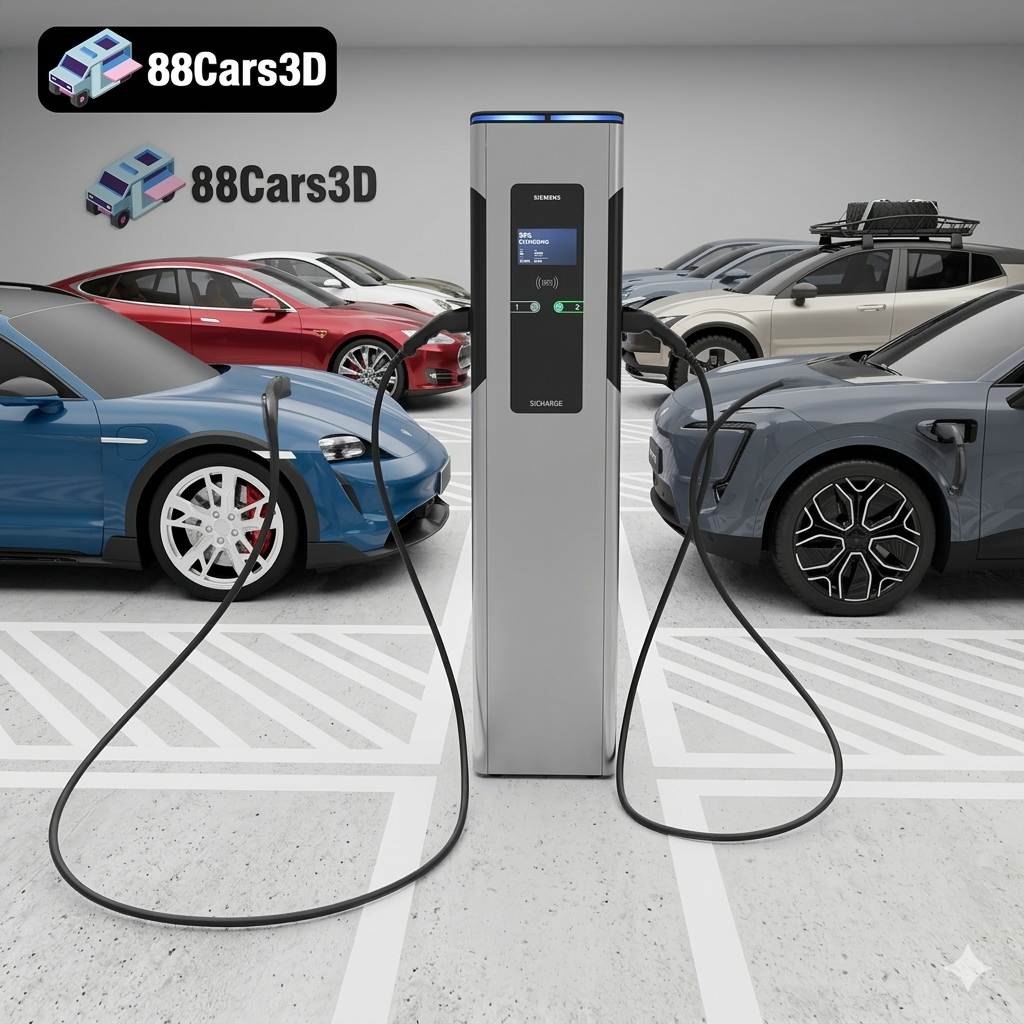
Download the Future of Mobility EV 3D Models Bundle. Includes the Volvo EX30, Tesla Model S, AVATR 11, Porsche Taycan, and a Siemens EV Charger. Save big on this highly optimized 5-in-1 pack for ArchViz and game development!
Price: $89.99

