Get 50% OFF All Premium 3D & STL Models!

In the fast-evolving landscape of 3D content creation, high-quality, pre-optimized assets are the bedrock of efficient and impactful projects. Whether you’re crafting a blockbuster video game, visualizing a new automotive concept, or developing immersive AR/VR experiences, the foundational elements—like meticulously detailed 3D car models—dictate the success and realism of your final output. Today, we delve deep into the technical prowess and versatile applications of such an asset, spotlighting a truly iconic piece of American machinery: the Harley-Davidson Road King 3D Model. This particular model stands out as a prime example of how expert modeling and optimization can serve a multitude of professional pipelines, from real-time game engines to high-fidelity rendering, and even physical 3D printing.
The Harley-Davidson Road King represents the quintessential American touring cruiser, known for its classic lines, powerful V-twin engine, and timeless appeal. Capturing this essence in a digital format, while ensuring it is “game-ready,” requires a deep understanding of topology, material efficiency, and target platform considerations. The Harley-Davidson Road King 3D Model available at 88cars3d.com exemplifies this balance, offering an incredibly optimized, low-polygon digital recreation that maintains the unmistakable aesthetic of this legendary motorcycle without compromising performance. Its careful construction makes it an invaluable asset for developers and artists aiming for both visual quality and technical efficiency across various interactive and static mediums.
The utility of any 3D model is heavily dependent on the file formats it supports. A comprehensive offering ensures maximum compatibility and flexibility across diverse software and project requirements. The Harley-Davidson Road King 3D Model, for instance, comes packed with a wide array of formats, each serving a specific purpose in the professional workflow. Understanding these formats is crucial for any 3D professional to streamline their production pipeline and achieve optimal results.
The .blend format is Blender’s native file type, providing a fully editable scene with all associated data, including meshes, materials, textures, lighting, cameras, animations, and even physics simulations. For artists and studios working within the Blender ecosystem, this format offers unparalleled flexibility. You can open the Harley-Davidson Road King directly, inspect its topology, modify materials, adjust UVs, or integrate it into an existing Blender scene with ease. It’s the go-to for deep customization and leveraging Blender’s powerful modeling and rendering tools before exporting to other platforms.
Autodesk’s .fbx (Filmbox) format has become the de facto standard for exchanging 3D data between different software applications and game engines. It supports geometry, materials, textures, animations, and rigging, making it ideal for pipelines involving Unreal Engine, Unity, 3ds Max, Maya, and more. When working with the Harley-Davidson Road King, the .fbx file ensures that the model’s structure, separate components (like wheels and steering), and pivot points are accurately transferred, ready for animation and physics setup in real-time environments.
The .obj (Wavefront OBJ) format is a widely supported, universal solution for basic geometry exchange. While it doesn’t typically carry animation or advanced material properties, it’s excellent for transferring mesh data (vertices, UVs, normals) between virtually any 3D software. For simple static renders or as a base for re-texturing in a new application, the .obj version of the Road King provides a clean, compatible mesh that can be easily imported and assigned new PBR materials.
.glb (GL Transmission Format Binary) is an increasingly vital format, particularly for modern web-based 3D, augmented reality (AR), and virtual reality (VR) applications. It’s a self-contained binary file that includes models, textures, and animations, optimized for efficient loading and rendering in browsers and mobile devices. The .glb version of the Harley-Davidson Road King is perfect for creating lightweight interactive experiences, such as product configurators on websites or showcasing the model in a mobile AR app, ensuring quick load times and smooth performance.
The .stl (Stereolithography) format is almost exclusively used for 3D printing. It represents a 3D model as a series of connected triangles, defining only the surface geometry without color or texture information. For those looking to bring the Harley-Davidson Road King into the physical realm, the .stl file is what you’d feed into your slicer software. While the digital model is low-poly, the .stl variant allows for careful scaling and printing, preserving the iconic silhouette for display-scale models, particularly on resin printers to capture finer details.
.ply (Polygon File Format) is another common format for storing 3D data, particularly useful for scanned data, CAD applications, and scientific analysis. It can store a wider range of properties than .obj, including color per vertex, normal information, and sometimes even transparency. While less common for general game development, it serves as a robust option for precise mesh transfer or specific engineering visualization tasks where the Road King model might be integrated.
The inclusion of an .unreal format (often a packaged asset or a specifically optimized FBX for Unreal) signifies that the Harley-Davidson Road King 3D Model is pre-configured for the Unreal Engine environment. This means assets are likely pre-staged for direct import, potentially with optimized material setups, collision meshes, and proper scaling, significantly reducing setup time for developers building projects within Unreal’s powerful real-time renderer.
For professionals rooted in Autodesk 3ds Max, the .max file provides the native project scene. Similar to .blend, it offers full editability, allowing users to leverage 3ds Max’s robust modeling, animation, and rendering capabilities (e.g., V-Ray or Corona Renderer). Artists can refine lighting, add complex textures, set up intricate animations, or integrate the Harley-Davidson Road King into larger architectural or cinematic renders, making it a powerful starting point for high-fidelity visualization.
This comprehensive suite of formats, available with the Harley-Davidson Road King 3D Model from 88cars3d.com, underscores the commitment to providing versatile and production-ready assets that cater to every facet of the 3D industry.
Creating a visually compelling 3D model is one challenge; optimizing it for real-time applications without sacrificing its iconic look is another entirely. The Harley-Davidson Road King 3D Model stands as a testament to this delicate balance, engineered specifically for performance-critical environments like mobile games, AR/VR, and large-scale open-world simulations. Its game-ready status is not merely a label but a result of meticulous design and technical considerations.
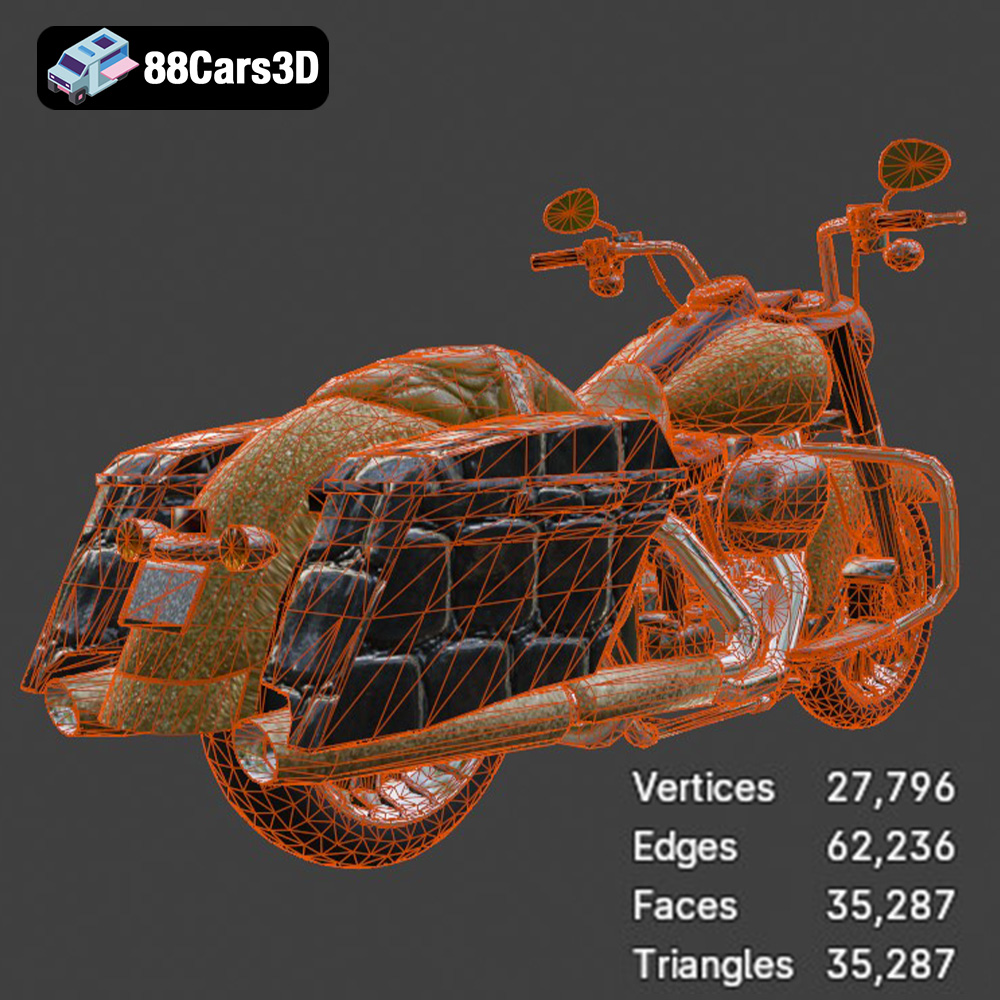
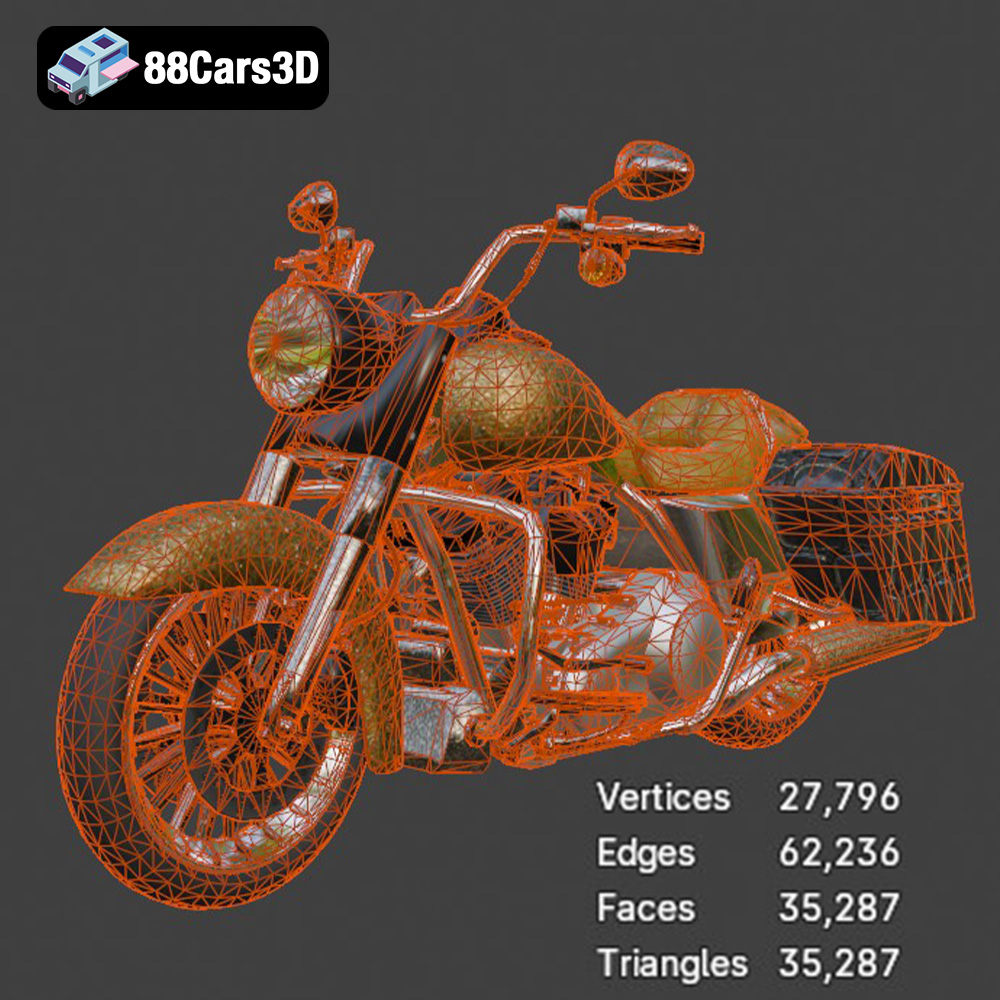
At the heart of the Road King model’s efficiency is its incredibly optimized, low-polygon topology, boasting just over 35,000 triangles. To put this into perspective, many high-fidelity cinematic models can easily run into millions of polygons. This lean poly count is an absolute game-changer for mobile platforms, where processing power and memory are at a premium. For open-world games requiring dozens or even hundreds of vehicles on screen simultaneously, or for AR/VR applications demanding buttery-smooth frame rates, a model like this offers a massive performance advantage. It allows developers to populate expansive digital environments with authentic vehicles, such as the Harley-Davidson Road King, without bogging down the system. This directly translates to better user experience, wider compatibility across devices, and ultimately, a more successful project.
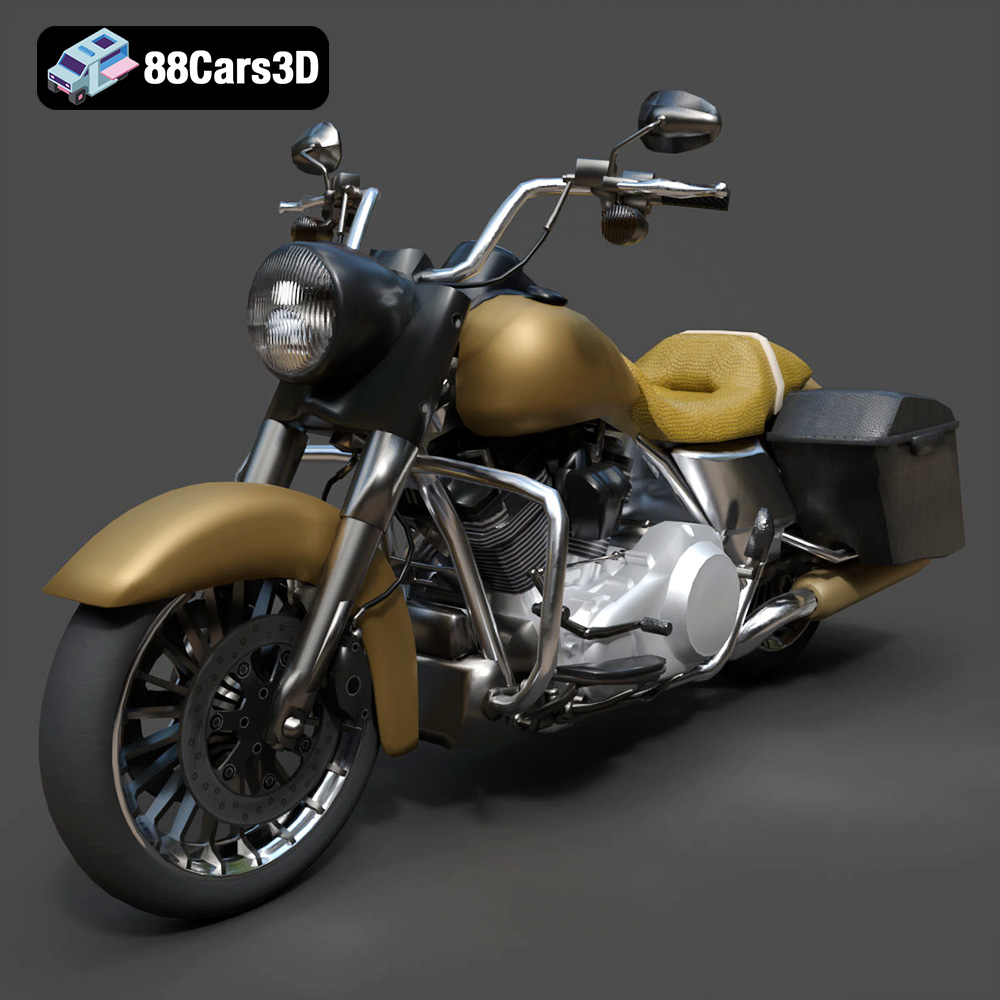
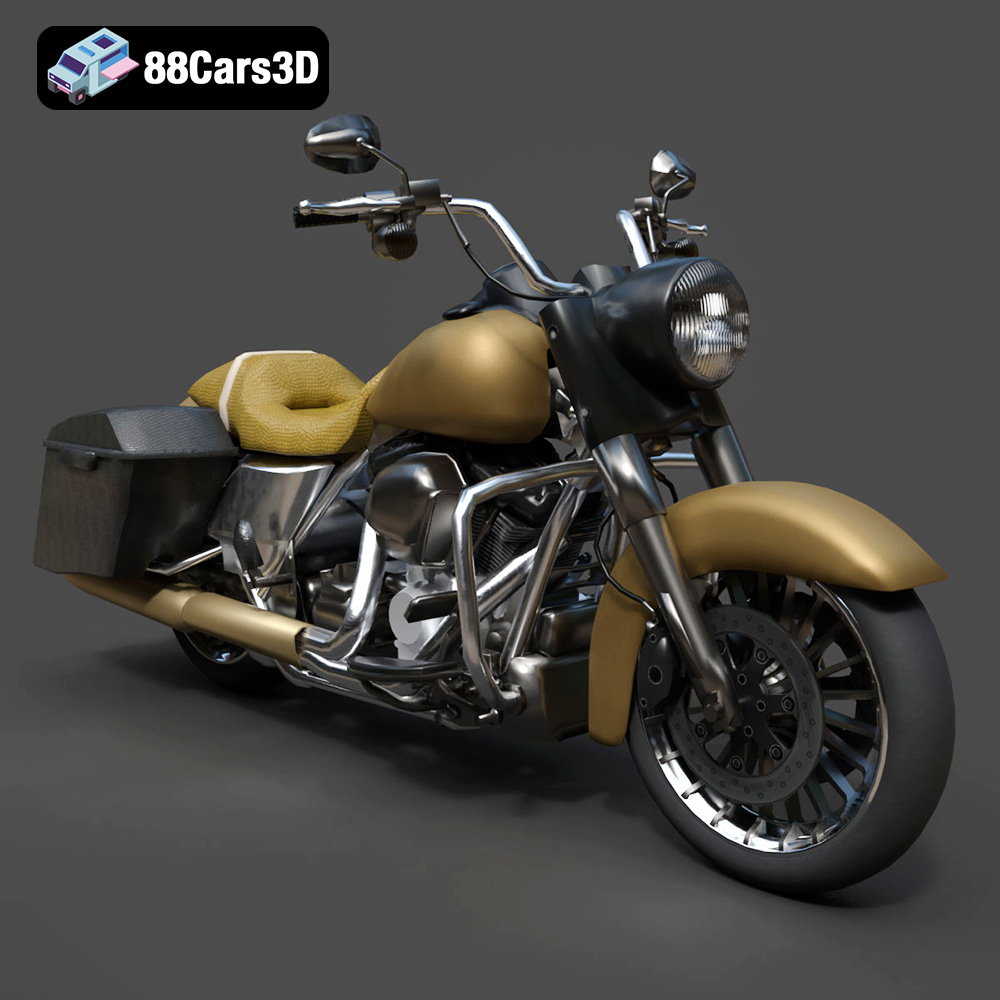
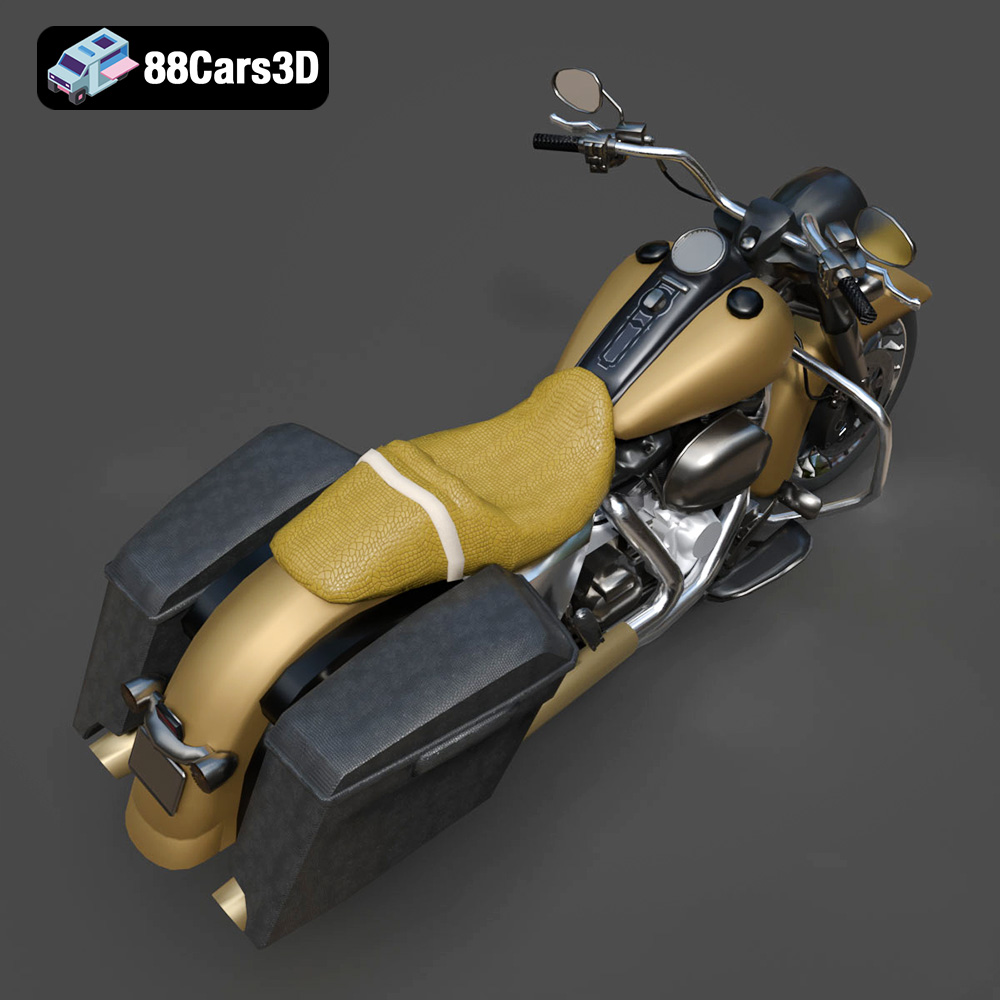
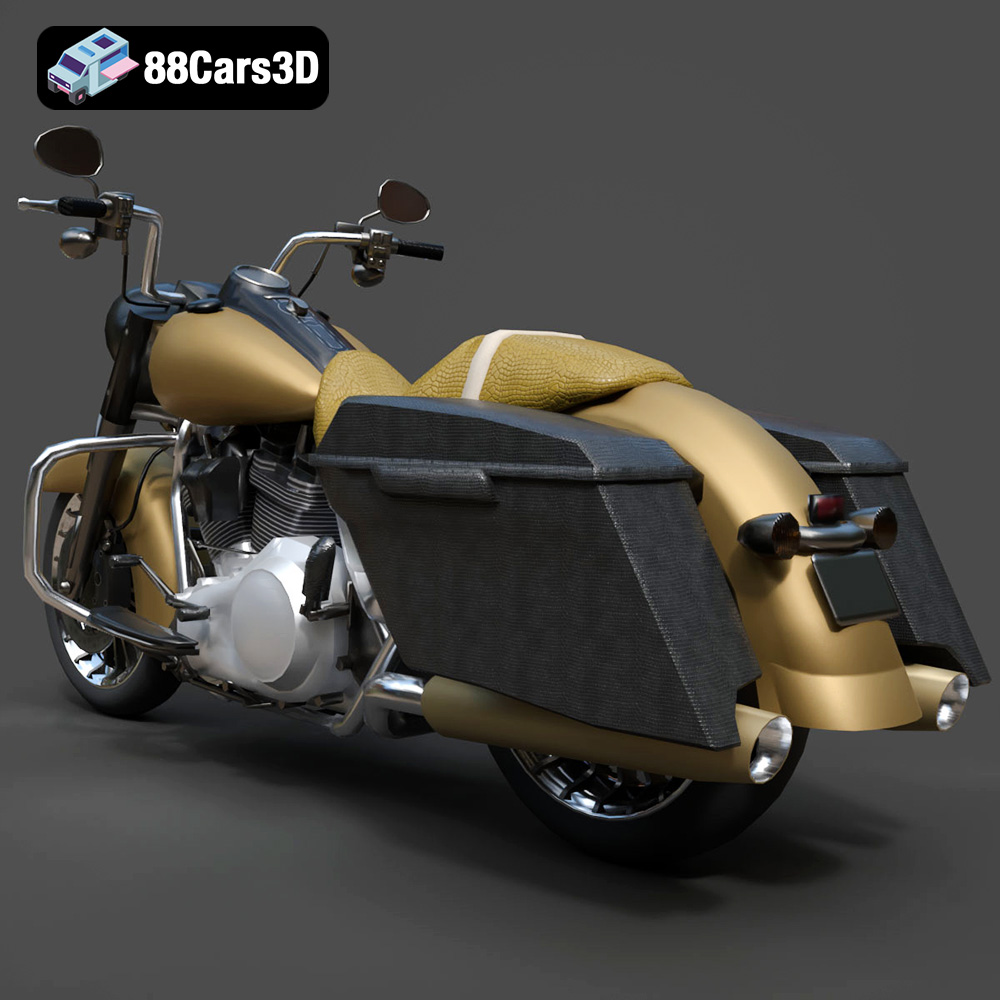
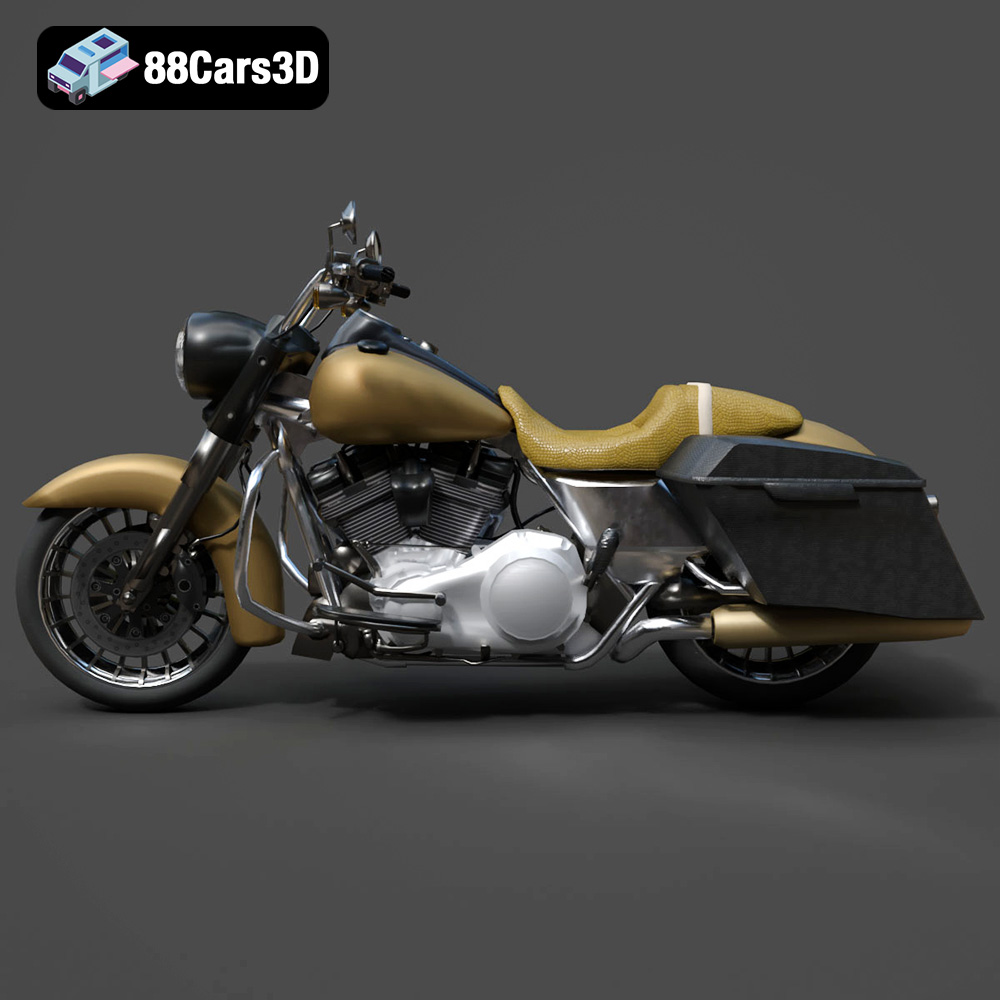
The challenge with low-poly models is often losing intricate details. However, the Harley-Davidson Road King 3D Model expertly navigates this. Its design philosophy focuses on capturing the essential “silhouette” and key identifying features of the iconic motorcycle. This includes the distinctive large chrome headlight nacelle, the prominent V-twin engine profile, sweeping dual exhaust system, and classic hard saddlebags. The optimized wheel geometry, for instance, is designed to look impressive while consuming minimal poly count. This means that even with a low triangle budget, the unmistakable “Road King” character shines through, making it instantly recognizable. Advanced techniques like efficient UV mapping (for textures) and the potential application of baked normal maps (to simulate high-poly details) further enhance its visual quality without increasing geometric complexity, a critical advantage for game assets.
Beyond static representation, interactive 3D models need to be rigged for movement and physics. The Harley-Davidson Road King 3D Model is built with this in mind. Key components such as the wheels and steering elements are separated, allowing for independent animation and precise physics rigging. This modularity is crucial for realistic driving mechanics in games, where wheels need to rotate, the handlebars need to steer, and the entire vehicle might need to lean into a turn. Furthermore, the proper pivot setup for steering, wheel rotation, and even kickstand articulation provides a robust foundation for developers to quickly implement dynamic interactions, bringing the virtual Road King to life with convincing motion and behavior.
The true value of a game-ready asset like the Harley-Davidson Road King 3D Model is realized when it’s seamlessly integrated into a game engine. Whether it’s Unreal Engine, Unity, or Godot, the process involves a series of technical steps to ensure the model performs optimally and looks its best. The inclusion of various file formats further simplifies this process for developers.
Unreal Engine is renowned for its cinematic rendering capabilities and robust development tools. For the Harley-Davidson Road King, the preferred import format would typically be .fbx or, if available, the .unreal specific asset. Importing the .fbx file is straightforward: drag and drop it into the Content Browser. Upon import, developers can configure settings for materials, collision, and animation. The model’s clean geometry and separated components (as highlighted by its pivot setup for steering and wheel rotation) make it ideal for Unreal’s physics system, Chaos, and its animation blueprints. Artists can then set up PBR (Physically Based Rendering) materials, applying textures for paint, chrome, and rubber to achieve a realistic appearance under Unreal’s advanced lighting. The low-poly nature of the Road King model ensures it runs efficiently even when part of dense open-world traffic or a dynamic multiplayer scene, leveraging Unreal’s excellent LOD (Level of Detail) system if desired.
Unity, another powerhouse in game development, offers similar ease of integration. The .fbx file is again the primary choice for importing the Harley-Davidson Road King 3D Model. Once imported, Unity’s asset pipeline allows for rapid material assignment. Developers can create new PBR materials and drag-and-drop textures (Albedo, Metallic, Smoothness, Normal maps, etc.) onto the various parts of the motorcycle. Adding colliders is essential for physics interactions; Unity’s Box Collider or Mesh Collider components can be quickly applied. For animation, the separated wheels and steering components are invaluable, allowing for scripting dynamic rotations and turns. For mobile game development, where performance is paramount, the Harley-Davidson Road King’s optimized 35k triangle count makes it an exemplary asset for achieving high visual quality without sacrificing frame rates, aligning perfectly with Unity’s focus on mobile and lightweight applications.
While game engines are for deployment, Blender often serves as a powerful pre-production hub. The included .blend file for the Harley-Davidson Road King offers a fully editable starting point. Developers can utilize Blender for any last-minute adjustments, such as refining UV layouts for custom texture painting, adding specific mesh details via normal map baking, or even creating simple animations before exporting to game engines. Blender’s robust modeling and UV editing tools allow for fine-tuning the model to fit unique project requirements. For example, if a project demands a specific custom paint job or a unique accessory, artists can perform these modifications in Blender, ensuring the exported .fbx maintains all optimizations and is perfectly tailored for the target game engine.
While the Harley-Davidson Road King 3D Model is optimized for game-ready performance, its versatility extends far beyond interactive experiences. Its clean topology and accurate proportions make it an excellent candidate for high-fidelity rendering, architectural visualization, augmented reality, and even tangible 3D prints, showcasing the broad utility of well-crafted 3D car models.
For architectural visualization studios or automotive design firms, the included .max file allows for integration into Autodesk 3ds Max, a powerhouse for professional rendering. Despite its low-poly nature, the Road King can be elevated to stunning realism through advanced rendering techniques. By applying complex PBR materials, setting up realistic studio lighting or environmental HDRI lighting, and leveraging renderers like V-Ray or Corona, artists can achieve photo-realistic stills and animations. For close-up shots, additional detail can be simulated using high-resolution normal maps baked from a more detailed model or procedural textures. Even as a background element in a sprawling urban render or an elegant automotive showroom scene, the Harley-Davidson Road King holds its own, adding a touch of classic Americana to any visualization project.
The burgeoning fields of augmented reality (AR), virtual reality (VR), and WebGL demand highly optimized assets that can be loaded quickly and rendered smoothly on various devices. The Harley-Davidson Road King 3D Model, particularly in its .glb format, is an ideal candidate. Developers can create interactive browser-based showrooms where users can spin the bike, change colors, or inspect details in real-time. In AR applications, the model can be “placed” in a real-world environment through a smartphone, allowing users to visualize the iconic cruiser in their driveway. For VR, it can populate virtual showrooms or be part of immersive digital museum exhibits. Its low poly count and efficient structure ensure minimal load times and consistent performance, which are critical for maintaining user immersion and preventing motion sickness in AR/VR environments.
The ability to convert a digital asset into a physical object opens up exciting possibilities for prototyping, collectibles, and educational tools. The Harley-Davidson Road King 3D Model’s inclusion of an .stl format caters directly to the 3D printing community. While it’s an optimized low-poly model, its clean mesh translates well into a physical print, especially when considering the recommended scales of 1:32, 1:43, or 1:64. For preserving the model’s subtle contours and crisp edges, resin printing is highly recommended over FDM, allowing for finer layer heights (0.04–0.08 mm). Detailed print settings are provided, including specific recommendations for supports (handlebars, saddlebags, dual exhausts) and print orientation (frame angled, wheels separately) to ensure structural integrity and a smooth finish. Post-processing, such as sanding and painting with classic Vivid Black or two-tone schemes, can transform the printed model into a stunning miniature collectible, a tangible representation of this legendary motorcycle.
In the competitive landscape of 3D content creation, access to high-quality, pre-optimized assets is not just a convenience, but a strategic advantage. Platforms like 88cars3d.com specialize in providing professional-grade 3D car models that empower artists and developers to achieve their creative visions with unparalleled efficiency and quality. The Harley-Davidson Road King 3D Model perfectly encapsulates this value proposition.
Developing 3D models from scratch is an incredibly time-consuming and resource-intensive process, demanding expert modeling, texturing, and optimization skills. By choosing a ready-made, game-ready asset like the Harley-Davidson Road King, studios and individual creators can drastically cut down on production timelines and costs. Instead of spending weeks or months on a single vehicle, that time can be reallocated to core gameplay development, environmental design, or other crucial project elements. This accelerated workflow is vital for meeting tight deadlines and bringing projects to market faster, providing a significant competitive edge. The instant availability of multiple file formats further eliminates conversion headaches, allowing immediate integration into virtually any pipeline.
The quality of a project is often determined by the consistency of its assets. When models are sourced from reputable marketplaces like 88cars3d.com, there’s an assurance of professional standards. This includes clean, efficient topology, accurate real-world scale, proper pivot setups for animation, and comprehensive file format support. The Harley-Davidson Road King 3D Model is a prime example of this commitment to quality, offering a model that is not only visually accurate but also technically sound and optimized for performance. This reliability means fewer bugs, smoother integrations, and a higher overall fidelity for the end product. For any professional seeking to elevate their projects with top-tier automotive assets, investing in models from 88cars3d.com ensures a foundation of excellence.
The Harley-Davidson Road King 3D Model is more than just a digital asset; it’s a testament to the power of optimized 3D content in today’s demanding production environments. Its meticulously crafted, game-ready topology, with just over 35,000 triangles, makes it an ideal choice for high-performance applications such as mobile gaming, open-world simulations, and lightweight AR/VR experiences. Yet, its inherent quality and comprehensive file format support ensure it seamlessly transitions into high-fidelity rendering workflows in applications like 3ds Max, or even into the physical world through 3D printing.
From animating its separate wheels and steering components in Unreal Engine and Unity to producing stunning visualizations or printing a detailed scale model, this Road King model offers unparalleled versatility. It embodies the technical excellence that accelerates development, maintains visual fidelity, and expands creative possibilities across the digital and physical realms. For anyone seeking to integrate an iconic piece of Americana into their next project, the Harley-Davidson Road King 3D Model available at 88cars3d.com represents an invaluable, performance-driven asset ready for immediate deployment.
The Harley-Davidson Road King 3D Model is an incredibly optimized, game-ready digital recreation of the quintessential American touring cruiser. Stripping away the heavy fairings of other touring models, the Road King is famous for its classic, nostalgic silhouette, featuring a large chrome headlight nacelle, a prominent V-twin engine, and iconic hard saddlebags. This 3D model accurately captures the legendary highway cruiser aesthetic while being engineered with extreme efficiency in mind. Built with highly optimized, low-polygon topology (just over 35k triangles), it delivers the unmistakable Harley-Davidson profile without consuming heavy memory resources. It is the absolute perfect asset for mobile game development, open-world background traffic, GTA-style mods, and lightweight AR/VR applications. Perfect for virtual cross-country highway scenes, biker lifestyle mobile games, and optimized interactive web showrooms.
$15.9
.blend
.cruiser
.fbx
.obj
.rendering
.stl
35k-polygons
car-3d-model
game-ready
harley-davidson
low-poly
mobile-game-asset
optimized
road-king
touring-motorcycle
VR/AR