Get 50% OFF All Premium 3D & STL Models!

In the expansive and ever-evolving landscape of 3D content creation, the pursuit of photorealism and detailed digital assets drives innovation across industries. From cinematic spectacles and immersive video games to cutting-edge architectural visualization and industrial design, the demand for high-quality 3D models is constant. Among the most sought-after assets are vehicles, especially those with an iconic status that transcends mere transportation. Today, we’re diving deep into the technical intricacies and creative potential of such an asset: the Harley-Davidson Night Rod 3D Model, a premium offering available on 88cars3d.com that epitomizes digital craftsmanship and versatility.
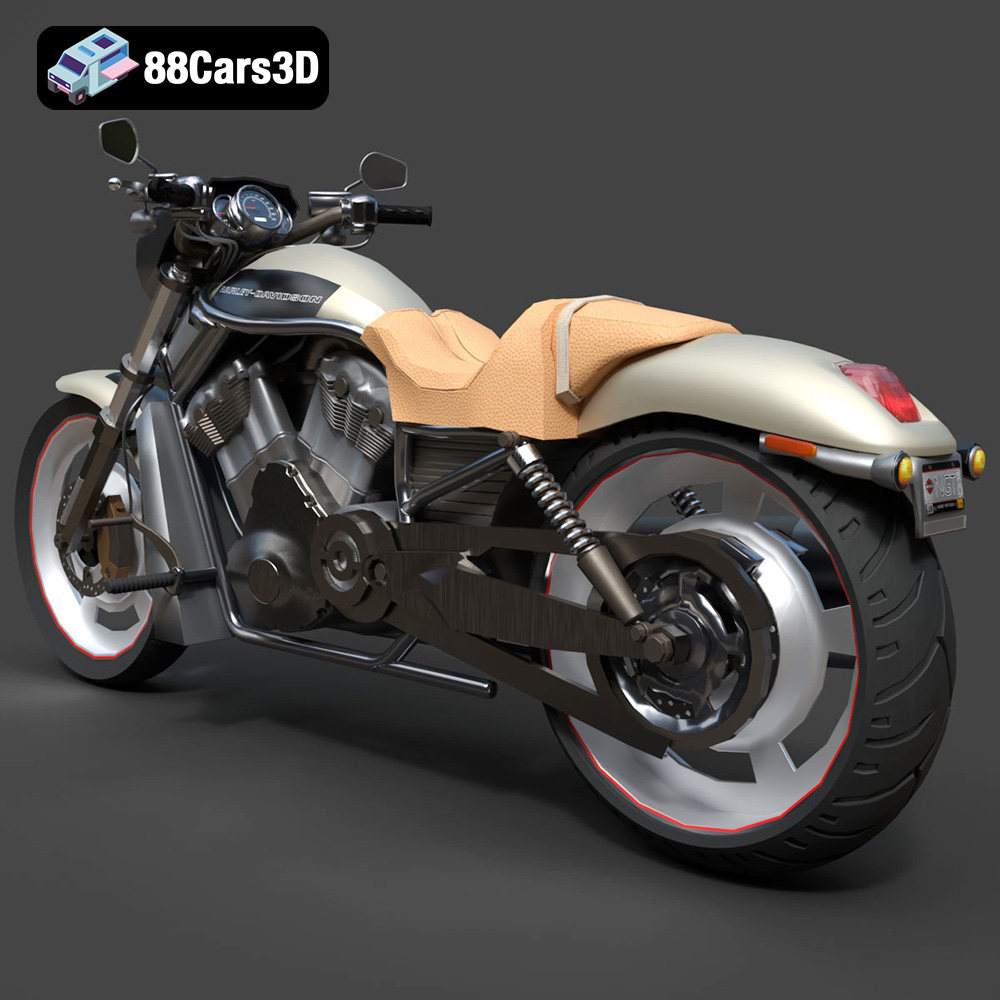
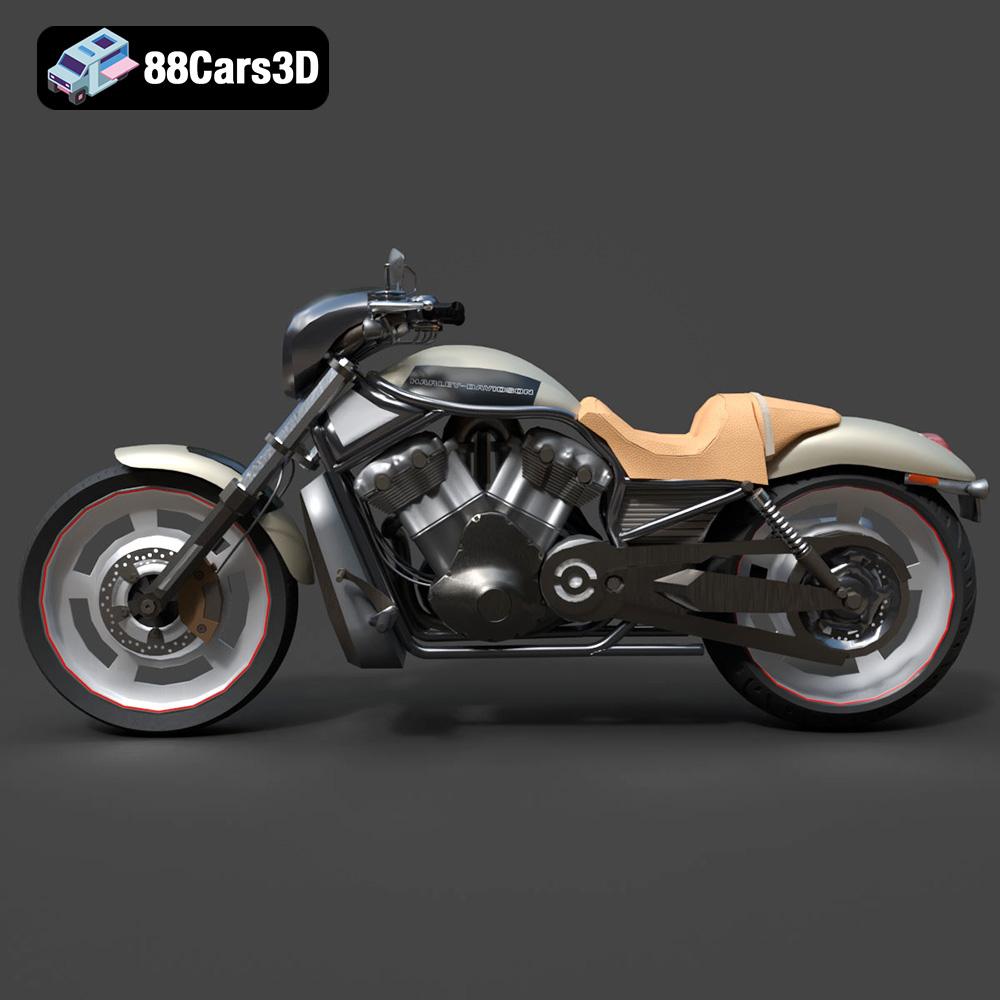
The Harley-Davidson Night Rod, part of the legendary VRSC (V-Rod) family, is not just a motorcycle; it’s a statement. Known for its aggressive, low-slung drag-bike profile and the unique liquid-cooled Revolution V-Twin engine – a powerhouse developed in collaboration with Porsche – it’s a machine steeped in attitude and performance. Its sinister aesthetic, characterized by blacked-out styling and a massive rear tire, makes it an ideal subject for digital artists looking to inject grit, power, and authentic American muscle into their projects. This particular 3D model captures every nuance, making it a perfect hero vehicle for a vast array of applications, from stunning automotive rendering to dynamic game environments and even precise 3D printing projects.
Navigating the world of 3D models often means encountering a myriad of file formats, each with its unique strengths, compatibility, and intended applications. Choosing the right format is crucial for a smooth workflow, ensuring your assets integrate seamlessly into your chosen software and pipeline. The Harley-Davidson Night Rod 3D Model, recognizing this need for flexibility, comes with a comprehensive suite of file types, catering to nearly every professional use case. Understanding these formats is key to unlocking the full potential of your 3D car models and game assets.
The .blend format is the native file type for Blender, the powerful open-source 3D creation suite. When you receive a .blend file, you’re not just getting the mesh; you’re getting a complete Blender scene. This includes all geometry, materials, textures, lighting setups, cameras, animation data, and even modifiers. It’s fully editable, allowing artists to delve into the model’s construction, make custom alterations, adjust shaders, or animate components directly within Blender. For those working within the Blender ecosystem for automotive rendering or game asset preparation, the .blend file provides the highest degree of flexibility and control.
.fbx (Filmbox) is arguably the most widely used proprietary file format for 3D data exchange, developed by Autodesk. It’s incredibly robust, supporting geometry, materials, textures, animations, bones, and light information. This makes it ideal for transferring 3D car models between different software applications like 3ds Max, Maya, and Blender, and crucially, for importing assets into real-time game engines such as Unreal Engine and Unity. Its widespread adoption ensures reliable compatibility and a streamlined pipeline for game developers and visualization artists, making it a cornerstone for complex game assets.
The .obj (Wavefront Object) format is a universal standard for storing 3D geometry. It’s a simple, text-based format that defines geometry (vertices, normals, texture coordinates, faces) and can reference external material files (.mtl) for basic shading information. While .obj doesn’t support animation or rigging, its simplicity and near-universal compatibility make it excellent for mesh transfer between almost any 3D software. For foundational cross-software compatibility or as a clean mesh for sculpting and retopology, .obj remains an indispensable format.
.glb (GL Transmission Format Binary) is a modern, royalty-free format designed for efficient transmission and loading of 3D scenes and models in web and AR/VR applications. It’s a binary container that includes 3D models, textures, animations, and PBR materials into a single, compact file, making it incredibly performant for browser-based display and augmented reality experiences. For showcasing 3D car models on websites or deploying interactive virtual showrooms, .glb is the go-to format for its optimization and ease of use.
.stl (Stereolithography) is the de facto standard file format for 3D printing. It represents a 3D model as a series of connected triangles (a triangulated surface mesh) without any color, texture, or material information. Its primary purpose is to describe the surface geometry of a 3D object for manufacturing. For hobbyists and professionals looking to bring the Harley-Davidson Night Rod 3D Model into the physical world through 3D printing, the .stl file is what your slicer software will consume to generate print paths.
The .ply (Polygon File Format) is another format for storing 3D data, often used with scanned 3D models or in scientific computing. It can store not only geometry but also properties like color, transparency, and normal vectors for each vertex or face. While less common for everyday artistic exchange than .fbx or .obj, it’s favored in applications requiring high precision mesh data, such as CAD, reverse engineering, or detailed analysis, providing a robust option for specific technical pipelines.
The inclusion of an .unreal file (or an Unreal Engine-ready asset package) signifies an asset specifically prepared and optimized for direct import into Unreal Engine. This often means the model has been correctly scaled, materials are set up with PBR workflows, collision meshes are present, and LODs (Levels of Detail) might be configured. For developers integrating 3D car models into projects within Unreal, this format drastically reduces setup time, allowing for immediate use in real-time environments.
Similar to .blend for Blender, the .max format is the native file type for Autodesk 3ds Max. This file contains the complete 3ds Max scene, including all modeling, materials, textures, lighting, cameras, and animation data. 3ds Max is a powerful tool widely used for architectural visualization, automotive rendering, and motion graphics. Having the .max file provides maximum flexibility for artists using 3ds Max to fully customize, animate, and render the Harley-Davidson Night Rod 3D Model with all its intricate details and scene setups.
The essence of a compelling 3D model lies in its ability to faithfully recreate its real-world counterpart while remaining versatile for various digital applications. The Harley-Davidson Night Rod 3D Model achieves this balance with remarkable precision, offering artists and developers a truly exceptional asset.
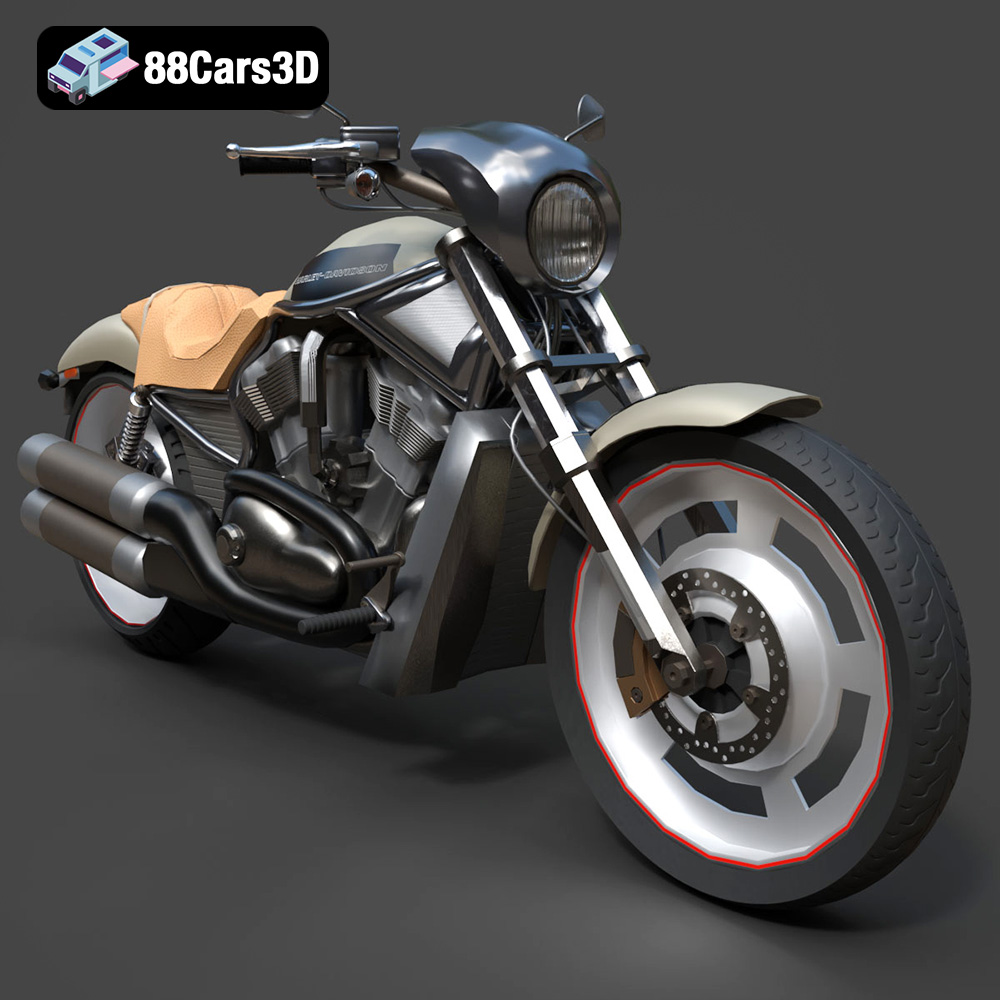
The Night Rod is legendary for its unique blend of classic Harley styling with a modern, high-performance edge. This 3D model starts with the accurate VRSC (V-Rod) chassis geometry, ensuring the unmistakable low-slung, drag-bike proportions are perfectly preserved. Every curve, every angle, from the aggressive rake to the wide stance, has been meticulously translated into the digital realm. The inclusion of the highly detailed, liquid-cooled Revolution V-Twin engine block, complete with its radiator shroud, speaks volumes about the commitment to authenticity. This isn’t just a shell; it’s a fully realized mechanical masterpiece. The signature blacked-out styling on the frame, engine, and front forks is replicated through careful material application and shading, enhancing the bike’s sinister appeal.
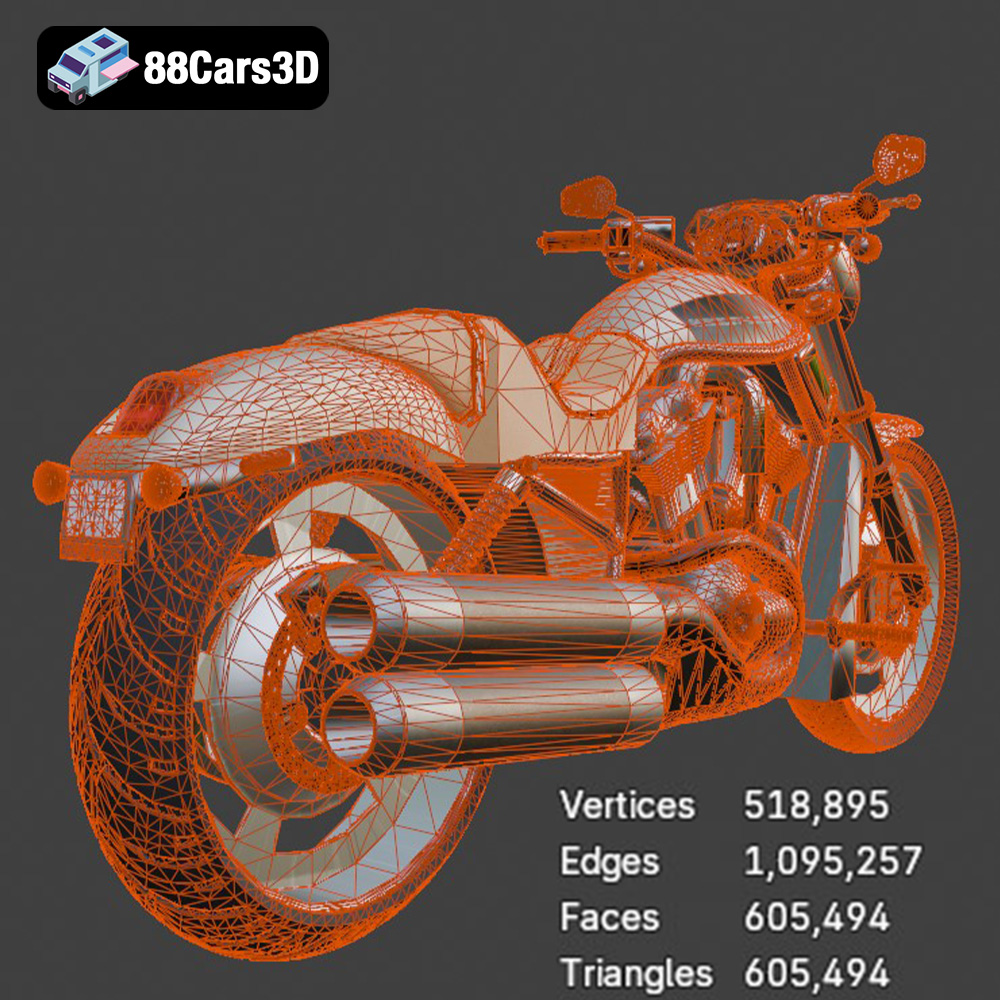
One of the standout technical advantages of this model is its optimized high-detail topology. With just over 600k triangles (specifically 605,494 triangles), 518,895 vertices, and 1,095,257 edges, the model strikes an ideal balance. This polygon count is substantial enough to deliver premium close-up mechanical detail without the crushing memory load typically associated with multi-million polygon CAD rips. This makes it an excellent “hero” vehicle, capable of withstanding scrutiny in high-resolution renders while remaining highly manageable as a game asset for current-generation game engines. The separate wheels, steering components, and suspension are not merely aesthetic; they are designed with proper pivot setups, enabling realistic animation of wheel rotation, steering, and even kickstand articulation, crucial for dynamic scenes or drivable vehicle systems.
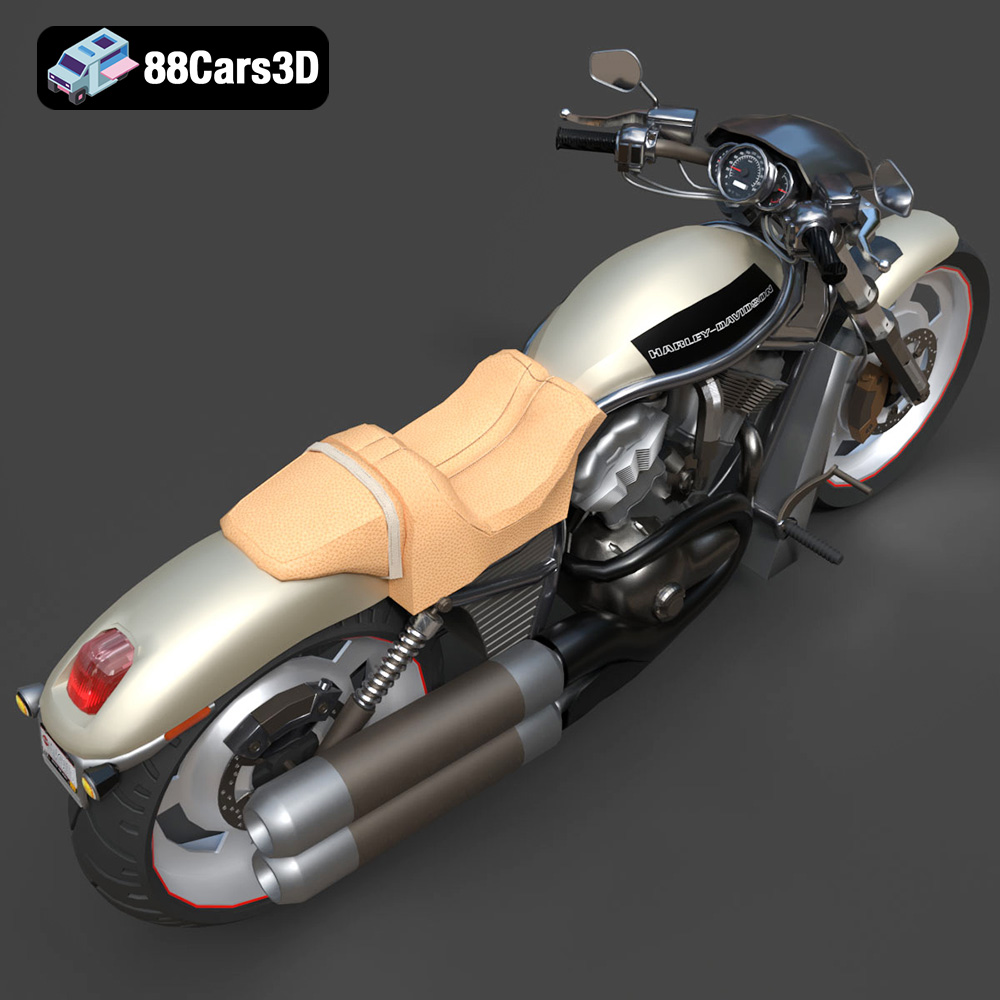
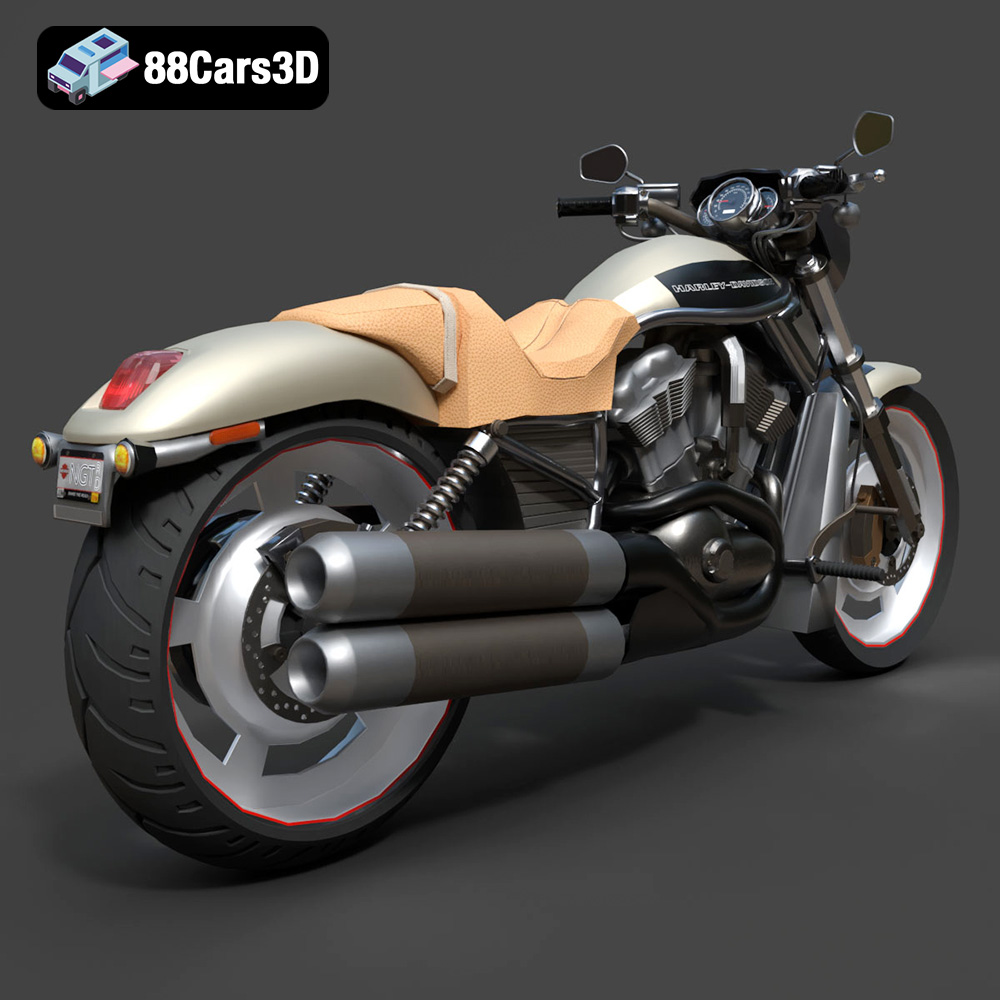
The attention to detail extends to every visible component. The distinctive swept-back dual exhaust system, the massive 240mm rear tire mounted on slotted or solid cast wheels, and the aerodynamic speed screen cowl are all accurately modeled. Even the sleek, chopped rear fender contributes to the iconic silhouette. Moving to the rider interface, the deep, low-slung drag-style saddle geometry, forward-reaching drag handlebars with detailed grips, mirrors, and levers, and authentic forward foot control and peg placements create an immersive experience. The minimalist analog gauge cluster mounted below the handlebars completes the cockpit, optimized geometry making it suitable for compelling first-person POV in gaming or VR applications.
The true value of a high-quality 3D asset lies in its seamless integration into diverse professional workflows. The Harley-Davidson Night Rod 3D Model is engineered for adaptability, proving its worth in automotive rendering, game development, and interactive experiences.
For artists focused on creating breathtaking static images or animated sequences, this 3D model is an invaluable asset for automotive rendering. In software like 3ds Max or Blender, the detail and clean topology allow for exceptional results. Artists can experiment with moody studio lighting setups to emphasize the bike’s dark aesthetic, or place it within gritty urban environments to enhance its street-racer persona. PBR (Physically Based Rendering) material workflows can be applied to achieve realistic metallic reflections on the engine components, subtle textures on the leather saddle, and the deep, reflective qualities of the blacked-out bodywork. Customization options, such as changing fuel tank and fender colors to classic Vivid Black or Black Denim, or swapping exhaust pipes for aftermarket variants, provide creative freedom. Even subtle details like adding custom baked normal maps can simulate high-poly weld marks and engine casing details, pushing realism further.
Achieving a striking automotive render involves more than just a great model; it requires an artistic eye for lighting, composition, and materials. With the Night Rod, artists can leverage global illumination solutions to create soft, realistic ambient light, or use targeted spot and area lights to highlight specific mechanical elements. The geometry is robust enough for extreme close-ups, allowing focus on the intricate cooling fins of the Revolution V-Twin engine or the texture of the tire tread. Camera angles can be chosen to emphasize the bike’s low profile and aggressive stance, making it perfect for marketing campaigns, digital portfolios, or even print media.
The interactive nature of video games and simulations demands assets that are not only visually impressive but also highly optimized for real-time performance. The Harley-Davidson Night Rod 3D Model, at ~605k triangles, is perfectly positioned as a “hero” drivable vehicle for current-generation console and PC games. Its polygon count provides high detail for main character vehicles without crippling frame rates.
Importing the .fbx or .unreal formats into Unreal Engine is a straightforward process. Once in the engine, developers can set up physics assets, define collision meshes, and implement drivable vehicle blueprints to bring the Night Rod to life. The model’s real-world scale accuracy ensures it fits perfectly into existing game worlds. The separate, animated components (wheels, steering) are crucial for realistic vehicle dynamics. Furthermore, the optimized geometry is excellent for immersive first-person POV experiences in gaming, allowing players to feel truly connected to the machine. For multiplayer environments or scenes with many vehicles, developers might opt to create lower LODs (Levels of Detail) from this high-detail base, ensuring scalability without compromising visual quality up close.
The rapidly expanding fields of Augmented Reality (AR), Virtual Reality (VR), and interactive visualization offer new avenues for showcasing detailed 3D car models. The Harley-Davidson Night Rod 3D Model is well-suited for these cutting-edge applications.
Using the .glb format, the model can be seamlessly integrated into web-based AR viewers, allowing users to place a virtual Night Rod in their physical environment via their smartphone. For high-end VR experiences, such as virtual motorcycle showrooms or interactive configurators, the model’s fidelity shines. Users can walk around, inspect details, and even customize the bike in a fully immersive 3D space, interacting with various components and experimenting with paint schemes or aftermarket parts. This level of detail and versatility makes it an ideal asset for product showcases, educational tools, or unique marketing activations that go beyond traditional static renders.
The versatility of a well-constructed 3D model extends beyond digital displays, crossing into the tangible world through 3D printing. The Harley-Davidson Night Rod 3D Model, specifically available as a 3D printable STL, offers enthusiasts the unique opportunity to hold a physical manifestation of this iconic motorcycle.
The .stl format is the industry standard for 3D printing, translating the Night Rod’s digital geometry into a series of interconnected triangles that 3D printers can interpret to build a physical object layer by layer. This allows hobbyists and collectors to create display-scale custom motorcycle models. The inherent detail of the digital model translates remarkably well into a physical print, capturing the intricate engine components, the precise lines of the frame, and the distinctive exhaust system.
To achieve the best possible physical reproduction of the Night Rod, adherence to specific 3D printing settings is paramount. For this model, recommended scales include 1:12, 1:10, or 1:8, allowing for a good balance of detail and manageable print size. Resin printing (SLA/DLP) is highly recommended over FDM for finer details, especially for preserving the delicate engine cooling fins and the intricate wheel designs. A layer height between 0.04-0.08 mm for resin printers will ensure smooth surfaces and sharp features.
Key technical considerations include a wall thickness of 1.2-2.0 mm for structural integrity, and an infill of 20-30% to provide strength without excessive material use. Due to the Night Rod’s complex geometry, supports are required for areas like the radiator shroud, handlebars, exhaust pipes, and the kickstand. Print orientation is also critical: printing the main frame angled can improve structural integrity and surface finish, while wheels and exhaust pipes should typically be printed separately to optimize detail and minimize support marks. This thoughtful approach ensures that the transition from digital to physical is smooth and results in a high-quality collectible.
Once printed, the physical Night Rod model requires post-processing to achieve a professional finish. This typically involves careful sanding to remove support marks and layer lines, followed by applying a primer to create an even base for painting. The real magic happens with the paint job. Artists can choose classic Harley-Davidson finishes like Vivid Black or Black Denim for the bodywork, meticulously masking areas for contrasting gloss/matte black mixes for the engine accents, replicating the authentic blacked-out aesthetic. The ability to create a tangible, hand-finished model from the digital file adds another layer of engagement and creativity to the process.
The Harley-Davidson Night Rod 3D Model is more than just a collection of polygons; it’s a catalyst for creative expression across a spectrum of professional endeavors. Its detail and versatility make it suitable for diverse applications, proving its worth as a premium asset.
In the world of advertising, capturing attention and conveying a brand’s essence is paramount. The Night Rod 3D Model excels in this arena. Imagine a moody, neon-lit urban street scene where the bike is the undeniable focal point, its blacked-out styling reflecting the digital city lights. This model is ideal for dark lifestyle brand campaigns, evoking a sense of rebellion, freedom, and raw power. Automotive visualization studios can leverage this asset to create stunning product showcases, allowing potential buyers to explore every angle of the virtual bike long before it hits the showroom floor. Its aggressive stance makes it perfect for marketing material for action-oriented video games or even luxury goods targeting a similar demographic.
For digital artists and concept designers, the Night Rod provides a robust foundation for exploration. It can serve as a highly detailed base for creating custom builds, where artists might redesign parts, add futuristic elements, or integrate it into fantastical vehicles. Its clean topology allows for easy modification and integration of additional components. Envision a cyberpunk future where the Night Rod is modified with advanced weaponry or exotic propulsion systems, or a post-apocalyptic scenario where it’s a rugged, battle-hardened survivor. The model’s authentic design elements provide a strong anchor to reality, even when pushing creative boundaries into the realm of science fiction or fantasy.
While primarily a vehicle, the Night Rod also plays a crucial role in enriching architectural visualization projects. Adding realistic 3D car models or motorcycles to exterior scenes instantly brings them to life, conveying scale, context, and atmosphere. A Night Rod parked outside a modern, minimalist building or cruising down a street in a bustling city rendering can add a powerful narrative element, suggesting an edgy urban lifestyle or a sense of dynamic movement. Its distinctive presence can turn a static architectural render into a compelling visual story, making the spaces feel lived-in and more engaging for clients and audiences alike.
The journey through the technical specifications and creative applications of the Harley-Davidson Night Rod 3D Model reveals an asset crafted with exceptional detail and foresight. From its meticulously accurate geometry capturing the legendary VRSC chassis and Revolution V-Twin engine, to its optimized topology balancing visual fidelity with performance, this model stands as a testament to high-quality 3D asset development. It is truly a versatile tool for professionals across various digital domains.
Whether your passion lies in crafting hyper-realistic automotive rendering, developing immersive open-world game assets, creating interactive AR/VR experiences, or even bringing digital designs to life through 3D printing, this Night Rod model is engineered to exceed expectations. Its extensive file format support, including .blend, .fbx, .obj, .glb, .stl, .ply, .unreal, and .max, ensures compatibility with virtually any professional pipeline, providing unparalleled flexibility. This model streamlines your workflow, allowing you to focus on creativity rather than wrestling with asset preparation.
For anyone seeking premium 3D car models that combine iconic design with technical excellence, the Harley-Davidson Night Rod 3D Model from 88cars3d.com represents an invaluable investment. Its balance of high detail and manageable poly count makes it a ‘hero’ asset ready for any challenge. Explore this exceptional model and a wide range of other high-quality 3D assets to elevate your projects to the next level.
The Harley-Davidson Night Rod 3D Model is a high-detail digital recreation of the legendary dark custom power cruiser. Part of the iconic VRSC (V-Rod) family, the Night Rod is famous for its aggressive, low-slung drag-bike profile and its liquid-cooled Revolution V-Twin engine—developed in partnership with Porsche. Characterized by its blacked-out styling and massive rear tire, it represents a perfect fusion of American muscle and high-performance engineering. This 3D model accurately captures the sinister aesthetic of the original bike, featuring the signature color-matched speed screen, drag-style handlebars, fat 240mm rear tire, and the distinctive swept-back dual exhaust system. Built with an incredibly balanced, high-polygon topology (just over 600k triangles), it provides excellent visual fidelity for close-up rendering while remaining highly manageable as a hero vehicle for current-generation game engines. Perfect for gritty urban street scenes, dark biker lifestyle campaigns, modern open-world video games, and automotive visualization.
$45
.blend
.fbx
.obj
.rendering
.stl
blacked-out
drag-bike
game asset
harley-davidson
mid-poly
motorcycle-3d-model
night-rod
power-cruiser
revolution-engine
v-rod
VR/AR
vrsc