Get 50% OFF All Premium 3D & STL Models!

In the illustrious pantheon of automotive legends, few machines command the same awe and reverence as the Porsche 918 Spyder. A technological marvel that redefined the hypercar landscape, it stands as a testament to engineering prowess, blending a high-revving V8 with cutting-edge electric motors. For professionals in visualization, game development, and interactive experiences, capturing the essence of such a vehicle in digital form is paramount. This isn’t just about creating a static representation; it’s about delivering a dynamic, versatile, and technically sound 3D asset that can seamlessly integrate into diverse workflows, from photorealistic renders to real-time interactive environments.
The quest for digital authenticity leads many to seek out premium 3D car models that don’t compromise on detail, optimization, or flexibility. The Porsche 918 Spyder (With Detachable Roof) 3D Model exemplifies this pursuit. It’s more than just a model; it’s a meticulously crafted digital twin designed to meet the rigorous demands of professional production pipelines. From its iconic top-exit exhausts to its signature detachable Targa-style roof panels, every facet of this legendary machine has been recreated with an obsessive attention to detail, making it an indispensable asset for anyone aiming to elevate their automotive projects.
The challenge of translating a physical marvel like the Porsche 918 Spyder into a compelling 3D model lies in balancing aesthetic fidelity with technical efficiency. This particular 3D model excels by precisely replicating the car’s distinctive silhouette, aerodynamically sculpted bodywork, and intricate details. Features like the aggressive rear diffuser and the active aerodynamic rear wing are not just present, but accurately proportioned, ensuring the digital model conveys the same sense of speed and purpose as its real-world counterpart. For automotive rendering artists, this level of detail is crucial for creating renders that can truly be mistaken for photographs.
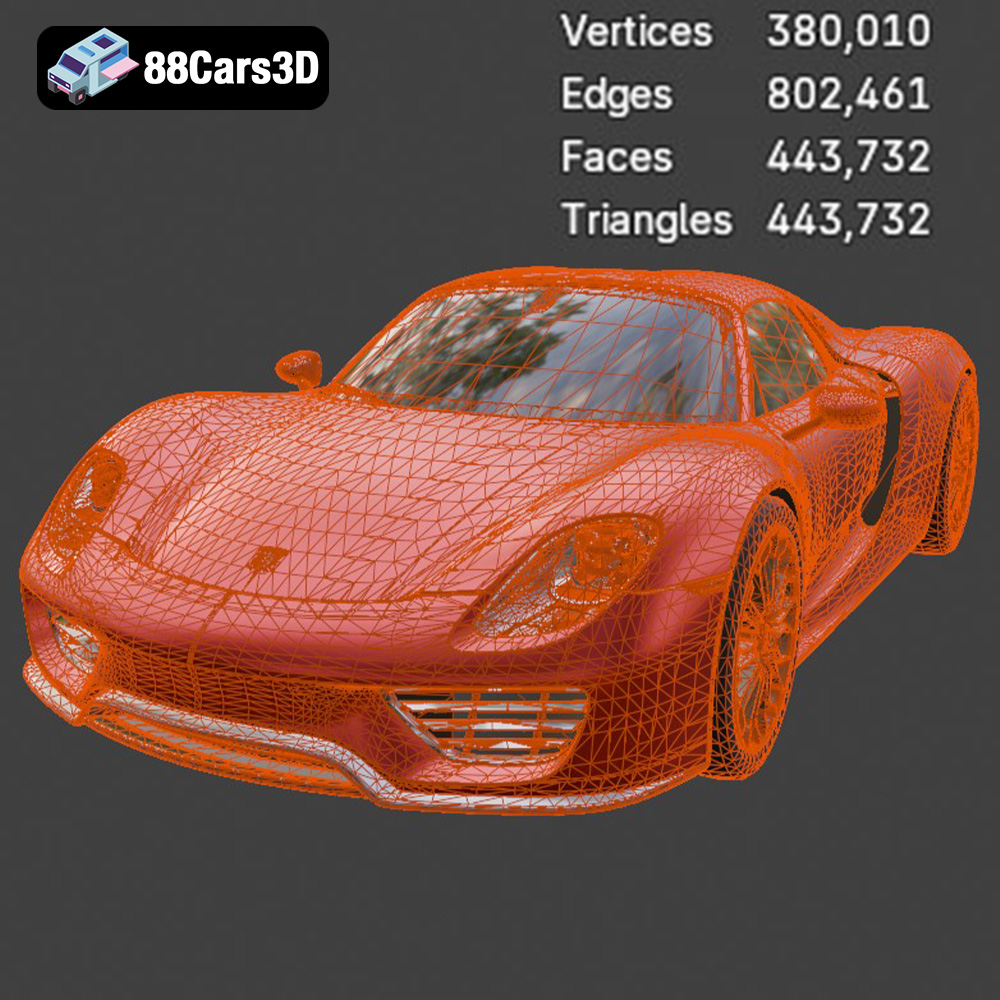
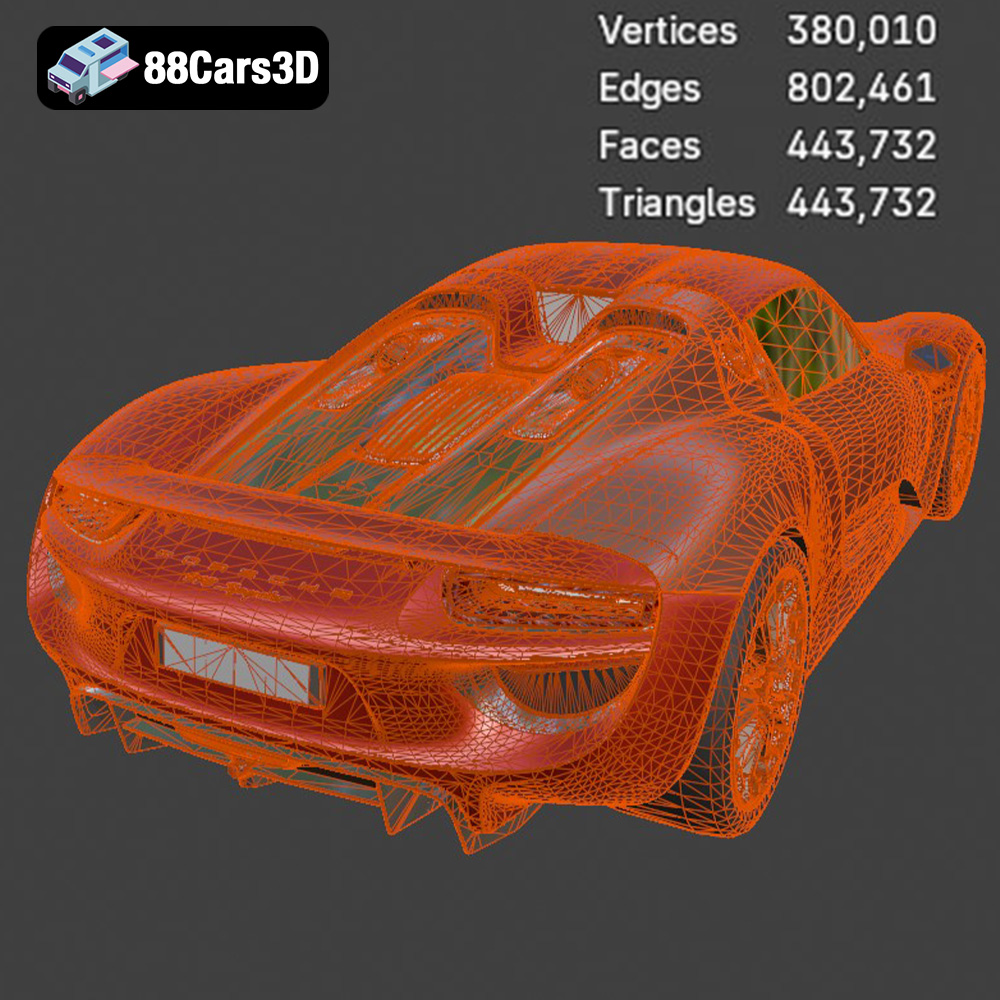
Beyond visual accuracy, a truly professional 3D car model must be built on a robust technical foundation. This involves careful consideration of topology, poly count, and asset organization. The Porsche 918 Spyder model boasts a clean, mid-polygon topology of just over 443k triangles. This “sweet spot” ensures stunning visual fidelity for close-up cinematic shots while maintaining a lightweight profile ideal for real-time game engines. The separation of components like wheels, steering, doors, and crucially, the detachable roof panels, provides animators and riggers with the flexibility needed to create dynamic and interactive scenes, a critical factor for immersive game assets and AR/VR experiences.
When working with professional 3D car models, understanding the various file formats available is crucial for seamless integration into diverse workflows. Each format serves a specific purpose, offering different advantages in terms of compatibility, data preservation, and optimization for particular applications. The Porsche 918 Spyder (With Detachable Roof) 3D Model from 88cars3d.com comes with a comprehensive suite of formats, ensuring maximum utility for any project.
The .blend format is native to Blender, the popular open-source 3D creation suite. It encapsulates an entire Blender project, including mesh data, materials, textures, lighting, camera setups, and even animation data. For users working within the Blender ecosystem, this format offers the most complete and editable experience. Artists can easily modify geometry, adjust materials, re-rig components, or extend animations directly within the native environment, making it ideal for deep customization and complex scene development.
Autodesk’s .fbx (Filmbox) format has become an industry standard for interoperability, especially within game development and real-time visualization. It’s renowned for its ability to store not just mesh data, but also hierarchies, animation, skinning, and blend shapes. This makes .fbx an excellent choice for exporting animated characters and complex assets like 3D car models into game engines such as Unreal Engine and Unity. Its widespread adoption ensures reliable data transfer between different 3D software packages, providing a robust bridge for real-time pipelines.
The .obj (Wavefront Object) format is one of the most widely supported and universal 3D file formats. It primarily stores geometric data (vertices, normals, texture coordinates, and faces) and can link to external material definition files (.mtl). While it doesn’t typically store animation or rigging data, its simplicity and ubiquitous compatibility make it an excellent choice for basic mesh exchange between virtually any 3D software. For static renders or base meshes that will be textured and rigged from scratch in a new application, .obj is a dependable option.
.glb (GLB, the binary form of glTF) is a relatively newer format designed for efficient transmission and loading of 3D scenes and models. Optimized for web-based applications, augmented reality (AR), virtual reality (VR), and mobile, .glb packs all necessary data (geometry, materials, textures, animations) into a single, compact file. This “all-in-one” packaging makes it incredibly easy to deploy 3D content across platforms with minimal fuss, making it perfect for interactive digital showrooms or browser-based configurators.
The .stl (Stereolithography) format is the de facto standard for 3D printing. It represents 3D models as a series of connected triangles (a tessellated surface) without any color, texture, or material information. Its sole purpose is to define the surface geometry of a 3D object for manufacturing. When preparing a 3D car model for physical production, converting it to .stl is the necessary step to send it to a 3D printer. The Porsche 918 Spyder model is perfectly convertible to .stl, enabling enthusiasts to bring the hypercar to life as a physical scale model.
.ply (Polygon File Format or Stanford Triangle Format) is another format for storing 3D data, particularly useful for scanned data, CAD, and scientific applications. It can store a wider range of properties than .obj, including color per vertex, normal vectors, and transparency, making it suitable for high-precision geometry and data analysis. While less common in artistic workflows, it offers a robust solution for technical or reverse-engineering applications.
The .unreal designation implies a model specifically packaged and optimized for direct import into Unreal Engine. This often means pre-configured materials, collision meshes, LODs (Levels of Detail), and sometimes even basic blueprints. While not a standalone file format in the same way as .fbx or .obj, it represents an asset that has undergone the necessary processing to be ‘plug-and-play’ within the Unreal Engine environment, saving developers significant setup time.
Similar to .blend for Blender, the .max format is the native file type for Autodesk 3ds Max. It stores the complete scene data, including geometry, materials, lighting, cameras, animations, and modifiers. For professionals utilizing 3ds Max for architectural visualization, product design, or cinematic rendering, having the model in its native .max format allows for full creative control and the ability to leverage 3ds Max’s powerful rendering and animation toolsets.
The versatility of a high-quality 3D car model like the Porsche 918 Spyder lies in its ability to adapt to various professional applications. From the high-stakes world of game development to the demanding standards of cinematic visualization, this asset is engineered for performance and fidelity across the board.
For game developers, a “hero” car asset must strike a perfect balance between visual impact and real-time performance. The Porsche 918 Spyder 3D Model is built with game-readiness in mind. Its optimized topology (443k triangles) means it can be rendered smoothly even on current-gen consoles and PCs, without sacrificing the intricate details that define a hypercar. The proper pivot setup for steering, wheel rotation, and the detachable roof panels facilitates realistic rigging and animation, essential for immersive driving simulators, open-world titles, and racing games. Imagine a player experiencing the thrill of peeling back the roof panels in-game, transforming their driving experience instantly – this model makes such dynamic interactions a reality.
In the realm of automotive rendering and visualization, photorealism is the ultimate goal. Agencies creating high-octane commercials, luxury brand showcases, or architectural renders often require 3D car models that can hold up under intense scrutiny and dramatic lighting. The Porsche 918 Spyder model’s clean quad-based flow and real-world scale accuracy make it an ideal candidate for such demanding applications. Its detailed exterior and interior geometry, coupled with textures, allow for breathtaking close-ups that highlight the carbon fiber elements, the intricate stitching on the sport seats, or the reflection of studio lights on its sleek bodywork. This model empowers artists to craft visuals that blur the line between digital and reality.
As AR and VR technologies become more prevalent, the demand for optimized yet highly detailed 3D assets grows. The 918 Spyder model’s efficient poly count makes it excellent for interactive digital showrooms, mobile AR experiences, or virtual test drives. Its balanced topology ensures smooth performance in VR, minimizing latency and enhancing immersion. Imagine a potential customer exploring the hypercar in an augmented reality app, rotating it, opening the doors, and even detaching the roof panels with a tap – this model is primed for such cutting-edge applications, providing a truly interactive and engaging experience.
Beneath the sleek exterior of any premium 3D car model lies a complex web of technical decisions and meticulous craftsmanship. The quality of these underlying technical specifications dictates a model’s performance, flexibility, and overall value in a professional pipeline.
The term “poly count” often dictates a model’s suitability for different applications. A model that is too high-poly can cripple real-time performance, while one that is too low-poly will lack detail for cinematic renders. The Porsche 918 Spyder 3D model hits an impressive sweet spot with 380,010 vertices, 802,461 edges, and 443,732 faces/triangles. This “mid-polygon” approach means it is detailed enough to be a high-end cinematic asset, capable of holding up to extreme close-ups without showing faceted geometry, yet optimized enough to run smoothly as a “hero” car in Unreal Engine or Unity. The highly optimized topology, visible in its clean quad-based flow, not only ensures smooth subdivision for high-resolution renders but also facilitates easier deformation and animation.
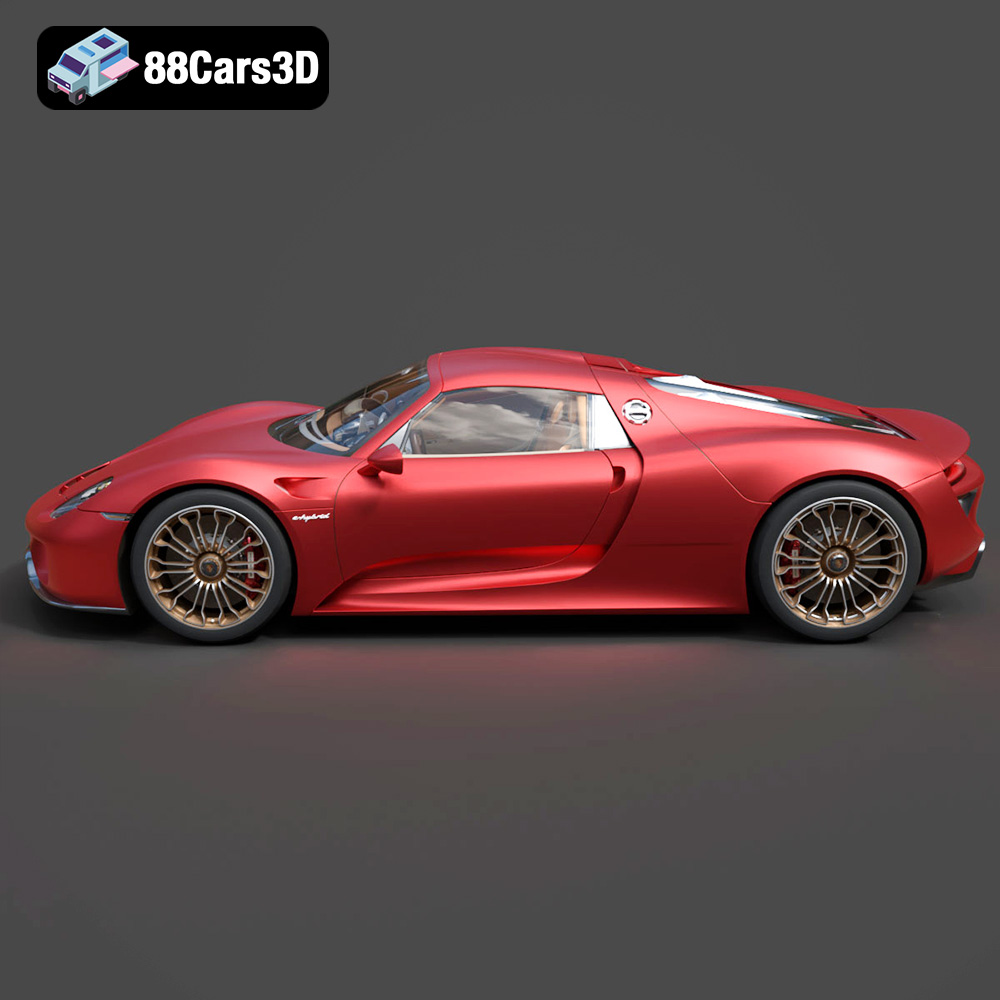
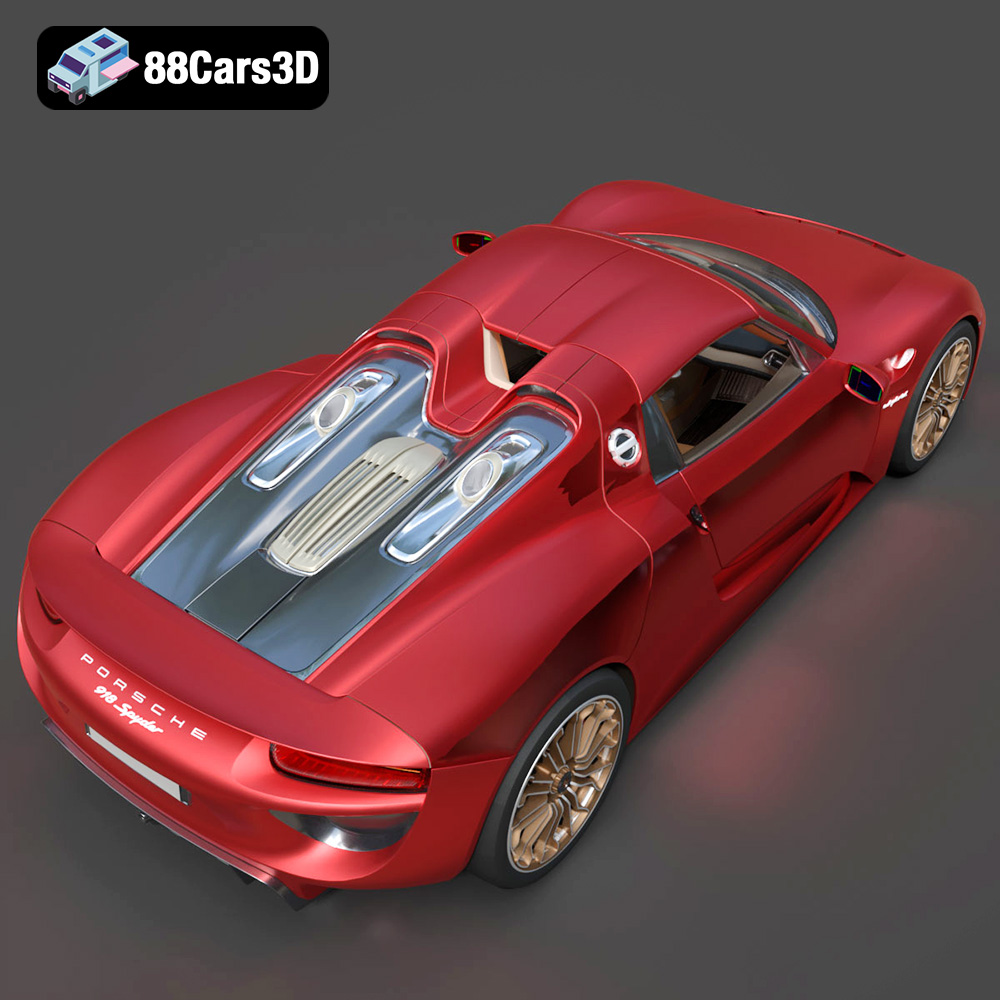
One of the standout features of this 3D model is its fully detachable Targa-style roof panels. This isn’t merely a static option; the roof panels are separated and configured for easy removal and animation. This means an artist or developer can seamlessly switch between the closed-coupe track profile and the open-air Spyder configuration. For animators, the proper pivot setup extends to all key components: wheels for rotation, steering components for dynamic turns, and doors for entry/exit animations. This level of modularity significantly reduces setup time for complex cinematics or interactive scenarios, providing immediate utility for dynamic storytelling or gameplay mechanics.
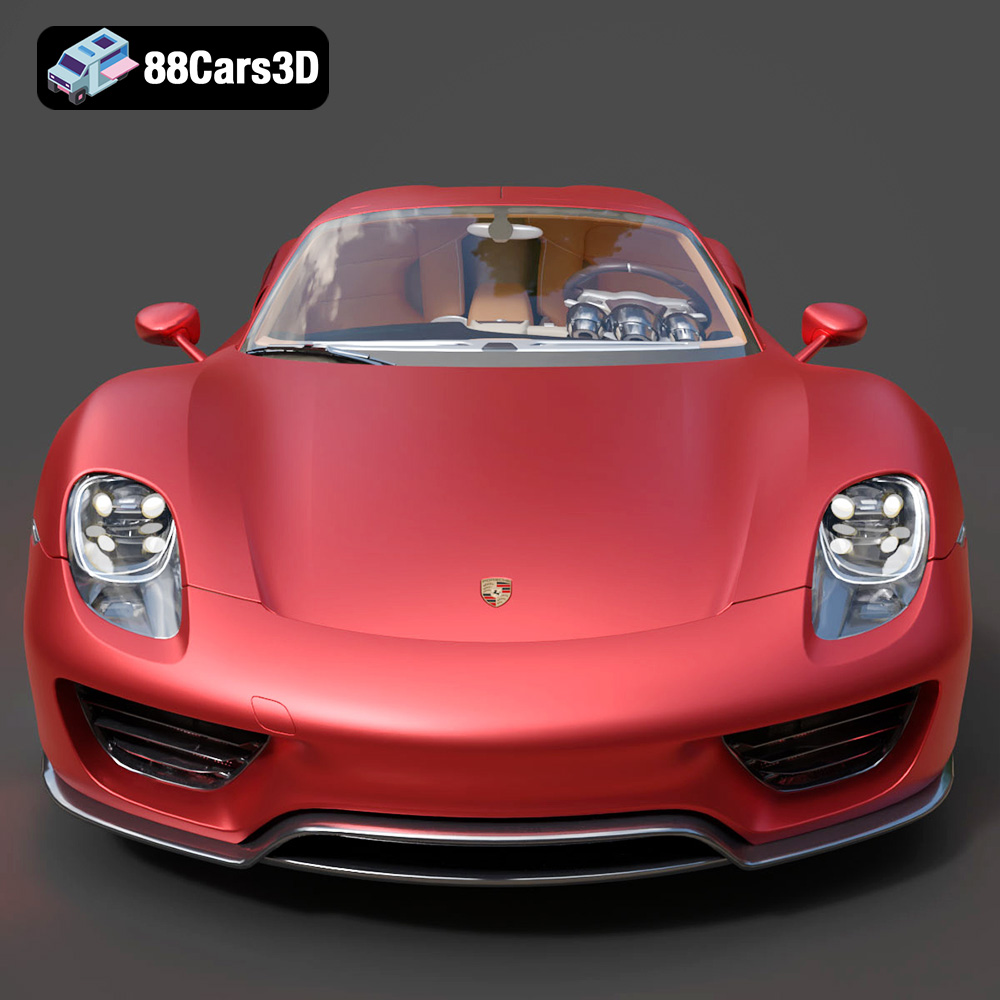
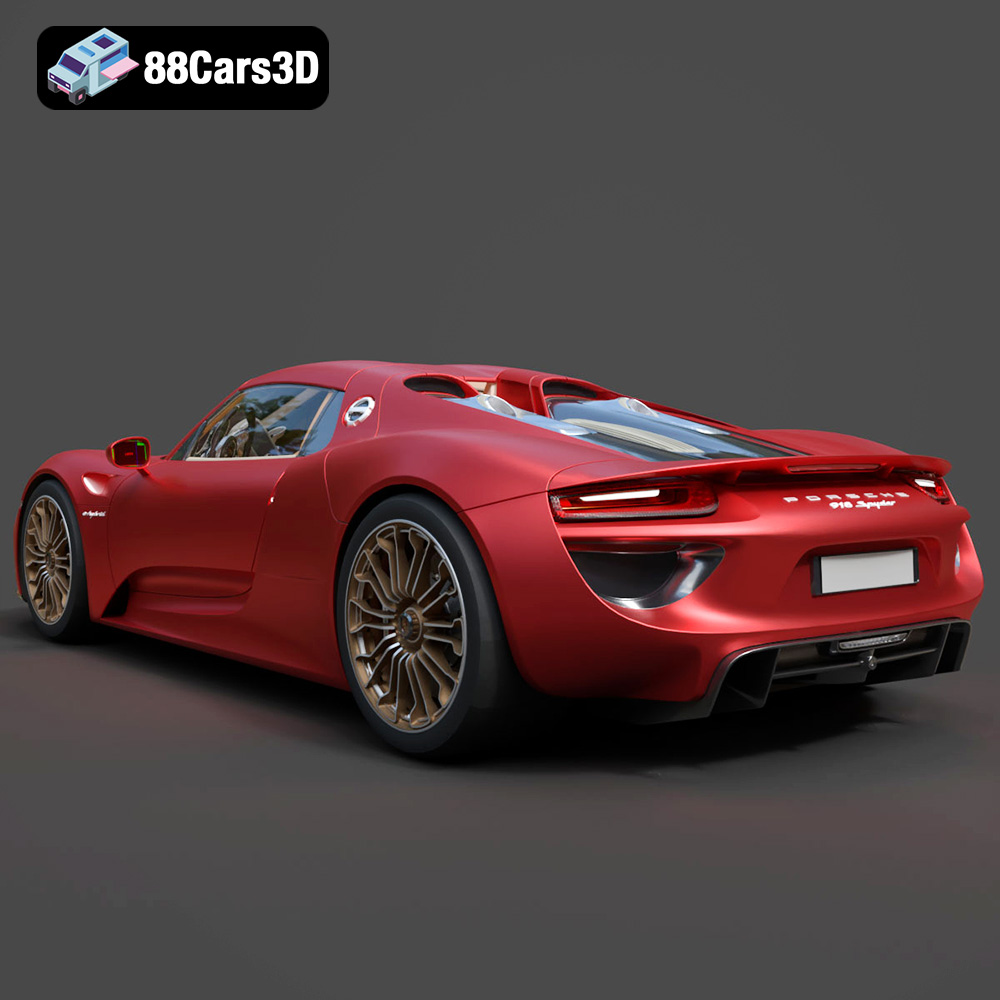
The attention to detail extends beyond the primary silhouette. On the exterior, signature elements like the four-point LED headlights, sleek 3D taillight blades, aggressive rear diffuser, and active aerodynamic rear wing are all meticulously modeled. The detailed lightweight forged alloy wheels reveal massive carbon-ceramic brake calipers, adding another layer of realism crucial for close-up shots. Inside, the model offers an authentic driver-centric cockpit layout, blending luxury with high-tech carbon fiber. The sweeping, elevated center console geometry with digital displays, premium sport bucket seat geometry, and the signature sport steering wheel with its driving mode selector dial are all accurately represented. The interior geometry is further optimized for a smooth first-person POV, making it ideal for immersive gaming or VR experiences where players might sit inside the car.
The true measure of a versatile 3D asset lies in its adaptability across a spectrum of real-world production scenarios and its potential for artistic customization. The Porsche 918 Spyder 3D model offers both in abundance.
Imagine a global advertising agency tasked with creating a launch commercial for a new luxury product. Instead of costly physical shoots, they can leverage a premium 3D car model like the Porsche 918 Spyder. They could place the hypercar in various CGI environments—a futuristic cityscape, a desolate desert road, or a sleek studio—all rendered with absolute photorealism. For game studios, this model could be the centerpiece of a new racing title, a “hero” car that players aspire to unlock, fully drivable and customizable. In the architectural visualization sector, a well-placed, high-fidelity 3D car model can breathe life and aspiration into a rendered scene of a luxury garage or a modern villa. The fact that this model is ready for both rendering and real-time engines ensures its relevance across multiple disciplines. 88cars3d.com consistently provides high-quality 3D car models that empower these professional workflows.
While the base model is incredibly detailed, true creative freedom often comes with customization options. The Porsche 918 Spyder 3D model is designed with this in mind. Artists can effortlessly configure scenes with the roof panels securely on or artfully placed in the virtual background to emphasize the Spyder profile. The model’s clean topology and material setup allow for easy application of various textures and shaders. Imagine applying legendary “Weissach Package” wraps, such as the classic Martini Racing or Salzburg liveries, to instantly transform its character. Exterior paint colors can be changed to match striking factory PTS (Paint to Sample) options, giving each render a unique identity. Furthermore, adapting lighting for dramatic, neon-lit nighttime city streets or bright, sun-drenched race track environments can profoundly alter the mood and narrative of your visuals.
Beyond screen-based applications, the Porsche 918 Spyder 3D model also extends its utility into the physical world through 3D printing. Convertible to the .stl format, it allows hobbyists and professionals to fabricate display-scale models (recommended 1:24, 1:18, or 1:12). For optimal results, resin printing is highly recommended to capture the sharp aero edges, intricate top exhausts, and delicate wheel spokes that define the 918 Spyder. Specific print settings are crucial: layer height between 0.04–0.12 mm, wall thickness of 1.2–2.0 mm, and an infill of 15–25%. Supports will be necessary for complex overhangs like the side mirrors, aggressive front splitter, rear wing, and of course, the detached roof panels. Post-processing, including sanding, priming, and applying striking Porsche colors like Liquid Metal Silver or Guards Red with Acid Green hybrid brake caliper details, can transform a digital file into a tangible, collectible automotive masterpiece.
The Porsche 918 Spyder stands as a beacon of automotive engineering, and its digital counterpart, the Porsche 918 Spyder (With Detachable Roof) 3D Model, similarly sets a high bar for 3D assets. From its meticulously optimized geometry and versatile file format offerings to its animation-ready features and potential for both stunning renders and interactive experiences, this model is a testament to what professional-grade 3D car models can achieve. Whether you’re a game developer seeking a hero car, an automotive rendering artist crafting a cinematic masterpiece, an AR/VR designer building an immersive showroom, or a hobbyist bringing a digital dream to life via 3D printing, this asset provides the foundation for unparalleled creativity.
Investing in a high-fidelity 3D model like this from a trusted source such as 88cars3d.com means acquiring not just a digital file, but a powerful tool engineered to streamline workflows, enhance visual quality, and unlock new creative possibilities. It’s more than just polygons and textures; it’s the essence of a hypercar, ready to accelerate your next project.
The Porsche 918 Spyder 3D Model is a breathtaking digital recreation of one of the most legendary German hypercars ever produced. Forming one-third of the automotive world’s modern “Holy Trinity,” the 918 Spyder redefined the supercar landscape by pairing a high-revving naturally aspirated V8 with advanced dual electric motors. This 3D model accurately captures the sleek, aerodynamically sculptured aesthetic of the hybrid hypercar. Most notably, this model features the signature fully detachable Targa-style roof panels, allowing you to seamlessly switch between the closed-coupe track profile and the open-air Spyder configuration. It also features the iconic top-exit exhaust pipes, four-point LED headlights, aggressive rear diffuser, and active aerodynamic rear wing. Built with an incredibly efficient, clean mid-polygon topology (just over 443k triangles), it provides flawless visual fidelity for stunning close-up automotive renders while remaining perfectly lightweight for real-time game engines. Perfect for high-speed racing simulators, luxury automotive galleries, cinematic commercial visualizations, and AR/VR supercar showrooms.
$55