Get 50% OFF All Premium 3D & STL Models!

There’s an undeniable allure to classic automobiles, especially those with a storied racing pedigree. These machines represent more than just transportation; they embody eras of engineering innovation, design elegance, and thrilling competition. For artists, developers, educators, and enthusiasts alike, bringing these legends to life in the digital realm presents a unique opportunity. Whether for breathtaking visualizations, immersive game environments, or detailed historical simulations, the demand for meticulously crafted 3D car models continues to grow.
Today, we’re taking a closer look at a prime example of digital automotive artistry: the BMW 328 Mille Miglia Touring Coupe 3D Model. This iconic pre-war racing coupe, celebrated for its lightweight tubular frame and aerodynamic aluminum body crafted by Touring of Milan, achieved legendary status in the 1940 Mille Miglia endurance race. Recreating such a piece of history requires an exceptional level of detail and technical precision, making it an invaluable asset for a myriad of professional applications.
In this comprehensive guide, we’ll explore the intricate world of high-fidelity 3D automotive assets, from understanding essential file formats to integrating models into complex workflows for rendering, game development, and even 3D printing. We’ll delve into the technical specifications that define a truly professional model and showcase how assets like the BMW 328 Mille Miglia Touring Coupe 3D Model from 88cars3d.com empower creators to realize their most ambitious projects.
In the expansive universe of 3D content creation, understanding the various file formats is paramount. Each format serves specific purposes, optimized for different stages of the production pipeline, from initial modeling to real-time rendering and physical fabrication. The BMW 328 Mille Miglia Touring Coupe 3D Model, available on 88cars3d.com, is offered in a comprehensive suite of formats, ensuring maximum compatibility and utility across diverse professional workflows. Let’s break down these essential formats and their optimal use cases.
The .blend format is the native file type for Blender, a powerful, open-source 3D creation suite. When you receive a .blend file, you’re gaining access to a fully editable Blender scene, complete with materials, textures, lighting, camera setups, and even animation data. This makes it ideal for artists who primarily work within Blender, offering unparalleled flexibility for customization, tweaking shaders, adjusting geometry, or re-rigging components for specific animations. For the BMW 328 Mille Miglia Touring Coupe 3D Model, the .blend file provides a complete, ready-to-render setup within Blender, allowing for immediate artistic exploration.
Autodesk’s .fbx format is arguably the most widely adopted interchange format in the 3D industry. It’s designed for high fidelity data exchange between different 3D software applications and, crucially, is the preferred format for real-time engines like Unreal Engine and Unity. An .fbx file can encapsulate geometry, materials, textures, animations, rigging, and even scene hierarchy. For projects involving game development or real-time visualization, an .fbx version of the BMW 328 Mille Miglia Touring Coupe 3D Model is invaluable, ensuring a smooth transition into your interactive pipeline with minimal loss of data or visual integrity.
The .obj (Wavefront OBJ) format is a universal standard, prized for its simplicity and wide cross-software compatibility. It primarily stores geometry (vertices, normals, UV coordinates) and can reference external material (.mtl) and texture files. While it doesn’t support complex features like animation or rigging, its widespread support makes it an excellent choice for basic model exchange when you need to bring a static mesh into almost any 3D application. For many artists, the .obj version of the BMW 328 Mille Miglia Touring Coupe 3D Model serves as a reliable fallback or a starting point for re-texturing in a different renderer.
.glb (GL Transmission Format Binary) is a relatively newer format that has gained significant traction, especially in augmented reality (AR), virtual reality (VR), and browser-based 3D applications. It’s a self-contained, binary format that efficiently packages 3D model data, including geometry, materials, textures, and animations, into a single file. This optimization for quick loading and display makes the .glb version of the BMW 328 Mille Miglia Touring Coupe 3D Model perfect for web viewers, mobile AR experiences, or interactive museum exhibits.
The .stl (STereoLithography) format is the cornerstone of 3D printing. It represents a 3D model as a series of connected triangles, defining only the surface geometry without color, texture, or material information. This “manifold” mesh structure is what 3D printers understand. The inclusion of an .stl option for the BMW 328 Mille Miglia Touring Coupe 3D Model directly caters to enthusiasts and professionals looking to produce physical collectibles or prototypes, ensuring the geometry is optimized for additive manufacturing processes.
The .ply (Polygon File Format) is another format for storing 3D data, particularly useful for scanned data, CAD, and scientific applications. It can store a wider range of properties than .obj, including color, transparency, normals, and even confidence values for each vertex. For precise engineering visualization or detailed analysis of the BMW 328 Mille Miglia Touring Coupe 3D Model’s shape, the .ply format offers a robust, feature-rich representation.
The .unreal designation often implies an asset specifically prepared or packaged for direct integration into Unreal Engine. While Unreal primarily uses .fbx for import, a .unreal file might refer to a complete Unreal Engine asset package (.uasset) containing not just the mesh, but also configured materials, collision data, LODs (Levels of Detail), and blueprints, ready to be dropped into a project. This format dramatically streamlines workflows for game developers or virtual production artists utilizing Unreal Engine.
Similar to .blend for Blender, the .max format is the native project file for Autodesk 3ds Max. It contains the entire scene data, including geometry, materials, textures, lighting, cameras, modifiers, and animation. For professionals working in 3ds Max, having the BMW 328 Mille Miglia Touring Coupe 3D Model in .max format means full parametric control, the ability to modify stack histories, and access to all the scene’s original setup, making it ideal for high-end rendering and animation studios.
The availability of such a diverse array of formats for the BMW 328 Mille Miglia Touring Coupe 3D Model underscores its versatility and the commitment of 88cars3d.com to providing truly professional-grade 3D car models that meet the demands of any project.
Recreating a classic like the BMW 328 Mille Miglia Touring Coupe is not merely about replicating shapes; it’s about preserving history through digital art. The challenge lies in translating the intangible spirit and intricate details of a legendary vehicle into a perfect 3D car model.
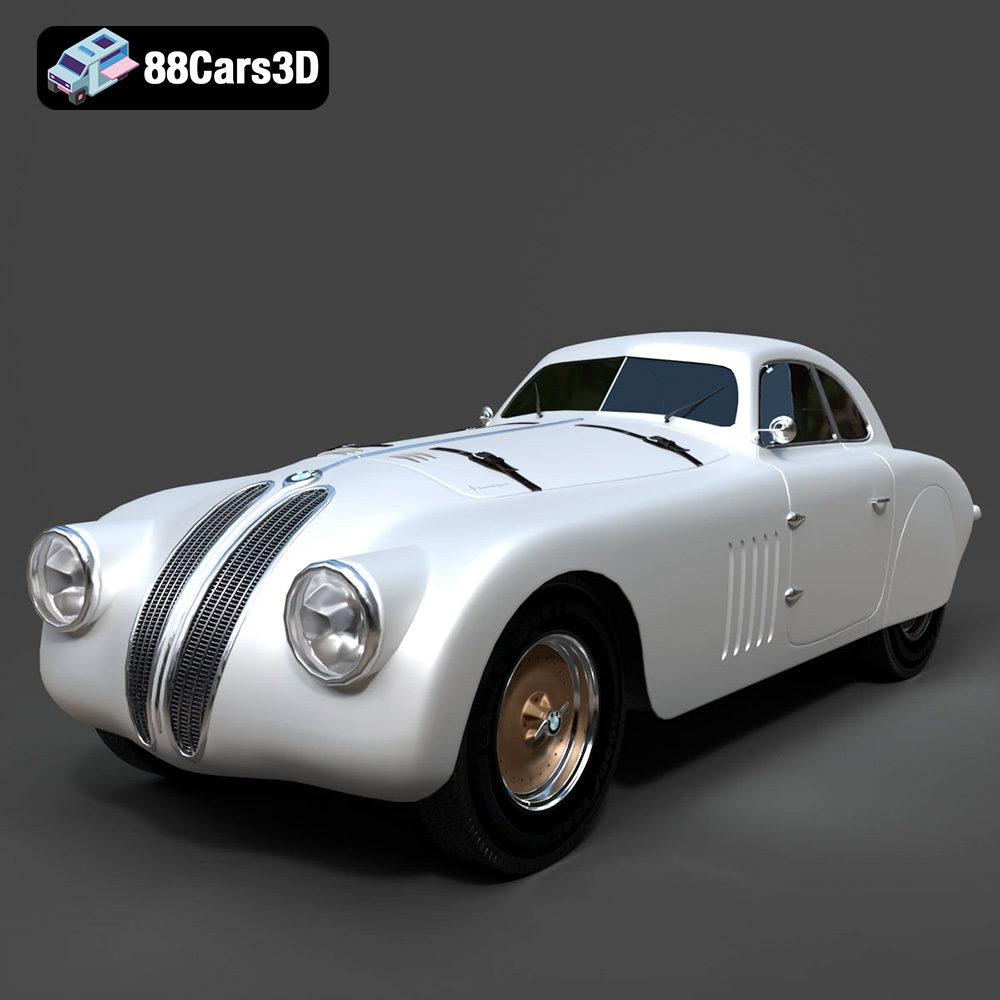
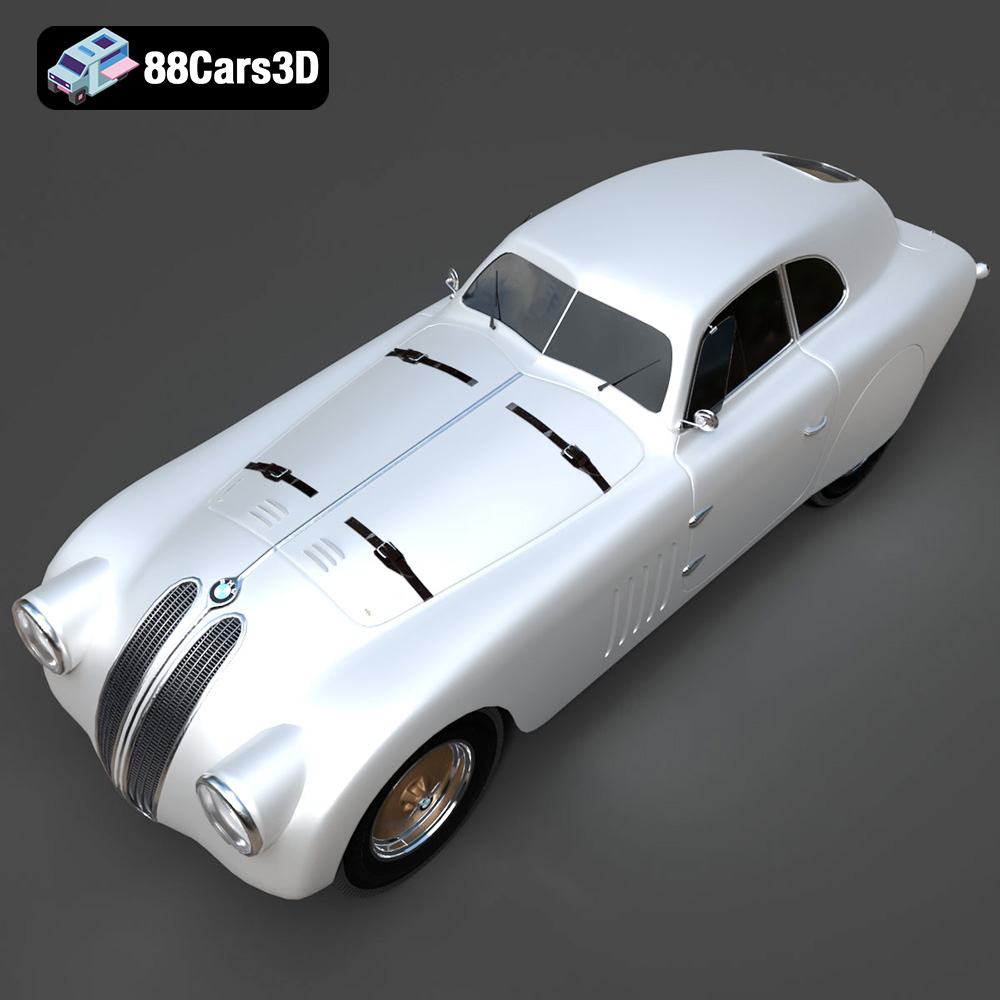
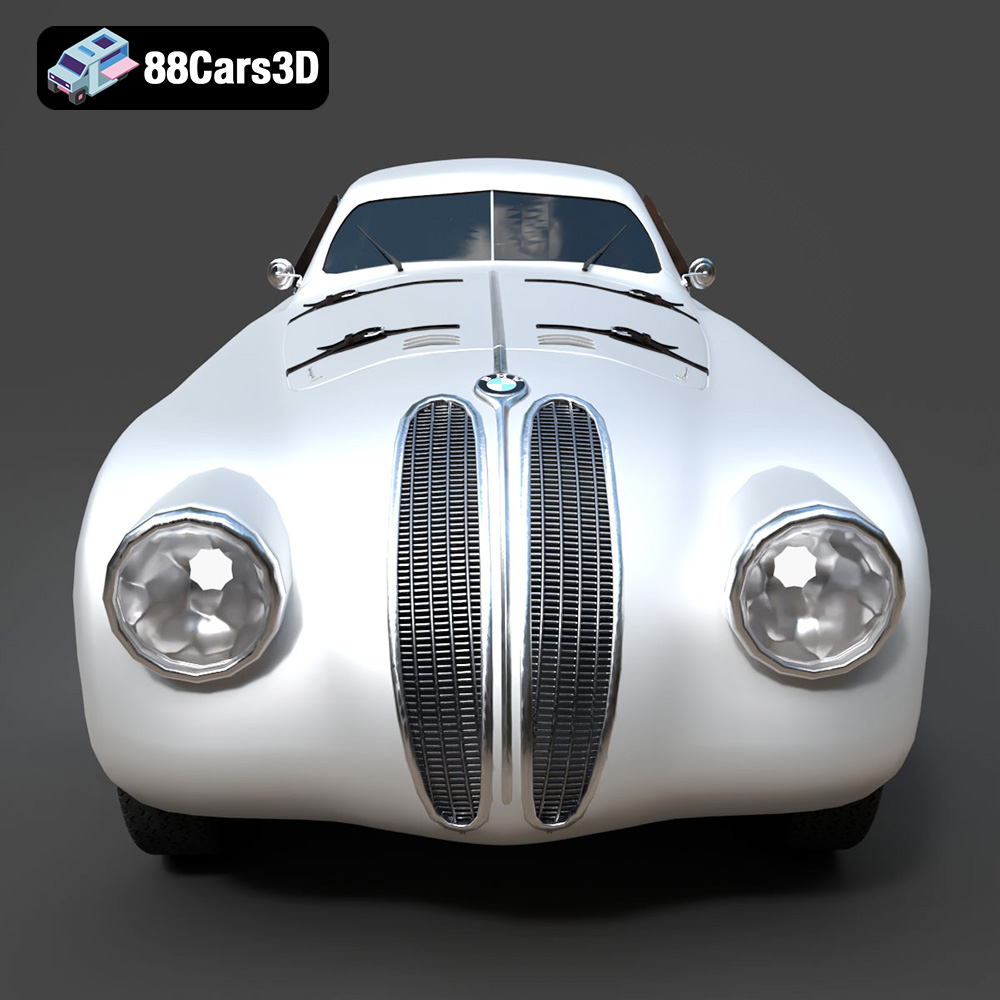
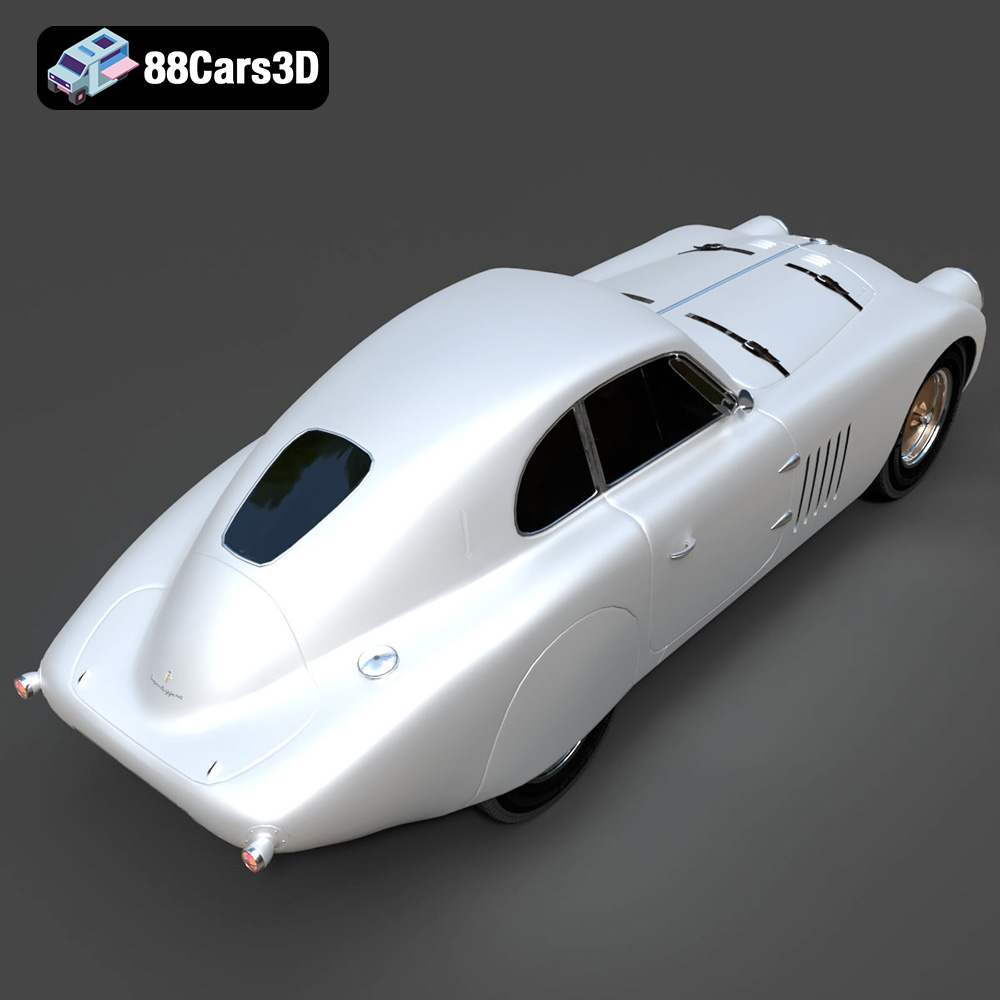
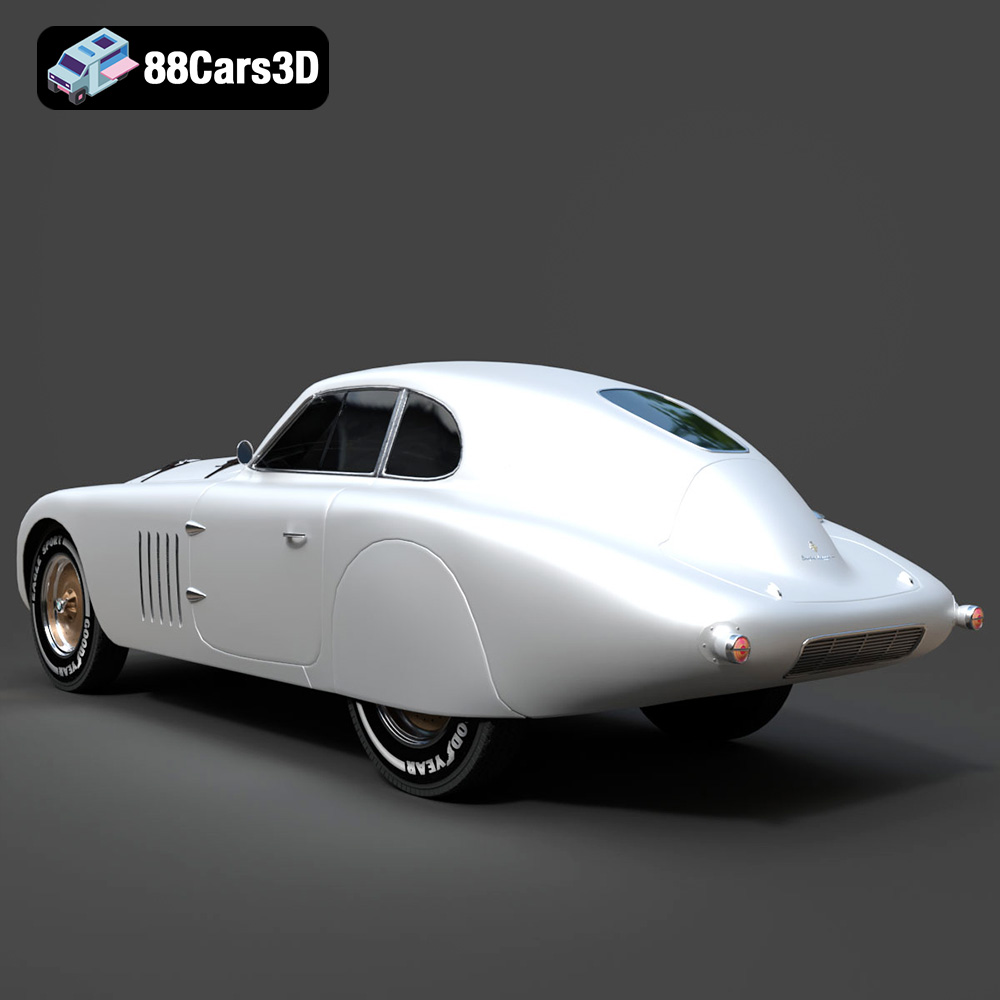
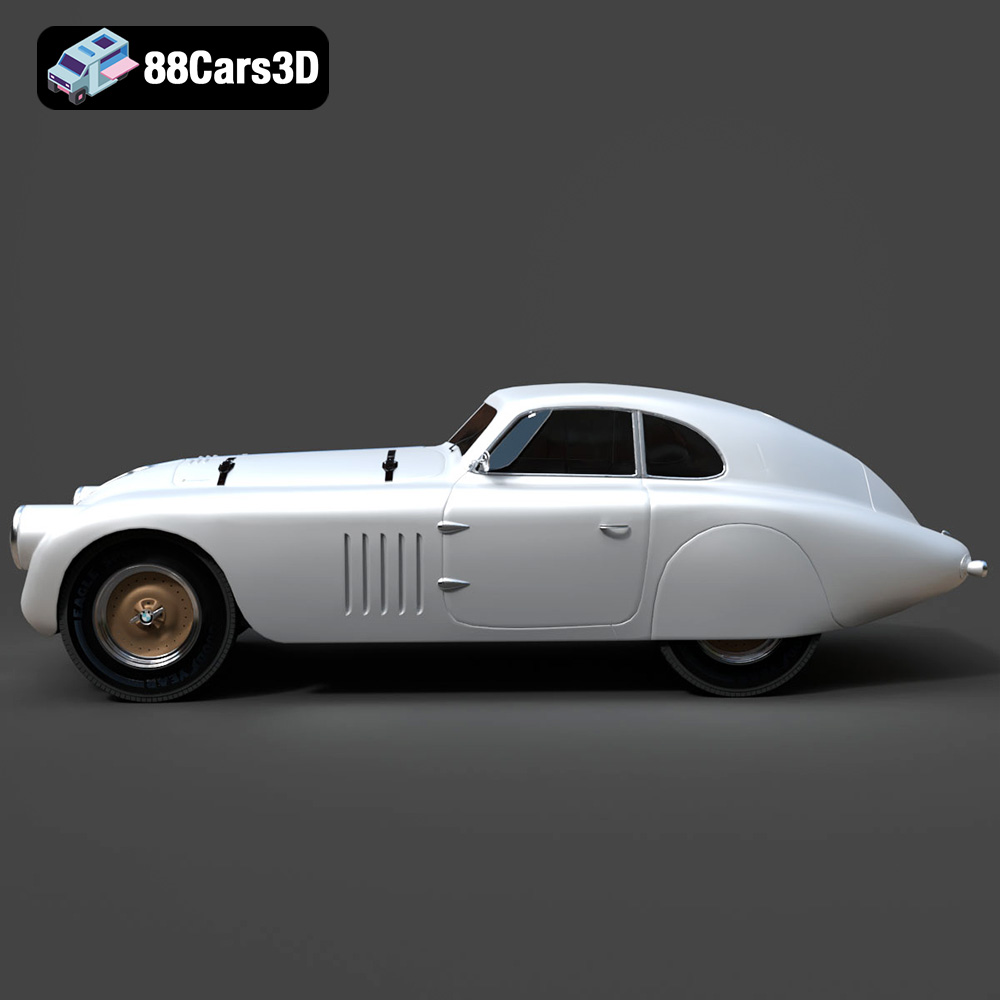
The BMW 328 Mille Miglia Touring Coupe is instantly recognizable by its groundbreaking aerodynamic aluminum body. This 3D model accurately captures its streamlined fastback design, a hallmark of its racing prowess. Every curve, from the distinctive covered headlamps to the iconic kidney grille, is meticulously modeled. The model goes further, including period-correct racing wheels, aerodynamic wheel covers, and subtle chrome trim and emblem detailing that evoke the car’s original splendor. Separate components for wheels and steering allow for dynamic animation, making it ideal for cinematic sequences or realistic driving simulations.
While the exterior wows with its sleek lines, the interior of the BMW 328 Mille Miglia Touring Coupe was a focused, minimalist racing cockpit. The 3D model honors this by reproducing the period-style steering wheel, essential analog instrument cluster, and specialized racing seat configuration. Even the dashboard and control detailing are faithfully recreated, offering a glimpse into the functional aesthetics of vintage motorsport. This attention to both external grandeur and internal purpose ensures the model is not just visually appealing but historically accurate.
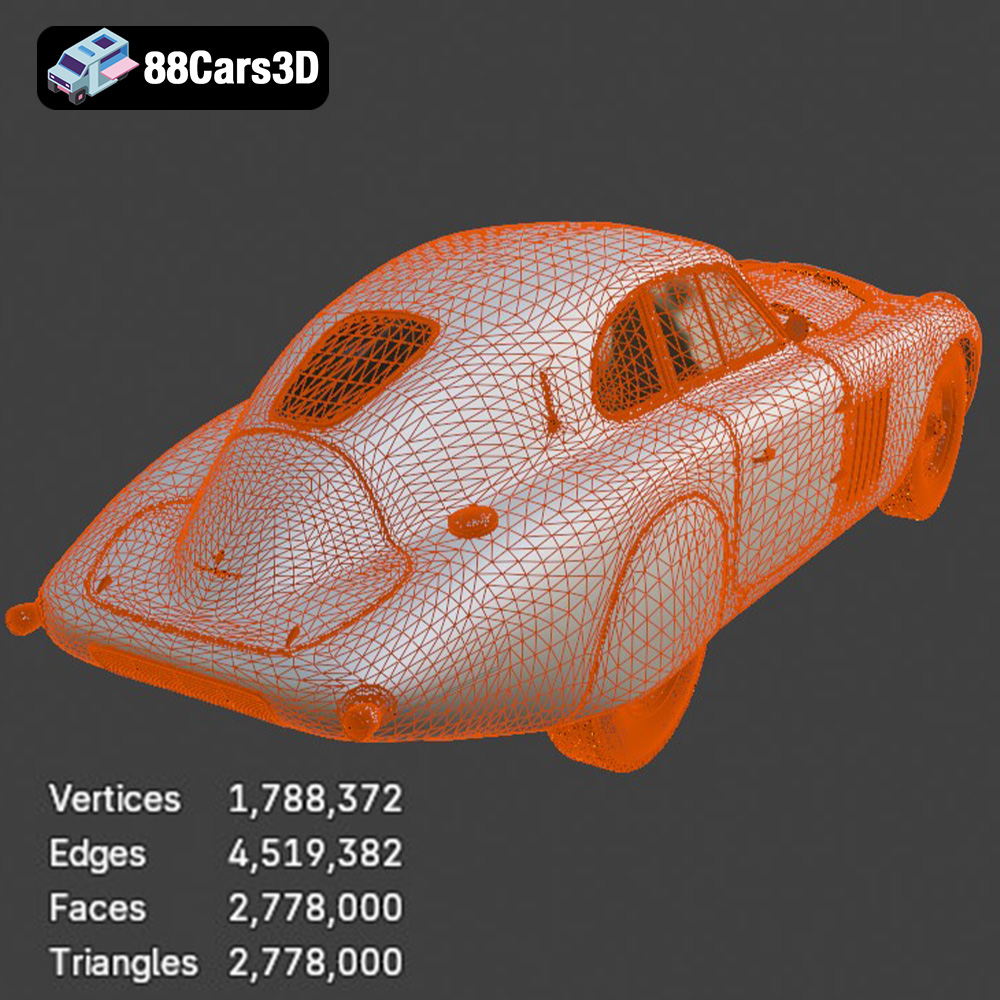
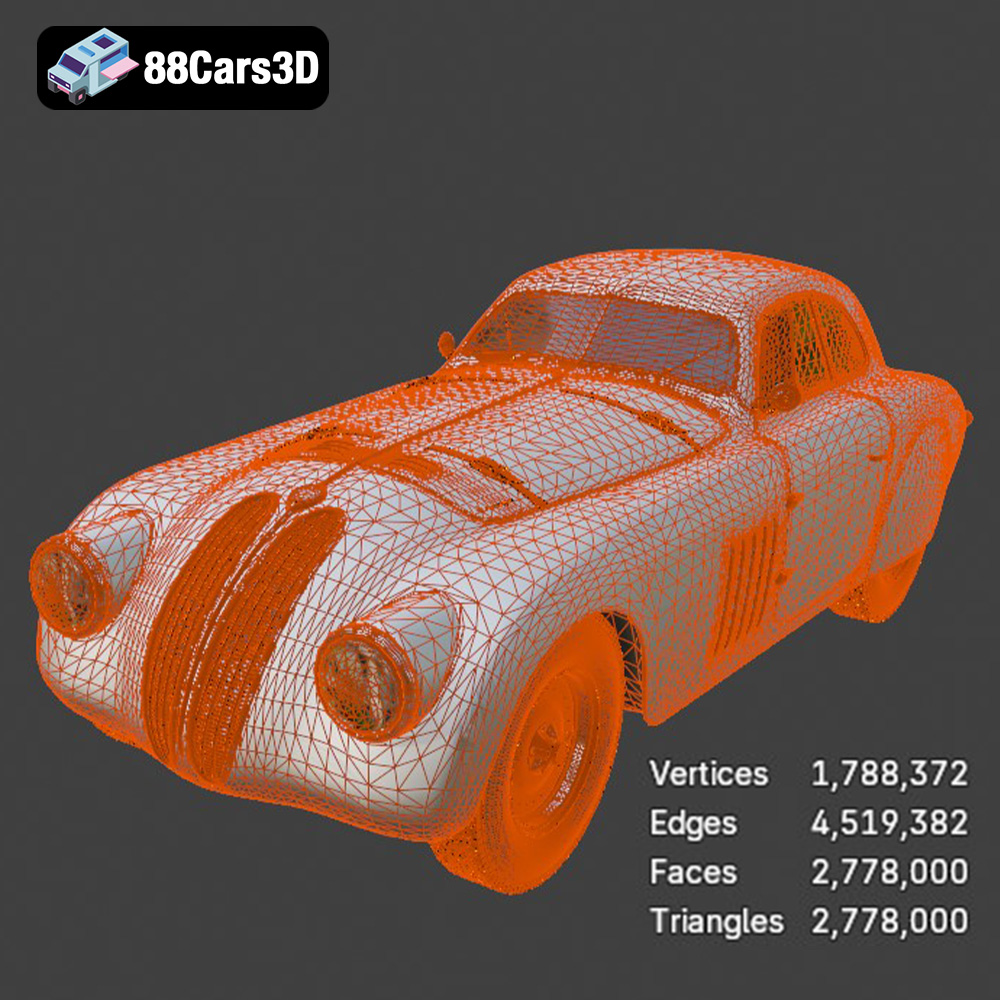
Beyond visual accuracy, a professional 3D car model is defined by its underlying technical foundation. The BMW 328 Mille Miglia Touring Coupe 3D Model boasts a clean and well-organized mesh structure with optimized polygon flow. This means the geometry is efficient, free of errors, and engineered for both performance and realism. Furthermore, real-world scale accuracy is critical for integration into larger scenes or real-time environments, ensuring that the vehicle maintains its proper proportions when placed alongside other assets or in an architectural visualization. Proper pivot setups for steering and wheel rotation are also essential for realistic animation and physics simulations, a detail often overlooked in lesser models.
High-quality 3D car models like the BMW 328 Mille Miglia Touring Coupe are more than just digital sculptures; they are versatile tools that power professional pipelines across industries. Their robust construction and comprehensive format support enable seamless integration into diverse creative projects.
For automotive marketing, museum displays, or historical promotional materials, photo-realistic rendering is paramount. Using software like 3ds Max or Blender, artists can leverage the clean topology and optimized materials of the BMW 328 Mille Miglia Touring Coupe 3D Model to create stunning visuals. Workflows often involve importing the .max or .blend file, setting up advanced physically based rendering (PBR) materials, configuring realistic studio or environment lighting, and applying detailed textures to replicate polished aluminum or vintage paint finishes. Customization options, such as changing body color, adding Mille Miglia race livery, or modifying wheel styles, allow artists to tailor the model for specific narrative or branding requirements, achieving cinematic quality renders.
The world of game development demands efficient, optimized assets that perform well in real-time environments without sacrificing visual fidelity. The .fbx and .unreal formats of the BMW 328 Mille Miglia Touring Coupe 3D Model are specifically designed for this purpose. Developers can import these assets into Unreal Engine or Unity, taking advantage of their optimized geometry and pre-configured materials. The clean mesh structure and proper pivot points are crucial for setting up realistic physics, collision detection, and driving mechanics. This model is perfect for vintage racing games, historical open-world environments, or motorsport simulations, providing authentic game assets that immerse players in a bygone era of racing.
Augmented Reality (AR) and Virtual Reality (VR) applications offer incredibly immersive ways to experience classic cars. For virtual showrooms, interactive museum exhibits, or educational tools, the .glb format provides a lightweight, optimized solution for the BMW 328 Mille Miglia Touring Coupe 3D Model. Developers can integrate the model into ARKit, ARCore, or WebXR projects, allowing users to place the car in their real-world environment or explore its details in a fully virtual space. The optimized geometry ensures smooth performance on a variety of devices, making interactive classic car exhibitions and racing history experiences accessible and engaging.
One of the most exciting capabilities of modern 3D car models is the ability to transform digital data into physical objects. The BMW 328 Mille Miglia Touring Coupe 3D Model is not just for screens; it’s also designed to be 3D printable, opening up new avenues for collectors, hobbyists, and educators to create tangible representations of this automotive legend.
The included .stl format is specifically engineered for additive manufacturing. For optimal results, attention to detail in the slicer software is key. The product’s recommended scales (1:32, 1:24, 1:18, 1:12) allow for diverse display options, from detailed miniatures to larger collectibles. A layer height of 0.08–0.16 mm is suggested to capture the fine curves and intricate details of the fastback body. Wall thickness should be between 1.5–2.5 mm to ensure structural integrity. Given the complex geometry of the BMW 328 Mille Miglia Touring Coupe, supports are required for elements like mirrors, underbody details, and wheel arches to prevent warping and ensure fidelity during printing. Printing the body angled and the wheels separately is a strategic approach that maximizes surface quality and reduces the need for excessive supports on critical visual areas.
Once printed, the physical model benefits greatly from careful post-processing. This typically involves sanding to smooth layer lines, applying a primer to unify the surface, and then choosing a paint finish. For a truly authentic look, a gloss vintage racing paint finish is ideal, perhaps complemented by optional historical race decals to celebrate its Mille Miglia legacy. This iterative process of digital design, physical fabrication, and artistic finishing allows enthusiasts to own a piece of automotive history, making the BMW 328 Mille Miglia Touring Coupe 3D Model a versatile asset for both virtual and real-world applications.
The distinction between a casual 3D asset and a professional-grade 3D car model often lies in its technical underpinnings. For the BMW 328 Mille Miglia Touring Coupe 3D Model, these details are crucial for delivering exceptional results in diverse applications, from high-fidelity automotive rendering to real-time game assets.
A “clean and well-organized mesh structure” means the model utilizes efficient polygon distribution (poly flow) without unnecessary vertices or overlapping faces. This is vital for smooth deformations if the model is animated and ensures accurate subdivision if used in high-fidelity rendering. While specific poly counts aren’t provided, an optimized polygon flow suggests the model balances detail with performance. For real-time applications, Levels of Detail (LODs) are usually implemented. Although not explicitly mentioned as included, the clean base mesh of the BMW 328 Mille Miglia Touring Coupe 3D Model provides an excellent foundation for generating multiple LODs, allowing game engines to swap lower-resolution versions of the car at a distance to maintain frame rates, without compromising visual quality up close.
Effective UV mapping is fundamental for applying textures accurately and efficiently. Clean UVs prevent stretching or distortion of textures, ensuring that intricate details like chrome trim or period-correct emblems render flawlessly. The model is stated to include materials and textures, indicating it’s ready for Physically Based Rendering (PBR) workflows. PBR materials accurately simulate how light interacts with surfaces, producing highly realistic reflections, refractions, and diffuse lighting. This allows for rich, detailed surface qualities, whether replicating the smooth aluminum-style body panels or the vintage leather of the interior cockpit, enhancing the overall realism in any rendering engine or real-time environment.
The “proper pivot setup for steering and wheel rotation” is a small but critical technical detail that signifies a production-ready asset. Correct pivot points ensure that animations are smooth and realistic, whether for a cinematic sequence depicting the car racing down a digital Mille Miglia track or for interactive driving mechanics in a game. This pre-configured readiness saves artists and developers significant time and effort in the rigging and animation phase. Furthermore, the “real-world scale accuracy” ensures effortless integration into larger scenes, whether placing the car on a virtual concourse lawn or within a historically accurate street environment, guaranteeing its proportions are correct relative to other architectural elements or characters.
The world of 3D modeling offers endless possibilities for creative expression and technical innovation, particularly when it comes to preserving and reimagining automotive heritage. High-quality 3D car models are indispensable tools for professionals across various industries, enabling everything from stunning automotive rendering to immersive game experiences and tangible 3D prints.
The BMW 328 Mille Miglia Touring Coupe 3D Model stands as a testament to the meticulous craftsmanship and technical prowess required to recreate such a legendary vehicle. Its accurate detailing, clean topology, real-world scale, and comprehensive file format support make it an exceptionally versatile asset. Whether your project demands breathtaking visualizations, realistic game assets, interactive AR/VR experiences, or a physical scale model, this digital recreation of the iconic Mille Miglia winner is designed to exceed expectations.
By understanding the nuances of 3D model formats, appreciating the blend of historical accuracy and technical optimization, and exploring the diverse professional workflows, creators can unlock the full potential of such assets. Discover this exquisite model and many other premium 3D car models for your next project at 88cars3d.com, where quality and versatility drive innovation.
The BMW 328 Mille Miglia Touring Coupe 3D Model is a high-detail digital recreation of the legendary pre-war racing coupe that achieved historic success in the 1940 Mille Miglia endurance race. Renowned for its aerodynamic aluminum body crafted by Touring of Milan and its lightweight tubular frame, the BMW 328 Mille Miglia Coupe stands as an icon of classic motorsport engineering. This 3D model accurately represents the streamlined fastback body, covered headlamps, signature kidney grille design, aerodynamic wheel covers, racing cockpit layout, and period-correct detailing. Built with clean topology and real-world scale accuracy, it is ideal for rendering, animation, historical visualization, game development, and AR/VR classic automotive showcases. Convertible to .stl format for collectible scale classic race car models and display miniatures.
$29.99
.arvr
.blend
.bmw328
.car3dmodel
.classicracecar
.fbx
.gameasset
.glb
.max
.millemiglia
.motorsport
.obj
.ply
.prewarcar
.rendering
.simulation
.stl
.touringcoupe
.unreal
.vintagecar