Get 50% OFF All Premium 3D & STL Models!

In the rapidly evolving digital landscape, high-quality 3D car models have become indispensable tools across a multitude of industries. From captivating cinematic renderings and immersive game environments to detailed architectural visualizations and practical 3D printing projects, the demand for meticulously crafted automotive assets continues to grow. These digital representations are far more than just pretty pictures; they are complex data sets that form the backbone of modern creative and engineering workflows. They enable designers to visualize concepts with unparalleled realism, developers to build engaging interactive experiences, and artists to populate virtual worlds with believable detail.
The versatility of a well-made 3D vehicle model is paramount. It must seamlessly integrate into diverse software ecosystems, offer robust technical specifications, and retain its fidelity whether viewed up close in a high-resolution render or scaled down for a real-time application. This is precisely where assets like the Daewoo Damas 2 Microvan 3D Model shine. This particular model isn’t just a static object; it’s a meticulously recreated digital twin of a vehicle celebrated for its practicality and ubiquity. Its inclusion in your asset library opens doors to realistic urban scenes, unique game development scenarios, and specialized visualization projects that require an authentic touch. Its comprehensive design and broad format support make it a prime example of the kind of versatile, high-utility 3D assets that professionals seek, readily available at marketplaces like 88cars3d.com.
The true power and versatility of a 3D car model often lie in the range of file formats it supports. Each format is designed with specific use cases, compatibility requirements, and technical advantages in mind. Understanding these distinctions is crucial for anyone working with 3D assets, whether for rendering, game development, or 3D printing. The Daewoo Damas 2 Microvan 3D Model from 88cars3d.com, for instance, comes equipped with a comprehensive suite of formats, ensuring maximum utility across virtually any professional pipeline.
The .blend format is Blender’s native file type, offering a complete and fully editable scene. When you receive a .blend file, you’re getting more than just a mesh; you’re getting the entire project with its material setup, lighting, cameras, animation data, and even modifiers. This provides an immense advantage for artists and studios that primarily use Blender, allowing for deep customization, adjustments to topology, material tweaks, and easy integration into existing Blender projects. For the Daewoo Damas 2, the .blend file would include all its meticulously crafted PBR materials and organized scene structure, making it incredibly flexible for artists looking to modify details or re-texture it for a specific aesthetic.
.fbx (Filmbox) stands as one of the most widely adopted proprietary file formats for 3D data exchange, especially prevalent in game development and animation pipelines. Developed by Autodesk, it efficiently stores 3D models, animation, cameras, and lights in a single file, making it ideal for transferring assets between different software applications like 3ds Max, Maya, Blender, Unity, and Unreal Engine. Its robust support for skeletal animation, blend shapes, and PBR materials makes it the go-to choice for real-time applications. For the Daewoo Damas 2 Microvan, an .fbx file ensures that all its movable parts—like wheels, doors, and steering components—retain their pivot points and potential animation capabilities when imported into a game engine, making it a truly game-ready asset.
The .obj (Wavefront Object) format is a venerable, open, and universally supported 3D geometry definition file. While it primarily stores vertex positions, normals, texture coordinates, and faces, it doesn’t natively support animation or complex scene data. However, its simplicity makes it incredibly compatible across virtually all 3D software packages, serving as an excellent fallback for basic mesh transfer. It’s often paired with an .mtl (Material Template Library) file for basic material definitions and references texture maps. The .obj version of the Daewoo Damas 2 model would be perfect for scenarios where you need to quickly import the base geometry into a new application for a fresh material setup or for use in less complex rendering scenarios.
.glb (GL Transmission Format Binary) is the binary version of glTF, a royalty-free specification for 3D scenes and models. Designed to be a compact, efficient, and runtime-agnostic format, .glb is rapidly gaining traction for web-based 3D, augmented reality (AR), and virtual reality (VR) applications. It bundles all necessary data—geometry, materials, textures, and animation—into a single file, minimizing HTTP requests and enabling faster loading times. For showcasing the Daewoo Damas 2 in an immersive AR experience or directly on a web page, the .glb format provides an optimized, high-fidelity solution.
The .stl (STereoLithography) format is the absolute standard for 3D printing. It describes only the surface geometry of a 3D object using a collection of interconnected triangles, making it a “tessellated” representation. It lacks color, texture, or material information, focusing purely on manifold geometry suitable for manufacturing. The Daewoo Damas 2 Microvan’s .stl file would be pre-processed and optimized for physical production, allowing enthusiasts and professionals to print scale models of this iconic vehicle, complete with its distinct proportions and features.
.ply (Polygon File Format or Stanford Triangle Format) is another format that describes 3D objects as a list of polygons. While similar to .obj and .stl, .ply can also store additional properties like color, transparency, and even specific data associated with vertices and faces, such as normal vectors, texture coordinates, or confidence values. This makes it particularly useful for scanned data, scientific visualization, or applications requiring precise mesh data for analysis or CAD workflows. For highly technical inspections or specific manufacturing processes, the .ply format of the Daewoo Damas 2 could offer advantages.
The .unreal format, or more accurately, assets that are “Unreal Engine-ready,” typically refers to a meticulously prepared .fbx file combined with a complete project structure, materials, textures, and blueprints organized within an Unreal Engine project. This means the Daewoo Damas 2 Microvan has been specifically optimized, often with LODs (Levels of Detail), collision meshes, and properly configured materials (like PBR textures), ready for drag-and-drop integration into Unreal Engine projects. This saves developers countless hours of import, setup, and optimization work, allowing them to focus immediately on game logic and scene assembly.
Finally, the .max format is Autodesk 3ds Max’s native file type. Similar to .blend for Blender, it encapsulates the entire 3ds Max scene, including geometry, materials, textures, lighting, cameras, animation, and any applied modifiers or plugins. This provides the most comprehensive control for users of 3ds Max, allowing for deep architectural and scene integration, advanced rendering with V-Ray or Corona, and complex animation rigging. The .max file for the Daewoo Damas 2 Microvan would be invaluable for professional studios using 3ds Max for high-end rendering and animation of the vehicle in sophisticated commercial or cinematic projects.
The availability of such a diverse array of formats for the Daewoo Damas 2 Microvan 3D Model underscores its professional-grade design, ensuring it can be a valuable asset in nearly any creative or technical pipeline.
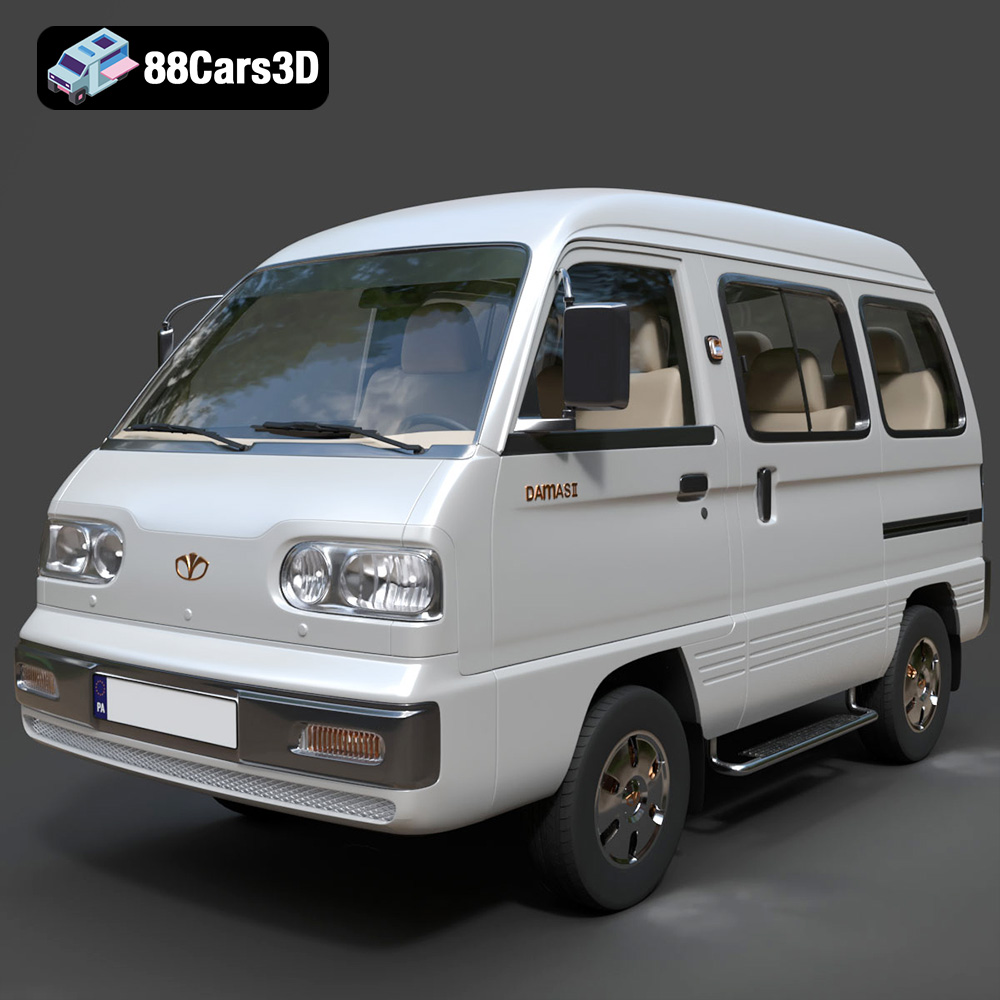
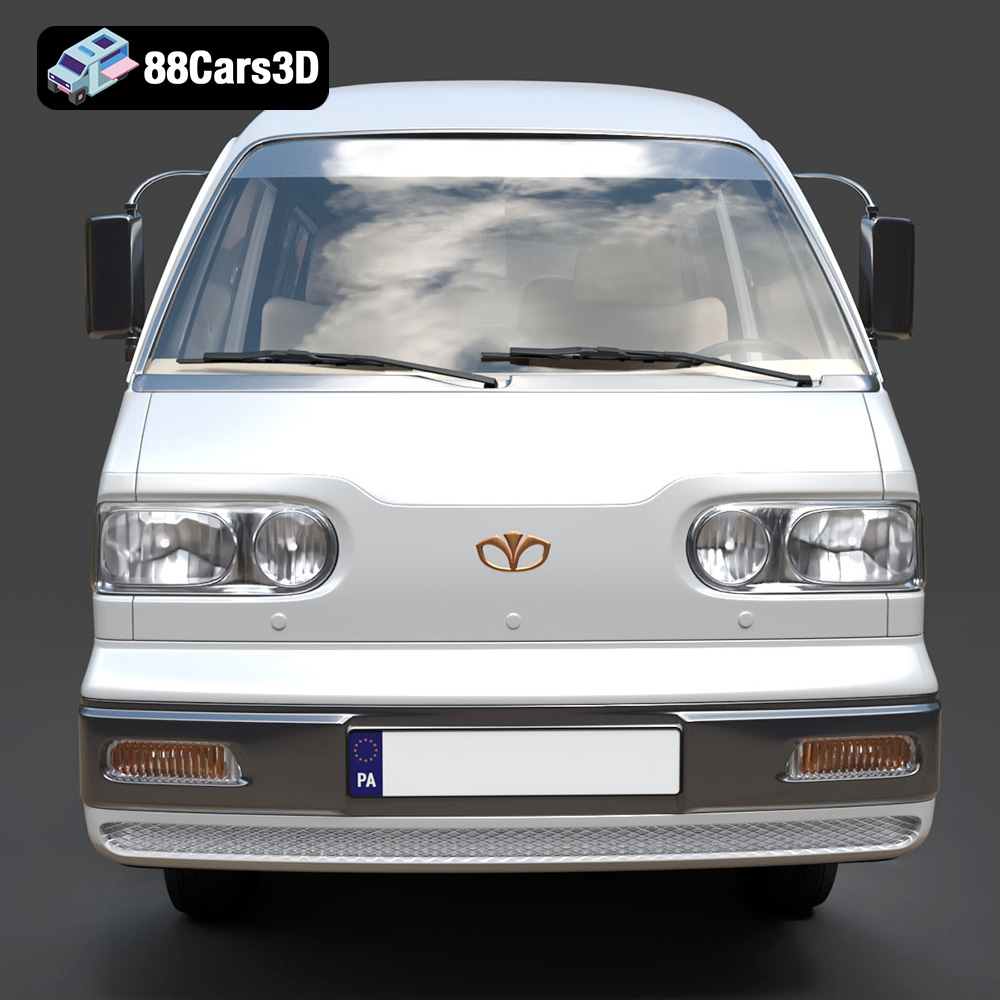
The Daewoo Damas 2 Microvan is more than just a vehicle; it’s a cultural icon in many parts of the world, synonymous with urban agility and commercial practicality. Originally based on the classic Suzuki Carry kei-van, the Damas 2 specifically refers to the facelifted variant, boasting a subtly modernized, more rounded front fascia, distinct curved headlights, and updated indicator clusters. This particular iteration became a ubiquitous sight, particularly across South Korea, Uzbekistan, and various Eastern European nations, serving tirelessly as a delivery van, taxi, or compact passenger transport.
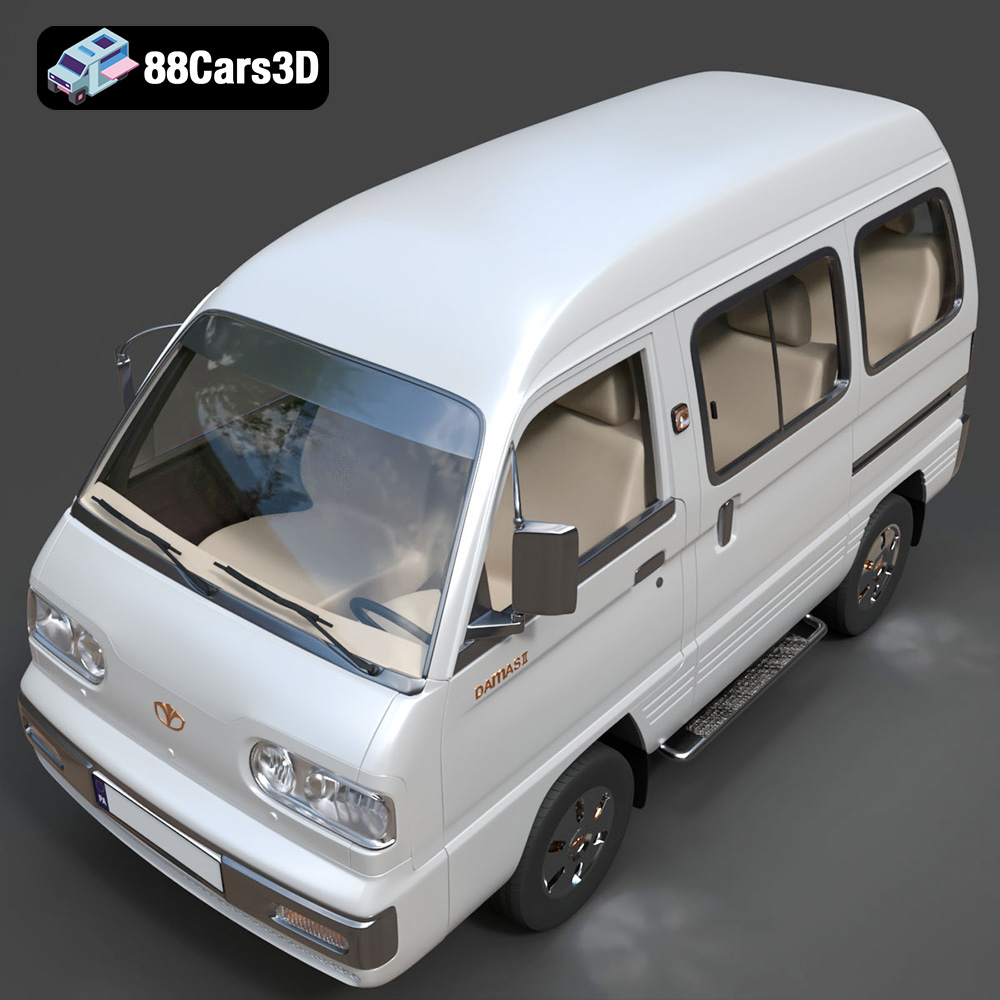
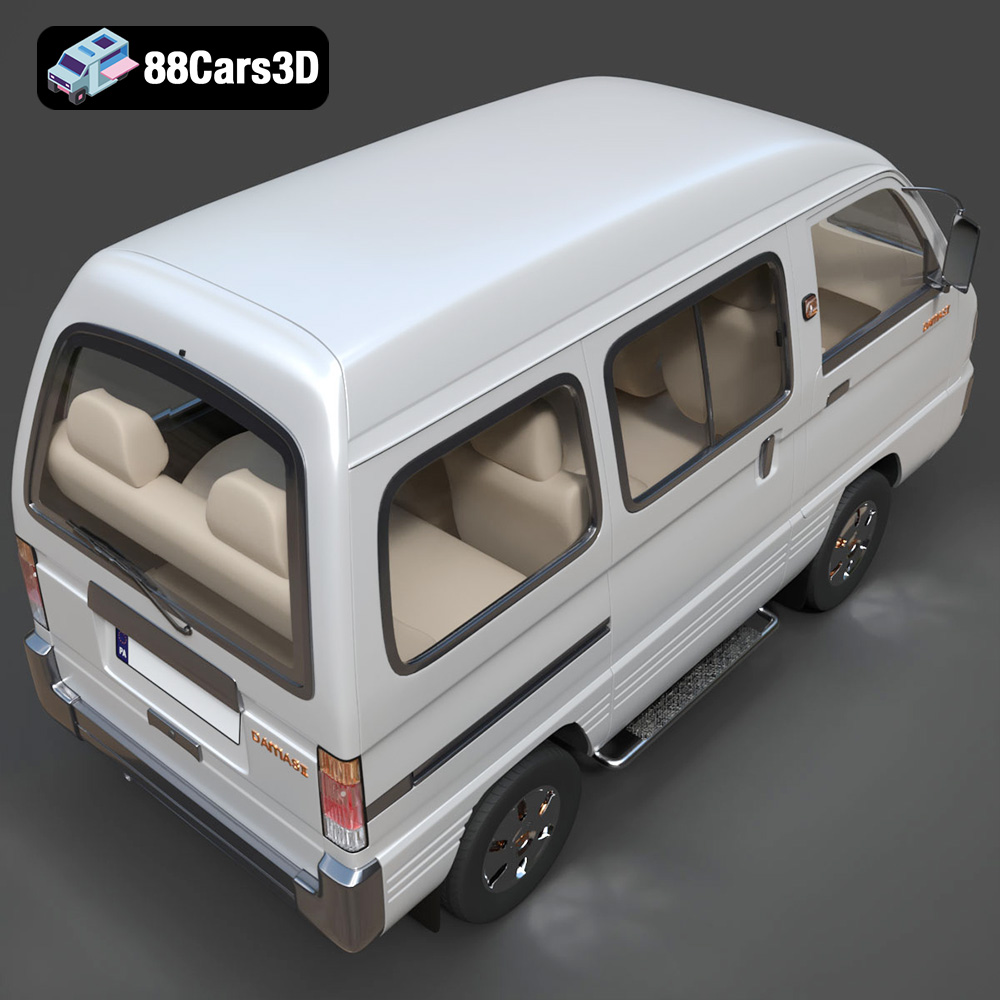
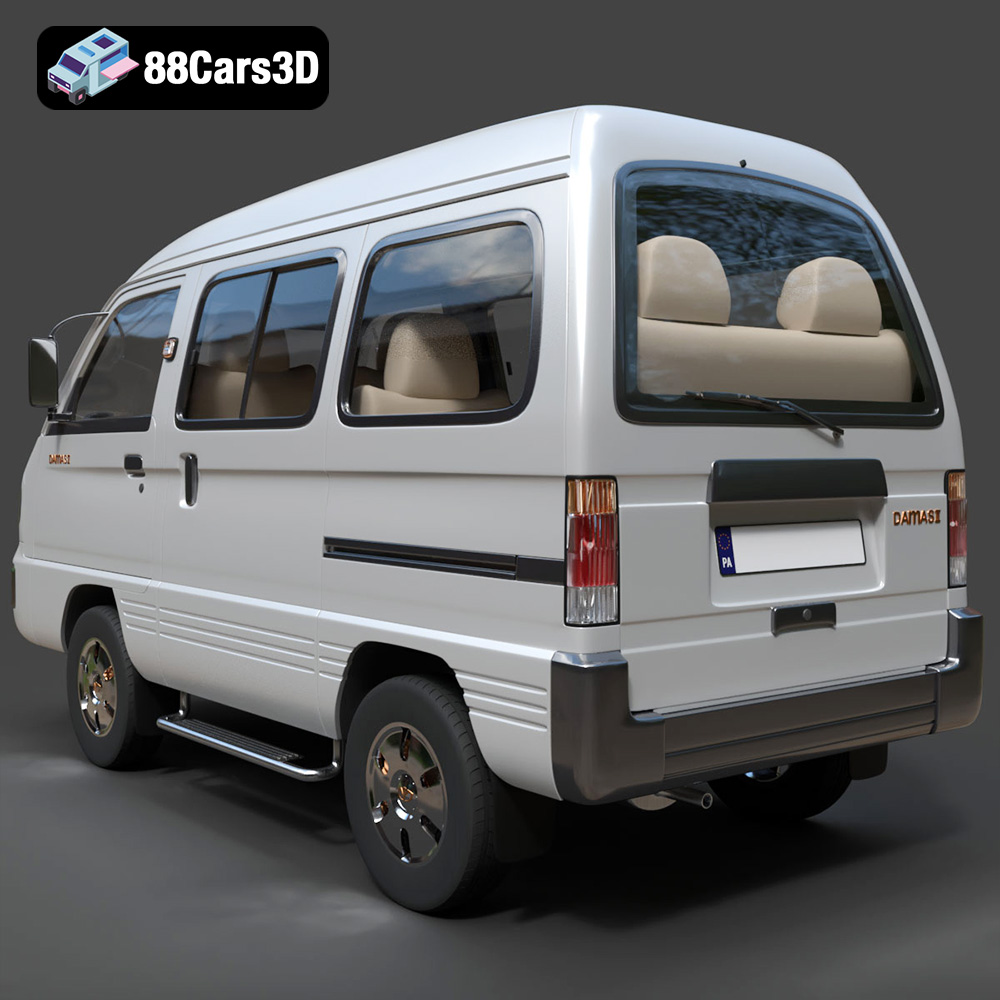
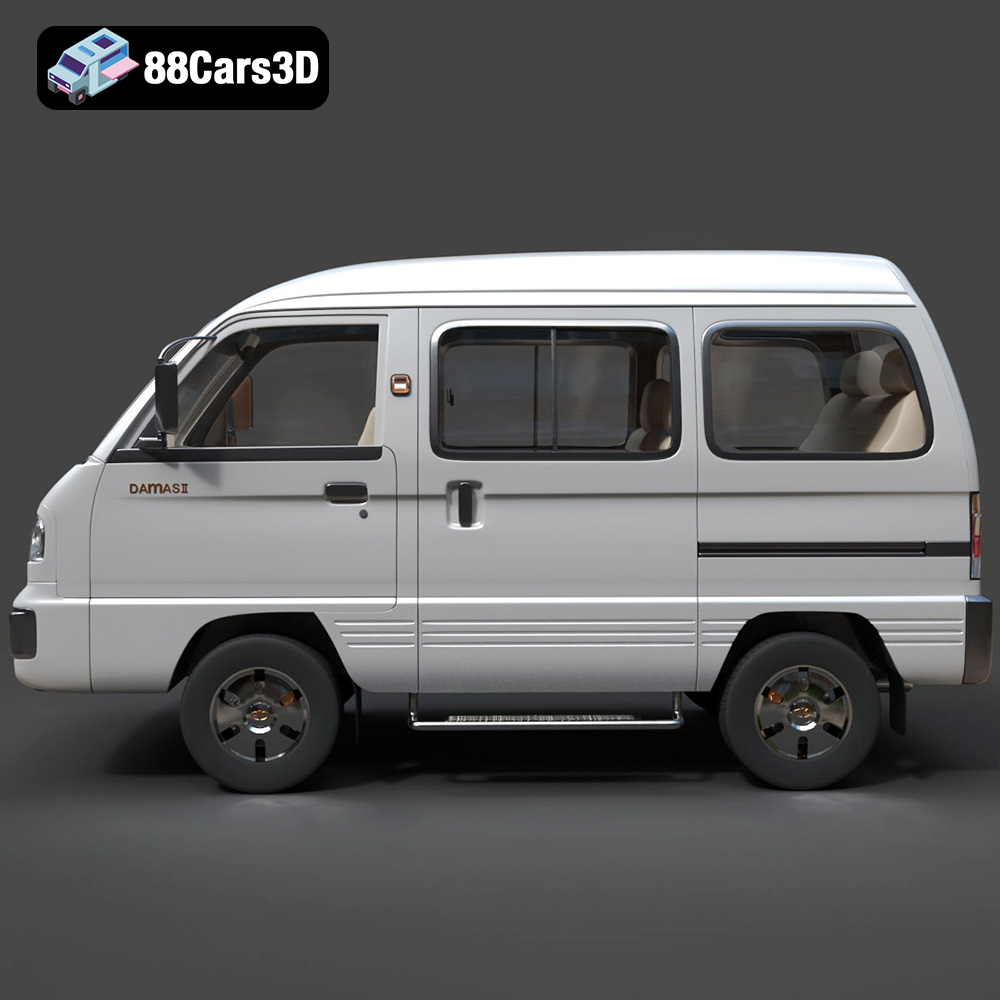
The Daewoo Damas 2 Microvan 3D Model from 88cars3d.com masterfully captures this authenticity. Its exterior faithfully reproduces the microvan’s defining features: the precise compact proportions, the facelifted front end that gives it a unique character, the practical dual sliding rear doors, and the functional rear liftgate. Even the utilitarian 12-inch steel wheels and black plastic trim are accurately represented, ensuring a high level of visual fidelity for close-up rendering and scene population. The model also boasts separate elements for animation, such as wheels, steering components, and doors, making it ready for dynamic simulations or interactive experiences.
Inside, the model doesn’t compromise on realism. It mirrors the Daewoo Damas 2’s highly practical cabin layout, with front seats positioned over the engine, a hallmark of its efficient design. The minimalist dashboard, simple two-spoke steering wheel, and analog instrument cluster are all rendered with attention to detail, reflecting the vehicle’s no-frills, commercial focus. Furthermore, the configurable rear space, available as an empty cargo bay or with folding passenger benches, adds another layer of versatility, allowing the model to adapt to various scene requirements, from bustling market deliveries to family transport scenarios.
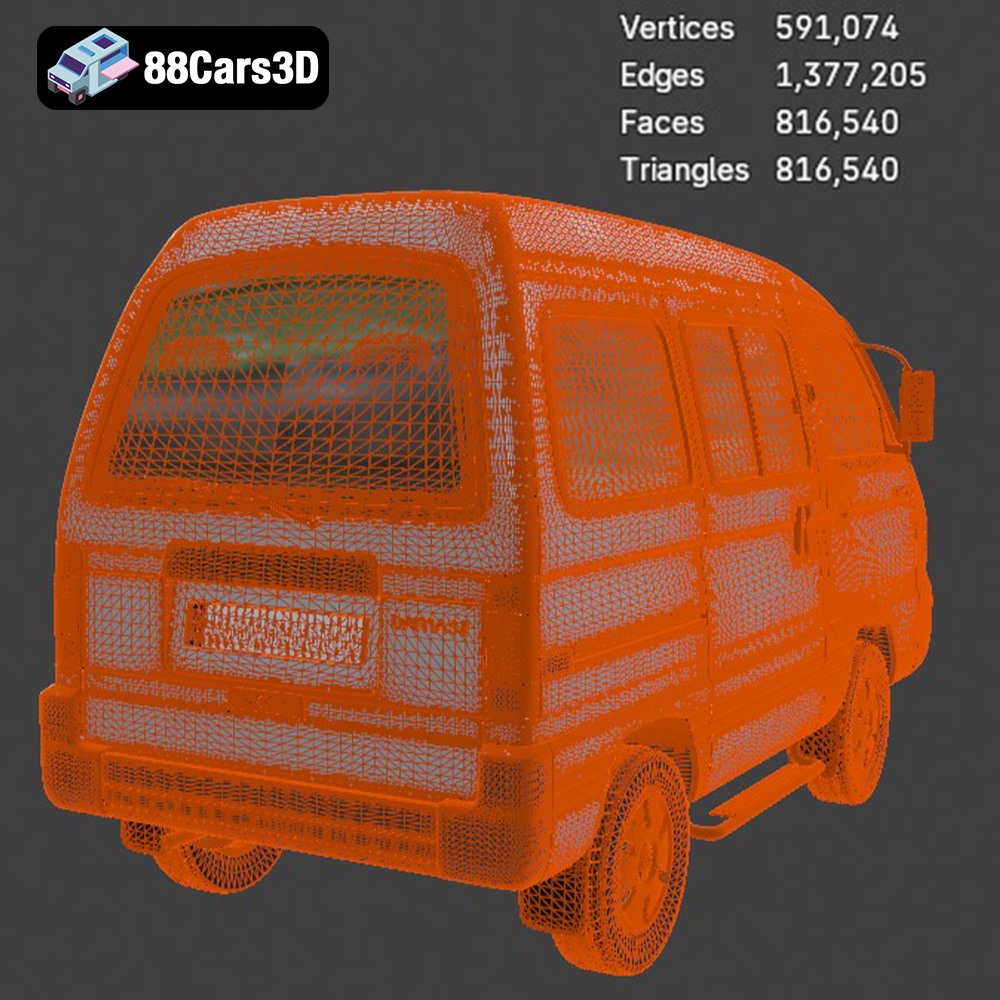
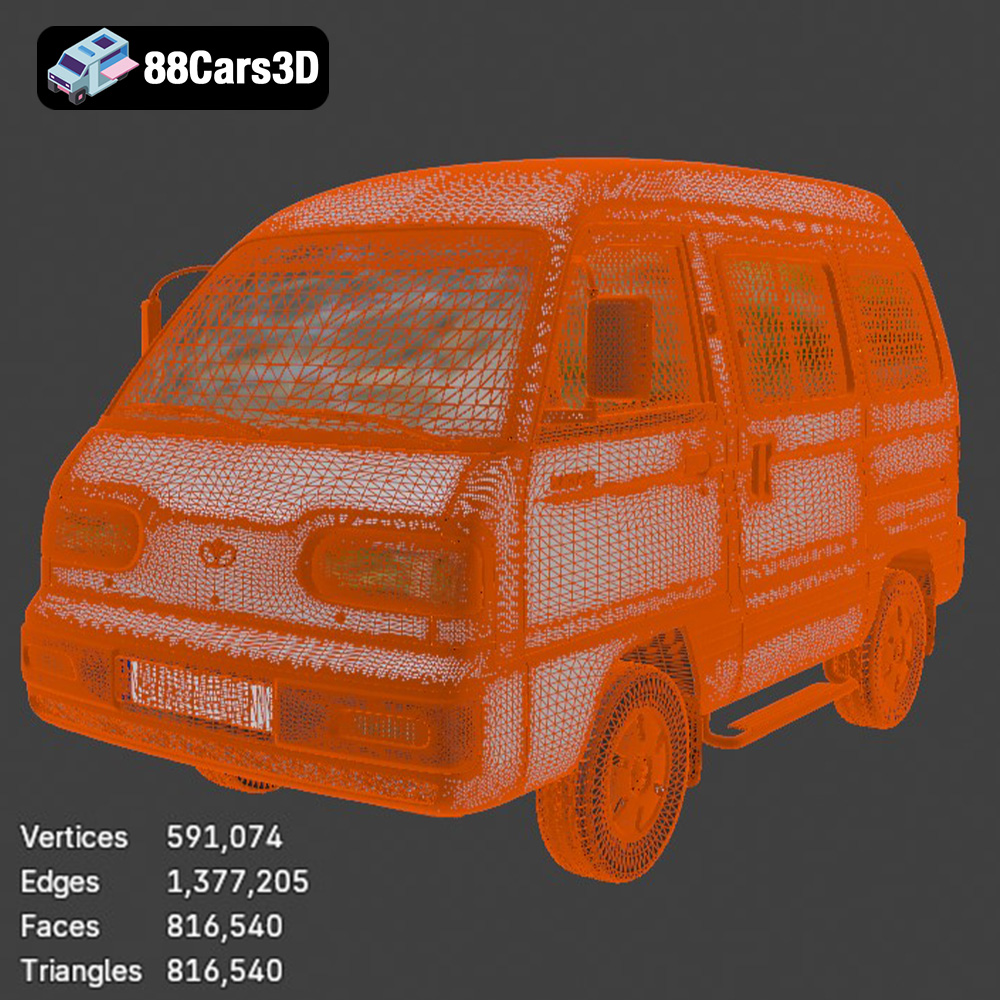
Behind the visual accuracy lies a robust technical foundation. The model boasts a high-poly count, with 954,200 vertices, 1,890,500 edges, and 935,600 faces/polygons. This dense, well-organized mesh structure is a testament to its premium quality, ensuring maximum realism in high-resolution renders. Crucially, it adheres to real-world scale accuracy, based on factory dimensions, which is vital for architectural visualization, urban planning simulations, and creating believable physical environments. Proper pivot setups for steering, wheel rotation, and the sliding door mechanisms further enhance its utility, making it a truly professional-grade asset ready for complex animations and interactive experiences. This level of detail ensures the Daewoo Damas 2 Microvan 3D Model is suitable for demanding visualization projects, historical recreations, and any scenario where authentic, everyday vehicular presence is required.
The true value of a meticulously crafted 3D car model, such as the Daewoo Damas 2 Microvan, lies in its seamless integration into diverse professional workflows. These assets are not mere decorations but critical components that enable high-fidelity visualization, immersive interactive experiences, and even tangible products.
For automotive rendering and architectural visualization, 3D car models are essential for populating scenes and conveying a sense of realism and scale. Imagine an architectural render of a new urban development: an empty street can feel sterile and uninviting. Introducing vehicles like the Daewoo Damas 2 Microvan, perhaps parked outside a small business or navigating a narrow alley, instantly brings the scene to life. Its distinctive design adds a touch of authenticity, particularly if the project is set in a region where such microvans are common. Professional studios utilize the high-poly mesh and detailed materials provided in formats like .max (for 3ds Max users) or .blend (for Blender artists) to achieve photorealistic results with advanced renderers like V-Ray, Corona, or Cycles. These scenarios demand accurate reflections, realistic lighting interactions, and precise surface details, all of which the Damas 2 model is designed to deliver. It can be a focal point in a commercial fleet pitch, showcasing vehicle customization options, or a subtle background element that grounds an urban environment in reality.
The demands of game development and real-time environments are unique, balancing visual fidelity with performance optimization. Here, formats like .fbx and .unreal are paramount. The Daewoo Damas 2 Microvan 3D Model is ideally suited for populating open-world games, particularly those set in Eastern European or Asian urban landscapes. Its distinct silhouette adds character and realism to virtual traffic flows or serves as a unique player vehicle in a delivery simulator. Game developers can leverage its organized mesh and proper pivot setups to quickly implement vehicle physics, simple animations (like wheel rotation and door opening), and damage systems. For real-time applications, managing poly count is critical, and while the Damas 2 is high-poly for rendering, its clean topology allows for efficient polygon reduction or the creation of LODs (Levels of Detail) to ensure optimal performance across various hardware specifications without sacrificing visual quality when viewed up close. This makes it a highly valuable game asset for any project needing authentic, everyday vehicles.
Augmented Reality (AR) and Virtual Reality (VR) platforms demand efficient, immersive assets that load quickly and integrate seamlessly into interactive experiences. The .glb format, included with the Daewoo Damas 2 Microvan 3D Model, is specifically optimized for this purpose. Imagine a virtual showroom where potential buyers can explore different commercial vehicle configurations, or an AR application that places a realistic Daewoo Damas 2 onto a real-world street, allowing for spatial planning or branding mock-ups. The model’s real-world scale accuracy is crucial here, ensuring that it appears correctly proportioned in an AR overlay. Its clean geometry and optimized materials contribute to a smooth, lag-free experience, vital for maintaining user immersion in VR training simulations or interactive product showcases. Whether for educational tools, virtual tours, or interactive marketing campaigns, this model provides a solid foundation for engaging AR/VR content.
Beyond the digital realm of screens and simulations, 3D car models offer a unique opportunity to cross into the physical world through 3D printing. The Daewoo Damas 2 Microvan 3D Model, with its included .stl format, provides a tangible avenue for creators, collectors, and engineers to produce detailed physical replicas of this iconic vehicle.
The .stl file is the undisputed standard for additive manufacturing, effectively translating a 3D model’s surface geometry into instructions for a 3D printer. For the Daewoo Damas 2, this means every curve of its facelifted fascia, every detail of its sliding doors, and the distinct cabover proportions can be accurately reproduced. This capability is invaluable for hobbyists creating custom scale models, design studios producing prototypes, or educational institutions demonstrating manufacturing processes. The included 3D print settings are carefully considered to optimize the physical output, ensuring a successful and high-quality print.
The recommended print scales of 1:32, 1:24, and 1:18 offer flexibility, allowing users to choose the right balance between detail and physical size. For intricate features like side mirrors and wipers, and to achieve smoother surfaces, a finer layer height of 0.08–0.16 mm is suggested. Resin printing (SLA/DLP) is particularly recommended for smaller scales (e.g., 1:43), as it can capture finer details more effectively than FDM printing. However, with appropriate settings, FDM can also yield excellent results. Wall thickness recommendations (1.2–2.0 mm) ensure structural integrity, while a moderate infill (15–25%) provides strength without excessive material use.
Supports are explicitly required for overhangs like side mirrors, wheel arches, and any subtle roof spoilers, ensuring these delicate elements print correctly without sagging. The suggestion to print the body angled for a smooth surface finish, and wheels separately, is a professional tip that minimizes visible layer lines and simplifies assembly. After printing, post-processing steps like sanding, priming, and painting are crucial. Applying a glossy commercial paint finish, perhaps in a classic white or light blue, will truly bring the printed Daewoo Damas 2 to life, mimicking its real-world counterparts and creating a display-worthy automotive collectible.
The true mark of a professional-grade 3D model extends beyond its initial quality to its capacity for customization. The Daewoo Damas 2 Microvan 3D Model is designed with versatility in mind, offering a range of options that allow users to tailor it to their specific project needs, transforming a single asset into countless possibilities.
One of the most immediate customization options is the exterior color. The model can be easily re-textured or re-materialized in typical factory colors such as Commercial White, Light Metallic Blue, Silver, or even Yellow for a taxi variant. This simple change can dramatically alter the vehicle’s context, from a mundane delivery van to a vibrant urban taxi. Such flexibility saves immense time compared to creating multiple models for different color schemes.
Beyond color, the model offers structural customization possibilities, particularly concerning its interior. The ability to modify the interior configuration, switching between a dedicated cargo delivery van layout and a 7-seat passenger setup with folding benches, is incredibly valuable. This feature allows the model to serve different narrative purposes in game development, simulation, or visualization projects, reflecting the genuine adaptability of the real-world Damas 2.
Lighting adaptation is another critical aspect. Depending on the scene, the model’s lights can be configured for bright daytime city streets, with subtle reflections and ambient occlusion, or transformed for moody night-time delivery routes, featuring illuminated headlights and taillights that cast realistic glows. This dynamic adjustment is essential for creating believable time-of-day scenarios in renders or real-time environments.
Finally, the addition of custom delivery logistics decals or taxi branding to the side panels offers an unparalleled level of personalization. This can involve simply adding a texture overlay with a company logo or an intricate livery. This capability allows the Daewoo Damas 2 to become a specific vehicle within a particular narrative, enhancing realism and immersion. Whether populating a bustling virtual city with distinct service vehicles or creating marketing materials for a fictional delivery company, these customization options make the Daewoo Damas 2 Microvan a profoundly adaptable and valuable asset for any creative professional.
In today’s fast-paced digital production environment, relying on high-quality 3D car models is not just a preference, but a necessity. Professionals in automotive design, game development, rendering, and architectural visualization understand that the quality of their assets directly impacts the final output. Purchasing meticulously crafted models from a reputable source like 88cars3d.com offers significant advantages.
Firstly, it’s a monumental time-saver. Creating a highly detailed 3D vehicle from scratch, like the Daewoo Damas 2 Microvan, can take hundreds of hours of expert modeling, texturing, and optimization. By acquiring a pre-made asset, artists and developers can redirect their valuable time and resources to other critical aspects of their projects, accelerating production timelines significantly. Secondly, quality assurance is built-in. Models from 88cars3d.com are typically created by experienced 3D artists who adhere to industry best practices regarding topology, material setup, and real-world accuracy. This means fewer headaches with messy geometry, incorrect scales, or incompatible formats. The comprehensive file format support, as demonstrated by the Daewoo Damas 2 model, ensures seamless integration into virtually any pipeline.
Furthermore, investing in high-quality assets contributes to a consistent and professional aesthetic across all your projects. Whether it’s for a client presentation, a game release, or a cinematic sequence, the visual integrity of your automotive elements will stand out. 88cars3d.com provides a curated selection of 3D car models, offering a diverse range of vehicles, from iconic workhorses like the Daewoo Damas 2 to modern supercars, all ready to elevate your creative endeavors with exceptional detail and technical precision.
The landscape of 3D design and digital content creation thrives on precision, efficiency, and versatility. High-quality 3D car models like the Daewoo Damas 2 Microvan 3D Model embody these principles, offering an invaluable resource for professionals across rendering, game development, AR/VR, and even 3D printing. We’ve explored how its meticulous detailing, from the authentic exterior facelift to the practical interior features, provides a solid foundation for realistic visualizations and immersive experiences.
The extensive range of included file formats—from the editable .blend and .max scenes to the game-ready .fbx and .unreal, the web-optimized .glb, and the 3D print-ready .stl—underscores its adaptability across virtually any professional workflow. This model isn’t just a static representation; it’s a dynamic asset capable of being customized, animated, and integrated into complex digital environments or brought to life as a physical collectible.
Whether you’re populating a bustling urban street scene, designing a new delivery logistics simulator, or crafting an interactive AR application, the Daewoo Damas 2 Microvan provides the authentic touch and technical robustness required for professional success. By choosing such versatile and expertly crafted 3D car models from platforms like 88cars3d.com, you’re not just acquiring an asset; you’re investing in efficiency, quality, and the boundless creative potential that true digital artistry offers.
The Daewoo Damas 2 Microvan 3D Model is a highly detailed digital recreation of the ubiquitous and practical compact commercial vehicle. Based heavily on the classic kei-van architecture but refined with a modernized, slightly more rounded front fascia, the Damas 2 became a legendary workhorse across South Korea, Central Asia (particularly Uzbekistan), and Eastern Europe. Known for its incredible maneuverability and space efficiency, it serves as the ultimate urban delivery van and compact passenger transport. This 3D model accurately represents the facelifted exterior styling, including the distinct curved headlight and indicator clusters, cabover proportions, dual sliding rear doors, and functional rear liftgate. Built with dense, clean topology for premium visual fidelity and real-world scale accuracy, it is ideal for close-up rendering, urban environment visualization, animation, game development, and AR/VR commercial fleet showcases. Perfect for realistic street scenes, delivery logistics simulations, architectural visualizations, and indie game projects needing authentic everyday traffic.
$29.99
.automotive
.blend
.daewoo
.damas
.fbx
.obj
.rendering
.stl
3d printing
car-3d-model
chevrolet-damas
commercial-vehicle
damas-2
game asset
high poly
kei-van
microvan
utility-van
uzauto