Get 50% OFF All Premium 3D & STL Models!

The automotive industry has always been at the forefront of innovation, not just in vehicle design and engineering, but also in how these marvels are conceptualized, presented, and marketed. Today, the convergence of high-fidelity 3D assets and powerful real-time rendering engines like Unreal Engine has revolutionized automotive visualization. Gone are the days of slow, costly offline renders; we now live in an era where designers, engineers, and marketers can interact with photorealistic car models in real-time, explore intricate details, and create breathtaking cinematics with unprecedented speed and flexibility.
For professionals in game development, architectural visualization, virtual production, and especially automotive design, Unreal Engine offers an unparalleled toolkit. It empowers artists and developers to transform raw CAD data into stunning interactive experiences, from immersive AR/VR car configurators to captivating marketing campaigns and cutting-edge virtual showrooms. This comprehensive guide will take you on a deep dive into the essential workflows, advanced features, and optimization strategies required to achieve cinematic realism and optimal performance for your automotive projects within Unreal Engine. We’ll explore everything from project setup and asset import to advanced lighting, material creation, interactivity, and deployment, ensuring you have the knowledge to push the boundaries of automotive visualization. Platforms like 88cars3d.com provide the crucial foundation of high-quality, pre-optimized 3D car models, making it easier to jumpstart your projects.
The foundation of any successful Unreal Engine project lies in its initial setup. For automotive visualization, choosing the right template and configuring core project settings can significantly impact performance, visual fidelity, and development efficiency. This initial phase sets the stage for how effectively you can leverage Unreal Engine’s advanced rendering capabilities.
When starting a new project in Unreal Engine, you’re presented with several template options. For automotive visualization, the most suitable choices typically fall into the “Games” or “Film, Television & Live Events” categories, depending on your primary objective. A “Blank” template offers maximum flexibility, allowing you to add only the necessary features and content, which is excellent for experienced users focused on optimization. Alternatively, the “Virtual Production” or “Archviz” templates can provide a good starting point with pre-configured settings and assets relevant to high-quality visual output, often including cinematic camera rigs, lighting setups, and post-processing volumes.
Once your project is created, navigate to Edit > Project Settings. Here, critical configurations await. Under the Engine > Rendering section, you’ll find parameters that dictate the engine’s rendering pipeline. For top-tier visuals, ensure that Ray Tracing is enabled, alongside Lumen Global Illumination and Reflections, and Virtual Shadow Maps. These technologies are pivotal for achieving the soft, accurate lighting and reflections that define automotive realism. It’s also wise to check the Engine > Input settings if you plan on adding interactive elements, ensuring your control schemes are well-defined from the outset. For detailed information on these settings, refer to the official Unreal Engine documentation on Engine Rendering Features.
Achieving photorealism in automotive visualization demands careful attention to rendering settings. Lumen Global Illumination and Reflections are a game-changer, providing dynamic, real-time indirect lighting and complex reflections that accurately simulate how light behaves on metallic and reflective car surfaces. To enable Lumen, navigate to Project Settings > Engine > Rendering and set Global Illumination and Reflections to Lumen. Complementing Lumen, Virtual Shadow Maps (VSM) offer extremely detailed and high-resolution shadows, crucial for rendering subtle details like tire tread or panel gaps with accuracy.
For cinematic output, the Movie Render Queue (MRQ) is an indispensable tool. Located under Editor > Movie Render Queue, this advanced rendering system allows you to output high-quality image sequences (EXR, PNG, JPG) with features like anti-aliasing, motion blur, and sophisticated post-processing at a resolution and quality far exceeding real-time playback. When using MRQ, you can configure numerous output settings, including render passes (e.g., world position, normal, depth) for enhanced compositing flexibility in external software. It also provides options for temporal upsampling and anti-aliasing that dramatically improve visual fidelity, ensuring your renders are production-ready. Configuring these settings correctly from the start prevents costly rework and ensures your project’s visual integrity.
The quality of your 3D car models is paramount to achieving photorealistic results in Unreal Engine. Sourcing models with clean topology, proper UV mapping, and realistic material definitions is the first step. Once acquired, effective import and optimization strategies are crucial for both visual fidelity and real-time performance.
Unreal Engine supports various 3D file formats, with FBX being a long-standing industry standard for static meshes, skeletal meshes, and animations. When importing FBX files, ensure that your model is exported with appropriate scale, origin, and smoothing groups. Unreal Engine’s FBX import options allow you to control aspects like normal generation, material creation, and LODs, giving you granular control over the imported asset.
However, for complex automotive datasets, especially those originating from CAD software, Datasmith is the preferred workflow. Datasmith, a powerful toolkit within Unreal Engine, streamlines the conversion of entire scenes and complex assets from CAD programs (like SolidWorks, Catia, Rhino), architectural tools (Revit, SketchUp), and DCC applications (3ds Max, Maya) into Unreal-ready assets. Datasmith intelligently tessellates CAD geometry, preserves scene hierarchy, metadata, and material assignments, making the transition significantly smoother. It supports formats like .udatasmith, SolidWorks SLDASM, Catia CGR, and more. For even broader interoperability and scene description, the Universal Scene Description (USD) format is gaining traction. USD allows for collaborative workflows, non-destructive editing, and efficient handling of massive datasets, offering a robust solution for complex automotive pipelines, including support for USDZ for AR applications. When sourcing automotive assets from marketplaces such as 88cars3d.com, look for models optimized for these workflows, often provided in formats like FBX or with clean, pre-processed geometry suitable for Datasmith import.
High-fidelity automotive models often come with extremely high polygon counts, which can cripple real-time performance. Unreal Engine 5’s Nanite virtualized geometry is a revolutionary technology that handles these massive polygon counts with ease. Nanite intelligently streams and processes only the necessary geometry at a per-pixel level, allowing artists to import film-quality assets directly into the engine without needing to manually create LODs (Levels of Detail) for static meshes. To enable Nanite, simply right-click on your static mesh asset in the Content Browser and select Nanite > Enable Nanite. This feature dramatically simplifies the optimization pipeline for static meshes, allowing for unprecedented visual detail even on complex car bodies.
While Nanite handles static meshes brilliantly, traditional LODs (Levels of Detail) remain crucial for skeletal meshes (e.g., animated characters or car parts with complex deformations) and for projects targeting platforms that don’t fully leverage Nanite (such as mobile AR/VR). LODs involve creating multiple versions of an asset, each with decreasing polygon counts, which are swapped based on the camera’s distance to the object. Unreal Engine provides built-in tools for generating LODs automatically or allows you to import custom LODs. For non-Nanite meshes, effective decimation strategies using tools within your 3D modeling software or Unreal Engine’s built-in Mesh Editor can reduce polygon counts while maintaining visual integrity. The goal is to strike a balance between visual fidelity and optimal performance, ensuring a smooth frame rate across various target platforms.
Realistic materials and dynamic lighting are the twin pillars of convincing automotive visualization. The subtle interplay of light on polished paint, chrome, and glass is what truly brings a virtual car to life. Unreal Engine’s Physically Based Rendering (PBR) pipeline and advanced lighting systems provide the tools to achieve this level of realism.
Physically Based Rendering (PBR) is fundamental to achieving photorealistic materials. It relies on a set of texture maps that mimic real-world light interactions, ensuring materials look correct under any lighting conditions. For automotive visualization, key PBR maps include:
In Unreal Engine’s Material Editor, you connect these texture maps to the corresponding inputs of the main Material node. You can also leverage material instances for efficient iteration, allowing artists to create multiple variations (e.g., different paint colors, finishes) from a single master material without recompiling shaders. Advanced materials might incorporate clear coat layers, flake effects for metallic paint, or complex emissive properties for headlights and taillights, using blend modes and custom expressions to achieve sophisticated visual effects.
Unreal Engine 5’s lighting capabilities, particularly Lumen and hardware-accelerated Ray Tracing, are crucial for capturing the nuanced reflections and sophisticated global illumination that define automotive aesthetics. Lumen provides dynamic global illumination and reflections, meaning light bounces realistically around your scene in real-time. This is indispensable for showing off the intricate curves and reflective surfaces of a car in a virtual studio or an outdoor environment, with accurate light spill and color bleeding.
For even higher fidelity, especially for reflections and soft shadows, hardware-accelerated Ray Tracing (if supported by your GPU) can be enabled. Ray Tracing provides pixel-perfect reflections on chrome and glass, highly accurate ambient occlusion, and pristine soft shadows that react dynamically to light sources. When combined with Lumen, Ray Tracing elevates the visual realism to cinematic levels. Lighting setups typically involve a combination of:
Utilizing the Unreal Engine documentation on lighting will provide deeper insights into configuring these advanced systems for optimal results.
Beyond static renders, Unreal Engine excels at creating dynamic, interactive experiences and compelling cinematic content. From enabling users to customize a car in real-time to crafting a breathtaking car chase sequence, these features elevate automotive visualization from passive viewing to active engagement.
Blueprint Visual Scripting is Unreal Engine’s powerful node-based scripting system, allowing artists and designers to create complex gameplay and interactive functionalities without writing a single line of C++ code. For automotive configurators, Blueprint is invaluable. You can script logic for:
A common workflow involves creating a Blueprint Actor for the car, with child components for various customizable parts. UI elements (using UMG – Unreal Motion Graphics) then trigger events in the car’s Blueprint, driving the customization options. This enables rich, interactive experiences for virtual showrooms or marketing tools, directly enhancing user engagement.
For creating high-quality, pre-rendered marketing videos, virtual production sequences, or engaging cinematic trailers, Sequencer is Unreal Engine’s non-linear cinematic editor. It offers a comprehensive suite of tools to control cameras, lights, animations, visual effects (Niagara), and even trigger Blueprint events over time. Key features for automotive cinematics include:
Sequencer is also at the heart of virtual production workflows, allowing real-time compositing of live-action footage with virtual backgrounds rendered in Unreal Engine, often displayed on LED walls. This provides immediate feedback and creative flexibility on set, making it invaluable for automotive commercials and virtual photo shoots.
Beyond static and animated models, simulating realistic vehicle physics adds another layer of immersion, particularly for game development, driving simulators, or interactive demonstrations. Unreal Engine provides robust physics capabilities. The built-in Chaos Physics Engine offers advanced rigid body dynamics, destruction, and vehicle simulation. For vehicles, you can use the Vehicle Movement Component, which provides a framework for implementing wheeled vehicle physics, including engine torque, gear ratios, suspension, and tire friction. This component allows for tuning various parameters to match the handling characteristics of real-world vehicles, from sports cars to heavy-duty trucks.
Implementing realistic vehicle dynamics involves setting up collision meshes, defining wheel properties (radius, width, suspension length), and carefully tuning the engine and transmission curves. For more complex or custom physics behaviors, developers might leverage C++ for a deeper integration with Chaos, or use Blueprint to create custom forces and interactions. For example, a car configurator might allow a user to “test drive” their customized vehicle, experiencing the impact of different wheel sizes or aerodynamic packages on handling, further enhancing the interactive experience.
Creating stunning automotive visuals is one challenge; ensuring they run smoothly and are deployable across diverse platforms is another. Effective optimization strategies are crucial, especially when targeting real-time applications, games, or immersive AR/VR experiences.
Optimizing your Unreal Engine project is a continuous process. Even with Nanite, other aspects of your scene can significantly impact performance. Key areas to focus on include:
Adhering to these best practices ensures your automotive scenes run smoothly, providing a polished and professional user experience.
Augmented Reality (AR) and Virtual Reality (VR) offer incredibly immersive ways to experience automotive designs, from virtual showrooms to interactive prototyping. However, AR/VR experiences demand extremely high and consistent frame rates (e.g., 90 FPS per eye for comfortable VR) to prevent motion sickness, making optimization even more critical.
Careful planning and iterative optimization are key to delivering compelling and comfortable AR/VR automotive experiences.
Virtual Production (VP) with LED walls has transformed cinematic content creation, including high-end automotive commercials and product reveals. Unreal Engine is at the core of this revolution, providing the real-time graphics rendered on the LED volume.
VP workflows allow for unparalleled creative freedom, enabling filmmakers to change environments, time of day, and camera angles on the fly, significantly reducing the time and cost associated with traditional shoots. The ability to see the final composite in real-time provides immediate feedback, accelerating decision-making and enhancing collaboration.
Unreal Engine has firmly established itself as the premier real-time platform for automotive visualization, transforming how vehicles are designed, presented, and experienced. From the initial stages of project setup and intelligent asset import using Datasmith and the groundbreaking power of Nanite, to the intricate craft of PBR material creation and dynamic lighting with Lumen and Ray Tracing, Unreal Engine provides an end-to-end solution for achieving photorealistic results.
We’ve explored how Blueprint empowers interactive configurators, how Sequencer delivers cinematic masterpieces for virtual production, and the critical optimization strategies needed for deployment across diverse platforms, including the demanding requirements of AR/VR. The journey from raw CAD data to a breathtaking, interactive automotive experience is complex, but with the right workflows and an understanding of Unreal Engine’s capabilities, the possibilities are virtually limitless. Whether you’re a game developer creating a next-gen racing title, an automotive designer iterating on a new model, or a marketer crafting an immersive brand experience, mastering these techniques will elevate your projects to unprecedented levels of realism and engagement. Start experimenting with these powerful tools today, and consider sourcing high-quality, pre-optimized 3D car models from trusted platforms like 88cars3d.com to accelerate your development and achieve professional-grade results.

Texture: Yes | Material: Yes | 3D Printable: Yes. Download the Italian Thoroughbreds Bundle featuring 5 iconic 3D models: Lamborghini Huracán Performante, Ferrari 458 Italia, Lamborghini Urus, Diablo SV, and Maserati GT. Optimized for 4K rendering and 3D printing (STL included). Save 50% with this ultimate Italian vehicle collection.
Price: $199.99

Download the Elite Future Mobility Bundle featuring 4 highly optimized 3D models: Tesla Model S, Avatr 11, Li L9, and Zoox Robotaxi. Perfect for ArchViz, Smart City renders, and game dev. Optimized for Unreal Engine and Blender. Includes .fbx, .obj, and .max formats.
Price: $99

🚗 5 Iconic German Cars (BMW M4 G82, M5 CS, X3, 1 Series & Mercedes E-Class). ✅ Optimized for ArchViz: Ready for Corona & V-Ray. 💰 Save €71 with this limited-time collection! 🚀 Instant Download after purchase.
Price: $119

Download the Extreme Off-Road & Survival 3D Models Bundle! Includes the Brabus 800 Adventure, Dodge Ram Bigfoot, Spec Truck, and a Caravan. Save over €210 on this premium 4-in-1 off-grid vehicle pack for ArchViz and game development.
Price: $149.99

Download the Heavy Duty & Commercial Logistics 3D Models Bundle! Includes the Ford Sterling, Caterpillar CT680, Mercedes Citaro Bus, and Vito Van. Save over €130 on this massive, game-ready 4-in-1 industrial vehicle pack.
Price: $109.99

Download the Ultimate Custom Motorcycles 3D Models Bundle. Includes a Custom Chopper, Ducati 916 Café Fighter, Harley XR1200X, and BMW K100. Perfect premium props for luxury ArchViz garages. Save over €250 today!
Price: $159.99

Download the ultimate JDM Street Racing 3D Models Bundle! Includes the Nissan GT-R, Toyota Supra, Mazda RX-7, Lancer Evo IX, and Honda NSX. Save big on this highly optimized, game-ready 5-in-1 Japanese legend car pack.
Price: $129.99

Download the ultimate American Muscle & Cinematic Classics 3D Models Bundle! Includes the Dodge Charger ’68, Mustang Eleanor GT500, Camaro Z28 ’79, and a custom ’69 Mustang. Save over €240 on this game-ready, premium 4-in-1 pack.
Price: $149.99

Download the Everyday City Traffic 3D Models Bundle. Includes the VW Golf, Kia Picanto, Hyundai Tucson, Toyota Yaris, and a DHL Ford Transit Van. Save big on this 5-in-1 pack, perfectly optimized for realistic ArchViz streets and game traffic.
Price: $99.99
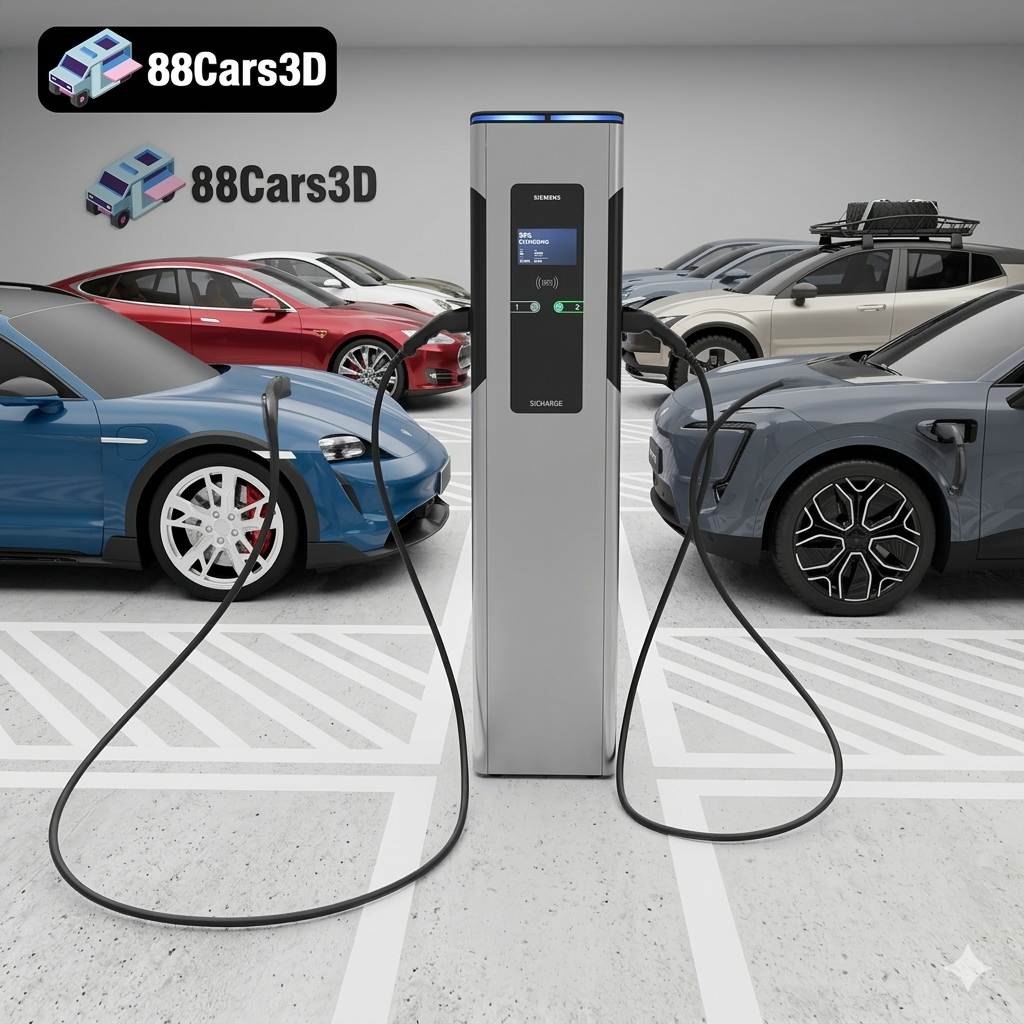
Download the Future of Mobility EV 3D Models Bundle. Includes the Volvo EX30, Tesla Model S, AVATR 11, Porsche Taycan, and a Siemens EV Charger. Save big on this highly optimized 5-in-1 pack for ArchViz and game development!
Price: $89.99

