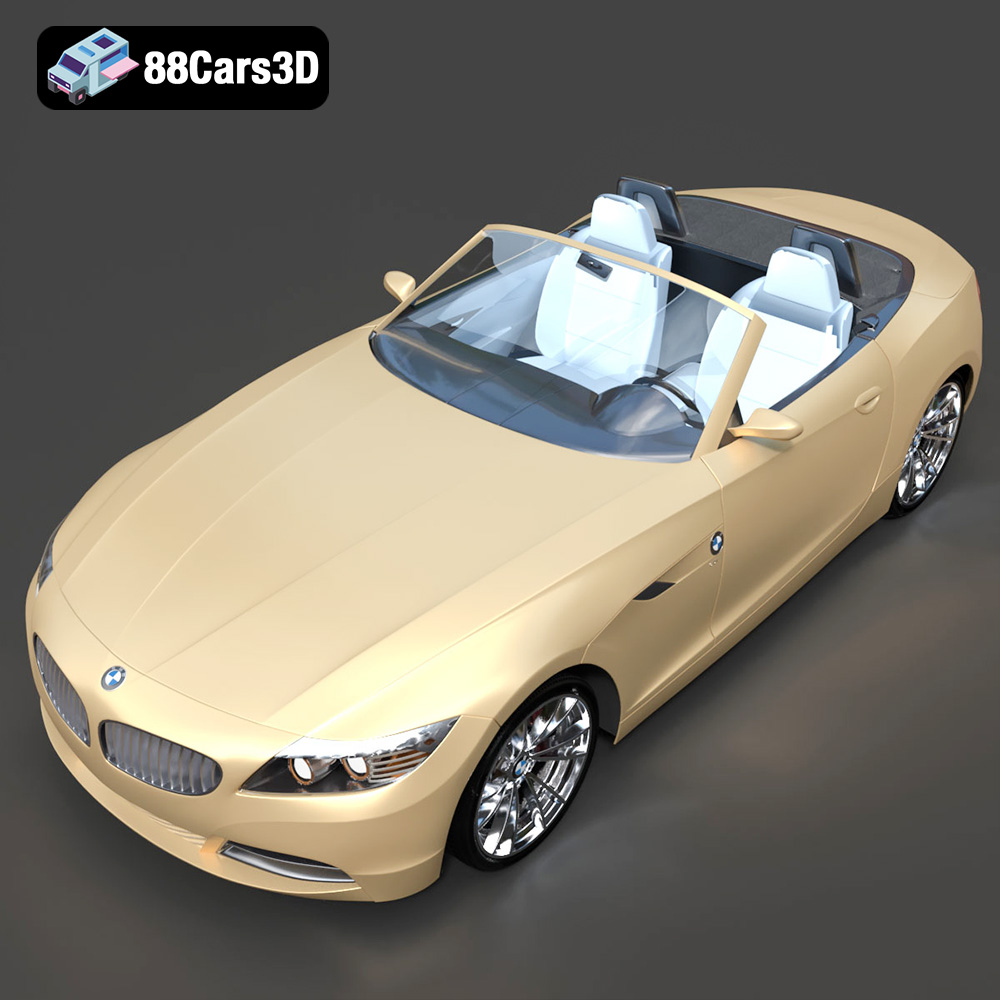
Driving Digital Dreams: A Deep Dive into Automotive 3D Models and the BMW Z4
The world of automotive design, visualization, and interactive media is perpetually evolving, pushing the boundaries of realism and immersion. At the heart of this innovation lies the mastery of 3D modeling, transforming conceptual visions into tangible digital assets. From high-octane racing simulations to breathtaking architectural visualizations and engaging AR/VR experiences, premium 3D car models are indispensable tools for professionals across industries.
Few vehicles embody the spirit of dynamic performance and elegant design quite like the BMW Z4. This iconic two-seat roadster, with its sporty proportions, long hood, and signature styling, is a favorite among enthusiasts and designers alike. Capturing its essence in the digital realm requires meticulous attention to detail and technical precision. This is where models like the BMW Z4 3D Model from 88cars3d.com become invaluable resources, offering unparalleled quality and versatility for a myriad of applications.
The Allure of the BMW Z4 in Digital Form
The BMW Z4 is more than just a car; it’s a statement of driving pleasure and sophisticated aesthetics. Its low stance, sculpted body lines, distinctive kidney grille, and sleek convertible profile present unique challenges and opportunities for 3D artists. A high-fidelity 3D model allows designers to explore every angle, material, and lighting condition without the constraints of physical prototyping. It empowers creators to place the Z4 in diverse digital environments—from sun-drenched coastal roads to futuristic cityscapes—making it a perfect centerpiece for any visual narrative.
The Growing Demand for High-Quality Automotive 3D Assets
The acceleration of real-time technologies, coupled with the increasing sophistication of rendering engines, has fueled an insatiable demand for top-tier automotive 3D assets. Game developers seek optimized models for seamless integration and fluid gameplay, while architectural visualization artists require photorealistic vehicles to populate their scenes. AR/VR developers leverage these models for immersive configurators and virtual showrooms, and even industrial designers utilize them for rapid prototyping and conceptual reviews. The consistency, accuracy, and technical cleanliness of models found on platforms like 88cars3d.com ensure that professionals can focus on their creative vision rather than grappling with asset preparation.
Understanding 3D Model File Formats
Navigating the diverse landscape of 3D applications and engines often means understanding a multitude of file formats, each with its own strengths and ideal use cases. For a comprehensive 3D car model like the BMW Z4, the inclusion of various formats ensures maximum compatibility and flexibility across different professional workflows. This versatility is a hallmark of high-quality assets, distinguishing them from generic models.
Mastering Production Workflows with Versatile Formats
The BMW Z4 3D Model is supplied in a robust selection of file formats, catering to virtually any professional pipeline:
- .blend: This is the native file format for Blender, a powerful open-source 3D creation suite. A .blend file often contains the complete scene, including the model’s geometry, materials, textures, lighting setups, cameras, and even animations. It’s ideal for users who wish to dive deep into the model’s construction, make significant modifications, or render directly within Blender using Cycles or Eevee. The clean quad-based topology of the Z4 model ensures smooth subdivision and easy editing within this environment.
- .fbx: Developed by Autodesk, FBX (Filmbox) is arguably the most widely adopted interchange format in the 3D industry, especially for real-time applications. It excels at preserving complex scene data such as hierarchical structures, animation data (including rigged characters), cameras, lights, and PBR materials. For game development (Unreal Engine, Unity), virtual production, and motion graphics, .fbx is the go-to format for its robust compatibility and efficiency. The BMW Z4 model’s proper pivot placement for animation is particularly beneficial when importing via FBX for interactive elements like opening doors or turning wheels.
- .obj: The Wavefront OBJ format is a universal standard, widely supported by almost every 3D application. It primarily stores geometry (vertices, normals, texture coordinates, and faces) and references external .mtl (material) files for basic material properties. While it doesn’t support animation or complex scene data like FBX, its simplicity and widespread compatibility make it excellent for static mesh exchange and archival purposes. It’s a reliable choice for cross-software compatibility, ensuring the Z4 model can be loaded into virtually any 3D package.
- .glb: The GL Transmission Format (glTF) and its binary variant, .glb, are quickly becoming the standard for 3D models on the web, AR/VR experiences, and mobile applications. Optimized for efficient transmission and loading, .glb files encapsulate geometry, materials, textures, and even animation in a single, compact file. This format is perfect for integrating the BMW Z4 into virtual showrooms, web-based car configurators, or augmented reality apps, delivering high quality with minimal load times.
- .stl: Stereolithography (.stl) is the de facto standard for 3D printing. It represents a 3D model as a raw, triangulated mesh without color, texture, or material information. The BMW Z4 3D Model specifically highlights its suitability for conversion to .stl for 3D printing, enabling users to create physical miniatures. Ensuring manifold geometry (a solid, watertight mesh) is crucial for successful .stl output, a characteristic inherent in well-prepared models.
- .ply: The Polygon File Format (.ply) is another mesh format capable of storing geometry, color, and sometimes normal information. It’s often used in applications involving 3D scanning, scientific visualization, and CAD, where precision mesh data is paramount. While less common for general animation, it offers a robust alternative for specific industrial or analytical applications of the BMW Z4 model.
- .unreal: This isn’t a standalone file format in the same way as .fbx or .obj, but rather implies an optimized asset specifically prepared for Unreal Engine. Typically, this means an .fbx file that has been meticulously set up with appropriate scaling, material IDs, UV channels, and collision meshes to integrate seamlessly into Unreal’s PBR workflow. For the BMW Z4, an “Unreal-ready” asset ensures that materials like car paint, glass, and chrome will render accurately within the engine, utilizing its advanced lighting and rendering capabilities.
- .max: The native file format for Autodesk 3ds Max, one of the leading software packages for 3D modeling, animation, and rendering in professional visualization. A .max file includes all scene data, modifiers, materials (e.g., V-Ray, Corona, Arnold setups), lighting, and camera configurations. It allows for full editability and provides the highest degree of control for artists working within the 3ds Max environment, making it ideal for high-end automotive rendering and animation projects involving the Z4.
From Real-Time Engines to Physical Prototypes: Format Selection
The ability to choose the correct file format is a critical skill for any 3D professional. For the BMW Z4 3D Model, this means selecting .fbx or .unreal for game development, .max or .blend for high-end rendering, .glb for web deployment, or converting to .stl for a physical collectible. This comprehensive format support underscores the versatility and value of investing in high-quality 3D car models that can adapt to evolving project needs and diverse platforms.
Crafting Realism: Technical Deep Dive into the BMW Z4 3D Model
The difference between a generic 3D model and a professional-grade asset lies in its technical foundation. The BMW Z4 3D Model exemplifies these principles, ensuring that artists and developers receive a robust and reliable foundation for their projects. Every technical advantage translates directly into saved production time and superior visual output.
Precision Geometry for Flawless Renders
One of the most critical aspects of any high-quality 3D model is its topology. The BMW Z4 model boasts clean quad-based topology, meaning its mesh is primarily constructed from four-sided polygons. This is paramount for several reasons:
- Subdivision Readiness: Quad topology allows for clean and predictable subdivision (e.g., using a TurboSmooth or Subdivision Surface modifier), producing perfectly smooth curves and surfaces without unsightly pinching or artifacts. This is essential for achieving the elegant, reflective surfaces characteristic of automotive rendering.
- Ease of Editing: Quads are much easier to work with for modeling and sculpting, allowing artists to make adjustments and propagate changes smoothly across the mesh.
- UV Unwrapping: Clean quads facilitate more efficient and distortion-free UV unwrapping, which is vital for applying high-resolution textures accurately.
Furthermore, the model adheres to real-world scale accuracy. This isn’t just a detail; it’s a necessity for realistic rendering and simulation. Correct scale ensures that lighting calculations are accurate, physical simulations behave predictably, and the model integrates seamlessly into scenes with other real-world objects without needing manual scaling adjustments. It provides a foundation for truly believable automotive rendering.
Optimizing for Performance and Scalability
The optimized polygon count of the BMW Z4 3D Model strikes a critical balance. It’s dense enough to capture all the intricate details of the Z4’s exterior and interior, but lean enough to perform efficiently in real-time environments like game engines or AR/VR applications. An optimized mesh avoids unnecessary geometry that can bog down performance while still maintaining visual fidelity. This scalability allows the model to be used as is for game assets or subdivided further for ultra-high-resolution cinematic renders.
Crucially, the model features proper pivot placement for animation. Components like doors, the hood, trunk, and wheels have their pivot points precisely located at their real-world rotation axes. This means animating these elements, whether for a game where a car takes damage, an interactive configurator, or a full cinematic sequence, becomes a straightforward task, saving countless hours of manual setup. This attention to detail significantly enhances the model’s utility for complex interactive projects and simulations, making it an ideal choice for serious developers and artists looking for top-tier 3D car models.
Unleashing Creativity: Applications Across Industries
The versatility of the BMW Z4 3D Model extends across a broad spectrum of digital industries, proving its value far beyond a single use case. From hyper-realistic visualizations to interactive experiences, this model stands as a testament to the power of well-crafted 3D car models.
Elevating Automotive Visualization and Marketing
- Rendering & Visualization: This is perhaps the most immediate application. The detailed exterior and interior, combined with clean topology, make the BMW Z4 3D Model perfect for stunning photorealistic renders. Imagine it in luxury automotive presentations, studio lighting setups, or dynamic promotional content. Artists can simulate different paint finishes (metallic, matte, gloss), explore various wheel designs, and adjust lighting environments for day, sunset, or night renders, creating visuals indistinguishable from real photography.
- Promotional Visuals: Automotive brands, advertisers, and marketing agencies can leverage this model to create compelling advertisements, configurators, and brand experiences. It eliminates the need for expensive physical photography shoots, offering endless possibilities for creative staging and presentation.
Integrating High-Fidelity Assets into Interactive Experiences
- Game Development: For developers working on racing games, open-world driving simulations, or even traffic systems within broader game environments, the optimized polygon count and accurate geometry of this BMW Z4 model are crucial. Its performance-friendly nature ensures smooth frame rates, while the detail allows for immersive gameplay experiences. The separated components for doors, hood, trunk, and wheels are ready for physics simulation and interactive damage systems.
- AR/VR Applications: As virtual showrooms and interactive car configurators become more prevalent, assets like the BMW Z4 3D Model are indispensable. Users can explore the car in a virtual space, walk around it, change colors, open doors, and even sit inside, all in real-time. This level of immersion is invaluable for sales, training, and customer engagement. The .glb format is particularly well-suited for such applications.
- Simulation & Training: Beyond entertainment, high-fidelity car models are vital for professional simulations. Whether for vehicle dynamics research, driver training scenarios, or urban planning visualization, the accurate representation and real-world scale of the Z4 model provide a reliable foundation for data-driven analysis and predictive modeling.
The Art of 3D Printing: Bringing the Z4 to Life
The digital realm often inspires tangible creations. The BMW Z4 3D Model takes this a step further by being specifically designed for 3D printing, transforming a virtual asset into a physical collectible. This adds an entirely new dimension of utility for hobbyists, collectors, and automotive enthusiasts.
Preparing the BMW Z4 Model for Physical Production
Converting a high-detail rendering model into a print-ready file requires careful consideration, and the BMW Z4 model provides the foundation for this with its clean geometry. For 3D printing, the model is typically converted to an .stl format, which represents the mesh as a series of triangles. The product description provides excellent guidance for optimal 3D print settings:
- Recommended Scale: Offering flexibility, scales like 1:24, 1:18, 1:12, and 1:10 allow for a range of physical model sizes, from desktop miniatures to larger display pieces.
- Layer Height: A finer layer height (0.10–0.18 mm) is recommended for FDM printing to capture the subtle curves and sharp edges of the Z4, minimizing visible layer lines and enhancing smoothness.
- Wall Thickness: A wall thickness of 2–3 mm ensures structural integrity for the printed model, preventing fragile points and ensuring durability.
- Infill: A moderate infill of 15–30% provides internal support, strength, and saves on material while keeping the model reasonably light.
- Supports: Supports are critical for overhangs and intricate details. The product specifies supports for mirrors, open roof edges, and the underbody, preventing drooping or deformation during the printing process.
- Print Orientation: The recommendation to print the body upside-down is a clever technique. For models with smooth, curved roofs and hoods, printing them facing the build plate (often with supports on the underside) results in a superior top surface finish, as the visible parts of the model are less affected by support removal or gravity.
- Separated Components: Printing wheels separately is a common practice, allowing for higher detail, easier painting, and potentially different material usage for tires versus rims.
Post-Processing and Finishing for Collector-Quality Miniatures
Once printed, the journey to a stunning physical BMW Z4 miniature often involves several post-processing steps:
- Sanding: Essential for removing layer lines and smoothing out any rough patches, leading to a professional finish.
- Primer: A primer coat helps reveal imperfections, provides a uniform base for paint, and ensures better adhesion for subsequent layers.
- Metallic Paint Finish: To truly capture the luxury look of a BMW, metallic paint is often chosen, replicating the shimmering effect of automotive finishes.
- Clear Coat: A final clear coat adds protection, deepens the color, and provides a glossy (or matte) finish, just like a real car’s paint job.
This comprehensive guidance ensures that even those new to 3D printing can achieve impressive results, transforming a digital asset into a tangible, collectible piece of automotive art. The detailed preparation by 88cars3d.com for the BMW Z4 3D Model makes this process accessible and rewarding.
Customization and Workflow Integration with the BMW Z4 3D Model
Beyond its inherent quality, the true power of a professional 3D asset lies in its adaptability. The BMW Z4 3D Model is designed with customization in mind, providing artists and developers the freedom to tailor the vehicle to their specific creative requirements and integrate it seamlessly into established workflows.
Tailoring the Z4 for Bespoke Visuals
The product offers a range of customization options that directly impact the visual narrative and aesthetic of your project:
- Change Body Color and Finish: This is fundamental for any automotive visualization. Whether you need a classic metallic sheen, a stealthy matte finish, or a vibrant gloss, the model’s clean material setup allows for easy adjustment of paint shaders. This enables artists to create diverse marketing assets or simulate different production options.
- Open-top or Closed-top Configuration: The ability to switch between convertible roof states adds significant flexibility. This is crucial for showcasing the Z4 in different moods or settings, from a leisurely drive with the top down to a sleek, aerodynamic look with the top up. This is often handled by separate mesh groups or blend shapes within the model.
- Modify Wheel Styles and Brake Caliper Colors: Wheels are a critical visual element for any car. The model’s separate wheels allow for easy swapping with alternative designs or modification of brake caliper colors to match a specific brand identity or performance package.
- Add Performance Package Styling: For artists aiming to depict specific trim levels or aftermarket modifications, the model provides a solid base for adding spoilers, body kits, or other performance-oriented details.
- Adjust Lighting Environments: While not strictly a model customization, the versatility of the model’s materials allows it to respond accurately to various lighting conditions—be it a bright outdoor scene, a dramatic sunset, or a controlled studio render. This adaptability is key for compelling automotive rendering.
Seamless Integration into Professional Design Pipelines
The provision of multiple industry-standard file formats (like .max for 3ds Max, .blend for Blender, and .fbx/.unreal for Unreal Engine) ensures that the BMW Z4 3D Model drops directly into professional pipelines with minimal fuss. For instance:
- In 3ds Max: Loading the .max file provides an artist with a fully editable scene, often pre-configured with materials compatible with renderers like V-Ray or Corona. Artists can immediately begin setting up custom cameras, lighting, and animation sequences for high-end visualizations.
- In Blender: The .blend file offers full control over the asset. Artists can take advantage of Blender’s powerful modeling, texturing, and rendering tools, modifying the model to suit bespoke project needs or rendering stunning cinematics.
- In Unreal Engine (or Unity): Importing the .fbx or .unreal asset involves straightforward steps. The model’s optimized poly count and clean UVs facilitate quick material setup using PBR workflows, allowing developers to integrate it into game levels or interactive experiences almost instantly. Collision meshes can be generated, and physical materials assigned to ensure realistic behavior.
The comprehensive nature of this BMW Z4 3D Model, available at 88cars3d.com, signifies a commitment to professional-grade assets that enhance efficiency and creative freedom. It enables designers and developers to leverage a highly detailed foundation, saving precious time and resources that would otherwise be spent modeling from scratch.
Conclusion
In the rapidly advancing world of 3D content creation, the demand for high-quality, technically sound 3D car models is constant. The featured BMW Z4 3D Model stands out as an exceptional example of an asset engineered for versatility and performance across diverse applications—from breathtaking automotive rendering and dynamic game assets to immersive AR/VR experiences and even tangible 3D prints.
Its meticulously crafted quad-based topology, real-world scale, optimized polygon count, and intelligent pivot placements provide a robust foundation for any project. Coupled with comprehensive file format support, including .blend, .fbx, .obj, .glb, .stl, .ply, .unreal, and .max, this model ensures seamless integration into virtually any professional workflow. Whether you’re an architect populating a scene, a game developer crafting an open world, a marketer creating stunning visuals, or an enthusiast seeking to 3D print a miniature, the BMW Z4 3D Model offers the precision and flexibility required.
Investing in such high-quality assets accelerates production, elevates visual fidelity, and empowers creative exploration. For those seeking premium 3D car models that meet the rigorous demands of modern digital production, exploring the collection at 88cars3d.com is an excellent starting point, where models like the BMW Z4 are ready to drive your digital visions forward.
Featured 3D Model
BMW Z4 3D Model 3D Printable STL
The BMW Z4 3D Model is a premium digital recreation of the iconic two-seat roadster developed by BMW. Known for its sporty proportions, long hood, short rear deck, and dynamic performance styling, the Z4 embodies precision engineering and modern roadster design. This 3D model accurately captures the Z4’s low stance, sculpted body lines, signature kidney grille, aerodynamic side vents, and sleek convertible profile. Designed with clean geometry and real-world scaling, it is ideal for rendering, animation, game development, AR/VR applications, and automotive simulations. Also includes optimal settings for 3D printing collectible miniatures.
$29.90
View This Model
Related Tags
.arvr
.blend
.bmw
.car3dmodel
.convertible
.fbx
.gameasset
.glb
.max
.obj
.ply
.rendering
.roadster
.simulation
.sportsCar
.stl
.unreal
.vehicleasset
.z4
automotive3d