Get 50% OFF All Premium 3D & STL Models!

In the dynamic world of real-time rendering and immersive experiences, nothing captures attention quite like a meticulously detailed and physically accurate vehicle. For developers, artists, and visualization professionals leveraging Unreal Engine, the challenge often lies in striking the perfect balance between visual fidelity and real-time performance, especially when dealing with complex 3D car models. Realistic vehicle interactions – from opening doors and suspension compression to full-blown driving simulations – demand robust collision detection and finely tuned physics.
This challenge is amplified when working with high-quality assets, which, while visually stunning, can introduce significant overhead if not optimized correctly. Whether you’re building a cutting-edge automotive configurator, an immersive AR/VR experience, or a high-octane racing game, mastering Unreal Engine’s collision and physics systems is paramount. This comprehensive guide will deep dive into the essential techniques, best practices, and advanced strategies for optimizing vehicle collision and physics in Unreal Engine, ensuring your automotive projects run smoothly while delivering unparalleled realism. We’ll explore everything from preparing your 3D car models for import to leveraging Unreal Engine’s powerful Chaos physics system and Blueprint scripting for truly interactive experiences.
At the heart of any interactive 3D car model in Unreal Engine lies a carefully constructed physics asset and an efficient collision setup. Without these fundamental elements, your vehicle would simply fall through the world or behave like a static prop. Understanding how to build and optimize these foundations is the first critical step towards achieving realistic and performant automotive simulations.
A Physics Asset (PhAT) in Unreal Engine is a specialized asset that defines the collision geometry and physical properties for a Skeletal Mesh. For a car, which often comprises a skeletal mesh for components like chassis, wheels, and potentially doors or hoods, the PhAT dictates how these parts interact physically with the environment and each other. The primary building blocks within a Physics Asset are collision primitives.
When creating collision shapes, the goal is always to use the simplest possible primitive that accurately represents the visual mesh’s physical bounds. Overly complex collision can quickly degrade performance, especially when many vehicles or environmental objects are interacting. For a car, it’s common to use a combination: a large box or several convex hulls for the main chassis, capsules for suspension arms, and spheres for wheel hubs, with a simple box or cylinder for the wheel’s main body.
Within your Physics Asset, each collision primitive is associated with a Physics Body. For a car, you typically want separate physics bodies for the main chassis and each wheel. This allows them to move independently and respond to forces realistically. The chassis might be a single, large body, while each wheel would be its own body, rotating and moving vertically relative to the chassis.
Constraints are the glue that holds these physics bodies together and defines their allowed movements. For a vehicle, constraints are crucial for:
When setting up constraints, pay close attention to the pivot points and axes of rotation. Incorrectly aligned constraints can lead to unexpected wobbles or unnatural movement. For instance, the wheel constraint’s primary axis should align perfectly with the wheel’s rotation axis. The hierarchy is also vital: typically, the chassis is the root body, and wheels are attached as children, inheriting the chassis’s movement but having their own localized physics responses.
The journey to perfect vehicle physics in Unreal Engine often begins long before you even open the editor. The way your 3D car models are prepared and imported significantly impacts their collision behavior and overall performance. High-quality 3D car models, such as those found on platforms like 88cars3d.com, come with clean topology and often include separate meshes for different parts, which is an excellent starting point for robust physics setup.
Before exporting your car model from your preferred Digital Content Creation (DCC) tool (e.g., Blender, Maya, 3ds Max), several steps are crucial for optimal collision in Unreal Engine:
The goal is to provide Unreal Engine with a well-structured FBX that it can easily interpret and convert into an efficient collision model. Sourcing high-quality automotive assets from marketplaces such as 88cars3d.com often means you’re starting with models that already adhere to many of these best practices, significantly streamlining your workflow.
Once your car model is prepared, importing it into Unreal Engine requires careful attention to the import settings:
After import, open the generated Physics Asset (PhAT). Here, you can fine-tune the auto-generated primitives or inspect your custom `UCX_` collision. You can manually add, remove, resize, and position collision primitives (boxes, spheres, capsules, convex hulls) for each physics body. Use the ‘AggGeom’ mode to visualize the combined collision geometry. Remember to group primitives into physics bodies and then connect those bodies with constraints, as discussed in the previous section. For detailed guidance on PhAT, refer to the official Unreal Engine documentation on Physics Assets.
Once the basic collision for your 3D car model is established, the next step involves refining its behavior and performance. Advanced optimization techniques ensure that your vehicle interacts realistically without becoming a burden on the CPU, especially in complex real-time rendering scenarios with many interacting objects. Balancing precision with performance is key here.
Unreal Engine offers different levels of collision complexity that dictate how detailed the physics engine considers your mesh for interactions. Understanding these settings is crucial for optimization:
For most vehicle components, ‘Use Simple as Complex’ combined with well-designed custom `UCX_` collision meshes is the optimal choice. This ensures your vehicles have accurate physical boundaries without the overhead of per-triangle collision checks.
Trace Channels allow you to categorize collision queries and control which objects respond to specific types of interactions. For automotive applications, custom trace channels can be incredibly powerful:
By defining and using custom trace channels (configured in Project Settings > Engine > Collision), you can precisely control which collision events trigger a response, significantly reducing unnecessary computations and improving real-time rendering performance.
Just as visual meshes benefit from Level of Detail (LODs) to optimize rendering based on distance, collision meshes can also leverage LODs to improve physics performance. When a car is far away, it doesn’t need a highly detailed collision mesh; a simpler representation will suffice and save valuable CPU cycles.
The process involves creating simplified collision meshes for your vehicle’s LODs:
Implementing LODs for collision is a powerful optimization strategy, particularly for environments with many vehicles or large open worlds. It ensures that physics calculations are scaled appropriately with visual detail, contributing to better overall game assets and a smoother real-time rendering experience.
With a solid collision foundation, the next step is to imbue your 3D car models with lifelike movement and responsiveness. Unreal Engine’s powerful Chaos physics system, combined with the flexibility of Blueprint visual scripting, provides an incredibly robust toolkit for creating nuanced and interactive vehicle dynamics, essential for high-fidelity automotive visualization and game development.
Unreal Engine 5 introduced the Chaos physics system, a highly scalable and optimized physics engine developed in-house by Epic Games. Chaos offers significant advantages over its predecessor, PhysX, particularly for complex scenarios involving many interacting bodies and destruction. For vehicles, Chaos provides a more stable and extensible foundation.
Key advantages of Chaos for vehicle dynamics include:
Configuring Chaos Solver settings (found in Project Settings > Engine > Physics > Chaos) allows you to globally adjust parameters like sub-stepping, iterations, and solver frequencies. For vehicles, increasing sub-steps and iterations can lead to more stable and accurate simulations, especially for fast-moving or high-impact scenarios, though it comes at a performance cost. It’s a balance you’ll need to profile and adjust based on your project’s specific needs.
Unreal Engine provides a dedicated Wheeled Vehicle class (and its Blueprint equivalent, `ChaosWheeledVehiclePawn` or `ChaosVehicleWheel`) that forms the backbone of most vehicle implementations. This class encapsulates complex physics calculations for wheels, suspension, engine, and transmission, allowing you to focus on tuning rather than implementing physics from scratch. Blueprint visual scripting is your primary interface for customizing these properties:
By leveraging Blueprint, even non-programmers can create sophisticated vehicle behaviors. It allows for rapid iteration and experimentation, letting you quickly test different setups and achieve the desired feel and responsiveness for your 3D car models in any real-time rendering project.
Creating beautiful, physically accurate 3D car models is one half of the equation; ensuring they run smoothly and scale effectively in diverse Unreal Engine projects is the other. Performance optimization for automotive visualization and real-time rendering involves leveraging advanced engine features and robust profiling techniques, especially when dealing with high-fidelity assets and complex physics simulations.
Unreal Engine 5’s Nanite virtualized geometry system is a game-changer for handling incredibly dense meshes, making models from 88cars3d.com, often featuring millions of polygons, performant in real-time. Nanite allows artists to import cinematic-quality assets directly into the engine without needing to create traditional LODs or bake normal maps, as it streams only the necessary detail based on screen space.
For physics-driven scenarios, Nanite plays a crucial, though sometimes indirect, role:
By using Nanite for your environment and for static parts of your vehicle, you can dedicate more processing power to accurate physics calculations for the dynamic, interactive components, ensuring both visual splendor and physics realism in your real-time rendering projects.
Optimizing physics is an iterative process of identifying bottlenecks and making targeted adjustments. Unreal Engine provides powerful profiling tools to help you diagnose performance issues:
Regular profiling is essential. Benchmark your scenes with multiple vehicles, different environments, and varying levels of interaction to ensure your optimizations are effective and maintain a smooth frame rate for your automotive visualization.
When your project involves multiple vehicles, especially in a networked multiplayer environment, optimization becomes even more critical. Each additional vehicle adds to the collision detection and physics calculation workload.
Effectively managing multiple vehicles and their physics ensures that your game assets remain performant even in crowded scenarios, critical for both realistic game development and large-scale automotive simulations.
The mastery of Unreal Engine’s collision and physics optimization isn’t just about making cars drive; it unlocks a realm of possibilities for interactive automotive experiences. From sophisticated configurators to cutting-edge virtual production, optimized physics are the bedrock of truly immersive and believable interactions.
Modern automotive visualization often extends beyond static renders to fully interactive 3D configurators, allowing potential buyers or designers to customize a vehicle in real-time. Optimized physics are absolutely essential for these applications, enhancing the user experience in subtle yet impactful ways:
For such applications, the meticulous preparation of 3D car models with clean topology and well-defined physics from resources like 88cars3d.com becomes invaluable, providing a robust foundation for these interactive systems.
The advent of virtual production, particularly with LED volumes, has revolutionized filmmaking and high-end advertising. Integrating physically accurate car models into these workflows demands a high level of real-time performance and precision:
The combination of high-fidelity visual rendering, robust physics, and interactive control, all driven by Unreal Engine’s capabilities, positions 3D car models as powerful tools for next-generation virtual production and advanced simulation scenarios, pushing the boundaries of what’s possible in real-time.
Mastering collision and physics optimization in Unreal Engine is not merely a technical task; it’s an art form that transforms static 3D car models into vibrant, interactive experiences. From the foundational choices in your DCC tool to the nuanced tuning within Unreal Engine, every decision impacts the realism and performance of your automotive projects. We’ve journeyed through preparing your high-quality assets, leveraging simple yet effective collision primitives, and harnessing the power of Chaos physics and Blueprint scripting.
The key takeaways are clear: prioritize clean assets, design simplified custom collision meshes, strategically use LODs for both visuals and physics, and relentlessly profile your project to identify and eliminate bottlenecks. Embracing features like Nanite for visual fidelity and precise Blueprint logic for interactive elements will elevate your automotive visualizations, games, and AR/VR applications. Whether you’re building an immersive configurator or a cutting-edge virtual production scene, a deep understanding of these principles ensures your creations are not only stunning but also seamlessly responsive.
Now, armed with these insights, it’s time to put theory into practice. Begin by evaluating your existing 3D car models and apply the optimization techniques discussed. Explore new high-quality assets from reputable sources like 88cars3d.com, knowing they provide a strong foundation for your work. Experiment with Chaos physics settings, fine-tune your vehicle Blueprints, and continuously profile your projects. The journey to perfectly optimized, physically accurate vehicles in Unreal Engine is an ongoing one, but with these strategies, you’re well-equipped to drive your projects towards unparalleled realism and performance.

Texture: Yes | Material: Yes | 3D Printable: Yes. Download the Italian Thoroughbreds Bundle featuring 5 iconic 3D models: Lamborghini Huracán Performante, Ferrari 458 Italia, Lamborghini Urus, Diablo SV, and Maserati GT. Optimized for 4K rendering and 3D printing (STL included). Save 50% with this ultimate Italian vehicle collection.
Price: $199.99

Download the Elite Future Mobility Bundle featuring 4 highly optimized 3D models: Tesla Model S, Avatr 11, Li L9, and Zoox Robotaxi. Perfect for ArchViz, Smart City renders, and game dev. Optimized for Unreal Engine and Blender. Includes .fbx, .obj, and .max formats.
Price: $99

🚗 5 Iconic German Cars (BMW M4 G82, M5 CS, X3, 1 Series & Mercedes E-Class). ✅ Optimized for ArchViz: Ready for Corona & V-Ray. 💰 Save €71 with this limited-time collection! 🚀 Instant Download after purchase.
Price: $119

Download the Extreme Off-Road & Survival 3D Models Bundle! Includes the Brabus 800 Adventure, Dodge Ram Bigfoot, Spec Truck, and a Caravan. Save over €210 on this premium 4-in-1 off-grid vehicle pack for ArchViz and game development.
Price: $149.99

Download the Heavy Duty & Commercial Logistics 3D Models Bundle! Includes the Ford Sterling, Caterpillar CT680, Mercedes Citaro Bus, and Vito Van. Save over €130 on this massive, game-ready 4-in-1 industrial vehicle pack.
Price: $109.99

Download the Ultimate Custom Motorcycles 3D Models Bundle. Includes a Custom Chopper, Ducati 916 Café Fighter, Harley XR1200X, and BMW K100. Perfect premium props for luxury ArchViz garages. Save over €250 today!
Price: $159.99

Download the ultimate JDM Street Racing 3D Models Bundle! Includes the Nissan GT-R, Toyota Supra, Mazda RX-7, Lancer Evo IX, and Honda NSX. Save big on this highly optimized, game-ready 5-in-1 Japanese legend car pack.
Price: $129.99

Download the ultimate American Muscle & Cinematic Classics 3D Models Bundle! Includes the Dodge Charger ’68, Mustang Eleanor GT500, Camaro Z28 ’79, and a custom ’69 Mustang. Save over €240 on this game-ready, premium 4-in-1 pack.
Price: $149.99

Download the Everyday City Traffic 3D Models Bundle. Includes the VW Golf, Kia Picanto, Hyundai Tucson, Toyota Yaris, and a DHL Ford Transit Van. Save big on this 5-in-1 pack, perfectly optimized for realistic ArchViz streets and game traffic.
Price: $99.99
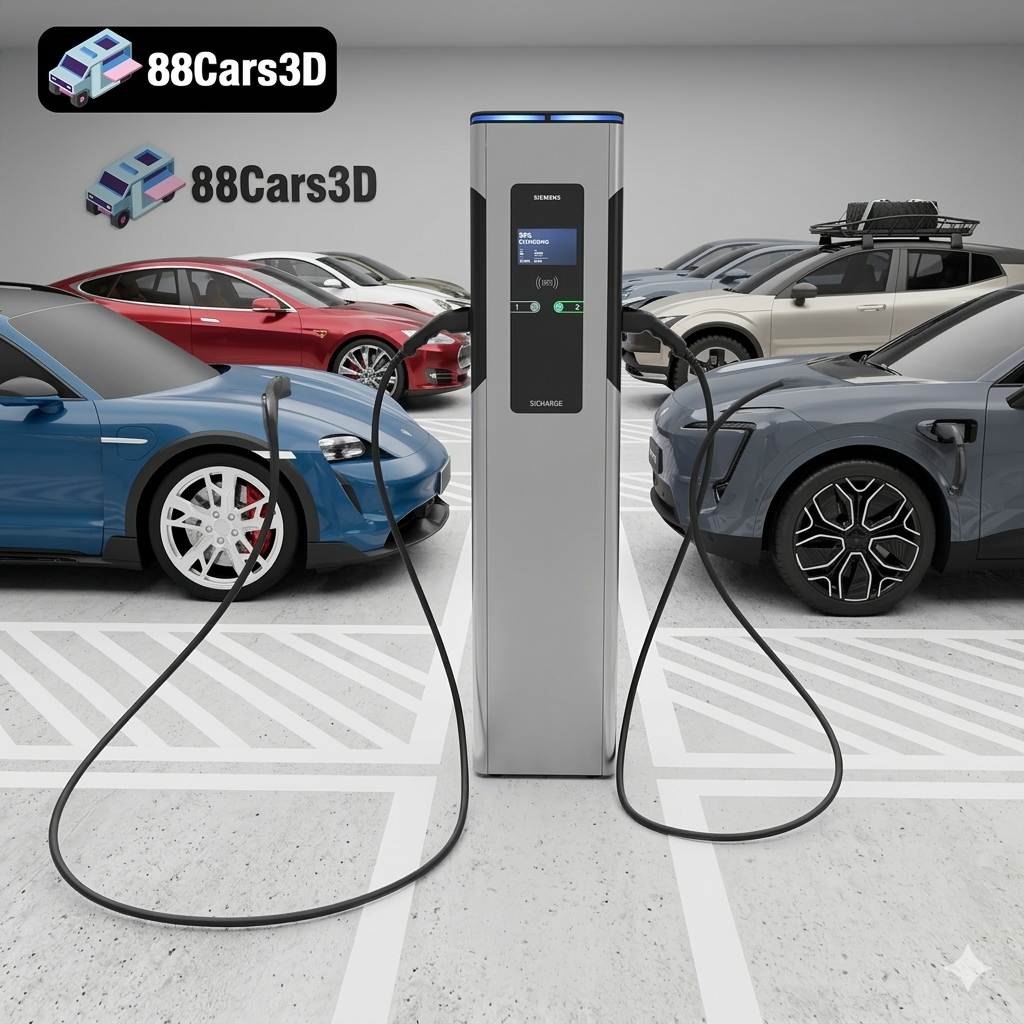
Download the Future of Mobility EV 3D Models Bundle. Includes the Volvo EX30, Tesla Model S, AVATR 11, Porsche Taycan, and a Siemens EV Charger. Save big on this highly optimized 5-in-1 pack for ArchViz and game development!
Price: $89.99

