Mastering Automotive 3D Assets: From Concept to Reality with Premium 3D Car Models
The world of digital visualization is more dynamic and demanding than ever, especially in industries reliant on high-fidelity automotive assets. From cinematic productions and immersive game environments to intricate architectural visualizations and interactive AR/VR experiences, the need for photorealistic and technically robust 3D car models is paramount. These assets aren’t just decorative; they are foundational elements that define the realism, performance, and overall impact of a project.
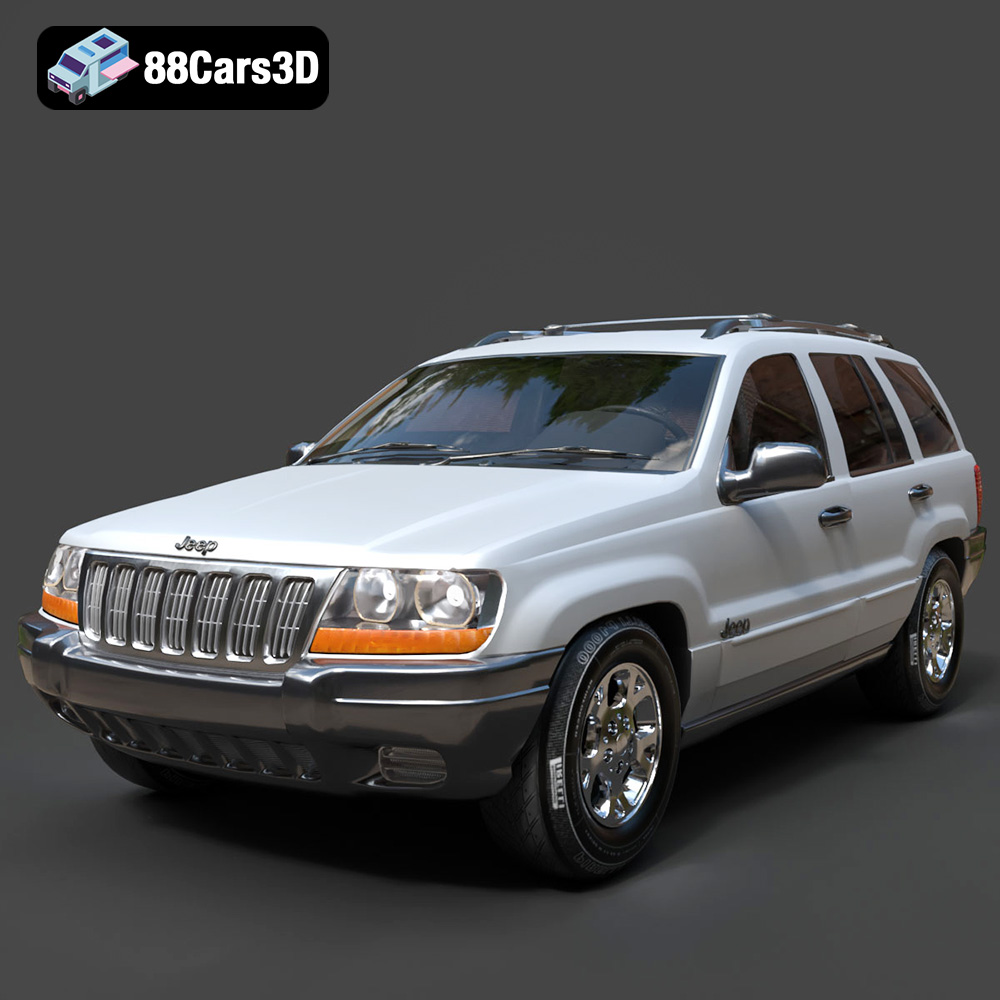
Creating exceptional 3D car models from scratch is a labor-intensive process, requiring specialized skills in modeling, texturing, rigging, and optimization. This is where premium marketplaces like 88cars3d.com become indispensable, offering artists and studios access to professionally crafted models that save countless hours and elevate project quality. Among the standout offerings, a particularly versatile asset that exemplifies this blend of detail and utility is the Jeep Grand Cherokee 3D Model. This iconic midsize SUV, renowned for its rugged capability and refined comfort, translates into a powerful digital asset, ready for a myriad of applications from realistic renders to interactive simulations and even physical 3D prints.
This comprehensive guide will delve into the technical intricacies of automotive 3D modeling, exploring critical file formats, professional workflows, and real-world applications. We’ll examine how a high-quality asset like the Jeep Grand Cherokee 3D Model can seamlessly integrate into diverse pipelines, empowering creators to achieve stunning results efficiently.
Understanding 3D Model File Formats: The Backbone of Digital Automotive Assets
The choice of a 3D model file format is far more than a technicality; it dictates compatibility, workflow efficiency, and the ultimate utility of your asset across different software and platforms. High-quality 3D car models, like those found on 88cars3d.com, often come in multiple formats to cater to varied professional needs. Understanding each format’s strengths and weaknesses is crucial for any serious 3D artist or developer.
.blend – The Native Blender Ecosystem
The .blend format is native to Blender, the popular open-source 3D creation suite. When you receive a .blend file, you’re not just getting a mesh; you’re often getting a fully editable Blender scene. This includes:
- Complete Scene Data: Meshes, materials, textures, lighting setups, cameras, animation data, and even modifiers are preserved.
- Editability: Artists can directly manipulate the original geometry, adjust material nodes, modify UV maps, and integrate the model into a larger Blender project with minimal setup.
- Customization: For models like the Jeep Grand Cherokee 3D Model, a .blend file offers unparalleled flexibility for customization, whether it’s changing the paint finish, swapping out wheels, or adding new accessories.
It’s ideal for projects where Blender is the primary DCC (Digital Content Creation) tool or where extensive modifications to the base model are anticipated.
.fbx – The Industry Standard for Interchange
Autodesk’s .fbx (Filmbox) format is arguably the most widely adopted interchange format in the 3D industry. It excels at transferring geometry, materials (often simplified), textures, animations, and skeletal data between different software applications.
- Game Engine Readiness: .fbx is the preferred format for importing assets into real-time engines like Unreal Engine and Unity, providing a robust pipeline for game assets.
- Broad Compatibility: Virtually all major 3D software (3ds Max, Maya, Blender, Cinema 4D, etc.) support .fbx import and export, making it a reliable choice for collaborative workflows.
- Animation Support: It efficiently handles complex animation data, making it suitable for animated vehicle sequences in cinematics or simulations.
The Jeep Grand Cherokee 3D Model in .fbx format ensures seamless integration into most professional rendering and game development pipelines.
.obj – The Universal Geometry Format
The .obj (Wavefront OBJ) format is a simple, universal geometry definition file. It stores 3D model data as vertices, UV coordinates, vertex normals, and polygonal faces. Materials are typically defined in an accompanying .mtl (material) file.
- High Compatibility: Almost every 3D software can import and export .obj, making it an excellent fallback for cross-software compatibility when other formats fail.
- Simplicity: Its text-based nature makes it relatively easy to understand and even manually edit for specific tasks.
- Focus on Geometry: While it supports basic material definitions, .obj’s strength lies in its reliable transfer of mesh data, making it perfect for modelers focused purely on sculpting or retopology before adding complex shaders.
.glb – Optimized for AR, VR, and Web
.glb (GLB Binary) is the binary representation of glTF (GL Transmission Format), a royalty-free specification for 3D scenes and models. It’s designed for efficient transmission and loading of 3D assets in web, AR, and VR contexts.
- Single File: Unlike glTF which can have multiple files (JSON, bin, images), .glb packages everything into a single binary file, simplifying asset management.
- Performance: Highly optimized for real-time rendering on various devices, from high-end PCs to mobile phones.
- Interactive Experiences: Ideal for showcasing the Jeep Grand Cherokee 3D Model in interactive virtual showrooms, browser-based configurators, or augmented reality apps.
.stl – The Standard for 3D Printing
The .stl (STereoLithography) format is the de facto standard for 3D printing. It represents a 3D model as a series of connected triangles (a tessellated surface) and contains no color, texture, or material information.
- Manifold Geometry: Crucially, .stl models must have “manifold” geometry (watertight, no holes, consistent normals) to be successfully printed.
- Physical Creation: Essential for turning a digital automotive asset into a tangible collectible, prototype, or scale model. The Jeep Grand Cherokee 3D Model, being 3D printable, opens up avenues for physical products.
.ply – Precision Mesh for CAD and Analysis
The .ply (Polygon File Format, or Stanford Triangle Format) is designed for storing 3D data from 3D scanners. It can store a wider range of properties than .obj, including color, transparency, and often more precise topological data.
- Versatile Data Storage: Capable of storing vertices, faces, normals, color, and other attributes.
- Scientific and Engineering: Frequently used in CAD, CAE, and scientific applications where precision and additional data per vertex/face are important.
- Alternative to OBJ: For complex meshes or datasets with additional per-element data, .ply can be a more robust choice than .obj.
.unreal – Engine-Ready Asset for Real-Time Environments
The .unreal format, or more accurately, assets packaged for Unreal Engine, implies a model specifically prepared for Epic Games’ powerful real-time engine. While often imported via .fbx, having a dedicated .unreal asset means the model has likely undergone specific optimization and setup:
- Pre-Configured Materials: PBR (Physically Based Rendering) materials are typically set up with appropriate textures (Albedo, Normal, Roughness, Metallic, Ambient Occlusion).
- Optimized Mesh: Potentially includes LODs (Levels of Detail) for performance scaling, proper collision meshes, and clean UV unwrapping for lightmaps.
- Blueprint Integration: For a vehicle, this might mean a pre-rigged setup with basic physics and animation blueprints, allowing for immediate use in driving simulations or interactive scenes.
The availability of the Jeep Grand Cherokee 3D Model in a .unreal ready format signifies its direct readiness for high-performance game development and virtual production.
.max – The 3ds Max Project File
The .max format is the native file type for Autodesk 3ds Max, a long-standing industry leader in modeling, animation, and rendering for architecture, visualization, and design.
- Full Control: Contains the complete 3ds Max scene, including geometry, modifiers, materials, textures, lights, cameras, and animation data.
- Parametric Editing: Allows for non-destructive editing through modifier stacks, giving artists maximum flexibility to tweak and refine the model without altering the base mesh.
- High-End Rendering: Ideal for V-Ray, Corona, or Arnold renders, where sophisticated material setups and intricate lighting scenarios are crucial for photorealism.
A .max file for the Jeep Grand Cherokee 3D Model means artists working in 3ds Max have the ultimate starting point for advanced rendering, animation, and scene integration.
Understanding these formats ensures that when you download a premium 3D car model from 88cars3d.com, you select the best option for your specific project, minimizing conversion headaches and maximizing creative output.
Deconstructing the Jeep Grand Cherokee 3D Model: A Technical Deep Dive
A truly professional 3D car model goes beyond mere visual accuracy; it embodies meticulous technical craftsmanship. The Jeep Grand Cherokee 3D Model exemplifies this, boasting a combination of precision modeling, optimized topology, and intelligent structure designed for versatility.
Exterior Fidelity: Capturing the Iconic Design
The exterior of any automotive 3D model is its most immediately recognizable feature. For the Jeep Grand Cherokee 3D Model, this means a faithful recreation of its distinctive persona:
- Proportional Accuracy: The model maintains real-world scale and accurate body proportions, critical for convincing renders and correct integration into virtual environments. Discrepancies here can break immersion.
- Detailed Components: Every key exterior element is precisely modeled, from the signature seven-slot grille and muscular body lines to the refined LED headlights, taillights, bumpers, mirrors, and trim components. This level of detail is crucial for close-up renders and for maintaining visual integrity in high-resolution game engines.
- Wheels and Underbody: Modeled alloy wheels, off-road tires with realistic tread patterns, visible brake systems, and essential underbody details contribute significantly to realism, especially in dynamic shots or when simulating off-road conditions. Transparent materials for glass and lighting elements further enhance this realism.
- Animation Readiness: Critical for automotive visualization, elements like doors, hood, tailgate, and wheels are separated and correctly pivoted. This “clean hierarchy” allows for straightforward rigging and animation, whether it’s opening doors in an architectural walkthrough or simulating wheel rotation and steering in a driving game.
Interior Refinement: Beyond the Surface
While often less visible in typical renders, a fully modeled interior is indispensable for certain applications like virtual showrooms, cinematic cutscenes, or AR/VR experiences where users can “enter” the vehicle. The Jeep Grand Cherokee 3D Model provides this depth:
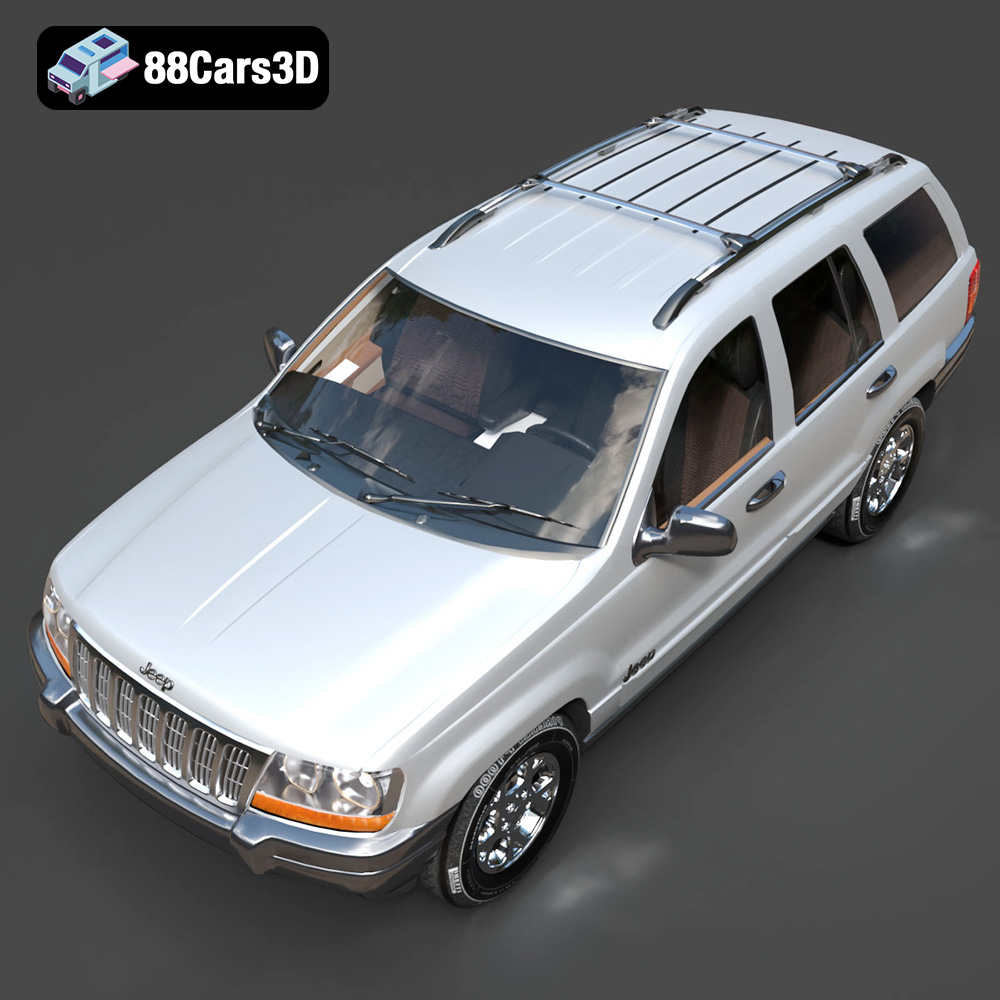
- Comprehensive Cabin Details: The dashboard, multifunction steering wheel, comfortable seats, and center console are all meticulously modeled. This ensures that interior shots or reflections are accurate and convincing.
- Interactive Elements: Represented digital instrument clusters, infotainment systems, and climate controls add a layer of realism and can be animated or made interactive in real-time applications. Subtle trim details further elevate the perceived quality.
- Optimized Interior Mesh: Despite its detail, the interior mesh is optimized for efficiency. This means a balanced polygon density that looks great in high-resolution renders while remaining performant enough for real-time engines, preventing unnecessary overhead.
Technical Advantages: Precision and Performance
Beyond visual detail, the underlying technical structure makes a model truly professional:
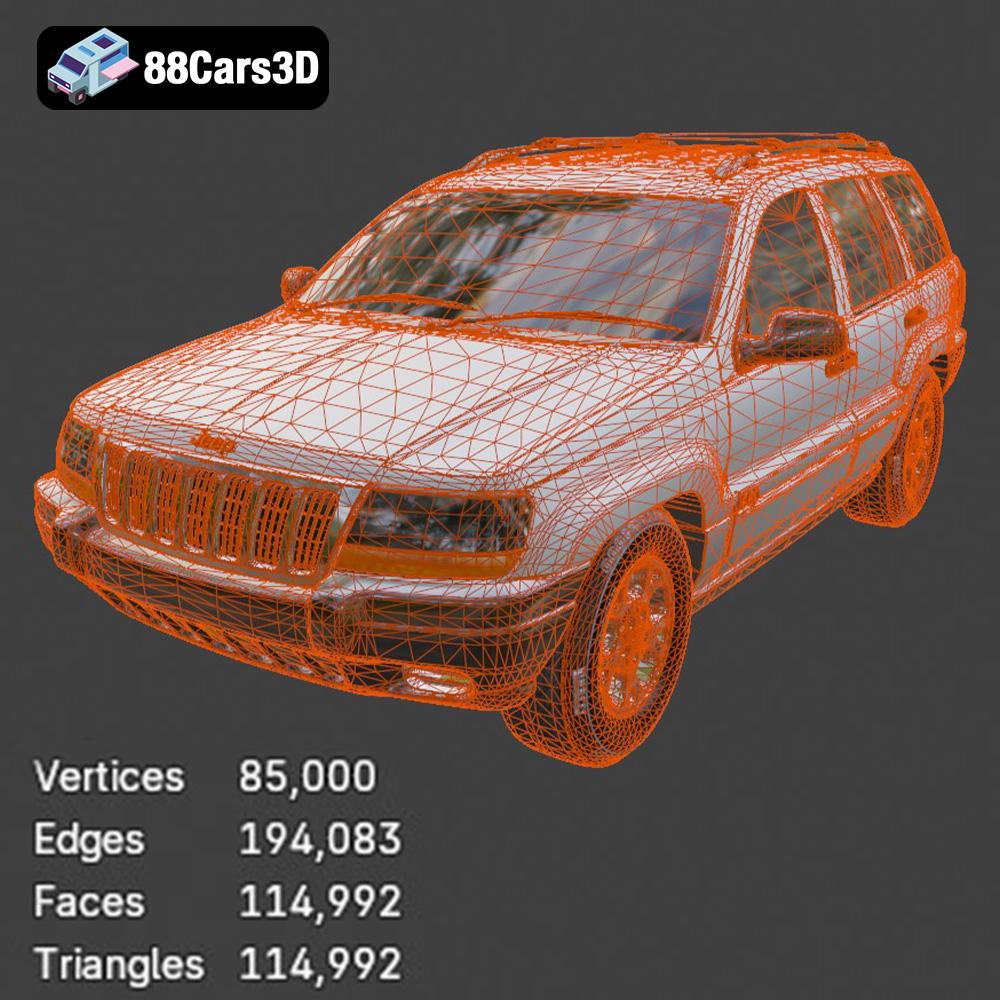
- Clean Topology: The model features clean and organized mesh topology. This means well-distributed polygons, minimal triangles in areas that should be quads, and proper edge flow. This is fundamental for smooth subdivision, easy UV unwrapping, and distortion-free deformation during animation. It ensures smooth shading and simplifies any further editing or modification.
- Real-World Scale: Adherence to real-world dimensions is vital for accurate physical simulations, correct lighting setups, and seamless integration into scenes with other real-world scaled assets.
- Proper Hierarchy and Pivot Setup: As mentioned, correctly set pivots for wheels, steering, and articulated parts are non-negotiable for animation. This saves artists immense amounts of time in rigging and ensures realistic movement.
- Balanced Polygon Density: The model strikes a balance between detail and performance. While not explicitly stated, models from premium sources like 88cars3d.com are typically designed to offer sufficient polygon count for high-quality renders while allowing for optimization (e.g., through LODs) for real-time uses. This avoids both under-detailing and over-detailing, which can hinder performance.
Integrating the Grand Cherokee into Professional Workflows
A versatile 3D asset like the Jeep Grand Cherokee 3D Model finds its place across a wide spectrum of professional applications. Its availability in various formats (from .blend and .max for DCC tools to .fbx and .unreal for game engines, and .glb for web/AR) speaks volumes about its adaptability.
Automotive Rendering & Visualization: Crafting Photorealism
For marketing agencies, automotive designers, and visualization studios, photorealism is the ultimate goal. The Grand Cherokee model excels here:
- High-Resolution Still Renders: Using software like 3ds Max (with V-Ray or Corona) or Blender (with Cycles), artists can leverage the model’s detailed geometry and clean UVs to create stunning marketing visuals. Applying advanced PBR materials for paint, glass, chrome, and rubber, combined with realistic studio lighting or environmental HDRI maps, can produce renders indistinguishable from actual photographs.
- Cinematic Sequences: In film and advertising, the model can be animated for dynamic driving shots, product reveals, or integrated into live-action footage. Its properly separated elements (doors, hood, wheels) simplify the rigging process for complex cinematic movements.
- Architectural Visualization: Placing the Jeep Grand Cherokee 3D Model in an architectural scene adds life, scale, and context. Its realistic appearance enhances the believability of exterior and interior architectural renders, making the scene feel lived-in and dynamic.
Game Development: Powering Interactive Experiences
In game development, the balance between visual quality and performance is critical. The Grand Cherokee’s optimized mesh and Unreal-ready assets make it a strong candidate for game projects:
- Open-World Driving Games: The model can serve as a primary player vehicle or an AI-controlled traffic asset. Its clean topology allows for efficient LOD creation, ensuring smooth performance at varying distances. The pre-rigged hierarchy (wheels, steering) significantly accelerates the implementation of vehicle physics and control systems in engines like Unreal or Unity.
- Off-Road Simulations: Given the Jeep brand’s legacy, this model is perfect for off-road driving simulations. Detailed suspension geometry (if included or added) combined with realistic tire physics can create highly immersive experiences over rugged terrain.
- Traffic Systems & Pedestrian Simulation: For urban environments or large open worlds, populating scenes with believable traffic is essential. The optimized nature of the model means multiple instances can be rendered efficiently without overburdening system resources.
AR/VR & Simulation: Immersive Digital Journeys
Augmented and Virtual Reality demand highly optimized assets that can run smoothly on diverse hardware. The .glb format and optimized meshes are crucial here:
- Interactive Virtual Showrooms: Car manufacturers or dealerships can use the Jeep Grand Cherokee 3D Model to create immersive virtual showrooms, allowing potential customers to explore the vehicle’s exterior and interior, customize colors, and interact with features in a 3D space.
- Immersive Off-Road Experiences: In VR, users could “drive” the Grand Cherokee through challenging virtual landscapes, experiencing its capabilities firsthand. This provides a compelling and engaging training or entertainment application.
- Training & Visualization Platforms: For emergency services training, vehicle maintenance simulations, or urban planning visualization, accurate 3D vehicle models are invaluable. They provide realistic context and allow for interactive scenarios.
The Art of 3D Printing Automotive Models: Bringing Digital to Life
The inclusion of the .stl format for the Jeep Grand Cherokee 3D Model is a testament to its versatility, allowing creators to bridge the gap between digital and physical. 3D printing offers a unique avenue for creating tangible collectibles, prototypes, and scale models.
Preparing for a Successful Print
While the .stl file provides the geometry, successful 3D printing requires careful preparation and understanding of the technology:
- Scale Considerations: The recommended scales (1:32 / 1:24 / 1:18 / 1:12) are crucial. Smaller scales (e.g., 1:32) demand finer detail resolution from the printer, often favoring resin (SLA/DLP) over FDM (Fused Deposition Modeling) for sharper edges and thinner features. Larger scales offer more tolerance but consume more material and time.
- Layer Height and Resolution: For intricate details, especially on smaller models, a lower layer height (e.g., 0.04-0.12 mm) is recommended. This minimizes visible layer lines, crucial for smooth automotive surfaces. Resin printers inherently achieve finer layer heights and detail.
- Wall Thickness: Ensuring adequate wall thickness (e.g., 1.2–2.0 mm) is vital to prevent fragile parts and ensure structural integrity during and after printing. This requires the digital model to be “watertight” or manifold.
- Infill: The infill percentage (e.g., 15–25%) affects the model’s strength and material consumption. A higher infill provides more rigidity.
Strategic Print Orientation and Supports
The orientation of the model on the print bed and the strategic placement of supports are key to print quality:
- Body Orientation: Printing the car body angled or even upside-down can dramatically improve the surface finish, especially on visible areas, by minimizing the need for supports on prominent exterior surfaces and allowing gravity to work in your favor.
- Supports: Supports are essential for overhangs (like side mirrors, bumper protrusions, roof spoilers, and wheel arches) that the printer cannot build in mid-air. Proper support placement prevents warping and ensures complex geometries are accurately reproduced. Careful removal of supports post-print is necessary to avoid damaging the model.
- Separate Parts for Detail: Printing wheels separately from the body, as suggested for the Jeep Grand Cherokee 3D Model, is a common practice. This allows for higher detail on the wheels (ensuring perfect roundness and tread definition) and easier painting/assembly. Other delicate parts like grilles or emblems might also benefit from separate printing.
Post-Processing: The Finishing Touches
Once printed, post-processing transforms a raw print into a professional scale model:
- Sanding & Filling: Removing support marks and layer lines through sanding is critical for smooth automotive surfaces. Fillers can be used to hide imperfections.
- Priming: A good primer creates an even surface for paint and helps reveal any remaining imperfections.
- Painting & Clear Coat: Applying automotive-grade paints (like modern Jeep factory colors) followed by a clear coat can replicate the realistic finish of a production vehicle. This is where the model truly comes to life, whether opting for a glossy, metallic, or matte appearance.
The Jeep Grand Cherokee 3D Model, with its detailed geometry and suitability for .stl conversion, empowers enthusiasts and professionals to create stunning physical replicas, adding another dimension to the value of this exceptional asset.
Customization and Iteration: Maximizing Your 3D Asset Investment
The true power of a high-quality 3D car model, particularly one as detailed and well-structured as the Jeep Grand Cherokee 3D Model from 88cars3d.com, lies in its capacity for extensive customization and iterative development. This flexibility ensures the asset remains valuable across multiple projects and evolving design requirements.
Tailoring Appearance for Specific Needs
The core model provides a fantastic foundation, but adaptation is often necessary to fit a specific narrative or brand:
- Paint Finishes and Materials: Beyond basic color changes, artists can experiment with different automotive paint types—metallic, pearlescent, matte, or even custom wraps. Adjusting roughness, reflectivity, and clear coat properties in PBR materials can dramatically alter the vehicle’s perceived quality and mood.
- Wheel and Tire Configurations: Swapping out the alloy wheels for off-road rims, performance tires, or even custom designer wheels can instantly change the vehicle’s character. These changes are straightforward due to the model’s separated elements.
- Trim Levels and Accessories: Replicating different trim levels (e.g., Altitude, Summit Reserve, Trailhawk) often involves subtle changes to chrome accents, body cladding, or interior finishes. Adding aftermarket accessories like roof racks, bull bars, skid plates, or custom decals can transform the Grand Cherokee into a specialized vehicle for any scenario.
- Interior Personalization: For close-up interior shots or VR experiences, customizing seat materials (leather, fabric), dashboard accents, or infotainment screen content can enhance realism and brand alignment.
Adapting for Diverse Environments and Lighting
The environment in which a vehicle is presented plays a huge role in its visual impact. The Jeep Grand Cherokee 3D Model is ready to shine in various settings:
- Lighting Setups: Artists can adjust lighting to convey different moods and times of day. A bright studio setup highlights design details, while a dramatic urban night scene emphasizes the vehicle’s presence. Off-road trail lighting can highlight its rugged capabilities, and cinematic environments demand intricate key and fill lights to create dynamic visual narratives.
- Environmental Integration: Seamlessly integrating the Grand Cherokee into diverse scenes—from bustling city streets and serene suburban driveways to challenging mountain terrain or vast desert landscapes—requires careful attention to reflection probes, ambient occlusion, and environmental lighting that matches the context.
- Performance and Optimization: For real-time applications, customization might involve creating additional Levels of Detail (LODs) for specific parts, optimizing material count, or creating custom collision meshes to ensure optimal performance without sacrificing visual quality.
The flexibility offered by a well-constructed asset like the Jeep Grand Cherokee 3D Model makes it a long-term investment. It’s not just a single model for a single project; it’s a foundation for countless iterations, customizations, and creative explorations.
Conclusion: Driving Innovation with Premium Automotive 3D Models
The landscape of 3D visualization and real-time interactive experiences continues to evolve at a rapid pace. At the heart of this evolution lies the demand for exceptionally crafted 3D assets that are not only visually stunning but also technically robust and versatile. As we’ve explored, a premium 3D car model like the Jeep Grand Cherokee 3D Model stands as a prime example of what’s achievable when meticulous artistry meets engineering precision.
From its accurate exterior proportions and detailed interior to its clean topology, proper animation hierarchy, and availability across a multitude of essential file formats, this model is designed to be a workhorse in any professional pipeline. Whether you’re an automotive renderer striving for photorealism in 3ds Max or Blender, a game developer optimizing performance for Unreal Engine, an AR/VR creator building immersive experiences with .glb, or even a hobbyist looking to bring a digital car to life through 3D printing with .stl, the Jeep Grand Cherokee 3D Model offers an unparalleled foundation.
Investing in high-quality 3D car models from trusted sources like 88cars3d.com significantly streamlines production, ensures technical integrity, and ultimately empowers creators to focus on their artistic vision rather than wrestling with foundational asset creation. The ability to customize, animate, render, and even physically produce such a detailed and versatile asset underscores its immense value in today’s demanding digital landscape. Embrace the power of premium 3D assets and drive your projects towards unparalleled realism and innovation.
Featured 3D Model
Jeep Grand Cherokee 3D Model 3D Printable STL
The Jeep Grand Cherokee 3D Model is a premium-quality digital recreation of the iconic midsize SUV from Jeep. Known for combining rugged off-road capability with refined comfort, the Grand Cherokee stands as one of the most versatile SUVs in its class. This 3D model accurately captures the bold front grille with signature seven-slot design, muscular body lines, elevated ground clearance, refined lighting elements, and balanced proportions. Built with clean topology and real-world scaling, it is ideal for rendering, animation, visualization, simulation, AR/VR, and game development projects requiring a powerful and practical SUV asset. It integrates seamlessly into urban streets, mountain terrain, desert landscapes, cinematic productions, and real-time driving simulations. Includes .blend, .fbx, .obj, .glb, .stl, .ply, .unreal, and .max formats.
$43.9
View This Model
Related Tags
.4x4vehicle
.arvr
.blend
.car3dmodel
.fbx
.gameasset
.glb
.grandcherokee
.jeep
.luxurysuv
.max
.obj
.offroadsuv
.ply
.rendering
.simulation
.stl
.suv3dmodel
.unreal
.vehicle3D