Get 50% OFF All Premium 3D & STL Models!

In the dynamic world of digital content creation, the demand for exceptionally detailed and optimized 3D car models has never been higher. From breathtaking cinematic renders and hyper-realistic video games to cutting-edge AR/VR experiences and even precise 3D prints, automotive assets form the backbone of countless projects. The essence lies not just in aesthetic appeal, but in the meticulous technical execution that allows these digital vehicles to perform flawlessly across diverse platforms and applications.
Today, we delve into the intricate process of crafting and utilizing premium 3D car models, exploring the technical nuances that elevate a good model to an indispensable asset. We’ll specifically highlight an outstanding example: the Lamborghini Huracán Performante LP 640-4 2017 3D Model. This particular model embodies the perfect synergy of visual fidelity and technical optimization, making it a benchmark for what professional-grade 3D car models should offer to artists, developers, and designers alike. Its razor-sharp aesthetics, combined with a highly efficient topology, make it an ideal subject to illustrate best practices in the realm of automotive 3D design.
Creating a compelling 3D car model is far more than simply extruding polygons. It’s a complex blend of artistic vision, engineering precision, and a deep understanding of digital optimization. Every curve, every panel gap, every aerodynamic element must be painstakingly recreated to capture the soul of the real-world vehicle. The challenge is amplified when the subject is a masterpiece of automotive engineering like the Lamborghini Huracán Performante, a car renowned for its aggressive styling and groundbreaking active aerodynamics.
The first step in any high-quality 3D car model project is rigorous research and reference gathering. This includes blueprints, high-resolution photographs, and even real-world measurements where possible. The goal is absolute accuracy in proportions, panel lines, and surface curvatures. For a vehicle like the Performante, this means precisely replicating its distinctive ALA (Aerodinamica Lamborghini Attiva) system, the unique forged composite textures, and the signature high-mounted dual exhausts. Deviations, however minor, can break the illusion of realism.
Once the geometry is established, attention shifts to materials and textures. Photorealistic rendering requires PBR (Physically Based Rendering) workflows, demanding albedo, normal, roughness, metallic, and ambient occlusion maps. These maps dictate how light interacts with the digital surface, simulating everything from a high-gloss paint finish to the coarse texture of Alcantara in the interior. The Lamborghini Huracán Performante model, for instance, is designed with elements mapped for Lamborghini’s unique “Forged Composite” carbon fiber textures, a testament to its commitment to authenticity.
While visual fidelity is paramount, a truly professional 3D car model must also be optimized for performance. This is where topology, poly count, and UV mapping come into play. A model that looks incredible but brings a game engine to its knees or renders impossibly slowly is of limited use. The goal is to achieve the highest visual quality with the lowest possible poly count, ensuring smooth deformations during animation and efficient rendering in real-time applications.
A “clean” mesh, typically quad-based, is essential for professional workflows. It simplifies UV unwrapping, makes subdividing smoother, and prevents shading artifacts. The Lamborghini Huracán Performante model boasts just over 314k triangles – a mid-polygon count that is a sweet spot for both detailed close-up renders and as a “hero” vehicle in modern game engines. This balance is critical for versatility across various production pipelines.
The choice of file format for a 3D model is often as critical as the model’s geometry and textures. Each format serves specific purposes, catering to different software, platforms, and stages of a production pipeline. Understanding these distinctions is fundamental for efficient asset management and seamless integration into various creative workflows. High-quality 3D car models, such as those found on 88cars3d.com, typically offer a range of formats to ensure maximum compatibility and utility, including the Lamborghini Huracán Performante LP 640-4 2017 model.
The `.blend` format is Blender’s native file type. It encapsulates an entire Blender scene, including all mesh data, materials, textures, lighting, cameras, animations, and even physics simulations. This format is ideal when working exclusively within Blender or when sharing a fully editable project with other Blender users. It offers the most flexibility for further modifications, rigging, or custom animation, retaining all non-destructive modifiers and node-based material setups. For artists who prefer Blender, receiving a `.blend` file means they can immediately dive into customizing the Lamborghini Huracán Performante model without losing any project data or having to rebuild materials from scratch.
Autodesk’s `.fbx` (Filmbox) format has become the de facto standard for interoperability between different 3D software applications and real-time game engines like Unreal Engine and Unity. It’s excellent for transferring mesh data, materials (though often simplified, requiring re-setup in the target software), textures, animation, and rigging information. `.fbx` is highly optimized for game development pipelines due to its efficient handling of animation and hierarchical data. When exporting a 3D car model for a game, `.fbx` is almost always the preferred choice because of its robust support for skeletal animations and blend shapes, crucial for realistic car deformation or advanced rigging.
The Wavefront `.obj` format is one of the oldest and most universally supported 3D file formats. It’s a simple, text-based format primarily used for transferring geometry data (vertices, normals, UVs, and faces). While it can reference external material files (`.mtl`), its material support is basic compared to `.fbx` or native formats. `.obj` is highly reliable for cross-software compatibility, making it a safe choice when the recipient’s software is unknown or when only the raw mesh data is needed. For sharing the core geometry of the Lamborghini Huracán Performante, `.obj` ensures nearly any 3D application can open and import it.
`.glb` (GL Transmission Format Binary) is the binary version of glTF, a royalty-free specification for the efficient transmission and loading of 3D scenes and models by applications. It packages geometry, materials, textures, and animations into a single, self-contained file, making it incredibly convenient for web-based 3D viewers, AR/VR applications, and mobile experiences. Its optimization for real-time rendering and small file size makes it perfect for displaying 3D car models directly in a browser or integrating them into augmented reality apps without significant loading times. The Performante model in `.glb` format would be ideal for a virtual showroom or an interactive web experience.
Stereolithography, or `.stl`, is the standard file format for 3D printing. It describes only the surface geometry of a 3D object using a collection of triangular facets. It doesn’t contain color, texture, or material information. For designers looking to bring their digital car models into the physical world, converting to `.stl` is essential. The Lamborghini Huracán Performante model, with its accurate geometry and clean mesh, can be readily converted to `.stl` for hobbyists to print detailed scale models, requiring careful consideration of print settings like wall thickness and support structures.
The Polygon File Format, or `.ply`, is a versatile file format that can store various properties, including color, transparency, and even normal vectors for each vertex or face, along with the standard mesh data. It’s often used in applications dealing with 3D scanners, CAD software, and scientific visualization where precise mesh data and per-vertex information are critical. While less common for general 3D asset exchange, `.ply` offers a robust solution for specific engineering, analysis, or reverse-engineering workflows where maintaining data integrity from scanned data is paramount.
While not a universal file format in the traditional sense, `.unreal` often refers to a specific asset structure or packaging within the Unreal Engine ecosystem. When a model is “Unreal-ready,” it means it’s often provided as a `.fbx` or other compatible format, pre-textured and organized in a way that allows for direct import and immediate use within Unreal Engine. This includes proper material setup, collision meshes, LODs (Levels of Detail), and sometimes even basic blueprints for functionality. An `.unreal` package for the Lamborghini Huracán Performante would signify that it’s been meticulously prepared to drop into an Unreal project, saving countless hours for game developers.
Similar to `.blend` for Blender, `.max` is the native file format for Autodesk 3ds Max. It stores the complete scene data, including geometry, materials, textures, lighting, cameras, animation, and modifiers specific to 3ds Max. This format is crucial for professional studios that primarily use 3ds Max for high-end automotive rendering, animation, or architectural visualization. Providing the Lamborghini Huracán Performante in `.max` format ensures that artists working in 3ds Max have full control over every aspect of the model, allowing for advanced custom rigging, complex V-Ray or Corona renders, and intricate scene setups.
By offering this diverse range of formats, including the `.blend`, `.fbx`, `.obj`, `.glb`, `.stl`, `.ply`, `.unreal`, and `.max` options, high-quality asset providers like 88cars3d.com ensure their 3D car models are accessible and functional for virtually any professional pipeline.
The Lamborghini Huracán Performante is not just a car; it’s a statement of aggressive performance and cutting-edge aerodynamics. Translating this into a 3D model requires exceptional attention to detail and technical prowess. The Lamborghini Huracán Performante LP 640-4 2017 3D Model available at 88cars3d.com is a prime example of such a digital recreation, meticulously optimized for a broad spectrum of professional applications.
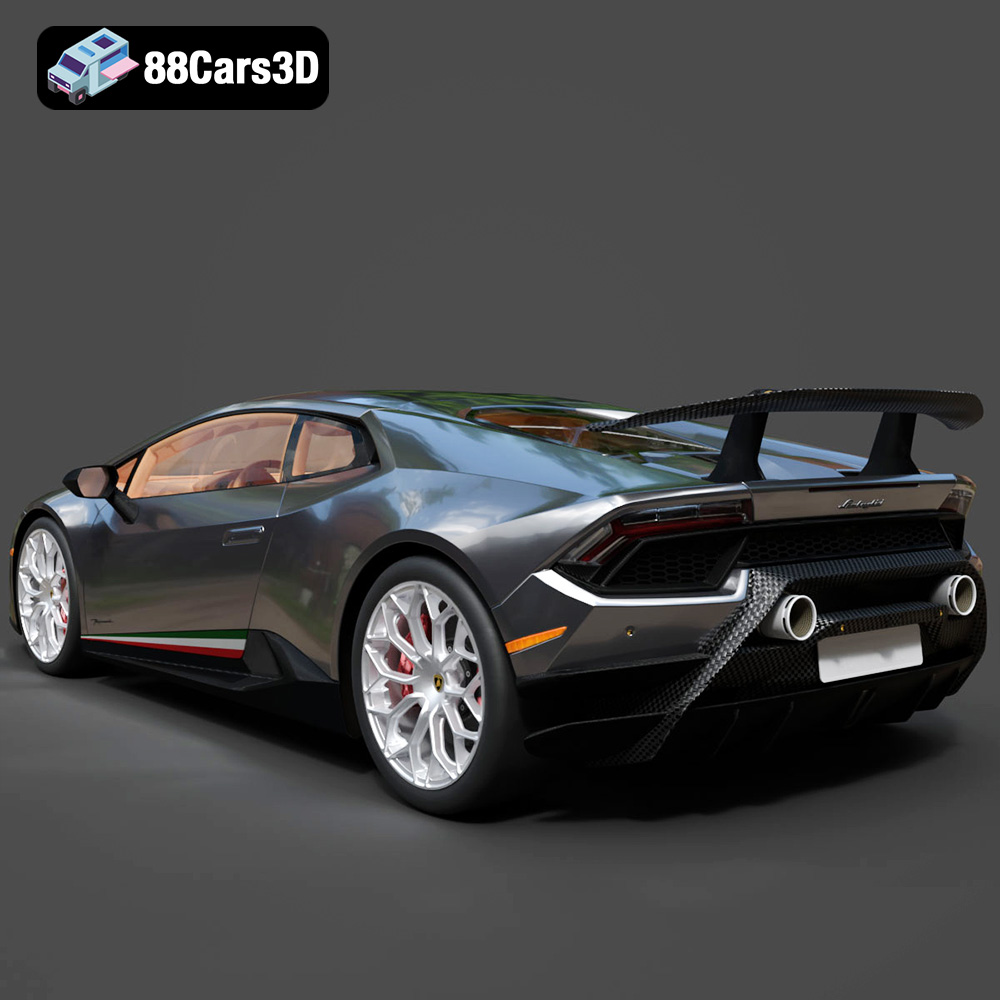
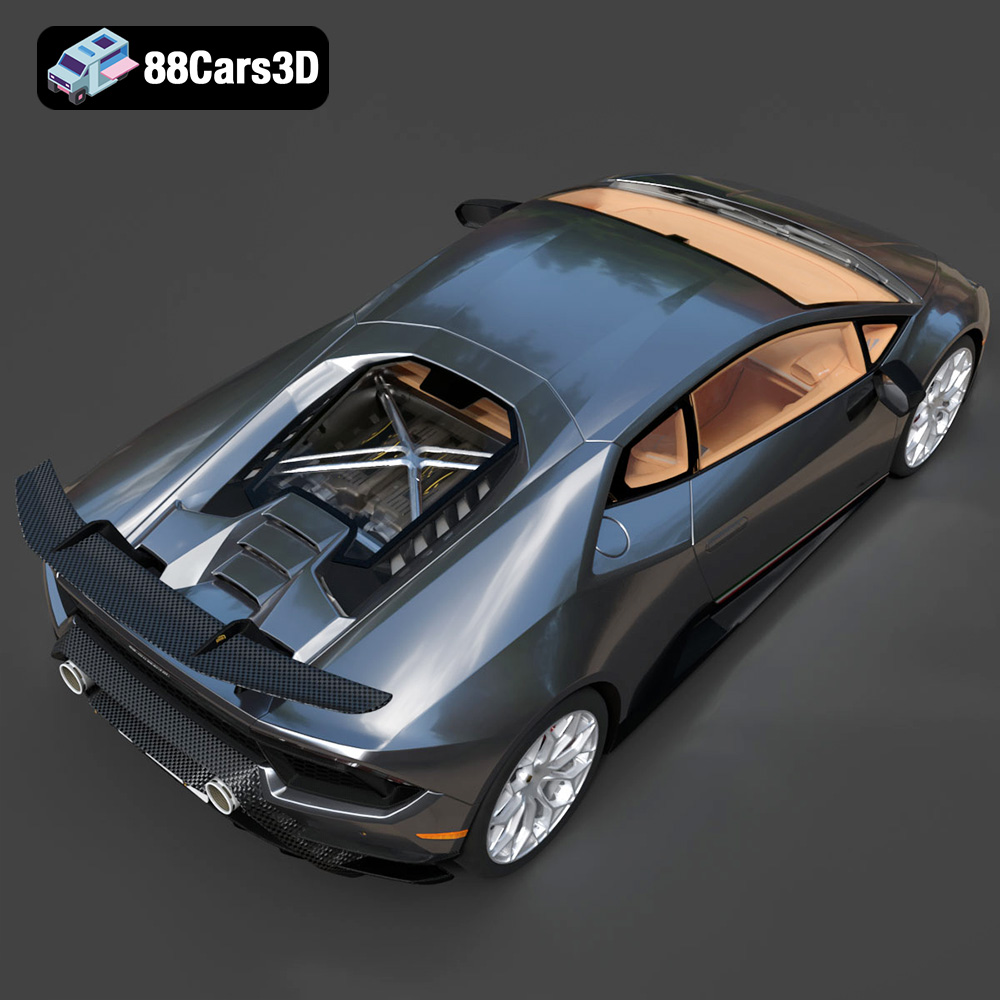
The Performante’s exterior is its most striking feature, defined by its track-focused modifications. The 3D model accurately captures these, from the distinctive high-mounted dual exhausts integrated into the rear fascia to the massive forged composite rear wing. Crucially, the model meticulously replicates the aggressive front splitter and the geometric cues that signify the revolutionary ALA (Aerodinamica Lamborghini Attiva) system, even if the active elements themselves are not animated by default, their presence is undeniable.
Beyond the major components, the model pays tribute to smaller yet significant details: the signature Y-shaped LED daytime running lights, sharp taillight clusters, and detailed lightweight forged alloy wheels housing massive carbon-ceramic brake calipers. The texture mapping for Lamborghini’s unique “Forged Composite” carbon fiber elements is a particular highlight, adding to the visual authenticity. Furthermore, elements like separate wheels, steering components, and doors are modeled for realistic animation and rigging, essential for interactive experiences and dynamic renders.
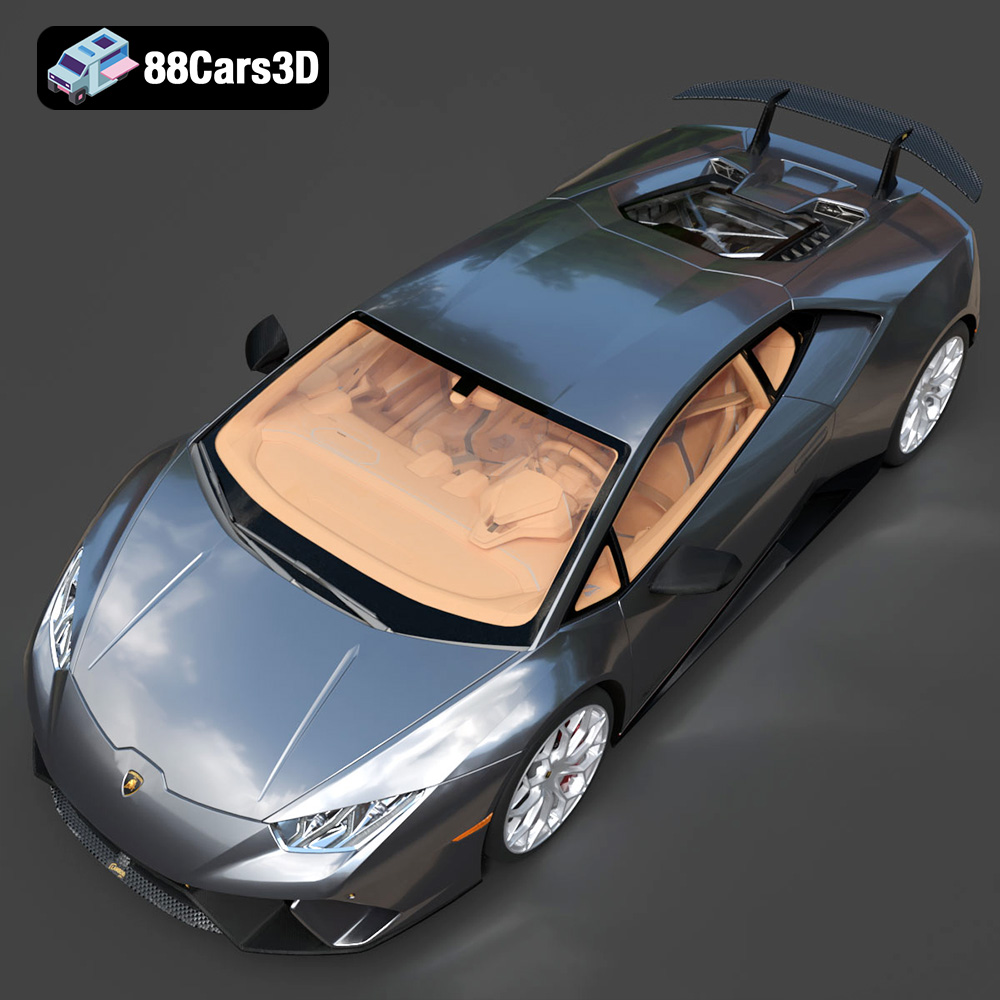
While the exterior screams performance, the interior of the Huracán Performante is a masterclass in driver-focused design. The 3D model successfully translates this, featuring an authentic track-focused cockpit layout. Premium sport bucket seat geometry, designed for Alcantara texture mapping, ensures comfort and grip are implied even in a digital form. The signature flat-bottom steering wheel with the iconic red Anima driving mode selector, and the hexagonal-themed center console with its jet-fighter-style ignition cover, are all faithfully recreated.
A significant technical advantage for the interior is its optimized geometry, specifically tailored for smooth first-person POV experiences in gaming or VR. This means careful poly distribution and UV mapping to ensure that when a player or viewer is inside the car, the details are crisp without overwhelming the rendering pipeline, a common pitfall for interior models.
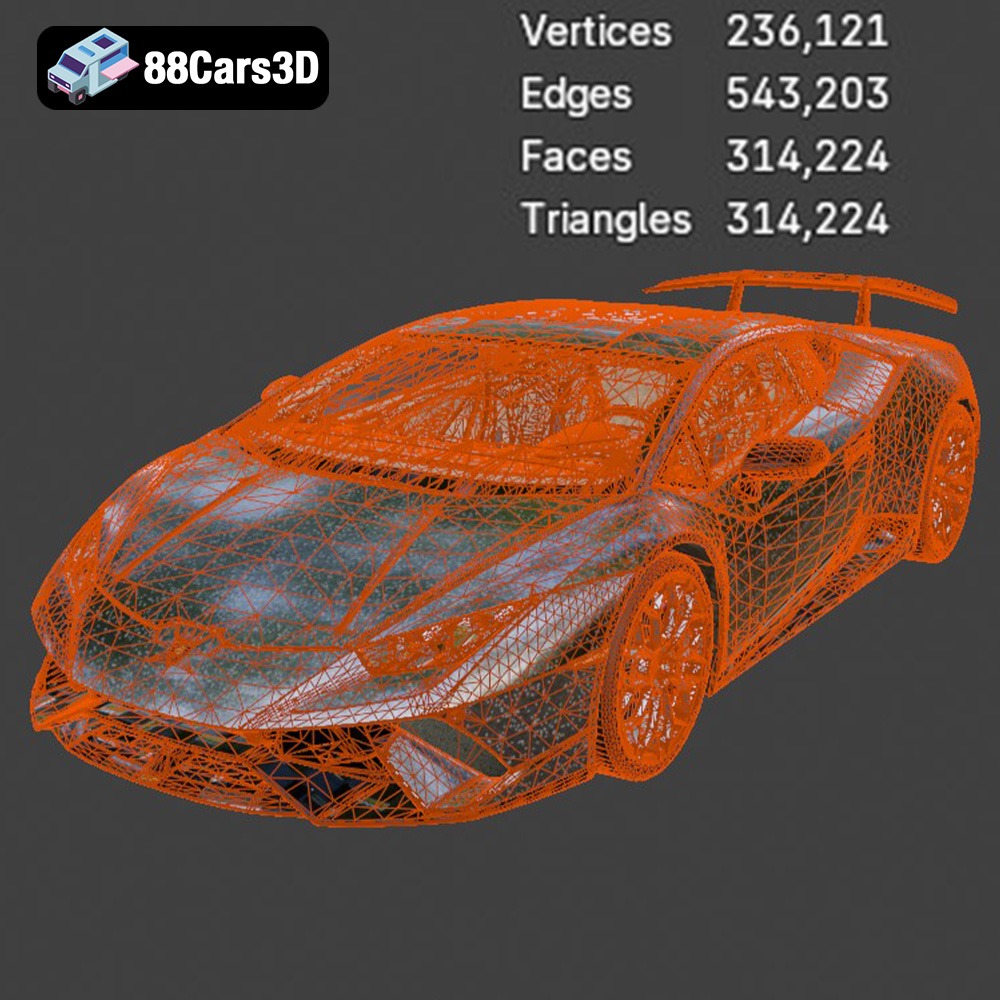
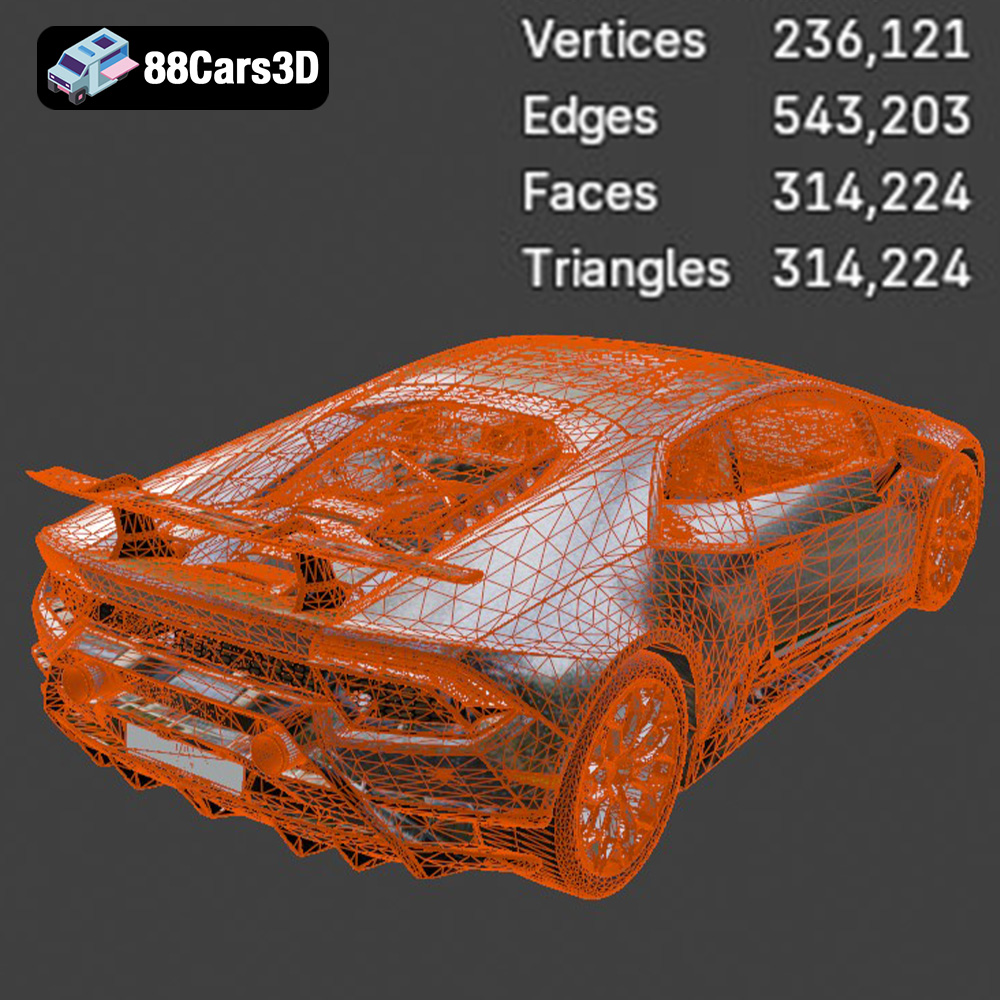
The true technical brilliance of this model lies in its topology. With 236,121 vertices, 543,203 edges, and 314,224 faces/polygons (totaling 314,224 triangles), it strikes an exceptional balance. This “mid-polygon” count is described as an “absolute dream for game developers,” detailed enough to be a drivable “hero” car while remaining light enough to run smoothly at 60+ FPS in engines like Unreal Engine or Unity.
This highly optimized, clean, quad-based structure is paramount. It allows for effortless subdivision for ultra-high-resolution renders when needed, while still performing efficiently in real-time. The real-world scale accuracy, based on Lamborghini factory dimensions, and proper pivot setup for steering and wheel rotation further enhance its utility, ensuring it behaves realistically whether static in a visualization or in motion within a simulator.
The versatility of a well-engineered 3D car model is its greatest asset. The Lamborghini Huracán Performante LP 640-4 2017 3D Model exemplifies this, proving invaluable across various professional disciplines, from producing high-end marketing materials to building immersive digital worlds.
For automotive rendering, the goal is often photorealism, blurring the line between digital and physical. Software like 3ds Max and Blender, paired with powerful renderers like V-Ray, Corona Renderer, or Cycles, are the industry standard. The Performante model, with its accurate geometry, clean topology, and PBR-ready materials (or the ability to easily create them), is perfectly suited for these environments. Artists can experiment with dramatic studio lighting setups, intricate reflection probes, and environmental effects to create high-octane automotive commercials or integrate the supercar into luxury architectural visualizations. The `.max` and `.blend` formats ensure native compatibility and full editability for advanced artists, allowing for custom scene setups and complex animation sequences.
The demands of real-time rendering in game development are stringent. Models must be optimized for performance, often requiring multiple Levels of Detail (LODs), efficient UV mapping, and robust collision meshes. The Performante model, with its ~314k triangle count, hits the sweet spot for a “hero” vehicle in modern racing games, open-world titles, or driving simulators. Its clean topology means efficient rigging for physics-based driving dynamics, and the inclusion of `.fbx` and `.unreal` formats significantly streamlines the import process into engines like Unreal Engine and Unity. Game developers can quickly integrate this model, set up its materials, and get it driving without extensive optimization work, saving valuable production time and resources.
Augmented Reality (AR) and Virtual Reality (VR) platforms impose unique constraints, prioritizing low poly counts and efficient draw calls to maintain high frame rates and prevent motion sickness. The optimized nature of the Lamborghini Huracán Performante model makes it an excellent candidate for interactive digital showrooms, supercar configurators, and mobile AR experiences. The `.glb` format, specifically designed for efficient transmission and rendering in web and mobile contexts, is particularly advantageous here. Imagine a potential buyer exploring the Performante’s interior in a VR showroom or customizing its paint color via an AR app on their phone – this model provides the visual fidelity without compromising performance.
Beyond the digital realm, high-quality 3D car models also bridge the gap to the physical world through 3D printing. For enthusiasts, collectors, or designers looking for tangible representations, a well-prepared 3D model can become a beautiful scale replica.
Converting a digital model for 3D printing requires specific considerations. The Lamborghini Huracán Performante model, convertible to `.stl` format, is suitable for hobbyists aiming for display-scale 1:18 or 1:24 supercar diecast replicas. Key print settings like layer height (0.04–0.12 mm, with resin printing highly recommended for sharp details), wall thickness (1.2–2.0 mm), and infill (15–25%) are crucial for a successful print. The model’s manifold geometry ensures it’s “watertight,” a prerequisite for most 3D printers, preventing errors during slicing.
Successful 3D printing often extends beyond the printer itself. Post-processing, including sanding, priming, and painting, is vital to achieve a professional finish. For a model like the Performante, selecting striking Lamborghini factory colors (e.g., Verde Mantis, Arancio Anthais, or Giallo Inti) paired with matte black or forged carbon details can elevate a printed model into a true collectible. Careful print orientation (body angled for smoothness, wheels printed separately) and strategic support placement (for aggressive elements like the front splitter and ALA rear wing) ensure the delicate features of the supercar are preserved during the printing process.
A significant advantage of investing in high-quality 3D car models, such as those available on 88cars3d.com, is their inherent flexibility for customization and long-term utility. A robust model is not a one-off asset but a foundation for myriad creative possibilities.
The Lamborghini Huracán Performante model is designed with customization in mind. Artists can easily change exterior paint colors to match any of Lamborghini’s striking factory Ad Personam options – be it matte, pearl, or metallic finishes. The unique “Forged Composite” material on the wing, engine cover, and bumpers can be emphasized or altered with different texture maps and shaders. Furthermore, modifying the wheel setup (swapping standard alloys for center-lock racing wheels) or adapting lighting for dramatic, neon-lit nighttime city streets versus bright race track environments are all straightforward adjustments that can dramatically alter the model’s presentation to fit a project’s unique vision. This adaptability saves countless hours compared to building assets from scratch for each scenario.
In a fast-evolving digital landscape, asset longevity is key. A meticulously built 3D car model, with clean topology and real-world scale, is inherently future-proof. It can be easily updated with new rendering techniques, adapted for future game engines, or repurposed for emerging technologies like advanced metaverse applications. By providing diverse file formats like `.blend`, `.fbx`, and `.max`, the Lamborghini Huracán Performante model ensures maximum compatibility and reusability across different software generations and production pipelines. This makes it a valuable long-term investment for any professional or studio, ensuring that this digital supercar remains relevant and usable for years to come.
The journey from a real-world automotive marvel to a high-fidelity 3D car model is a testament to the skill, precision, and technical understanding required in modern digital content creation. The Lamborghini Huracán Performante LP 640-4 2017 3D Model exemplifies the pinnacle of this craft, offering a meticulously optimized digital recreation that excels across all professional applications.
Whether you’re an automotive renderer aiming for breathtaking photorealism, a game developer crafting the next-generation racing simulator, an AR/VR specialist building immersive showrooms, or a hobbyist looking to 3D print a scale replica, this model provides the perfect blend of visual accuracy and technical performance. Its clean topology, extensive detail, and compatibility with a wide array of file formats make it an indispensable asset. Investing in such high-quality 3D car models, like those offered at 88cars3d.com, is not merely acquiring a digital asset, but empowering your projects with precision-engineered tools built for success in any creative endeavor.
Product Title:
Lamborghini Huracán Performante LP 640-4 2017 3D Model
Detailed Product Description:
The Lamborghini Huracán Performante LP 640-4 (2017) 3D Model is a meticulously optimized digital recreation of the track-focused Italian supercar. Born to dominate the Nürburgring, the Performante takes the dramatic styling of the standard Huracán and injects it with aggressive, motorsport-derived aerodynamics, most notably the revolutionary ALA (Aerodinamica Lamborghini Attiva) system and widespread use of forged carbon fiber.
This 3D model accurately captures the razor-sharp aesthetic of the Performante, featuring the signature high-mounted dual exhausts, the massive forged composite rear wing, a deep front splitter, and the unmistakable wedge-shaped profile. Built with an incredibly efficient and clean mid-polygon topology (just over 314k triangles), it strikes a flawless balance. It provides exceptional visual fidelity for stunning close-up automotive renders while remaining perfectly lightweight for use as a hero vehicle in modern real-time game engines.
Perfect for high-speed racing simulators, luxury automotive galleries, high-end commercial visualizations, and AR/VR supercar showrooms.
Exterior Features:
• Accurate 2017 Huracán Performante proportions and aggressive aerodynamic geometry
• Distinctive ALA (Aerodinamica Lamborghini Attiva) rear wing and active aero front splitter
• High-mounted dual exhaust system integrated into the rear fascia
• Signature Y-shaped LED daytime running lights and sharp taillight clusters
• Elements mapped for Lamborghini’s unique “Forged Composite” carbon fiber textures
• Detailed lightweight forged alloy wheels with massive carbon-ceramic brake calipers
• Separate wheels, steering components, and doors for realistic animation and rigging
Interior Features:
• Authentic track-focused, driver-centric cockpit layout
• Premium sport bucket seat geometry designed for Alcantara texture mapping
• Signature flat-bottom steering wheel with the red Anima driving mode selector
• Hexagonal-themed center console with jet-fighter-style ignition cover
• Optimized interior geometry tailored for smooth first-person POV in gaming or VR
Technical Specifications & Advantages:
• Vertices: 236,121
• Edges: 543,203
• Faces / Polygons: 314,224
• Triangles: 314,224
• Highly Optimized Topology: As shown in your wireframe renders, this model features a remarkably clean, quad-based structure. At ~314k triangles, it is an absolute dream for game developers—detailed enough to be a drivable “hero” car, yet light enough to run smoothly at 60+ FPS in Unreal Engine or Unity.
• Real-world scale accuracy based on Lamborghini factory dimensions
• Proper pivot setup for steering and wheel rotation
• Compatible with major 3D software platforms and modern real-time engines
Applications:
• Game Development: The perfect “hero” drivable supercar for current-gen racing games, open-world titles, and driving simulators.
• Rendering & Visualization: Ideal for dramatic studio lighting setups, high-octane automotive commercials, and modern luxury architectural renders.
• AR/VR: Excellent for interactive digital showrooms, supercar configurators, and mobile AR experiences due to its optimized poly count.
• 3D Printing: Convertible to .stl format for display-scale 1:18 or 1:24 supercar diecast hobbyists.
3D Print Setting:
• Recommended scale: 1:24 / 1:18 / 1:12
• Layer height: 0.04–0.12 mm (Resin printing is highly recommended to capture the sharp aero edges, wing pylons, and wheel spokes)
• Wall thickness: 1.2–2.0 mm
• Infill: 15–25%
• Supports: Required for side mirrors, the aggressive front splitter, and the ALA rear wing
• Print orientation: Body printed angled for a smooth surface finish; wheels printed separately
• Post-processing: Sanding, primer, and striking Lamborghini colors (e.g., Verde Mantis, Arancio Anthais, or Giallo Inti) with matte black/forged carbon details
Customization Options:
• Change exterior paint colors to match striking factory Ad Personam options (matte, pearl, or metallic)
• Emphasize the unique “Forged Composite” material on the wing, engine cover, and bumpers
• Modify the wheel setup (swap standard alloys for center-lock racing wheels)
• Adapt lighting for dramatic, neon-lit nighttime city streets or bright race track environments
Included File Formats:
.blend, .fbx, .obj, .glb, .stl, .ply, .unreal, .max
Title Tag:
Lamborghini Huracán Performante 2017 Optimized 3D Model
Meta Description:
Texture: Yes | Material: Yes
Download the highly detailed Lamborghini Huracán Performante 2017 3D Model (314k Triangles). Features aggressive track-focused styling, the iconic ALA rear wing, and high-mounted exhausts. Perfectly balanced for rendering, game development, and VR/AR. Includes .blend, .fbx, .obj, .glb, .stl, and .max formats.
Tags:
lamborghini, huracan, performante, lp640-4, supercar, sports-car, v10, track-car, mid-poly, game-ready, car-3d-model, automotive, rendering, vr-ar, blend, fbx, obj3D Print Setting: • Recommended scale: 1:24 / 1:32 / 1:43 • Layer height: 0.04–0.12 mm (Resin printing recommended for the smaller scale details like the Thor’s Hammer headlights) • Wall thickness: 1.2–2.0 mm • Infill: 15–25% • Supports: Required for side mirrors, wheel arches, and the subtle rear roof spoiler • Print orientation: Body printed angled for a smooth surface finish; wheels printed separately • Post-processing: Sanding, primer, and modern Volvo factory colors (like Sage Green, Glacier Silver, or Crystal White) paired with a gloss black roof.3D Printing, STL, 3D Printable, Miniature Car, Scale Model, FDM Ready, Resin Print, SLA, Digital Manufacture, Car Prototype, Automotive Collectible, 3D Print Model, Physical Asset, Tabletop Display, Manifold Geometry.
$45
.automotive
.blend
.fbx
.huracan
.lamborghini
.rendering
.sports car
.stl
.supercar
.v10
3D Print Model
3D Printable
and modern Volvo factory colors (like Sage Green
Automotive Collectible
Car Prototype
car-3d-model
Digital Manufacture
FDM Ready
game-ready
Glacier Silver
lp640-4
Manifold Geometry.
mid-poly
Miniature Car
or Crystal White) paired with a gloss black roof.3D Printing
performante
Physical Asset
primer
Resin Print
Scale Model
SLA
Tabletop Display
track-car
VR/AR
wheel arches