Get 50% OFF All Premium 3D & STL Models!

The automotive industry has always been at the forefront of technological innovation, and its visualization needs are no exception. From stunning marketing campaigns to immersive configurators and virtual production stages, the demand for hyper-realistic, real-time rendering of vehicles is escalating. For years, achieving truly dynamic and physically accurate global illumination (GI) in real-time was a holy grail, often requiring complex baked lighting solutions or compromises in visual fidelity.
Enter Unreal Engine and its revolutionary Lumen Global Illumination and Reflections system. Lumen is not just another lighting solution; it’s a paradigm shift, enabling artists and developers to create breathtakingly realistic automotive scenes with unparalleled speed and flexibility. Imagine a digital showroom where every subtle light bounce off a polished car chassis is accurate, where a vehicle’s paint gleams authentically under a changing sky, and where the interior ambient light adapts dynamically as doors open or close. This is the power Lumen brings to automotive visualization.
This comprehensive deep dive will explore Lumen’s technical intricacies, its immense benefits for rendering 3D car models, and how to harness its capabilities within Unreal Engine to craft visually stunning and performant automotive experiences. Whether you’re a game developer aiming for next-gen racing realism, an automotive designer visualizing future concepts, or a content creator building interactive showrooms, understanding Lumen is crucial for staying ahead. We’ll cover everything from project setup and optimization to advanced techniques, ensuring you can leverage the full potential of Unreal Engine’s real-time GI system.
Global Illumination (GI) is the holy grail of realistic rendering because it simulates how light behaves in the real world: bouncing off surfaces, picking up color, and illuminating areas that aren’t in direct view of a light source. Without GI, scenes look flat and artificial, lacking the subtle nuances that define reality. Traditionally, achieving high-quality GI in real-time has been computationally expensive, leading to compromises like pre-baked lightmaps (which are static and inflexible) or less accurate, screen-space approximations.
Lumen revolutionizes this by providing a robust, dynamic, and real-time GI solution within Unreal Engine. It’s designed to work seamlessly with various light sources, materials, and complex geometry, ensuring that every pixel on your screen receives physically accurate indirect lighting and reflections. For automotive visualization, this means car paint reacts realistically to its environment, interiors are softly lit by light filtering through windows, and shadows are rendered with true-to-life softness and color bleed.
Lumen operates using a hybrid software ray tracing approach, primarily relying on two main components to achieve its impressive results:
This combination allows Lumen to scale efficiently, delivering high-quality GI for both expansive environments and intricate details on vehicles. It’s truly dynamic, responding instantly to changes in lighting, geometry, or material properties.
Before Lumen, Unreal Engine artists often relied on a mix of techniques for GI:
Lumen surpasses these by offering real-time, dynamic, and high-quality GI that works across the entire scene, regardless of camera view. It provides accurate multi-bounce indirect lighting and reflections, volumetric lighting interaction, and emissive material contributions – all crucial for photorealistic automotive visualization. This fundamental shift means artists spend less time baking and more time iterating, creating more dynamic and immersive experiences.
Integrating Lumen into your Unreal Engine project for automotive visualization is a straightforward yet critical process. A proper setup ensures optimal performance and visual quality for your 3D car models. This section guides you through enabling Lumen, configuring its settings, and preparing your scene and assets to harness its full power.
To begin, Lumen needs to be activated within your Unreal Engine project. Navigate to Edit > Project Settings > Engine > Rendering. Scroll down to the Global Illumination section and select Lumen from the ‘Global Illumination Method’ dropdown. Similarly, in the Reflections section, choose Lumen as the ‘Reflection Method’. Enabling both is recommended for the most cohesive and realistic results, as Lumen handles both indirect lighting and reflections synergistically.
Once enabled, you’ll find a range of Lumen settings within the same Project Settings panel and in Post Process Volumes placed within your level. For detailed descriptions of these settings, always refer to the official Unreal Engine documentation at https://dev.epicgames.com/community/unreal-engine/learning.
The quality of your Lumen output heavily depends on your scene’s composition and the quality of your assets. When sourcing high-quality 3D car models from platforms like 88cars3d.com, ensure they come with clean topology, proper UV mapping, and PBR-ready materials. These foundations are crucial for Lumen to interpret and bounce light accurately.
Remember, Lumen is all about dynamic interaction. Experiment with different light positions, intensities, and colors to see how your automotive scene responds in real time. This iterative workflow is where Lumen truly shines, empowering artists to achieve their vision without the constraints of baked lighting.
While Lumen offers incredible visual fidelity, it’s also a sophisticated system that demands careful optimization, especially when working with high-detail 3D car models and aiming for real-time performance. Balancing visual quality with frame rate is key, particularly for interactive experiences, games, or AR/VR applications. This section delves into strategies for optimizing your automotive assets and scenes to get the most out of Lumen.
One of the most significant breakthroughs for high-fidelity automotive visualization in Unreal Engine is the synergy between Nanite virtualized geometry and Lumen. Nanite allows artists to import and render incredibly high-polygon models—even millions or billions of triangles per mesh—without traditional performance bottlenecks. For a detailed 3D car model, often boasting millions of polygons for components like the body, interior, and engine, Nanite is indispensable.
Crucially, Lumen can directly ray trace against Nanite meshes. This means that Lumen’s GI calculations benefit from the full geometric detail of your car model. The intricate curves of a fender, the complex assembly of an engine bay, or the detailed stitching on interior upholstery will all contribute to and receive accurate indirect lighting and reflections. This eliminates the need for simplified proxy geometry for GI, leading to far more realistic results.
Workflow for Nanite Car Models:
This combined power significantly reduces draw calls and memory overhead compared to traditional high-poly workflows, making it feasible to render multiple highly detailed vehicles within a Lumen-enabled scene.
While Nanite handles detail for static meshes, Level of Detail (LODs) are still relevant for skeletal meshes (e.g., if parts of your car are animated using bones) or for optimizing scenes with non-Nanite geometry. Strategic LOD creation ensures that distant objects consume fewer resources, allowing Lumen to focus its computational power on the visually critical areas around the main vehicle.
Lumen itself offers numerous performance settings within the Project Settings and Post Process Volume to fine-tune its impact:
Debugging Lumen Performance:
Unreal Engine provides powerful visualization tools to understand Lumen’s performance profile. Use the console command 'r.Lumen.Visualize 1' to access various debug views, such as Lumen Scene, Final Gather, and Reflections. These visualizations help identify areas where Lumen is struggling or consuming excessive resources, allowing you to make informed optimization decisions. For example, if ‘Lumen Scene’ shows overly complex geometry being traced at a distance, you might consider simplifying those specific assets or adjusting their Nanite settings.
For primary car models, aim for texture resolutions of 4K or 8K for critical components (body, interior) to ensure crispness, but use 2K or 1K for less visible elements (underbody, engine block). Maintaining efficient PBR material setups with minimal instruction counts also contributes to overall rendering performance, allowing Lumen to process reflections and indirect lighting more rapidly.
Beyond the fundamental setup, Lumen offers a powerful toolkit for advanced lighting scenarios, cinematic production, and interactive experiences in automotive visualization. Leveraging these techniques can elevate your 3D car models from static renders to dynamic, engaging showcases.
Lighting the interior of a car is notoriously challenging due to its confined spaces, complex geometry, and multiple small light sources. Lumen dramatically simplifies this process by accurately simulating light bouncing within these intricate environments. Traditional methods often struggled with light leaks, splotches, or needing countless baked lightmaps for every potential lighting scenario.
With Lumen, indirect light from windows and doors naturally permeates the cabin, creating soft, realistic ambient light. Emissive materials on dashboards, infotainment screens, and instrument clusters will genuinely illuminate the surrounding surfaces, adding depth and realism.
Lumen’s real-time, dynamic nature makes it an ideal companion for virtual production and cinematic content creation using Unreal Engine’s Sequencer. Imagine placing a digital car model from 88cars3d.com onto a virtual stage, where a director can instantly change the time of day, swap environments, or adjust studio lighting, all while Lumen provides accurate GI feedback.
Blueprint, Unreal Engine’s powerful visual scripting system, allows for the creation of rich, interactive automotive experiences that truly come alive with Lumen. This combination empowers artists to build dynamic environments where users can explore, customize, and interact with vehicles in ways previously impossible in real-time.
By combining Lumen’s powerful real-time GI with Blueprint’s flexibility, artists can push the boundaries of automotive visualization, creating experiences that are not only visually stunning but also deeply engaging and interactive.
Lumen’s integration into Unreal Engine has profoundly impacted various sectors of the automotive industry, accelerating workflows and unlocking new creative possibilities. From rapid prototyping to compelling marketing, its capabilities are being leveraged to deliver unprecedented realism in real-time. As the technology evolves, its applications will only expand, shaping the future of how we visualize and interact with vehicles.
One of the most immediate and impactful applications of Lumen is in next-generation automotive configurators. Historically, online car configurators relied on pre-rendered images or simplified 3D models with basic lighting, leading to a disconnected experience. With Lumen, a customer can customize a car in real-time, changing paint colors, wheel options, and interior trims, and see the environment’s light accurately bounce off the new selections. This level of dynamic realism makes the configuration process far more engaging and informative. A user can even toggle different showroom lighting setups, instantly seeing how a particular paint finish would look under bright daylight versus a moody evening setting, all with physically correct global illumination.
For marketing and advertising, Lumen powers the creation of cinematic trailers and interactive experiences that were once limited to expensive, offline render farms. Agencies can now produce high-fidelity visuals of new vehicle launches much faster, allowing for rapid iteration and creative exploration. Imagine a car reveal where the vehicle dynamically reacts to an ever-changing light show, with every reflection and shadow perfectly aligned—this is the new standard Lumen helps establish.
Augmented Reality (AR) and Virtual Reality (VR) offer immersive ways to experience automotive concepts, from virtual test drives to interactive design reviews. While performance optimization for AR/VR remains a critical consideration, Lumen brings an unparalleled level of realism to these platforms. For instance, in a VR showroom, a user can walk around a vehicle and observe how the ambient light truly illuminates its form and details, rather than relying on static or simplified lighting. This enhances immersion and the sense of presence.
Specific Optimization Tips for Lumen in VR:
By making virtual automotive experiences more visually compelling and physically accurate, Lumen helps bridge the gap between digital models and real-world perception in AR/VR.
The journey with Lumen is far from over. Epic Games continually refines its capabilities, pushing the boundaries of real-time GI. Future iterations promise even greater efficiency, higher fidelity, and broader compatibility across various hardware platforms. We can anticipate further integration with other advanced rendering features, such as improved volumetric cloud interactions and enhanced translucency effects, which are critical for realistic car glass and headlights.
The demand for physically accurate, real-time visuals will only grow, driven by the increasing sophistication of game engines and the convergence of industries. For professionals relying on high-quality 3D car models from marketplaces such as 88cars3d.com, Lumen ensures that these assets can be showcased and interacted with at the pinnacle of visual fidelity. It’s a foundational technology that empowers artists, designers, and developers to create the next generation of captivating automotive content, from cinematic masterpieces to fully interactive digital twins.
The evolution of real-time global illumination, spearheaded by Unreal Engine’s Lumen, marks a pivotal moment for automotive visualization. We’ve journeyed through Lumen’s technical architecture, its seamless integration with high-fidelity 3D car models, and the meticulous steps required to optimize scenes for peak performance. We’ve seen how its dynamic capabilities transform everything from intricate interior lighting to large-scale virtual production, offering a level of realism and flexibility previously unattainable in real-time.
Lumen empowers artists and developers to transcend the limitations of static lighting, enabling them to create interactive configurators where every color change feels impactful, build marketing assets that possess cinematic depth, and craft AR/VR experiences that genuinely immerse the user. The synergy with features like Nanite ensures that even the most polygon-dense car models, like those meticulously crafted and available on platforms like 88cars3d.com, can be rendered with breathtaking detail and accurate lighting interaction.
As you embark on your next automotive project in Unreal Engine, we encourage you to embrace Lumen. Experiment with its settings, push its boundaries, and leverage the wealth of resources available, including the comprehensive Unreal Engine documentation. The future of automotive visualization is dynamic, immersive, and incredibly real, and with Lumen at your command, you are well-equipped to drive that innovation forward.

Texture: Yes | Material: Yes | 3D Printable: Yes. Download the Italian Thoroughbreds Bundle featuring 5 iconic 3D models: Lamborghini Huracán Performante, Ferrari 458 Italia, Lamborghini Urus, Diablo SV, and Maserati GT. Optimized for 4K rendering and 3D printing (STL included). Save 50% with this ultimate Italian vehicle collection.
Price: $199.99

Download the Elite Future Mobility Bundle featuring 4 highly optimized 3D models: Tesla Model S, Avatr 11, Li L9, and Zoox Robotaxi. Perfect for ArchViz, Smart City renders, and game dev. Optimized for Unreal Engine and Blender. Includes .fbx, .obj, and .max formats.
Price: $99

🚗 5 Iconic German Cars (BMW M4 G82, M5 CS, X3, 1 Series & Mercedes E-Class). ✅ Optimized for ArchViz: Ready for Corona & V-Ray. 💰 Save €71 with this limited-time collection! 🚀 Instant Download after purchase.
Price: $119

Download the Extreme Off-Road & Survival 3D Models Bundle! Includes the Brabus 800 Adventure, Dodge Ram Bigfoot, Spec Truck, and a Caravan. Save over €210 on this premium 4-in-1 off-grid vehicle pack for ArchViz and game development.
Price: $149.99

Download the Heavy Duty & Commercial Logistics 3D Models Bundle! Includes the Ford Sterling, Caterpillar CT680, Mercedes Citaro Bus, and Vito Van. Save over €130 on this massive, game-ready 4-in-1 industrial vehicle pack.
Price: $109.99

Download the Ultimate Custom Motorcycles 3D Models Bundle. Includes a Custom Chopper, Ducati 916 Café Fighter, Harley XR1200X, and BMW K100. Perfect premium props for luxury ArchViz garages. Save over €250 today!
Price: $159.99

Download the ultimate JDM Street Racing 3D Models Bundle! Includes the Nissan GT-R, Toyota Supra, Mazda RX-7, Lancer Evo IX, and Honda NSX. Save big on this highly optimized, game-ready 5-in-1 Japanese legend car pack.
Price: $129.99

Download the ultimate American Muscle & Cinematic Classics 3D Models Bundle! Includes the Dodge Charger ’68, Mustang Eleanor GT500, Camaro Z28 ’79, and a custom ’69 Mustang. Save over €240 on this game-ready, premium 4-in-1 pack.
Price: $149.99

Download the Everyday City Traffic 3D Models Bundle. Includes the VW Golf, Kia Picanto, Hyundai Tucson, Toyota Yaris, and a DHL Ford Transit Van. Save big on this 5-in-1 pack, perfectly optimized for realistic ArchViz streets and game traffic.
Price: $99.99
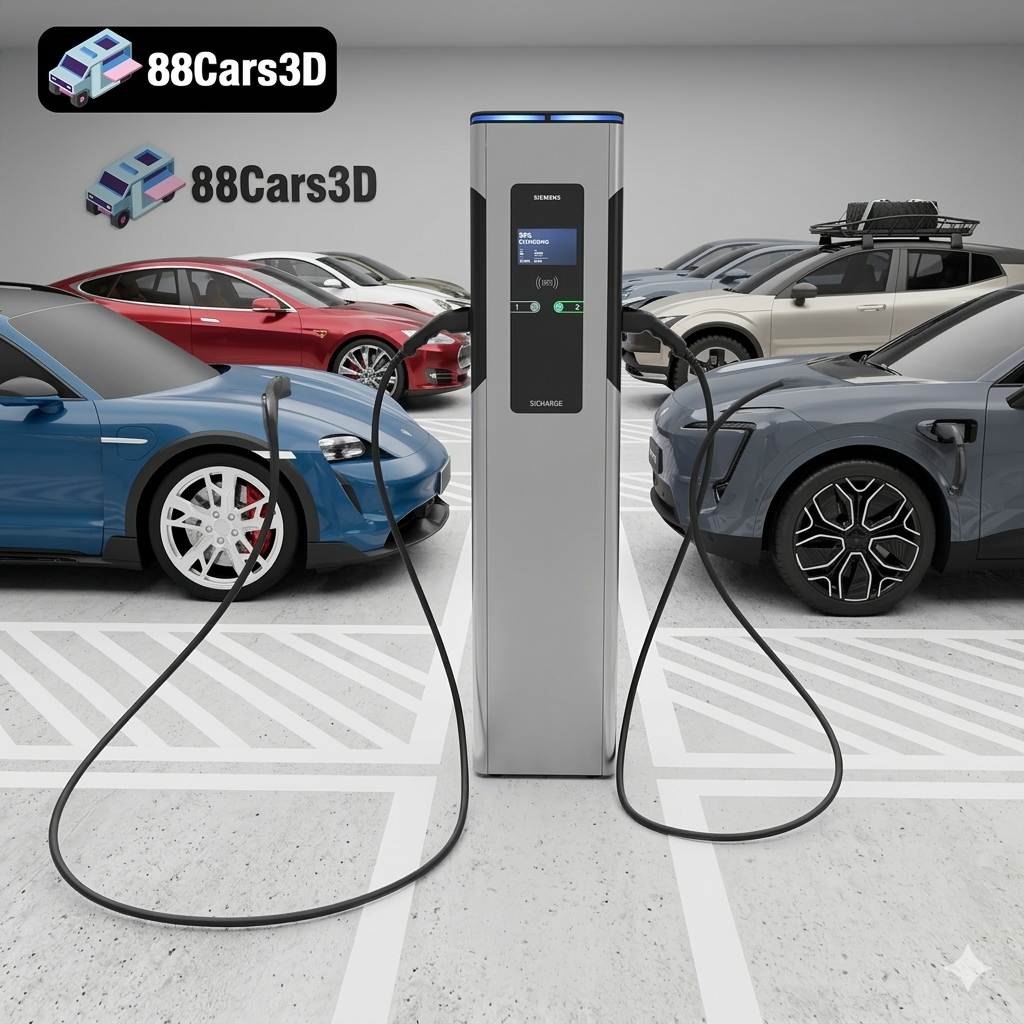
Download the Future of Mobility EV 3D Models Bundle. Includes the Volvo EX30, Tesla Model S, AVATR 11, Porsche Taycan, and a Siemens EV Charger. Save big on this highly optimized 5-in-1 pack for ArchViz and game development!
Price: $89.99

