Get 50% OFF All Premium 3D & STL Models!

In the vibrant world of 3D modeling, capturing the essence of historical vehicles is a blend of artistry and technical precision. Enthusiasts, developers, and artists often seek out highly detailed and accurate representations to enrich their projects, be it a cinematic rendering, an immersive game environment, or a historical visualization. The challenge lies in finding models that not only look authentic but are also technically sound and versatile enough for diverse applications. This is where specialized marketplaces like 88cars3d.com excel, providing professionals with access to exceptional assets, such as the featured IZ-49 Classic Motorcycle 3D Model.
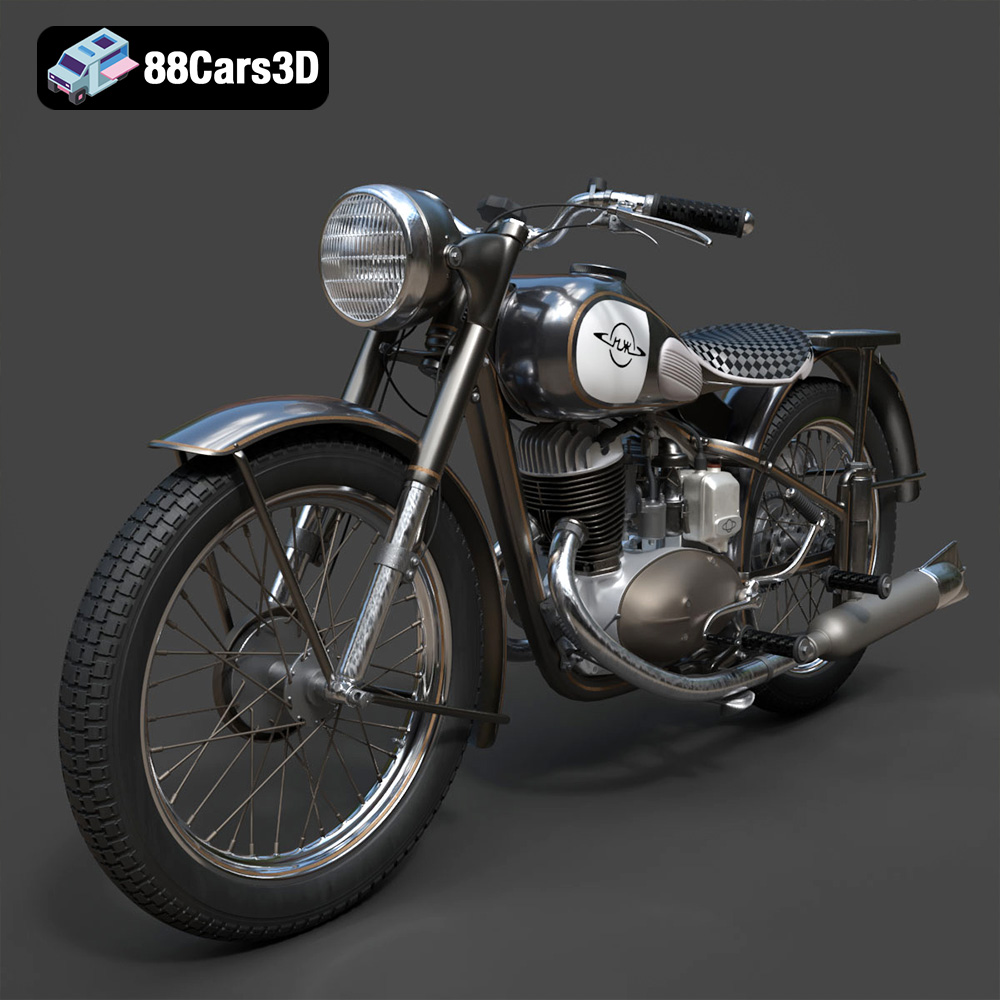
The IZ-49 is more than just a motorcycle; it’s a piece of post-war engineering history, an iconic Soviet-era vehicle produced between 1951 and 1958, celebrated for its rugged simplicity and durability. Recreating such a machine in 3D demands meticulous attention to detail, from its vintage steel frame to its single-cylinder engine and classic spoked wheels. This blog post will explore the critical aspects of working with high-quality 3D car models, with a particular focus on how the IZ-49 Classic Motorcycle 3D Model exemplifies best practices in automotive rendering, game asset development, and even 3D printing. We’ll delve into the technical underpinnings that make such a model valuable in professional pipelines, discuss essential file formats, and illustrate real-world applications across various industries.
When acquiring a 3D model, understanding the various file formats is paramount. Each format serves specific purposes, offering unique advantages in terms of compatibility, features, and optimization for different workflows. The IZ-49 Classic Motorcycle 3D Model, for instance, comes in a comprehensive suite of formats, ensuring maximum flexibility for any project. Let’s break down the most common and crucial ones:
The .blend format is native to Blender, a powerful open-source 3D creation suite. When you receive a .blend file, you’re not just getting the mesh; you’re getting a fully editable Blender scene. This includes the model’s geometry, materials (with all their nodes and textures), lighting setups, cameras, animations, modifiers, and even scene organization (collections, layers). For artists primarily working in Blender, this is invaluable as it allows for direct manipulation, material tweaking, and immediate integration into existing Blender projects without any conversion losses or compatibility issues. It’s the ultimate format for customization and iterative design within the Blender ecosystem.
.fbx (Filmbox) is an industry-standard format developed by Autodesk, widely adopted for its robust support of 3D models, animation, and scene data across different software. It is particularly ideal for real-time pipelines such as Unreal Engine and Unity. An .fbx file can encapsulate meshes, materials, textures, bones, skinning, and even camera data, making it an excellent bridge between modeling software (like 3ds Max or Blender) and game engines. Its versatility and ability to maintain hierarchy and animation data make it a go-to for game developers and cinematic artists. When importing into Unreal, for instance, .fbx ensures that pivot points, scale, and material slots are correctly transferred, streamlining the asset integration process.
The .obj (Wavefront OBJ) format is one of the oldest and most universally supported 3D file formats. It’s a simple, text-based format primarily used for transferring polygonal geometry (vertices, normals, texture coordinates, and faces) and material references. While it doesn’t typically store animation or scene hierarchy, its widespread compatibility makes it an excellent choice for cross-software transfers where you only need the raw model geometry and basic material assignments. Almost every 3D application can import and export .obj, ensuring interoperability even with niche or older software. It’s a reliable fallback for foundational model exchange.
.glb (GL Transmission Format Binary) is the binary version of glTF, a modern, royalty-free specification for the efficient transmission and loading of 3D scenes and models by engines and applications. .glb files are “self-contained,” meaning they embed textures and other assets directly into a single file, making them highly optimized for AR/VR applications and web-based displays (e.g., embedding a 3D model directly into a webpage). Their small file size and optimized structure ensure fast loading times and efficient rendering, crucial for interactive experiences on mobile devices or in browser contexts. For viewing the IZ-49 in an augmented reality app, .glb would be the preferred format.
.stl (STereoLithography) is the de facto standard file format for 3D printing. It represents a 3D model as a series of connected triangles (a tessellated surface) without color, texture, or other CAD attributes. Its simplicity makes it universally compatible with 3D slicing software, which prepares models for additive manufacturing. The IZ-49’s availability in .stl format directly addresses the need for physical collectibles, scale models, or even prototypes. For high-quality results, the model must have “manifold” geometry, meaning it’s watertight with no holes or self-intersecting surfaces, which is a critical characteristic of well-prepared models like those found on 88cars3d.com.
.ply (Polygon File Format, or Stanford Triangle Format) is another format for storing 3D data, particularly useful for scanned data, precision meshes, and scientific applications. It can store a variety of properties including color, transparency, normals, texture coordinates, and even reliability information. While less common for general 3D asset exchange than .fbx or .obj, .ply offers greater precision and flexibility for specific engineering, CAD, or analytical workflows where detailed mesh data is paramount. For reconstructing a historical vehicle for mechanical analysis or archival, .ply could be highly beneficial.
The .unreal format signifies an asset specifically optimized and prepared for direct integration into Unreal Engine projects. While usually an internal Unreal asset type rather than a direct import format, its inclusion implies that the IZ-49 has been meticulously prepared with Unreal’s requirements in mind. This typically means optimized polygon counts, correct material setups with PBR (Physically Based Rendering) textures, proper UV mapping for lightmaps and textures, collision meshes, and accurate pivot points, significantly reducing setup time for game developers. It’s an “asset package” ready to drop into an Unreal project.
.max is the native file format for Autodesk 3ds Max, a leading software for 3D modeling, animation, rendering, and visualization. Similar to .blend, a .max file contains the complete scene data, including geometry, materials (with Max-specific shaders), textures, lighting, cameras, animation, and modifiers. For artists and studios working within the Autodesk ecosystem, the .max file provides the most comprehensive and editable version of the model, allowing for full customization, complex rigging, and high-fidelity rendering with engines like V-Ray or Corona Renderer. The availability of this format for the IZ-49 ensures maximum control and fidelity for high-end visualization projects.
The provision of the IZ-49 Classic Motorcycle 3D Model in this diverse range of formats underscores its versatility and the producer’s commitment to professional-grade assets, enabling artists and developers to seamlessly integrate it into virtually any workflow.
Recreating a classic vehicle in 3D is a nuanced process that demands both historical accuracy and technical prowess. The IZ-49 Classic Motorcycle 3D Model stands as a testament to this delicate balance, transforming a historical artifact into a versatile digital asset. The process typically begins with extensive research, gathering blueprints, historical photographs, and reference materials to ensure every curve, component, and proportion is faithfully replicated.
For a model like the IZ-49, historical accuracy is paramount. This involves deep dives into archives to understand the motorcycle’s original production design, identifying the specific features of its 1951-1958 production run. The product description highlights “accurate mid-century motorcycle proportions” and “real-world scale accuracy,” which are direct results of this research. These details ensure that when the model is placed in a scene, whether it’s a retro street setting or a museum exhibit, it looks and feels authentic, contributing significantly to the immersive quality of any visualization. Without correct proportions, even the most detailed textures can’t salvage a model’s credibility.
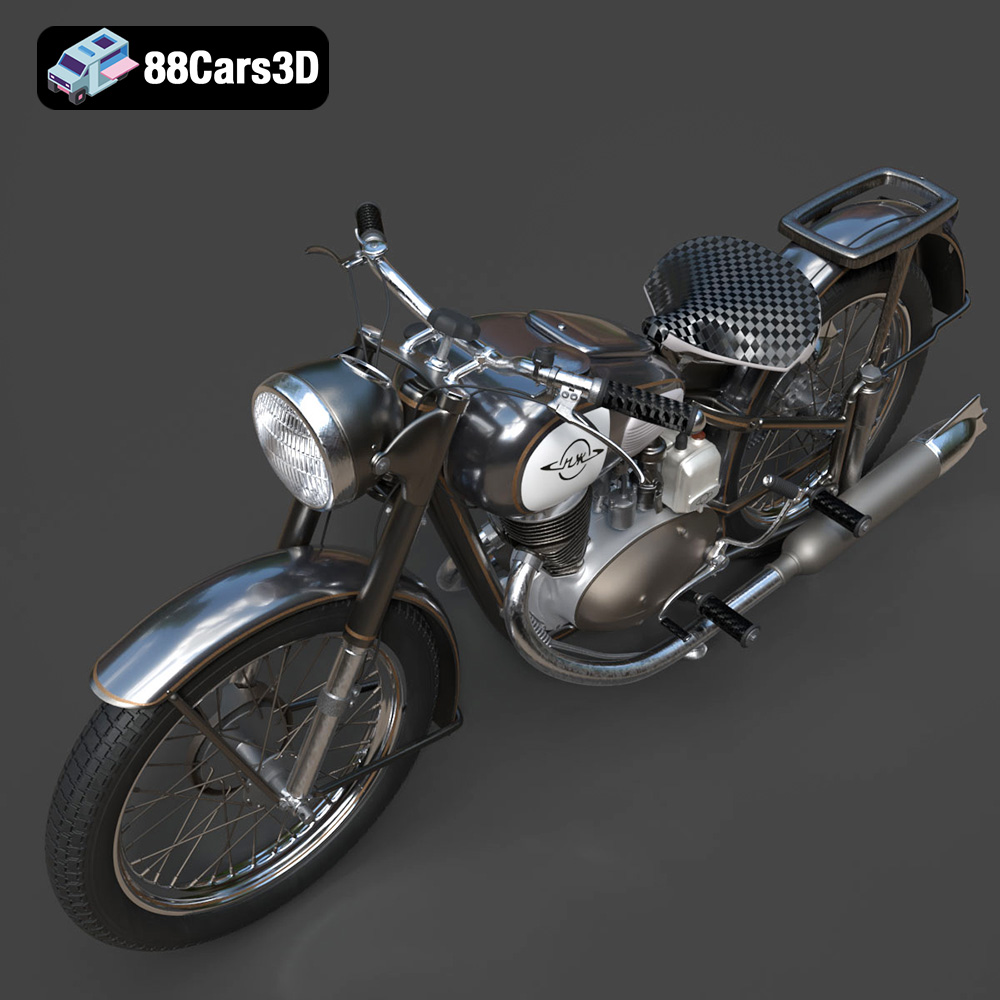
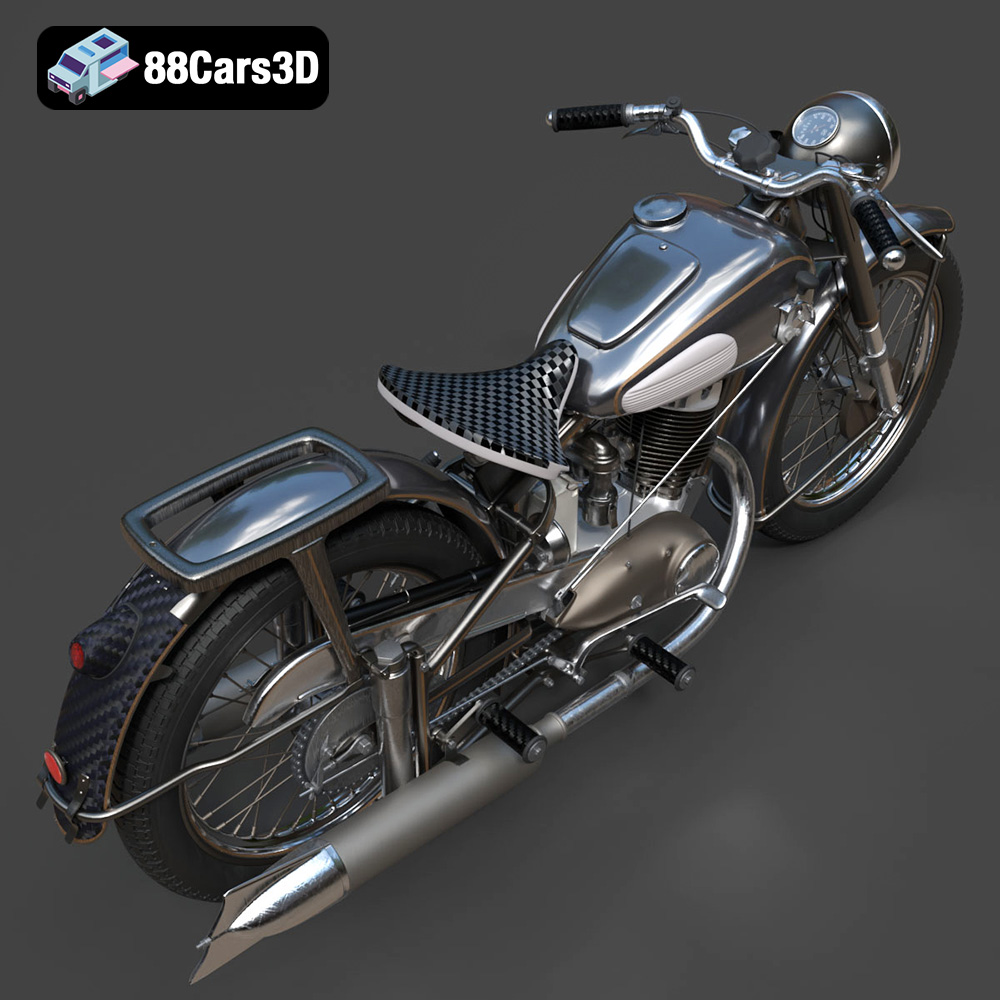
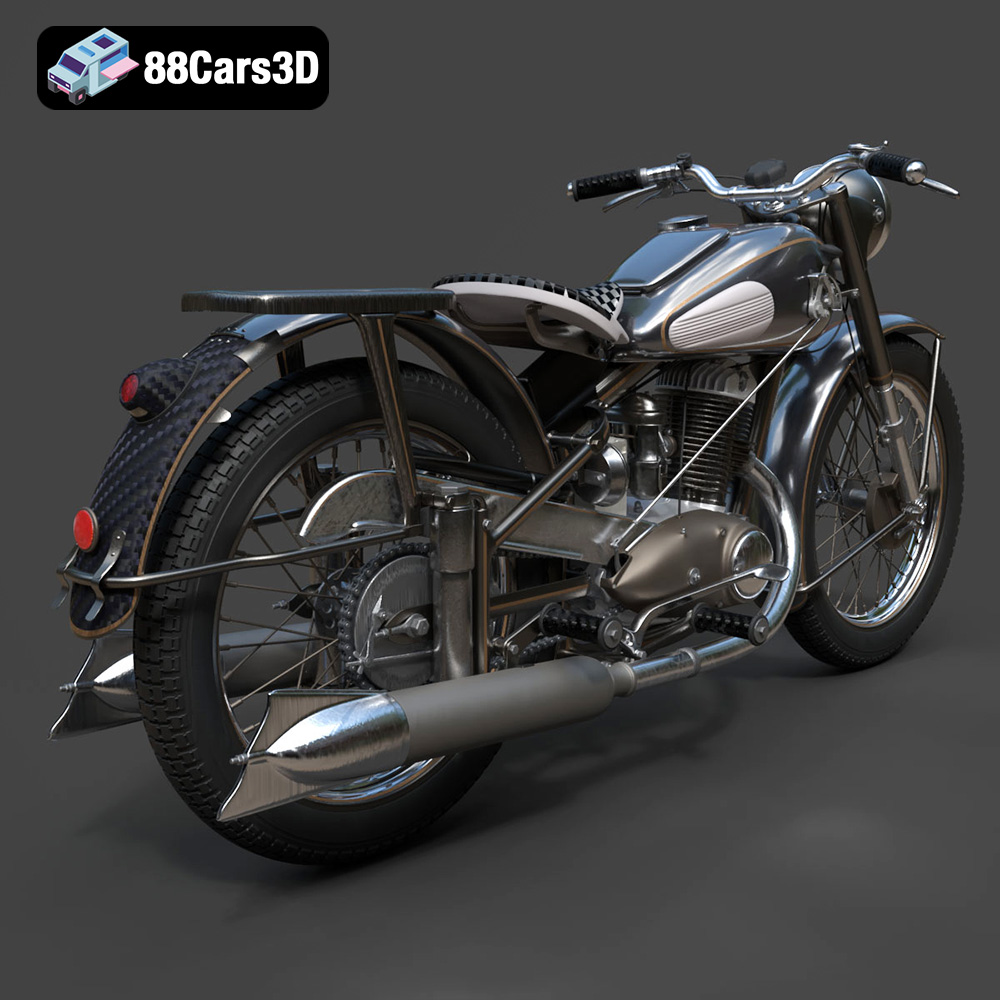
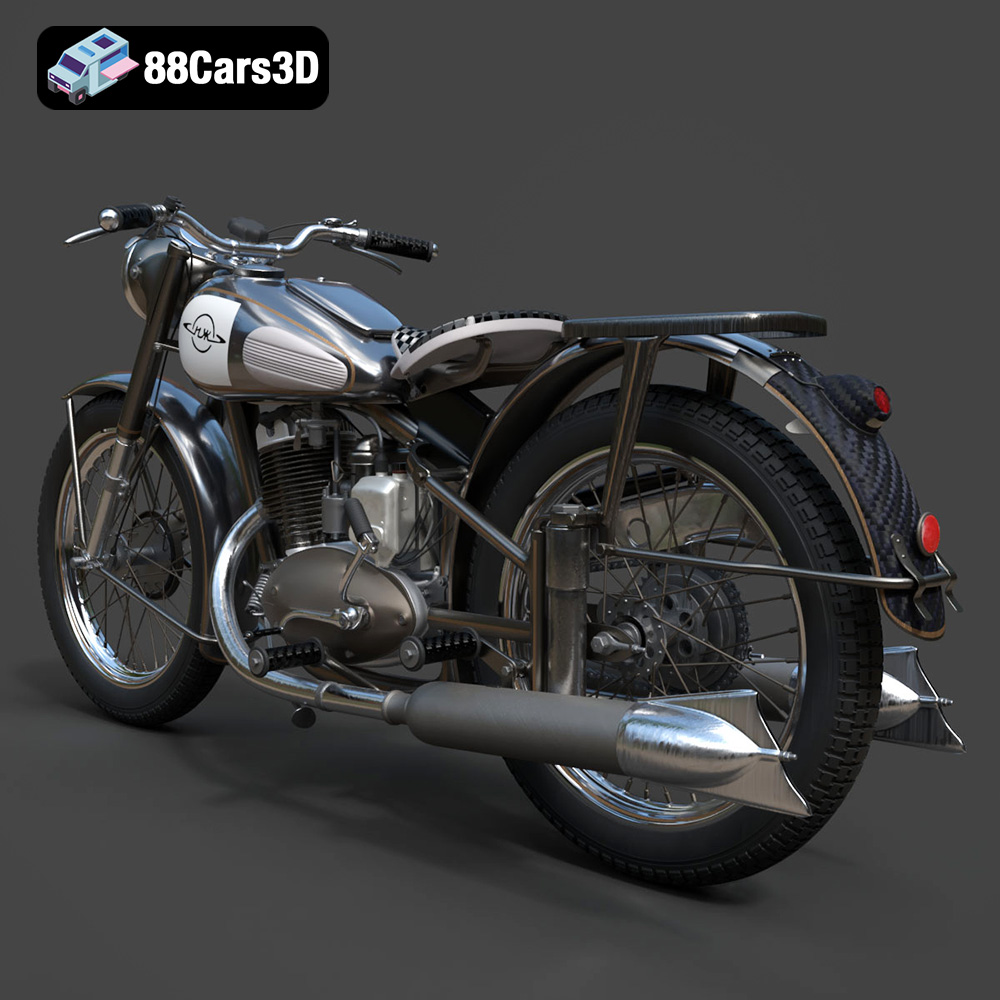
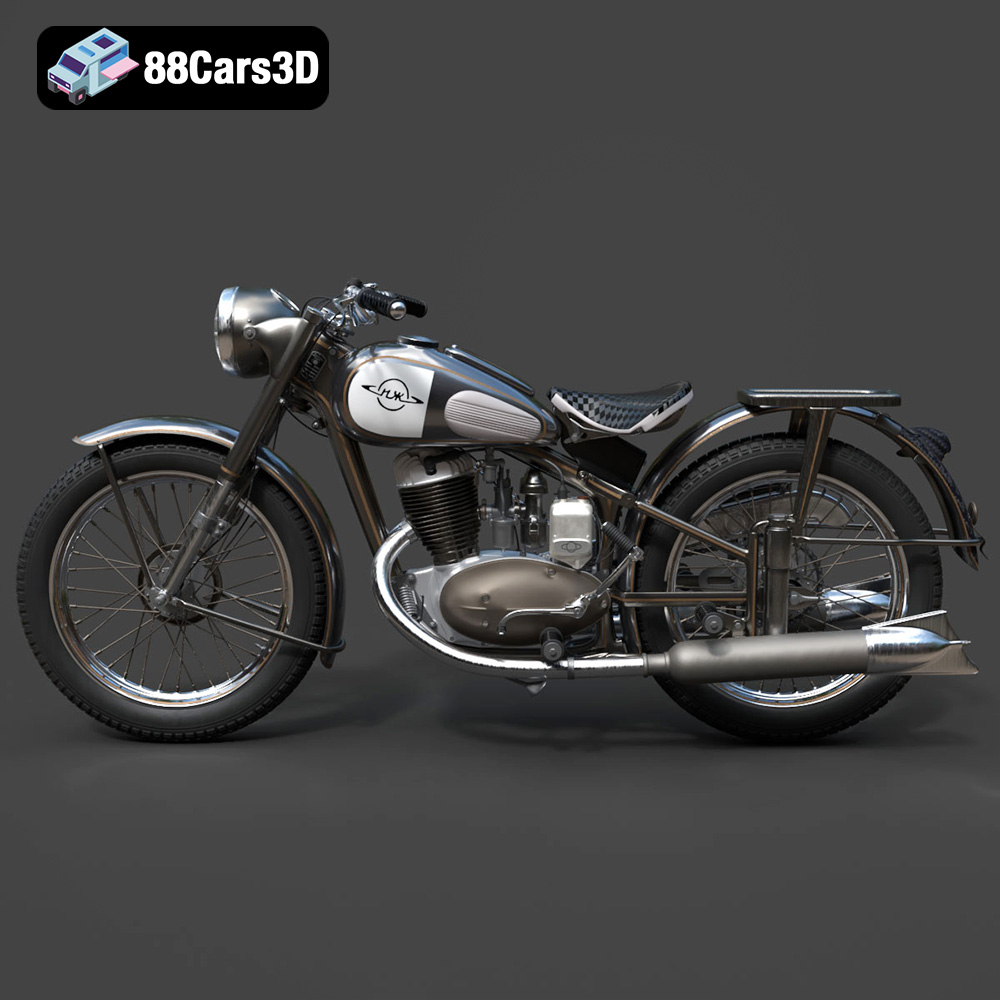
The modeling phase is where raw data is transformed into tangible 3D geometry. For the IZ-49, this meant individually modeling its “detailed single-cylinder engine block,” “classic spoked wheels with realistic hub detailing,” and “period-correct headlamp housing.” Every element, from the rounded vintage-style fuel tank to the rear luggage rack and exposed suspension, contributes to the overall realism. Furthermore, the inclusion of “separate wheels and steering components for animation” is a crucial technical detail, enabling artists to rig and animate the motorcycle for dynamic scenes without needing to break apart the mesh, saving significant time in production pipelines.
A high-quality 3D model like the IZ-49 Classic Motorcycle isn’t just a static object; it’s a dynamic asset designed to integrate into various professional workflows, from high-fidelity cinematic rendering to interactive game environments and beyond. Its technical advantages are specifically engineered to meet the demands of these diverse applications.
For professionals in architectural visualization, advertising, or film production, the IZ-49 model provides an exceptional base for stunning renders. Using software like 3ds Max or Blender, artists can leverage the “clean and well-organized mesh structure” and “optimized polygon flow for performance and realism.” In 3ds Max, this would involve loading the .max file, applying advanced V-Ray or Corona materials, setting up studio-grade lighting, and composing the scene. Similarly, in Blender, the .blend file allows for direct use of Cycles or Eevee renderers, taking advantage of the pre-configured materials and clean topology for photorealistic output. The “proper pivot setup for wheel rotation and steering” is invaluable for creating realistic still renders with dynamic poses or integrating the model into short animations for advertising spots or historical documentaries.
Game developers face the constant challenge of balancing visual fidelity with performance. The IZ-49, described as having an “optimized mesh for real-time engines,” is ideally suited for this. When imported into Unreal Engine or Unity via its .fbx or .unreal formats, its efficient poly count and well-managed UVs (implied by “optimized mesh”) ensure that it runs smoothly without bogging down the game engine. The pre-set pivot points for wheels and steering, mentioned in the product features, are particularly beneficial for rigging the vehicle to an in-game physics system, allowing players to drive or interact with it authentically. Whether it’s a historical open-world game, a retro racing simulation, or a period-based VR experience, this model provides a solid foundation for immersive interactive content.
The utility of 3D models extends far beyond digital screens. For many enthusiasts and professionals, the ability to transform a virtual object into a physical one through 3D printing opens up a world of possibilities, from collectible scale models to educational tools and physical prototypes. The IZ-49 Classic Motorcycle 3D Model is specifically designed with 3D printing in mind, evidenced by its available .stl format and detailed print settings.
The inclusion of the .stl format is a direct nod to the 3D printing community. However, merely having an .stl file isn’t enough; the underlying geometry must be “manifold,” meaning it has no holes, gaps, or self-intersecting faces. High-quality models like the IZ-49 are typically designed with this in mind, ensuring a clean mesh that can be reliably sliced and printed. For users, this means less time spent on mesh repair in programs like Meshmixer or Blender’s 3D Print Toolbox. The ability to convert this intricate motorcycle model into a physical object allows for the creation of unique desktop collectibles, diorama elements, or even parts for stop-motion animation.
The detailed 3D print settings provided with the IZ-49 model are incredibly valuable for anyone looking to bring this digital asset into the physical realm. Recommended scales (1:18, 1:12, 1:10, 1:8) offer flexibility for various display sizes. Specifications like “layer height: 0.08–0.16 mm” and “wall thickness: 1.5–2.5 mm” provide clear guidelines for achieving optimal detail and structural integrity, crucial for models with delicate parts like spokes and exhaust pipes. Furthermore, the advice on “supports: Required for exhaust pipe, handlebars, and fender edges” and “print orientation: Frame angled for optimal detail; wheels printed separately” demonstrates a deep understanding of successful 3D printing practices. Post-processing suggestions, such as “sanding, primer, vintage matte paint finish, optional weathering effects,” guide users towards achieving a truly authentic, museum-quality finish for their printed IZ-49 model.
The difference between a generic 3D model and a professional-grade asset lies in its underlying technical optimization. The IZ-49 Classic Motorcycle 3D Model embodies several key technical advantages that ensure its versatility and performance across various applications, from demanding rendering pipelines to resource-constrained real-time environments.
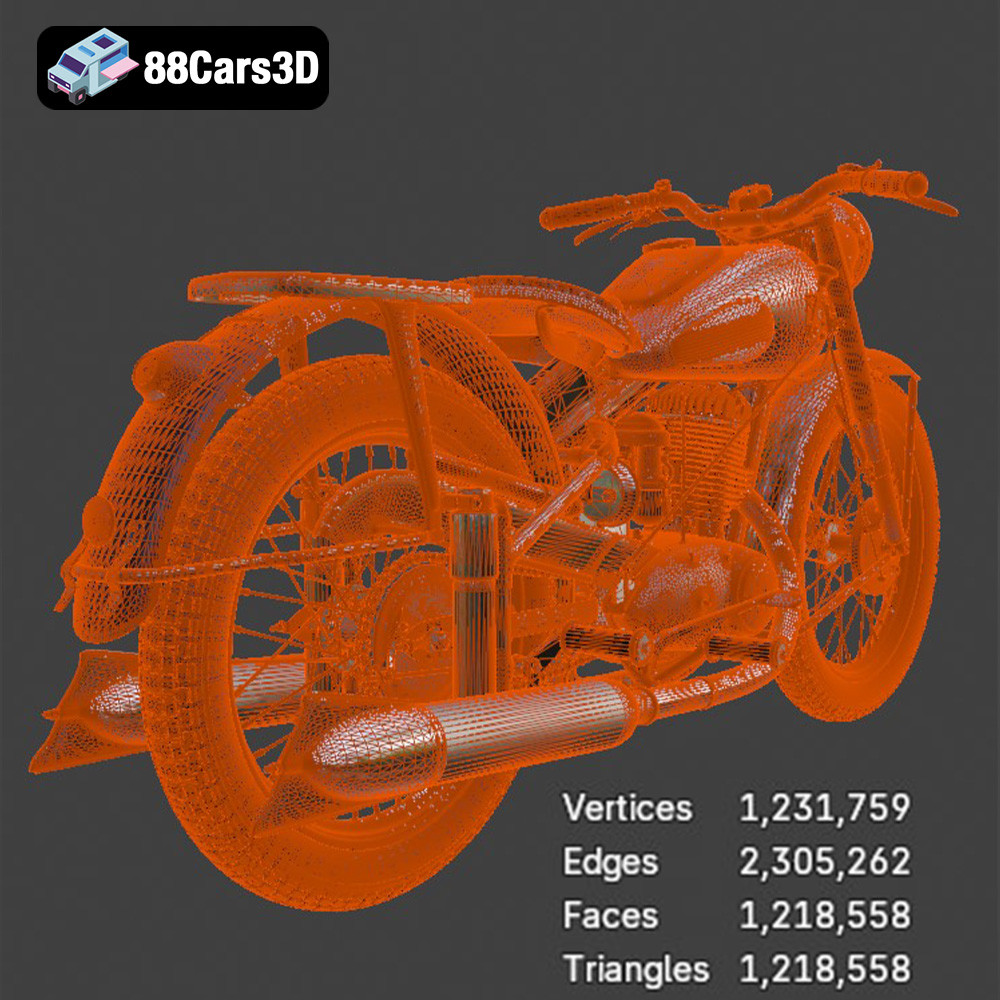
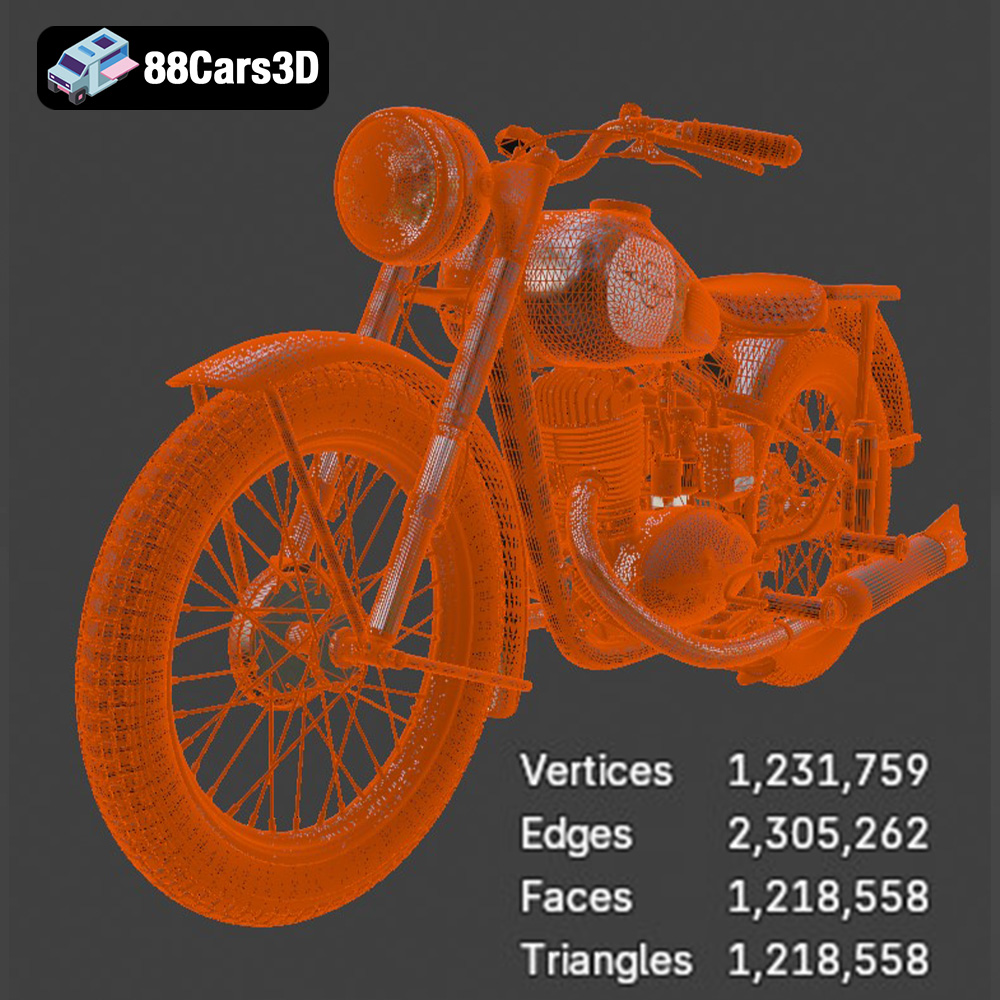
A “clean and well-organized mesh structure” is the foundation of any high-quality 3D model. This refers to the efficient and logical arrangement of polygons, ensuring that edges flow naturally along the contours of the object. For the IZ-49, this means that details like the fuel tank’s curve or the engine’s housing are represented with just enough polygons to maintain smooth surfaces without unnecessarily increasing the overall poly count. “Optimized polygon flow” also facilitates easier unwrapping for UVs, more predictable subdivision surface results, and cleaner deformations during animation. This attention to topology is crucial for both photorealistic renders (preventing unsightly artifacts) and real-time game engines (reducing computational load).
While not explicitly detailed in the product description, a model optimized for rendering and game development inherently requires well-executed UV mapping. UVs are 2D coordinates that tell a 3D program how to apply a 2D texture to a 3D surface. High-quality models feature clean, non-overlapping UV layouts that maximize texture resolution and minimize distortion. For the IZ-49, this would mean separate UV islands for the main body, engine, wheels, and smaller components, allowing for precise texture painting and material assignment. The phrase “Texture: Yes” and “Material: Yes” in the meta description indicates that these elements are properly prepared, likely supporting a PBR (Physically Based Rendering) workflow, which is standard for modern rendering and game engines, ensuring realistic material responses to light.
The mention of “proper pivot setup for wheel rotation and steering” is a critical technical advantage. Pivot points define the center of rotation for an object. For a vehicle, accurately placed pivots for wheels, steering, and suspension components are essential for easy rigging and animation. Without correctly placed pivots, animating the motorcycle would involve complex workarounds. Furthermore, a “clean and well-organized mesh structure” often extends to a logical scene hierarchy, where components are grouped and parented correctly (e.g., wheels parented to axles, axles to the frame). This organizational structure, typically maintained across formats like .blend, .fbx, and .max, streamlines the integration of the model into larger scenes or game engines, allowing artists and developers to manipulate specific parts of the motorcycle with ease.
The IZ-49 Classic Motorcycle 3D Model is not merely a digital replica; it’s a versatile tool that empowers artists and developers across a spectrum of creative and professional applications. Its detailed design and technical flexibility make it a valuable asset for numerous industries.
For rendering and visualization professionals, the IZ-49 is a perfect candidate for “historical showcases, vintage advertising visuals, and museum-style presentations.” Imagine a meticulously rendered scene of the IZ-49 cruising through a post-war European landscape or standing proudly in a digital museum exhibit. Its “authentic mid-century proportions” and “detailed vintage styling” provide the visual fidelity required for compelling still images and animated sequences. Customization options, such as changing the paint color to “military green, black, red, [or] classic cream,” or adding “weathered or restored finish,” allow artists to tailor the model to specific narrative needs, ensuring it fits seamlessly into any historical context or artistic vision.
The IZ-49 is “suitable for historical open-world games, retro driving simulations, and period-based environments,” serving as a key “game asset.” In these interactive settings, players could discover the motorcycle, ride it, or simply encounter it as part of the world-building. For AR/VR experiences, the model is “perfect for interactive historical demonstrations and immersive museum experiences,” allowing users to examine the IZ-49 from every angle, as if it were physically present. Its “optimized mesh for real-time engines” ensures smooth performance, which is paramount for maintaining immersion and preventing motion sickness in AR/VR applications. The ability to “adjust lighting for studio or historical scene setups” further enhances its utility in creating believable interactive environments.
Beyond entertainment, the IZ-49 also finds application in “mechanical education, restoration planning, and vintage engineering visualization.” For engineering students, a detailed 3D model can serve as an interactive learning tool to study the mechanics of a single-cylinder engine or a chain drive assembly. Restoration experts could use the model to plan repairs or modifications on a real IZ-49, visualizing changes before implementing them. Its accurate frame geometry and modeled suspension system offer valuable insights into its original production design, making it an excellent resource for anyone interested in the technical aspects of classic vehicle engineering. The opportunity to “modify seat texture or material” or “add period-correct decals” further expands its educational and visualization potential, allowing for various historical or conceptual representations.
The IZ-49 Classic Motorcycle 3D Model represents the pinnacle of digital craftsmanship in automotive asset creation. It seamlessly merges historical accuracy with technical excellence, providing artists, developers, and designers with a highly versatile tool for a myriad of applications. From crafting photorealistic renders in 3ds Max or Blender to building immersive game environments in Unreal Engine, and even producing tangible scale models through 3D printing, this asset is engineered for success.
Its comprehensive file format support, ranging from editable native files like .blend and .max to industry exchange formats like .fbx and specialized options like .stl for 3D printing and .glb for AR/VR, ensures universal compatibility. The meticulous attention to detail in its exterior features, mechanical components, and underlying mesh topology underscores its value as a professional-grade asset. By understanding the technical specifications and application possibilities, creators can unlock the full potential of such models.
For anyone seeking to integrate an authentic piece of automotive history into their next project, the IZ-49 Classic Motorcycle 3D Model offers an unparalleled foundation. High-quality 3D car models like this are essential investments for achieving top-tier results in automotive rendering, game asset development, visualization, and beyond. Explore this model and many other exceptional 3D assets at 88cars3d.com, your trusted source for premium digital vehicles.
The IZ-49 Classic Motorcycle 3D Model is a high-detail digital recreation of the iconic mid-20th century Soviet motorcycle known for its simplicity, durability, and post-war engineering heritage. Originally produced between 1951 and 1958, the IZ-49 became a symbol of reliable transportation across Eastern Europe. This 3D model accurately represents the vintage steel frame, rounded fuel tank, single-cylinder engine configuration, classic spoked wheels, exposed suspension components, rear luggage rack, and period-correct exhaust system. Designed with clean topology and real-world proportions, it is ideal for rendering, animation, historical visualization, simulation, and game development.
$25.9
.arvr
.blend
.classicmotorcycle
.fbx
.gameasset
.glb
.historicalvehicle
.iz49
.max
.motorcycle3dmodel
.obj
.ply
.rendering
.retrovehicle
.simulation
.sovietbike
.stl
.unreal
.vintagemotorcycle