Get 50% OFF All Premium 3D & STL Models!

In the vibrant landscape of real-time rendering and interactive experiences, visual effects (VFX) stand as a cornerstone, breathing life, dynamism, and immersion into virtual worlds. From the subtle shimmer of heat haze to the explosive spectacle of a car chase, well-crafted VFX can elevate a project from good to unforgettable. At the heart of Unreal Engine’s cutting-edge capabilities for creating such breathtaking visuals lies Niagara, a powerful and flexible particle system that empowers artists and developers to craft stunning, dynamic effects with unparalleled control.
This comprehensive guide delves deep into the Unreal Engine’s Niagara VFX system, offering a detailed exploration for both seasoned professionals and aspiring creators. We’ll navigate its intricate architecture, demystify its module-based workflow, and provide actionable insights into building, optimizing, and deploying high-fidelity real-time effects. Whether you’re enhancing a game environment, creating cinematic sequences, or developing an interactive automotive visualization, mastering Niagara is essential for pushing the boundaries of visual excellence. Prepare to unlock the full potential of real-time particle effects and transform your Unreal Engine projects with unparalleled visual flair.
Niagara represents a significant evolution from its predecessor, Cascade, offering a more data-driven, modular, and programmable approach to VFX creation. It’s designed for scalability, performance, and flexibility, allowing artists to build complex behaviors from simple, reusable components. Understanding its fundamental building blocks—Systems, Emitters, and Modules—is crucial to harnessing its power.
A Niagara System acts as the top-level container, orchestrating the behavior of one or more Niagara Emitters. Think of a System as a conductor leading an orchestra; it manages the lifecycle of its constituent emitters, their global parameters, and how they interact within the scene. For instance, a complex fire effect might be a single Niagara System comprising multiple emitters: one for the main flames, another for smoke trails, and perhaps a third for sparks and embers. The System allows you to control the entire effect as a single entity, making it easier to place, scale, and manage within your Unreal Engine level or Blueprint.
Niagara Emitters are the workhorses of the system. Each emitter is responsible for generating, updating, and rendering a specific type of particle. An emitter defines the core properties of its particles, such as their initial velocity, lifetime, size, and material. Unlike systems, emitters are self-contained logical units that can be reused across different Niagara Systems, promoting efficiency and consistency. When you create a new Niagara System, you often start by adding one or more emitters, either from a blank template or by selecting a pre-made emitter asset from the content browser. This modularity allows for rapid prototyping and iteration.
A Niagara System’s primary role is to combine and manage multiple emitters to create a cohesive visual effect. Systems provide a global context, allowing emitters to share parameters or be influenced by system-level properties. For example, a system might have a “Global Wind” parameter that affects all its constituent smoke and dust emitters. The System also controls the overall bounding box for the effect, which is critical for accurate culling and rendering performance. When you place a Niagara asset in your level, you’re placing a Niagara System. This wrapper object handles the spawning and despawning of all its emitters based on game logic or cinematic timelines. You can define System-level events, parameters, and even apply specific rendering options that affect all contained emitters, streamlining complex effect management and ensuring a consistent look for your real-time visuals.
Emitters are where the magic truly begins. They define how particles are born, how they evolve, and how they eventually die. Each emitter has its own stack of “modules” that dictate its behavior. An emitter can spawn particles continuously over time, in bursts, or on demand via Blueprint calls. Key properties you’ll configure on an emitter include its spawn rate, particle limit, and the initial state of the particles it generates. Unreal Engine provides a wide array of template emitters that serve as excellent starting points, such as “Simple Fountain,” “Explosion,” or “Smoke Trail.” These templates encapsulate common particle behaviors, allowing you to quickly adapt them to your specific needs, then fine-tune them with additional modules. Emitter settings also determine whether particles are simulated on the CPU or GPU, a crucial performance consideration we’ll explore later in our guide to real-time effects optimization.
Modules are the atomic units of behavior within Niagara. They are small, self-contained pieces of logic that operate on particles at different stages of their lifecycle: when they are spawned, during their update (every frame), or at render time. Niagara boasts an extensive library of modules, ranging from simple mathematical operations to complex physics simulations. For instance, a “Spawn Burst” module spawns a set number of particles instantly, while a “Gravity Force” module applies downward acceleration. “Scale Color” can change a particle’s color over its lifetime, and “Collision” can make particles interact with the environment. Modules can be stacked and ordered, with their execution order often dictating the final look and feel of the effect. This modularity fosters immense creativity and reusability, allowing artists to combine modules in countless ways to achieve unique and sophisticated visual effects. Understanding how to combine and customize these modules is the key to mastering Niagara and crafting compelling real-time effects for game development and automotive visualization.
Creating your inaugural Niagara effect in Unreal Engine is a straightforward process that lays the foundation for more complex visuals. This section will walk you through the essential steps, from initiating a new system to applying basic visual properties, ensuring you gain practical experience with the core workflow. Starting with a simple effect like a fountain or a basic smoke puff provides an excellent canvas for learning about particle systems.
To begin, navigate to your Content Browser, right-click, and select “FX” > “Niagara System.” Unreal Engine will then present you with options to either create a new system from scratch (using an empty system) or to select from a variety of existing “Niagara Emitter” templates. For our first effect, selecting a basic template like “Simple Fountain” or “Empty Emitter” is a good starting point. If choosing “Empty Emitter,” you’ll then need to add an emitter to your system. Right-click in the Niagara editor’s Emitters panel and select “Add Emitter,” then choose “New Emitter from Template” and pick something like “Fountain.” This sets up a basic particle generation source. Once created, double-click the new Niagara System asset to open the Niagara Editor, your central hub for VFX creation within Unreal Engine.
Inside the editor, you’ll see a hierarchy panel on the left (showing your System and its Emitters), a “Selection” panel below that, and a large “Graph” panel in the center where modules are added. The “Preview” panel displays your effect in real-time. Each emitter has several “stacks”: Emitter Spawn, Emitter Update, Particle Spawn, Particle Update, and Render. These stacks represent different stages of a particle’s lifecycle, and this is where you’ll add the modules that define your effect’s behavior. For instance, modules placed in “Particle Spawn” define properties at the moment a particle is born, while “Particle Update” modules modify these properties every frame throughout the particle’s life. This structured approach provides explicit control over every aspect of your real-time effects, making Niagara a powerful tool for game development.
For a basic fountain effect, you’ll primarily work within the “Particle Spawn” and “Particle Update” stacks. In “Particle Spawn,” you typically add modules that define a particle’s initial state. A crucial module here is Initialize Particle, which allows you to set the particle’s initial position, velocity, size, color, and lifetime. For instance, you might set an initial velocity along the Z-axis to make particles shoot upwards. Also in “Particle Spawn,” you’ll find modules like Spawn Burst Instantaneous or Spawn Rate. For a continuous fountain, “Spawn Rate” is ideal, allowing you to specify how many particles are generated per second. Experiment with these values to see how they impact the density and flow of your effect, shaping the initial look of your Unreal Engine particle system.
Next, move to the “Particle Update” stack. This is where particles are modified over their lifetime. Modules here include Gravity Force to pull particles downwards, Scale Color to fade them out or change their hue, and Scale Sprite Size to make them shrink or grow. For a fountain, adding “Gravity Force” is essential to simulate the parabolic arc of water droplets. You can adjust the force strength and direction. As you add and modify modules, the preview window updates in real-time, providing immediate feedback on your changes. Don’t be afraid to experiment with different values and module combinations to achieve desired effects. The key is to understand that “Spawn” modules set initial conditions, and “Update” modules continuously modify them, creating dynamic and evolving real-time visuals.
While the initial setup defines particle behavior, their visual appearance is largely determined by the material applied to them. Without a proper material, particles will often appear as simple white squares. To assign a material, navigate to the “Render” stack of your emitter and locate the “Sprite Renderer” module (or whichever renderer type you are using). Within this module’s properties, you’ll find a slot for “Material.” You can either use an existing particle material from Unreal Engine’s starter content or create your own. A common approach is to create a new material (e.g., M_Particle_Fountain) and set its blend mode to “Translucent” and its shading model to “Unlit.”
Inside your particle material, you’ll typically use the Particle Color node to access the color and alpha values set by your Niagara modules (like “Scale Color”). For the base texture, a simple radial gradient or a soft alpha texture can work wonders. Connect this texture’s RGB to the “Emissive Color” input and its alpha to the “Opacity” input of your material’s output node. By utilizing PBR principles, even for unlit translucent particles, you can achieve a more cohesive look by ensuring your particle textures blend well with the surrounding environment’s lighting. For instance, using a soft, subtle texture combined with the particle’s dynamic color and size scaling will produce a far more appealing effect than a plain, hard-edged sprite. Experiment with different textures and material parameters to find the perfect visual style for your particles, integrating seamlessly with your project’s aesthetic, much like the detailed materials on 3D car models found on platforms like 88cars3d.com complement realistic automotive scenes.
Once you’ve grasped the fundamentals of Niagara, the next step is to explore its advanced capabilities to create truly dynamic and interactive visual effects. This involves leveraging user parameters for external control, utilizing data interfaces to connect effects with scene geometry, and understanding the nuances of simulation stages to optimize performance and complexity for real-time rendering.
One of Niagara’s most powerful features is its ability to expose parameters, allowing effects to be dynamically controlled by external sources, such as Blueprint scripts, Sequencer tracks, or even other Niagara Systems. This transforms static effects into responsive, interactive elements of your project. For instance, you could have a dust cloud effect whose intensity changes based on a vehicle’s speed, or a magical aura that reacts to player input. Beyond simple parameter exposure, Niagara’s data interfaces provide sophisticated methods for particles to interact with the environment, sampling properties from meshes, skeletal animations, or even audio cues to drive their behavior. This level of connectivity opens up a vast realm of creative possibilities, allowing for effects that are deeply integrated into your game or visualization.
Furthermore, understanding the different simulation stages—specifically CPU and GPU particles—is crucial for managing performance and achieving high particle counts. While CPU particles offer greater flexibility for complex logic and interaction with game code, GPU particles are designed for sheer volume and speed, capable of rendering hundreds of thousands of particles with minimal impact on frame rate. Mastering the balance and knowing when to apply each simulation type is a hallmark of an experienced VFX artist. By strategically combining these advanced techniques, you can craft visual effects that are not only visually stunning but also performant and seamlessly integrated into your Unreal Engine project, whether it’s a high-octane game or a detailed automotive visualization.
To make your Niagara effects truly dynamic, you’ll want to expose certain module properties as “User Parameters.” This allows external systems to modify these values at runtime. To do this, simply click the small arrow next to a parameter in the Details panel of a module (e.g., Spawn Rate, Color, Gravity Force) and select “Expose as User Parameter.” This will add a new entry under the “User Parameters” section in your Niagara System’s hierarchy. You can rename these for clarity (e.g., “User.EffectIntensity”).
Once exposed, you can control these parameters directly from a Blueprint. In your Blueprint (e.g., an Actor Blueprint that spawns your Niagara System or controls an existing one), add a “Niagara Component.” Then, from an event graph, you can drag off the Niagara Component reference and use nodes like Set Niagara Variable (Float, Vector, Color, etc.). For example, if you exposed “User.EffectIntensity” as a float, you’d use “Set Niagara Variable Float.” Connect the appropriate value to this node, and your Niagara effect will respond dynamically. This is incredibly powerful for interactive elements, such as adjusting exhaust smoke based on engine RPM for a high-fidelity automotive simulator, or changing the glow of an object based on player proximity. Learn more about Blueprint interaction with Niagara and other Unreal Engine features at Unreal Engine’s official documentation.
Niagara’s Data Interfaces allow particles to interact with and sample data from various external sources within Unreal Engine. This is a game-changer for creating realistic and context-aware effects. Common data interfaces include:
To use a data interface, add a module that requires it (e.g., “Sample Skeletal Mesh Position”) and assign the interface in the module’s properties. These interfaces can provide location, velocity, normal, color, and other data that then drives particle behavior via standard modules. This level of interaction can dramatically enhance realism, for instance, by having vehicle debris correctly bounce off nearby geometry, crucial for realistic automotive visualization.
Regarding Simulation Stages, Niagara offers both CPU and GPU particle simulations.
You set the simulation stage per emitter in the Emitter Properties. Choosing the correct stage is paramount for performance and is often dictated by the effect’s complexity and desired particle count in real-time rendering.
Creating visually stunning effects is only half the battle; ensuring they run efficiently is equally crucial, especially in real-time applications like games, AR/VR, and high-fidelity automotive visualization. Poorly optimized particle effects can quickly become a significant performance bottleneck, leading to frame rate drops and a less immersive user experience. Niagara provides several tools and techniques to help you maintain a healthy balance between visual quality and performance.
The core philosophy behind Niagara optimization revolves around understanding where your resources are being consumed and making informed decisions about particle counts, simulation types, and material complexity. A key consideration is the distinction between CPU and GPU particles, which dictates not only where the computation happens but also the types of effects you can achieve at scale. Beyond that, utilizing Level of Detail (LOD) systems and ensuring accurate bounding boxes are fundamental strategies for managing performance based on distance and visibility. Finally, the materials applied to your particles are often one of the largest contributors to rendering cost, making material optimization a critical step in the performance pipeline. By meticulously addressing these areas, you can ensure your Niagara effects enhance, rather than hinder, your project’s overall performance in Unreal Engine.
The decision between GPU particles and CPU particles is arguably the most impactful choice for Niagara performance.
To choose, consider the effect’s requirements: Does it need to interact with game logic? Is a very high particle count essential? A judicious blend of both, with each handling what it does best, often yields the best results for real-time effects optimization.
Level of Detail (LOD) is a powerful optimization technique where the complexity of an effect automatically reduces as its distance from the camera increases. Niagara Systems can have multiple LOD levels, allowing you to define simpler versions of an effect (fewer particles, simpler materials, less complex logic) for when it’s far away. To set up LODs, select your Niagara System in the Content Browser, right-click, and choose “Edit LODs.” Here you can create different LODs and specify the distance at which they activate. Within the Niagara Editor, each Emitter and even individual modules can have their properties overridden per LOD, providing granular control over scaling effect complexity and enhancing real-time rendering performance.
Culling is the process of preventing objects not visible to the camera from being rendered. For Niagara effects, accurate Bounding Boxes are crucial for effective culling. If a Niagara System’s bounding box doesn’t accurately encompass all its particles, the effect might be culled prematurely (disappearing when still visible) or rendered unnecessarily (wasting resources). In the Niagara Editor, in the Emitter Properties, ensure “Fixed Bounds” is enabled and accurately set the minimum and maximum extents of your effect. This tells Unreal Engine the precise volume occupied by your particles, allowing it to correctly determine when to render them. You can also enable “Use Max Draw Distance” on the Niagara Component to specify a hard distance beyond which the effect will not render, regardless of visibility, further aiding performance optimization for your game assets.
The materials applied to your particles can be a significant performance hog due to overdraw and complex shader instructions.
By keeping particle materials lean and optimized, you can dramatically improve rendering performance, especially with high particle counts, ensuring your Unreal Engine projects run smoothly.
Niagara’s versatility makes it an indispensable tool across a broad spectrum of real-time applications, from high-stakes game development to precise automotive visualization and cinematic virtual production. Its ability to create dynamic, interactive, and visually rich effects means it’s not just about aesthetics; it’s about enhancing immersion, providing critical feedback, and telling compelling stories. Understanding how industry professionals leverage Niagara can provide invaluable insights for your own projects.
In game development, Niagara is central to everything from combat effects and environmental phenomena to UI feedback. For automotive visualization, it brings vehicle showcases to life with realistic exhaust fumes, dynamic dust, or even simulated rain droplets on a car body. Virtual production pipelines utilize Niagara for on-set effects that seamlessly integrate with LED walls, providing real-time feedback for directors and cinematographers. The key to successful implementation in any of these fields lies not just in technical proficiency but also in adhering to best practices that balance artistic vision with performance requirements. This includes meticulous planning, modular design, and robust debugging strategies. By examining specific applications, we can see how Niagara elevates the quality and interactivity of real-time experiences across diverse industries, making it a critical skill for any Unreal Engine developer.
Niagara excels at creating believable and dynamic environmental effects that significantly enhance immersion. Imagine a scene with a high-fidelity 3D car model, perhaps sourced from a specialized marketplace like 88cars3d.com. To make that car truly come alive in an environment, you’d use Niagara for:
For interactive scenes, you might use Blueprint to trigger specific Niagara effects. For example, a vehicle model could have a Niagara System for exhaust smoke, where the “Spawn Rate” and “Velocity” parameters are controlled by the car’s speed and engine RPM, providing real-time visual feedback to the driver. This level of detail and interactivity is crucial for realistic simulations and engaging user experiences.
In cinematic sequences and high-end automotive visualization, Niagara plays a pivotal role in adding polish and realism. When showcasing meticulously crafted 3D car models—the kind with clean topology and realistic materials found at 88cars3d.com—Niagara can elevate the presentation:
The combination of high-quality assets and dynamic Niagara effects creates a truly immersive and professional presentation, pushing the boundaries of real-time rendering.
Even with the best practices, complex effects can introduce performance issues or unexpected behavior. Unreal Engine provides robust tools for debugging and profiling Niagara:
Regularly profiling your effects in a representative environment is crucial. Don’t wait until the end of your project to optimize; integrate performance checks throughout your workflow for efficient game development and visualization projects.
Unreal Engine’s Niagara VFX system is a revolutionary tool that offers unparalleled flexibility, power, and scalability for creating real-time visual effects. From crafting simple environmental elements like a gentle rain shower to orchestrating complex, interactive explosions, Niagara empowers artists and developers to bring their creative visions to life with stunning fidelity and performance. Its modular architecture, robust parameter exposure, and deep integration with other Unreal Engine systems like Blueprint and Sequencer make it an indispensable asset in any modern real-time production pipeline.
We’ve traversed the landscape of Niagara, from its fundamental components—Systems, Emitters, and Modules—through the practical steps of building your first effect, to exploring advanced techniques like data interfaces and user parameters. Crucially, we’ve also emphasized the vital importance of optimization, stressing the strategic choices between CPU and GPU particles, effective LOD management, and lean material creation, all essential for maintaining smooth frame rates and high performance. Whether you’re enhancing a game, producing a cinematic masterpiece, or elevating an automotive visualization with assets from marketplaces like 88cars3d.com, the principles discussed here will serve as your guide.
The journey with Niagara is one of continuous learning and experimentation. Its vast module library and expressive capabilities mean there’s always something new to discover. We encourage you to dive into the Unreal Engine editor, experiment with different module combinations, and challenge yourself to create increasingly complex and optimized effects. The power to craft truly immersive and visually captivating experiences is now at your fingertips. Go forth and unleash the full potential of real-time VFX!

Texture: Yes | Material: Yes | 3D Printable: Yes. Download the Italian Thoroughbreds Bundle featuring 5 iconic 3D models: Lamborghini Huracán Performante, Ferrari 458 Italia, Lamborghini Urus, Diablo SV, and Maserati GT. Optimized for 4K rendering and 3D printing (STL included). Save 50% with this ultimate Italian vehicle collection.
Price: $199.99

Download the Elite Future Mobility Bundle featuring 4 highly optimized 3D models: Tesla Model S, Avatr 11, Li L9, and Zoox Robotaxi. Perfect for ArchViz, Smart City renders, and game dev. Optimized for Unreal Engine and Blender. Includes .fbx, .obj, and .max formats.
Price: $99

🚗 5 Iconic German Cars (BMW M4 G82, M5 CS, X3, 1 Series & Mercedes E-Class). ✅ Optimized for ArchViz: Ready for Corona & V-Ray. 💰 Save €71 with this limited-time collection! 🚀 Instant Download after purchase.
Price: $119

Download the Extreme Off-Road & Survival 3D Models Bundle! Includes the Brabus 800 Adventure, Dodge Ram Bigfoot, Spec Truck, and a Caravan. Save over €210 on this premium 4-in-1 off-grid vehicle pack for ArchViz and game development.
Price: $149.99

Download the Heavy Duty & Commercial Logistics 3D Models Bundle! Includes the Ford Sterling, Caterpillar CT680, Mercedes Citaro Bus, and Vito Van. Save over €130 on this massive, game-ready 4-in-1 industrial vehicle pack.
Price: $109.99

Download the Ultimate Custom Motorcycles 3D Models Bundle. Includes a Custom Chopper, Ducati 916 Café Fighter, Harley XR1200X, and BMW K100. Perfect premium props for luxury ArchViz garages. Save over €250 today!
Price: $159.99

Download the ultimate JDM Street Racing 3D Models Bundle! Includes the Nissan GT-R, Toyota Supra, Mazda RX-7, Lancer Evo IX, and Honda NSX. Save big on this highly optimized, game-ready 5-in-1 Japanese legend car pack.
Price: $129.99

Download the ultimate American Muscle & Cinematic Classics 3D Models Bundle! Includes the Dodge Charger ’68, Mustang Eleanor GT500, Camaro Z28 ’79, and a custom ’69 Mustang. Save over €240 on this game-ready, premium 4-in-1 pack.
Price: $149.99

Download the Everyday City Traffic 3D Models Bundle. Includes the VW Golf, Kia Picanto, Hyundai Tucson, Toyota Yaris, and a DHL Ford Transit Van. Save big on this 5-in-1 pack, perfectly optimized for realistic ArchViz streets and game traffic.
Price: $99.99
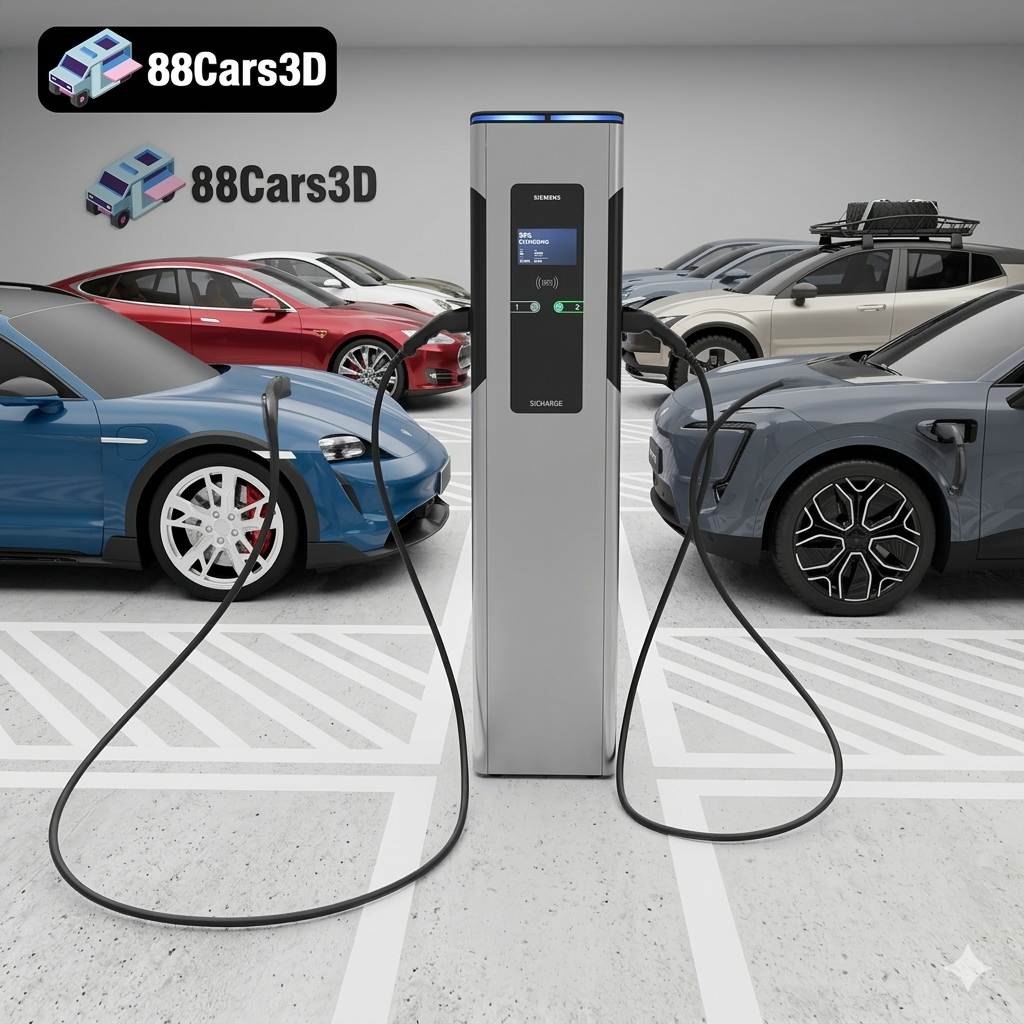
Download the Future of Mobility EV 3D Models Bundle. Includes the Volvo EX30, Tesla Model S, AVATR 11, Porsche Taycan, and a Siemens EV Charger. Save big on this highly optimized 5-in-1 pack for ArchViz and game development!
Price: $89.99

