Get 50% OFF All Premium 3D & STL Models!

The world of 3D automotive design is a fascinating blend of artistic vision and technical precision. From capturing the sleek lines of a supercar to engineering a robust vehicle for a game environment, creating compelling 3D car models demands expertise across a multitude of disciplines. Whether you’re an aspiring 3D artist, a seasoned game developer, an automotive designer, or a visualization professional, understanding the intricate workflow from initial concept to a stunning final render is crucial. This comprehensive guide will take you through the entire process, diving deep into topology, UV mapping, PBR materials, rendering techniques, and optimization strategies for various applications like game development, AR/VR, and even 3D printing. By the end, you’ll have a robust understanding of the best practices and advanced techniques employed by industry professionals to achieve breathtaking realism and optimal performance in their automotive projects. Get ready to rev your engines and embark on a journey into the high-fidelity world of 3D car modeling.
The foundation of any exceptional 3D car model lies in meticulous preparation and an exhaustive collection of reference materials. Before a single polygon is laid, it’s imperative to gather as much real-world data as possible. This initial phase dictates the accuracy, realism, and overall quality of your final model. Skipping or rushing this step often leads to costly errors later in the production pipeline, resulting in disproportionate models or details that don’t hold up to scrutiny. Think of it as an architect meticulously reviewing blueprints before construction begins; the more detailed the plan, the stronger the edifice.
Start by amassing a vast library of images, videos, and technical drawings of your target vehicle. This includes multiple angles (front, back, side, top, ¾ views), interior shots, engine bays, undercarriages, and close-ups of specific details like headlights, grilles, wheels, and badges. Seek out high-resolution photographs taken in various lighting conditions to understand how light interacts with different surfaces. Factory blueprints or engineering drawings are invaluable as they provide precise, orthographic views and crucial dimensions. Exploded diagrams can help in understanding complex assemblies. Don’t forget to research the car’s history, design philosophy, and unique characteristics – these subtle nuances can inform your modeling decisions and add personality to your creation. Platforms like Pinterest, automotive enthusiast forums, and official manufacturer websites are excellent resources.
Once your references are gathered, the next critical step is to set up your modeling environment with accurate scale and proportion. Most 3D software (e.g., 3ds Max, Blender, Maya) allows you to import reference images as image planes or background images. Aligning these images precisely is paramount. Use at least three orthogonal views (front, side, top) and align them to a common origin. Ensure the scale is consistent across all views by using a known dimension of the car, such as its wheelbase or overall length. This often involves trial and error, scaling and positioning the images until they match. For instance, if you know the car is 4.5 meters long, set your scene units to meters and scale your image planes accordingly. This attention to detail in the setup phase guarantees that your model’s dimensions will be accurate from the outset, saving countless hours of corrective modeling later on.
Topology, the arrangement of polygons and their connecting edges, is arguably the most critical aspect of creating high-quality 3D car models. Clean, efficient, and well-structured topology is essential for achieving smooth subdivision surfaces, proper deformation, optimal performance in game engines, and seamless UV mapping. Automotive surfaces are notoriously complex, characterized by sweeping curves, sharp creases, and intricate cutouts, all of which demand careful attention to edge flow.
For realistic, production-ready car models, especially those intended for rendering or cinematic use, subdivision surface modeling is the industry standard. This technique relies on an underlying low-polygon mesh that is smoothed and refined by algorithms (e.g., OpenSubdiv). The key to successful subdivision modeling is to maintain an “all-quad” topology – meaning your mesh should consist primarily of four-sided polygons. Triangles and N-gons (polygons with more than four sides) can cause pinching, unpredictable smoothing, and artifacts, especially in curved areas.
The edge flow should meticulously follow the natural contours and design lines of the car. For example, edges should run along character lines, panel gaps, and the boundaries of distinct surfaces. Loop cuts should be strategically placed to define sharp edges, such as around wheel arches, window frames, and door seams. Adding “support loops” or “holding loops” close to these sharp edges helps to maintain their crispness when subdivided, preventing them from becoming too soft. Software like Blender, with its robust modeling tools, allows for precise control over vertex, edge, and face manipulation. When working with Blender 4.4, you can find detailed information on mesh editing and subdivision surfaces in the official documentation at https://docs.blender.org/manual/en/4.4/, which explains the nuances of tools like loop cut and slide, knife tool, and various snapping options crucial for maintaining clean topology.
The appropriate polygon count is highly dependent on the model’s intended use. For high-fidelity renders, a final subdivided mesh might have several million polygons, ensuring buttery-smooth surfaces and intricate details. However, for real-time applications like games or AR/VR, excessive polygon counts are detrimental to performance. Here, a “low-poly” base mesh (perhaps 50,000 to 200,000 triangles for a full car, depending on detail level) is modeled, and its fine details are later baked into normal maps from a high-poly version.
The goal is to achieve visual fidelity with the fewest possible polygons. This involves intelligently distributing polygons – dense where detail is critical (e.g., headlights, grilles, wheels) and sparser on large, flat surfaces. Techniques like decimation and retopology are employed to optimize polygon count. Retopology, often done manually or with aid from tools, involves creating a new, optimized mesh over a high-detail sculpt, ensuring clean edge flow while reducing poly count. Understanding where to add detail and where to simplify is a skill honed through practice, balancing aesthetic requirements with performance budgets.
UV mapping is the process of flattening a 3D model’s surface into a 2D space, allowing you to apply textures, decals, and material details accurately. For complex automotive models, with their curved panels, intricate grilles, and numerous separate parts, effective UV unwrapping is a detailed and often challenging task. A well-executed UV layout is crucial for preventing texture distortion, maximizing texture resolution, and facilitating efficient texture painting.
The goal of a strategic UV layout is to create organized, non-overlapping UV islands that make efficient use of the 0-1 UV space. For PBR (Physically Based Rendering) workflows, consistent texel density across the model is vital. Texel density refers to the number of texture pixels per unit of surface area on the 3D model. If different parts of your car have vastly different texel densities, textures applied to them will appear blurry on some parts and overly sharp on others.
To achieve uniform texel density, you typically unwrap different components of the car (e.g., hood, door, fender, wheel) into separate UV islands. These islands should be scaled proportionally to their real-world surface area and packed tightly within the 0-1 UV square to minimize wasted space. Consider the texture resolutions you’ll be using; a typical car model might use multiple 4K (4096×4096 pixels) texture sets for various parts (e.g., body, interior, wheels) to maintain high fidelity. For maximum realism, you might have one texture set for the main body panels, another for the interior, and separate sets for individual complex components like headlights or intricate wheel designs. This modular approach allows for targeted detail and optimized asset management.
Strategic seam placement is key to minimizing visible texture seams and distortion. Seams should ideally be placed in inconspicuous areas, such as along natural breaks in the geometry (e.g., panel gaps, edges where parts meet), underneath the car, or within crevices. Tools in 3ds Max, Blender, or Maya offer various unwrapping methods like planar, cylindrical, spherical, and “smart UV project” (in Blender). For complex curved surfaces, “peel” or “unfold” tools are often used to relax the UVs, minimizing stretching and compression.
Using a checker map texture during the UV unwrapping process is an excellent way to visually identify distortion and inconsistent texel density. Areas where the checker pattern appears stretched, squashed, or uneven indicate issues that need to be addressed. Overlapping UVs can be a performance enhancer for symmetrical parts (e.g., left and right side doors or wheels) where the texture is identical, allowing a single texture area to be applied to multiple mesh parts. However, for unique details or damage, separate UVs are necessary. For game assets, texture atlasing, combining multiple small textures into one larger texture map, is a common optimization technique, helping to reduce draw calls and improve rendering performance.
Physically Based Rendering (PBR) has revolutionized 3D visualization, enabling artists to create materials that react to light in a way that accurately mimics real-world physics. For automotive models, mastering PBR materials is essential for achieving the convincing look of car paint, chrome, glass, rubber, and leather. This section delves into the principles of PBR and advanced shading techniques.
PBR workflows typically come in two main flavors: Metallic-Roughness and Specular-Glossiness. The Metallic-Roughness workflow is generally favored in game development and real-time engines, while Specular-Glossiness is common in offline renderers. For car paint, the Metallic-Roughness workflow typically involves:
Beyond these core maps, automotive paint often requires advanced shader networks to simulate its multi-layered structure: a base color coat, metallic flakes, and a clear coat. The clear coat layer is a critical component, providing the distinctive high-gloss, reflective quality of car paint. This is often achieved by layering a second reflective shader on top of the base paint, with its own roughness and normal properties, simulating the depth and sheen of a real clear coat. For metals, the metallic map would be fully white, with roughness dictating polish level. Chrome, for example, would have a very low roughness value.
Modern 3D software like Blender, 3ds Max (with Corona or V-Ray), or Maya (with Arnold) utilizes node-based shader editors, allowing artists to build incredibly complex and realistic materials. For automotive projects, these networks often go beyond simple PBR setups.
Consider a tire material: it’s not just a single texture. It involves a base rubber material with appropriate roughness, a normal map for tread patterns and sidewall details, an ambient occlusion map for subtle shading in crevices, and potentially displacement maps for truly bumpy surfaces. Weathering and wear can be introduced through layered textures or procedural masks that affect roughness, color, and even generate subtle dirt or dust layers.
Glass materials for windows and headlights also demand specific attention. While a simple PBR glass might suffice, advanced shaders can incorporate thin-film interference for realistic chromatic aberration, accurate Fresnel reflections, and even subtle dirt or water effects. Light scattering and refraction are key. For headlights, the internal optics, reflectors, and light sources need to be accurately modeled and shaded to achieve a convincing look. Understanding how to layer and blend different material properties using masks and procedural textures within a node editor is paramount for achieving the highest level of realism.
Even the most meticulously modeled and textured car will fall flat without compelling lighting and a robust rendering workflow. This stage transforms your 3D assets into stunning photorealistic images, suitable for marketing, portfolio, or cinematic use. It involves carefully crafting the scene’s illumination, optimizing render settings, and applying the final touches in post-production.
Lighting is an art form. For automotive renders, two primary approaches are common: studio lighting and environmental lighting.
Understanding how different light sources affect your car’s PBR materials is crucial. Reflections are key for showcasing car paint and chrome, so strategically placing lights to create pleasing highlights and specular glints is essential.
Rendering is computationally intensive, and balancing quality with render time is a constant challenge. Modern render engines like Corona Renderer, V-Ray, Blender’s Cycles, and Arnold offer a wealth of settings to fine-tune this balance. Key considerations include:
Experimentation is key. Start with lower quality settings for test renders, progressively increasing them for the final output. Rendering in “regions” or smaller sections can also help identify issues quickly.
The raw render from your 3D software is rarely the final image. Post-processing and compositing in software like Adobe Photoshop or Affinity Photo are indispensable for adding that final layer of polish and achieving a truly professional look.
Common post-processing steps include:
By leveraging the render passes, you can selectively adjust specific elements. For example, you can adjust the reflections without affecting the diffuse color, or fine-tune the ambient occlusion independently. This non-destructive workflow allows for maximum creative control and refinement.
The journey of a 3D car model often extends beyond static renders. Its ultimate destination might be a real-time environment like a video game, an interactive AR/VR experience, or even a physical object produced via 3D printing. Each of these applications demands specific optimization strategies and considerations.
For game development, performance is king. High-fidelity automotive models need rigorous optimization to run smoothly in real-time engines like Unity or Unreal Engine.
These techniques ensure that players experience smooth frame rates while still enjoying a visually rich automotive world.
Augmented Reality (AR) and Virtual Reality (VR) environments present unique challenges. While they share many optimization principles with game development, AR/VR often has even stricter performance budgets due to the high frame rates required to prevent motion sickness (typically 90 FPS or higher).
Testing on target devices (e.g., Meta Quest, HoloLens, mobile phones for AR) is essential to ensure a smooth and immersive experience.
Taking a virtual car model into the physical realm via 3D printing requires a distinct set of preparations. The rules of polygons and rendering give way to the realities of physical fabrication.
Each 3D printing technology (FDM, SLA, SLS) has its own nuances, so it’s always wise to consult the printer’s specifications and guidelines.
The journey of a 3D car model, from initial concept to a final, polished output, is a complex yet incredibly rewarding endeavor. It demands a blend of artistic flair and rigorous technical understanding. We’ve explored the critical stages: from the foundational importance of precise reference gathering and the mastery of clean topology for smooth surfaces, through the intricacies of UV mapping for efficient texturing and the creation of photorealistic PBR materials. We’ve also delved into the art of lighting and rendering, concluding with the essential optimization techniques required for diverse applications such as high-performance game assets, immersive AR/VR experiences, and even physical 3D prints.
Each step in this workflow builds upon the last, and proficiency in one area often enhances capabilities in others. The commitment to detail, from a perfectly aligned blueprint to the subtle nuances of a clear coat shader, is what truly elevates a good model to an exceptional one. Whether you are aiming to create stunning marketing visuals, integrate high-fidelity vehicles into a cutting-edge game, or produce a tangible prototype, the principles and practices outlined here will serve as your comprehensive guide. Keep practicing, keep learning, and don’t hesitate to explore platforms like 88cars3d.com to find professional-grade 3D car models that can inspire your next project or jumpstart your own creative workflow. The road to 3D automotive mastery is long, but with these tools and insights, you’re well on your way to crafting truly breathtaking digital vehicles.
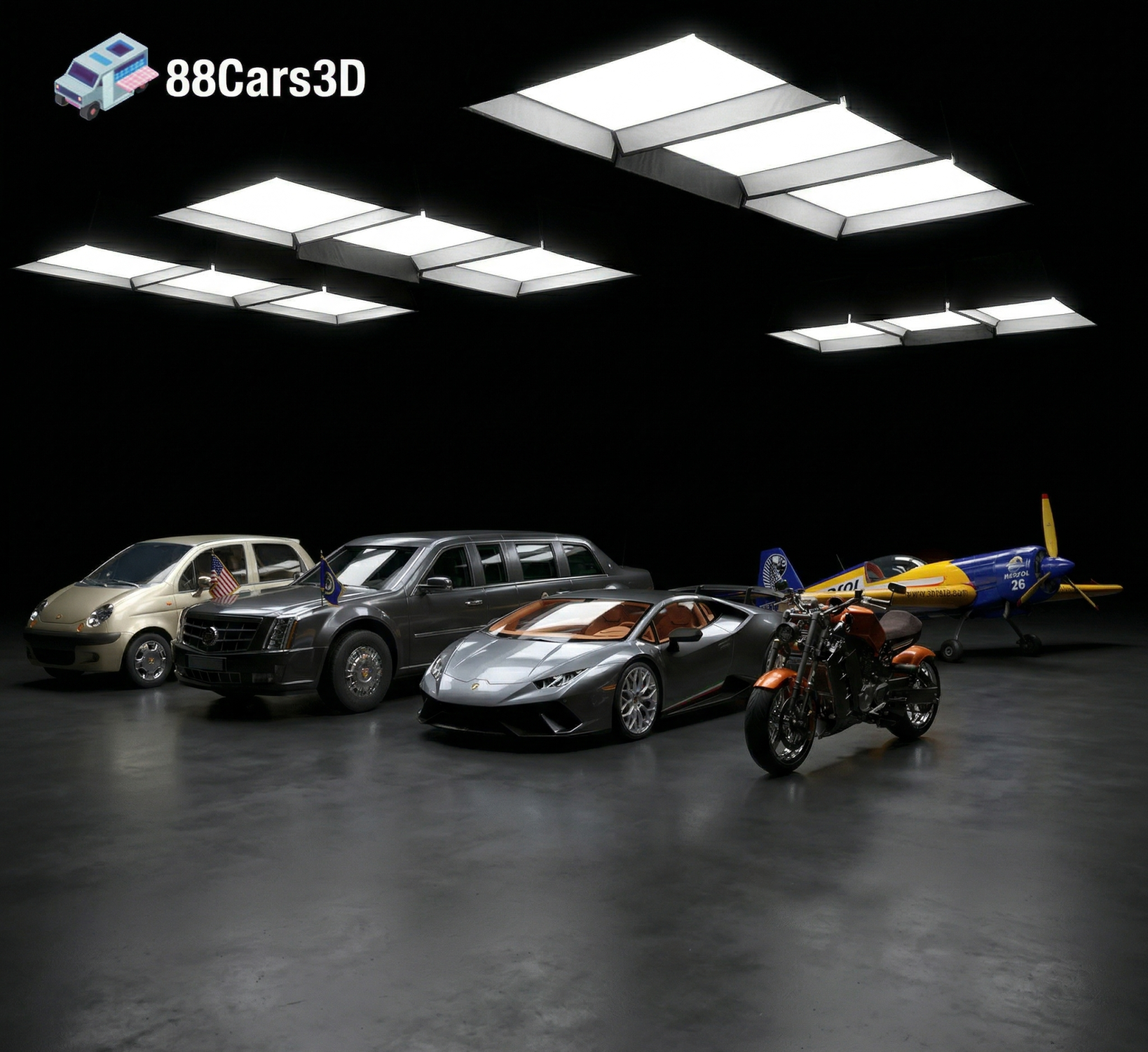
Texture: Yes | Material: Yes | 3D Printable: Yes. Download the Ultimate Creators’ Showcase featuring 5 premium 3D models: Lamborghini Huracan, ZAV Concept Motorcycle, Sukhoi SU-26, Presidential Limousine, and Daewoo Damas. Optimized for 4K CGI rendering and 3D printing. Save massive with this exclusive multi-category bundle!
Price: $99.99

Texture: Yes | Material: Yes | 3D Printable: Yes. Download the Italian Thoroughbreds Bundle featuring 5 iconic 3D models: Lamborghini Huracán Performante, Ferrari 458 Italia, Lamborghini Urus, Diablo SV, and Maserati GT. Optimized for 4K rendering and 3D printing (STL included). Save 50% with this ultimate Italian vehicle collection.
Price: $199.99

Download the Elite Future Mobility Bundle featuring 4 highly optimized 3D models: Tesla Model S, Avatr 11, Li L9, and Zoox Robotaxi. Perfect for ArchViz, Smart City renders, and game dev. Optimized for Unreal Engine and Blender. Includes .fbx, .obj, and .max formats.
Price: $99

🚗 5 Iconic German Cars (BMW M4 G82, M5 CS, X3, 1 Series & Mercedes E-Class). ✅ Optimized for ArchViz: Ready for Corona & V-Ray. 💰 Save €71 with this limited-time collection! 🚀 Instant Download after purchase.
Price: $119

Download the Extreme Off-Road & Survival 3D Models Bundle! Includes the Brabus 800 Adventure, Dodge Ram Bigfoot, Spec Truck, and a Caravan. Save over €210 on this premium 4-in-1 off-grid vehicle pack for ArchViz and game development.
Price: $149.99

Download the Heavy Duty & Commercial Logistics 3D Models Bundle! Includes the Ford Sterling, Caterpillar CT680, Mercedes Citaro Bus, and Vito Van. Save over €130 on this massive, game-ready 4-in-1 industrial vehicle pack.
Price: $109.99

Download the Ultimate Custom Motorcycles 3D Models Bundle. Includes a Custom Chopper, Ducati 916 Café Fighter, Harley XR1200X, and BMW K100. Perfect premium props for luxury ArchViz garages. Save over €250 today!
Price: $159.99

Download the ultimate JDM Street Racing 3D Models Bundle! Includes the Nissan GT-R, Toyota Supra, Mazda RX-7, Lancer Evo IX, and Honda NSX. Save big on this highly optimized, game-ready 5-in-1 Japanese legend car pack.
Price: $129.99

Download the ultimate American Muscle & Cinematic Classics 3D Models Bundle! Includes the Dodge Charger ’68, Mustang Eleanor GT500, Camaro Z28 ’79, and a custom ’69 Mustang. Save over €240 on this game-ready, premium 4-in-1 pack.
Price: $149.99

Download the Everyday City Traffic 3D Models Bundle. Includes the VW Golf, Kia Picanto, Hyundai Tucson, Toyota Yaris, and a DHL Ford Transit Van. Save big on this 5-in-1 pack, perfectly optimized for realistic ArchViz streets and game traffic.
Price: $99.99

