Get 50% OFF All Premium 3D & STL Models!

“`html
The journey from a digital 3D model to a tangible, detailed replica of your favorite car begins with a crucial step: slicing. This process, where specialized software transforms your STL files into machine-readable instructions, is the bedrock of successful 3D printing. For enthusiasts looking to bring automotive masterpieces to life, whether from personal designs or curated collections on platforms like 88cars3d.com, understanding slicing is paramount. Poorly sliced files can lead to print failures, wasted filament, and disappointing results. Conversely, a well-sliced model, optimized for your specific printer and material, can reveal astonishing levels of detail, creating exhibition-worthy printable car models. This guide will delve deep into the technical nuances of slicing, covering everything from fundamental file preparation to advanced settings for both FDM and resin 3D printers. Prepare to elevate your printing game and unlock the full potential of your 3D printer settings and slicing software.
Before any slicing can occur, the integrity of your STL files is crucial. An STL (STereoLithography) file describes the 3D surface geometry of an object using a collection of triangular facets. Think of it as a mesh of tiny triangles that collectively form the shape of your car model. The quality of this mesh directly impacts printability. Clean geometry, meaning no holes, inverted normals, or overlapping triangles, ensures the slicing software can accurately interpret the model’s boundaries. For intricate automotive models, often downloaded as STL files, ensuring this cleanliness is the first line of defense against print failures.
A manifold mesh is essential for 3D printing – it’s a watertight surface with no holes or self-intersections. Imagine a balloon; it has a continuous surface. A non-manifold mesh is like a balloon with holes or sections that fold back on themselves. Most 3D modeling software, and dedicated mesh repair tools, can identify and often fix these issues. When downloading models from marketplaces such as 88cars3d.com, reputable providers ensure their files are manifold and print-ready. However, for custom models or files from less curated sources, using software like Meshmixer or Netfabb to perform a “Make Solid” or “Inspector” check is highly recommended. This process identifies non-manifold edges, holes, and internal faces, allowing you to repair them before proceeding to the slicer.
Correctly scaling your model is vital. While slicers can resize models, it’s best to start with a model at a scale that makes sense for your desired print size and printer capabilities. For detailed printable car models, ensure the scale preserves crucial features like panel gaps, grilles, and emblems. Equally important is the initial orientation of the model on the virtual build plate. This decision significantly impacts the need for support structures, print quality, and build time. Generally, orienting a model to minimize overhangs and maximize the surface area contacting the build plate will yield the best results. For cars, printing them upright often presents the most challenges due to wheel arches, spoilers, and undercarriage details. Experimenting with a 45-degree tilt or even printing in sections can be beneficial.
Once your STL file is clean and appropriately oriented, it’s time to load it into your chosen slicer software. Popular options include Ultimaker Cura, PrusaSlicer, and Simplify3D. These programs interpret the 3D model and slice it into thin horizontal layers, generating G-code – the set of instructions your 3D printer follows. Mastering the fundamental settings within these slicers is key to achieving high-quality prints. These settings dictate everything from the smoothness of curves to the strength of the final object.
Layer height is arguably the most impactful setting. It determines the thickness of each individual layer deposited by the printer. A smaller layer height (e.g., 0.08mm or 0.1mm) results in finer details, smoother curves, and less visible layer lines – ideal for intricate printable car models. However, it significantly increases print time as the printer must lay down many more layers. Larger layer heights (e.g., 0.2mm or 0.3mm) drastically reduce print time but come with more pronounced layer lines and less fine detail. For most FDM prints of car models, a layer height between 0.1mm and 0.2mm offers a good balance. Resin printers, with their much finer resolution capabilities, often utilize layer heights of 0.025mm to 0.05mm.
Infill refers to the internal support structure printed within the hollow parts of your model. While it adds strength, high infill percentages consume more material and significantly increase print time. For display models, infill density can often be kept low, around 10-20%. The infill pattern also plays a role. Grid, triangles, and gyroid are common choices. The gyroid pattern is particularly popular for its strength in all directions and efficient material usage. For structural parts or functional prints, higher infill densities (30-50% or more) might be necessary. Understanding how infill affects print time, material consumption, and object strength is crucial for optimizing your prints.
Overhangs and bridges are common challenges in 3D printing, especially with complex geometries like those found in printable car models. When a layer needs to be printed in mid-air, unsupported, the filament can droop or fail to adhere, leading to a failed print. Support structures are temporary scaffolding printed alongside the model to hold up these overhangs. Generating and removing supports effectively is a critical skill for any 3D printer operator.
Slicers offer various support types, including standard, tree (or organic), and custom supports. Standard supports are typically generated as a grid or lines directly beneath the overhang. Tree supports are often more efficient, using less material and being easier to remove, as they branch out from a single point. The key is to ensure supports are only placed where absolutely necessary. Enabling settings like “Support Overhang Angle” (often around 45-60 degrees) tells the slicer to only generate supports for angles steeper than this threshold. This minimizes the amount of support material and simplifies removal. For car models, pay close attention to overhangs under spoilers, wheel arches, and bumpers.
The “Support Interface” setting is invaluable. It creates a denser, flatter surface directly beneath your model’s overhangs, making the contact area easier to remove cleanly and providing a smoother surface finish on the supported area. Experiment with the “Support Interface Density” and “Support Roof/Floor” settings. When it comes to removal, patience is key. For FDM prints, carefully use hobby knives, pliers, or specialized tools to break away the supports. Avoid excessive force that could damage the model. For resin prints, supports are often removed before final curing, and a gentle approach with flush cutters or a hobby knife is essential. Sometimes, supports can be strategically placed on less visible areas of the model to aid removal.
The way your printable car model is positioned on the build plate and how it adheres to it are fundamental to a successful print. Incorrect orientation can lead to excessive supports and surface defects, while poor bed adhesion is one of the most common causes of print failure, resulting in prints detaching mid-print or warping.
For FDM printing, orienting the model to maximize contact with the build plate and minimize the need for supports is paramount. This might mean printing a car model on its side, or even in multiple pieces that are later assembled. For resin printing, orientation is critical for print success and surface quality. Typically, orienting models with a slight tilt (10-45 degrees) off the build plate helps reduce suction forces and allows uncured resin to drain more effectively. The goal is to expose the smallest possible cross-sectional area to the build plate on each layer, minimizing peel forces during print detachment.
Bed adhesion techniques vary depending on your printer and material. For FDM, ensuring your build surface (glass, PEI, BuildTak) is clean is the first step. Adhesives like glue stick, hairspray, or specialized bed adhesives can significantly improve adhesion. Using a “brim” or “raft” in your slicer settings adds a wider base of material around the print’s footprint, increasing surface area contact with the build plate and preventing lifting. For resin printers, ensuring the build plate is clean and properly leveled is crucial. The initial adhesion layers (often thicker and printed slower) are vital for establishing a strong bond to the build plate. Checking and cleaning your FEP or PFA film regularly is also important for resin print success.
The first layer is the foundation of your entire print. If it’s not right, the rest of the print is likely to fail. In your slicer, settings for the first layer are often separate. This includes a slightly slower print speed (e.g., 15-25mm/s for FDM) and potentially a slightly higher temperature for the nozzle and bed to ensure good adhesion. Ensure your printer is properly calibrated, and the Z-offset (the distance between the nozzle and the build plate) is correctly set. A first layer that is too high will result in poor adhesion and gaps, while one that is too low can cause the nozzle to drag and potentially damage the build surface or clog the nozzle. For resin prints, the first few layers are printed slower and at a slightly higher exposure time to ensure a solid anchor to the build plate.
Beyond the fundamental settings, advanced slicing techniques allow for further optimization, especially when dealing with complex models like those found on 88cars3d.com. Material choice also plays a significant role, dictating optimal 3D printer settings.
Some advanced slicers offer “Adaptive Layers” or “Variable Layer Height.” This intelligent feature allows the slicer to automatically adjust the layer height throughout the print. It uses smaller layer heights in areas with high detail or sharp curves and larger layer heights in smoother, less detailed sections. This can dramatically reduce print time without sacrificing quality on critical features, making it perfect for detailed printable car models with varying levels of complexity. Implementing this requires careful consideration of where detail is most important.
Print speed is a delicate balance. While faster prints are desirable, pushing the limits too far can compromise print quality, leading to artifacts like ghosting, ringing, or poor layer adhesion. Dialing in optimal print speeds for different features (e.g., outer walls, inner walls, infill, travel moves) is key. This often involves printing calibration tests (like speed towers) and observing the results. Similarly, calibrating your printer’s “Flow Rate” or “Extrusion Multiplier” ensures the correct amount of filament is extruded. An incorrectly calibrated flow rate can lead to over-extrusion (blobs, poor detail) or under-extrusion (gaps, weak prints). This is typically done by printing a single-wall cube and measuring the wall thickness.
Different filament materials require distinct 3D printer settings. PLA is easy to print, offers good detail, and is suitable for most display models, but can be brittle. PETG is more durable and temperature-resistant but can be stringier and require slightly higher temperatures. ABS offers excellent strength and temperature resistance but requires a heated enclosure and good ventilation due to fumes. For resin printers, selecting the right type of resin (standard, tough, flexible, high-temp) is crucial, as is tuning exposure times for each specific resin and printer combination. Always refer to the material manufacturer’s recommended temperature ranges and printing guidelines when setting up your slicer.
Even the best-sliced and printed model often benefits from post-processing. This is where you transform a raw print into a polished replica, bringing out the true beauty of your printable car models.
As discussed, careful support removal is the first step. Once supports are gone, you’ll likely have small marks or blemishes where they attached. For FDM prints, sanding is a common technique. Start with a coarser grit sandpaper (e.g., 120-220 grit) to remove support marks and level surfaces, then progressively move to finer grits (400, 800, 1000, and even higher) for a smooth finish. For resin prints, sanding is also effective, but be mindful of the material’s properties. Various fillers and primers can be used to fill small gaps or imperfections before sanding. For a truly smooth finish on FDM prints, vapor smoothing with acetone (for ABS) or using specialized smoothing compounds can be employed, but these methods require caution and proper safety equipment.
Many complex printable car models are designed to be printed in multiple parts for easier printing and enhanced detail (e.g., separate wheels, chassis, body panels). Super glue (cyanoacrylate) or specialized plastic adhesives are commonly used for assembly. Ensure a clean fit between parts before gluing. Painting FDM prints can be challenging due to visible layer lines. Applying a primer coat is essential to provide a uniform surface and help fill minor imperfections. Acrylic paints are popular for their ease of use and low VOCs. For resin prints, the smoother surface generally takes paint exceptionally well. Using an airbrush can provide a very professional finish. Don’t forget small details like painting headlights, grilles, and window trim to truly bring your car model to life.
In conclusion, mastering the slicing process is an indispensable skill for anyone serious about achieving high-quality 3D prints, especially for detailed automotive replicas. By understanding the intricacies of STL files, meticulously configuring your 3D printer settings in your slicer, strategically employing support structures, and paying close attention to bed adhesion and orientation, you lay the groundwork for success. The journey doesn’t end at the print completion; thoughtful post-processing transforms a raw print into a stunning model. Whether you’re downloading ready-to-print designs from marketplaces like 88cars3d.com or working with your own creations, these principles remain constant. Continuous learning, experimentation with different settings, and a willingness to troubleshoot are your greatest assets. With practice, you’ll confidently navigate the slicing software, overcome common printing challenges, and consistently produce breathtaking printable car models that showcase both your skills and the incredible potential of additive manufacturing.
“`
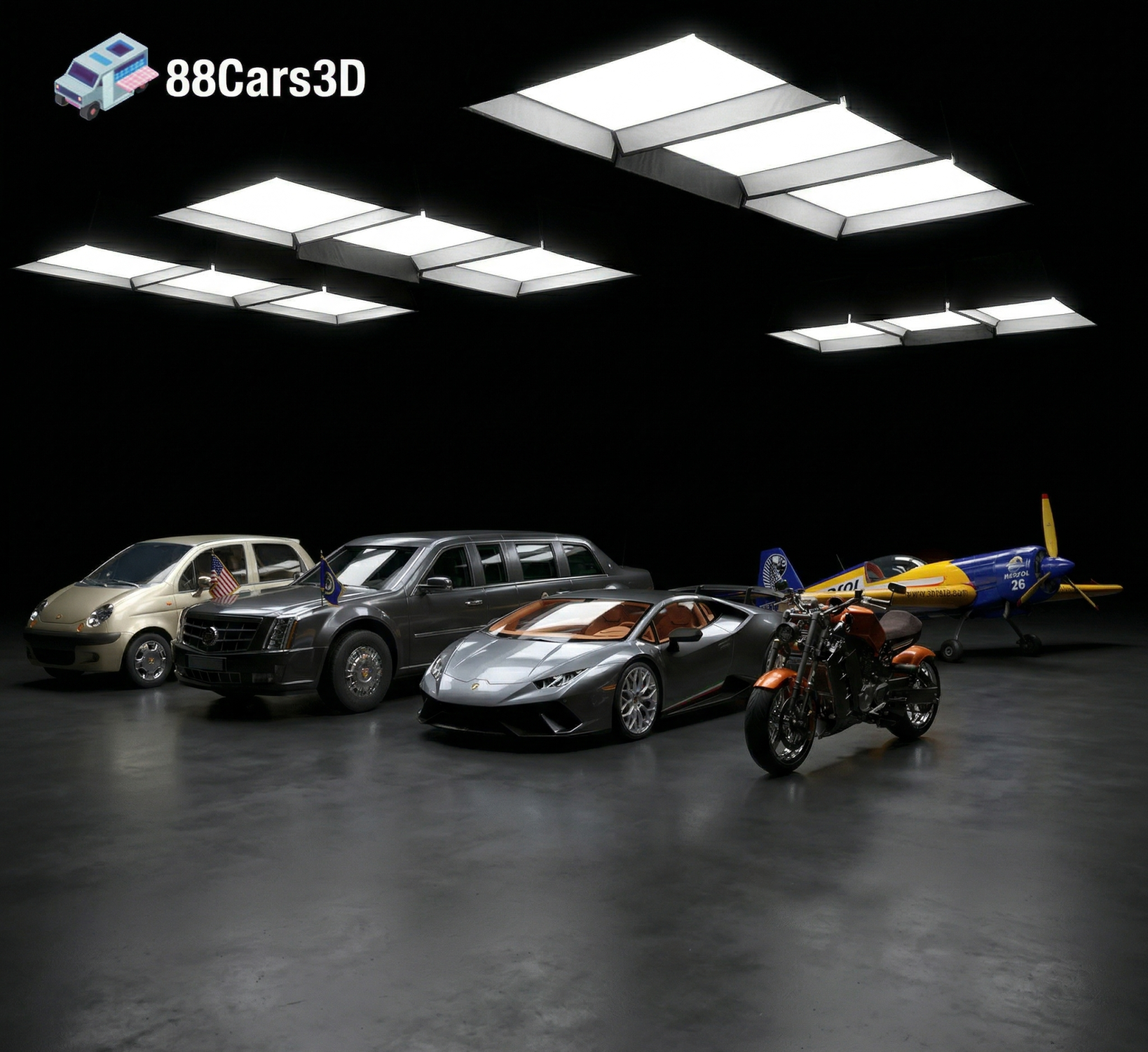
Texture: Yes | Material: Yes | 3D Printable: Yes. Download the Ultimate Creators’ Showcase featuring 5 premium 3D models: Lamborghini Huracan, ZAV Concept Motorcycle, Sukhoi SU-26, Presidential Limousine, and Daewoo Damas. Optimized for 4K CGI rendering and 3D printing. Save massive with this exclusive multi-category bundle!
Price: $99.99

Texture: Yes | Material: Yes | 3D Printable: Yes. Download the Italian Thoroughbreds Bundle featuring 5 iconic 3D models: Lamborghini Huracán Performante, Ferrari 458 Italia, Lamborghini Urus, Diablo SV, and Maserati GT. Optimized for 4K rendering and 3D printing (STL included). Save 50% with this ultimate Italian vehicle collection.
Price: $199.99

Download the Elite Future Mobility Bundle featuring 4 highly optimized 3D models: Tesla Model S, Avatr 11, Li L9, and Zoox Robotaxi. Perfect for ArchViz, Smart City renders, and game dev. Optimized for Unreal Engine and Blender. Includes .fbx, .obj, and .max formats.
Price: $99

🚗 5 Iconic German Cars (BMW M4 G82, M5 CS, X3, 1 Series & Mercedes E-Class). ✅ Optimized for ArchViz: Ready for Corona & V-Ray. 💰 Save €71 with this limited-time collection! 🚀 Instant Download after purchase.
Price: $119

Download the Extreme Off-Road & Survival 3D Models Bundle! Includes the Brabus 800 Adventure, Dodge Ram Bigfoot, Spec Truck, and a Caravan. Save over €210 on this premium 4-in-1 off-grid vehicle pack for ArchViz and game development.
Price: $149.99

Download the Heavy Duty & Commercial Logistics 3D Models Bundle! Includes the Ford Sterling, Caterpillar CT680, Mercedes Citaro Bus, and Vito Van. Save over €130 on this massive, game-ready 4-in-1 industrial vehicle pack.
Price: $109.99

Download the Ultimate Custom Motorcycles 3D Models Bundle. Includes a Custom Chopper, Ducati 916 Café Fighter, Harley XR1200X, and BMW K100. Perfect premium props for luxury ArchViz garages. Save over €250 today!
Price: $159.99

Download the ultimate JDM Street Racing 3D Models Bundle! Includes the Nissan GT-R, Toyota Supra, Mazda RX-7, Lancer Evo IX, and Honda NSX. Save big on this highly optimized, game-ready 5-in-1 Japanese legend car pack.
Price: $129.99

Download the ultimate American Muscle & Cinematic Classics 3D Models Bundle! Includes the Dodge Charger ’68, Mustang Eleanor GT500, Camaro Z28 ’79, and a custom ’69 Mustang. Save over €240 on this game-ready, premium 4-in-1 pack.
Price: $149.99

Download the Everyday City Traffic 3D Models Bundle. Includes the VW Golf, Kia Picanto, Hyundai Tucson, Toyota Yaris, and a DHL Ford Transit Van. Save big on this 5-in-1 pack, perfectly optimized for realistic ArchViz streets and game traffic.
Price: $99.99

