Get 50% OFF All Premium 3D & STL Models!

The automotive industry is in a constant state of evolution, and nowhere is this more evident than in the realm of visualization. Gone are the days when static renders and lengthy animation pipelines were the only options for showcasing vehicle designs. Today, real-time rendering, powered by engines like Unreal Engine, has revolutionized how we perceive, interact with, and even develop automobiles. From concept design and marketing to interactive configurators and virtual production, Unreal Engine offers an unparalleled toolkit for achieving photorealistic results with incredible efficiency.
This comprehensive guide dives deep into the technical workflows and best practices for leveraging Unreal Engine to create stunning automotive visualizations. We’ll explore everything from importing high-fidelity 3D car models and crafting physically based materials to dynamic lighting, interactive experiences, and optimization strategies for various applications. Whether you’re an experienced Unreal Engine developer, a 3D artist transitioning into real-time, or an automotive designer seeking cutting-edge tools, this article will equip you with the knowledge to push the boundaries of realism and interactivity. Prepare to unlock the full potential of your automotive projects, transforming static assets into dynamic, immersive experiences.
Unreal Engine has firmly established itself as a cornerstone in the automotive visualization landscape, moving far beyond its gaming roots. Its robust feature set, continuous innovation, and open-source accessibility make it an ideal platform for designers, engineers, and marketers alike. The engine’s ability to render complex scenes with stunning fidelity in real-time empowers users to iterate rapidly on designs, create engaging marketing materials, and even facilitate virtual test drives without a physical prototype. The shift from offline rendering to real-time not only accelerates production cycles but also fosters a more interactive and immersive user experience, critical in today’s digital-first world.
One of Unreal Engine’s most significant advantages is its versatility. It can handle everything from high-resolution cinematic sequences to optimized interactive web experiences and demanding virtual reality simulations. This adaptability, combined with powerful tools for PBR materials, advanced lighting, and extensive Blueprint scripting capabilities, provides a comprehensive solution for virtually any automotive visualization need. For more foundational knowledge on Unreal Engine’s vast capabilities, the official Unreal Engine learning portal at dev.epicgames.com/community/unreal-engine/learning is an invaluable resource.
Unreal Engine’s dominance stems from several key technological advancements. Features like Lumen for real-time global illumination, Nanite for virtualized geometry, and Chaos Physics for realistic vehicle dynamics offer unparalleled realism and performance. Lumen provides dynamic indirect lighting and reflections that react instantly to changes in the scene, eliminating the need for pre-baked lightmaps and accelerating iteration times. Nanite allows artists to import incredibly high-polygon 3D car models, often CAD-level detail, directly into the engine without traditional polygon budget constraints, freeing them to focus on artistic quality rather than optimization until the very final stages. This combination allows for a level of visual fidelity previously unattainable in real-time, enabling automotive artists to reproduce the intricate details, luxurious materials, and complex lighting interactions that define high-end vehicles.
Proper project setup is crucial for a smooth automotive visualization workflow. Start by creating a new project using the “Blank” or “Film, Television & Live Events” template, as these often come with relevant plugins enabled and a cleaner starting point. Essential plugins include Datasmith for CAD data import, which streamlines the process of bringing complex vehicle assemblies into Unreal while preserving metadata and hierarchy. Consider enabling Aximmetry DMX for virtual production setups if you plan on integrating with LED walls. In Project Settings, navigate to Rendering and ensure “Hardware Ray Tracing” is enabled if your hardware supports it, as this will significantly enhance Lumen, Nanite, and other features. For optimal visual quality, set the default Post Processing Volume’s “Auto Exposure” to Manual and adjust for consistent lighting. Consider using a Movie Render Queue preset for high-quality cinematic exports, configuring anti-aliasing (e.g., Temporal Sample Count to 64 or 128) and output formats.
The foundation of any compelling automotive visualization is a high-quality 3D car model. The realism of your final output directly correlates with the fidelity and preparation of your source assets. Platforms like 88cars3d.com offer meticulously crafted 3D car models specifically designed for Unreal Engine, featuring clean topology, realistic UV mapping, and PBR-ready materials. While these models provide an excellent starting point, understanding the import and optimization pipeline within Unreal Engine is crucial for maximizing visual quality and performance.
The choice of file format often depends on the source. For CAD data, Datasmith is the preferred pipeline, supporting formats like SolidWorks, Catia, STEP, IGES, and more, automatically tessellating geometry and maintaining instance data. For more traditional polygonal models, FBX remains a widely accepted standard, ensuring proper material slots, smoothing groups, and animation data are preserved. Emerging formats like USD (Universal Scene Description) are also gaining traction due to their ability to encapsulate complex scene data, including geometry, materials, animations, and variants, making them ideal for collaborative and large-scale projects.
When sourcing automotive assets from marketplaces such as 88cars3d.com, look for models with:
Before importing, ensure your model’s pivot point is at the origin and frozen transforms are applied in your 3D modeling software. This prevents unexpected scaling or rotation issues in Unreal Engine.
Nanite virtualized geometry is a game-changer for high-fidelity automotive visualization. It allows you to import and render 3D car models with millions, or even billions, of polygons without a noticeable performance hit. Nanite intelligently processes geometry on demand, streaming only the necessary detail to the GPU, meaning artists can directly import highly detailed CAD models or sculpted meshes. To enable Nanite for a Static Mesh, simply open the mesh editor, navigate to the “Nanite Settings” section, and check “Enable Nanite.” You can adjust settings like “Fallback Relative Error” to control the detail of non-Nanite geometry rendered at distance, though for most automotive cases, keeping this low or at default is fine. Always test your Nanite assets thoroughly; while it significantly reduces poly budget concerns, complex material setups or overlapping meshes can still impact performance.
While Nanite handles detail for high-poly meshes, Levels of Detail (LODs) remain crucial for non-Nanite meshes, particularly for distant objects or when targeting lower-end hardware, mobile AR/VR, or legacy rendering paths. LODs are simplified versions of a mesh that are swapped in at increasing distances from the camera, reducing polygon count and draw calls. Unreal Engine offers robust LOD generation capabilities. In the Static Mesh Editor, you can click “LOD Settings” and choose “Auto Generate LODs” or import custom LODs. When auto-generating, specify the number of LODs and “Screen Size” thresholds, which define at what percentage of screen coverage each LOD should be active. For instance, LOD0 at 1.0 (full detail), LOD1 at 0.5 (half screen size), LOD2 at 0.25 (quarter screen size), and so on. Carefully balancing LOD quality and screen size ensures optimal performance without visible popping artifacts. Use the “LOD Coloration” view mode in the viewport to visualize active LODs.
Materials are where the magic truly happens in automotive visualization, transforming raw geometry into lifelike surfaces that reflect light accurately. Physically Based Rendering (PBR) is the cornerstone of realism in modern real-time engines, and Unreal Engine’s Material Editor provides an incredibly powerful and flexible environment for creating stunning PBR materials. Understanding the principles of PBR—how light interacts with surfaces based on their metallic and roughness properties—is paramount to achieving photorealistic results for car paint, glass, rubber, and chrome.
The core PBR parameters in Unreal Engine are Base Color, Metallic, Roughness, Normal, and Ambient Occlusion. These inputs, typically driven by texture maps, define how light is absorbed, reflected, and scattered by the surface. For car paint, this means carefully balancing the metallic and roughness values to simulate the clear coat, flake effect, and underlying color. For tires, it’s about accurately representing the rough, non-metallic nature of rubber, while glass requires specific translucent material setups. Mastering these parameters is essential for any automotive artist aiming for top-tier visual fidelity.
A typical PBR material in Unreal Engine involves connecting texture maps to the appropriate material inputs:
These textures are authored in external software (e.g., Substance Painter, Photoshop) and imported into Unreal Engine. Ensure textures are set to the correct compression settings (e.g., BC7 for Base Color/Normal, BC4 for grayscale maps) for optimal performance and quality.
Automotive surfaces demand specialized material techniques:
Always leverage Material Instances. Create a master material with all the necessary parameters, then create instances for each unique color or variation. This allows for quick iteration and significant memory savings.
Lighting is arguably the most critical element in automotive visualization, transforming a static 3D model into a captivating, photorealistic representation. Unreal Engine’s advanced lighting capabilities, particularly with the advent of Lumen, enable artists to achieve dynamic, physically accurate illumination that reacts in real-time. This means instant feedback on lighting changes, dramatically accelerating the iteration process for design reviews and creative adjustments. Beyond raw technical power, lighting sets the mood, highlights design lines, and emphasizes the craftsmanship of a vehicle, making it feel tangible and desirable.
From the subtle interplay of reflections on a glossy paint finish to the dramatic shadows cast by a complex alloy wheel, every aspect of a car’s aesthetic is influenced by light. Unreal Engine provides a comprehensive suite of lighting tools, including directional, point, spot, and rectangular lights, along with advanced sky and environment systems. Integrating these tools effectively, especially with the power of Lumen, allows artists to simulate diverse environments—from a sun-drenched showroom to a moody evening street—with incredible accuracy and artistic control.
Lumen is Unreal Engine’s dynamic global illumination and reflections system, providing real-time indirect lighting that reacts immediately to direct lighting, material changes, and geometry alterations. For automotive scenes, Lumen is indispensable as it accurately simulates how light bounces around the environment, filling dark areas and adding realistic light bleed, crucial for detailed interiors and complex bodywork. To enable Lumen, go to Project Settings > Rendering > Global Illumination and Reflections, set them both to “Lumen.” Then, in your Post Process Volume, override “Global Illumination Method” and “Reflection Method” to Lumen. For optimal quality, ensure “Hardware Ray Tracing” is enabled in Project Settings if your GPU supports it, as it significantly enhances Lumen’s accuracy and performance. Adjusting the “Lumen Scene Lighting Quality” and “Lumen Scene Detail” in the Post Process Volume allows you to balance visual fidelity and performance.
Achieving stunning automotive lighting often involves a combination of light sources:
Consider using a combination of these lights, ensuring that each light source serves a purpose. Avoid over-lighting, which can flatten the image; instead, aim for contrast and deliberate shadow placement to emphasize form.
Post-processing effects are the final layer of polish that can elevate your automotive visualization from good to breathtaking. Applied via a Post Process Volume, these effects simulate camera and display characteristics, enhancing mood and realism:
Apply these effects judiciously; overdoing post-processing can quickly break immersion. The goal is enhancement, not distraction.
Beyond static renders and linear cinematics, Unreal Engine truly shines in its ability to create interactive automotive experiences. This capability empowers users to explore vehicle designs, customize configurations, and even simulate driving dynamics in real-time. At the heart of this interactivity lies Blueprint Visual Scripting, Unreal Engine’s powerful node-based scripting system. Blueprint enables artists and designers, even those without extensive programming knowledge, to create complex gameplay mechanics, user interfaces, and intricate logical flows, transforming passive viewers into active participants.
Imagine a potential customer exploring a car configurator, effortlessly swapping out wheel designs, changing paint colors, or opening doors with a click. Or a virtual showroom allowing prospects to walk around and inspect a vehicle from every angle, interacting with its features. Blueprint makes these scenarios not just possible, but relatively straightforward to implement. By abstracting complex code into logical, visual nodes, Blueprint significantly lowers the barrier to entry for creating rich, engaging automotive applications, from simple interactions to full-fledged virtual experiences.
Automotive configurators are a prime application for Blueprint. The core logic involves switching out mesh components, applying different materials, and updating UI elements based on user selections.
This modular approach allows for robust configurators that are easy to expand and maintain.
For more immersive experiences, simulating vehicle dynamics adds another layer of realism. Unreal Engine’s Chaos Vehicles system provides a robust framework for creating physically accurate car physics.
While fully accurate engine sound integration (relying on complex audio systems) is beyond the scope of this visual-focused post, you can trigger basic engine rev sounds or tire squeals through Blueprint based on vehicle speed or wheel slip events, linking visual and auditory feedback. Further information on vehicle systems can be found on the Unreal Engine learning portal.
Augmented Reality (AR) and Virtual Reality (VR) offer unparalleled immersion for automotive visualization, allowing users to experience vehicles in a profoundly new way.
Prioritize performance heavily for AR/VR applications, as dropped frames directly impact user comfort and experience. Regular profiling with tools like the GPU Visualizer and Stat commands is essential.
Unreal Engine isn’t just for interactive experiences; it’s a powerhouse for creating stunning cinematic content and revolutionizing virtual production workflows. For automotive brands, this means crafting breathtaking commercials, marketing films, or design reveal videos with unprecedented speed and flexibility. The engine’s real-time capabilities allow filmmakers and animators to visualize shots, iterate on camera movements, and finalize lighting and composition directly within the engine, bypassing lengthy render farm queues.
The integration of tools like Sequencer, combined with emerging technologies like LED volume virtual production, positions Unreal Engine at the forefront of automotive storytelling. This approach not only streamlines traditional animation pipelines but also opens up entirely new possibilities for in-camera visual effects and real-time collaboration. From intricate camera moves highlighting a car’s design to dynamic, evolving environments, Unreal Engine provides the creative freedom to bring any automotive vision to life on screen.
Sequencer is Unreal Engine’s powerful multi-track non-linear editor for creating cinematic sequences, animations, and gameplay events. For automotive cinematics, it’s indispensable:
Sequencer’s iterative nature means you can review and refine your animation in real-time, making adjustments on the fly.
Virtual Production (VP), particularly with LED volumes, is transforming filmmaking, and its applications in automotive are immense. It allows real-time rendering of environments behind physical vehicles on LED screens, enabling “in-camera VFX” and removing the need for green screens.
This advanced workflow demands meticulous project setup, synchronization, and optimization to ensure smooth real-time performance across all display nodes.
Regardless of the application—game, configurator, AR/VR, or cinematic—performance optimization is critical. Unreal Engine provides powerful profiling tools:
Consistent profiling and iterative optimization will ensure your automotive visualization runs smoothly and looks its best.
Unreal Engine has undeniably reshaped the landscape of automotive visualization, providing artists and developers with an incredibly powerful and versatile platform to create stunning, interactive, and truly immersive experiences. From importing high-fidelity 3D car models and harnessing the detail of Nanite to crafting photorealistic PBR materials, illuminating scenes with Lumen, and building dynamic interactions with Blueprint, the engine offers a complete ecosystem for bringing automotive designs to life. We’ve explored how these tools facilitate rapid iteration, enable groundbreaking real-time rendering, and open doors to advanced applications like virtual production and AR/VR configurators.
The journey into mastering Unreal Engine for automotive visualization is continuous, with new features and best practices emerging regularly. By applying the technical workflows and optimization strategies outlined in this guide, you are well-equipped to tackle complex projects and deliver cutting-edge results. Remember to prioritize high-quality assets, such as those found on 88cars3d.com, and continuously refine your techniques. Embrace the power of real-time, experiment with new ideas, and leverage the vast resources available on the Unreal Engine learning portal to stay ahead. The future of automotive design and marketing is real-time, and with Unreal Engine, you are at the forefront of this exciting revolution.
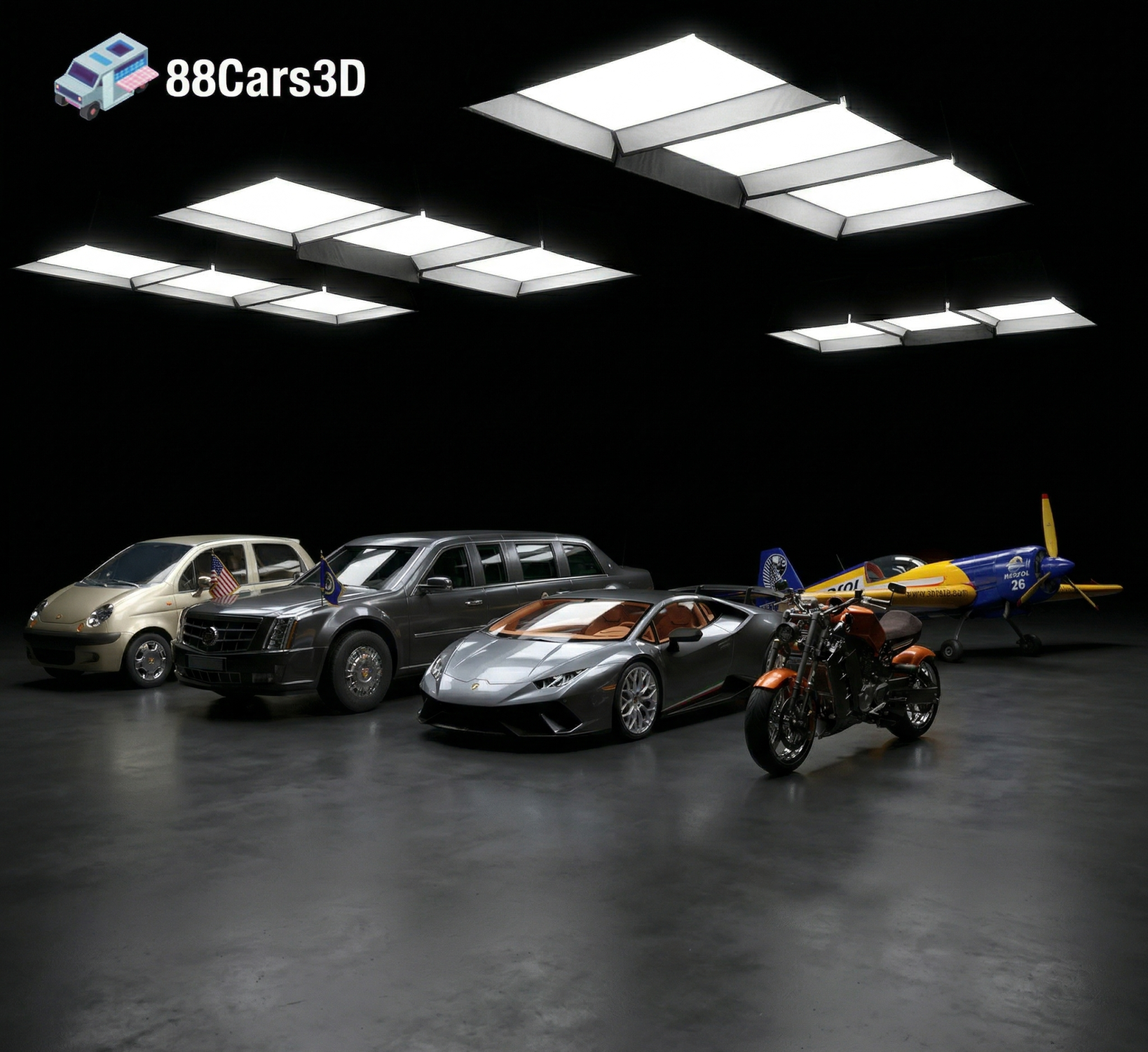
Texture: Yes | Material: Yes | 3D Printable: Yes. Download the Ultimate Creators’ Showcase featuring 5 premium 3D models: Lamborghini Huracan, ZAV Concept Motorcycle, Sukhoi SU-26, Presidential Limousine, and Daewoo Damas. Optimized for 4K CGI rendering and 3D printing. Save massive with this exclusive multi-category bundle!
Price: $99.99

Texture: Yes | Material: Yes | 3D Printable: Yes. Download the Italian Thoroughbreds Bundle featuring 5 iconic 3D models: Lamborghini Huracán Performante, Ferrari 458 Italia, Lamborghini Urus, Diablo SV, and Maserati GT. Optimized for 4K rendering and 3D printing (STL included). Save 50% with this ultimate Italian vehicle collection.
Price: $199.99

Download the Elite Future Mobility Bundle featuring 4 highly optimized 3D models: Tesla Model S, Avatr 11, Li L9, and Zoox Robotaxi. Perfect for ArchViz, Smart City renders, and game dev. Optimized for Unreal Engine and Blender. Includes .fbx, .obj, and .max formats.
Price: $99

🚗 5 Iconic German Cars (BMW M4 G82, M5 CS, X3, 1 Series & Mercedes E-Class). ✅ Optimized for ArchViz: Ready for Corona & V-Ray. 💰 Save €71 with this limited-time collection! 🚀 Instant Download after purchase.
Price: $119

Download the Extreme Off-Road & Survival 3D Models Bundle! Includes the Brabus 800 Adventure, Dodge Ram Bigfoot, Spec Truck, and a Caravan. Save over €210 on this premium 4-in-1 off-grid vehicle pack for ArchViz and game development.
Price: $149.99

Download the Heavy Duty & Commercial Logistics 3D Models Bundle! Includes the Ford Sterling, Caterpillar CT680, Mercedes Citaro Bus, and Vito Van. Save over €130 on this massive, game-ready 4-in-1 industrial vehicle pack.
Price: $109.99

Download the Ultimate Custom Motorcycles 3D Models Bundle. Includes a Custom Chopper, Ducati 916 Café Fighter, Harley XR1200X, and BMW K100. Perfect premium props for luxury ArchViz garages. Save over €250 today!
Price: $159.99

Download the ultimate JDM Street Racing 3D Models Bundle! Includes the Nissan GT-R, Toyota Supra, Mazda RX-7, Lancer Evo IX, and Honda NSX. Save big on this highly optimized, game-ready 5-in-1 Japanese legend car pack.
Price: $129.99

Download the ultimate American Muscle & Cinematic Classics 3D Models Bundle! Includes the Dodge Charger ’68, Mustang Eleanor GT500, Camaro Z28 ’79, and a custom ’69 Mustang. Save over €240 on this game-ready, premium 4-in-1 pack.
Price: $149.99

Download the Everyday City Traffic 3D Models Bundle. Includes the VW Golf, Kia Picanto, Hyundai Tucson, Toyota Yaris, and a DHL Ford Transit Van. Save big on this 5-in-1 pack, perfectly optimized for realistic ArchViz streets and game traffic.
Price: $99.99

