The automotive industry is in a perpetual state of innovation, and one of the most exciting frontiers transforming how we design, visualize, and interact with vehicles is Augmented Reality (AR). Imagine placing a photorealistic 3D car model directly in your driveway, customizing its paint job in real-time, or exploring its intricate interior as if it were physically present. Unreal Engine stands at the forefront of this revolution, offering unparalleled visual fidelity, robust development tools, and real-time rendering capabilities that empower creators to build breathtaking AR experiences.
This comprehensive guide delves deep into the technical intricacies of leveraging Unreal Engine for automotive AR applications. We’ll explore everything from setting up your project and optimizing high-quality 3D car models—like those found on marketplaces such as 88cars3d.com—to crafting interactive user interfaces and mastering performance for mobile AR devices. Whether you’re a seasoned Unreal Engine developer, a 3D artist specializing in automotive visualization, or a game developer looking to expand into AR, prepare to unlock the full potential of real-time rendering to create immersive and impactful augmented reality experiences.
Laying the Foundation: Unreal Engine Project Setup & AR Configuration
Embarking on an AR project in Unreal Engine requires meticulous initial setup to ensure a smooth development process and optimal performance. The engine’s modular nature allows for precise configuration, targeting specific AR platforms and leveraging its powerful rendering capabilities. Understanding these foundational steps is crucial before you even import your first 3D car model.
Unreal Engine for Mobile AR: Project Settings & Plugin Activation
The first step is creating a new Unreal Engine project, ideally starting with a Blank or Mobile template to pre-configure appropriate settings. Crucially, you’ll need to enable the necessary AR plugins. Navigate to Edit > Plugins and search for “AR”. You’ll typically enable:
- ARKit (for iOS/iPadOS devices): Provides Apple’s framework for high-fidelity world tracking, plane detection, and light estimation.
- ARCore (for Android devices): Google’s equivalent framework, offering similar robust AR capabilities.
- OpenXR (for cross-platform AR, including some future standalone AR devices): While ARKit/ARCore are common for mobile, OpenXR is gaining traction for broader AR/VR hardware support.
After enabling these, you’ll be prompted to restart the editor. Following this, go to Project Settings > Platforms > iOS or Android. Here, you’ll configure platform-specific packaging settings. For iOS, ensure you have a valid signing certificate and provisioning profile. For Android, verify your SDK, NDK, and JDK paths are correctly set up, and that you’re targeting the appropriate API levels. For optimal AR performance on mobile, always set your Default RHI (Render Hardware Interface) to Vulkan (Android) or Metal (iOS) in Project Settings under Platforms > Android/iOS > Rendering, as these offer significant performance advantages over OpenGL ES.
Configuring the AR Session: World Tracking & Light Estimation
Once the plugins are active, the core of your AR experience is managed by an AR Session Component. This component is typically added to your PlayerController or a dedicated Blueprint. Within the AR Session Component, you configure vital parameters that dictate how the AR system perceives and interacts with the real world:
- Session Type: Defines the tracking mode, e.g., ‘World’ for six-degrees-of-freedom (6DoF) tracking, ‘Face’ for face tracking, or ‘Image’ for image-based tracking. For automotive visualization, ‘World’ tracking is almost always required.
- Plane Detection Mode: Specifies what types of real-world surfaces the AR system should detect (e.g., horizontal, vertical, or both). For placing a car, ‘Horizontal’ is usually sufficient.
- Light Estimation Mode: Crucial for visual realism. Enabling this allows the AR system to estimate the ambient light conditions of the real environment. Unreal Engine can then use this data to dynamically adjust the lighting of your virtual car model, making it blend seamlessly with its surroundings. Options typically include ‘AmbientIntensity’ (basic light estimation) or ‘EnvironmentalLighting’ (more advanced, providing a cubemap for reflections).
Understanding these settings and how they interact with the physical environment is fundamental. For more in-depth configuration details, consult the official Unreal Engine documentation on AR learning resources.
Importing & Optimizing 3D Car Models for AR Reality
The visual fidelity of your AR application heavily relies on the quality and optimization of your 3D car models. Unlike traditional desktop or console rendering, mobile AR devices have strict performance budgets. Sourcing high-quality, well-optimized assets and then further streamlining them for AR is a critical phase in the development pipeline.
Sourcing High-Quality & Optimized Automotive Assets
The foundation of any stunning automotive AR experience begins with exceptional 3D models. These models need to be meticulously crafted, featuring clean topology, accurate dimensions, and proper UV mapping to ensure textures render correctly. While some projects may involve creating models from scratch, leveraging specialized marketplaces is often more efficient and provides professional-grade results. Platforms like 88cars3d.com offer a curated selection of high-quality 3D car models specifically designed for Unreal Engine, featuring clean mesh geometry, realistic PBR materials, and optimized polycounts suitable for various applications, including real-time rendering and AR/VR.
When selecting models, prioritize those with:
- Clean Topology: Quads-based geometry is easier to optimize and deform. Avoid excessive triangles or n-gons.
- Proper UV Mapping: Overlapping UVs should be minimized unless specifically for a shared texture area. Ensure lightmap UVs are present and free of overlaps for static lighting scenarios.
- Modular Design: Components like wheels, doors, and interiors as separate meshes allow for easier interaction and optimization (e.g., culling parts not visible).
- PBR-ready Textures: Models should come with albedo, normal, roughness, metallic, and optionally ambient occlusion maps.
Importing these models into Unreal Engine is typically done via FBX. Drag and drop the FBX file into your Content Browser, ensuring you check options like “Combine Meshes” (if appropriate), “Generate Lightmap UVs” (if not provided), and “Import Materials” if your FBX contains embedded material definitions.
The Optimization Imperative: LODs, Polycount, & Draw Calls
For mobile AR, raw polygon counts often need to be significantly lower than for cinematic or high-end PC rendering. While Nanite is a game-changer for high-poly assets on modern desktop/console platforms, it is generally not supported on mobile AR devices. Therefore, traditional optimization techniques are paramount:
- Level of Detail (LODs): This is the cornerstone of mobile optimization. Create multiple versions of your car model, each with progressively fewer polygons. Unreal Engine automatically swaps between these LODs based on the camera’s distance to the object. A common strategy involves 3-5 LODs: LOD0 (high poly), LOD1 (medium poly, ~50% reduction), LOD2 (low poly, ~75% reduction), and potentially LOD3/LOD4 for extremely distant or simple representations. You can generate LODs within the Static Mesh Editor by right-clicking the mesh and selecting “Generate LODs”.
- Polycount Reduction: Aim for a total polycount that allows for smooth performance. For a single hero car in AR, 50,000-150,000 triangles for LOD0 is a reasonable target, dropping to 10,000-20,000 for LOD2/3. Use tools like Unreal’s built-in Mesh Simplification (under the LOD settings) or external 3D software to reduce polygon count effectively.
- Draw Calls: Every unique material, mesh, and light contributes to draw calls, which are costly on mobile GPUs. Combine meshes where possible (e.g., interior elements into a single mesh if they share materials), use texture atlases to reduce material count, and minimize the number of unique materials per car component.
Texture Management & PBR for Mobile AR
Texture resolution and format also play a significant role in performance and memory footprint.
- Texture Resolutions: While 4K textures look great, they are often overkill for mobile AR unless specifically for hero elements viewed extremely close. Aim for 2K (2048×2048) for primary car body textures and 1K (1024×1024) or even 512×512 for smaller details, tires, or interior elements.
- Texture Compression: Unreal Engine provides various compression settings (e.g., BC7, BC5, ASTC). ASTC is particularly efficient for mobile platforms. In the Texture Editor, adjust the ‘Compression Settings’ to ‘Auto’ or ‘VectorDisplacementmap’ for normal maps, and choose an appropriate option for color and data textures.
- PBR Material Setup: Physically Based Rendering (PBR) is essential for photorealism. Ensure your car models come with Albedo (Base Color), Normal, Roughness, Metallic, and Ambient Occlusion maps. These maps are directly plugged into Unreal Engine’s standard Material Graph, ensuring realistic light interaction and reflections. For mobile, it’s often beneficial to pack Roughness, Metallic, and Ambient Occlusion into the RGB channels of a single texture to reduce sample count and draw calls.
By meticulously optimizing your 3D car models, you lay the groundwork for a visually stunning and performant AR experience that can run smoothly on a wide range of mobile devices.
Crafting Realistic AR Environments: Materials & Lighting
Achieving photorealistic automotive visualizations in AR requires a deep understanding of Unreal Engine’s material system and its lighting capabilities, particularly how they interact with the real-world environment. The goal is to make your virtual car indistinguishable from reality, blending seamlessly with its surroundings.
Physically Based Materials in Unreal Engine for Automotive AR
Unreal Engine’s Material Editor is a node-based system that allows for incredibly detailed and physically accurate material creation. For automotive AR, replicating real-world car paint, glass, rubber, and chrome is paramount. Here’s a breakdown of key material properties:
- Base Color (Albedo): This is the diffuse color of the material. For car paint, it’s the primary color, often combined with a subtle metallic flake texture. It should ideally be desaturated for metallic surfaces.
- Metallic: A value of 0 means the material is dielectric (non-metal), while 1 means it’s fully metallic. Car paint, for instance, often has a metallic value slightly above 0 to simulate the metallic flakes, while chrome would be 1.
- Roughness: Controls the microscopic surface imperfections that scatter light. A value of 0 is perfectly smooth (like polished chrome or wet paint), while 1 is completely rough (like matte plastic). Car paint often has a low roughness value, while tires have high roughness. This map is crucial for realistic reflections.
- Normal Map: Provides fine surface detail without adding actual geometry. Essential for subtle panel gaps, tire treads, or fabric textures on interior components.
- Ambient Occlusion (AO): Although usually calculated during lighting, an AO texture map can provide pre-baked contact shadows and self-occlusion, enhancing depth and realism, especially for static elements or on mobile where dynamic AO might be too costly.
- Clear Coat (for car paint): Unreal Engine has a dedicated Clear Coat shading model, perfect for automotive paint. It simulates a transparent layer over a metallic base, allowing for a second set of specular highlights and reflections, just like real car clear coat. This is often enabled by setting the Material’s Shading Model to ‘Clear Coat’ and adjusting its ‘Clear Coat Roughness’ and ‘Clear Coat Normal’ inputs.
When creating materials, always strive for physically accurate values rather than artistic guesswork. Referencing real-world material parameters and using PBR texture sets (Albedo, Normal, Roughness, Metallic, AO) is the best practice. Consider creating Material Instances from a master car paint material to easily adjust colors and properties across different vehicle models or configurations without recompiling shaders for each change.
Dynamic Lighting & AR Light Estimation
Lighting is the ultimate determinant of realism in AR. The challenge is making your virtual car respond to the real-world lighting conditions. Unreal Engine provides sophisticated tools to achieve this:
- AR Light Estimation: As mentioned in setup, enabling ‘EnvironmentalLighting’ in your AR Session Component allows Unreal to sample the real-world environment’s lighting. This generates an ambient cubemap that can be used for reflections and a color temperature/intensity that influences your scene’s primary light sources.
- HDR Sky Capture: Integrate the AR-estimated environmental cubemap into your scene. You can access this cubemap via Blueprint and apply it to a Sky Light component. This means the reflections on your car’s surface will dynamically match the real-world environment captured by the device’s camera, grounding the car convincingly.
- Directional Light & Scene Components: You’ll typically have a Directional Light (representing the sun) and potentially a Sky Light in your AR scene. Crucially, these lights should be set to ‘Movable’ to respond to AR light estimation. In Blueprint, you can read the estimated light intensity and color temperature from the AR Session and apply it to your Directional Light’s intensity and color.
- Baked Lighting (for static AR scenes): While AR is dynamic, if you have elements that are static in your AR scene (e.g., a virtual showroom floor that always appears the same), baking static lighting using Lightmass can yield incredibly realistic results with minimal runtime performance cost. However, the car itself will typically use dynamic lighting to react to the real environment. The Forward Renderer, optimized for mobile, is highly recommended for AR due to its efficiency and better support for mobile HDR and anti-aliasing.
Balancing performance with visual fidelity is key. Avoid excessive dynamic lights on mobile. Instead, rely on the AR light estimation for overall ambient and directional light, augmented by careful material work to achieve maximum realism.
Bringing Cars to Life: Interactivity with Blueprints & UI
Beyond simply placing a static 3D car model, the true power of AR lies in its interactivity. Unreal Engine’s Blueprint visual scripting system empowers developers to create dynamic and engaging automotive configurators, interactive showcases, and educational tools without writing a single line of C++ code.
Building Interactive Car Configurator Features
Blueprints allow you to define complex logic and interactions, bringing your static car models to life. For an automotive AR configurator, common interactive features include:
- Color Customization: This is a fundamental feature. Using a Dynamic Material Instance, you can expose parameters of your car paint material (like Base Color, Roughness, or even Clear Coat properties) to Blueprint. UI buttons can then call functions to update these parameters, instantly changing the car’s appearance.
- Component Swapping: Allow users to change wheel designs, interior trim, or even body kits. This involves setting up arrays of Static Mesh Components or Skeletal Meshes and using Blueprint to swap their visibility or assign new meshes based on user input. For example, clicking a “Change Wheels” button cycles through different wheel meshes loaded into an array.
- Door & Hood Animation: Animate car doors, trunks, and hoods opening and closing. This can be achieved using Sequencer for pre-baked cinematic animations which are then triggered via Blueprint (e.g., on a button click or touch event). Alternatively, you can use simple timelines in Blueprint to interpolate rotation or translation of specific mesh components.
- Interior Exploration: Allow users to “teleport” inside the car for a virtual interior tour. This could involve manipulating the AR camera’s position and orientation directly via Blueprint or providing a “ghost” camera that moves within the car’s interior.
- Scale & Rotation Adjustment: Enable users to intuitively scale and rotate the virtual car in their physical space using multi-touch gestures (pinch-to-scale, two-finger rotate). This requires mapping touch inputs to the actor’s transform properties in Blueprint.
Each interaction is typically driven by an Event Dispatcher or Direct Function Call initiated by a UI element (button, slider) or a direct AR interaction (like tapping on the car). This modular approach ensures scalability and ease of debugging.
UI/UX Design for Intuitive AR Experiences
User Interface (UI) and User Experience (UX) are paramount in AR. A cluttered or unintuitive interface can quickly break immersion. Unreal Engine’s UMG (Unreal Motion Graphics) UI system is ideal for creating responsive and engaging interfaces:
Remember that AR experiences often involve varying lighting conditions and backgrounds. Design your UI with good contrast and readability in mind. Extensive testing on actual mobile devices is crucial to validate the UI/UX and ensure a smooth, enjoyable user journey.
Performance & Fidelity: Mastering AR Optimization
Even with the most high-quality 3D car models, a visually stunning AR application will fail if it runs poorly. Achieving a smooth frame rate and minimal battery drain on mobile devices is a continuous balancing act between visual fidelity and aggressive optimization. This section details strategies to maximize performance in your Unreal Engine AR projects.
Mobile Scalability & Rendering Settings for AR
Unreal Engine provides a robust scalability system that allows you to tailor rendering quality to target different hardware. For AR, focusing on mobile-specific settings is paramount:
- Mobile Renderer (Forward Renderer): For mobile AR, always use the Forward Renderer. It’s significantly more performant than the Deferred Renderer (which Lumen and Nanite rely on heavily), especially for transparent objects and multiple lights, and has better support for mobile anti-aliasing and HDR. You can enable this in Project Settings > Platforms > Android/iOS > Rendering.
- Scalability Settings: Unreal Engine’s scalability groups (e.g., View Distance, Anti-Aliasing, Post-Processing, Shadow Quality, Effects Quality, Texture Quality) can be set in Edit > Project Settings > Engine > Scalability or controlled dynamically at runtime via Blueprint. For mobile AR, start with ‘Low’ or ‘Medium’ presets and incrementally increase specific settings if performance allows. For instance, keep texture quality high for your hero car, but reduce shadow quality.
- Post-Processing: Effects like Bloom, Vignette, Depth of Field, and Screen Space Ambient Occlusion (SSAO) are visually impactful but computationally expensive. Use them sparingly or disable them entirely for mobile AR. If absolutely necessary, keep their intensity and radius very low.
- Static & Dynamic Shadows: Dynamic shadows are costly. If your AR experience involves placing a car on a plane, consider faking ground shadows using a decal or a slightly transparent, textured plane directly beneath the car. For dynamic shadows, use a low cascade count (1 or 2) for the directional light, and ensure shadow resolution is optimized.
- Anti-Aliasing: Temporal Anti-Aliasing (TAA) can be effective but might introduce ghosting on mobile. FXAA or MSAA (if the mobile renderer supports it) might be better alternatives, or relying on higher screen resolutions.
Regularly profile your application using Unreal Insight or Xcode Instruments/Android Studio Profiler to identify performance bottlenecks. Common culprits include overdraw, excessive draw calls, high poly counts, and unoptimized post-processing.
Streamlining Assets for Peak Performance
Beyond rendering settings, the efficiency of your assets directly impacts performance. A well-optimized asset pipeline is crucial for real-time AR:
- Level of Detail (LOD) Management: As discussed, robust LODs are non-negotiable. Ensure LOD transition distances are tuned for AR scenarios, where objects might be viewed both up close and from a distance. The LOD bias in texture settings can also force lower-resolution mipmaps for textures further away, saving memory.
- Texture Streaming: Enable texture streaming in Project Settings (Engine > Rendering) to only load textures at the required resolution, significantly reducing memory footprint and load times. Ensure your textures have proper mipmaps generated.
- Occlusion Culling: Unreal Engine automatically performs frustum culling (objects outside the camera view are not rendered). For complex scenes, implement hierarchical occlusion culling (using Occlusion Culling volumes) to prevent rendering objects that are hidden behind other objects.
- Material Complexity: Keep your materials as simple as possible. Avoid excessive shader instructions, complex node networks, and multiple texture lookups where one might suffice (e.g., texture packing). The ‘Shader Complexity’ view mode (Alt+8) in the editor is invaluable for identifying costly materials.
- Blueprint Optimization: While Blueprints are powerful, inefficient logic can impact performance. Avoid ‘Event Tick’ for heavy calculations. Use ‘Timers’ or ‘Custom Events’ where possible. Cache references to actors and components rather than performing ‘Get Actor Of Class’ calls every frame.
- Memory Budget: Mobile devices have limited RAM. Monitor your application’s memory usage through profiling tools. High-resolution textures, unoptimized meshes, and an abundance of assets can quickly consume memory, leading to crashes or poor performance.
The goal is to provide a visually rich experience without overtaxing the mobile device’s resources. Iterative testing and profiling on various target devices are essential to strike the right balance. For more in-depth optimization guides, refer to Unreal Engine’s comprehensive learning resources.
Advanced AR Concepts & Real-World Automotive Applications
With the fundamentals mastered, we can explore more advanced AR features and dive into the tangible benefits that Unreal Engine-powered AR brings to the automotive industry, transforming everything from design and sales to training and maintenance.
Persistent AR & Object Tracking for Enhanced Experiences
Beyond basic plane detection, advanced AR capabilities significantly enhance the realism and utility of automotive applications:
- Persistent AR Experiences: Imagine placing a custom car in your garage, closing the app, and finding it in the exact same spot when you reopen it. Persistent AR allows an AR session to be saved and reloaded. This is achieved by storing the AR world’s spatial anchors and map data. ARKit’s ‘WorldMap’ and ARCore’s ‘Cloud Anchors’ are mechanisms to save and share spatial data, enabling users to resume or share AR experiences across sessions or even devices. This is invaluable for showcasing a vehicle over multiple days or for collaborative design reviews.
- Image Tracking: Instead of relying solely on plane detection, image tracking uses a pre-defined 2D image (e.g., a car brochure, a logo, a specific marker) to anchor and display your 3D car model. The Unreal AR system tracks the image, and your virtual car appears precisely on top of it. This is excellent for interactive marketing campaigns or augmenting physical product displays.
- Object Tracking: This takes image tracking a step further. Instead of a 2D image, it tracks a pre-scanned 3D object (e.g., a small physical car model or a specific part). The virtual model can then accurately overlay or augment the real-world object. This is powerful for interactive repair manuals or visualizing internal components on a real engine block. Setting up object tracking involves scanning the physical object to create a reference file, which is then imported into Unreal Engine and used with an ARTrackableObject component.
These advanced tracking methods make AR experiences more robust, context-aware, and seamlessly integrated into the user’s physical world, moving beyond simple “placard” AR to truly immersive augmentations.
Automotive Visualization Use Cases: From Showroom to Training
The automotive industry is rapidly adopting AR for a myriad of applications, leveraging Unreal Engine’s capabilities to drive innovation and engagement:
- Virtual Showrooms & Configurators: The most prominent use case. Customers can virtually place a car in their desired location, customize colors, wheels, and interior trims, and even explore the interior at a 1:1 scale. This dramatically enhances the buying experience, allowing for personalized visualization before a physical car is available. Car models sourced from platforms like 88cars3d.com are perfectly suited for these high-fidelity virtual showrooms.
- Design Review & Prototyping: Designers and engineers can overlay new car designs onto existing prototypes or into real-world environments. This allows for rapid iteration, identification of ergonomic issues, and aesthetic evaluation in context, saving significant time and resources compared to building physical mockups.
- Sales & Marketing Tools: Dealerships can use AR apps to showcase vehicle variants that aren’t physically on the lot. Marketing campaigns can leverage image tracking to bring cars to life from brochures or magazines, creating highly engaging promotional content.
- Training & Maintenance: Technicians can use AR to overlay repair instructions, wiring diagrams, or virtual X-rays directly onto a physical vehicle. Complex procedures can be visualized step-by-step, improving efficiency and reducing errors. This minimizes the need for physical training models and expensive manuals.
- Driver Assistance & Navigation: While still nascent, future applications could integrate AR overlays into windshields, providing real-time navigation cues, warning alerts, or highlighting points of interest directly in the driver’s line of sight, enhancing safety and convenience.
Unreal Engine’s photorealistic rendering and interactive capabilities make it the ideal platform for these diverse automotive AR applications, bridging the gap between digital models and real-world utility.
Conclusion: Driving the Future of Automotive with Unreal Engine AR
The journey through building AR applications for automotive visualization with Unreal Engine reveals a powerful synergy between cutting-edge technology and creative expression. From the meticulous setup of AR sessions and the critical optimization of high-quality 3D car models to the crafting of realistic materials and interactive experiences with Blueprint, every step is an opportunity to push the boundaries of immersive digital interaction. We’ve seen how proper LOD management, texture optimization, and intelligent use of Unreal Engine’s mobile rendering features are paramount for delivering smooth, high-fidelity experiences on mobile AR devices.
The future of automotive visualization is undeniably intertwined with augmented reality. As AR hardware evolves and computational power grows, the possibilities will only expand, leading to even more seamless and photorealistic interactions. By leveraging tools like Unreal Engine, developers and artists are not just creating applications; they are shaping how we perceive, interact with, and ultimately purchase and maintain vehicles. To kickstart your next project, explore the vast library of optimized, high-quality 3D car models available at 88cars3d.com, designed to seamlessly integrate into your Unreal Engine workflows. Embrace the power of AR, and drive the future of automotive visualization today.
Featured 3D Car Models
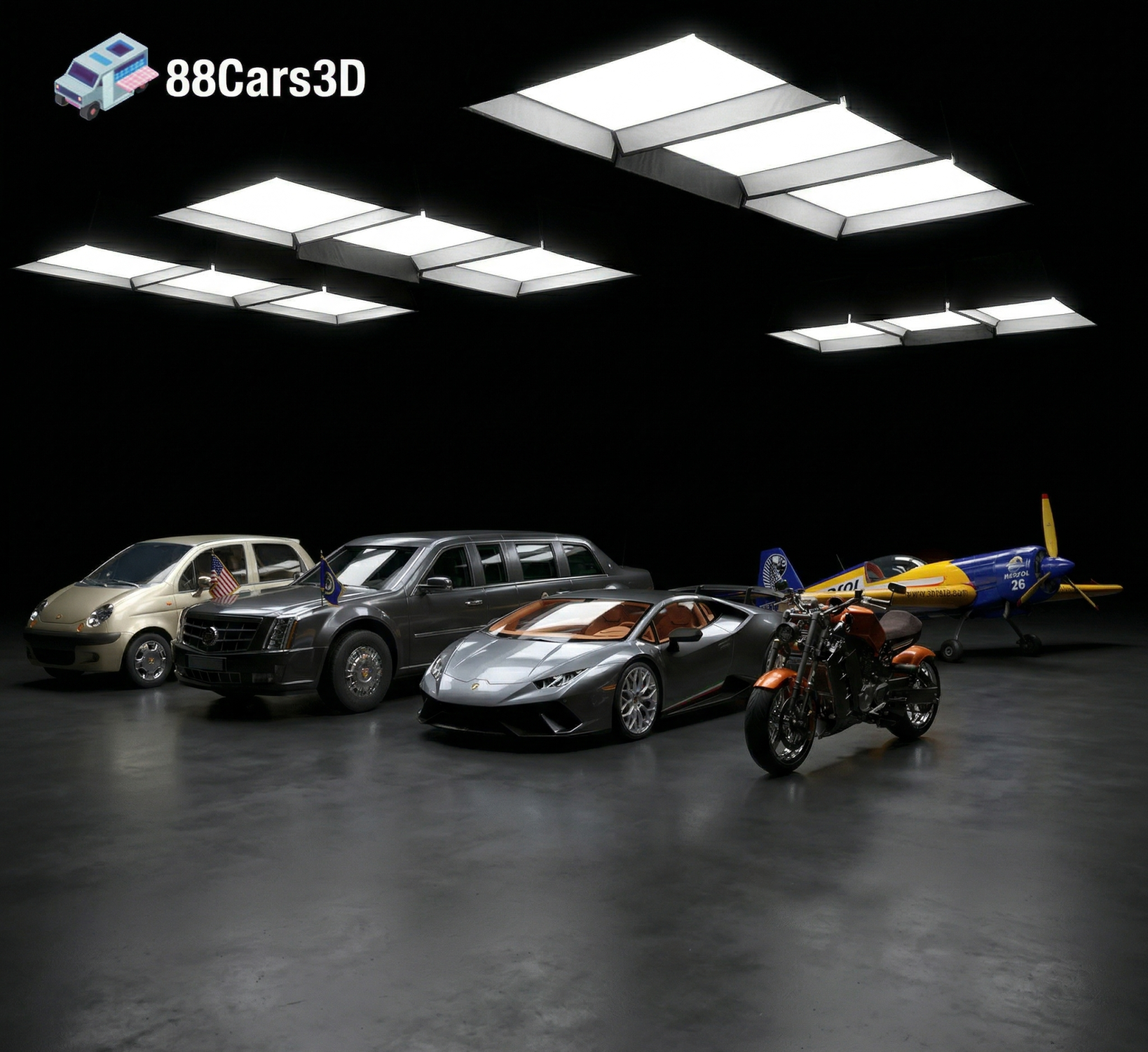
Texture: Yes | Material: Yes | 3D Printable: Yes. Download the Ultimate Creators’ Showcase featuring 5 premium 3D models: Lamborghini Huracan, ZAV Concept Motorcycle, Sukhoi SU-26, Presidential Limousine, and Daewoo Damas. Optimized for 4K CGI rendering and 3D printing. Save massive with this exclusive multi-category bundle!
Price: $99.99
View Product

Texture: Yes | Material: Yes | 3D Printable: Yes. Download the Italian Thoroughbreds Bundle featuring 5 iconic 3D models: Lamborghini Huracán Performante, Ferrari 458 Italia, Lamborghini Urus, Diablo SV, and Maserati GT. Optimized for 4K rendering and 3D printing (STL included). Save 50% with this ultimate Italian vehicle collection.
Price: $199.99
View Product

Download the Elite Future Mobility Bundle featuring 4 highly optimized 3D models: Tesla Model S, Avatr 11, Li L9, and Zoox Robotaxi. Perfect for ArchViz, Smart City renders, and game dev. Optimized for Unreal Engine and Blender. Includes .fbx, .obj, and .max formats.
Price: $99
View Product

🚗 5 Iconic German Cars (BMW M4 G82, M5 CS, X3, 1 Series & Mercedes E-Class). ✅ Optimized for ArchViz: Ready for Corona & V-Ray. 💰 Save €71 with this limited-time collection! 🚀 Instant Download after purchase.
Price: $119
View Product

Download the Extreme Off-Road & Survival 3D Models Bundle! Includes the Brabus 800 Adventure, Dodge Ram Bigfoot, Spec Truck, and a Caravan. Save over €210 on this premium 4-in-1 off-grid vehicle pack for ArchViz and game development.
Price: $149.99
View Product

Download the Heavy Duty & Commercial Logistics 3D Models Bundle! Includes the Ford Sterling, Caterpillar CT680, Mercedes Citaro Bus, and Vito Van. Save over €130 on this massive, game-ready 4-in-1 industrial vehicle pack.
Price: $109.99
View Product

Download the Ultimate Custom Motorcycles 3D Models Bundle. Includes a Custom Chopper, Ducati 916 Café Fighter, Harley XR1200X, and BMW K100. Perfect premium props for luxury ArchViz garages. Save over €250 today!
Price: $159.99
View Product

Download the ultimate JDM Street Racing 3D Models Bundle! Includes the Nissan GT-R, Toyota Supra, Mazda RX-7, Lancer Evo IX, and Honda NSX. Save big on this highly optimized, game-ready 5-in-1 Japanese legend car pack.
Price: $129.99
View Product

Download the ultimate American Muscle & Cinematic Classics 3D Models Bundle! Includes the Dodge Charger ’68, Mustang Eleanor GT500, Camaro Z28 ’79, and a custom ’69 Mustang. Save over €240 on this game-ready, premium 4-in-1 pack.
Price: $149.99
View Product

Download the Everyday City Traffic 3D Models Bundle. Includes the VW Golf, Kia Picanto, Hyundai Tucson, Toyota Yaris, and a DHL Ford Transit Van. Save big on this 5-in-1 pack, perfectly optimized for realistic ArchViz streets and game traffic.
Price: $99.99
View Product


