Get 50% OFF All Premium 3D & STL Models!

“`html
The world of 3D printing is a fascinating intersection of digital design and physical creation. At the heart of this process lies the humble 3D model file, the digital blueprint that guides your printer. While many aspiring makers and seasoned hobbyists are familiar with the concept of 3D printing, a critical yet often overlooked aspect is the choice of file format. For those looking to bring stunning printable car models to life, understanding the nuances between formats like STL, OBJ, and FBX is paramount to achieving professional-quality results. This guide will delve deep into the technical characteristics of each format, explore their strengths and weaknesses in the context of 3D printing, and provide actionable advice to help you select the best file format for your next project. Whether you’re downloading pre-made models from platforms like 88cars3d.com or preparing your own creations, mastering this fundamental aspect will significantly enhance your 3D printing workflow and the quality of your output.
We’ll cover everything from the underlying data structures of these formats to practical slicing strategies and post-processing techniques. By the end of this article, you’ll have a clear understanding of how to navigate these file types, troubleshoot common issues, and ultimately, print flawless 3D models every time.
At its most fundamental level, a 3D model is a digital representation of an object’s surface. Different file formats employ distinct methods to store this geometric information, and this is where their suitability for 3D printing diverges. The primary goal of 3D printing is to create a solid, watertight object, and the file format must effectively convey this information to the slicing software.
The STL (STereoLithography) format, despite its age, remains the undisputed king of 3D printing file formats. Developed by 3D Systems in the 1980s, its simplicity is its greatest strength and, at times, its limitation. An STL file represents the surface geometry of a 3D object using a collection of triangular facets. Each facet is defined by three vertices (points in 3D space) and a normal vector, which indicates the outward-facing direction of the surface. This makes it incredibly straightforward for slicing software to interpret the shape and begin the process of dividing it into printable layers.
Key Technical Aspects of STL:
When downloading models from marketplaces like 88cars3d.com, you’ll almost always find them provided in STL format, precisely because it’s universally compatible with virtually all 3D printers and slicing software. However, the lack of additional data means that complex surfacing or intricate details might require careful meshing during the export process from the design software.
The OBJ (Object) file format, developed by Autodesk, is a more versatile format that can store geometric data along with additional information such as color, texture maps, and material properties. This makes it a popular choice in 3D modeling, animation, and visual effects, but its use in 3D printing is more nuanced than STL.
Key Technical Aspects of OBJ:
For 3D printing, the primary benefit of OBJ is its ability to preserve color information. While most FDM printers can only print in a single color at a time, multi-color printing technologies (like those using multiple extruders or filament changers) or resin printers that support color can leverage this data. However, the color information itself isn’t directly interpreted by standard slicers for FDM printing; it requires specific plugins or workflows. For pure geometric accuracy for single-color prints, an OBJ file that has been properly triangulated and exported as a watertight mesh can function similarly to an STL.
The FBX (Filmbox) format, also owned by Autodesk, is a proprietary format designed as an interchange format for 3D animation, modeling, and rendering pipelines. It’s extremely feature-rich, capable of storing geometry, materials, textures, lighting, cameras, skeletal animation, and more. While powerful, its complexity often makes it overkill and potentially problematic for direct 3D printing workflows.
Key Technical Aspects of FBX:
For 3D printing car models, FBX files are rarely the direct choice. If you obtain an FBX model, the first step before slicing will invariably be to export it as an STL or a clean OBJ file. The extra data contained within an FBX (like animation data) would only add complexity and potential compatibility issues if not stripped away during the export process.
Now that we understand the fundamental differences, let’s compare how these formats perform in practical 3D printing scenarios. The choice often boils down to the intended application, the source of the model, and the capabilities of your design and slicing software.
For the vast majority of 3D printing applications, especially for hobbyists and makers, STL is the go-to format. Its simplicity ensures maximum compatibility across different printers, slicers (like Cura, PrusaSlicer, Simplify3D), and operating systems. When you download a printable car model from a site like 88cars3d.com, you are most likely receiving a carefully prepared STL file designed for ease of use.
Strengths for 3D Printing:
Weaknesses for 3D Printing:
When using STL, the primary concern is the quality of the mesh itself. A poorly constructed STL, even if “watertight,” can lead to slicing artifacts. Software like Meshmixer or Netfabb are invaluable tools for repairing and optimizing STL files before printing.
OBJ’s ability to store color and texture information makes it an attractive option when these aspects are important for your project. For instance, if you’re experimenting with multi-color FDM printing or plan to paint a model with intricate decal placements, an OBJ might offer advantages if your workflow supports it.
Strengths for 3D Printing:
Weaknesses for 3D Printing:
If your goal is a single-color print, and the OBJ file is well-formed, you can often export it as an STL without significant loss of geometric fidelity. However, it’s crucial to ensure that the OBJ file represents a watertight manifold mesh. Many 3D modeling programs can export OBJ files that are easily convertible to STL.
FBX is overwhelmingly designed for animation and game asset pipelines. Its complexity and the proprietary nature of some implementations make it ill-suited for direct use in standard 3D printing workflows. The unnecessary inclusion of animation, rigging, or complex scene data can lead to errors or simply be ignored by the slicing software.
Strengths (Irrelevant for most 3D Printing):
Weaknesses for 3D Printing:
If you encounter an FBX file, treat it as a source file that needs to be exported into a more print-friendly format. Blender, Maya, or 3ds Max can all export FBX files to STL or OBJ.
Regardless of the format you start with, ensuring the model is prepared correctly for slicing is crucial. This involves checking for errors, optimizing the mesh, and selecting the right slicing parameters. For detailed printable car models, meticulous preparation is key to capturing intricate lines and proportions.
The concept of a “watertight” or “manifold” mesh is fundamental to 3D printing. This means the digital surface forms a closed volume with no holes, gaps, or internal faces. Slicing software relies on this to determine the inside and outside of the model and to correctly calculate infill and supports.
Common Mesh Errors:
Tools for Repair:
When dealing with models from platforms like 88cars3d.com, the STL files are typically pre-checked and repaired. However, it’s always good practice to run a quick check in your preferred repair software, especially if you encounter slicing errors.
Once the file is clean, the next step is slicing – converting the 3D model into layer-by-layer instructions (G-code) for your 3D printer. The settings you choose here dramatically impact print quality, strength, and time.
Key Slicing Settings:
Experimentation is key. Start with recommended profiles for your material and printer, then adjust settings based on the specific model and desired outcome. For instance, printing a sleek supercar body might benefit from a finer layer height and slower speeds than a more robust off-road vehicle.
Proper support generation and model orientation are critical for successfully printing models with overhangs and complex geometries, which are abundant in car models.
Support Strategies:
Print Orientation:
For example, printing a detailed car wheel might be best done upright to capture all the caliper and rim details clearly, requiring supports inside the wheel spokes. A car body might benefit from being printed upside down, with the roof resting on the build plate, minimizing supports on the visible exterior.
Once the print is complete and the supports have been removed, the journey isn’t over. Post-processing is where you transform a raw 3D print into a show-quality model.
Careful and patient support removal is crucial to avoid damaging the print. Use appropriate tools like flush cutters, pliers, hobby knives (X-Acto), and sometimes dental picks for detailed work.
Layer lines are an inherent characteristic of FDM printing. Sanding is the primary method for removing them and achieving a smooth surface.
For car models, painting is often the final and most rewarding step. A well-painted model can truly bring the digital design to life.
The choice between STL, OBJ, and FBX for 3D printing boils down to the specific application and workflow. For universal compatibility and straightforward geometric printing, STL remains the industry standard. Its simplicity ensures that virtually any slicer and printer can interpret the data, making it the safest bet, especially when downloading models from curated marketplaces like 88cars3d.com. OBJ offers the potential to carry color and texture data, which can be beneficial for multi-color printing or advanced visualization workflows, but requires more specialized software and printer capabilities.
FBX, while a powerful format, is generally not suitable for direct 3D printing due to its complexity and focus on animation. It should always be converted to STL or OBJ before proceeding. Regardless of the format, the critical factor for successful 3D printing is a clean, watertight, and manifold mesh. Investing time in mesh repair using tools like Meshmixer or Blender will prevent countless printing headaches. Furthermore, mastering slicing parameters – layer height, print speed, infill, and supports – along with careful print orientation, are essential for achieving high-quality results, particularly for detailed automotive models.
By understanding the technical nuances of each file format and implementing best practices in file preparation, slicing, and post-processing, you can elevate your 3D printing projects from basic prints to stunningly accurate replicas. Whether you are a hobbyist building a collection of classic cars or an engineer prototyping a new automotive component, this knowledge will empower you to unlock the full potential of your 3D printer and the incredible digital models available today.
“`
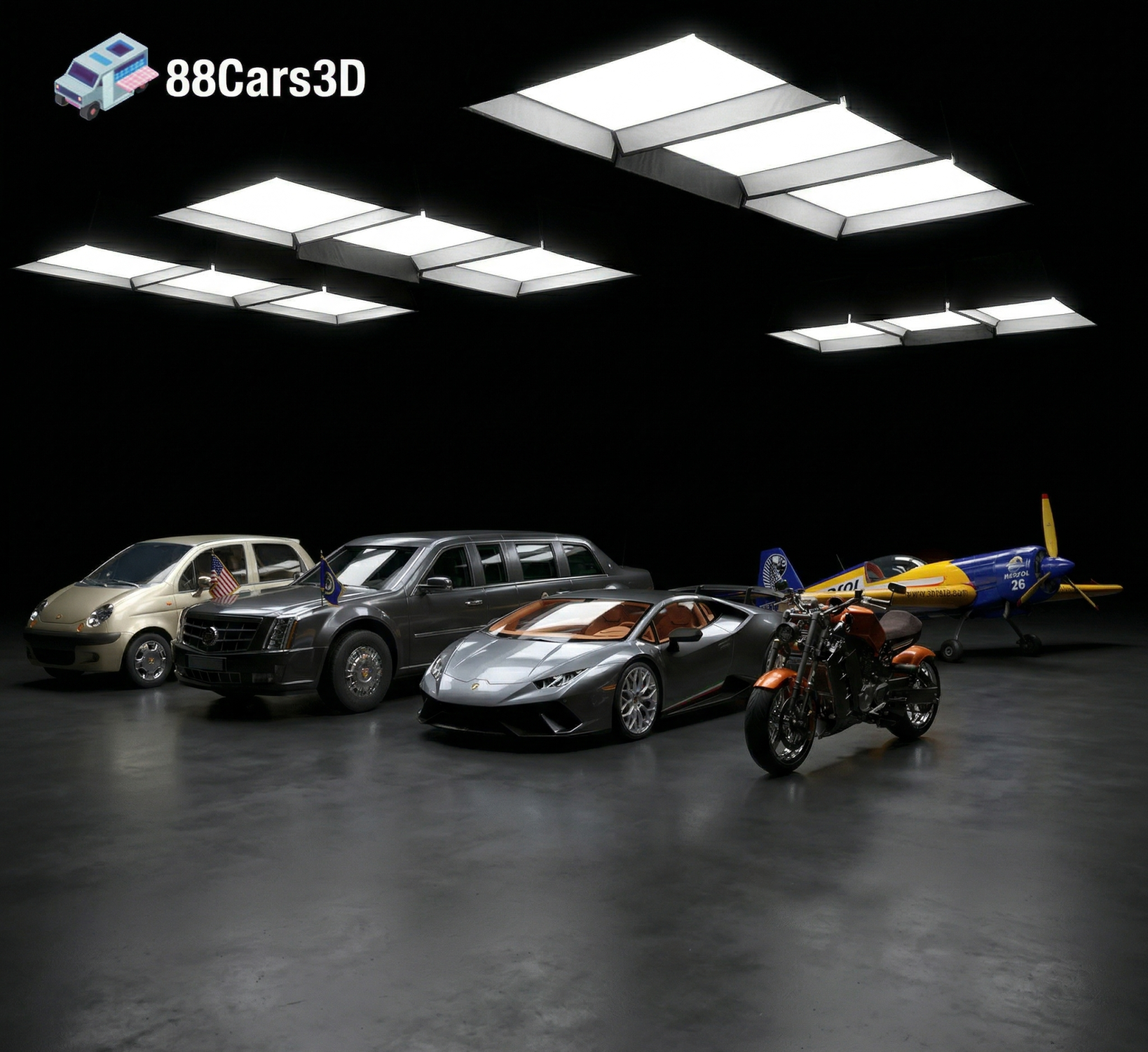
Texture: Yes | Material: Yes | 3D Printable: Yes. Download the Ultimate Creators’ Showcase featuring 5 premium 3D models: Lamborghini Huracan, ZAV Concept Motorcycle, Sukhoi SU-26, Presidential Limousine, and Daewoo Damas. Optimized for 4K CGI rendering and 3D printing. Save massive with this exclusive multi-category bundle!
Price: $99.99

Texture: Yes | Material: Yes | 3D Printable: Yes. Download the Italian Thoroughbreds Bundle featuring 5 iconic 3D models: Lamborghini Huracán Performante, Ferrari 458 Italia, Lamborghini Urus, Diablo SV, and Maserati GT. Optimized for 4K rendering and 3D printing (STL included). Save 50% with this ultimate Italian vehicle collection.
Price: $199.99

Download the Elite Future Mobility Bundle featuring 4 highly optimized 3D models: Tesla Model S, Avatr 11, Li L9, and Zoox Robotaxi. Perfect for ArchViz, Smart City renders, and game dev. Optimized for Unreal Engine and Blender. Includes .fbx, .obj, and .max formats.
Price: $99

🚗 5 Iconic German Cars (BMW M4 G82, M5 CS, X3, 1 Series & Mercedes E-Class). ✅ Optimized for ArchViz: Ready for Corona & V-Ray. 💰 Save €71 with this limited-time collection! 🚀 Instant Download after purchase.
Price: $119

Download the Extreme Off-Road & Survival 3D Models Bundle! Includes the Brabus 800 Adventure, Dodge Ram Bigfoot, Spec Truck, and a Caravan. Save over €210 on this premium 4-in-1 off-grid vehicle pack for ArchViz and game development.
Price: $149.99

Download the Heavy Duty & Commercial Logistics 3D Models Bundle! Includes the Ford Sterling, Caterpillar CT680, Mercedes Citaro Bus, and Vito Van. Save over €130 on this massive, game-ready 4-in-1 industrial vehicle pack.
Price: $109.99

Download the Ultimate Custom Motorcycles 3D Models Bundle. Includes a Custom Chopper, Ducati 916 Café Fighter, Harley XR1200X, and BMW K100. Perfect premium props for luxury ArchViz garages. Save over €250 today!
Price: $159.99

Download the ultimate JDM Street Racing 3D Models Bundle! Includes the Nissan GT-R, Toyota Supra, Mazda RX-7, Lancer Evo IX, and Honda NSX. Save big on this highly optimized, game-ready 5-in-1 Japanese legend car pack.
Price: $129.99

Download the ultimate American Muscle & Cinematic Classics 3D Models Bundle! Includes the Dodge Charger ’68, Mustang Eleanor GT500, Camaro Z28 ’79, and a custom ’69 Mustang. Save over €240 on this game-ready, premium 4-in-1 pack.
Price: $149.99

Download the Everyday City Traffic 3D Models Bundle. Includes the VW Golf, Kia Picanto, Hyundai Tucson, Toyota Yaris, and a DHL Ford Transit Van. Save big on this 5-in-1 pack, perfectly optimized for realistic ArchViz streets and game traffic.
Price: $99.99

