Get 50% OFF All Premium 3D & STL Models!

“`html
The intricate world of automotive design extends far beyond the sleek lines of a car’s exterior. The interior, a space crafted for comfort, control, and aesthetic appeal, often holds just as much fascination for enthusiasts and creators. For 3D printing hobbyists and automotive aficionados, the ability to replicate these detailed interiors adds an unparalleled level of realism to their projects. Whether you’re building a diorama, customizing a scale model, or even exploring functional prototypes, 3D printing offers a powerful avenue. However, capturing the nuances of dashboard elements, seating textures, and steering wheel details requires a blend of high-quality STL files and precise 3D printer settings. This guide will delve into the technicalities of transforming digital car interior STL files into tangible, highly detailed 3D prints. We’ll cover everything from selecting the right models and preparing your files to optimizing slicer settings, mastering support structures, and achieving professional-looking post-processed results. Get ready to elevate your automotive 3D printing game and bring the detailed interiors of your favorite cars to life.
The journey to a successful 3D printed car interior begins with the digital asset itself. Not all STL files are created equal, especially when it comes to capturing the fine details inherent in automotive interiors. High-quality models are characterized by clean geometry, minimal triangulation artifacts, and importantly, appropriate wall thicknesses that can be resolved by your chosen 3D printer. For intricate components like door panels with tiny switches or dashboards with delicate vents, the fidelity of the original 3D model is paramount. Marketplaces like 88cars3d.com specialize in offering meticulously designed printable car models with interiors, ensuring that the geometry is optimized for additive manufacturing.
Beyond the initial download, a critical step is mesh repair. Even professionally designed STL files can sometimes contain errors that hinder the slicing process. These can include non-manifold edges, inverted normals, or holes in the mesh. Software like Meshmixer, Blender, or even built-in tools within slicers like PrusaSlicer can help identify and fix these issues. A manifold, watertight mesh is essential for the slicer to accurately calculate infill and support structures.
Furthermore, consider the scale at which you intend to print. A dashboard designed for a 1:18 scale model will have vastly different requirements than one for a 1:4 scale display piece. Understanding the limitations of your 3D printer’s resolution is key. Fine details like seat stitching or small buttons might not resolve well at very small scales or with larger nozzle sizes. Always check the recommended print scale for the STL files if provided by the vendor.
When evaluating an STL file for a car interior, look for:
Common mesh repair tasks include:
Software like Autodesk Netfabb or even simpler tools within slicers are invaluable for ensuring your STL files are print-ready.
Once your STL file is prepared, the next crucial step is configuring your slicer software. Whether you’re using FDM (Fused Deposition Modeling) or resin printing, the settings must be tailored to capture the fine details of car interiors. For FDM printers, nozzle size plays a significant role. A smaller nozzle, such as 0.2mm or 0.3mm, can reproduce finer details compared to a standard 0.4mm nozzle, albeit at the cost of longer print times. Layer height is another critical parameter; a lower layer height (e.g., 0.08mm to 0.12mm) will result in smoother curves and finer details, while a higher layer height (e.g., 0.2mm) will be faster but may exhibit more visible layer lines.
Material selection is also important. For FDM, PLA is often preferred for its ease of printing and good detail reproduction. PETG offers increased durability, while ABS can provide a smoother finish after post-processing but is more challenging to print. For resin printing (SLA/DLP/MSLA), a high-detail resin is ideal. Settings like exposure time, lift speed, and layer height are crucial for resin. Lower layer heights (0.025mm to 0.05mm) and optimized exposure times are essential for capturing minute details like instrument cluster dials or seat stitching. Infill percentage and pattern can be adjusted based on the part’s function; for display models, a low infill (5-15%) is often sufficient to save material and time, while structural components might require higher densities.
Key FDM settings to focus on:
For resin printing:
When downloading printable car models from reputable sources like 88cars3d.com, look for recommendations on printer type and basic settings that can serve as a starting point for your slicer configuration.
Car interiors are rife with overhangs and complex geometries: seats curve upwards, dashboards angle outwards, and steering columns descend. Effective support structures are therefore non-negotiable for successfully printing these detailed models. The goal is to provide just enough support to hold unsupported sections during printing without damaging the delicate details during removal or leaving unsightly marks.
For FDM printing, support types such as ‘normal,’ ‘tree,’ or ‘hybrid’ offer different advantages. Tree supports, in particular, are often favored for detailed models as they typically touch the model at fewer points and can be easier to remove, minimizing surface damage. Support density, pattern, and interface layers are critical. A denser support structure will be more stable but harder to remove. Using support interface layers (a denser, more easily removable layer just below the model surface) can significantly improve surface finish and ease of removal.
In resin printing, supports are equally vital but function differently. They are typically thinner and more numerous, often acting as anchors to the build plate and guiding the print upwards. Again, minimizing contact points on visible surfaces is key. Careful placement of support tips on areas that will be less noticeable or can be easily sanded is a professional technique. The angle of support structures is also important; typically, supports are angled at 45 degrees to prevent them from interfering with the downward movement of the build plate.
When downloading STL files for complex interiors, some vendors may provide pre-supported versions or recommendations for support placement. Always inspect the generated supports in your slicer before printing.
The orientation of your car interior model on the print bed can dramatically impact print quality, strength, and the need for supports. For FDM printing, orienting the model to minimize overhangs and maximize the contact area with the build plate is crucial for strong bed adhesion. For resin printers, orientation is more about minimizing the surface area perpendicular to the build plate during layer curing to reduce peel forces, which can lead to print failures.
For many car interior components, printing them upright or at a slight angle (e.g., 15-30 degrees) can be advantageous. This orientation often places the majority of detailed features facing upwards, allowing gravity to assist with layer adhesion and reducing the need for extensive supports on visible surfaces. However, this is a balancing act. If the base of the model is small, it may require a raft or brim for stability. For resin printers, a flat, large surface area oriented parallel to the build plate is generally undesirable due to high peel forces. Instead, orienting the model at an angle and ensuring sufficient support is key.
Bed adhesion is the foundation of any successful 3D print. For FDM, this means ensuring your print bed is level, clean, and at the correct temperature for your chosen filament. Adhesives like glue stick, hairspray, or specialized build surface tapes can significantly improve adhesion, especially for materials prone to warping like ABS. Resin printers rely on a clean, undamaged FEP film and a level build plate for consistent adhesion. The initial layers printed on the build plate are critical for the success of the entire print.
Experimenting with different orientations for complex interior parts is often necessary to find the optimal balance between support minimization and print stability.
One of the most fundamental trade-offs in 3D printing is between print quality and print time. This is particularly relevant when printing detailed car interiors, where preserving fine features often necessitates sacrificing speed. The primary setting governing this is layer height.
For FDM printing, decreasing the layer height from, say, 0.2mm to 0.1mm effectively doubles the number of layers required to print the same height of an object. If the print speed remains constant, this directly doubles the print time. Similarly, going down to 0.08mm or 0.06mm further increases print duration exponentially. However, the benefit is a significant reduction in the visibility of layer lines, resulting in smoother curves and sharper details, which are crucial for elements like seat textures, dashboard panels, and steering wheels.
In resin printing, layer heights are typically much smaller, ranging from 0.025mm to 0.05mm. While the absolute difference in time per layer is less dramatic than with FDM, the cumulative effect over hundreds or thousands of layers is substantial. A print with 0.025mm layers will take twice as long as an identical print at 0.05mm layers, assuming all other settings are equal. The decision often comes down to the intended use and display of the printed interior. For a display model where extreme detail is paramount, investing the extra time for lower layer heights is worthwhile. For a component that will be heavily post-processed or viewed from a distance, a slightly higher layer height might be acceptable to save significant print time.
Consider printing a 50mm tall car seat:
These are simplified calculations, as print speed for outer walls, travel moves, and other factors also contribute to total time. However, the layer height remains the most dominant factor for vertical resolution and print duration.
Balancing print time with desired detail is key to an efficient and satisfying printing process, especially when working with complex printable car models.
The journey doesn’t end when the print is finished. Post-processing is where raw 3D prints are transformed into polished, professional-looking models. For car interiors, this stage is critical for achieving realism. The first step after removing supports is cleaning up any marks left behind. For FDM prints, this might involve carefully trimming away support remnants with flush cutters, hobby knives, or pliers. Small imperfections can often be smoothed with sandpaper, starting with a coarser grit (e.g., 200-400) and progressing to finer grits (e.g., 800-2000) for a smooth finish.
For resin prints, post-processing involves washing to remove uncured resin (typically with 90%+ isopropyl alcohol or specialized resin cleaners) and then post-curing under UV light to achieve full material hardness and stability. After curing, support removal is similar to FDM, though supports are generally easier to break away cleanly due to the brittle nature of cured resin. Sanding and filing are then used to smooth any remaining nubs.
Filling and priming are essential steps for both FDM and resin prints, especially if a perfectly smooth surface is desired or if painting is planned. Model putty or specialized fillers can be used to fill layer lines or small gaps. A primer coat not only reveals imperfections that need further attention but also provides an ideal surface for paint adhesion. Painting techniques can range from simple spray painting to detailed brushwork, using acrylics or enamels to replicate the materials and colors of a real car interior – from leather textures and wood grain to the matte finish of plastic dashboards.
The level of post-processing required depends on the desired final look. For realistic scale models, meticulous sanding, filling, and painting are crucial. Resources on painting techniques for scale models can provide further guidance. When you download high-quality STL files from platforms like 88cars3d.com, you’re starting with a great foundation that makes these post-processing steps more rewarding.
Bringing the intricate details of car interiors to life through 3D printing is a rewarding endeavor that blends technical skill with artistic vision. By carefully selecting and preparing your STL files, meticulously tuning your 3D printer settings for either FDM or resin, mastering the application and removal of support structures, and dedicating time to thorough post-processing, you can achieve stunningly realistic results. Remember that practice and experimentation are key; each printer, material, and model presents unique challenges and opportunities. Whether you’re creating a single component or a complete interior assembly, the principles outlined here provide a robust framework for success. So, dive in, explore the possibilities, and let your passion for automotive detail drive your next 3D printing project.
“`
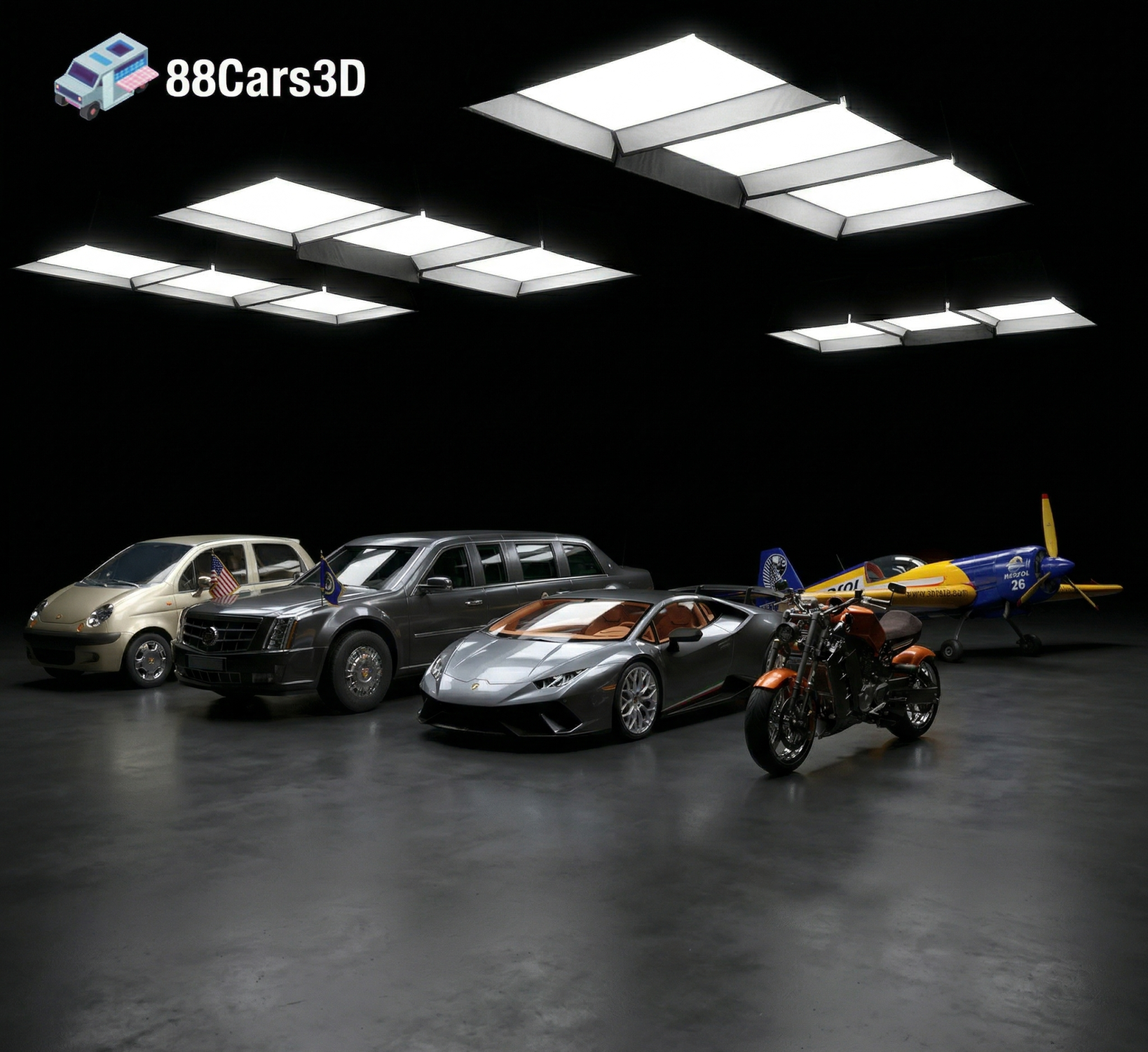
Texture: Yes | Material: Yes | 3D Printable: Yes. Download the Ultimate Creators’ Showcase featuring 5 premium 3D models: Lamborghini Huracan, ZAV Concept Motorcycle, Sukhoi SU-26, Presidential Limousine, and Daewoo Damas. Optimized for 4K CGI rendering and 3D printing. Save massive with this exclusive multi-category bundle!
Price: $99.99

Texture: Yes | Material: Yes | 3D Printable: Yes. Download the Italian Thoroughbreds Bundle featuring 5 iconic 3D models: Lamborghini Huracán Performante, Ferrari 458 Italia, Lamborghini Urus, Diablo SV, and Maserati GT. Optimized for 4K rendering and 3D printing (STL included). Save 50% with this ultimate Italian vehicle collection.
Price: $199.99

Download the Elite Future Mobility Bundle featuring 4 highly optimized 3D models: Tesla Model S, Avatr 11, Li L9, and Zoox Robotaxi. Perfect for ArchViz, Smart City renders, and game dev. Optimized for Unreal Engine and Blender. Includes .fbx, .obj, and .max formats.
Price: $99

🚗 5 Iconic German Cars (BMW M4 G82, M5 CS, X3, 1 Series & Mercedes E-Class). ✅ Optimized for ArchViz: Ready for Corona & V-Ray. 💰 Save €71 with this limited-time collection! 🚀 Instant Download after purchase.
Price: $119

Download the Extreme Off-Road & Survival 3D Models Bundle! Includes the Brabus 800 Adventure, Dodge Ram Bigfoot, Spec Truck, and a Caravan. Save over €210 on this premium 4-in-1 off-grid vehicle pack for ArchViz and game development.
Price: $149.99

Download the Heavy Duty & Commercial Logistics 3D Models Bundle! Includes the Ford Sterling, Caterpillar CT680, Mercedes Citaro Bus, and Vito Van. Save over €130 on this massive, game-ready 4-in-1 industrial vehicle pack.
Price: $109.99

Download the Ultimate Custom Motorcycles 3D Models Bundle. Includes a Custom Chopper, Ducati 916 Café Fighter, Harley XR1200X, and BMW K100. Perfect premium props for luxury ArchViz garages. Save over €250 today!
Price: $159.99

Download the ultimate JDM Street Racing 3D Models Bundle! Includes the Nissan GT-R, Toyota Supra, Mazda RX-7, Lancer Evo IX, and Honda NSX. Save big on this highly optimized, game-ready 5-in-1 Japanese legend car pack.
Price: $129.99

Download the ultimate American Muscle & Cinematic Classics 3D Models Bundle! Includes the Dodge Charger ’68, Mustang Eleanor GT500, Camaro Z28 ’79, and a custom ’69 Mustang. Save over €240 on this game-ready, premium 4-in-1 pack.
Price: $149.99

Download the Everyday City Traffic 3D Models Bundle. Includes the VW Golf, Kia Picanto, Hyundai Tucson, Toyota Yaris, and a DHL Ford Transit Van. Save big on this 5-in-1 pack, perfectly optimized for realistic ArchViz streets and game traffic.
Price: $99.99

