Get 50% OFF All Premium 3D & STL Models!

The automotive industry is in a perpetual race towards innovation, not just in vehicle design and engineering, but also in how these marvels are presented to the world. In this landscape, real-time rendering with Unreal Engine has emerged as a game-changer, offering unparalleled fidelity, interactivity, and speed for everything from concept visualization to marketing campaigns and immersive experiences. However, harnessing the full power of Unreal Engine, especially with high-fidelity 3D car models, requires more than just artistic skill; it demands meticulous asset management and project organization.
Working with complex automotive assets—each comprising intricate geometry, sophisticated materials, and multiple components—can quickly become overwhelming without a strategic approach. This comprehensive guide will equip you with the knowledge and best practices needed to efficiently manage your 3D car models within Unreal Engine. We’ll delve into setting up robust project structures, optimizing imports, mastering PBR materials, leveraging cutting-edge Unreal Engine features like Nanite and Lumen, and ensuring peak performance for diverse applications. By the end, you’ll have a clear roadmap for creating stunning, performant, and easily maintainable automotive projects, positioning you at the forefront of real-time visualization.
A well-organized Unreal Engine project is the bedrock of any successful real-time automotive visualization. Without a clear structure, even the most talented teams can find themselves bogged down by clutter, leading to inefficiencies, increased error rates, and difficulty scaling. Establishing robust conventions from the outset ensures smooth workflows, particularly when collaborating or revisiting projects after a period.
Upon creating a new project, thoughtful consideration of initial settings is crucial. While Unreal Engine offers various templates, starting with a ‘Blank’ or ‘Games’ template often provides the most flexibility, allowing you to tailor the environment precisely. Always ensure you’re working with a stable engine version, ideally an LTS (Long Term Support) release for production, or the latest version for cutting-edge features like those found in Unreal Engine 5. Depending on your target platform and visual fidelity goals, adjust the default scalability settings (e.g., to ‘Cinematic’ for high-end rendering) as a baseline. Essential plugins such as Datasmith, USD Importer, and possibly specific automotive plugins should be enabled from the start.
The Content Browser is your central hub, and its organization dictates much of your project’s efficiency. A logical, hierarchical folder structure is paramount. We recommend a structure that separates assets by type and then by origin or category. For instance:
/Game/Assets/Cars/Manufacturer/Model/ (e.g., /Game/Assets/Cars/Audi/R8/)/Game/Materials/ (General materials, parent materials)/Game/Textures/ (General textures, LUTs)/Game/Blueprints/ (Reusable logic, car blueprints)/Game/Maps/ (Levels, showcase scenes)/Game/Sequences/ (Cinematic sequences)Within each model’s folder (e.g., /Game/Assets/Cars/Audi/R8/), further subdivide into: Meshes/, Materials/, Textures/, SkeletalMeshes/, Physics/, and Blueprints/ specific to that model. This granular approach ensures that all related assets for a particular car are easily found and managed.
Consistent naming conventions are not merely a suggestion; they are a non-negotiable professional standard. They drastically improve readability, searchability, and maintainability, especially in team environments. A widely adopted practice involves using prefixes to denote asset types:
SM_ for Static Meshes (e.g., SM_Car_AudiR8_Body)SK_ for Skeletal Meshes (e.g., SK_Car_AudiR8_Chassis)M_ for Master Materials (e.g., M_CarPaint_Parent)MI_ for Material Instances (e.g., MI_Car_AudiR8_Paint_Red)T_ for Textures (e.g., T_Car_AudiR8_Paint_BaseColor)BP_ for Blueprints (e.g., BP_Car_AudiR8)P_ for Particle Systems (Niagara) (e.g., P_ExhaustSmoke)LC_ for Level Blueprints (e.g., LC_Showroom_Day)DT_ for Data Tables (e.g., DT_CarColors)Combine these prefixes with a clear descriptor: Prefix_Category_Subcategory_Descriptor. For example, SM_Car_AudiR8_Body_LOD0. Consistency extends to folder naming; avoid spaces or special characters, opting for camelCase or underscores. This meticulous approach, though seemingly minor, drastically streamlines development and helps prevent asset conflicts or loss.
The journey from a digital content creation (DCC) tool to Unreal Engine involves careful import and optimization steps, particularly for detailed 3D car models. Even models sourced from high-quality marketplaces like 88cars3d.com, which are often pre-optimized, require specific Unreal Engine configurations to perform optimally.
When importing 3D car models, FBX remains a widely used format, though USD (Universal Scene Description) is rapidly gaining traction due to its non-destructive, layer-based nature, making it ideal for collaborative automotive pipelines. For FBX, critical import settings include:
USD offers advantages for automotive pipelines by allowing scene composition from multiple sources non-destructively. This means different artists can work on various aspects of a car (body, interior, engine) and layer their contributions. Unreal Engine’s USD importer supports this robust workflow, maintaining asset fidelity and metadata. Furthermore, USDZ is an excellent format for AR/VR applications, making it a valuable addition when sourcing models from platforms such as 88cars3d.com.
Unreal Engine 5 introduced Nanite, a virtualized geometry system that revolutionizes how high-detail assets are handled. For 3D car models, which often feature millions of polygons in their pristine state, Nanite is a game-changer. It allows artists to import cinematic-quality meshes directly, without manual LOD (Level of Detail) creation, while maintaining real-time performance.
To enable Nanite, simply right-click on a Static Mesh in the Content Browser, navigate to ‘Nanite,’ and select ‘Enable Nanite.’ Once enabled, Unreal Engine automatically processes the mesh, streaming only the necessary triangle data at runtime based on screen space. This drastically reduces draw calls and memory footprint. Nanite is perfect for the main car body, intricate interior details, and wheel designs, where geometric fidelity is paramount. It’s important to note that Nanite is best suited for static meshes and generally not ideal for meshes that deform (like a flexible car antenna) or for small, instanced props. For a deep dive into Nanite, consult the official Unreal Engine documentation at https://dev.epicgames.com/community/unreal-engine/learning.
Accurate collision meshes are vital for realistic interaction and performance. The default collision generated by Unreal Engine can be either too simple (e.g., a single convex hull for an entire car) or overly complex for the needs of physics simulation. The best practice is to create custom simplified collision meshes in your DCC tool. These are typically simpler versions of the actual geometry and are named with a `UCX_` prefix (e.g., `UCX_Car_AudiR8_Body`) corresponding to the mesh they represent.
For complex interactive components or drivable vehicles, you’ll need a Physics Asset. The Physics Asset Editor (PhAT) allows you to define individual rigid bodies for parts like wheels, doors, and suspension components, along with constraints that govern their movement. This enables realistic vehicle dynamics, suspension articulation, and interactive elements such as opening doors or rotating wheels based on physics. Setting this up accurately is a foundational step for any interactive automotive experience.
The visual appeal of any 3D car model in Unreal Engine hinges significantly on its materials. Physically Based Rendering (PBR) is the standard for achieving photorealistic results, accurately simulating how light interacts with surfaces. Mastering PBR materials in Unreal Engine’s Material Editor is essential for bringing automotive assets to life with stunning realism.
An efficient material workflow in Unreal Engine heavily relies on parent materials and material instances. Instead of creating a new unique material for every single surface variant, you should establish robust parent materials that define common properties (e.g., a master car paint material, a master rubber material, a master glass material). These parent materials expose parameters, allowing artists to adjust properties like base color, metallicness, roughness, clear coat strength, and normal map intensity through simple sliders and color pickers.
For example, a `M_CarPaint_Parent` material could include parameters for a metallic base, a clear coat layer, flake normals, and roughness variations. From this parent, you would create `MI_Car_AudiR8_Paint_Red`, `MI_Car_AudiR8_Paint_Blue`, or `MI_Car_AudiR8_Paint_MatteBlack` by simply adjusting the exposed parameters. This approach offers several critical advantages:
To expose a parameter, simply convert a node’s input pin to a parameter in the Material Editor. Give it a descriptive name and a default value. These parameters will then appear in the Material Instance editor.
PBR materials require a set of textures to define their properties: Base Color (or Albedo), Normal, Roughness, Metallic, Ambient Occlusion, and sometimes Displacement/Height maps. Effective texture management is crucial for both visual quality and performance. When importing textures, consider their resolution relative to their importance and screen space presence:
Avoid indiscriminately using 8K textures everywhere, as this can quickly consume GPU memory and impact streaming performance. Enable ‘Streaming Mip Maps’ for all textures to allow Unreal Engine to load lower-resolution versions when an object is further away, significantly saving memory.
For efficiency, consider texture packing. Common practice involves combining non-color maps into a single texture: Red channel for Metallic, Green for Roughness, Blue for Ambient Occlusion (MR/AO maps). This reduces the number of texture lookups and memory footprint. Ensure correct compression settings: DXT1/DXT5 for diffuse, BC7 for higher quality, and BC5/NormalMap for normal maps. Always ensure Base Color textures have sRGB enabled, while other maps (normal, roughness, metallic) have sRGB disabled to maintain linear color space accuracy.
Achieving fluid frame rates (e.g., 60 FPS for desktop, 90 FPS for VR) while maintaining visual fidelity for 3D car models is a constant balancing act. Effective asset optimization, particularly through Level of Detail (LODs) and strategic culling, is fundamental to real-time efficiency.
While Nanite minimizes the need for manual LODs on highly detailed static meshes, traditional LODs remain critical for non-Nanite meshes, deformable objects, or when targeting platforms that don’t fully support Nanite (e.g., mobile VR). LODs are simplified versions of a mesh that are swapped in at varying distances from the camera, reducing polygon count and draw calls.
Unreal Engine provides an automated LOD generation system:
While convenient, automated LODs might not always yield optimal results for intricate car components. For critical parts like wheels or complex interior elements, manual LODs (created in your DCC software and imported) offer superior control, ensuring that important silhouettes and details are preserved even at lower poly counts. When importing manual LODs, name them appropriately (e.g., `SM_Car_Body_LOD0`, `SM_Car_Body_LOD1`) and assign them within the Static Mesh Editor.
Implementing a smooth `Dithered LOD Transition` is also important to prevent jarring pop-ins when LODs switch, maintaining visual continuity.
For complex scenes featuring multiple vehicles or expansive environments, sophisticated scene management techniques are essential. Data Layers in Unreal Engine allow you to logically organize actors (meshes, lights, Blueprints) into distinct layers that can be loaded or unloaded at runtime. For automotive projects, this means you can have layers for different car variants, interior configurations, or even external scene props, loading only what’s visible or relevant. This is invaluable for configurators or large-scale virtual production sets where resources need to be tightly managed.
World Partition, introduced in Unreal Engine 5, is designed for extremely large open worlds. It automatically streams portions of your world based on proximity to the player, eliminating the need for manual level streaming. While a single car model doesn’t require World Partition, if your automotive visualization involves placing vehicles within vast landscapes or city environments, understanding World Partition is crucial for integrating your assets effectively and ensuring performance at scale.
Maintaining a strict performance budget is paramount. Monitor key metrics using Unreal Engine’s built-in profilers: `Stat Unit` (overall frame time), `Stat GPU` (GPU performance), `Stat RHI` (rendering hardware interface). Common performance bottlenecks in automotive scenes include:
Utilize features like `Occlusion Culling` and `Frustum Culling` (enabled by default) to prevent rendering objects outside the camera’s view. For multiple static cars in a large scene, consider using Hierarchical LODs (HLODs) to combine distant meshes into single, simplified geometry, further reducing draw calls.
Unreal Engine’s Blueprint visual scripting system empowers developers, artists, and designers to add complex logic and interactivity to their projects without writing a single line of C++ code. For automotive visualization, Blueprint is indispensable for creating dynamic configurators, interactive demos, and realistic vehicle behaviors.
A fundamental practice for automotive assets is to encapsulate car models within Blueprints. This allows you to treat a car as a single, interactive entity rather than a collection of disparate meshes and materials. Start by creating a `BP_Car_Master` which serves as a parent for all specific car models.
This master Blueprint would typically contain:
Child Blueprints, like `BP_Car_AudiR8` or `BP_Car_Porsche911`, would then inherit from `BP_Car_Master`, overriding specific meshes and material instances to represent their unique characteristics. This modular approach significantly improves reusability and maintainability.
For interaction, attach components for doors, hood, and trunk, making them children of a specific bone in the skeletal mesh or a pivot point. Then, use Blueprint to drive their rotation or translation based on user input, creating interactive experiences such as opening a car door, illuminating interior lights, or adjusting the steering wheel.
Automotive configurators often require dynamically swapping meshes, materials, and textures at runtime based on user selections (e.g., choosing a different wheel, changing paint color, or selecting interior upholstery). Blueprint provides robust mechanisms for this.
For example, a `DT_CarColors` data table might have columns for ColorName, HexCode, and a MaterialInstance reference. When a user selects “Arctic White,” the Blueprint looks up “Arctic White” in the data table, retrieves its Material Instance, and applies it to the car’s body component.
Pushing the boundaries of automotive visualization means embracing advanced Unreal Engine features to achieve stunning realism, cinematic storytelling, and immersive interactive experiences across various platforms.
Unreal Engine 5’s Lumen global illumination and reflections system is transformative for real-time automotive visualization. Car paint, with its complex clear coat, metallic flakes, and dynamic reflections, benefits immensely from Lumen’s ability to simulate indirect lighting and reflections with incredible accuracy and speed. Lumen calculates diffuse interreflection with infinite bounces and indirect specular reflection, meaning your car models will look integrated and dynamically lit within any environment.
To enable Lumen, navigate to Project Settings > Engine > Rendering, and set ‘Global Illumination’ and ‘Reflections’ to ‘Lumen.’ Fine-tune Lumen’s quality and performance through settings like ‘Final Gather Quality’ and ‘Max Trace Distance’ in your Post Process Volume. For specific automotive scenarios, like showcasing a car in a reflective showroom, Lumen’s accuracy provides truly photo-realistic results. While Lumen is powerful, it does have a performance cost; balance its settings with your target hardware and framerate. For comprehensive setup details and optimization tips, the official Unreal Engine documentation (https://dev.epicgames.com/community/unreal-engine/learning) is an invaluable resource.
For crafting compelling automotive commercials, product reveals, or brand films, Unreal Engine’s Sequencer is an indispensable tool. Sequencer is a non-linear cinematic editor that allows you to choreograph camera movements, animate car components (e.g., opening doors, rotating wheels), keyframe material parameter changes (e.g., a paint color transition), and synchronize visual effects (Niagara particle systems for exhaust smoke or dust). For high-end automotive cinematics, precise control over every element of your 3D car models is crucial.
In virtual production workflows, where LED walls are used to display real-time environments around physical vehicles, your 3D car models play a central role. Assets must be meticulously prepared: clean geometry, optimized PBR materials that react realistically to studio lighting, and robust Blueprints for real-time adjustments on set. Consistency in scale and pivot points is critical. The car models become virtual props that blend seamlessly with the physical set, allowing filmmakers to capture stunning in-camera visual effects with unparalleled flexibility.
The immersive nature of Augmented Reality (AR) and Virtual Reality (VR) offers unique opportunities for automotive visualization, from virtual showrooms to interactive driving experiences. However, AR/VR platforms demand extremely aggressive optimization due to their stringent performance requirements (e.g., a stable 90 FPS for VR to prevent motion sickness).
Key optimization strategies for AR/VR automotive assets:
For AR applications, especially on mobile, consider exporting assets in formats like USDZ. Platforms like 88cars3d.com often provide pre-optimized models in various formats, including USDZ, enabling seamless integration into iOS Quick Look or Android ARCore experiences, bringing high-fidelity cars directly into the real world through a smartphone camera.
In the dynamic realm of real-time automotive visualization, meticulous asset management and project organization are not just luxuries—they are fundamental necessities. From the initial project setup and systematic naming conventions to the strategic application of Unreal Engine’s advanced features like Nanite and Lumen, every step contributes to the efficiency, scalability, and ultimate success of your creations. Mastering the intricacies of FBX/USD imports, perfecting PBR material workflows, and relentlessly optimizing for performance are the hallmarks of a professional pipeline.
By leveraging Blueprint for interactivity and embracing advanced techniques for cinematics and AR/VR, you can transform static 3D car models into captivating, performant, and truly immersive experiences. A well-organized project accelerates iteration, fosters collaboration, and ensures that your high-fidelity 3D car models, perhaps sourced from curated marketplaces like 88cars3d.com, shine brightest in any application.
Start by establishing a strong foundation, consistently apply best practices, and continuously refine your workflows. The effort invested in meticulous asset management today will pay dividends in the quality, efficiency, and longevity of your Unreal Engine automotive projects. The road to unparalleled real-time visualization is paved with precision and organization; embark on it with confidence and expertise.
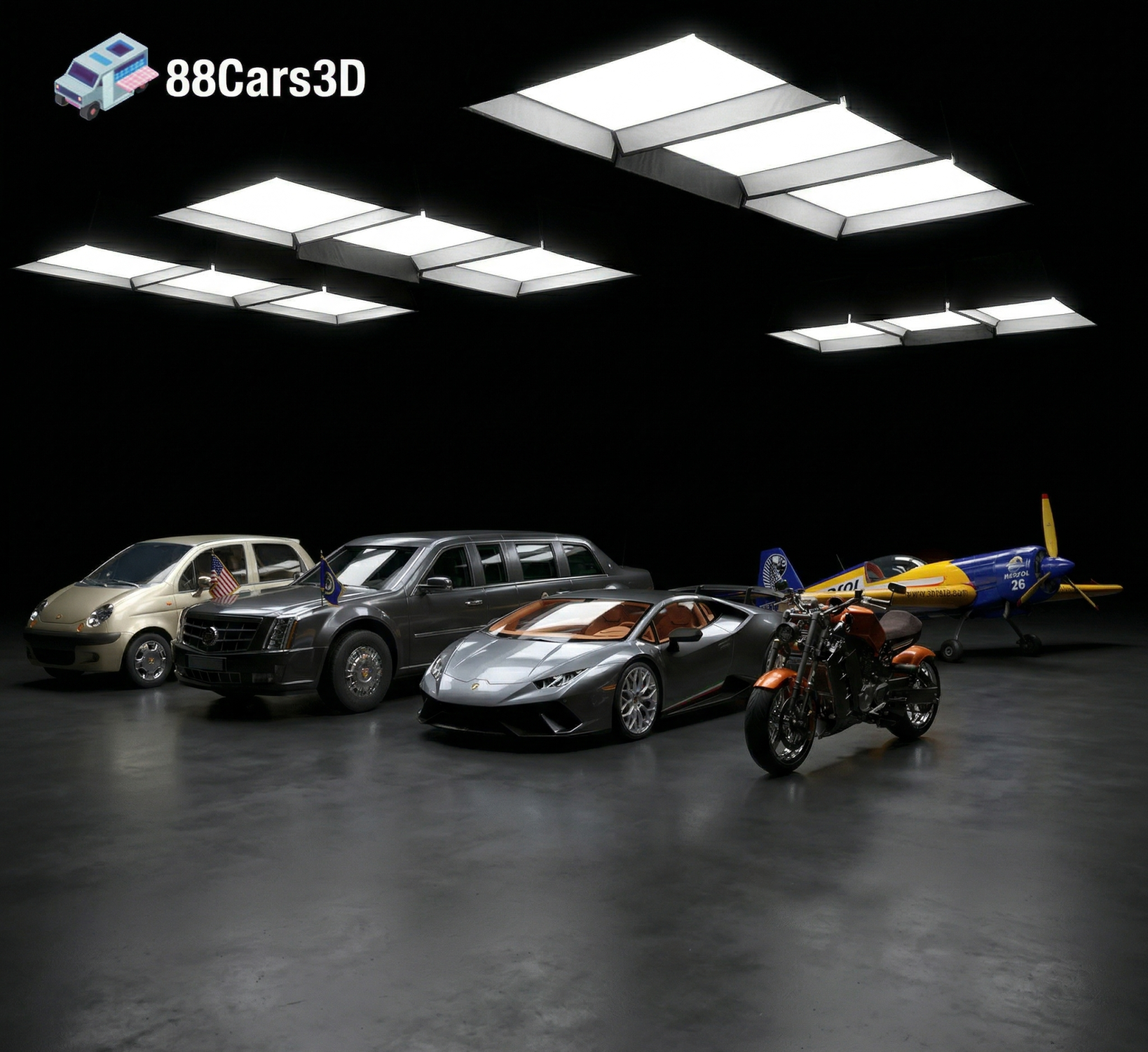
Texture: Yes | Material: Yes | 3D Printable: Yes. Download the Ultimate Creators’ Showcase featuring 5 premium 3D models: Lamborghini Huracan, ZAV Concept Motorcycle, Sukhoi SU-26, Presidential Limousine, and Daewoo Damas. Optimized for 4K CGI rendering and 3D printing. Save massive with this exclusive multi-category bundle!
Price: $99.99

Texture: Yes | Material: Yes | 3D Printable: Yes. Download the Italian Thoroughbreds Bundle featuring 5 iconic 3D models: Lamborghini Huracán Performante, Ferrari 458 Italia, Lamborghini Urus, Diablo SV, and Maserati GT. Optimized for 4K rendering and 3D printing (STL included). Save 50% with this ultimate Italian vehicle collection.
Price: $199.99

Download the Elite Future Mobility Bundle featuring 4 highly optimized 3D models: Tesla Model S, Avatr 11, Li L9, and Zoox Robotaxi. Perfect for ArchViz, Smart City renders, and game dev. Optimized for Unreal Engine and Blender. Includes .fbx, .obj, and .max formats.
Price: $99

🚗 5 Iconic German Cars (BMW M4 G82, M5 CS, X3, 1 Series & Mercedes E-Class). ✅ Optimized for ArchViz: Ready for Corona & V-Ray. 💰 Save €71 with this limited-time collection! 🚀 Instant Download after purchase.
Price: $119

Download the Extreme Off-Road & Survival 3D Models Bundle! Includes the Brabus 800 Adventure, Dodge Ram Bigfoot, Spec Truck, and a Caravan. Save over €210 on this premium 4-in-1 off-grid vehicle pack for ArchViz and game development.
Price: $149.99

Download the Heavy Duty & Commercial Logistics 3D Models Bundle! Includes the Ford Sterling, Caterpillar CT680, Mercedes Citaro Bus, and Vito Van. Save over €130 on this massive, game-ready 4-in-1 industrial vehicle pack.
Price: $109.99

Download the Ultimate Custom Motorcycles 3D Models Bundle. Includes a Custom Chopper, Ducati 916 Café Fighter, Harley XR1200X, and BMW K100. Perfect premium props for luxury ArchViz garages. Save over €250 today!
Price: $159.99

Download the ultimate JDM Street Racing 3D Models Bundle! Includes the Nissan GT-R, Toyota Supra, Mazda RX-7, Lancer Evo IX, and Honda NSX. Save big on this highly optimized, game-ready 5-in-1 Japanese legend car pack.
Price: $129.99

Download the ultimate American Muscle & Cinematic Classics 3D Models Bundle! Includes the Dodge Charger ’68, Mustang Eleanor GT500, Camaro Z28 ’79, and a custom ’69 Mustang. Save over €240 on this game-ready, premium 4-in-1 pack.
Price: $149.99

Download the Everyday City Traffic 3D Models Bundle. Includes the VW Golf, Kia Picanto, Hyundai Tucson, Toyota Yaris, and a DHL Ford Transit Van. Save big on this 5-in-1 pack, perfectly optimized for realistic ArchViz streets and game traffic.
Price: $99.99

