Get 50% OFF All Premium 3D & STL Models!

“`html
The thrill of holding a detailed 3D printed car model in your hands is a rewarding experience, especially when it’s a perfect replica of your dream machine. However, the journey from a digital STL file to a tangible masterpiece often hinges on a critical, yet sometimes overlooked, step: slicing. This is where your 3D printer transforms layers of digital information into physical reality. Many enthusiasts download exquisite car models, only to be met with print failures – stringing, poor surface finish, brittle parts, or models that simply don’t adhere to the build plate. The culprit? Inadequate slicing parameters.
This comprehensive guide will demystify the slicing process for printable car models. We’ll delve deep into the essential settings, from layer height and infill to support structures and print orientation, equipping you with the knowledge to overcome common printing challenges. Whether you’re using FDM printing or resin printing, and regardless of your chosen slicer software like Cura or PrusaSlicer, you’ll learn how to fine-tune your settings for unparalleled print quality. By understanding the nuances of slicing, you’ll unlock the full potential of your 3D printer and breathe life into the intricate details of your favorite vehicles. Get ready to elevate your hobby and achieve those showroom-quality prints you’ve always wanted!
Before we dive into slicing, it’s crucial to understand the nature of the STL file format. STL, or Stereolithography, is the de facto standard for 3D printing. It represents a 3D object’s surface geometry using a mesh of triangles. Each triangle is defined by its three vertices and a normal vector, indicating which side of the triangle is “outward.” For printable car models, especially those from marketplaces like 88cars3d.com, the quality of this underlying mesh is paramount. Clean geometry with well-defined triangles and manifold integrity ensures that the slicer can accurately interpret the model’s boundaries.
A “manifold” mesh is a watertight object with no holes, internal faces, or overlapping triangles. Think of it like a perfectly sealed container. Non-manifold errors can cause significant problems during slicing, leading to incorrect layer generation, missing sections, or even slicer crashes. While many downloadable models are designed to be print-ready, it’s good practice to perform a basic mesh check, especially if you encounter unusual slicing behavior. Software like Meshmixer, Blender, or Netfabb offer tools to analyze and repair STL files. Key checks include identifying non-manifold edges, flipped normals, and isolated vertices.
The way the triangles are connected, or the mesh topology, also influences slicing. Models with excessively high polygon counts (dense meshes) can sometimes slow down slicing software and potentially lead to longer processing times. Conversely, models with too few polygons might appear faceted or lack fine detail. For automotive models, which often feature sharp edges and smooth curves, a balanced polygon count is ideal. Many sources of printable car models provide options for different resolutions, allowing you to choose a file that best suits your needs and your printer’s capabilities. A good mesh will have triangles that are consistently sized and oriented, simplifying the slicing process and resulting in cleaner toolpaths.
While STL is dominant, other file formats like OBJ and FBX are also used, especially in 3D modeling. OBJ files can store color and texture information, which might be relevant for some advanced printing workflows, though not typically for standard layer-by-layer slicing. FBX is a more complex format used in animation and game development. For most 3D printing scenarios, sticking with STL is recommended, as it’s universally supported by slicers. Ensure you are downloading the correct version of the file from your chosen vendor; some might offer pre-supported or unsupported versions, affecting your slicing approach.
Fused Deposition Modeling (FDM) printers build objects layer by layer by extruding melted filament. Achieving high-quality prints with FDM requires careful tuning of several parameters within your slicing software. For detailed car models, especially those with delicate parts like spoilers, mirrors, or interior components, optimizing these settings is critical. The goal is to balance print speed, layer adhesion, surface smoothness, and structural integrity.
Common slicers for FDM include Ultimaker Cura, PrusaSlicer, and Simplify3D. While their interfaces differ, the fundamental settings are similar. For 3D printing intricate automotive models, starting with a moderate quality profile is often a good approach. For example, a layer height of 0.1mm to 0.15mm provides a good balance between detail and print time. Higher layer heights (e.g., 0.2mm or 0.3mm) will be faster but will result in more visible layer lines, which can detract from the finish of a car model. Conversely, extremely low layer heights (e.g., 0.05mm) can significantly increase print times and may not always yield proportional improvements in quality depending on the printer’s accuracy.
Layer height directly impacts the visual quality and print duration. For a 1:24 scale model, 0.1mm layer height might be ideal. For larger models, 0.15mm or 0.2mm might suffice. Print speed is another critical factor. Printing too fast can lead to under-extrusion, poor layer adhesion, ghosting (vibrations causing artifacts), and stringing. A general starting point for outer walls on detailed models could be 40-50 mm/s, with inner walls potentially faster (50-60 mm/s). Travel speed, the speed at which the nozzle moves when not extruding, can be much higher (100-150 mm/s) to reduce print time but should be tuned to avoid excessive vibration.
Temperature settings for the nozzle and bed are filament-dependent. PLA, a popular choice for its ease of printing, typically requires a nozzle temperature of 190-220°C and a bed temperature of 50-60°C. PETG offers better temperature resistance and durability but can be more prone to stringing, requiring slightly higher temperatures (220-250°C nozzle, 70-80°C bed) and potentially slower print speeds. ABS requires even higher temperatures and often an enclosure to prevent warping. Always consult the filament manufacturer’s recommendations. Advanced settings include retraction distance and speed, crucial for minimizing stringing between separate parts of the model. For PLA, a retraction distance of 5-7mm at 40-50 mm/s is a common starting point.
The infill is the internal structure of the print, providing support for top layers and adding strength. For display models, high infill density is often unnecessary. An infill density of 10-20% is usually sufficient, saving material and print time. The infill pattern also matters. Grid, Gyroid, and Cubic patterns offer good strength in multiple directions. For hollow models or those with internal supports, ensure adequate top and bottom layers (e.g., 4-6 layers) to create a solid surface. If your car model has thin walls or delicate components that might sag, increasing infill density or adding more top layers can help. Some slicers allow you to set different infill settings for different parts of the model, enabling you to reinforce critical areas.
Placing the STL file on the virtual build plate in the slicer is more than just positioning; it’s about optimizing for print quality and support needs. For car models, consider how the object will be oriented to minimize visible layer lines on key surfaces (like the hood or roof) and to reduce the amount of support structures required. Printing a car body upright might require extensive supports inside the wheel wells and under the chassis, which can be difficult to remove cleanly. Printing it on its side might lead to a less desirable finish on the door panels. Often, a slight angle or printing in sections (if the model is designed for it) can yield the best results.
Bed adhesion is critical to prevent prints from detaching during the printing process. This is achieved through proper bed leveling, a clean build surface, and often the use of adhesion aids like a brim or raft. A brim adds a single layer of material around the base of the print, increasing surface area contact with the bed. A raft is a thicker base structure that the print is built upon, useful for very small contact areas or materials prone to warping. For most car models with a decent base footprint, a brim is usually sufficient. Ensure your first layer prints slowly and perfectly; this sets the foundation for the entire print.
Resin 3D printing, using technologies like SLA (Stereolithography) and DLP (Digital Light Processing), excels at capturing incredibly fine details, making it ideal for intricate printable car models. However, the slicing process for resin printers involves different considerations compared to FDM. Instead of extruding plastic, resin printers cure liquid photopolymer resin layer by layer using UV light. This means settings revolve around light exposure times, layer thickness, and crucially, the orientation and support strategy to manage forces during the print’s upward movement.
Resin slicers like ChiTuBox, Lychee Slicer, and PrusaSlicer (for resin) offer specific parameters. Key settings include layer height, which for resin is often much finer than FDM (e.g., 0.025mm to 0.05mm) to achieve high resolution. The normal exposure time determines how long each layer is cured. This varies significantly based on the resin type, layer height, and printer’s light source power. A typical starting point might be 2-8 seconds per layer, with a longer “bottom exposure” time for the initial layers to ensure strong adhesion to the build plate (e.g., 20-60 seconds).
This is arguably the most critical aspect of resin slicing. Unlike FDM, where supports primarily prevent overhangs from collapsing, in resin printing, supports are essential to manage the peel forces as the build plate lifts after each layer cures. If a layer has a large surface area that needs to detach from the FEP film at the bottom of the resin vat, it creates significant suction. This can lead to print failures, layer separation, or damage to the FEP film.
Therefore, models should be oriented at an angle (typically 30-45 degrees) to break up large, flat surfaces and minimize suction. This angled orientation also helps to distribute the peel forces more evenly. The type and placement of support structures are vital. Resin slicers offer various support types: light, medium, heavy, and custom. For delicate car models, using a combination of medium supports for general areas and light supports for smaller details is often effective. The tips of the supports should be fine enough to create minimal scarring on the model’s surface, yet strong enough to hold it. Careful placement, ensuring supports are not attached to critical visual surfaces, is key. Using auto-supports and then manually refining them is a common workflow. Platforms like 88cars3d.com often provide models that have been pre-oriented and partially supported, but manual adjustment is usually recommended.
Resin models, especially larger ones, are often “hollowed” within the slicer to save resin and reduce curing time. This involves creating an internal cavity, leaving a wall thickness (e.g., 1.5mm to 3mm). Drainage holes must be added to allow uncured resin to escape from the hollow interior as the model prints and is removed from the vat. If not properly drained, trapped resin can lead to internal pressure buildup, cracking, or poor curing. These holes should be placed in inconspicuous areas, like the underside of the chassis or inside the wheel wells.
Exposure settings are highly resin-specific. Manufacturer recommendations are a starting point, but fine-tuning is often necessary. Over-exposure can lead to loss of detail and “blooming” (resin curing beyond the intended area), while under-exposure results in weak, easily breakable parts or layers not fully curing. Running exposure calibration tests (e.g., AmeraLabs Town, Cones of Calibration) is highly recommended for any new resin or printer setup. This helps determine the optimal normal exposure time for your specific setup.
Beyond the basic settings, several advanced techniques can significantly improve the quality and success rate of printing complex printable car models. These often involve a deeper understanding of how the slicer generates toolpaths and how your printer behaves.
One such technique is fine-tuning retraction settings in FDM. Excessive retraction can cause filament grinding or clog the nozzle, while insufficient retraction leads to stringing. Experimenting with retraction distance (in mm) and retraction speed (in mm/s) is crucial. For example, direct drive extruders typically require shorter retraction distances (0.5-2mm) than Bowden setups (4-7mm). Using “Combing” options in the slicer can also help keep the nozzle within the model’s boundaries when traveling, further reducing stringing and surface imperfections.
Effective part cooling is essential for FDM printing, especially for materials like PLA. Good cooling helps solidify extruded plastic quickly, allowing for sharper details, better overhang performance, and reduced warping. Slicers allow you to control the fan speed throughout the print. For initial layers, it’s often beneficial to have the fan off or at a low speed to ensure good bed adhesion. As the print progresses, gradually increasing the fan speed to 100% can improve overall quality. However, some materials like ABS or PETG may require reduced cooling to prevent layer delamination. Over-cooling can also lead to weak parts. Finding the right balance based on your material and printer is key. Enabling “Enable Support Cooling” in your slicer can also help provide better support structure stability.
To optimize the trade-off between print time and detail, many modern slicers support adaptive layers or variable layer height. This advanced feature allows the slicer to automatically adjust the layer height based on the model’s geometry. For steep curves or vertical sections, it can use a larger layer height (e.g., 0.2mm) to speed up the print. For fine details, horizontal surfaces, or subtle curves, it can reduce the layer height (e.g., 0.08mm) to capture more detail. This intelligent approach can significantly reduce overall print time without sacrificing the quality of critical features on your car models. You can often manually define where variable layer height should be applied or let the slicer determine it automatically. Experimenting with these settings can lead to surprisingly efficient and high-quality prints.
Once your 3D printed car model is complete, the journey isn’t over. Post-processing is where you refine the print, remove imperfections, and prepare it for painting and assembly. This stage is as important as slicing and printing itself for achieving a professional-looking result.
For FDM prints, the most common post-processing steps include removing support structures and rafts/brims. Careful removal is essential to avoid damaging the model. Tools like pliers, flush cutters, hobby knives, and dental picks are invaluable. For resin prints, this involves washing the uncured resin off the model (using isopropyl alcohol or specialized cleaners) and then post-curing under UV light to achieve its final hardness and strength. Support removal on resin prints is often done after washing but before final curing for easier manipulation, though supports can be brittle.
Visible layer lines are a common characteristic of FDM prints. Sanding is the primary method to smooth these out. Start with a coarser grit sandpaper (e.g., 120-220 grit) to remove major imperfections and supports, then gradually move to finer grits (e.g., 400, 800, 1000, and even higher) for a smooth finish. Wet sanding (using water or a lubricant) can help prevent clogging and achieve a smoother surface. For significant layer lines or gaps, automotive putty or filler primer can be used to fill imperfections before sanding. Applying a primer coat before painting is crucial, as it helps seal the surface, reveals any remaining imperfections, and provides a uniform base for paint adhesion.
For resin prints, sanding is also common, particularly to smooth out support marks. Because resin prints are typically much smoother out of the printer, the sanding process is often less intensive. A good wash and cure cycle is vital for durability. Filling small gaps or pinholes might be necessary, using model putties or UV-curable fillers designed for resin. The goal is to create a perfectly smooth canvas for painting.
Many detailed car models are designed to be printed in multiple parts, allowing for easier printing and better detail capture (e.g., separate chassis, body, wheels, interior). These parts will need to be assembled using adhesives suitable for your printing material. Cyanoacrylate (super glue) is common for both FDM and resin prints, but specific plastic cements or epoxy glues might be required for certain materials or larger assemblies. Ensure you have a dry fit before applying glue to check alignment.
Painting your 3D printed car model is where it truly comes to life. Automotive spray paints, acrylics, and airbrush paints are all viable options. Masking tape is essential for achieving clean lines between different colors (e.g., body paint vs. trim). Decals can be applied for emblems, racing stripes, or other details. Clear coats (gloss, satin, or matte) are used as a final protective layer and to achieve the desired sheen. For advanced users, weathering techniques can add realism, simulating dirt, rust, or wear.
Even with the best slicing practices, print failures can occur. Understanding common issues and their causes is crucial for any 3D printing enthusiast. For FDM, common problems include stringing, warping, layer shifting, under-extrusion, and nozzle clogs. Stringing is often caused by incorrect retraction settings or high temperatures. Warping is usually due to poor bed adhesion or printing materials that contract significantly upon cooling (like ABS). Layer shifts often result from mechanical issues, such as loose belts or stepper motor skipping due to excessive speed or binding.
Resin printing has its own set of common failures: print detachment from the build plate, layer separation, suction cup failures, and uncured or brittle parts. Detachment and separation are frequently linked to insufficient bottom exposure, poor bed adhesion, or excessive peel forces. Suction cup failures occur when a layer has too large a surface area exposed to the FEP film. Brittle or uncured parts are typically due to incorrect exposure times or the use of expired or contaminated resin.
Sometimes, the root cause of a print failure lies within the STL file itself. Non-manifold geometry, holes, or intersecting faces can confuse the slicer and lead to corrupted toolpaths. Before resorting to complex printer adjustments, always ensure your file is clean. Using software like Meshmixer or Blender to perform a “Make Solid” or “Mesh Repair” operation can often fix these issues. You can also use Netfabb’s repair functions. For downloaded models, especially those from less reputable sources, this step is essential. When downloading high-quality printable car models from specialized marketplaces like 88cars3d.com, the likelihood of encountering mesh errors is significantly reduced, but a quick check never hurts.
A well-calibrated printer is the foundation of successful printing. Regular maintenance ensures all components are functioning optimally. For FDM printers, this includes: ensuring the bed is level, checking belt tension, cleaning the nozzle and heatbreak, lubricating Z-axis rods, and ensuring filament path is clear. Performing calibration prints, such as temperature towers and retraction tests, helps dial in the optimal settings for specific filaments. For resin printers, maintenance involves: ensuring the FEP film is clean and free from damage, checking the screen for dead pixels, calibrating the Z-axis, and ensuring the build plate is properly leveled and cleaned.
Understanding your printer’s capabilities and limitations is also part of troubleshooting. Some printers are better suited for fine details, while others prioritize speed or material versatility. Knowing when to adjust your slicing strategy to match your hardware can prevent many headaches. For instance, if your FDM printer struggles with small overhangs, orienting the model to minimize them or increasing support density might be necessary.
Mastering the art of slicing is a continuous learning process, but one that yields incredibly satisfying results. By understanding the intricacies of STL files, delving into the specific settings for both FDM printing and resin printing, and employing advanced techniques, you can transform digital designs into stunningly accurate printable car models. From carefully selecting layer heights and infill densities to strategically placing support structures and optimizing print orientation, every setting plays a role. Don’t underestimate the power of proper mesh repair and consistent printer calibration. Remember, platforms like 88cars3d.com provide excellent starting points with high-quality models, but the final print quality is often determined by your slicing expertise.
We encourage you to experiment with the settings discussed, start with simpler models if you’re new to slicing, and gradually tackle more complex designs. Analyze your prints, identify areas for improvement, and refine your profiles. With patience and practice, you’ll consistently achieve prints that showcase the incredible detail and engineering that goes into automotive design. Happy printing, and may your garages be filled with perfectly replicated miniature vehicles!
“`
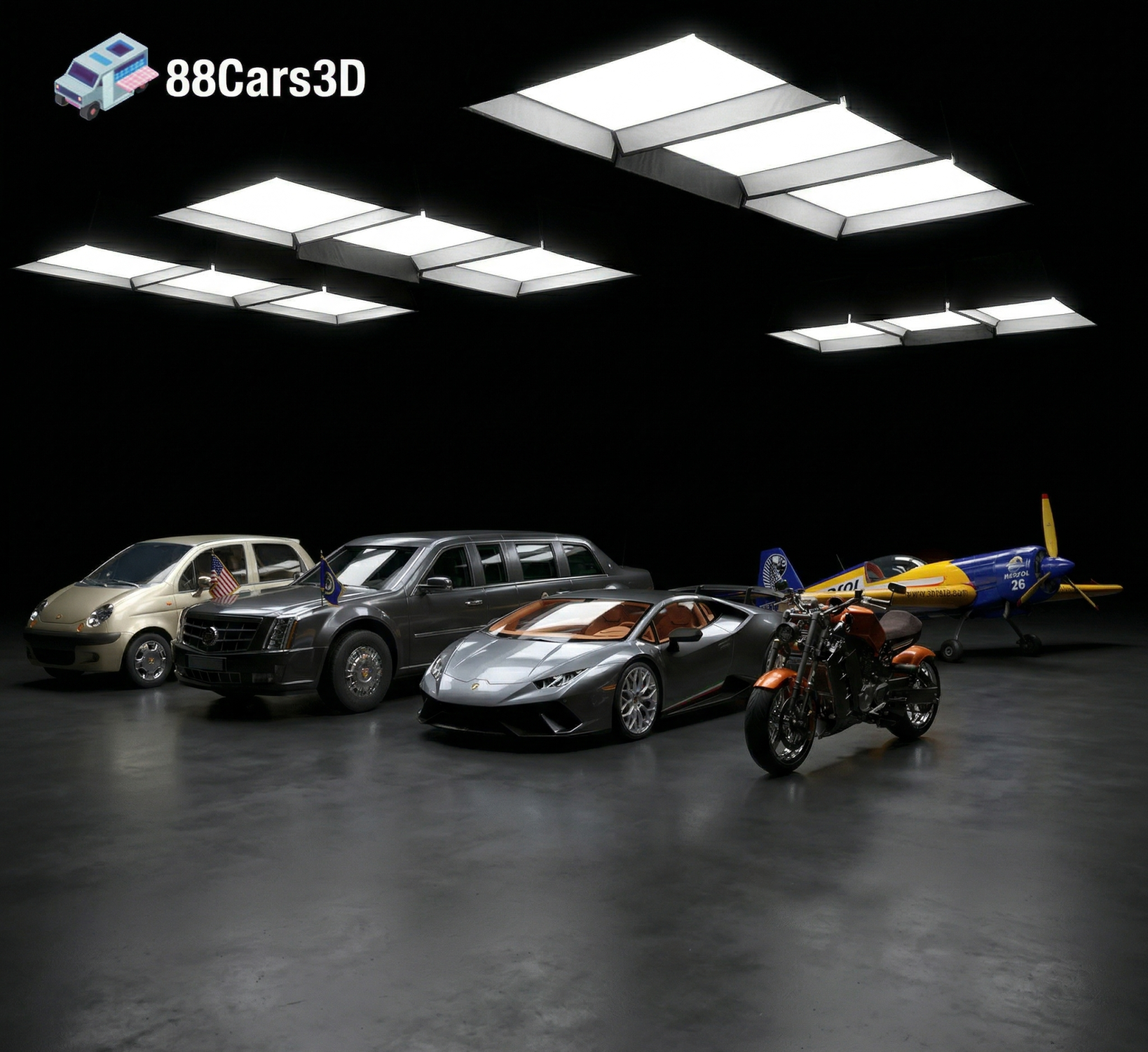
Texture: Yes | Material: Yes | 3D Printable: Yes. Download the Ultimate Creators’ Showcase featuring 5 premium 3D models: Lamborghini Huracan, ZAV Concept Motorcycle, Sukhoi SU-26, Presidential Limousine, and Daewoo Damas. Optimized for 4K CGI rendering and 3D printing. Save massive with this exclusive multi-category bundle!
Price: $99.99

Texture: Yes | Material: Yes | 3D Printable: Yes. Download the Italian Thoroughbreds Bundle featuring 5 iconic 3D models: Lamborghini Huracán Performante, Ferrari 458 Italia, Lamborghini Urus, Diablo SV, and Maserati GT. Optimized for 4K rendering and 3D printing (STL included). Save 50% with this ultimate Italian vehicle collection.
Price: $199.99

Download the Elite Future Mobility Bundle featuring 4 highly optimized 3D models: Tesla Model S, Avatr 11, Li L9, and Zoox Robotaxi. Perfect for ArchViz, Smart City renders, and game dev. Optimized for Unreal Engine and Blender. Includes .fbx, .obj, and .max formats.
Price: $99

🚗 5 Iconic German Cars (BMW M4 G82, M5 CS, X3, 1 Series & Mercedes E-Class). ✅ Optimized for ArchViz: Ready for Corona & V-Ray. 💰 Save €71 with this limited-time collection! 🚀 Instant Download after purchase.
Price: $119

Download the Extreme Off-Road & Survival 3D Models Bundle! Includes the Brabus 800 Adventure, Dodge Ram Bigfoot, Spec Truck, and a Caravan. Save over €210 on this premium 4-in-1 off-grid vehicle pack for ArchViz and game development.
Price: $149.99

Download the Heavy Duty & Commercial Logistics 3D Models Bundle! Includes the Ford Sterling, Caterpillar CT680, Mercedes Citaro Bus, and Vito Van. Save over €130 on this massive, game-ready 4-in-1 industrial vehicle pack.
Price: $109.99

Download the Ultimate Custom Motorcycles 3D Models Bundle. Includes a Custom Chopper, Ducati 916 Café Fighter, Harley XR1200X, and BMW K100. Perfect premium props for luxury ArchViz garages. Save over €250 today!
Price: $159.99

Download the ultimate JDM Street Racing 3D Models Bundle! Includes the Nissan GT-R, Toyota Supra, Mazda RX-7, Lancer Evo IX, and Honda NSX. Save big on this highly optimized, game-ready 5-in-1 Japanese legend car pack.
Price: $129.99

Download the ultimate American Muscle & Cinematic Classics 3D Models Bundle! Includes the Dodge Charger ’68, Mustang Eleanor GT500, Camaro Z28 ’79, and a custom ’69 Mustang. Save over €240 on this game-ready, premium 4-in-1 pack.
Price: $149.99

Download the Everyday City Traffic 3D Models Bundle. Includes the VW Golf, Kia Picanto, Hyundai Tucson, Toyota Yaris, and a DHL Ford Transit Van. Save big on this 5-in-1 pack, perfectly optimized for realistic ArchViz streets and game traffic.
Price: $99.99

