Get 50% OFF All Premium 3D & STL Models!

“`html
The world of 3D printing has unlocked incredible possibilities for hobbyists, model makers, and automotive enthusiasts alike. Whether you’re recreating a classic supercar, a rugged off-roader, or a futuristic concept, the ability to bring these detailed vehicle models to life from digital STL files is exhilarating. At 88cars3d.com, we specialize in providing high-quality, print-ready printable car models, but the journey from digital file to physical object also hinges on having the right 3D printer. Choosing the best machine for printing intricate automotive designs involves understanding the nuances of different technologies, key features, and specific 3D printer settings. This guide will delve into the technical considerations for selecting a printer capable of capturing the fine details, sharp edges, and smooth surfaces that define a great car model, helping you make an informed decision for your next project.
When embarking on the quest to 3D print detailed vehicle models, the first and most crucial decision is selecting the printing technology. The two dominant contenders are Fused Deposition Modeling (FDM) and Stereolithography (SLA) or Digital Light Processing (DLP) – collectively known as resin printing. Each offers distinct advantages and disadvantages, directly impacting the fidelity and quality of your automotive prints.
FDM printers build objects layer by layer by extruding melted thermoplastic filament through a heated nozzle. This technology is widely accessible, relatively affordable, and offers a broad range of material options, including PLA, PETG, and ABS. For vehicle models, FDM printers have made significant strides in improving detail. Smaller nozzle sizes, such as 0.2mm or 0.3mm, compared to the standard 0.4mm, can drastically increase the resolution and capture finer details like panel lines, small vents, and intricate wheel designs. Optimizing slicing parameters is paramount with FDM. Layer heights as low as 0.05mm can produce incredibly smooth surfaces, minimizing the visible layer lines characteristic of this technology. Print speed also plays a vital role; printing at slower speeds, especially for outer walls and fine details, allows the filament to cool and adhere properly, resulting in cleaner geometry. While FDM can achieve impressive results for car models, achieving the razor-sharp edges and microscopic details found on high-end collectibles might still require significant post-processing or advanced FDM printers.
Resin printers, such as SLA and DLP, use a light source (laser or projector) to selectively cure liquid photopolymer resin layer by layer. This process inherently offers much higher resolution than FDM, making it the go-to technology for replicating extremely intricate details. The layer lines are often imperceptible, and the surface finish is exceptionally smooth right off the print bed. For car models with delicate components, complex undercuts, or the need for a showroom-quality finish without extensive sanding, resin printing is often superior. Layer heights in resin printing are typically much smaller, often down to 0.01mm to 0.05mm, allowing for astounding detail capture. The choice between SLA and DLP often comes down to speed and pixel resolution. DLP printers generally print faster as they cure an entire layer at once, whereas SLA uses a laser that traces each layer. The pixel size of the DLP projector or the laser spot size of the SLA machine dictates the XY resolution, which is critical for fine details on car models. While resin printing excels in detail, it typically involves more messier post-processing (washing and curing), requires specific safety precautions due to uncured resin, and materials can be more expensive and brittle compared to FDM filaments.
Beyond the core technology, several hardware and software features significantly influence your ability to print detailed car models successfully. Focusing on these aspects will help you identify printers that are well-suited for the intricacies of automotive designs.
The build volume dictates the maximum size of a single print you can achieve. While many highly detailed car models are printed at a smaller scale, some enthusiasts may wish to print larger replicas. For most 1:18 or 1:24 scale models, a modest build volume is sufficient. However, if you plan on printing larger, more imposing models, ensure the printer’s build area can accommodate your ambitions. More critical for detail, however, is the printer’s *resolution*. For FDM printers, this is primarily determined by the nozzle diameter and the minimum achievable layer height. Aim for printers that support 0.2mm or smaller nozzles and can reliably print at layer heights of 0.1mm or lower. For resin printers, the XY resolution (pixel size for DLP, laser spot size for SLA) and the Z-axis resolution (layer height) are paramount. A smaller pixel size and a lower layer height translate directly to finer details, sharper edges, and smoother curves, essential for capturing the sleek lines of a car model. Look for resin printers with XY resolutions of 50 microns or better, and layer heights of 0.025mm or 0.05mm.
A stable and reliable print bed is the bedrock of any successful 3D print, especially for complex geometries like car models that can have significant surface area interacting with the print bed. Warping, where the corners of a print lift off the bed, is a common failure mode that can ruin hours of printing. For FDM printers, features like a heated print bed are essential, especially when printing with materials like ABS. Build surface options such as glass, PEI sheets, or textured surfaces offer different levels of adhesion. Magnetic flexible build plates can also be a boon, allowing for easy removal of prints without damaging them. Auto-bed leveling systems are invaluable, ensuring consistent first-layer adhesion across the entire build surface, which is critical for a good foundation. For resin printers, ensuring the build plate is perfectly level and clean is crucial. Resin adhesion to the build plate is managed by the “peel-away” mechanism, which involves the cured layer peeling off the FEP film at the bottom of the resin vat. The speed of this peel-away process and the quality of the FEP film significantly impact print success and detail preservation.
Even the most advanced 3D printer can become a source of frustration if it’s overly complicated to operate or maintain. For printing detailed car models, where precision is key, a user-friendly interface and straightforward maintenance procedures are highly beneficial. Look for features like intuitive touchscreen controls, filament run-out sensors (on FDM printers), and simple-to-follow calibration steps. For resin printers, consider the ease of refilling and draining the resin vat, and the accessibility of the build plate for cleaning. Software integration is also important. Compatibility with popular slicing software like Cura, PrusaSlicer, or ChiTuBox is essential, as these programs allow you to fine-tune slicing parameters, generate supports, and optimize your prints. Printers that offer firmware updates and active community support can also be invaluable when troubleshooting issues or looking for advanced tips related to file preparation and print optimization.
Selecting specific printer models can be challenging as the market evolves rapidly. However, by focusing on reputable brands and models known for their detail and reliability, you can narrow down your choices. We’ll categorize recommendations by technology.
For FDM printing of car models, consider printers that offer excellent accuracy, stability, and the ability to use smaller nozzles. Printers with direct-drive extruders are often preferred for their better control over filament flow, crucial for intricate details and retractions. Look for machines that are known for their sturdy build, often featuring a CoreXY or robust Cartesian motion system, which minimizes vibrations and ringing artifacts. Brands like Prusa, Bambu Lab, and Creality (with higher-end models) often offer printers that fit this bill. For example, a Prusa i3 MK4, with its high-quality components and reputation for reliability, can produce excellent results when dialed in with a 0.2mm nozzle and a low layer height (e.g., 0.1mm). Bambu Lab printers, known for their speed and ease of use, also offer impressive detail capabilities. When downloading printable car models from marketplaces such as 88cars3d.com, these printers can faithfully reproduce even complex designs with the right settings. Remember to invest in high-quality filament; brands offering tight diameter tolerances and consistent extrusion will yield better results.
Achieving fine details on FDM printers requires meticulous 3D printer settings.
When absolute fidelity and surface smoothness are non-negotiable, resin printers reign supreme. For detailed car models, look for machines with high XY resolution (e.g., 4K or 8K screens) and a proven track record for reliability. Brands like Elegoo (e.g., Saturn or Mars series), Anycubic (e.g., Photon series), and Phrozen offer excellent options in various price ranges. An Elegoo Saturn 2 with its 8K mono LCD offers exceptional detail, capturing even the smallest emblems and grille textures. Similarly, Anycubic’s Photon Mono series provides great value with impressive resolution. The key here is selecting a printer with a small pixel size and a low layer height capability. When downloading models from platforms like 88cars3d.com, resin printers will often reproduce them with minimal modification needed, often requiring only light sanding on support contact points.
Resin printing involves a distinct workflow that is crucial for achieving optimal results with detailed models:
Regardless of the printer technology you choose, the quality of your digital model and how you prepare it for printing are paramount. This involves understanding STL file structures, mesh repair, and effective slicing techniques.
STL files represent 3D models as a mesh of triangular facets. For successful 3D printing, this mesh must be “watertight” or “manifold,” meaning it has no holes, inverted faces, or non-manifold edges. Software like Autodesk Netfabb, Meshmixer, or even features within Blender can diagnose and repair these issues. For instance, if a car door has a small gap where it meets the body, the slicer might interpret this as a hole, leading to print failures. Tools like “Make Solid” in Meshmixer or “Fix Mesh” in Netfabb can often resolve these problems automatically or semi-automatically. When downloading models from marketplaces such as 88cars3d.com, the files are generally well-prepared, but it’s always good practice to inspect them, especially if you plan on scaling them or modifying them.
The slicer is your bridge between a 3D model and the 3D printer. Fine-tuning its settings is crucial for achieving the desired balance between detail, strength, and print time. For car models, consider these parameters:
Even with the best 3D printer and meticulous settings, post-processing is often required to achieve a truly professional-looking car model. This stage transforms a raw print into a display-ready piece.
Careful removal of support structures is the first step. For FDM prints, use flush cutters, pliers, or specialized tools to gently break away supports. For resin prints, supports are often easier to remove after washing but before curing, as the resin is still slightly pliable. Sanding is key for smoothing layer lines on FDM prints and support marks on both technologies. Start with a coarser grit (e.g., 150-220) and progressively move to finer grits (e.g., 400, 800, 1000, and even higher). For FDM, filler primer spray can help fill in remaining layer lines before painting. Resin prints typically require less aggressive sanding, focusing on support contact points.
Painting can bring your 3D printed car model to life. For FDM prints, a primer is essential for a smooth, uniform base coat and to hide layer lines. Acrylic paints, model enamels, or airbrush paints can be used. Thinning paints and applying multiple thin coats is better than one thick coat. For resin prints, a light sanding or a quick blast of primer is usually sufficient before painting. If your model was printed in multiple parts (common for complex FDM or resin models), assembly is the final step. Cyanoacrylate (super glue) or specialized plastic adhesives work well for FDM parts. For resin, super glue or epoxy adhesives are recommended. Ensure good ventilation and use appropriate safety gear during painting and gluing.
Choosing the right 3D printer for detailed vehicle models involves a deep understanding of printing technologies, key hardware features, and meticulous preparation and post-processing. Whether you opt for the evolving detail capabilities of FDM printers with smaller nozzles and low layer heights, or the unparalleled fidelity of resin printers, the goal remains the same: to faithfully reproduce the intricate designs of automotive masterpieces. By focusing on resolution, build stability, and user-friendliness, you can select a machine that complements your hobbyist passion or professional needs. Platforms like 88cars3d.com provide a fantastic starting point with high-quality STL files, but mastering your 3D printer settings, practicing effective slicing techniques, and dedicating time to post-processing are the keys to unlocking truly stunning, detailed 3D printed car models. Happy printing!
“`
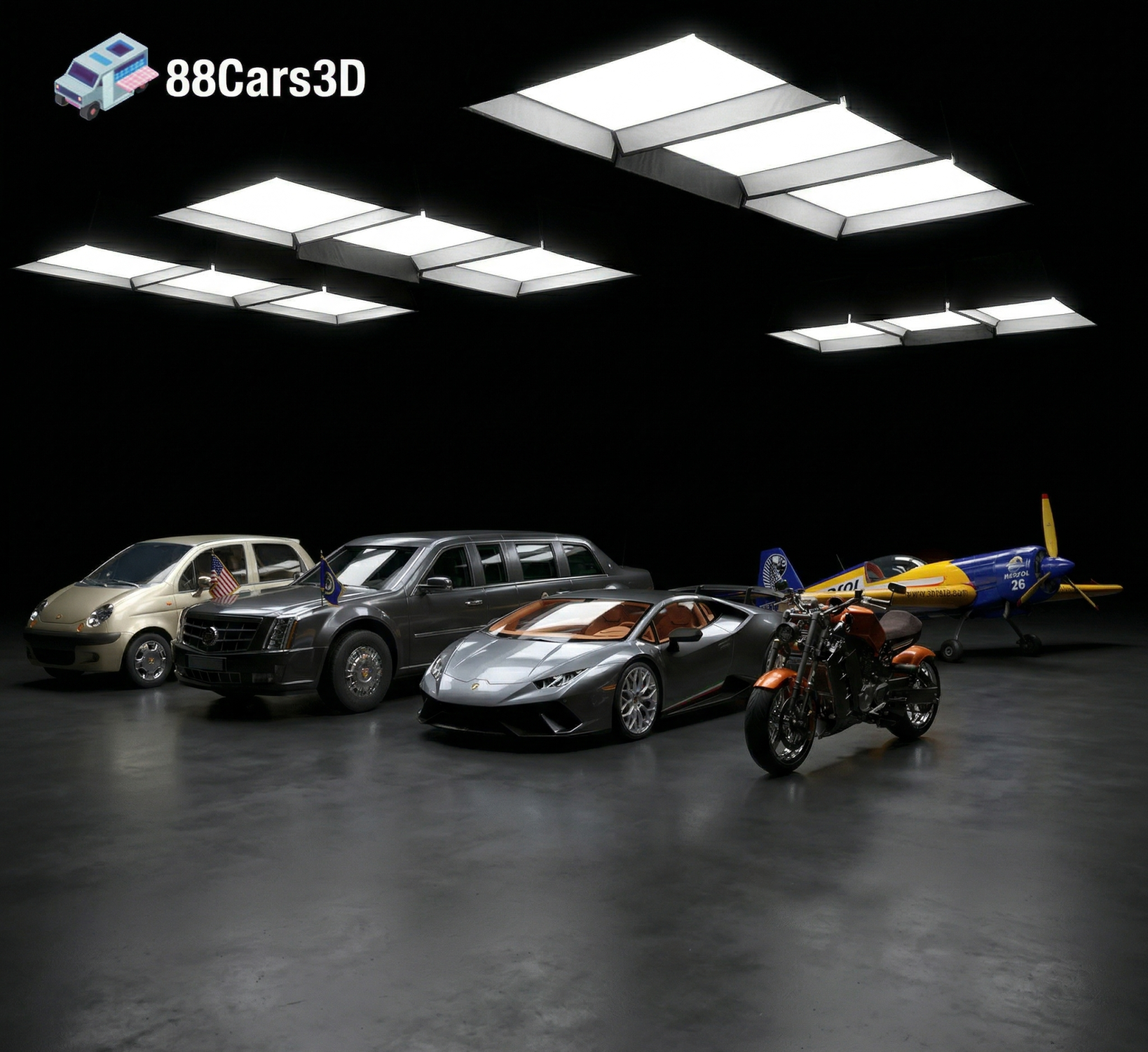
Texture: Yes | Material: Yes | 3D Printable: Yes. Download the Ultimate Creators’ Showcase featuring 5 premium 3D models: Lamborghini Huracan, ZAV Concept Motorcycle, Sukhoi SU-26, Presidential Limousine, and Daewoo Damas. Optimized for 4K CGI rendering and 3D printing. Save massive with this exclusive multi-category bundle!
Price: $99.99

Texture: Yes | Material: Yes | 3D Printable: Yes. Download the Italian Thoroughbreds Bundle featuring 5 iconic 3D models: Lamborghini Huracán Performante, Ferrari 458 Italia, Lamborghini Urus, Diablo SV, and Maserati GT. Optimized for 4K rendering and 3D printing (STL included). Save 50% with this ultimate Italian vehicle collection.
Price: $199.99

Download the Elite Future Mobility Bundle featuring 4 highly optimized 3D models: Tesla Model S, Avatr 11, Li L9, and Zoox Robotaxi. Perfect for ArchViz, Smart City renders, and game dev. Optimized for Unreal Engine and Blender. Includes .fbx, .obj, and .max formats.
Price: $99

🚗 5 Iconic German Cars (BMW M4 G82, M5 CS, X3, 1 Series & Mercedes E-Class). ✅ Optimized for ArchViz: Ready for Corona & V-Ray. 💰 Save €71 with this limited-time collection! 🚀 Instant Download after purchase.
Price: $119

Download the Extreme Off-Road & Survival 3D Models Bundle! Includes the Brabus 800 Adventure, Dodge Ram Bigfoot, Spec Truck, and a Caravan. Save over €210 on this premium 4-in-1 off-grid vehicle pack for ArchViz and game development.
Price: $149.99

Download the Heavy Duty & Commercial Logistics 3D Models Bundle! Includes the Ford Sterling, Caterpillar CT680, Mercedes Citaro Bus, and Vito Van. Save over €130 on this massive, game-ready 4-in-1 industrial vehicle pack.
Price: $109.99

Download the Ultimate Custom Motorcycles 3D Models Bundle. Includes a Custom Chopper, Ducati 916 Café Fighter, Harley XR1200X, and BMW K100. Perfect premium props for luxury ArchViz garages. Save over €250 today!
Price: $159.99

Download the ultimate JDM Street Racing 3D Models Bundle! Includes the Nissan GT-R, Toyota Supra, Mazda RX-7, Lancer Evo IX, and Honda NSX. Save big on this highly optimized, game-ready 5-in-1 Japanese legend car pack.
Price: $129.99

Download the ultimate American Muscle & Cinematic Classics 3D Models Bundle! Includes the Dodge Charger ’68, Mustang Eleanor GT500, Camaro Z28 ’79, and a custom ’69 Mustang. Save over €240 on this game-ready, premium 4-in-1 pack.
Price: $149.99

Download the Everyday City Traffic 3D Models Bundle. Includes the VW Golf, Kia Picanto, Hyundai Tucson, Toyota Yaris, and a DHL Ford Transit Van. Save big on this 5-in-1 pack, perfectly optimized for realistic ArchViz streets and game traffic.
Price: $99.99

