Get 50% OFF All Premium 3D & STL Models!

In the dynamic world of digital content creation, the demand for high-fidelity 3D assets continues to escalate. From blockbuster game titles and photorealistic architectural visualizations to interactive AR/VR experiences and commercial advertising, precise and performant 3D models are the backbone of compelling visual narratives. Few assets are as universally recognized or as technically challenging to master as automotive models. These aren’t just static objects; they are complex assemblies of intricate curves, reflective surfaces, and finely tuned details that demand meticulous attention from concept to final render.
The pursuit of realism in automotive visualization has driven artists and developers to push the boundaries of modeling, texturing, and rendering techniques. It’s a field where a slight imperfection can break immersion, and a perfectly executed detail can elevate an entire project. This pursuit is particularly relevant with the advent of electric vehicles, which often feature unique design languages and integrated technologies that require accurate digital representation. Today, we’ll explore the critical aspects of professional 3D car models, highlighting technical workflows, industry applications, and how a meticulously crafted asset like the Volvo XC40 Recharge (2020) 3D Model from 88cars3d.com exemplifies excellence in this demanding domain.
The automotive industry is in constant flux, and so too is its digital counterpart. Electric vehicles (EVs) are rapidly reshaping vehicle aesthetics and performance, bringing with them new design challenges and opportunities for 3D artists. Traditional grilles give way to aerodynamic, often body-colored panels; intricate combustion engine components are replaced by sleek battery packs and electric motors; and interiors embrace minimalism and advanced digital interfaces. Capturing these contemporary elements with precision is paramount for any modern visualization project.
The core challenge for 3D artists creating automotive models lies in balancing extreme visual fidelity with optimization. Clients and developers expect models that look indistinguishable from their real-world counterparts under various lighting conditions, while also performing flawlessly within the constraints of real-time engines or complex rendering pipelines. This means clean topology, efficient UV mapping, and thoughtfully applied materials. A model that achieves this balance, such as the Volvo XC40 Recharge (2020) 3D Model, provides artists with a versatile foundation, whether they’re producing high-resolution stills for marketing or populating a vast open-world game environment.
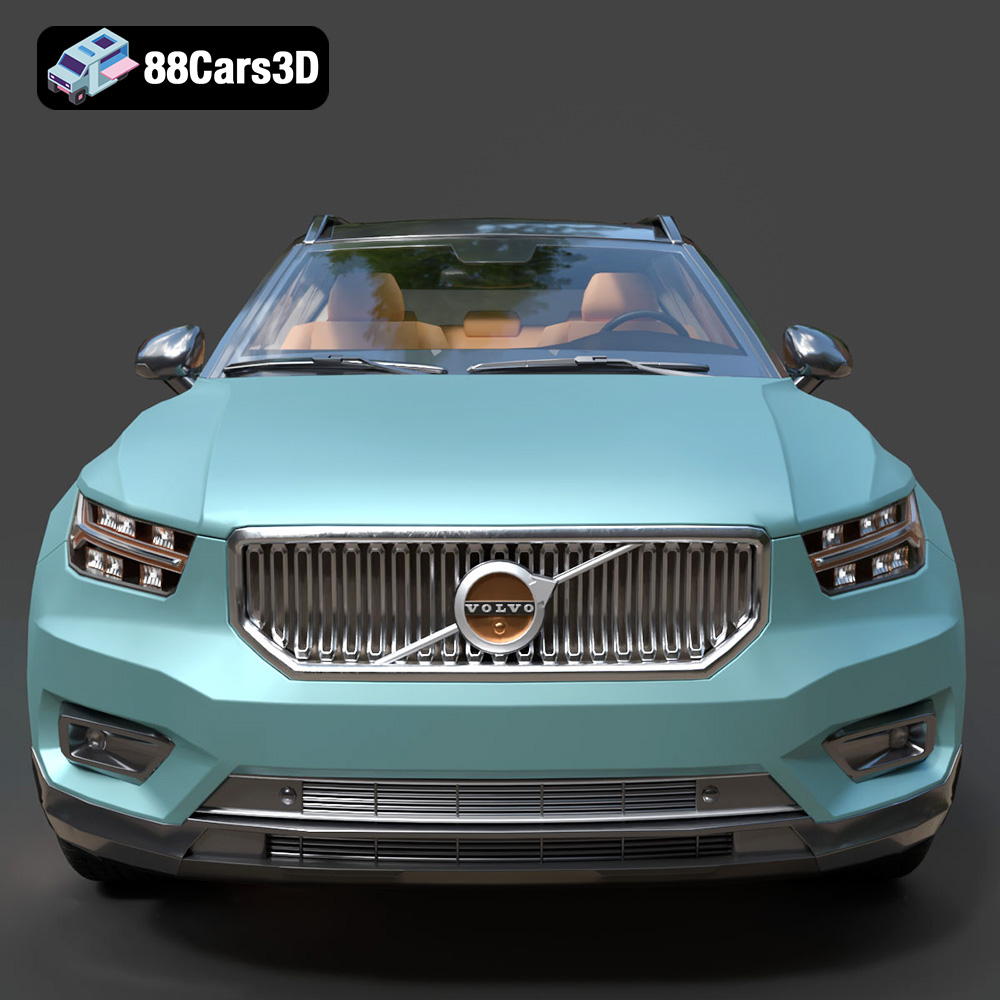
As EVs become mainstream, their presence in architectural visualizations (ArchViz), marketing campaigns, and virtual environments is growing exponentially. Projects aiming for a modern, sustainable aesthetic often feature electric cars prominently. The Volvo XC40 Recharge, as Volvo’s first fully electric SUV, represents a significant cultural and technological shift. Its distinct closed-off grille and “Thor’s Hammer” LED headlights are iconic design cues that signify its EV status. For designers, having access to such a recognizable and contemporary EV model allows them to infuse their projects with a sense of relevance and forward-thinking design, effortlessly communicating a modern, eco-conscious sensibility.
The choice of file format for a 3D model is not merely a technicality; it’s a fundamental decision that dictates compatibility, functionality, and workflow efficiency across various software platforms and use cases. Each format is engineered with specific strengths, catering to different stages of the 3D pipeline—from initial modeling to final deployment in games, rendering, or manufacturing. The Volvo XC40 Recharge (2020) 3D Model is provided in a comprehensive array of formats, ensuring maximum flexibility for any professional project.
The .blend format is Blender’s native file type. It’s a complete package, capable of storing not just mesh data, but also materials, textures, lighting setups, animations, cameras, simulations, and even an entire scene’s project structure. For users deeply integrated into the Blender workflow, a .blend file offers the most editable and robust starting point. It allows for direct manipulation of every aspect of the model, from tweaking individual vertices to adjusting complex shader networks, making it ideal for customization and further development within the Blender environment.
.fbx (Filmbox) is arguably the most prevalent interchange format in the 3D industry, especially favored for game development and animation. Developed by Autodesk, it efficiently stores geometric data, materials, textures, animation curves, skinning, and camera information. Its broad adoption ensures seamless transfer between major 3D applications like 3ds Max, Maya, Blender, and real-time engines such as Unreal Engine and Unity. When importing the Volvo XC40 Recharge as an .fbx, artists can expect robust material assignments and animation potential for components like wheels and doors, making it an excellent choice for dynamic scenes or interactive applications.
The .obj (Wavefront OBJ) format is a venerable and universally supported file type, recognized by almost every 3D software package. While it primarily stores geometric information (vertices, normals, texture coordinates) and references to external material files (.mtl), it is a reliable choice for transferring basic mesh data. Its simplicity makes it extremely stable and less prone to compatibility issues compared to more complex formats. For foundational mesh exchange or when precise geometry is the primary concern, .obj remains a go-to option, ensuring the Volvo XC40 Recharge’s accurate proportions are preserved across platforms.
.glb (GL Transmission Format Binary) is the binary version of glTF, a royalty-free specification for the efficient transmission and loading of 3D scenes and models by applications. It’s specifically optimized for web-based 3D, AR (Augmented Reality), and VR (Virtual Reality) environments, as it bundles textures and animations directly into a single, self-contained file. This makes .glb files incredibly efficient for rapid deployment on websites, social media, or lightweight immersive experiences without needing to manage separate asset files. For interactive product showcases or digital car configurators featuring the XC40 Recharge, .glb is an ideal format.
.stl (Stereolithography) is the standard file format for 3D printing and CAD software. It represents a 3D model as a series of connected triangles (a tessellation of the surface geometry). While it lacks color, texture, or material information, its strength lies in its ability to define a watertight mesh suitable for additive manufacturing. Converting the Volvo XC40 Recharge (2020) 3D Model to .stl allows enthusiasts to 3D print scale models, bringing the digital design into the physical realm for collectors or display. Precision in topology is crucial here, ensuring the printed model accurately reflects the digital form.
The .ply (Polygon File Format) format is designed to store geometric information from 3D scanners or advanced modeling techniques. It can store a variety of properties including color, transparency, normals, texture coordinates, and even reliability information for each polygon. It’s often used in applications requiring high-precision mesh data, scientific visualization, or scenarios where the integrity of captured real-world data is paramount. For detailed analysis or specialized CAD workflows of the XC40 Recharge model, .ply offers a robust data structure.
The inclusion of an .unreal file (often a .uasset or directly formatted for Unreal Engine import) signifies an asset specifically prepared for Unreal Engine. This often implies optimized mesh divisions, collision setups, level of detail (LOD) configurations, and Unreal-specific material networks. An engine-ready asset like the Volvo XC40 Recharge ensures a smoother import and integration process, leveraging Unreal’s native capabilities for real-time rendering, physics, and interactive elements without extensive re-work. It streamlines the pipeline for game developers aiming to include the vehicle in their virtual worlds.
Finally, the .max format is Autodesk 3ds Max’s native scene file. Like .blend, it encapsulates an entire project, including all geometry, materials, lighting, cameras, animation, and scene settings specific to 3ds Max. For professionals working within the Autodesk ecosystem, particularly for high-end rendering, animation, and architectural visualization, the .max file provides complete creative control. It allows for deep customization, utilizing 3ds Max’s powerful rendering engines like V-Ray or Corona, and full access to the Volvo XC40 Recharge’s underlying structure for complex scene integration and advanced visual effects.
Automotive rendering is a specialized discipline that demands an acute understanding of lighting, materials, and composition to produce images that are virtually indistinguishable from photographs. Achieving this photorealism is not just about raw polygon count, but how these elements are meticulously combined and rendered.
For decades, 3ds Max has been a powerhouse in high-end automotive rendering and visualization. Paired with industry-standard renderers like V-Ray or Corona, it offers unparalleled control over scene setup, material properties, and global illumination. A professional artist using the Volvo XC40 Recharge (2020) 3D Model in 3ds Max can take advantage of its clean topology and real-world scale to create stunning visuals. This involves setting up realistic studio lighting or environmental HDRI maps, crafting advanced car paint shaders with multiple clear coats, flake effects, and reflections, and fine-tuning tire rubber and glass materials. The accurate proportions and detailed interior of the XC40 Recharge allow for close-up shots that reveal the vehicle’s premium design, right down to the virtual Orrefors crystal-style gear shifter representation.
Blender has emerged as a formidable contender in the rendering arena, with its Cycles path tracer offering unbiased, photorealistic results and Eevee providing real-time rendering capabilities for quick iterations. An artist using the .blend file of the Volvo XC40 Recharge can directly access its materials and textures, making it easy to adapt to specific rendering needs. With Cycles, one can achieve breathtaking realism by simulating light interactions precisely, ideal for detailed product shots or marketing imagery. Eevee, on the other hand, is perfect for rapid previews, animations, or even creating entire interactive configurators that run efficiently, showcasing the XC40 Recharge’s design from multiple angles without extensive render times.
Architectural Visualization (ArchViz) is a prime application for high-quality 3D car models. Adding vehicles to architectural renders breathes life into scenes, provides scale, and hints at the lifestyle associated with a property. The Volvo XC40 Recharge (2020) 3D Model is an ideal choice for modern ArchViz projects, especially those emphasizing sustainable living or contemporary urban design. Imagine it parked in the driveway of a minimalist smart home or navigating a sleek, pedestrian-friendly city street. Its distinct EV aesthetics and luxurious Scandinavian design instantly elevate the realism and narrative of the visualization, projecting a sophisticated and environmentally conscious image for the architectural development. 88cars3d.com provides assets that effortlessly integrate into these high-stakes projects.
In game development, the challenge of realism is compounded by the necessity for real-time performance. Game assets must be meticulously optimized to render smoothly at high frame rates while still maintaining visual integrity. This requires careful consideration of poly count, UV layouts, material complexity, and Level of Detail (LOD) implementation.
Unreal Engine is a dominant force in real-time visualization and game development, known for its cinematic rendering capabilities and robust toolset. Importing the Volvo XC40 Recharge (2020) 3D Model into Unreal Engine, especially with the included .unreal file or a well-prepared .fbx, significantly streamlines the process. Developers can utilize Unreal’s Material Editor to create physically based rendering (PBR) materials that react realistically to the engine’s advanced lighting. The model’s separate wheels, steering components, and doors are crucial for rigging, enabling realistic suspension, steering, and door animations. This foundation allows for the creation of drivable vehicles in open-world games, dynamic traffic systems, or interactive product experiences, where the XC40 Recharge can serve as a hero vehicle or a high-quality background asset.
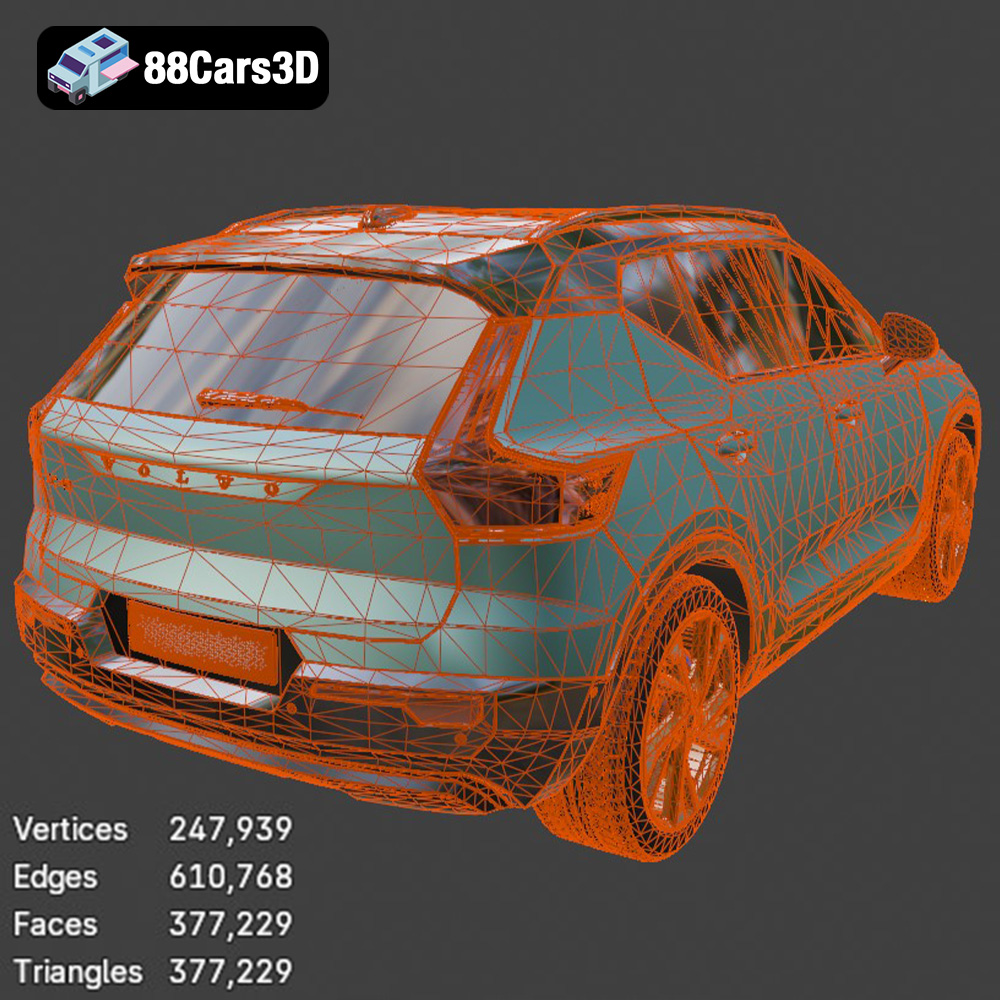
Unity, another widely used game engine, also benefits greatly from optimized 3D car models. For mobile games, where performance constraints are even tighter, the mid-polygon count of the Volvo XC40 Recharge (approximately 377k triangles) is a significant advantage. This topology strikes a superb balance: visually rich enough for current-generation mobile devices and PC games, yet light enough to be rendered efficiently alongside other complex scene elements. Developers can implement LODs to swap out higher-detail models for simpler versions when the car is further from the camera, further conserving resources. The clean UVs (implied by high-quality models) are essential for baking lighting and creating efficient texture atlases, which are key for mobile optimization.
The technical specifications of the Volvo XC40 Recharge (2020) 3D Model underscore its suitability for game development. With 247,939 vertices, 610,768 edges, and 377,229 triangles, it falls into the “mid-poly” category. This is a deliberate and intelligent design choice. A model with significantly fewer polygons might look blocky or lack detail in close-up shots, while one with millions of polygons would be too heavy for real-time applications. The XC40 Recharge’s optimized topology ensures it “holds up gorgeously in foreground shots” while simultaneously being “lightweight enough to populate modern virtual environments” without causing performance bottlenecks. This balance is critical for professional game asset pipelines and is a hallmark of the quality found at 88cars3d.com.
The utility of high-quality 3D car models extends far beyond traditional screen-based rendering. They serve as foundational assets for physical manufacturing through 3D printing and are crucial for developing immersive Augmented Reality (AR) and Virtual Reality (VR) applications, bridging the gap between digital design and tangible interaction.
3D printing offers an exciting avenue for bringing digital car models into the physical world. For this, the model must be “manifold,” meaning it has a solid, watertight mesh without any gaps or intersecting geometry. The Volvo XC40 Recharge (2020) 3D Model, with its clean and optimized topology, is well-suited for conversion to .stl format for 3D printing. The provided 3D print settings are invaluable, recommending specific scales (1:24, 1:32, 1:43), layer heights, infill percentages, and wall thicknesses. The advice to use resin printing for finer details like the “Thor’s Hammer” headlights highlights the attention to detail required for successful physical replication. This means car enthusiasts, model makers, or even designers needing a physical prototype can directly leverage this digital asset to create a tangible representation of Volvo’s electric SUV.
AR and VR are transforming how consumers interact with products, especially high-value items like automobiles. Imagine a prospective buyer exploring the Volvo XC40 Recharge in a virtual showroom, walking around it, opening doors, and even “sitting inside” to examine the detailed dashboard and Scandinavian minimalist interior – all from the comfort of their home. Or consider an AR experience where the XC40 Recharge appears scaled to life-size in their driveway, allowing them to visualize it in a real-world context. The .glb format, included with this model, is specifically optimized for these applications, ensuring fast loading times and efficient rendering in web-based or mobile AR/VR environments. The optimized interior geometry is “tailored to look authentic from the exterior or in VR,” a critical feature for truly immersive experiences.
The multifaceted nature of the Volvo XC40 Recharge (2020) 3D Model, supporting everything from high-end rendering to real-time gaming and physical 3D printing, speaks volumes about its quality and versatility. This adaptability is what defines a truly professional 3D asset. Whether it’s for a print ad, a video game, an educational simulator, or a personalized desktop model, this single asset can be leveraged across diverse media, maximizing value for creators. Such versatile 3D car models are a cornerstone of modern digital content pipelines, enabling consistent visual branding and efficient production across platforms.
The true value of a premium 3D car model lies not just in its initial visual appeal, but in the underlying technical craftsmanship that makes it usable, adaptable, and future-proof across a multitude of applications. This technical edge saves countless hours of rework and ensures consistent quality in the final output.
Topology, the arrangement of polygons (faces) in a 3D model, is fundamental to its quality and performance. A clean, quad-heavy topology, as described for the Volvo XC40 Recharge (2020) 3D Model, is a hallmark of professional work. It ensures smooth deformations during animation, predictable subdivision for higher detail, and ease of modification. The polygon count (or triangle count, which is 377,229 for the XC40 Recharge) is a critical optimization metric. This “mid-polygon” range is ideal: detailed enough for close-up shots and high-resolution renders, yet optimized for real-time engines without overwhelming system resources. This balance is incredibly difficult to achieve and is a testament to the modeler’s expertise, making it “incredibly efficient” for demanding projects.
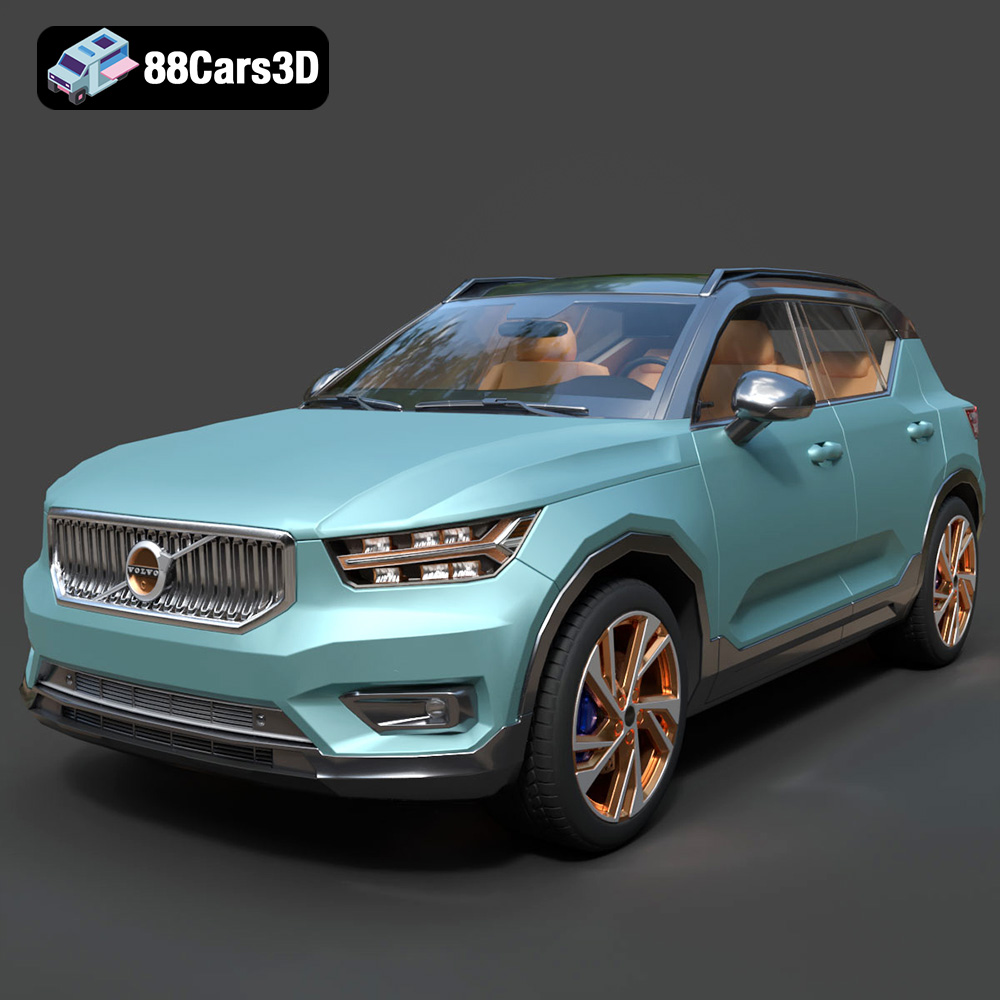
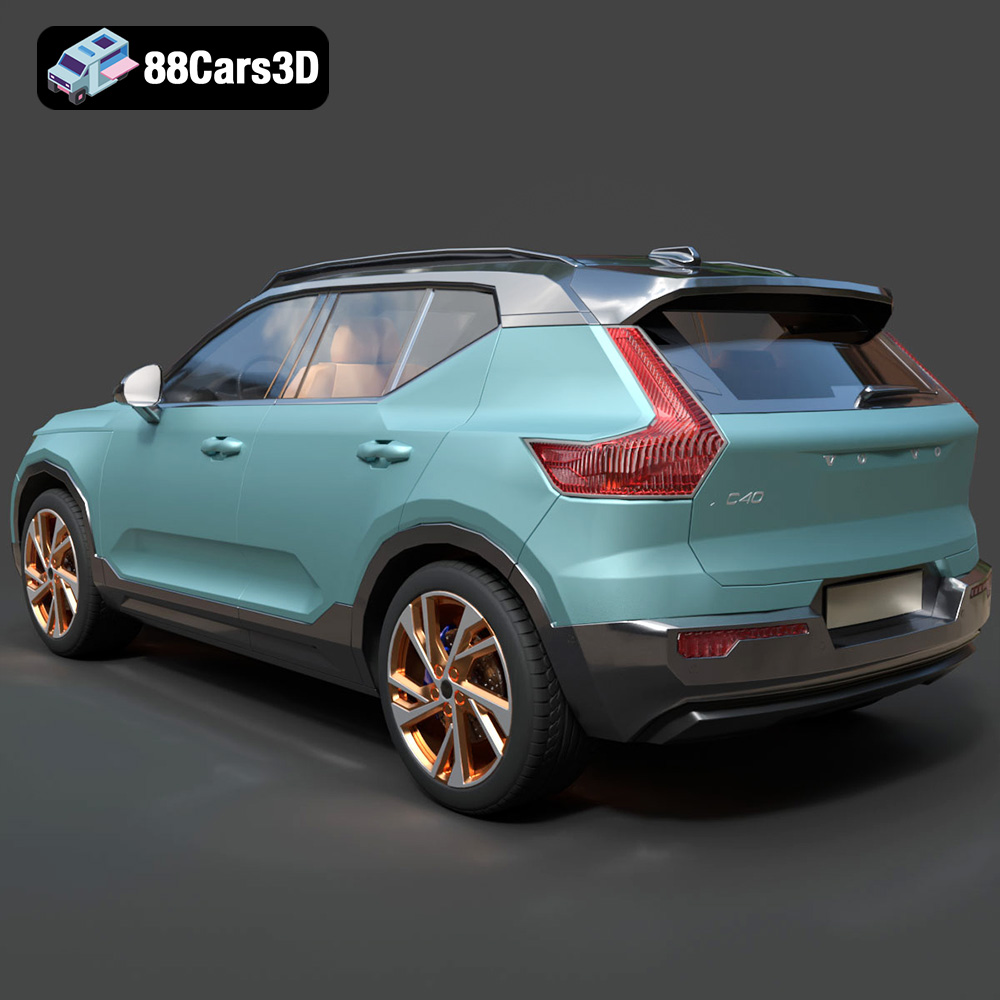
Accuracy in detail is paramount for automotive models, reflecting the brand’s design language and engineers’ intent. The Volvo XC40 Recharge model meticulously captures these specifics: the “distinctive EV-specific closed-off front grille,” “highly detailed ‘Thor’s Hammer’ LED headlight clusters,” and the “signature vertical taillights.” Even the interior is not overlooked, featuring an “authentic driver-centric, Scandinavian minimalist cabin layout” with a “detailed dashboard” and an “accurately sculpted center console with the signature Orrefors crystal-style gear shifter representation.” These granular details are what transform a generic car model into a specific, recognizable, and premium vehicle that resonates with an audience familiar with the brand.
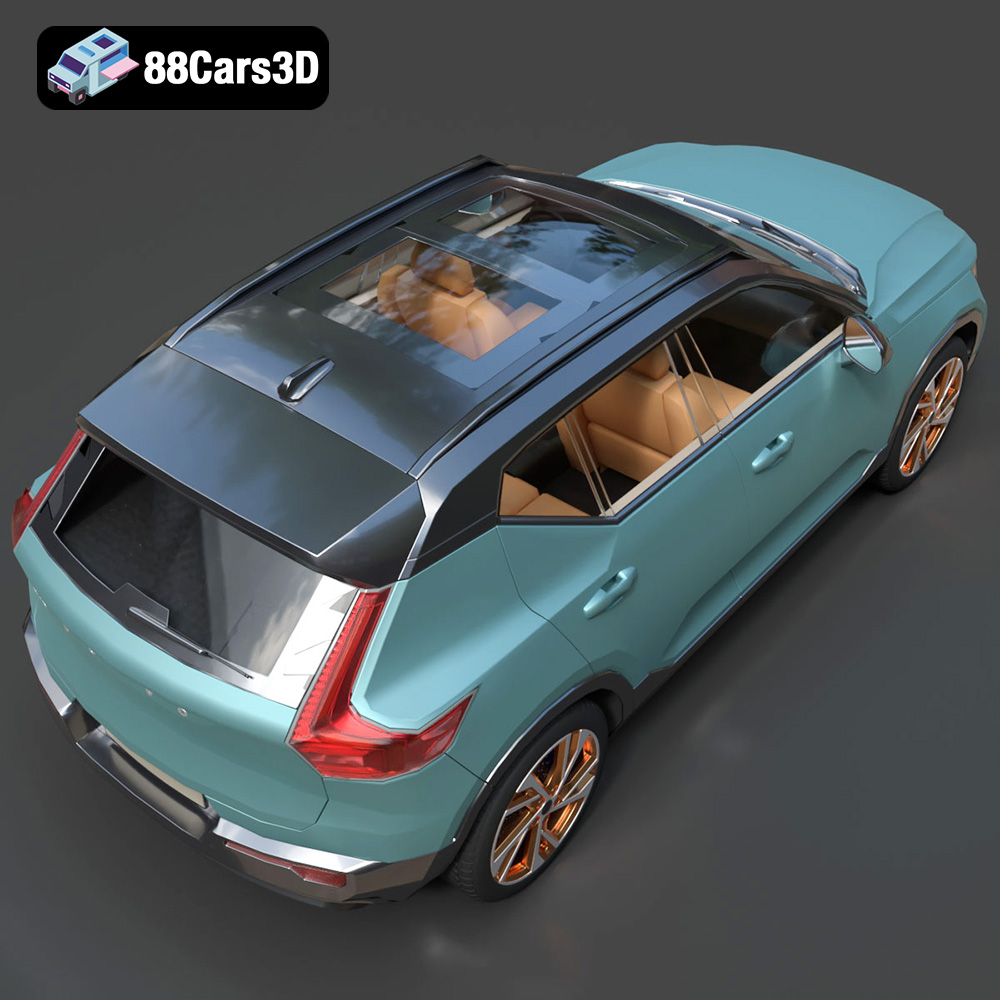
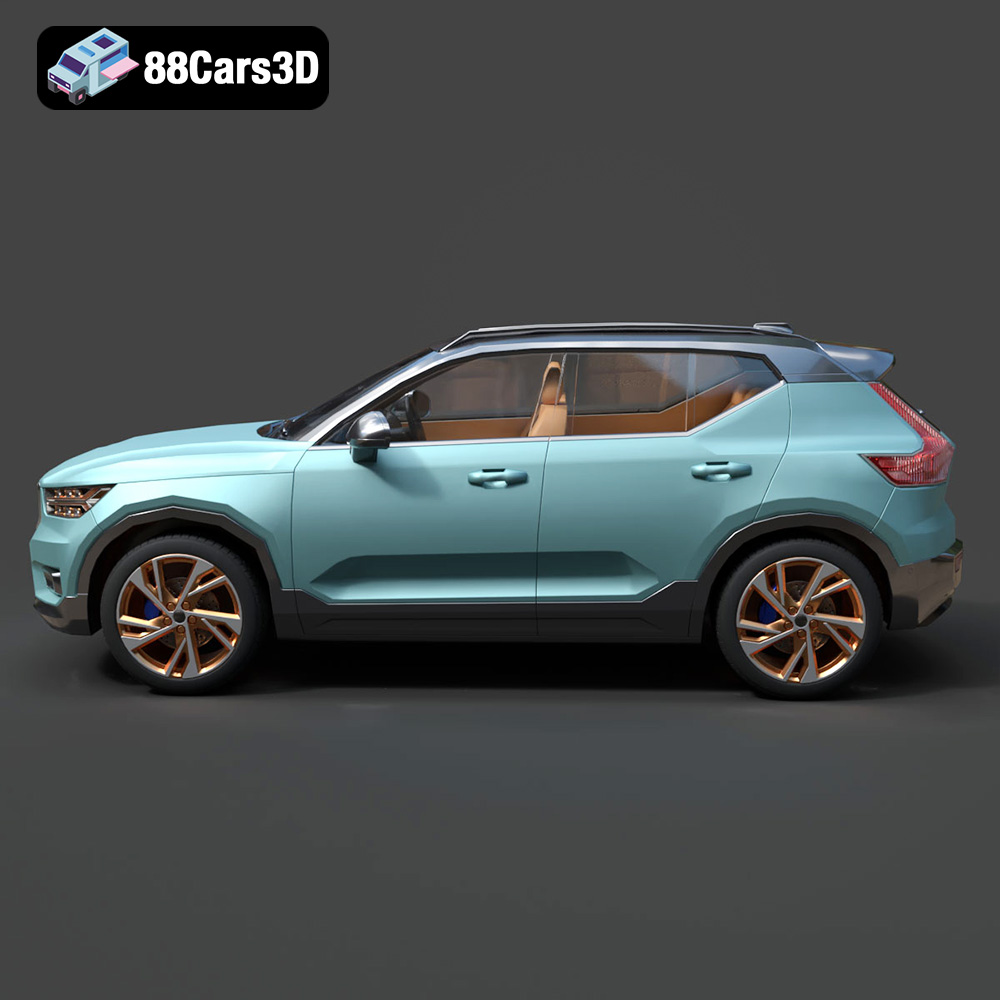
A truly professional 3D model is not just a static representation but a flexible asset that can be customized to fit diverse project requirements. The Volvo XC40 Recharge (2020) 3D Model offers excellent customization potential. Artists can easily “apply the signature two-tone paint scheme (colored body with a black roof/pillars) or go for a sleek monochrome look.” Modifying wheel setups to match different trim levels, adding accessories like roof cargo boxes, or adapting lighting for specific moods (sunny suburban driveways vs. moody city streets) are all straightforward thanks to the model’s clean structure and logical component separation. Features like “separate wheels, steering components, and doors for rigging and animation” and “proper pivot setup for steering and wheel rotation” are crucial for animators and game developers, allowing for dynamic interactions and realistic vehicle movement.
The creation and deployment of high-quality 3D car models are central to modern digital content creation across industries. From the stunning photorealism demanded by architectural visualization and commercial rendering to the efficient performance required for immersive game environments and interactive AR/VR experiences, the underlying technical precision of a 3D asset dictates its ultimate utility and value. The meticulous balance between visual fidelity and optimization, combined with broad format compatibility, defines a truly professional asset.
The Volvo XC40 Recharge (2020) 3D Model stands as an exemplary representation of this standard. Its optimized mid-poly count, accurate portrayal of distinctive EV design elements, detailed interior, and comprehensive file format support make it an indispensable tool for designers, artists, and developers. Whether you’re crafting a cutting-edge architectural render, populating a next-gen game world, or bringing a design to life through 3D printing, this model offers the foundation for success. For those seeking premium 3D car models that deliver on both aesthetics and technical excellence, a visit to 88cars3d.com is highly recommended. Investing in such high-quality assets streamlines workflows, elevates visual output, and ultimately helps tell more compelling stories in the ever-expanding digital landscape.
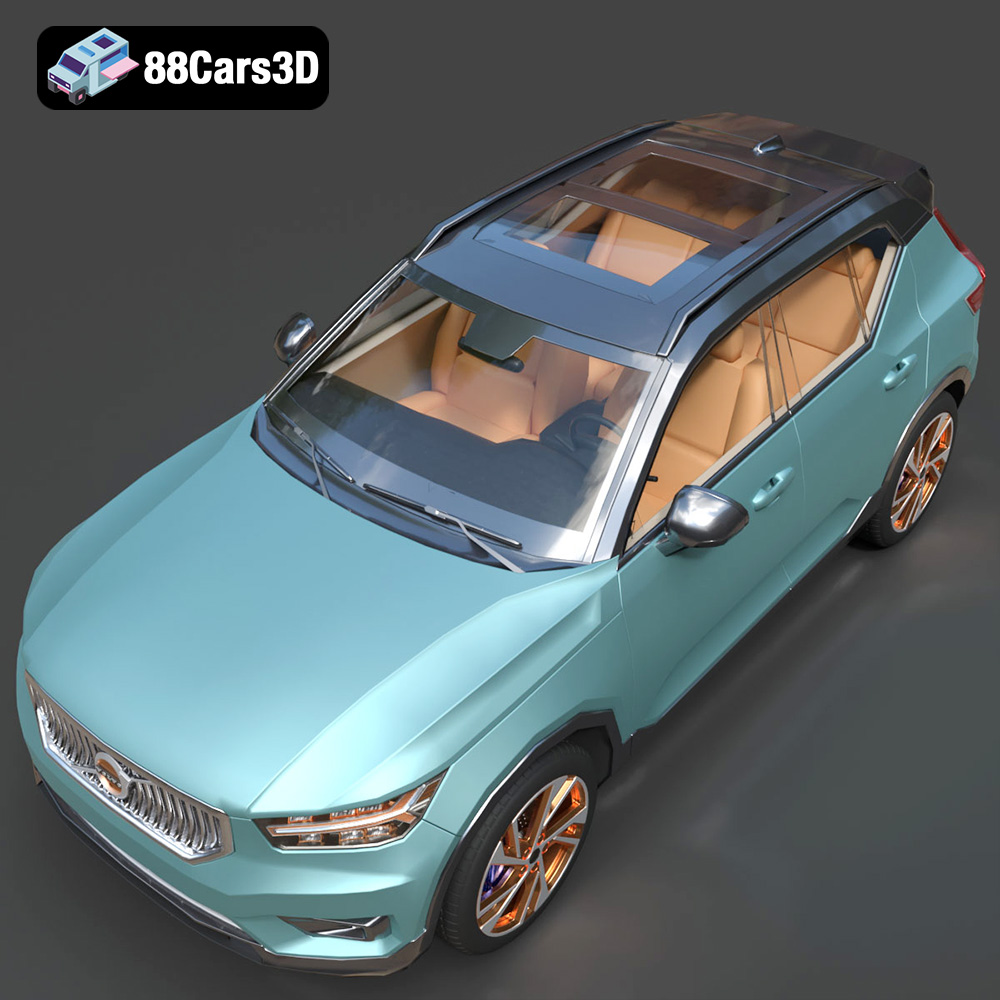
The Volvo XC40 Recharge (2020) 3D Model is an exceptionally accurate digital recreation of the Swedish brand’s groundbreaking first fully electric SUV. Marrying Volvo’s renowned commitment to safety and Scandinavian minimalism with a cutting-edge EV powertrain, the XC40 Recharge is a highly recognizable and premium compact crossover built on the CMA platform. This 3D model perfectly captures the distinct, modernized EV styling of the 2020 Recharge edition. It features the signature closed-off, body-color front grille (a hallmark of Volvo’s electric line), the iconic “Thor’s Hammer” LED headlight assemblies, an aerodynamic contrast-color roof, and the muscular yet compact crossover stance. Built with a highly efficient, impeccably clean mid-polygon topology (just over 377k triangles), it strikes the absolute perfect balance. It provides crisp visual fidelity for close-up automotive rendering while remaining lightweight enough to populate modern virtual environments, ArchViz driveways, and real-time game engines. Perfect for populating modern, eco-conscious street scenes, luxury architectural visualizations, electric vehicle commercial mockups, and mobile/PC game development.
$9.99
.archviz
.blend
.ev
.fbx
.obj
.rendering
.volvo
.xc40
car-3d-model
compact-suv
electric-vehicle
game-ready
mid-poly
Scandinavian design
SUV
traffic-car
xc40-recharge