Get 50% OFF All Premium 3D & STL Models!

The world of 3D modeling stands at the intersection of art and engineering, offering unparalleled opportunities to visualize, simulate, and even fabricate concepts with breathtaking fidelity. From blockbuster films and immersive video games to cutting-edge product design and architectural walkthroughs, high-quality 3D assets are the backbone of modern digital creation. For automotive enthusiasts and professionals alike, the allure of recreating iconic vehicles in the digital realm is particularly strong. It’s not just about aesthetics; it’s about precision, performance, and the seamless integration into diverse production pipelines.
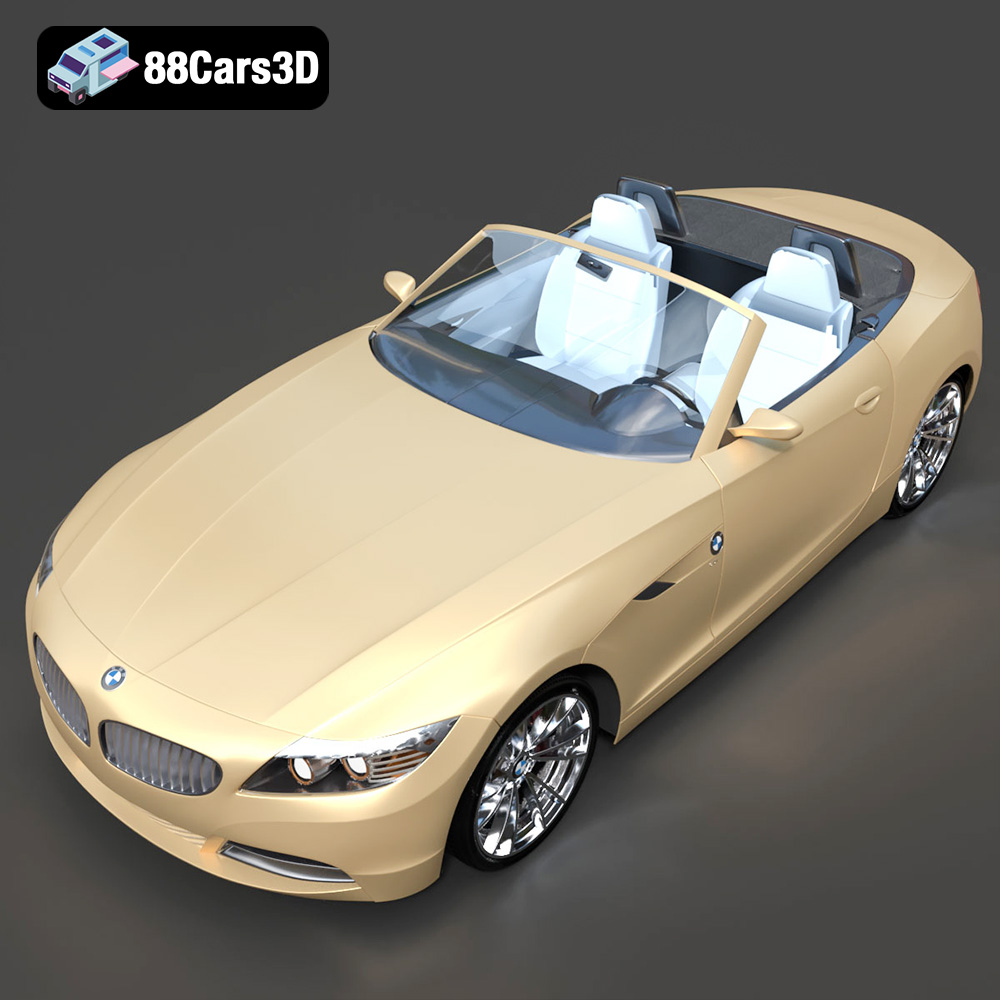
Whether you’re an automotive designer prototyping a new concept, a game developer crafting an exhilarating racing experience, or an architect populating a photorealistic visualization, the demand for meticulously crafted 3D car models is constant. These aren’t merely decorative elements; they are complex technical assets requiring accurate scaling, clean topology, and versatile material setups. One such exemplary asset, the BMW Z4 3D Model, available on 88cars3d.com, stands as a testament to this blend of artistry and technical excellence. This premium digital recreation of the iconic two-seat roadster embodies precision engineering and modern roadster design, making it an invaluable addition to any professional toolkit.
In this comprehensive guide, we’ll delve into the technical intricacies of working with high-quality 3D car models, exploring how an asset like the BMW Z4 3D Model can elevate your projects across various industries. We’ll cover essential file formats, discuss integration into popular 3D software and real-time engines, explore rendering techniques for photorealistic results, and even touch upon the exciting world of 3D printing physical miniatures.
Before diving into specific applications, a foundational understanding of 3D model file formats is crucial. Each format serves a particular purpose, optimized for different stages of the 3D pipeline—from creation and editing to rendering, real-time display, and physical fabrication. The BMW Z4 3D Model, like many professional 3D car models, offers a range of formats to ensure maximum compatibility and utility.
The .blend format is Blender’s native file type. It’s a powerhouse for containing an entire scene, including mesh data, materials, textures, lighting, cameras, animation data, and even custom scripts. For artists working primarily in Blender, this format offers the most flexibility. When you download the BMW Z4 3D Model as a .blend file, you gain immediate access to its fully editable geometry, carefully configured materials, and potentially a pre-set lighting environment, making it an ideal starting point for customization and animation within Blender’s ecosystem. Its primary advantage lies in retaining all the nuances of the original Blender project, ensuring no data loss during transfer.
As a widely adopted proprietary format by Autodesk, .fbx (Filmbox) is arguably the most common exchange format in 3D production. It excels at transferring 3D models and animation data between different software applications like 3ds Max, Maya, Cinema 4D, and especially real-time engines such as Unreal Engine and Unity. An .fbx file for the BMW Z4 3D Model would typically include mesh data, materials (often simplified PBR or standard material definitions), textures, UV mapping, skinning, and animation. Its strength lies in its robustness for interoperability, making it the go-to choice for game assets and real-time pipelines where consistent data transfer is paramount.
The .obj (Wavefront OBJ) format is a much older, simpler, and universally supported geometry definition file. While it lacks support for animation and often requires external material files (.mtl), its simplicity ensures broad compatibility across almost all 3D software. An .obj file primarily defines vertex positions, UV coordinates, vertex normals, and faces. For the BMW Z4 3D Model, an .obj export ensures that its core geometric data and UVs are accessible in virtually any 3D application, making it a reliable fallback for cross-software workflows, particularly for static renders or where material setup needs to be done from scratch in the target software.
.glb (GL Transmission Format Binary) is the binary version of the glTF format, designed for efficient transmission and loading of 3D scenes and models by applications. It’s quickly becoming the standard for 3D content on the web, in AR (Augmented Reality), and VR (Virtual Reality) experiences. A .glb file of the BMW Z4 3D Model would be highly optimized, containing the model’s geometry, textures, and PBR materials in a single, compact file. Its small file size and quick load times make it perfect for virtual showrooms, interactive web viewers, or mobile AR apps where performance and accessibility are critical.
The .stl (STereoLithography) format is the industry standard for 3D printing. It represents a 3D model as a series of connected triangles, defining only the surface geometry without color, texture, or material information. While less versatile for visual rendering, it is indispensable for additive manufacturing. For the 3D printable BMW Z4 3D Model, the .stl file would be meticulously prepared with manifold geometry, ensuring a watertight mesh suitable for direct slicing and printing. This format is crucial for bringing the digital model into the physical world, whether for collectible miniatures or functional prototypes.
The .ply (Polygon File Format) is another format for storing 3D data, capable of representing a wider range of properties than .obj or .stl, including color, transparency, normals, texture coordinates, and even reliability information for each polygon. It’s often used in scientific and CAD applications where precise mesh data and attribute information are important. While less common for everyday rendering, it can be valuable for complex reverse engineering, 3D scanning, or analytical tasks involving the BMW Z4 3D Model.
The .unreal format, or more accurately, assets imported and configured within Unreal Engine, represents a highly optimized and engine-specific asset. While not a standalone file format in the same way as .fbx or .obj, “unreal” typically refers to an asset package directly prepared for Unreal Engine. This implies not just the mesh, but also its materials, textures, collision meshes, LODs (Levels of Detail), and potentially even blueprint functionality. The BMW Z4 3D Model, when provided as “unreal” compatible, means it has undergone the necessary optimizations to perform efficiently and look stunning within Unreal’s real-time rendering environment.
Similar to .blend, .max is the native file format for Autodesk 3ds Max. It encompasses all scene data, including geometry, modifiers, materials, textures, lighting, cameras, animation, and scene settings. For users of 3ds Max, the .max file provides the fullest control over the BMW Z4 3D Model, allowing for deep customization, complex animation setups, and seamless integration into existing 3ds Max workflows for high-end rendering and visualization.
Automotive rendering is an art form that demands meticulous attention to detail, from the interplay of light on a perfectly sculpted body panel to the subtle reflections in a chrome emblem. The BMW Z4 3D Model provides an excellent foundation for achieving photorealistic results, thanks to its accurate proportions, clean geometry, and detailed features.
For decades, 3ds Max has been a cornerstone of professional architectural visualization and automotive rendering. Paired with powerful render engines like V-Ray or Corona Renderer, it can produce images virtually indistinguishable from photographs. The BMW Z4 3D Model, provided in its native .max format, allows artists to immediately leverage its clean quad-based topology. This is critical for subdividing the mesh smoothly without artifacts, essential for close-up shots of the Z4’s sculpted body lines and aerodynamic panels. Materials, often set up using Physically Based Rendering (PBR) principles, accurately simulate the reflectivity of paint, the specularity of chrome, and the texture of tires and interior fabrics. Artists can meticulously craft studio lighting setups, using HDRIs (High Dynamic Range Images) to capture realistic reflections and global illumination, or place the Z4 within a detailed environment for contextual renders, such as a coastal road or a luxury showroom. The separated components for doors, hood, trunk, and wheels also allow for dynamic scene setups and animation sequences.
Blender has emerged as a formidable contender in professional 3D, offering powerful rendering capabilities with Cycles (path-tracer) and Eevee (real-time renderer). The .blend file of the BMW Z4 3D Model is ready to be dropped into a Blender scene, complete with pre-configured PBR materials. Artists can utilize Cycles for stunning, unbiased photorealistic renders, focusing on subtle light bounces and accurate material interactions. Eevee, on the other hand, offers incredible speed for interactive previews and animated sequences, making it perfect for rapid iteration or generating stylish promotional visuals. Customization options, such as changing body color and finish (metallic, matte, gloss), are easily achievable through Blender’s node-based shader editor, allowing for endless creative variations for this exceptional model from 88cars3d.com.
In the realm of interactive experiences, 3D car models are not just static images; they are dynamic assets that must perform efficiently while maintaining visual integrity. The BMW Z4 3D Model is explicitly designed with game development and real-time applications in mind, offering optimized polygon counts and clean topology.
Real-time engines like Unreal Engine and Unity demand specific optimizations to ensure smooth performance. The BMW Z4 3D Model’s optimized polygon count is a key advantage here, preventing excessive GPU load. For game development, this typically involves creating LODs (Levels of Detail) – progressively simpler versions of the model that swap in as the car moves further from the camera, significantly reducing rendering overhead. Collision meshes are also essential, defining the physical boundaries of the vehicle for accurate interactions with the game world. When importing the Z4 into Unreal or Unity, the .fbx format is often preferred for its robust support of mesh data, PBR materials, and rigging. The proper pivot placement for animation (doors, wheels, steering) is crucial, allowing developers to easily implement vehicle physics, opening doors, and responsive steering within the engine’s framework. The model’s interior mesh is also optimized for both real-time engines, ensuring the sport-style cockpit remains detailed without being overly heavy.
Augmented Reality (AR) and Virtual Reality (VR) are transforming how we interact with products, especially in the automotive sector. Virtual showrooms and interactive car configurators allow potential buyers to explore a vehicle in unprecedented detail. The BMW Z4 3D Model, particularly in its optimized .glb format, is perfect for these applications. Its compact size and efficient PBR material setup ensure quick loading times and smooth performance on mobile devices or VR headsets. Users can walk around the Z4, open doors, change paint colors, modify wheel styles, and even “sit” inside to explore the detailed dashboard and infotainment display, all in a real-time, immersive environment. The clean geometry ensures that even when viewed up close in VR, the model holds up to scrutiny.
Beyond digital displays, the BMW Z4 3D Model offers the exciting possibility of tangible creation through 3D printing. The availability of the .stl format, designed for this very purpose, makes it a prime candidate for producing collectible roadster miniatures and display models.
3D printing requires a specific kind of model integrity: manifold geometry. This means the model must be “watertight” with no holes or intersecting faces, ensuring that the slicer software can accurately interpret the object’s volume. The BMW Z4 3D Model, when prepared as a 3D printable STL, is designed with this in mind. For FDM (Fused Deposition Modeling) printers, understanding print settings is crucial. Recommended scales (1:24, 1:18, 1:12, 1:10) dictate the overall size, while layer height (e.g., 0.10–0.18 mm) affects surface smoothness. Wall thickness (2-3 mm) ensures structural integrity. Supports are often required for overhangs like mirrors, open roof edges, and underbody details. A strategic print orientation, such as printing the body upside-down, can optimize for smooth top surfaces. For finer details, particularly at smaller scales (e.g., 1:32 or 1:43), resin (SLA/DLP) printing is often recommended for its superior resolution, allowing minute features like brake discs and interior details to be captured accurately.
The journey from a raw 3D print to a polished collectible is an art in itself. Post-processing is key to achieving a high-quality finish. This typically involves several stages: sanding to remove layer lines or support marks, applying primer for an even surface, and then painting. For the BMW Z4, a metallic paint finish followed by a clear coat can replicate the luxurious sheen of a real car. Wheels are often printed separately to allow for enhanced detailing and easier painting, then assembled. The ability to customize paint colors (e.g., modern BMW factory colors), add performance package styling, or even apply custom decals, allows for truly unique miniature creations. This hands-on process connects the digital asset to the tactile world, offering a unique satisfaction that only 3D printing can provide.
In the demanding world of 3D production, the underlying technical quality of a model is as important as its aesthetic appeal. The BMW Z4 3D Model from 88cars3d.com prioritizes technical advantages that set it apart, ensuring it’s not just a pretty face but a robust, workflow-ready asset.
The description highlights “clean quad-based topology,” which is a hallmark of a professional 3D model. Quads (four-sided polygons) are preferred over tris (triangles) for subdivision surfaces, animation, and UV unwrapping because they deform more predictably and allow for cleaner mesh manipulation. This translates directly into smoother surfaces when rendered at high resolutions or when deformed for animation. Proper UV mapping is equally critical, ensuring textures wrap seamlessly around the model without distortion. This allows artists to easily apply new materials or create custom paint jobs without complex re-mapping. The “real-world scale accuracy” means the BMW Z4 3D Model will fit perfectly into scenes or simulations without requiring tedious resizing, maintaining consistency across projects and ensuring accurate physical interactions in game engines or simulations.
The “proper pivot placement for animation (doors, wheels, steering)” is a crucial detail for any dynamic 3D vehicle. Correct pivots are essential for rigging and animation, allowing animators to effortlessly open doors, rotate wheels, or steer the car with realistic kinematics. This saves countless hours of setup time and reduces the potential for errors in complex animated sequences. The “optimized polygon count” strikes a balance between visual fidelity and performance, making the model suitable for both high-end renders and real-time applications. Finally, its “compatibility with major 3D platforms and engines” speaks to its versatility. Whether you’re working in 3ds Max, Blender, Unreal, or needing an STL for 3D printing, the comprehensive file format support ensures seamless integration, making the BMW Z4 3D Model a truly adaptable and valuable asset for any professional workflow.
The journey through the creation and application of 3D car models reveals a fascinating landscape where technical precision meets creative ambition. From the nuanced interplay of light in a photorealistic render to the thrill of driving an optimized vehicle in a game, or the tactile satisfaction of holding a meticulously 3D printed miniature, high-quality assets are indispensable.
The BMW Z4 3D Model exemplifies the characteristics of such an asset: accurate proportions, clean quad-based topology, real-world scale, optimized polygon count, and comprehensive file format support. Its versatility makes it suitable for a vast array of applications, including luxury automotive presentations, studio lighting setups, racing game environments, virtual showrooms, and the creation of detailed physical collectibles. Whether you are a professional seeking to enhance your automotive rendering projects, a game developer building immersive worlds, or an enthusiast venturing into 3D printing, this model offers a robust and adaptable foundation.
Investing in such a high-caliber 3D model means investing in efficiency, quality, and creative potential. For those looking to elevate their digital automotive projects with premium 3D car models, resources like 88cars3d.com provide a curated selection of assets designed to meet the rigorous demands of professional workflows. The BMW Z4 3D Model, with its detailed design and technical advantages, is a prime example of the exceptional quality available, ready to drive your next project forward.
The BMW Z4 3D Model is a premium digital recreation of the iconic two-seat roadster developed by BMW. Known for its sporty proportions, long hood, short rear deck, and dynamic performance styling, the Z4 embodies precision engineering and modern roadster design. This 3D model accurately captures the Z4’s low stance, sculpted body lines, signature kidney grille, aerodynamic side vents, and sleek convertible profile. Designed with clean geometry and real-world scaling, it is ideal for rendering, animation, game development, AR/VR applications, and automotive simulations. Perfect for coastal driving scenes, luxury showrooms, racing environments, promotional visuals, and interactive vehicle experiences. Includes .blend, .fbx, .obj, .glb, .stl, .ply, .unreal, and .max formats for rendering, simulation, AR/VR, game development, and 3D printing.
$9.99
.arvr
.blend
.bmw
.car3dmodel
.convertible
.fbx
.gameasset
.glb
.max
.obj
.ply
.rendering
.roadster
.simulation
.sportsCar
.stl
.unreal
.vehicleasset
.z4
automotive3d