Get 50% OFF All Premium 3D & STL Models!

In the dynamic world of 3D visualization, game development, and digital media, authenticity is paramount. Whether you’re a seasoned automotive rendering artist, a game developer crafting immersive historical experiences, or an architect visualizing a period-correct street scene, the quality and accuracy of your 3D models can make or break a project. High-fidelity assets are not just visually pleasing; they serve as a cornerstone for believable simulations, compelling narratives, and engaging interactive content. The demand for meticulously crafted 3D models of vehicles, ranging from classic automobiles to vintage motorcycles, continues to grow as artists strive to push the boundaries of realism.
This pursuit of digital authenticity is perfectly exemplified by assets like the IZ-49 Classic Motorcycle 3D Model. This particular model, available on 88cars3d.com, is a testament to the dedication required to digitally preserve and reintroduce an iconic piece of history into modern creative pipelines. The IZ-49, a symbol of mid-20th century Soviet engineering, brings with it a unique aesthetic and a story, making it an ideal subject for a wide array of projects, from historical reconstructions to cinematic sequences and interactive museum exhibits. Its detailed recreation ensures that artists can drop it directly into their scenes with confidence, knowing it meets the rigorous standards of professional production.
The versatility and utility of any 3D model are heavily dependent on the file formats it supports. Different formats cater to specific stages of the 3D pipeline, from initial modeling and texturing to real-time rendering, animation, and even physical fabrication. Understanding these formats is crucial for artists and developers to ensure seamless integration into their preferred software and engines, and to maximize the potential of their purchased assets. The IZ-49 Classic Motorcycle 3D Model provides a comprehensive suite of file formats, ensuring maximum compatibility across various professional applications.
The .blend format is the native file type for Blender, the popular open-source 3D creation suite. When you receive a .blend file, you’re getting a fully editable scene, complete with materials, textures, lighting, camera setups, and often, animation rigs. For the IZ-49, this means Blender users have direct access to every component, allowing for easy modification of materials, exploration of mesh topology, and even re-rigging for custom animations. It’s ideal for deep customization and leveraging Blender’s powerful rendering engines like Cycles or Eevee.
.fbx (Filmbox) is arguably the most widely adopted proprietary file format for 3D data exchange, developed by Autodesk. It’s the go-to format for transferring models, animations, and scenes between various 3D applications and game engines like Unreal Engine and Unity. An .fbx file for the IZ-49 would typically include the mesh geometry, UV mapping, materials (often with basic properties like diffuse color and normal maps embedded or referenced), and crucially, skeletal animation data if the model were rigged. Its robust nature makes it ideal for real-time pipelines where consistent data transfer is essential.
The .obj (Wavefront OBJ) format is a universal standard, highly compatible with virtually every 3D software package. It’s a simpler, text-based format primarily used for transferring pure geometric data (vertices, normals, UVs, and faces). While it doesn’t typically store animation or complex material setups directly, it’s exceptionally reliable for basic model exchange. For the IZ-49, an .obj file provides a clean mesh that can be easily imported into any 3D application for re-texturing, re-shading, or further modeling, making it a foundational asset for cross-software compatibility.
.glb (GL Transmission Format Binary) is an increasingly important format optimized for web-based 3D, AR, and VR applications. It’s a self-contained single file that includes geometry, materials, textures, and animation, making it highly efficient for delivery over the internet. Its compact size and ease of integration into web viewers or AR/VR experiences make it perfect for showcasing the IZ-49 in interactive product viewers, virtual showrooms, or augmented reality applications on mobile devices, providing a lightweight yet visually rich experience.
.stl (Stereolithography) is the de facto standard file format for 3D printing. It represents a 3D model as a collection of unconnected triangular facets, making it suitable for manufacturing processes like FDM, SLA, and SLS. The IZ-49 Classic Motorcycle 3D Model’s availability in .stl format means it can be directly prepared for printing, transforming the digital asset into a tangible collectible or a prototype. This format is crucial for hobbyists and professionals looking to create physical scale models or custom parts.
.ply (Polygon File Format) is another common format for storing 3D data, particularly popular in scientific and engineering applications, as well as 3D scanning. It can store a wider range of properties than .obj, including color, transparency, and sometimes even point cloud data. For a model like the IZ-49, a .ply file offers a precise mesh representation, potentially useful for analysis or integration into CAD systems where intricate geometry and exact measurements are paramount.
The .unreal format signifies an asset that is specifically packaged or optimized for Unreal Engine. While often derived from .fbx, having a dedicated .unreal asset means it’s likely pre-configured with Unreal-specific materials, collision meshes, LODs (Levels of Detail), and pivot points, ready for immediate import and use within the engine. This significantly streamlines the workflow for game developers and real-time visualization artists utilizing Unreal Engine, reducing setup time and ensuring optimal performance for the IZ-49.
.max is the native file format for Autodesk 3ds Max, a powerful 3D modeling, animation, rendering, and compositing software widely used in architectural visualization, automotive rendering, and film production. A .max file for the IZ-49 includes the full scene setup, including lights, cameras, modifiers, and complex V-Ray or Corona materials, allowing 3ds Max users to leverage the model within their established rendering pipelines without any conversion or data loss.
Creating a 3D model like the IZ-49 Classic Motorcycle is an intricate process that demands both artistic vision and technical precision. The goal is to not just replicate its form but to capture its essence, from the subtle curves of its vintage frame to the intricacies of its mechanical components. The value of a high-quality 3D asset lies in its fidelity to the original and its readiness for various professional applications.
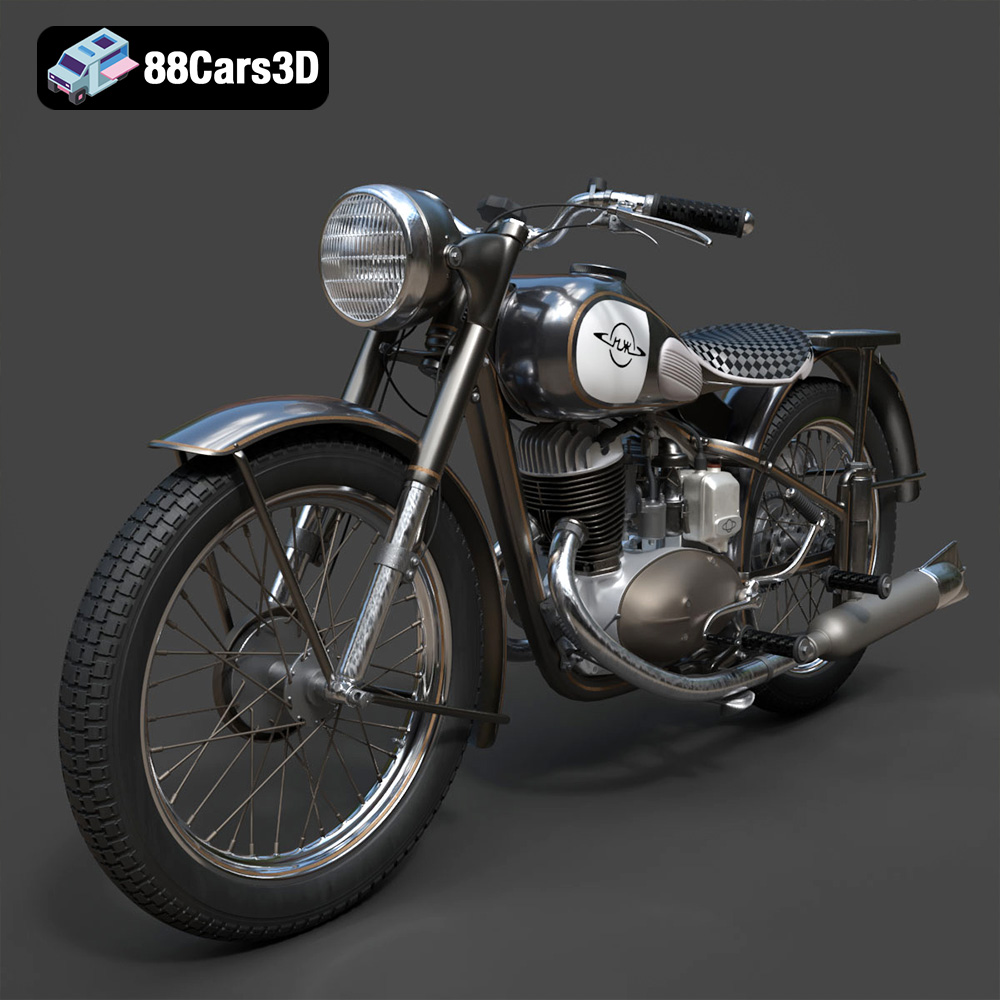
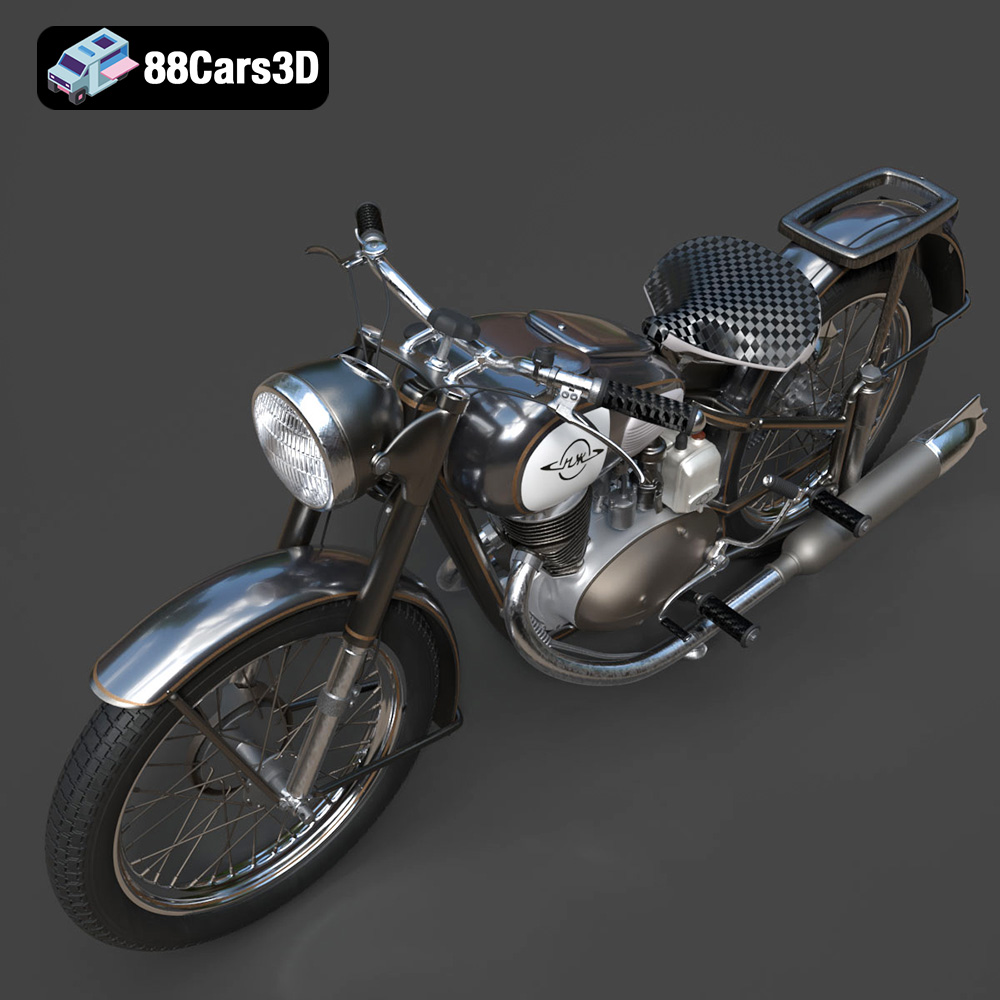
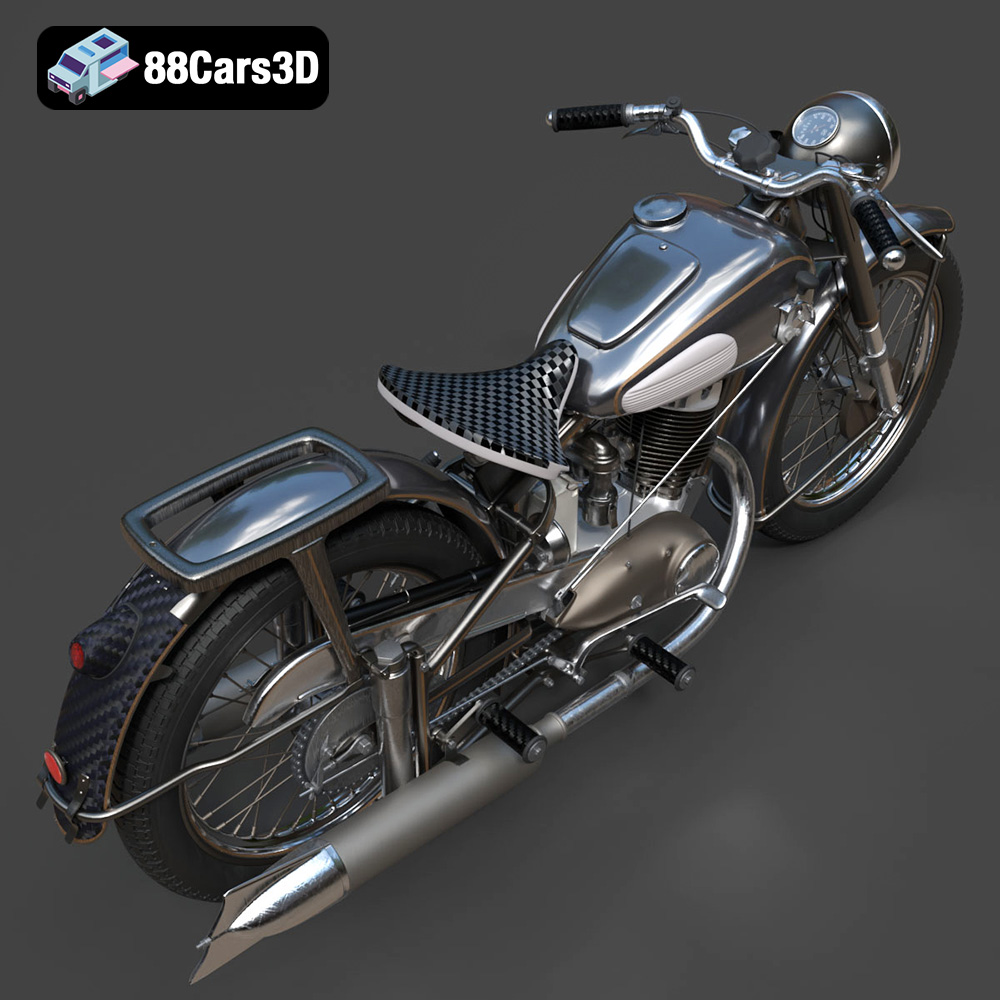
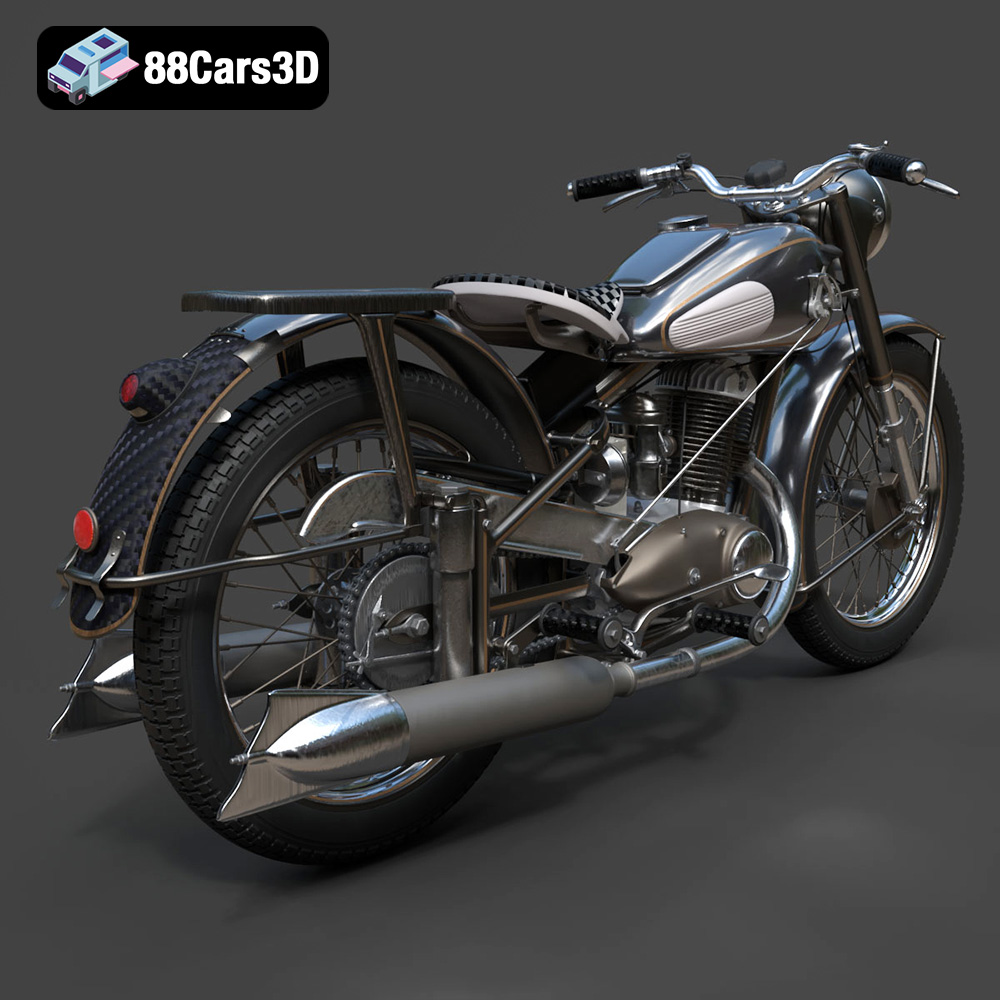
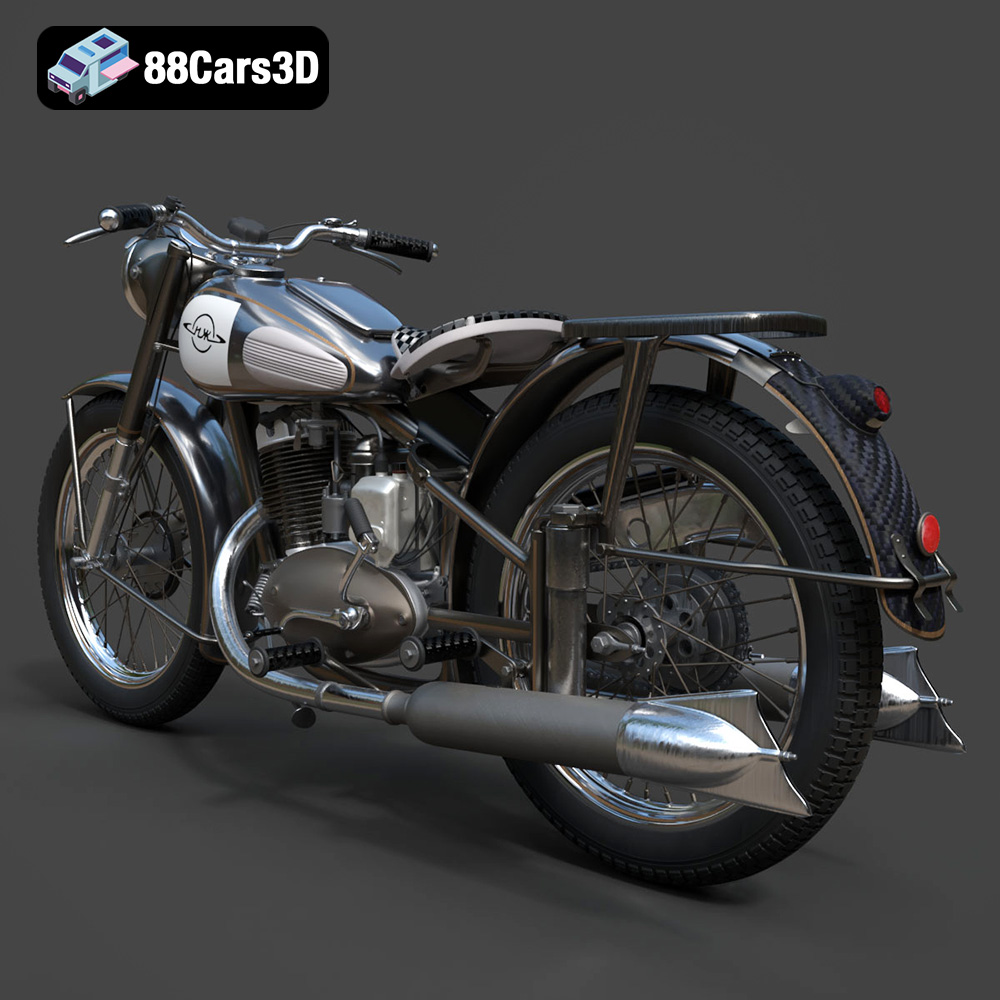
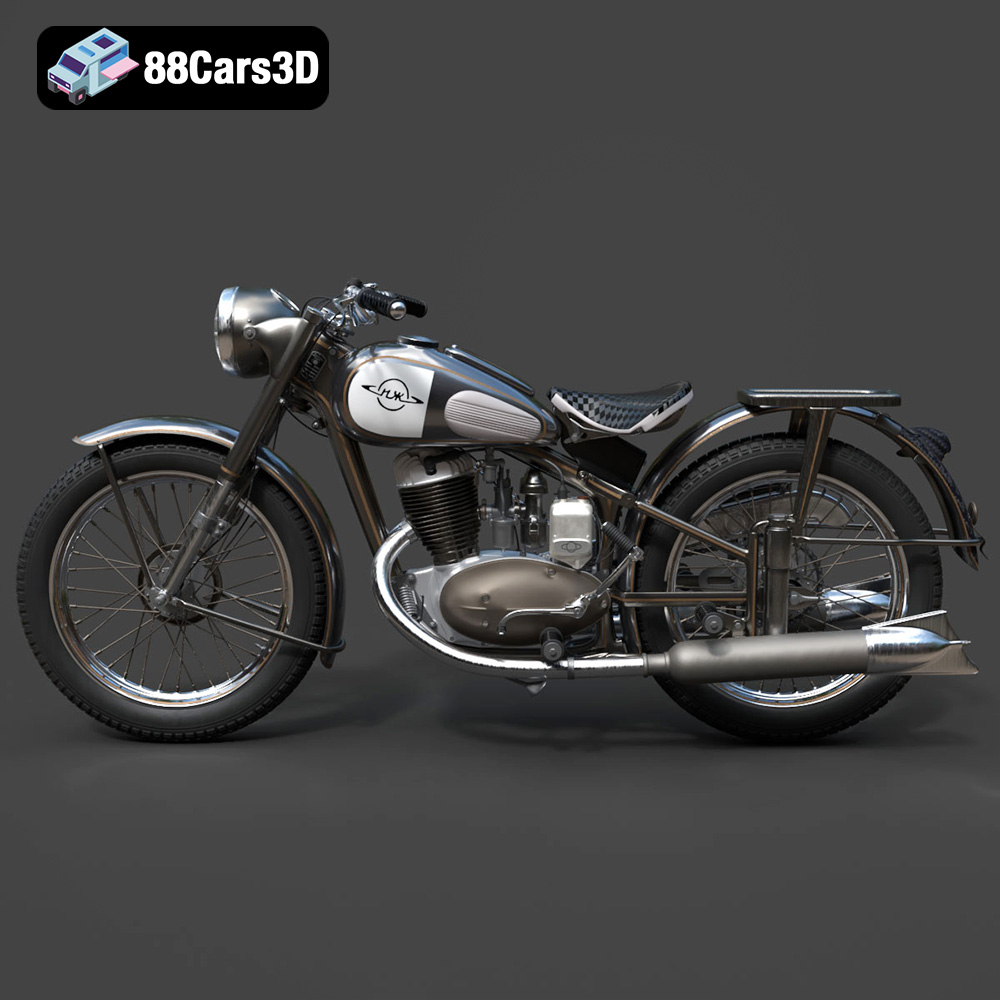
The exterior of the IZ-49 is where its iconic identity truly shines. This 3D model meticulously captures the accurate mid-century motorcycle proportions, instantly recognizable to enthusiasts and historians. Details like the rounded vintage-style fuel tank, classic front and rear fenders, and the period-correct headlamp housing are all faithfully recreated. The spoked wheels, a hallmark of vintage motorcycles, feature realistic hub detailing that adds to the model’s authenticity. For animators, the inclusion of separate wheels and steering components is invaluable, allowing for realistic motion paths and interactive control.
Beyond the visible aesthetic, the mechanical and structural details provide the model with its depth and functionality. The IZ-49 model includes a detailed single-cylinder engine block, a modeled suspension system, and an accurate chain drive assembly. The realistic exhaust pipe routing follows the original design, contributing to the overall integrity. The frame geometry accurately reflects the original production design, providing a solid foundation for any engineering visualization or historical analysis. Such attention to mechanical accuracy ensures that the model can be used for more than just visual flair; it can serve as a reference for educational or simulation purposes.
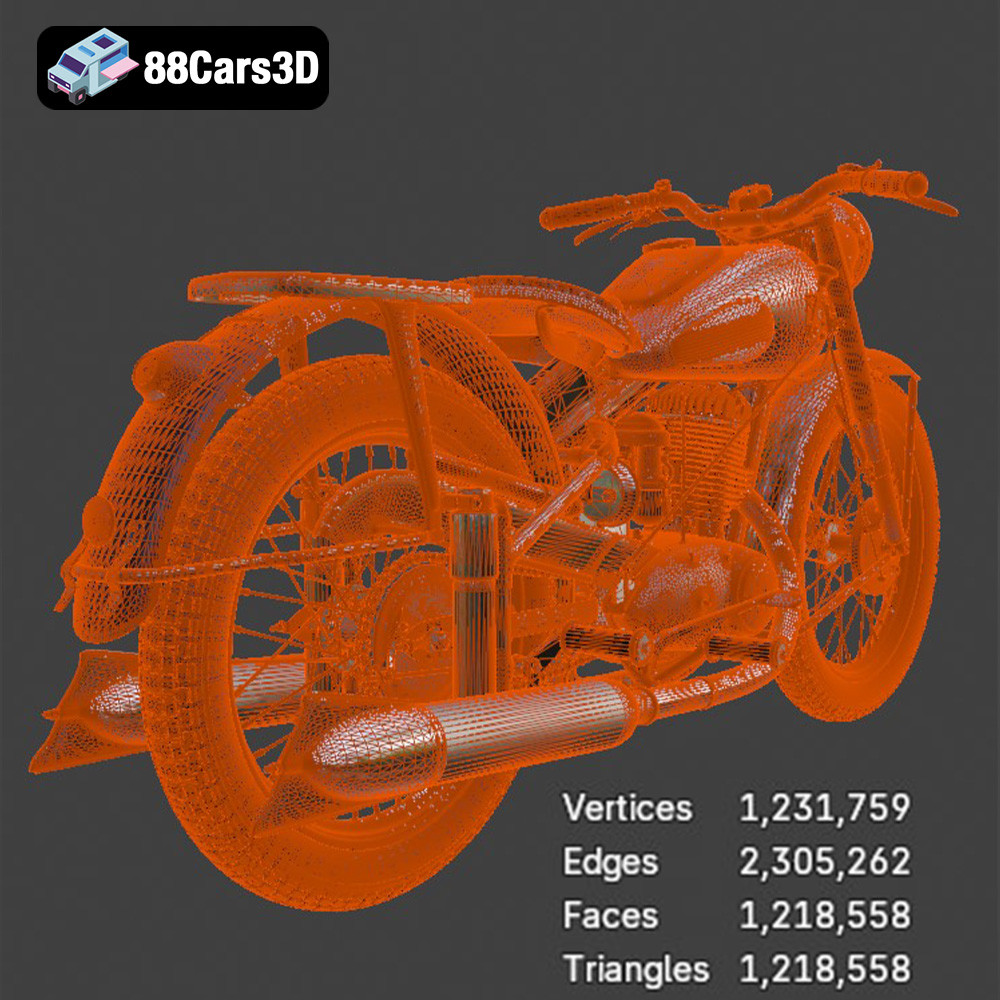
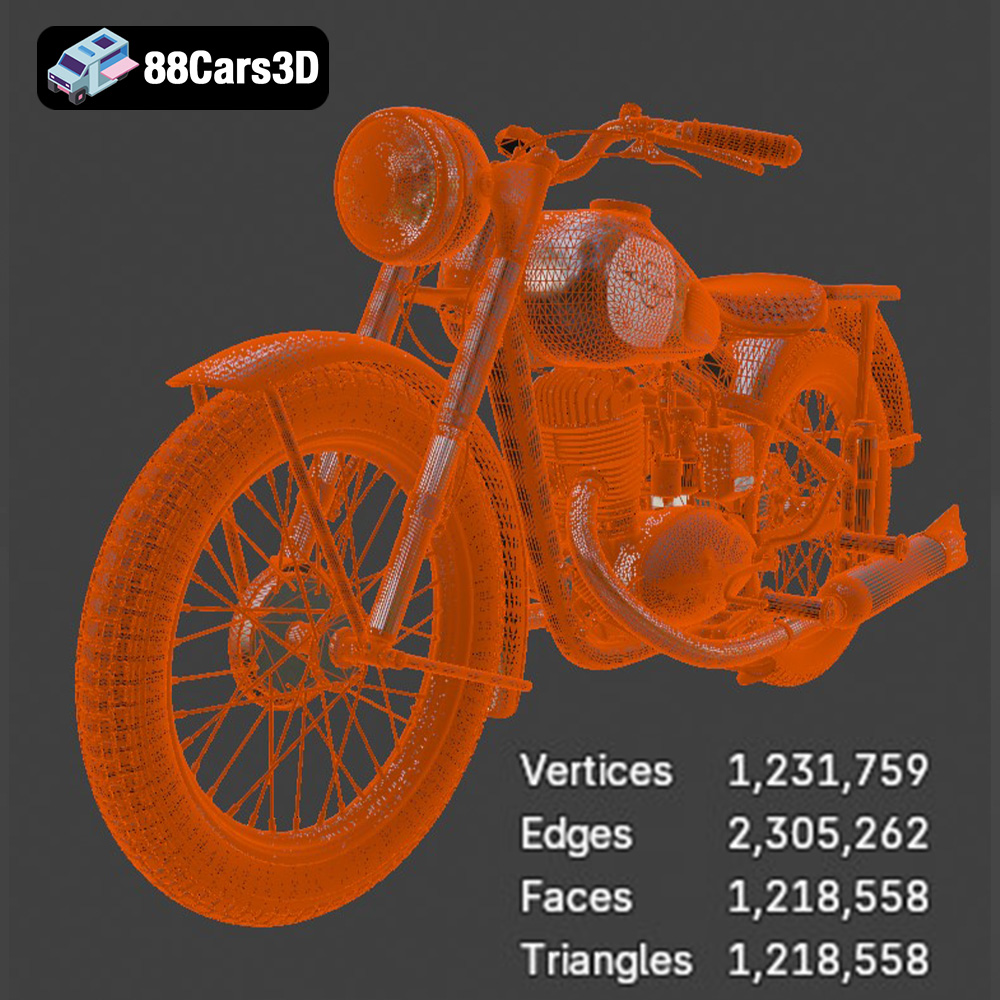
A truly professional 3D model balances visual detail with technical efficiency. The IZ-49 Classic Motorcycle 3D Model boasts a clean and well-organized mesh structure with optimized polygon flow. This means the model is efficient for real-time applications like games or AR/VR, maintaining good performance without sacrificing visual fidelity. While exact poly counts vary depending on the level of detail for different parts, a model of this quality would typically be subdivided appropriately: higher poly counts for smooth, visible surfaces like the fuel tank (e.g., 50,000-100,000 polygons for high-res render, and optimized LODs for games at 15,000-30,000 polygons), and lower counts for less prominent mechanical elements. The real-world scale accuracy ensures seamless integration into existing scenes, and proper pivot setup for wheel rotation and steering facilitates easy animation and rigging, a critical advantage for animators and game developers looking for ready-to-use game assets.
The versatility of the IZ-49 Classic Motorcycle 3D Model, coupled with its broad file format support, makes it a valuable asset across various professional 3D pipelines. Its design caters to both highly realistic offline rendering and performance-critical real-time applications, making it a flexible choice for artists and developers.
For those focused on creating stunning visual content, the IZ-49 is a powerhouse. In software like 3ds Max (using the .max file) or Blender (with the .blend file), artists can leverage advanced rendering engines such as V-Ray, Corona Renderer, Cycles, or Eevee. The model’s clean topology and well-defined UVs (which are standard for a model of this quality, even if not explicitly detailed in poly counts) allow for the application of complex PBR (Physically Based Rendering) materials. Imagine rendering the IZ-49 in a vintage garage scene with dramatic lighting, showcasing its metallic gleam and the subtle wear on its leather seat. Artists can easily adjust paint colors (military green, black, red, classic cream), add weathered or restored finishes, and modify seat textures to match specific project requirements for automotive rendering or cinematic projects.
Game developers, especially those building historical open-world games or retro driving simulations, will find the IZ-49 an excellent asset. The .fbx and .unreal formats are specifically tailored for real-time engines like Unreal Engine and Unity. The model’s optimized mesh and proper pivot setups mean it can be efficiently integrated into a game environment as a vehicle game asset. LODs (Levels of Detail) can be easily generated or adjusted to ensure performance scales with distance, allowing for dense scenes without significant frame rate drops. Whether it’s a background prop in a period-correct town or a fully drivable vehicle, the IZ-49 provides the detail needed for immersive gameplay.
The world of Augmented Reality (AR) and Virtual Reality (VR) offers new ways to interact with digital content. The IZ-49, particularly in its optimized .glb format, is perfect for creating interactive historical demonstrations or immersive museum experiences. Imagine visitors donning a VR headset to explore a virtual museum where they can walk around, examine, and even “sit on” a perfectly recreated IZ-49 motorcycle. In AR, the model could be overlaid onto real-world environments, allowing students to study its mechanics in their classroom or enthusiasts to place a virtual IZ-49 in their driveway. These applications require models that are both visually accurate and performance-friendly, characteristics that the IZ-49 embodies.
The utility of a 3D model isn’t confined to digital screens. For many enthusiasts and professionals, the ability to transform a digital asset into a physical object is a significant advantage. The IZ-49 Classic Motorcycle 3D Model is designed with 3D printing in mind, opening up possibilities for collectors, model makers, and even designers looking for physical prototypes.
The inclusion of the .stl format makes the IZ-49 immediately suitable for 3D printing. However, preparing a digital model for physical output requires careful consideration. The model’s clean mesh and manifold geometry (meaning it has no holes or inverted normals) are crucial for successful slicing and printing. Before printing, users typically employ slicing software to convert the .stl file into G-code, which dictates the printer’s movements. This process involves setting parameters like scale, layer height, wall thickness, and infill, all of which are vital for a successful print. The IZ-49’s design, with separate components like wheels and steering, allows for modular printing, which can enhance detail and simplify support removal.
To achieve the best results when 3D printing the IZ-49, specific settings are recommended. Suggested scales like 1:18, 1:12, 1:10, or 1:8 allow for various levels of detail and display sizes. A finer layer height (e.g., 0.08–0.16 mm) will capture more intricate details, crucial for a realistic scale model. Wall thickness of 1.5–2.5 mm provides structural integrity, while an infill of 15–25% offers a good balance between strength and material usage. Supports are often required for overhangs and delicate parts like the exhaust pipe, handlebars, and fender edges. Post-processing is key to achieving a professional finish, involving sanding to smooth layer lines, applying primer for an even paint base, and then using a vintage matte paint finish, potentially with optional weathering effects to enhance its classic appeal. This meticulous approach transforms the digital IZ-49 into a stunning tangible collectible.
The IZ-49 Classic Motorcycle 3D Model provides a rich foundation for countless creative projects. Its historical accuracy and technical robustness make it adaptable across diverse industries, allowing for compelling visual narratives and functional applications.
Filmmakers and documentary creators often require period-accurate assets to bring historical scenes to life without the prohibitive costs of acquiring and restoring actual vintage vehicles. The IZ-49 is perfect for this. Imagine a scene in a historical drama set in post-war Eastern Europe, where a character rides this very motorcycle through cobblestone streets. Digital doubles of vehicles like the IZ-49 can be seamlessly integrated into live-action footage or used in fully CG sequences, providing unparalleled control over camera angles, lighting, and environmental interactions. This elevates the visual quality and historical authenticity of any cinematic project.
For game studios, incorporating historically accurate 3D car models and motorcycle assets can significantly enhance player immersion. In an open-world game set in the mid-20th century, the IZ-49 could serve as a non-player vehicle, a collectible, or even a player-controlled mode of transport. Its optimized mesh means it can be deployed widely across expansive game maps without impacting performance, contributing to a believable and rich virtual environment. Developers could use it to create unique challenges, puzzles, or narrative elements tied to its historical context, making it a truly versatile game asset.
Educational institutions and museums can leverage the IZ-49 for interactive learning experiences. A virtual museum could feature a highly detailed, explorable 3D model of the motorcycle, allowing students to virtually dismantle it to understand its mechanical components or to see how it evolved over time. Simulation software could use the model for mechanical education or restoration planning, allowing engineers to test theories or plan repairs in a virtual space before committing to physical work. This provides a safe, accessible, and engaging way to study vintage engineering and history.
The world of 3D modeling thrives on detail, accuracy, and versatility. High-quality 3D assets, particularly those representing iconic vehicles like the IZ-49 Classic Motorcycle, are indispensable tools for professionals across various industries. From crafting breathtaking automotive rendering scenes to populating immersive game worlds and producing collectible 3D prints, the demand for meticulously engineered digital models continues to grow.
The IZ-49 Classic Motorcycle 3D Model stands out as an exceptional example of digital craftsmanship. Its faithful recreation of a mid-20th century icon, combined with its optimized mesh, real-world scale, and comprehensive file format support, makes it an invaluable asset. Whether you’re working in 3ds Max, Blender, Unreal Engine, or preparing for 3D printing, this model offers the flexibility and quality required for demanding projects. For artists, developers, and enthusiasts seeking premium 3D car models and automotive assets, exploring the extensive collection at 88cars3d.com offers a gateway to bringing their creative visions to life with unparalleled authenticity and technical excellence.
The IZ-49 Classic Motorcycle 3D Model is a high-detail digital recreation of the iconic mid-20th century Soviet motorcycle known for its simplicity, durability, and post-war engineering heritage. Originally produced between 1951 and 1958, the IZ-49 became a symbol of reliable transportation across Eastern Europe. This 3D model accurately represents the vintage steel frame, rounded fuel tank, single-cylinder engine configuration, classic spoked wheels, exposed suspension components, rear luggage rack, and period-correct exhaust system. Designed with clean topology and real-world proportions, it is ideal for rendering, animation, historical visualization, simulation, and game development. Includes .blend, .fbx, .obj, .glb, .stl, .ply, .unreal, and .max formats for rendering, simulation, AR/VR, game development, and 3D printing.
$9.99
.arvr
.blend
.classicmotorcycle
.fbx
.gameasset
.glb
.historicalvehicle
.iz49
.max
.motorcycle3dmodel
.obj
.ply
.rendering
.retrovehicle
.simulation
.sovietbike
.stl
.unreal
.vintagemotorcycle